The main tag of Gold Price Articles.
You can use the search box below to find what you need.
[wd_asp id=1]
The main tag of Gold Price Articles.
You can use the search box below to find what you need.
[wd_asp id=1]
The copper market is approaching a critical juncture as prices hover near record territory in October 2025. Currently trading around $10,900 per ton, copper has demonstrated remarkable resilience despite global economic uncertainties, gaining over 15% year-over-year. This comprehensive analysis examines whether copper will break through to new all-time highs in the coming months, potentially reaching the $12,000 per ton threshold that leading industry experts are forecasting.
Copper’s impressive performance comes amid a complex interplay of supply constraints and growing demand from the energy transition sector. The metal has surged toward all-time highs primarily due to widespread supply disruptions, with prices recently coming within $600 of breaking the record high of approximately $11,100 per ton set earlier in 2025.
Market volatility has increased in recent weeks, particularly after President Trump announced potential additional 100% tariff impacts on copper in early October. Despite this temporary cooling effect, copper prices have maintained their elevated position, reflecting the market’s focus on fundamental supply tightness rather than short-term policy fluctuations.
The copper market has experienced significant supply-side challenges throughout 2025. A wave of accidents and operational issues at major mines in Chile, the Democratic Republic of Congo (DRC), and Indonesia has severely constrained global output at critical moments.
These disruptions have prevented the market from building anticipated inventories, effectively offsetting what analysts had previously forecasted as a potential surplus year. The persistence of these operational challenges suggests that supply constraints may continue to provide price support through early 2026.
In Chile, which accounts for approximately 28% of global copper supply forecast, labor disputes and technical difficulties at several major operations have reduced output expectations. Similar issues in the DRC and Indonesia have compounded the global supply shortfall, with mining companies struggling to meet production targets despite high price incentives.
Leading industry figures have presented decidedly optimistic outlooks for copper prices through the end of 2025 and into 2026.
Kenny Ives, chief commercial officer at Chinese copper and cobalt producer CMOC Group and CEO of its trading arm IXM, projects copper prices potentially reaching $11,000-$12,000 per ton before the end of 2025. During the London Metal Exchange (LME) Week summit in October 2025, Ives described himself as “nice and bullish” on copper’s prospects.
This positive sentiment carries particular weight as Ives, once a contender for the top position at Glencore Plc, rarely offers public market views. His optimistic stance signals confidence despite recent price volatility stemming from escalating U.S.-China trade tensions.
Nick Snowdon, head of metals research at Mercuria Energy Group and a well-known copper bull, has echoed this positive stance. Speaking at the same industry event, Snowdon suggested prices could “quite easily” reach $12,000 per ton, representing a potential 10% increase from current levels.
Financial institutions present a somewhat more measured outlook, though forecasts have been trending higher throughout 2025:
BMI (Fitch Solutions): Recently raised its 2025 average copper price forecast to $9,650 per ton, up from its previous estimate of $9,500, citing resilient demand and persistent supply disruptions
Trading Economics: Projects copper prices to reach approximately $11,900 per ton by late 2026
Investment Banks: Several major banks maintain price targets in the $9,000-$10,000 range for 2025-2026, with bull case scenarios extending to $15,000 if supply constraints persist and energy transition demand accelerates
The disparity between bullish industry insiders and more conservative bank analysts highlights the uncertainty surrounding both supply recovery timelines and the pace of demand growth.
The consensus among analysts points to sustained strength in copper prices through 2026, with most forecasts placing the metal in the $10,000-$12,000 per ton range. The potential for new record highs remains contingent on several factors:
Notably, even the more conservative copper price insights represent historically strong levels for copper, suggesting widespread agreement that structural support for prices will persist.
Despite projections of increased global copper output at the beginning of 2025, actual production has consistently underperformed expectations throughout the year. Several factors contribute to this underperformance:
CMOC Group, which operates two copper-cobalt mines in the DRC, has firsthand experience with the operational challenges facing producers. The fact that Kenny Ives maintains a bullish outlook despite CMOC’s exposure to disrupted regions suggests the company views supply constraints as likely to persist.
While mine supply has faced constraints, refined copper production capacity has expanded, particularly in China. New smelters and refineries have increased global processing capabilities, though their utilization depends on concentrate availability.
This dynamic creates periods where refined copper markets can quickly shift between surplus and deficit conditions based on concentrate flow disruptions. Treatment charges, which miners pay smelters to process their concentrate, have fluctuated significantly throughout 2025, reflecting this tension between processing capacity and mine output.
Copper inventories on major exchanges have fluctuated significantly throughout 2025. Low visible inventory levels have periodically triggered price spikes, while strategic releases from China’s State Reserve Bureau have occasionally tempered rallies.
This inventory management aspect adds another layer of complexity to price forecasting, as government policy decisions regarding strategic reserves can temporarily offset physical market tightness. However, with exchange inventories generally remaining below historical averages, the market remains vulnerable to supply shocks.
China remains the dominant force in global copper consumption, accounting for over 50% of worldwide demand. The country’s manufacturing sector, particularly in electronics and electrical equipment, continues to drive substantial copper usage despite economic headwinds.
Chinese copper consumption patterns provide critical signals for global price direction. While overall economic growth has moderated, copper-intensive sectors have shown resilience, particularly those aligned with strategic priorities like renewable energy and electric transportation.
China’s ongoing infrastructure development programs, including renewable energy projects and grid modernization, create significant copper demand. Policy shifts toward greater infrastructure spending have historically correlated with copper price rallies.
Recent government announcements regarding infrastructure investment have supported copper prices despite concerns about the broader Chinese economy. These targeted spending programs often prioritize electricity transmission, renewable energy, and transportation—all copper-intensive sectors.
The troubled Chinese property sector has been a counterbalancing force to otherwise strong copper demand. Housing construction activities, a major source of copper consumption, have remained subdued in 2025.
Any policy-driven revival in this sector could significantly boost copper demand and prices. Analysts closely monitor policy announcements related to property market support, as these could signal additional copper demand not currently factored into price forecasts.
Chinese copper import premiums—the additional amount buyers are willing to pay above exchange prices—serve as a key indicator of real demand. These premiums have shown strength in late 2025, suggesting robust physical market conditions despite macroeconomic concerns.
The persistence of high import premiums indicates that Chinese consumers are actively securing physical metal, potentially in anticipation of future supply constraints or price increases. This behavior supports the bullish case for copper price forecast through 2026.
The accelerating production of electric vehicles represents a structural shift in copper demand. Each electric vehicle requires substantially more copper than conventional vehicles:
This intensity differential means that even modest EV market share gains translate into significant additional copper demand. With major automotive manufacturers accelerating their electrification timelines, this demand growth appears increasingly structural rather than cyclical.
Wind and solar power installations continue to drive copper demand growth:
Global renewable capacity additions have consistently exceeded forecasts in recent years, creating additional copper demand beyond what was projected in earlier market analyses. This trend appears likely to continue as renewable energy economics improve and policy support strengthens.
The global push to upgrade aging electrical grids and expand capacity to accommodate renewable energy sources creates additional copper demand. Smart grid technologies, energy storage systems, and charging infrastructure all require significant copper inputs.
In mature economies, grid infrastructure replacement and upgrades represent a major source of copper demand. Meanwhile, in developing economies, the expansion of basic electricity access creates new copper consumption that may persist for decades.
The global shift to electrifying copper demand is set to underpin rising copper prices—triggering forecasts of looming shortages later this decade. This structural demand growth occurs independently of typical economic cycles, potentially changing copper’s traditional role as a purely cyclical commodity.
Escalating trade disputes, particularly between the United States and China, pose risks to copper prices. Recent threats by President Trump of additional 100% tariffs on Chinese goods have temporarily dampened price momentum, highlighting the market’s sensitivity to trade policy developments.
Trade friction can impact copper through multiple channels:
The market’s reaction to the October 2025 tariff threat demonstrates that geopolitical developments can create short-term price volatility, even amid tight supply fundamentals.
Producer countries are increasingly seeking greater control and benefits from their mineral resources. This trend manifests in higher taxation, stricter environmental regulations, and requirements for local processing—all factors that can constrain supply and support prices.
Recent policy changes in Latin American copper-producing countries have created additional uncertainty about future supply growth. These measures range from increased royalties to more stringent permitting requirements, potentially extending development timelines and raising production costs.
Political instability in key copper-producing regions creates periodic supply concerns:
These regional risks tend to be priced into the market inconsistently, creating potential opportunities for traders who closely monitor political and operational developments in key producing regions.
Technical analysts identify several key price levels that could influence copper’s trajectory:
The metal’s repeated approaches toward record territory in 2025 have established a clear resistance zone that many traders believe will eventually be broken if fundamental supply constraints persist.
Speculative positioning in copper futures provides insights into market sentiment. Recent data shows hedge funds and other financial investors maintaining substantial long positions, reflecting confidence in copper’s upward potential despite short-term volatility.
The current positioning suggests that many financial participants share the bullish outlook expressed by industry veterans like Ives and Snowdon. However, this positioning also creates risk of short-term liquidation should economic data disappoint or supply conditions unexpectedly improve.
Copper’s traditional correlation with equity markets and risk assets has evolved in 2025, with the metal occasionally demonstrating independent strength during broader market downturns. This changing correlation pattern reflects copper’s dual role as both an economic barometer and a critical energy transition metal.
The partial decoupling from traditional correlations suggests growing recognition of copper’s structural demand story, potentially providing support during economic slowdowns that would historically have pressured prices more significantly.
Industry forecasts for the copper market balance show divergent views:
These divergent forecasts reflect the uncertainty surrounding both production recovery timelines and the pace of demand growth. The actual balance outcome will significantly influence price direction in early 2026.
Looking toward 2026 and beyond, structural supply challenges become more pronounced:
This combination of factors has led many industry observers to predict a sustained period of market deficits beginning in 2026 or 2027, providing fundamental support for elevated price levels.
Copper inventory cycles typically influence price movements. The projected path suggests:
Historical analysis suggests that sustained price rallies often coincide with inventory drawdowns, while periods of inventory rebuilding can temporarily pressure prices even in structurally tight markets.
Several factors could pressure copper prices below current forecasts:
A severe global recession would likely trigger at least a temporary price correction, though energy transition demand might provide a higher floor than in previous economic downturns.
Conversely, several developments could drive prices toward or beyond record levels:
The combination of persistent supply constraints and accelerated energy transition spending could create conditions for a significant price rally, potentially pushing copper well beyond the $12,000 per ton level suggested by industry veterans.
For investors considering exposure to copper:
The optimal approach depends on investor risk tolerance, time horizon, and views on both copper price direction and broader market conditions.
The copper industry faces long-term challenges in replacing depleted reserves:
These structural challenges suggest that even if copper prices incentivize new exploration and development, the supply response may be both slower and smaller than in previous price cycles.
Technological advancements are helping address some supply challenges:
While these innovations can incrementally improve existing operations, they are unlikely to fully offset the challenges of declining grades and increasingly complex ore bodies without significantly higher prices.
Secondary copper production from recycled sources is gaining prominence:
Recycling will likely play an increasingly important role in the copper market, but technical constraints and the long lifecycle of many copper applications limit its ability to fully address potential primary supply shortfalls.
Many analysts believe copper has a strong chance of setting new price records by 2026, potentially exceeding $12,000 per ton if supply disruptions persist and energy transition demand accelerates. However, this outcome depends on global economic conditions remaining supportive and Chinese demand maintaining strength.
The bullish case is supported by ongoing supply disruptions and structural demand growth from energy transition applications. The bearish case centers on potential economic slowdowns and faster-than-expected supply recovery.
Price volatility creates both challenges and opportunities for mining investments. While higher average prices improve project economics, volatility complicates investment decisions and financing arrangements. Companies with low-cost operations and strong balance sheets are better positioned to weather price fluctuations.
Mining companies must evaluate projects against a range of potential price scenarios, with most now using conservative long-term price assumptions while recognizing the potential upside from structural demand growth.
Copper is essential to virtually all aspects of the energy transition, from renewable generation to electrified transportation and grid modernization. The International Energy Agency estimates that achieving net-zero emissions targets would require copper demand for clean energy technologies to more than double by 2040.
This growing role in the energy transition may fundamentally change copper’s market dynamics, with demand becoming less cyclical and more driven by policy and climate goals than traditional economic cycles.
Futures markets provide price discovery and risk management tools for the copper industry. While speculative activity can temporarily drive price movements, physical market fundamentals ultimately determine sustainable price levels. The relationship between futures and physical premiums offers insights into real supply-demand conditions.
Changes in futures market regulations, participant behavior, or exchange rules can influence short-term price discovery, but lasting price trends reflect underlying physical market conditions.
A global recession would likely pressure copper prices downward in the short term as industrial demand contracts. However, the magnitude of decline might be less severe than in previous downturns due to structural support from energy transition applications.
Government infrastructure stimulus programs often target copper-intensive sectors during economic recoveries, potentially creating a faster rebound than in previous cycles. The growing portion of demand tied to energy transition may also provide support during economic weakness.
Discovery Alert’s proprietary Discovery IQ model delivers instant notifications on significant ASX mineral discoveries, offering investors an immediate edge in markets like copper. Explore historic returns from major mineral discoveries on our dedicated discoveries page and position yourself ahead of the market.
Silver price (XAG/USD) maintains its position after retreating from a fresh record high of $53.77, currently trading around $52.40 per troy ounce during the European hours on Tuesday. Silver prices climbed as a historic short squeeze in London intensified a rally driven by soaring demand for safe-haven assets.
The price of the grey metal surged amid growing concerns over liquidity shortages in London, prompting some traders to secure cargo space on transatlantic flights for Silver bars, an unusually costly transport method typically reserved for Gold, in a bid to capitalize on higher prices in the London market, according to a Bloomberg report.
Meanwhile, Silver is trading at a significant premium in India compared to global prices, facing a surge in domestic demand from millions of investors. The premium has risen to as much as 10% above international rates, forcing physically backed exchange-traded funds to halt new subscriptions. Meanwhile, jewelers are struggling to keep up with strong festive demand ahead of Diwali.
The safe-haven demand for Silver surged amid renewed United States (US)-China trade tensions. The United States (US) and China decided to impose additional port fees on ocean shipping companies. The US is scheduled to start collecting fees on Tuesday.
China also started to collect the special taxes on US-owned, operated, built, or flagged vessels, but stated that Chinese-built ships would be exempted from the levies. However, China’s Commerce Ministry said in a statement on Tuesday that Beijing “hopes to resolve concerns through dialogue.”
Silver is a precious metal highly traded among investors. It has been historically used as a store of value and a medium of exchange. Although less popular than Gold, traders may turn to Silver to diversify their investment portfolio, for its intrinsic value or as a potential hedge during high-inflation periods. Investors can buy physical Silver, in coins or in bars, or trade it through vehicles such as Exchange Traded Funds, which track its price on international markets.
Silver prices can move due to a wide range of factors. Geopolitical instability or fears of a deep recession can make Silver price escalate due to its safe-haven status, although to a lesser extent than Gold’s. As a yieldless asset, Silver tends to rise with lower interest rates. Its moves also depend on how the US Dollar (USD) behaves as the asset is priced in dollars (XAG/USD). A strong Dollar tends to keep the price of Silver at bay, whereas a weaker Dollar is likely to propel prices up. Other factors such as investment demand, mining supply – Silver is much more abundant than Gold – and recycling rates can also affect prices.
Silver is widely used in industry, particularly in sectors such as electronics or solar energy, as it has one of the highest electric conductivity of all metals – more than Copper and Gold. A surge in demand can increase prices, while a decline tends to lower them. Dynamics in the US, Chinese and Indian economies can also contribute to price swings: for the US and particularly China, their big industrial sectors use Silver in various processes; in India, consumers’ demand for the precious metal for jewellery also plays a key role in setting prices.
Silver prices tend to follow Gold’s moves. When Gold prices rise, Silver typically follows suit, as their status as safe-haven assets is similar. The Gold/Silver ratio, which shows the number of ounces of Silver needed to equal the value of one ounce of Gold, may help to determine the relative valuation between both metals. Some investors may consider a high ratio as an indicator that Silver is undervalued, or Gold is overvalued. On the contrary, a low ratio might suggest that Gold is undervalued relative to Silver.
Occidental Petroleum Corporation (OXY) rose slightly in its latest intraday trading, attempting to recover part of its previous losses. However, the stock remains pressured after breaking a short-term corrective uptrend line earlier, while continuing to trade below the 50-day simple moving average, which reinforces the prevailing bearish momentum. In addition, the RSI shows ongoing negative signals despite reaching heavily oversold areas.
Therefore, we expect the stock to decline in upcoming trading sessions, especially if it breaks below the key support level of 42.35, targeting the next support at 40.15.
Today’s price forecast: Bearish.
Gold’s reversal from all-time highs near $4,180 found support at $4,090 earlier on Tuesday. The precious metal trimmed losses in risk-off markets amid simmering tensions between the US and China, returning to the $4,125 area during the European trading session.
News that the US and China were rolling out new fees for cargo vessels entering their ports has shattered expectations of a de-escalation of the trade rift between the world’s two major economies, and provided fresh demand to traditional safe-havens like Gold.
The 4-hour chart shows the RSI coming down from oversold levels, although, in the current fundamental context, downside attempts are likely to remain limited.
Bears have been contained at $4,090 (intraday low) on Tuesday. Further down, the previous all-time high, at $4.050 area (October 8, 9 highs is likely to challenge bears ahead of the $4,000 psychological level, and the October 7 and 10 lows, at the $3,940 area.
To the upside, the intraday high at $4,080 is the closest resistance, although the $4,200 round level might attract bulls. Beyond here, a Fibonacci extension tool shows the 461.8% extension of the mid-September rally, at $4,278.
Gold has played a key role in human’s history as it has been widely used as a store of value and medium of exchange. Currently, apart from its shine and usage for jewelry, the precious metal is widely seen as a safe-haven asset, meaning that it is considered a good investment during turbulent times. Gold is also widely seen as a hedge against inflation and against depreciating currencies as it doesn’t rely on any specific issuer or government.
Central banks are the biggest Gold holders. In their aim to support their currencies in turbulent times, central banks tend to diversify their reserves and buy Gold to improve the perceived strength of the economy and the currency. High Gold reserves can be a source of trust for a country’s solvency. Central banks added 1,136 tonnes of Gold worth around $70 billion to their reserves in 2022, according to data from the World Gold Council. This is the highest yearly purchase since records began. Central banks from emerging economies such as China, India and Turkey are quickly increasing their Gold reserves.
Gold has an inverse correlation with the US Dollar and US Treasuries, which are both major reserve and safe-haven assets. When the Dollar depreciates, Gold tends to rise, enabling investors and central banks to diversify their assets in turbulent times. Gold is also inversely correlated with risk assets. A rally in the stock market tends to weaken Gold price, while sell-offs in riskier markets tend to favor the precious metal.
The price can move due to a wide range of factors. Geopolitical instability or fears of a deep recession can quickly make Gold price escalate due to its safe-haven status. As a yield-less asset, Gold tends to rise with lower interest rates, while higher cost of money usually weighs down on the yellow metal. Still, most moves depend on how the US Dollar (USD) behaves as the asset is priced in dollars (XAU/USD). A strong Dollar tends to keep the price of Gold controlled, whereas a weaker Dollar is likely to push Gold prices up.
The EURJPY pair continued providing temporary trading, affected by the stability of the barrier at 177.05 to reach 175.95 again, to announce delaying the bullish attack in the current period.
Stochastic reach below 50 level might force the price to provide more of the corrective trading, to test the extra support at 175.20 to confirm monitoring the price behavior, as monitoring the price behavior is important due to the importance of the support by detecting the expected targets in the near and medium period trading.
The expected trading range for today is between 175.20 and 176.50
Trend forecast: Fluctuated within the bullish track
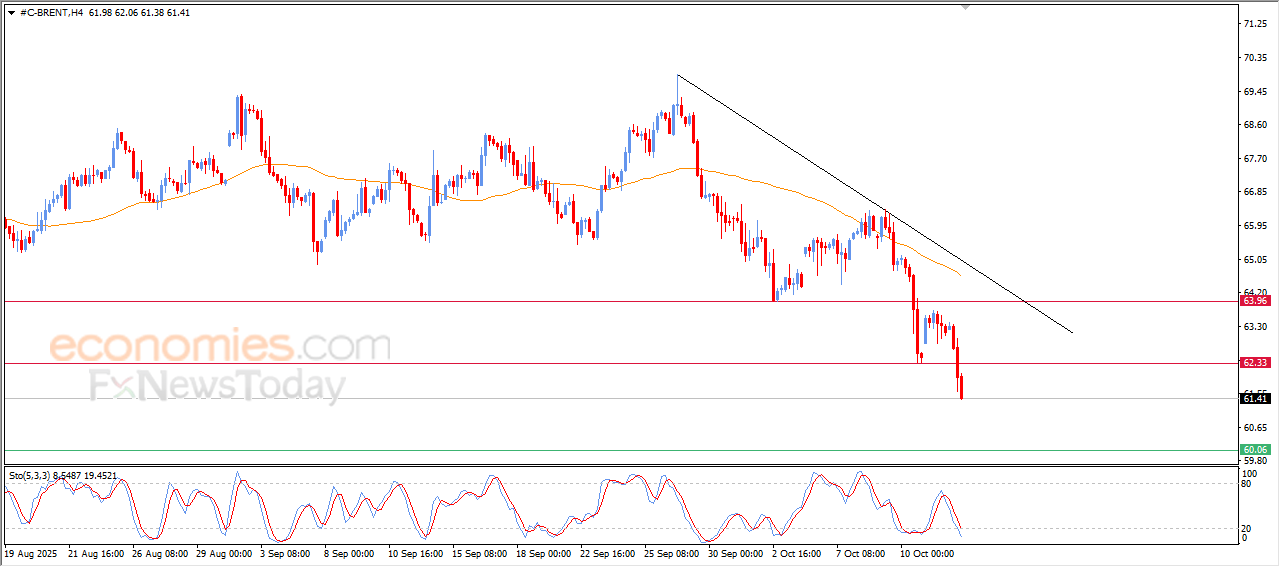
The (Brent) price witnessed fluctuated trading on its last intraday trading, amid the dominance of the main bearish trend on the short-term basis and its trading alongside steep bearish trendline that supports this track, with the continuation of the negative pressure due to its trading below EMA50, reducing the chances of the price’s recover on the near-term basis, besides the emergence of the negative signals on the relative strength indicators, after offloading its oversold conditions, opening the way for recording more of the losses in the upcoming period.
Get high-accuracy trading signals delivered directly to your Telegram. Subscribe to specialized packages tailored for the world’s top markets:
Full VIP signals performance report for 6-10, October 2025:
Gold is stretching its record-setting run early Tuesday, as the bullish sentiment remains unabated amid looming US-China trade risks and in anticipation of US Federal Reserve (Fed) Chair Jerome Powell’s speech later in the day.
Amidst a pause in the US Dollar’s (USD) overnight rebound and ongoing US-China trade talks, Gold buyers flex their muscles.
China’s Commerce Ministry confirmed early Tuesday that it had notified the US. in advance of its new rare earth export controls and held working-level talks on Monday under existing trade consultation channels.
Meanwhile, US Treasury Secretary Scott Bessent said on Monday that President Donald Trump remains on track to meet Chinese leader Xi Jinping in South Korea in late October.
The underlying positive factors, such as persistent expectations that the Fed will deliver two interest rate cuts this year, the extended US government shutdown and potential US-China trade war escalation continue to lend support to buyers.
Gold’s record-setting advance remains powered by the bullish inertia, in the absence of any bearish fundamentals.
Traders now look forward to a slew of speeches from the Fed officials, including Chairman Jerome Powell’s, for fresh hints on the scope of rate cuts by the year-end.
Powell is due to speak about the “Economic Outlook and Monetary Policy” at the National Association for Business Economics (NABE) Annual Meeting, Philadelphia.
The daily chart shows that the 14-day Relative Strength Index (RSI) is back into the extreme overbought zone, currently near 82.50,
Meanwhile, Gold buyers are once again challenging the upper boundary of the month-long rising channel, now at $4,162.
Gold could see a brief corrective pullback if it faces rejection at the abovementioned level amid heavily overbought RSI conditions.
In that case, sellers could attack the lower boundary of the rising channel at $4,014.
A daily candlestick closing basis below the latter would confirm a downside break from the channel, fuelling further correction toward the $3,950 psychological mark.
Further south, the $3,895 supply zone (October 1 and 2 highs) could come into play.
However, if buyers manage to take out the topside hurdle of the channel at $4,162 on a sustained basis, the record-setting rally could extend toward the $4,200 round level.
Jerome H. Powell took office as a member of the Board of Governors of the Federal Reserve System on May 25, 2012, to fill an unexpired term. On November 2, 2017, President Donald Trump nominated Powell to serve as the next Chairman of the Federal Reserve. Powell assumed office as Chair on February 5, 2018.
Next release:
Tue Oct 14, 2025 16:20
Frequency:
Irregular
Consensus:
–
Previous:
–
Source:
Federal Reserve
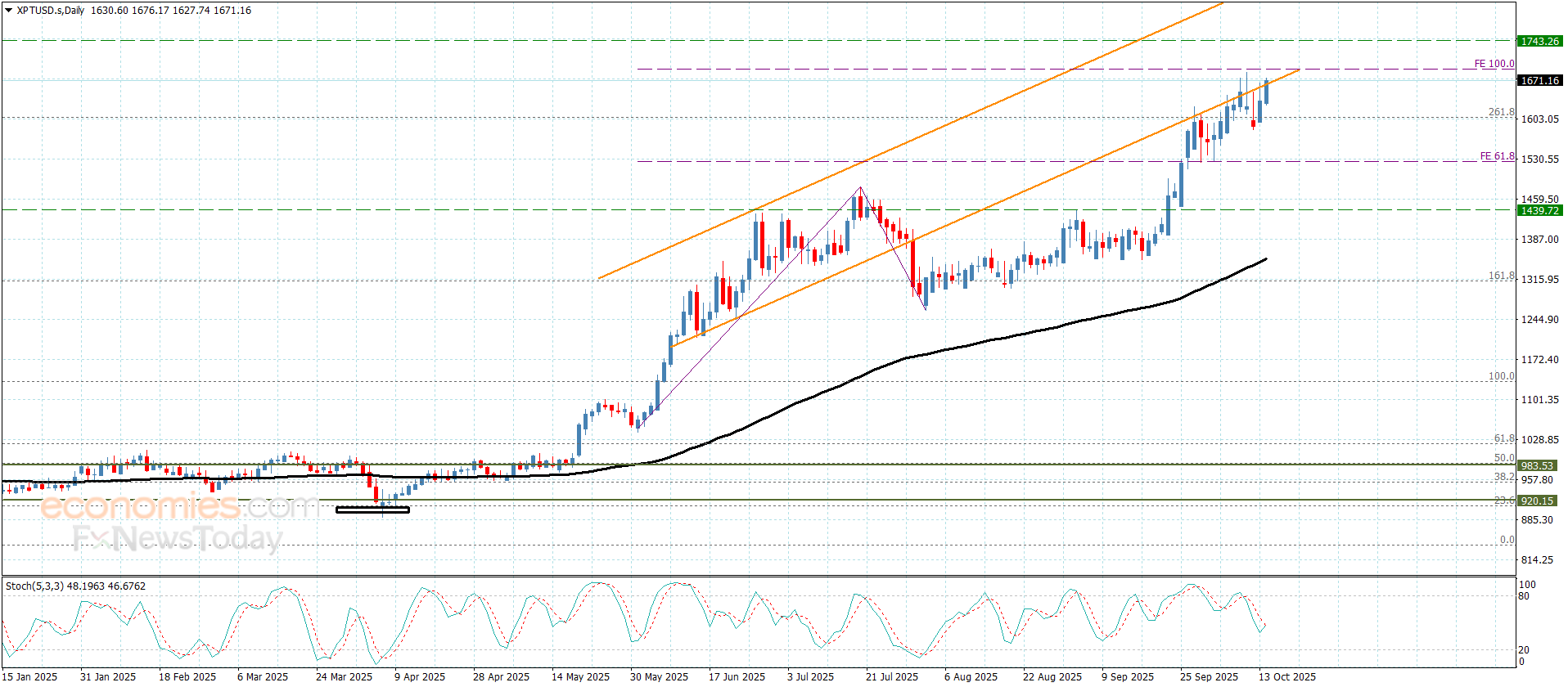
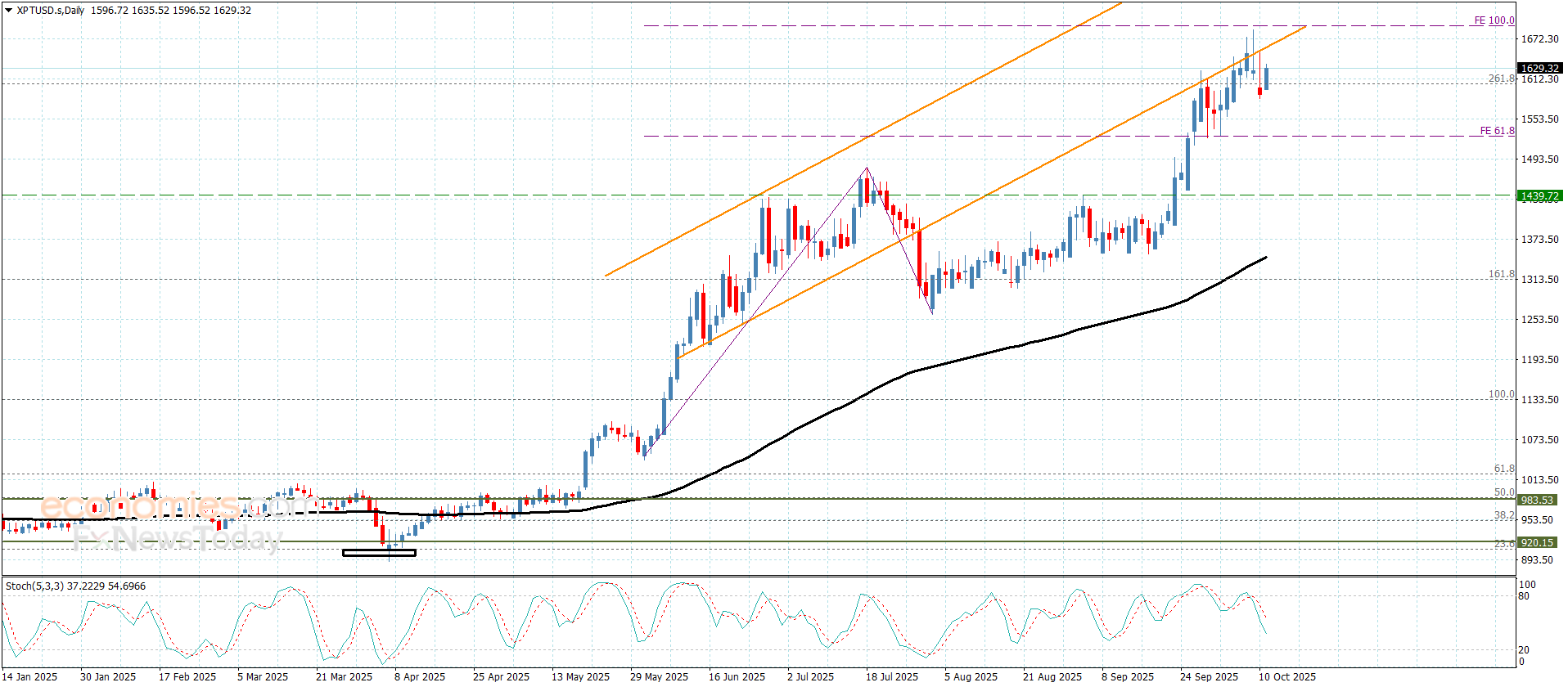
Platinum price provided mixed trading on Friday due to the contradiction between the main indicators, targeting 1583.00 level, then attempts to form bullish wave confirming the continuation of the suggested bullish scenario.
Reminding you that holding above $1525.00 support confirms the price surrender to the bullish bias dominance, to expect gathering positive momentum, to form new bullish rally and press on the barrier at $1690.00, and surpassing it will make the price record extra gains that might begin at $1745.00.
The expected trading range for today is between $1580.00 and $1690.00
Trend forecast: Bullish
Silver price (XAG/USD) attracts some buyers to near $52.60 during the early Asian session on Tuesday. The white metal has reached a fresh all-time high, surpassing its previous peak from 1980, as a historic short squeeze in London intensified.
The rally in Silver price is bolstered by concerns over a depleting silver inventory in London, which drove prices to a premium over those seen in New York and prompted traders to ship metals across the Atlantic for a profit.
Additionally, global trade uncertainties have fueled safe-haven demand, supporting the precious metal. US President Donald Trump on Friday threatened an additional 100% tariff on Chinese goods from November 1 in retaliation for new export controls Beijing is planning for valuable rare earth minerals.
Dovish remarks from the Federal Reserve (Fed) officials also lift the Silver price. Philadelphia Fed new President Anna Paulson said on Monday that rising risks to the job market argue for more interest rate cuts by the US central bank, as trade tariffs now appear unlikely to push up inflation as much as expected. Lower interest rates could reduce the opportunity cost of holding Silver, supporting the non-yielding precious metal.
On the other hand, renewed US Dollar (USD) demand and improved risk sentiment could weigh on the USD-denominated commodity price in the near term. Trump changed his rhetoric on China on Sunday, saying that China’s economy “will be fine” and that the US wants to “help China, not hurt it.”
Silver is a precious metal highly traded among investors. It has been historically used as a store of value and a medium of exchange. Although less popular than Gold, traders may turn to Silver to diversify their investment portfolio, for its intrinsic value or as a potential hedge during high-inflation periods. Investors can buy physical Silver, in coins or in bars, or trade it through vehicles such as Exchange Traded Funds, which track its price on international markets.
Silver prices can move due to a wide range of factors. Geopolitical instability or fears of a deep recession can make Silver price escalate due to its safe-haven status, although to a lesser extent than Gold’s. As a yieldless asset, Silver tends to rise with lower interest rates. Its moves also depend on how the US Dollar (USD) behaves as the asset is priced in dollars (XAG/USD). A strong Dollar tends to keep the price of Silver at bay, whereas a weaker Dollar is likely to propel prices up. Other factors such as investment demand, mining supply – Silver is much more abundant than Gold – and recycling rates can also affect prices.
Silver is widely used in industry, particularly in sectors such as electronics or solar energy, as it has one of the highest electric conductivity of all metals – more than Copper and Gold. A surge in demand can increase prices, while a decline tends to lower them. Dynamics in the US, Chinese and Indian economies can also contribute to price swings: for the US and particularly China, their big industrial sectors use Silver in various processes; in India, consumers’ demand for the precious metal for jewellery also plays a key role in setting prices.
Silver prices tend to follow Gold’s moves. When Gold prices rise, Silver typically follows suit, as their status as safe-haven assets is similar. The Gold/Silver ratio, which shows the number of ounces of Silver needed to equal the value of one ounce of Gold, may help to determine the relative valuation between both metals. Some investors may consider a high ratio as an indicator that Silver is undervalued, or Gold is overvalued. On the contrary, a low ratio might suggest that Gold is undervalued relative to Silver.
Gold price (XAU/USD) jumps to a fresh record high near $4,130 during the early Asian session on Tuesday. The precious metal extends the rally as renewed US-China trade tensions send investors flocking to safe-haven assets. The Federal Reserve’s (Fed) Chair Jerome Powell is scheduled to speak later on Tuesday.
Escalating trade tensions between the US and China reignited fears of a trade war between the world’s two largest economies, boosting safe-haven assets like the Gold price. US President Donald Trump announced on Friday that he will impose new trade measures against Beijing, including 100% tariffs on all Chinese goods and export controls on critical US-developed software, due to take effect by 1 November.
Nonetheless, Trump adopted a less strident stance on Sunday, saying that everything would be “fine” and that the US was not looking to “hurt” China.
Expectations mounted for further interest rate cuts by the US Fed, which contributes to Gold’s upside. Markets are currently pricing in an almost certain 25 basis points (bps) rate cut at the Fed’s October meeting, with another reduction expected in December, according to the CME FedWatch tool. Lower interest rates could reduce the opportunity cost of holding Gold, supporting the non-yielding precious metal.
Further consolidation or correction cannot be ruled out in the near term, as the yellow metal has climbed over 56% year-to-date so far this year. “Given the carousel of drivers, and how short-lived dips have been, this rally has legs in our view, but a near-term correction would be healthier for a longer-term uptrend,” said Suki Cooper, global head, commodities research at Standard Chartered Bank.
Gold has played a key role in human’s history as it has been widely used as a store of value and medium of exchange. Currently, apart from its shine and usage for jewelry, the precious metal is widely seen as a safe-haven asset, meaning that it is considered a good investment during turbulent times. Gold is also widely seen as a hedge against inflation and against depreciating currencies as it doesn’t rely on any specific issuer or government.
Central banks are the biggest Gold holders. In their aim to support their currencies in turbulent times, central banks tend to diversify their reserves and buy Gold to improve the perceived strength of the economy and the currency. High Gold reserves can be a source of trust for a country’s solvency. Central banks added 1,136 tonnes of Gold worth around $70 billion to their reserves in 2022, according to data from the World Gold Council. This is the highest yearly purchase since records began. Central banks from emerging economies such as China, India and Turkey are quickly increasing their Gold reserves.
Gold has an inverse correlation with the US Dollar and US Treasuries, which are both major reserve and safe-haven assets. When the Dollar depreciates, Gold tends to rise, enabling investors and central banks to diversify their assets in turbulent times. Gold is also inversely correlated with risk assets. A rally in the stock market tends to weaken Gold price, while sell-offs in riskier markets tend to favor the precious metal.
The price can move due to a wide range of factors. Geopolitical instability or fears of a deep recession can quickly make Gold price escalate due to its safe-haven status. As a yield-less asset, Gold tends to rise with lower interest rates, while higher cost of money usually weighs down on the yellow metal. Still, most moves depend on how the US Dollar (USD) behaves as the asset is priced in dollars (XAU/USD). A strong Dollar tends to keep the price of Gold controlled, whereas a weaker Dollar is likely to push Gold prices up.