The main tag of Gold Today Price Articles.
You can use the search box below to find what you need.
[wd_asp id=1]
The main tag of Gold Today Price Articles.
You can use the search box below to find what you need.
[wd_asp id=1]
NEW YORK, March 14, 2026, 14:18 EDT
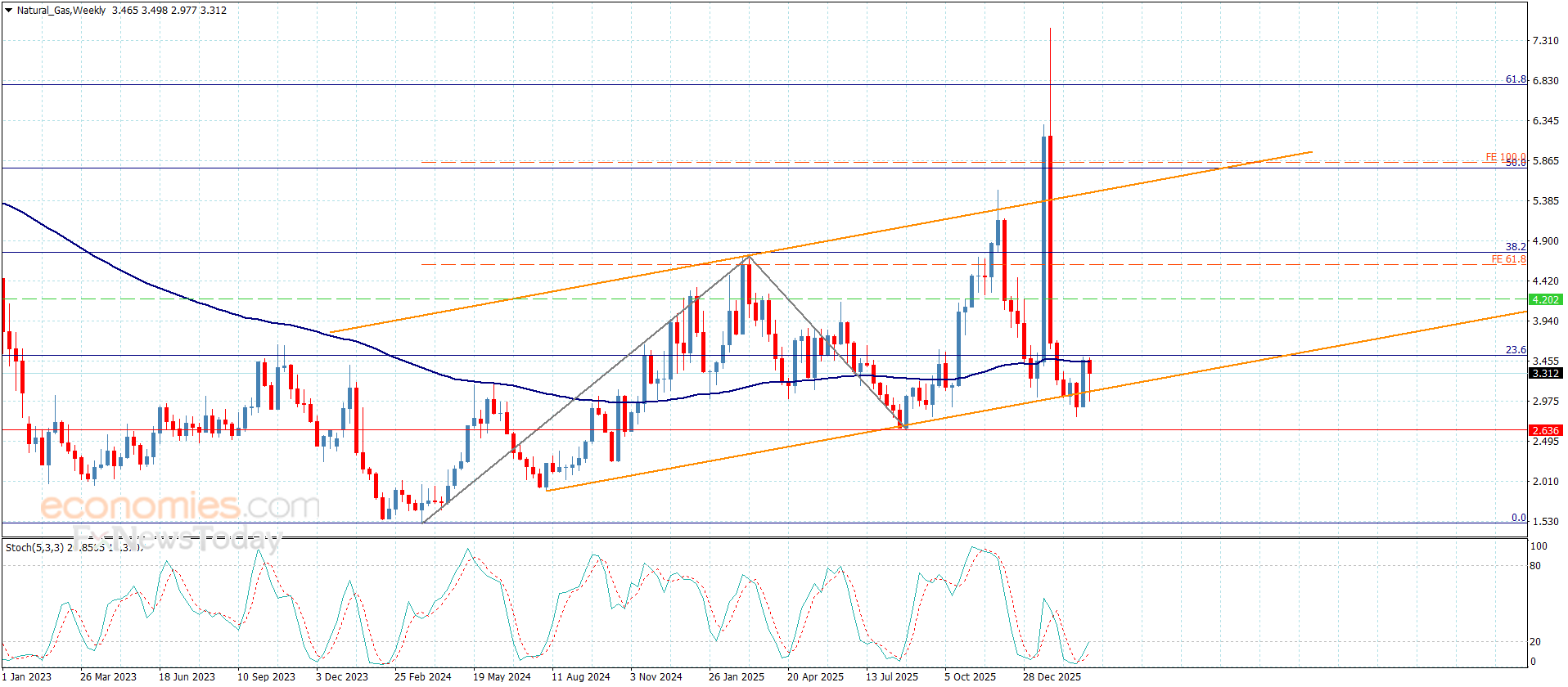
Natural gas futures in the U.S. slipped Friday. April Henry Hub contracts, the standard benchmark, wrapped up the day at $3.131 per mmBtu—down a little more than 3%. Forecasters are calling for mostly mild conditions through March, which has traders anticipating softer late-season heating demand. MarketWatch
The retreat stands out, given that the U.S. market remains shaped mostly by internal factors—supply, storage, and the weather—rather than the more acute LNG crunch seen overseas. According to the U.S. Energy Information Administration’s March Short-Term Energy Outlook, gas prices in Europe and Asia have climbed due to slower LNG flows through the Strait of Hormuz. But in the U.S., prices look set to stay largely insulated. Export terminals were already pushing capacity before the disruption, so there’s little slack left to boost shipments abroad for now. U.S. Energy Information Administration
The EIA now sees Henry Hub prices averaging around $3.76 per mmBtu in 2026, down from last month’s $4.31 call. For 2027, the agency is looking at $3.85. Unusually warm weather in February left inventories higher than expected, which has pulled the price outlook lower for the near term. U.S. Energy Information Administration
Storage helps buffer supply. As of the week ended March 6, working gas in storage hit 1,848 billion cubic feet—141 bcf higher than the same point last year, though still 17 bcf under the five-year norm. The EIA projects inventories finishing the winter close to 1,840 bcf. U.S. Energy Information Administration
Overseas supply remains under pressure. LNG for April delivery into Northeast Asia slipped to $19.50 per mmBtu, down from $22.50 the previous week. But JERA’s CEO, Yukio Kani, dismissed hopes that Middle East disruptions would resolve in a matter of weeks as “far too optimistic.” Venture Global CEO Mike Sabel, by contrast, described the ongoing volatility as “very short-term” and said he sees “very stable liquefaction prices” in the longer run. Reuters
Europe remains squeezed. On Friday, Dutch TTF front-month gas—the regional price benchmark—traded at roughly 50.1 euros per megawatt hour. Earlier in the week, Reuters noted the contract had eased back near 50 euros after jumping close to 65.5 euros on conflict headlines. Still, prices are sitting about 50% higher than February as storage levels across the region linger around 27% of capacity, the lowest for this time since 2022. Investing.com
Signals out of the U.S. continue to suggest ample supply. Gas rigs ticked up by one this week to 133, according to Baker Hughes, with the Haynesville figure now at its highest since May 2023. The EIA’s March report projects Lower 48 marketed gas production to average 118 bcf/d in 2026, rising to 121 bcf/d in 2027. Reuters
The downside risk for prices remains murky. NOAA’s 8-14 day forecast points to lingering below-normal temperatures in the Northeast, even while swaths of the West and central U.S. trend warmer. On the other side of the Atlantic, Europe is still staring at big storage deficits after burning through unusually large volumes. Another cold snap in late March or an unexpected drop in LNG flows could flip the supply balance quickly. Climate Prediction Center
The government’s yearly projection remains notably higher than the front-month market, at least for the moment. Friday settled at $3.131, trailing the EIA’s 2026 average of about $3.76. That points to the agency holding out for stronger prices ahead, despite trimming its outlook again. MarketWatch
BitcoinWorld
Silver Price Forecast: XAG/USD Plunges to Near $84.50 as Resilient US Dollar Dominates
NEW YORK, April 2025 – The silver price forecast turned bearish today as the XAG/USD pair lost significant ground, trading near the $84.50 level. This sharp decline primarily stems from a surprisingly resilient US Dollar, which continues to exert downward pressure on dollar-denominated commodities. Consequently, traders are reassessing their positions in the precious metals complex.
The recent movement in the silver price forecast highlights a classic inverse relationship. Specifically, the US Dollar Index (DXY) has rallied for three consecutive sessions. This rally follows stronger-than-expected US retail sales data and hawkish commentary from Federal Reserve officials. Therefore, market participants are pricing in a higher-for-longer interest rate environment. Higher US interest rates typically bolster the dollar’s appeal to yield-seeking investors. As a result, assets priced in dollars, like silver, become more expensive for holders of other currencies, dampening demand.
Historically, the XAG/USD pair exhibits high sensitivity to dollar strength. For instance, during the 2022-2023 rate hike cycle, silver experienced similar periods of consolidation and decline. However, analysts note that industrial demand fundamentals for silver remain robust. The global transition to green energy and electric vehicles continues to underpin long-term consumption. This creates a complex dynamic where short-term currency headwinds clash with long-term structural demand.
Several key factors are currently fueling the US Dollar’s ascent, directly impacting the silver price forecast. First, recent economic indicators suggest the US economy retains underlying momentum. Strong employment figures and persistent service-sector inflation give the Federal Reserve little impetus to cut rates prematurely. Second, geopolitical tensions in Europe and the Middle East have triggered a flight to safety. The US Dollar and US Treasuries remain preferred safe-haven assets during periods of uncertainty.
Furthermore, comparative monetary policy plays a crucial role. While the Fed maintains a cautious stance, other major central banks, like the European Central Bank, have signaled a more dovish pivot. This policy divergence widens the interest rate differential, making dollar-based assets more attractive. The table below summarizes the primary drivers:
| Driver | Impact on USD | Impact on Silver (XAG/USD) |
|---|---|---|
| Strong US Economic Data | Positive | Negative |
| Hawkish Fed Policy Stance | Positive | Negative |
| Geopolitical Risk (Flight to Safety) | Positive | Mixed (Safe-haven but dollar-denominated) |
| Divergent Global Central Bank Policies | Positive | Negative |
Market strategists provide critical context for the current silver price forecast. Dr. Anya Sharma, Head of Commodities Research at Global Markets Insight, states, “The short-term trajectory for silver is inextricably linked to real yields and the dollar. The current macro environment is challenging for non-yielding assets.” She further explains that while industrial demand provides a floor, it often fails to offset intense financial market selling during risk-off periods. Meanwhile, technical analysts point to key support levels. The $84.00 zone represents a major psychological and technical barrier, having acted as support multiple times in Q1 2025. A sustained break below this level could trigger further automated selling.
Data from the Commodity Futures Trading Commission (CFTC) shows that managed money accounts have reduced their net-long positions in silver futures for two straight weeks. This shift in speculative positioning often precedes or confirms a bearish trend. However, physical market indicators tell a different story. Reported silver imports into key markets like India and China have remained steady, suggesting underlying physical demand is absorbing some of the paper market’s selling pressure.
Understanding the silver price forecast requires examining historical patterns. Silver is known for its high volatility compared to gold. This characteristic stems from its dual role as both a monetary metal and an industrial commodity. During periods of dollar strength and rising rates, the monetary aspect suffers first. For example, the 2013 ‘Taper Tantrum’ saw silver lose over 35% of its value as the dollar rallied on expectations of Fed tightening. Today’s market echoes some of those dynamics but within a different fundamental backdrop of energy transition demand.
Market psychology also plays a significant role. The $85.00 level had served as a consolidation point. The break below it has likely triggered stop-loss orders from bullish traders, accelerating the downward move. This creates a feedback loop where technical selling reinforces fundamental drivers. Traders now watch for signs of capitulation or a reversal in dollar momentum as potential catalysts for a silver rebound.
The immediate silver price forecast remains under pressure, with XAG/USD hovering near $84.50 due to pronounced US Dollar strength. The confluence of resilient US economic data, a patient Federal Reserve, and geopolitical risk flows continues to support the greenback. While long-term industrial demand for silver provides a fundamental underpinning, short-term price action is dominated by currency and interest rate dynamics. Market participants should monitor upcoming US inflation data and Fed communications closely, as these will be pivotal for the dollar’s next move and, by extension, the path for silver prices.
Q1: Why does a strong US Dollar cause silver prices to fall?
A strong US Dollar makes silver, which is priced in dollars, more expensive for buyers using other currencies. This typically reduces international demand, putting downward pressure on the price.
Q2: What is the XAG/USD pair?
XAG is the ISO 4217 currency code for one troy ounce of silver. USD is the code for the US Dollar. The XAG/USD pair shows how many US dollars are needed to purchase one ounce of silver.
Q3: Besides the US Dollar, what other factors influence the silver price forecast?
Key factors include global industrial demand (especially from solar panel and electronics manufacturing), real interest rates, geopolitical uncertainty, mining supply, and investment flows into silver-backed ETFs.
Q4: Is the current decline in silver a buying opportunity for long-term investors?
Some analysts view periods of dollar-induced weakness as potential entry points, given silver’s critical role in renewable energy and technology. However, timing the market is difficult, and diversification is always recommended.
Q5: How does silver’s price action typically compare to gold’s during dollar rallies?
Silver generally exhibits higher volatility than gold. During strong dollar rallies, silver often experiences larger percentage declines due to its lower liquidity and its hybrid identity as both a precious and industrial metal.
This post Silver Price Forecast: XAG/USD Plunges to Near $84.50 as Resilient US Dollar Dominates first appeared on BitcoinWorld.
NEW YORK, March 14, 2026, 14:17 (EDT)
Regular gasoline in the U.S. hit an average of $3.675 a gallon on Saturday, building on a sharp jump seen in March as Brent crude closed above $100 a barrel Friday. Early attempts to tamp down the surge haven’t done much so far. AAA’s state-by-state numbers show the national average climbing further past $3.60—a threshold not seen since May 2024, first crossed just this Thursday. AAA Fuel Prices
Spring travel is ramping up right as pump prices climb, pressuring household confidence. In March, the University of Michigan reported that consumer sentiment slipped—gasoline costs have surged over 21% since the start of the conflict with Iran. Reuters
Gas prices are feeling the squeeze as market signals turn tighter. AAA reported the national average at $3.598 on March 12, pointing to Energy Information Administration figures showing gasoline demand hitting 9.24 million barrels per day last week. Domestic supply dropped to 249.5 million barrels, just as spring break travel kicked off. AAA Fuel Prices
Crude remains the key. Brent, the global benchmark, finished Friday at $103.14 a barrel. Goldman Sachs is now projecting Brent to stay over $100 through March, with a drop to $85 expected for April. The bank still anticipates a slide to the low $70s later in the year—if the situation at the Strait of Hormuz, which handles roughly a fifth of global oil flows, calms down. Reuters
Quick relief at the pump isn’t likely. Analysts noted a U.S. shipping-rule waiver and tapping emergency reserves could help break up some regional logjams, but they won’t halt climbing retail gasoline prices. Joe Brusuelas at RSM described the reserve release as just a “temporary salve.” GasBuddy’s Patrick De Haan estimated a waiver might only trim price hikes by “around a nickel a gallon” in areas that depend on imports. Reuters
Gas prices hit harder in some states than others. On Saturday, California drivers were paying an average of $5.483 a gallon, AAA data showed, while Washington stood at $4.837 and Texas at $3.350. A day earlier, California’s average reached $5.42. Last year, Chevron’s Richmond and El Segundo facilities, along with Marathon Petroleum’s Los Angeles plant, led the state for crude imports. Energy economist Philip Verleger called the West Coast the possible “poster child” for the price shock. And according to Matt Smith at Kpler, there just isn’t “a great deal of incremental supply” for the region. AAA Fuel Prices
China tightened the pressure Thursday, imposing an outright March ban on refined fuel exports—gasoline and diesel—aimed at preventing domestic shortfalls. The move threatens to thin out available export barrels in the Pacific, right as U.S. coastal buyers scramble to secure supply. Reuters
The U.S. government said Friday it expects initial shipments from the Strategic Petroleum Reserve—America’s emergency crude stash—to hit the market before next week wraps up. The Energy Department has put out a call for bids on 86 million barrels, marking the first tranche of the planned 172 million-barrel U.S. release. This move is part of the wider International Energy Agency’s 400 million-barrel coordinated effort. Reuters
Gasoline prices are still likely to climb in the short run, though gains could come more gradually. Most analysts see oil holding its ground, and De Haan expects fuel costs to keep tracking crude higher. If Brent hangs around $100, drivers should brace for further pump pain heading into late March. Reuters
This is a rough market to read. Goldman sees oil prices pulling back later if supply issues ease off. Barclays figures Brent at $85 in 2026 if the Strait of Hormuz stabilizes within two to three weeks. But if traders begin to factor in a four-to-six week jam, Barclays puts Brent at $100. For drivers, it comes down to this: a pump price spike for spring, and maybe, just maybe, some relief down the road—if the vital shipping route clears.
The oil futures paper market is likely underestimating the massive supply disruption that a closed Strait of Hormuz is creating in physical crude and fuel supply globally.
Crude futures prices briefly spiked early this week to $119 per barrel, before retreating to the $90s and trading at $100 a barrel early on Friday in Asian trade.
However, the premium of physical Dubai crude has surged to $38 per barrel over its paper equivalent, according to data compiled by Reuters columnist Clyde Russell.
The wide gap between paper and physical prices suggests that supply is being immediately choked off.
But traders on the paper market appear to believe that the record-high emergency stocks release and the U.S. Administration’s scrambling to calm the markets with comments that the war will end soon would ease the upward pressure on oil prices.
Analysts started expressing views that $200 oil is not a fantasy anymore—with 20% of global oil supply choked at the Strait of Hormuz buyers are racing to procure physical cargoes, refiners in Asia consider cutting processing rates, and Asian countries restrict fuel exports.
As a result, jet and diesel cracks soared to never-seen highs, leaving entire regions such as Europe in a shocking shortfall of middle distillates.
Related: Little-Known US Company Lands Important Pentagon Contract in Rare Earth Race
Hours after announcing the biggest-ever coordinated emergency release of oil stocks, of 400 million barrels, from reserves, the International Energy Agency warned that the Middle East war is creating the biggest supply disruption in the history of the oil market.
The IEA-coordinated release will take weeks and possibly months to reach the market. The U.S. release of stocks as part of the IEA action will take about 120 days to complete, ING’s commodities strategists Warren Patterson and Ewa Manthey said.
“If you assume a similar timeline for other countries, that works out to 3.3m b/d – far short of the supply losses we are seeing from the Persian Gulf,” they noted.
With limited capacity available to bypass the crucial Strait of Hormuz and storage filling up, Gulf producers have slashed their combined oil output by at least 10 million barrels per day, the IEA said in its monthly Oil Market Report on Thursday.
In addition, over 3 million barrels per day of refining capacity in the Gulf region has already shut due to attacks and a lack of viable export outlets.
“Runs elsewhere will be increasingly limited due to feedstock availability,” the IEA warned.
The coordinated stocks release, while a record-high since the agency was created in the 1970s, wouldn’t go far to help supply in most of developing Asia, where neither China nor India, the top crude importers, are IEA members. China has some buffer to withstand part of the supply shock, but Indian stockpiles are among the lowest in the region.
The U.S. Treasury moved to allow, until April 11, purchases of Russian crude stuck in tankers in floating storage. China and India will likely compete fiercely for this supply. And still, it will not come close to offsetting the massive loss of Middle Eastern supply, most of which goes to Asia.
Related: No Magnets, No Drones: How China Controls the Future of Warfare
“Asia’s alternative crude supply sources are severely limited, with both China and India competing for Russian crude,” said Sushant Gupta, Research Director, Asia Pacific Refining and Oils at Wood Mackenzie.
“Asian refiners will struggle to fulfil crude buying requirements for April, leading to run cuts across the region. Refiners will be dipping into their buffer stocks, which is typically up to 15 days of their needs,” Gupta added.
“Eventually, most countries will need to fall back on strategic petroleum reserves if the conflict continues.”
The conflict doesn’t look to be ending soon, despite the Trump Administration’s efforts to convince the market of the contrary and play down the spike in oil and gasoline prices.
Early this week, analysts at Wood Mackenzie said that Brent Crude prices could surge to $150 per barrel in the coming weeks.
“However, supply volumes at risk this time are dimensionally bigger – and real,” unlike in the 2022 Russian invasion of Ukraine, when supply was free flowing and just had to redirect to China and India, according to WoodMac.
“In our view, US$200/bbl is not outside the realms of possibility in 2026,” the analysts said.
The Trump Administration is scrambling to contain the fallout on prices. Energy Secretary Chris Wright on Thursday told CNN that oil prices are unlikely to hit $200 per barrel, “but we are focused on the military operation and solving a problem.”
At the same time, Wright told CNBC that the U.S. Navy is not ready to begin escorting oil tankers through the Strait of Hormuz.
While the paper market reacts to comments and attempts at assurances, the physical crude market is flashing signs of stress and distress as a large portion of global oil supply is now off the market for weeks, possibly months.
By Tsvetana Paraskova for Oilprice.com

The latest flashpoint is Iran’s Kharg Island, a small coral island in the northern Persian Gulf, roughly 15 miles off Iran’s mainland coast. Despite its size, the island is the single most important export hub in Iran’s oil industry. Nearly 90% of Iran’s crude oil exports pass through Kharg Island, making it a vital artery for global energy markets.
The facility can load roughly 7 million barrels of oil per day onto tankers and has storage capacity of around 30 million barrels. Pipelines carry crude from Iran’s giant fields — Ahvaz, Marun, and Gachsaran — directly to the island’s loading terminals.
Iran currently produces about 3.3 million barrels of crude oil daily and roughly 1.3 million barrels of condensate and liquids, accounting for about 4.5% of global oil supply. Most of that oil moves through Kharg Island before tankers sail through the Strait of Hormuz, the world’s most important oil shipping lane.
Trump said American forces had “totally obliterated every military target” on Kharg Island, but deliberately chose not to strike the oil infrastructure — at least for now. Targets included air defences, a naval base, and airport facilities, with Iranian state media confirming more than 15 explosions but no damage to oil infrastructure.
With about 20% of global oil and gas shipments passing through the Strait of Hormuz, any military escalation involving Kharg Island could send shockwaves through global energy markets. Analysts say a direct strike on the island’s oil infrastructure could trigger one of the biggest oil price spikes in years, pushing Brent crude and WTI crude futures well above $100 per barrel.
Energy analysts often describe Kharg Island as the choke point of Iran’s oil export system. That label reflects the island’s extraordinary role in the country’s energy economy. Every day, millions of barrels of crude flow through pipelines from Iran’s largest oil fields to massive storage tanks on the island. Tankers dock along long jetties that extend into deep water, allowing super tankers to load quickly and transport crude to Asia and global markets.
Satellite tracking services report that oil tankers have been loading almost continuously at Kharg Island since the war began. In the weeks before the latest military strikes, Iran reportedly increased exports sharply, attempting to move as much oil as possible before potential disruptions.
Current estimates suggest around 18 million barrels of crude are stored on the island, ready to be shipped.
Because almost all Iranian exports depend on this facility, destroying or disabling it could immediately halt most Iranian oil exports. For global markets, the result would be a sudden supply shock.
Even though Iran represents roughly 4–5% of global oil supply, losing those barrels would tighten an already fragile market.
Oil markets react quickly to geopolitical shocks. The latest US and Israeli strikes on Iranian energy and military sites have already triggered a sharp response.
After the attacks, Brent crude futures surged above $103 per barrel, while WTI crude oil jumped above $101, reaching the highest levels since mid-2022.
Even though the recent US bombing raids targeted military facilities on Kharg Island, officials confirmed that oil infrastructure and export terminals were not hit. However, the threat remains very real.
President Donald Trump warned that the US could strike Iran’s oil infrastructure if Tehran continues blocking ships through the Strait of Hormuz. That warning alone has injected enormous uncertainty into energy markets.
Oil traders know that Kharg Island represents a critical vulnerability in Iran’s energy system. If its export terminals were destroyed or severely damaged, global oil supply could tighten dramatically.
That risk explains why oil prices today remain extremely sensitive to every development in the Middle East conflict.
The Kharg Island crisis cannot be separated from the Strait of Hormuz, which serves as the main gateway for oil shipments from the Middle East to global markets.
Under normal conditions, roughly 20% of the world’s oil and liquefied natural gas flows through this narrow maritime corridor. The route connects major producers such as Saudi Arabia, Iraq, Kuwait, the United Arab Emirates, and Iran with customers across Asia, Europe, and the United States.
However, since the conflict escalated, shipping traffic through the Strait of Hormuz has slowed dramatically, with many tankers avoiding the region due to security risks.
If Iran continues threatening or blocking vessels, the market could lose access to millions of barrels per day of crude supply.
Energy strategists warn that the combination of Strait of Hormuz disruption and potential damage to Kharg Island could create one of the most severe oil supply crises in recent history.
In such a scenario, analysts believe oil prices could surge far beyond $120 per barrel, particularly if regional energy infrastructure becomes a target.
The biggest question facing energy markets today is simple: what happens if Kharg Island’s oil facilities are directly attacked?
Many analysts believe the price impact could be dramatic. Destroying the island’s export infrastructure would effectively cut off Iran’s main oil revenue stream and remove millions of barrels from global supply.
Some forecasts suggest oil prices could spike above $120 per barrel in the short term. In a worst-case scenario involving broader regional escalation, crude prices could climb even higher.
Rebuilding Kharg Island’s oil facilities would not be easy either. Experts estimate repairs could take many months or even more than a year, especially because international sanctions limit Iran’s access to technology, funding, and engineering support.
That means any disruption could have long-lasting consequences for global oil supply.
Right now, the global oil market is watching one small island in the Persian Gulf.
Kharg Island processes roughly 90% of Iran’s oil exports, making it one of the most important energy hubs in the Middle East. With Brent crude and WTI crude already trading near $100, the threat to this facility has become one of the biggest risks facing global markets.
If Kharg Island remains operational, oil prices may stabilize as traders wait for geopolitical clarity. But if the conflict escalates and the island’s oil infrastructure becomes a target, the world could face a major supply shock.
That outcome would push global oil prices sharply higher, increase gasoline costs worldwide, and intensify inflation pressures across major economies.
Where is Kharg Island located?
Kharg Island lies in the northern Persian Gulf, about 15 miles (25 km) off Iran’s southern coast. It sits near the entrance to the Strait of Hormuz, one of the world’s most important oil shipping routes.
Why is Kharg Island so important for global oil markets?
Kharg Island handles around 90% of Iran’s crude oil exports. The terminal can load up to 7 million barrels of oil per day and store roughly 30 million barrels. Any disruption there can quickly affect global oil supply and oil prices.
What did the US attack on Kharg Island target?
The US strikes targeted military facilities, including runways, missile storage sites, and naval infrastructure on the island. Officials said oil export terminals and storage tanks were not directly hit.
Important DisclaimersFXEmpire is owned and operated by Empire Media Network LTD., Company Registration Number 514641786, registered at 7 Jabotinsky Road, Ramat Gan 5252007, Israel. The content provided on this website includes general news and publications, our personal analysis and opinions, and materials provided by third parties. This content is intended for educational and research purposes only. It does not constitute, and should not be interpreted as, a recommendation or advice to take any action, including making any investment or purchasing any product. Before making any financial decision, you should conduct your own due diligence, exercise your own discretion, and consult with competent advisors. The content on this website is not personally directed to you, and we do not take into account your individual financial situation or needs. The information contained on this website is not necessarily provided in real time, nor is it guaranteed to be accurate. Prices displayed may be provided by market makers and not by exchanges. Any trading or other financial decision you make is entirely your own responsibility, and you must not rely solely on any information provided through the website. FXEmpire does not provide any warranty regarding the accuracy, completeness, or reliability of any information contained on the website and shall bear no responsibility for any trading losses you may incur as a result of using such information. The website may include advertisements and other promotional content. FXEmpire may receive compensation from third parties in connection with such content. FXEmpire does not endorse, recommend, or assume responsibility for the use of any third-party services or websites. Empire Media Network LTD., its employees, officers, subsidiaries, and affiliates shall not be liable for any loss or damage resulting from your use of the website or reliance on the information provided herein.Risk DisclaimersThis website contains information about cryptocurrencies, contracts for difference (CFDs), and other financial instruments, as well as about brokers, exchanges, and other entities trading in such instruments. Both cryptocurrencies and CFDs are complex instruments and involve a high risk of losing money. You should carefully consider whether you understand how these instruments work and whether you can afford to take the high risk of losing your money. FX Empire encourages you to conduct your own research before making any investment decision and to avoid investing in any financial instrument unless you fully understand how it works and the risks involved.
The EURJPY pair is affected by the stability at 184.40 barrier in the last period, which forces it to form new negative trading, approaching the initial negative target at 182.90 as appears in the above image.
Note that stochastic stability below 80 level might push the price to provide more negative trading, to attempt to target 182.45 level reaching %23.6 Fibonacci correction level near 182.00, while its rally again above 184.40 will confirm its move to the bullish track, to attempt to achieve several gains by its rally towards 184.80 and 185.45.
The expected trading range for today is between 182.00 and 183.65
Trend forecast: Fluctuated within the bearish trend
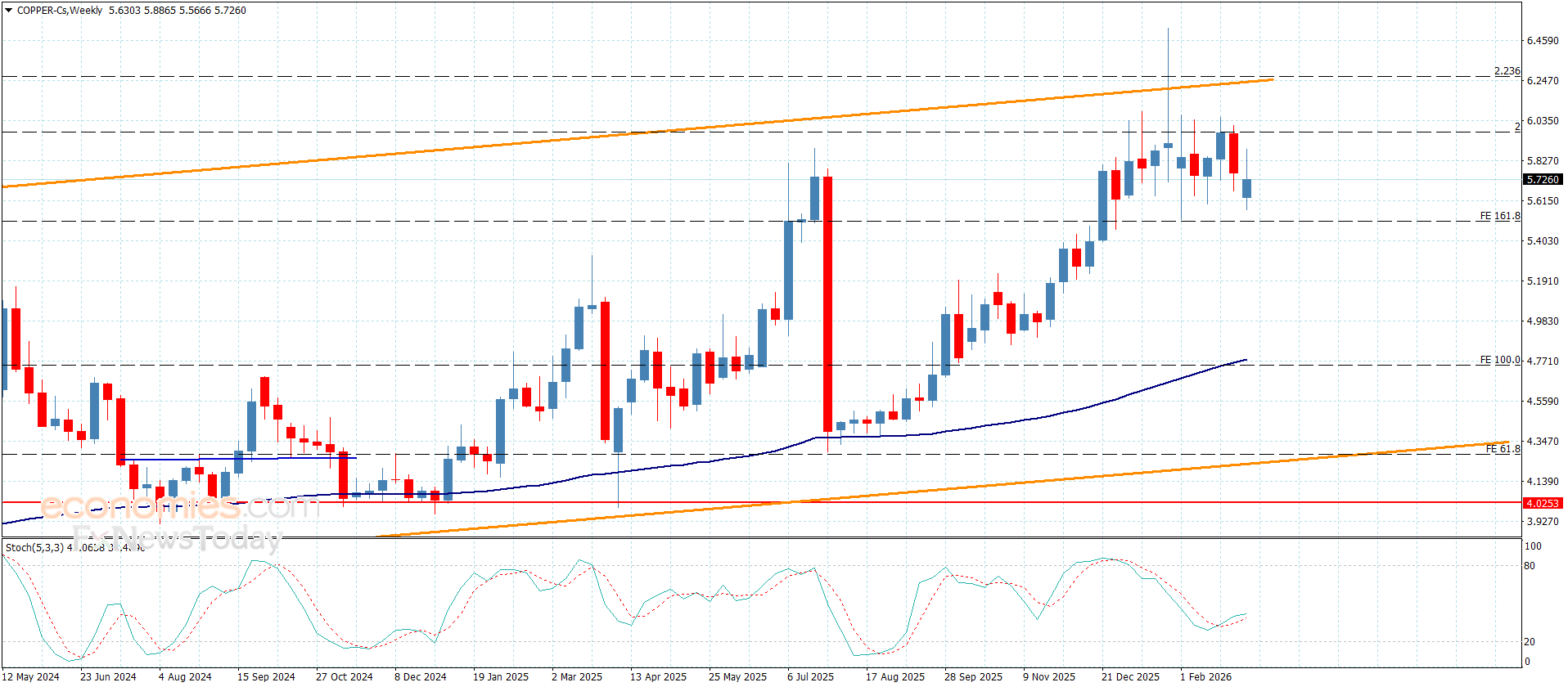
Copper price remains affected by the contradiction of the main indicators, which forces it to provide slow negative trading, to fluctuate near $5.7200, where gathering negative momentum makes us expect forming bearish waves, to attempt to reach the corrective stations at $5.6200, to press on the extra support near $5.5100, forming a key to detect the main trend in the upcoming trading.
While regaining the bullish trend requires forming strong bullish rally to settle above $5.9700 level, to begin targeting new positive stations by its rally towards $6.1200.
The expected trading range for today is between $5.6200 and $5.8200
Trend forecast: Bearish
Copper price remains affected by the contradiction of the main indicators, which forces it to provide slow negative trading, to fluctuate near $5.7200, where gathering negative momentum makes us expect forming bearish waves, to attempt to reach the corrective stations at $5.6200, to press on the extra support near $5.5100, forming a key to detect the main trend in the upcoming trading.
While regaining the bullish trend requires forming strong bullish rally to settle above $5.9700 level, to begin targeting new positive stations by its rally towards $6.1200.
The expected trading range for today is between $5.6200 and $5.8200
Trend forecast: Bearish