The main tag of Gold Today Price Articles.
You can use the search box below to find what you need.
[wd_asp id=1]
The main tag of Gold Today Price Articles.
You can use the search box below to find what you need.
[wd_asp id=1]
The global oil market is currently under a significant spotlight as prices fluctuate due to various geopolitical and economic factors. As of the latest reports, West Texas Intermediate (WTI) crude oil is forecasted to hover around $61.87 per barrel, while Brent crude prices are expected to reach approximately $65.50. These figures come amidst ongoing pressures exerted by OPEC+ and the broader dynamics of supply and demand in the oil market. In this article, we will delve into the factors influencing these prices, the implications of OPEC+ decisions, and what analysts predict for the future of oil prices.
Oil prices are primarily determined by the basic economic principle of supply and demand. When demand for oil exceeds supply, prices tend to rise. Conversely, if supply outstrips demand, prices usually fall. Recent trends indicate a complex interplay between these two forces, especially as economies around the world continue to recover from the COVID-19 pandemic. Factors such as industrial activity, travel demand, and energy transitions are influencing these dynamics.
For instance, as countries emerge from lockdowns, travel has seen a resurgence, significantly affecting oil demand. The International Air Transport Association (IATA) reported a notable increase in passenger numbers, which in turn drives up the demand for jet fuel. Additionally, industrial production has ramped up in several regions, increasing the demand for crude oil in manufacturing processes.
Geopolitical events can have a profound impact on oil prices. Conflicts, sanctions, and diplomatic relations among oil-producing countries often create volatility. For example, ongoing tensions in the Middle East, including conflicts involving Iran or disruptions in Libya, can restrict supply, leading to price increases. Conversely, resolutions to these conflicts can stabilize or even reduce prices.
The recent conflict in Ukraine has also raised concerns over European energy security, given the continent’s reliance on imports. The potential for sanctions on Russian oil has caused ripples in the market, prompting European nations to seek alternative sources and pushing prices higher.
The Organization of the Petroleum Exporting Countries (OPEC) is a coalition of oil-producing nations that collaborates to manage oil production levels and stabilize prices. In recent years, OPEC has expanded its coalition to include other major producers, such as Russia, forming what is known as OPEC+. This group plays a critical role in influencing global oil prices through its production decisions.
OPEC+ has historically aimed to balance the market by adjusting production levels. Their collective decisions can significantly sway oil prices, making them a focal point for analysts and investors alike.
OPEC+ has faced considerable challenges in balancing the needs of its member countries with the realities of a volatile market. Recent cuts in production aimed at stabilizing prices have put pressure on the group to maintain discipline among its members. Some countries may seek to boost output in response to rising prices, which can lead to an oversupply and subsequent price drops.
In 2023, OPEC+ announced a series of production cuts to address concerns over a supply glut caused by increased U.S. shale production. The aim was to support prices amid fears of a global economic slowdown. However, compliance among member countries has varied, leading to ongoing discussions about the future of these cuts.
As WTI and Brent crude prices hover around $61.87 and $65.50 respectively, OPEC+ is expected to closely monitor market conditions. Analysts predict that continued adherence to production cuts will be necessary to support prices. However, any substantial increase in global demand, especially from major economies like the United States and China, could influence OPEC+ to adjust its strategies.
For example, if the U.S. economy continues to show resilience, it may lead to an uptick in oil consumption, prompting OPEC+ to reconsider their production strategies to capitalize on rising prices.
The global economic recovery from the pandemic plays a pivotal role in shaping oil demand. As countries reopen and industries ramp up production, oil consumption is increasing. The International Energy Agency (IEA) has projected a rise in demand, particularly in sectors such as transportation and manufacturing. This uptick could provide upward pressure on oil prices if production levels do not keep pace.
Emerging markets, particularly in Asia, are also contributing to increased demand as their economies rebound. For example, India has shown significant growth in oil consumption as its manufacturing and transportation sectors expand.
Another factor influencing oil prices is the ongoing transition to renewable energy sources. Governments worldwide are investing heavily in green technologies and reducing reliance on fossil fuels. While this transition is essential for long-term sustainability, it may create short-term demand fluctuations as the market adjusts to new energy paradigms. The shift towards electric vehicles (EVs) and alternative energy sources could reshape demand for oil in the years to come.
For instance, countries like Norway are leading the charge in EV adoption, aiming for a significant reduction in gasoline and diesel vehicle sales by 2025. As more nations pursue similar goals, traditional oil demand may face long-term challenges.
Market analysts are divided in their predictions about the future of oil prices. Some believe that the current price ranges are sustainable, given the balance of supply and demand and OPEC+ strategies. Others warn that geopolitical tensions or a resurgence of COVID-19 cases could lead to abrupt changes in prices.
Recent reports from major financial institutions highlight a cautious optimism, suggesting that prices may stabilize in the coming months if OPEC+ maintains its discipline with production cuts. However, they also caution that any potential economic downturn could lead to reduced demand and lower prices.
In the short term, WTI and Brent prices are likely to remain volatile, influenced by immediate market factors and OPEC+ decisions. In the long term, however, the transition to renewable energy and changing consumption patterns may lead to a more stable pricing environment. Investors and stakeholders in the oil market should remain vigilant and consider a range of scenarios as they make strategic decisions.
For instance, while the short-term outlook might suggest price fluctuations due to geopolitical tensions or market adjustments, the long-term implications of energy transitions could redefine the global energy landscape.
The forecast for oil prices, with WTI at $61.87 and Brent at $65.50, reflects the complex interplay of global economic recovery, OPEC+ decisions, and geopolitical influences. While current prices may seem stable, the oil market remains susceptible to rapid changes due to external pressures and evolving demand dynamics. Stakeholders in the oil industry, from traders to policymakers, must stay informed and agile to navigate this landscape effectively.
Q1: What factors can cause oil prices to rise?
A1: Oil prices can rise due to increased demand, geopolitical tensions, production cuts by OPEC+, and disruptions in supply chains.
Q2: How does OPEC+ influence global oil prices?
A2: OPEC+ influences prices by coordinating production levels among member countries to stabilize or manipulate supply in response to market conditions.
Q3: What are the long-term implications of the shift to renewable energy on oil prices?
A3: The shift to renewable energy may lead to decreased long-term demand for oil, potentially resulting in lower prices and a need for oil producers to adapt their strategies.
Q4: How does the COVID-19 pandemic affect oil demand?
A4: The pandemic has caused significant disruptions to global travel and industrial activity, leading to decreased oil demand. As economies recover, demand is expected to rise, influencing prices.
Q5: What role do economic indicators play in oil price forecasts?
A5: Economic indicators such as GDP growth, industrial activity, and consumer spending provide insights into demand trends, helping analysts predict future oil price movements.
Q6: What recent geopolitical events have influenced oil prices?
A6: Events like the Ukraine conflict, sanctions on Iran, and tensions in the Middle East have all contributed to fluctuations in oil prices by impacting global supply chains.
Q7: What are the implications of rising oil prices for consumers?
A7: Rising oil prices can lead to higher fuel costs, which may affect transportation and goods pricing, ultimately impacting consumer spending and inflation rates.
In summary, while the oil market continues to experience fluctuations, understanding the underlying factors and keeping abreast of global developments will be essential for stakeholders navigating this complex landscape.
Gold price (XAU/USD) trades in positive territory around $3,750 during the early Asian session on Thursday. The precious metal edges higher amid expectations of further US rate cuts from the Federal Reserve (Fed) this year and persistent geopolitical risks.
The Fed cut its benchmark interest rate by 25 basis points (bps) at its September meeting, bringing the Federal Funds Rate to a target range of 4.00% to 4.25%. A Summary of Economic Projections (SEP), or ‘dot-plot’, showed that the median Fed policymakers expect two more rate reductions before the end of 2025, and one more in 2026. Lower interest rates could reduce the opportunity cost of holding Gold, supporting the non-yielding precious metal.
Furthermore, geopolitical uncertainty boosted demand for safe-haven assets like Gold. NATO warned Russia on Tuesday that it would use “all necessary military and non-military tools” to defend itself as it condemned Moscow for violating Estonian airspace in “a pattern of increasingly irresponsible behaviour”.
On the other hand, cautious remarks from Fed Chair Jerome Powell about the timing of the next cut in US interest rates might cap the upside for the yellow metal. Powell said on Tuesday that the US central bank would continue to balance concerns over labour market weakness with worries about inflation, while Fed officials took stances on both sides of the monetary policy path divide.
Gold has played a key role in human’s history as it has been widely used as a store of value and medium of exchange. Currently, apart from its shine and usage for jewelry, the precious metal is widely seen as a safe-haven asset, meaning that it is considered a good investment during turbulent times. Gold is also widely seen as a hedge against inflation and against depreciating currencies as it doesn’t rely on any specific issuer or government.
Central banks are the biggest Gold holders. In their aim to support their currencies in turbulent times, central banks tend to diversify their reserves and buy Gold to improve the perceived strength of the economy and the currency. High Gold reserves can be a source of trust for a country’s solvency. Central banks added 1,136 tonnes of Gold worth around $70 billion to their reserves in 2022, according to data from the World Gold Council. This is the highest yearly purchase since records began. Central banks from emerging economies such as China, India and Turkey are quickly increasing their Gold reserves.
Gold has an inverse correlation with the US Dollar and US Treasuries, which are both major reserve and safe-haven assets. When the Dollar depreciates, Gold tends to rise, enabling investors and central banks to diversify their assets in turbulent times. Gold is also inversely correlated with risk assets. A rally in the stock market tends to weaken Gold price, while sell-offs in riskier markets tend to favor the precious metal.
The price can move due to a wide range of factors. Geopolitical instability or fears of a deep recession can quickly make Gold price escalate due to its safe-haven status. As a yield-less asset, Gold tends to rise with lower interest rates, while higher cost of money usually weighs down on the yellow metal. Still, most moves depend on how the US Dollar (USD) behaves as the asset is priced in dollars (XAU/USD). A strong Dollar tends to keep the price of Gold controlled, whereas a weaker Dollar is likely to push Gold prices up.
Russian refining capacity has been heavily disrupted by Ukrainian drone strikes, with Energy Aspects estimating up to 1 million barrels per day knocked offline. OilX and Vortexa project diesel exports this month will slump to their lowest in five years. Moscow has already maintained a gasoline export ban through most of 2025, citing refinery constraints and domestic financing shortages. While diesel exports have not been formally capped, the physical shortfall is tightening European product balances and sustaining crack spreads above seasonal norms. The result is higher margins for refiners globally and a key factor behind Brent’s resilience above $68.
Turkey’s state energy firm BOTAS secured a 20-year LNG supply contract with Mercuria, committing to roughly 70 bcm of U.S. LNG through 2045. A separate nine-year agreement with Australia’s Woodside adds 5.8 bcm of LNG starting in 2030. These deals reduce Ankara’s dependence on Russian pipeline flows and set the foundation for Turkey to become a European LNG hub. The shift carries long-term consequences for oil-linked gas pricing, eroding Gazprom’s influence and bolstering U.S. export demand. While LNG is not crude, the pivot reshapes energy flows in Europe and adds to geopolitical pressure on Russian oil exports.
Fed Chair Jerome Powell warned that U.S. equity valuations appear “fairly highly valued,” pushing the DXY dollar index to 97.30. The stronger dollar normally weighs on crude, but despite the currency move, both WTI and Brent held firm. This highlights how near-term oil price formation is being driven primarily by physical balances and supply disruptions rather than macro sentiment alone. Traders warn, however, that continued dollar strength could limit Brent’s ability to breach $70 convincingly.
Technically, WTI crude has reclaimed the 50-day EMA at $64.50 and is approaching the $66.00 resistance band. A daily close above $66 could open momentum toward $68, while downside protection sits at $62 and then $60. Brent crude faces a similar setup, with the $69–$70 zone acting as a ceiling. A breakout would clear the way to $72, while $65 remains the critical floor. Indicators confirm improving momentum, with RSI recovering above 50 and MACD signaling a potential bullish crossover.
Geopolitical narratives continue to shape sentiment. President Trump stated at the U.N. that Ukraine’s battlefield performance has “surpassed expectations,” fueling speculation of harsher sanctions on Russian energy. OPEC+ supply is also shifting—Kuwait increased output to 3.2 million barrels per day, its highest in a decade, offsetting some Russian shortfalls. Iraq, too, has been ramping exports as OPEC+ gradually rolls back earlier cuts. This balancing act between OPEC+ increases and Russian constraints defines the push-pull dynamic currently holding crude in the mid-$60s to high-$60s range.
Deals across the energy sector reinforce confidence in elevated pricing. Petrobras awarded TechnipFMC subsea contracts worth $75–$250 million to bolster offshore production. Sempra Energy sold a $10 billion infrastructure stake to KKR, while Exxon and Petrobras jointly challenged a $4.6 billion merger in Brazil’s subsea sector. These moves show upstream and midstream players are positioning aggressively for a decade of resilient oil demand, underscoring why crude prices are finding strong structural support despite recessionary concerns.
With WTI at $64.77 and Brent at $69.00, both benchmarks are trading near critical resistance but remain underpinned by inventory draws, delayed Kurdish flows, and Russian export disruptions. Technicals point to upside toward $70–$72 for Brent and $66–$68 for WTI if momentum holds. The downside remains cushioned by $62 support for WTI and $65 for Brent. Considering the tightening fundamentals and geopolitical backdrop, the balance of risk favors a Buy stance on crude benchmarks, with near-term upside stronger than downside risk into October.
Gold prices retreated from record highs on Wednesday, now changing hands near an intraday low of $3,749.63. The US Dollar (USD) found near-term demand as Federal Reserve (Fed) Chair Jerome Powell commented on monetary policy on Tuesday. His words had no immediate impact on financial markets, but as investors digested the news, a less dovish monetary policy future for the United States (US) surged.
Chair Powell pretty much reiterated what he said following the September monetary policy announcement, sticking to a cautious approach to future interest rate cuts amid risks of inflation gaining fresh momentum. On the labor market, Powell noted it is less dynamic and “somewhat softer,” but did not sound concerned. These comments followed a row of Fed speakers pledging more aggressive action. As a result, the Greenback recovered on relief.
Focus now shifts to the upcoming US data. The country will release the final estimate of the Q2 Gross Domestic Product (GDP) on Thursday and updated Personal Consumption Expenditures (PCE) Price Index figures on Friday. Stable growth and easing inflationary pressures would provide additional strength to the Greenback.
The daily chart for the XAU/USD pair shows it trimmed Tuesday’s gains, but also that it holds at the upper end of its weekly range. In the same chart, technical indicators eased, but remain far above their midlines. In fact, the Relative Strength Index heads marginally lower at around 74, still in extreme readings. At the same time, the pair keeps developing above bullish moving averages, with the 20 Simple Moving Average (SMA) heading firmly south at around $3,617, reflecting the bulls’ dominance.
The near-term picture hints at another leg lower. Technical indicators in the 4-hour chart head south almost vertically, easing from extreme overbought readings and approaching their midlines. A bullish 20 Simple Moving Average (SMA) offers immediate support at $3,736.00, while the 100 and 200 SMAs maintain their strong upward slopes far below the shorter one.
Support levels: 3,736.00 3,722.54 3,707.40
Resistance levels: 3,758.80 3,779.15 3,791.00
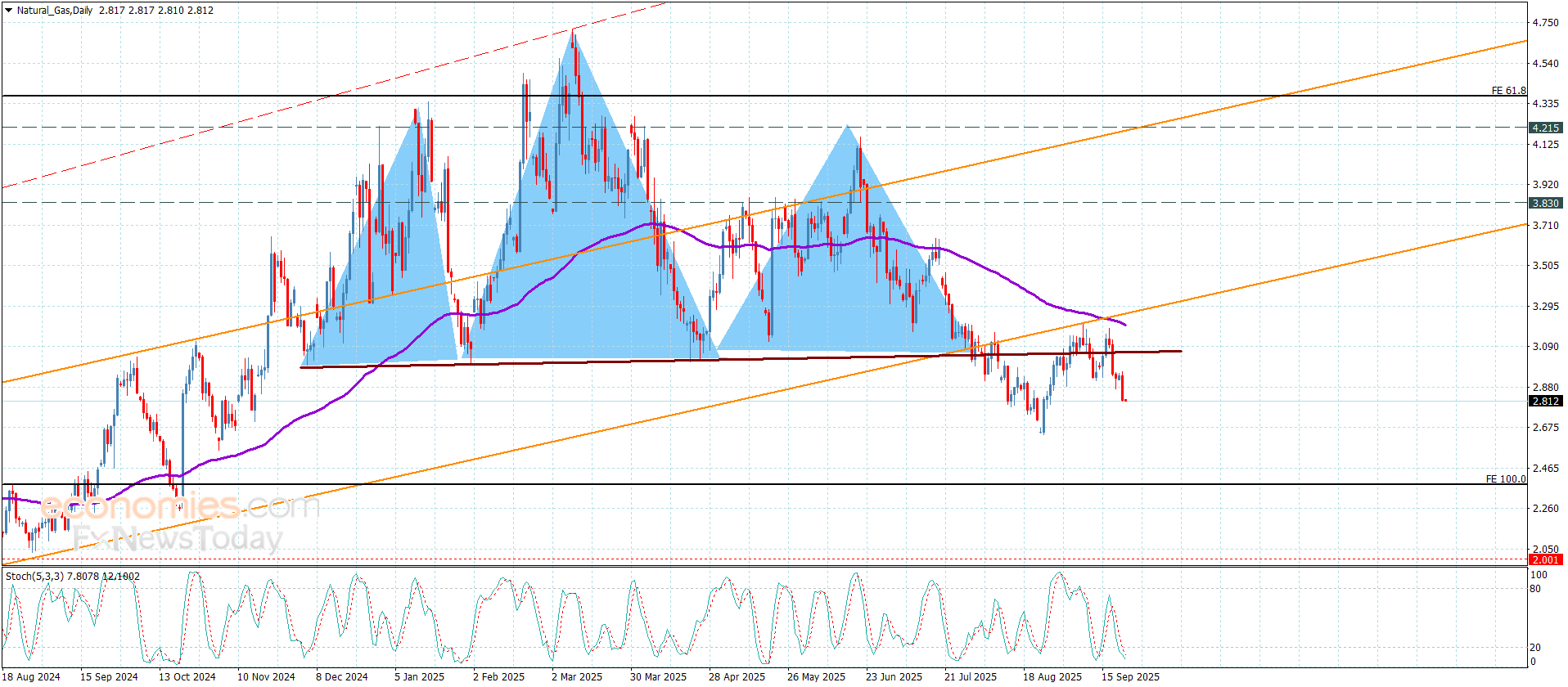
U.S. natural gas futures (NG=F) are trading near $2.858 per MMBtu, up 0.2% intraday, after volatile swings in early New York trade. A pickup in LNG feedgas demand is absorbing some of the selling pressure that followed expectations for another large storage build. Traders are closely watching the rollover to the November contract this Friday, which typically injects seasonal volatility as colder weather demand gets priced in. Despite recent pullbacks, NG=F remains supported by the longer-term uptrend line from February 2024, keeping the market within a technically constructive range.
Fundamentals showed a notable shift last week with Cheniere Energy’s third liquefaction train at Corpus Christi coming online. That boost pushed LNG feedgas demand above 15 Bcf/d, even with the Cove Point outage curbing volumes. Forecasts now project total LNG flows surpassing 16 Bcf/d later in Q4, particularly as the Golden Pass facility begins to take gas. The return of incremental export demand has limited downside pressure and continues to position LNG as the dominant growth engine for U.S. gas, offsetting record domestic production.
Across the Atlantic, benchmark Dutch TTF contracts fell 1.1% to €31.90/MWh, extending a 5% monthly decline as inventories remain 82% full, well above the EU’s Nov. 1 target. Demand is down nearly 29% year-over-year, reinforcing the view that Europe’s storage safety net will cap upside price risks this winter. Norway’s pipeline exports are rising again after heavy September maintenance, while LNG imports into Northwest Europe remain exceptionally high for the season. These dynamics temper bullish U.S. export expectations in the near term, as Europe looks comfortably supplied.
The European Commission recently proposed banning Russian LNG imports by the end of 2026, a year earlier than planned. Analysts at Goldman Sachs argue the ban would have “limited impact” on global gas balances, as Russian cargoes would simply be redirected elsewhere. Still, any acceleration of sanctions could alter flows into Asia or Latin America, reshaping U.S. export competitiveness. At the same time, U.S. gas executives are warning that tariffs on oilfield services equipment are raising costs, complicating drilling programs in the Permian and Haynesville. According to the Dallas Fed energy survey, executives expect Henry Hub to average $3.35 in six months, $3.53 in one year, and $4.50 in five years, highlighting a gradual, policy-sensitive climb.
Technically, NG=F is trapped between $2.820 support and $3.220 resistance, with the market attempting to close the August gap near $2.72. The 50-day EMA is sitting around $3.05, and as long as prices remain above it, short-term bearish attacks appear limited. Traders expect an impulsive jump on the next cold-weather forecast, which could test $3.45, the first resistance level flagged by chartists. Seasonality favors upside into November and December, as heating demand rises and storage withdrawals accelerate.
24.09.2025 · TradingNEWS Archive
24.09.2025 · TradingNEWS Archive
24.09.2025 · TradingNEWS Archive
24.09.2025 · TradingNEWS Archive
Spot market data underscores current volatility. El Paso trades at $1.55, Waha at $1.475, and PG&E Citygate slipped $0.245, reflecting localized oversupply and constrained takeaway. Stanfield dropped a sharp $1.305, further signaling regional imbalance. These spot prices remain deeply discounted versus Henry Hub, underscoring that while the futures market holds near $2.85, producers are still facing steep basis differentials in constrained regions.
The U.S. Natural Gas Supply Association (NGSA) projects consumption to hit record highs this winter, even as production stays near peak levels. The EIA’s forecast sees Henry Hub averaging $3.70 in Q4 and $4.30 by 2026, reflecting steady structural demand growth from LNG and data centers. EQT, the largest U.S. gas producer, reiterated its ambition to reclaim the top spot in output by leveraging LNG-linked sales and power demand, signaling confidence in higher long-term pricing.
With natural gas futures holding $2.858, a base is forming above the $2.82–$2.85 range. Short-term downside is limited, given LNG flows above 15 Bcf/d and winter demand on the horizon. The wide disconnect between regional spot weakness and benchmark resilience reflects structural LNG demand offsetting oversupply. Given the seasonal cycle, robust export flows, and bullish five-year projections pointing to $4.50/MMBtu, the market favors a Buy stance on NG=F, with near-term upside toward $3.20–$3.45 and medium-term potential at $4.00+ if winter proves colder than average.
Gold is trading with moderate losses on Wednesday, snapping a three-day winning streak amid a somewhat firmer US Dollar. The Precious metal has returned to the $3,760 area, although it remains at a short distance from the $3,791 record high reached on Tuesday.
The US Dollar is drawing some support from Fed Chair Jerome Powell’s comments on Tuesday, warning against market hopes of a steep monetary easing cycle. Powell reiterated that the Fed is in a challenging position trying to navigate higher inflationary risks and a softening labor market, and that the bank is likely to move slowly on rate cuts.
From a technical perspective, Gold seems ready for a healthy correction, following a nearly 15% rally from mid-August lows. The 4-hour RSI has retreated from overbought levels, and the MACD is crossing below the signal line, suggesting the possibility of a deeper pullback.
Bears, however, will have to push the pair below the intra-day low, at $3,750, and Tuesday’s low, at $3,736. Further down the previous all-time high, in the area of $3,700, would come into focus.
On the upside, Tuesday’s high, at $3,790, and the psychological level at $3,800 are likely to test any potential bullish reaction. Beyond here, the 261.8% Fibonacci retracement of the mid-September pullback, at $3,828, emerges as the next target.
The table below shows the percentage change of US Dollar (USD) against listed major currencies today. US Dollar was the strongest against the Euro.
| USD | EUR | GBP | JPY | CAD | AUD | NZD | CHF | |
|---|---|---|---|---|---|---|---|---|
| USD | 0.54% | 0.41% | 0.52% | 0.28% | -0.15% | 0.36% | 0.46% | |
| EUR | -0.54% | -0.13% | 0.00% | -0.26% | -0.68% | -0.18% | -0.08% | |
| GBP | -0.41% | 0.13% | 0.08% | -0.13% | -0.49% | -0.06% | 0.01% | |
| JPY | -0.52% | 0.00% | -0.08% | -0.26% | -0.67% | -0.24% | -0.09% | |
| CAD | -0.28% | 0.26% | 0.13% | 0.26% | -0.40% | 0.07% | 0.19% | |
| AUD | 0.15% | 0.68% | 0.49% | 0.67% | 0.40% | 0.51% | 0.62% | |
| NZD | -0.36% | 0.18% | 0.06% | 0.24% | -0.07% | -0.51% | 0.13% | |
| CHF | -0.46% | 0.08% | -0.01% | 0.09% | -0.19% | -0.62% | -0.13% |
The heat map shows percentage changes of major currencies against each other. The base currency is picked from the left column, while the quote currency is picked from the top row. For example, if you pick the US Dollar from the left column and move along the horizontal line to the Japanese Yen, the percentage change displayed in the box will represent USD (base)/JPY (quote).
from
Natural gas price took advantage of the positive momentum that comes from stochastic rally above EMA50 in yesterday’s trading, delaying the negative attack by its stability above $3.050, achieving some gains by its stability near $3.150.
The current rise didn’t affect the main bearish scenario, due to its stability below the main resistance at $2.265, to expect forming sideways trading, then begin forming bearish waves, to press on $2.820 level again, while its success in surpassing the resistance and holding above it will turn the bullish track again, providing strong chance for recording several gains by its rally to $3.450 initially.
The expected trading range for today is between $2.820 and $3.220
Trend forecast: Bearish
The (Brent) price declined in its last intraday trading, gathering the gains of its previous rises, attempting to offload some of its overbought conditions on the relative strength indicators, with the emergence of negative overlapping signals, to gather its positive strength that might help it to recover and rise again, amid the dominance of strong minor bullish wave, taking advantage of the dynamic support that is represented by its trading above EMA50, reinforcing the chances for the price recovery in the upcoming period.
Get high-accuracy trading signals delivered directly to your Telegram. Subscribe to specialized packages tailored for the world’s top markets:
Full VIP signals performance report for September 15–19, 2025:
Silver price (XAG/USD) recovers its daily losses, trading around $44.10 per troy ounce during the European hours on Wednesday. The non-interest-bearing Silver maintains its position near a 14-year high of $44.47, which was reached on Tuesday as traders widely expect a 25-basis-point rate cut by the US Federal Reserve (Fed) at its October policy meeting.
The CME FedWatch tool suggests that money markets are currently pricing in nearly a 93% possibility of a Fed rate cut in October, up from 90% a day earlier. Traders will likely observe the upcoming US Q2 Gross Domestic Product Annualized and Personal Consumption Expenditures (PCE) Price Index data, the Federal Reserve’s preferred inflation gauge, due later in the week.
Safe-haven Silver draws buyers as geopolitical tensions rise, with NATO vowing a “robust” response to Russian airspace violations. Moreover, President Trump warned at the United Nations (UN) General Assembly on Tuesday that the United States (US) is ready to impose a “very strong round of powerful tariffs” if Russia refuses to end the war in Ukraine.
Additionally, Silver found support from strong fundamentals, with tight supply and steady demand from solar, EV, and electronics sectors underpinning prices. India’s silver imports are also set to rise in the coming months, backed by solid investment and industrial demand that has already absorbed last year’s surplus shipments.
Silver is a precious metal highly traded among investors. It has been historically used as a store of value and a medium of exchange. Although less popular than Gold, traders may turn to Silver to diversify their investment portfolio, for its intrinsic value or as a potential hedge during high-inflation periods. Investors can buy physical Silver, in coins or in bars, or trade it through vehicles such as Exchange Traded Funds, which track its price on international markets.
Silver prices can move due to a wide range of factors. Geopolitical instability or fears of a deep recession can make Silver price escalate due to its safe-haven status, although to a lesser extent than Gold’s. As a yieldless asset, Silver tends to rise with lower interest rates. Its moves also depend on how the US Dollar (USD) behaves as the asset is priced in dollars (XAG/USD). A strong Dollar tends to keep the price of Silver at bay, whereas a weaker Dollar is likely to propel prices up. Other factors such as investment demand, mining supply – Silver is much more abundant than Gold – and recycling rates can also affect prices.
Silver is widely used in industry, particularly in sectors such as electronics or solar energy, as it has one of the highest electric conductivity of all metals – more than Copper and Gold. A surge in demand can increase prices, while a decline tends to lower them. Dynamics in the US, Chinese and Indian economies can also contribute to price swings: for the US and particularly China, their big industrial sectors use Silver in various processes; in India, consumers’ demand for the precious metal for jewellery also plays a key role in setting prices.
Silver prices tend to follow Gold’s moves. When Gold prices rise, Silver typically follows suit, as their status as safe-haven assets is similar. The Gold/Silver ratio, which shows the number of ounces of Silver needed to equal the value of one ounce of Gold, may help to determine the relative valuation between both metals. Some investors may consider a high ratio as an indicator that Silver is undervalued, or Gold is overvalued. On the contrary, a low ratio might suggest that Gold is undervalued relative to Silver.
Despite the stability of the GBPJPY pair in the last period below the barrier at 200.45, but the continuation of the main indicators’ contradiction that pushed it to form sideways trading by its repeated stability near 199.60.
We will keep waiting for gathering the extra negative momentum, to ease the mission of forming new correctional waves, to target 198.60 level reaching the extra support at 197.80, while breaching the barrier will turn the bullish track back, to begin recording extra gains by its rally towards 200.90 and 201.55.
The expected trading range for today is between 198.60 and 200.40
Trend forecast: Bearish