The main tag of Gold Today Price Articles.
You can use the search box below to find what you need.
[wd_asp id=1]
The main tag of Gold Today Price Articles.
You can use the search box below to find what you need.
[wd_asp id=1]
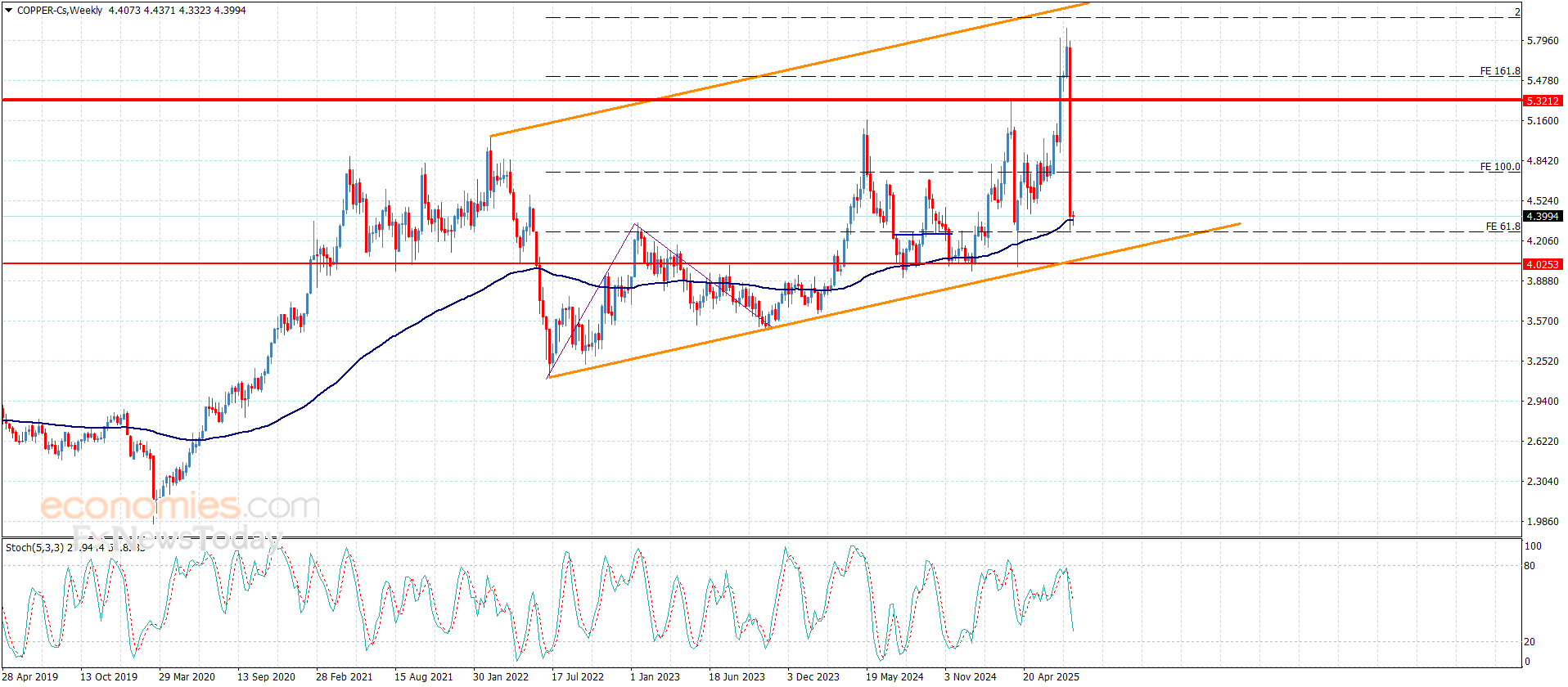
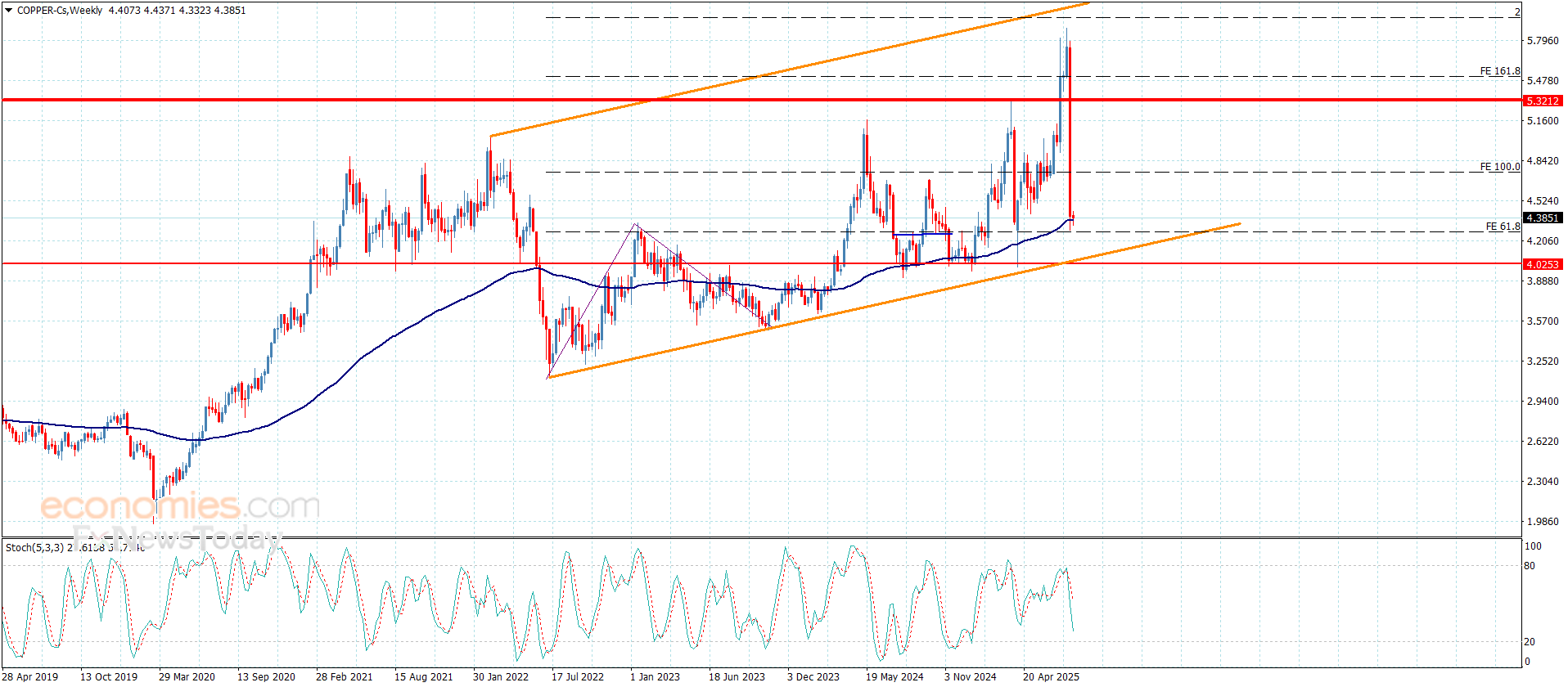
Despite the weakness of copper price’s last trading and its repeated fluctuation near the moving average 55 at $4.4000 level, the overall positive stability within the bullish channel’s levels and by the stability of the extra support near $4.2600, these factors support our bullish suggestion, to keep gathering extra positive momentum, then begin targeting positive stations by $4.6300 and $4.7500.
The risk of changing the main trend by breaking the main support at $4.0500, which forces it to suffer big losses by reaching $3.8700.
The expected trading range for today is between $4.2600 and $4.6300
Trend forecast: Bullish
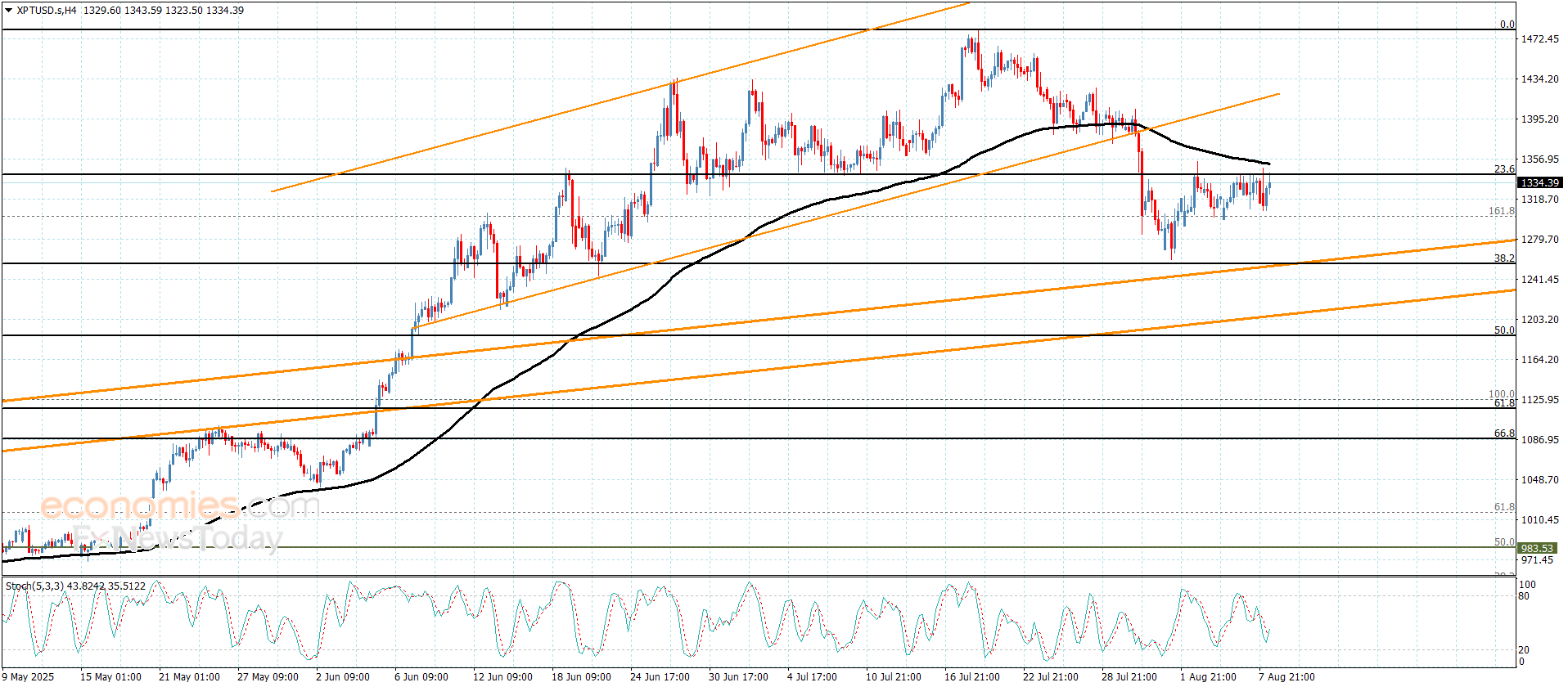
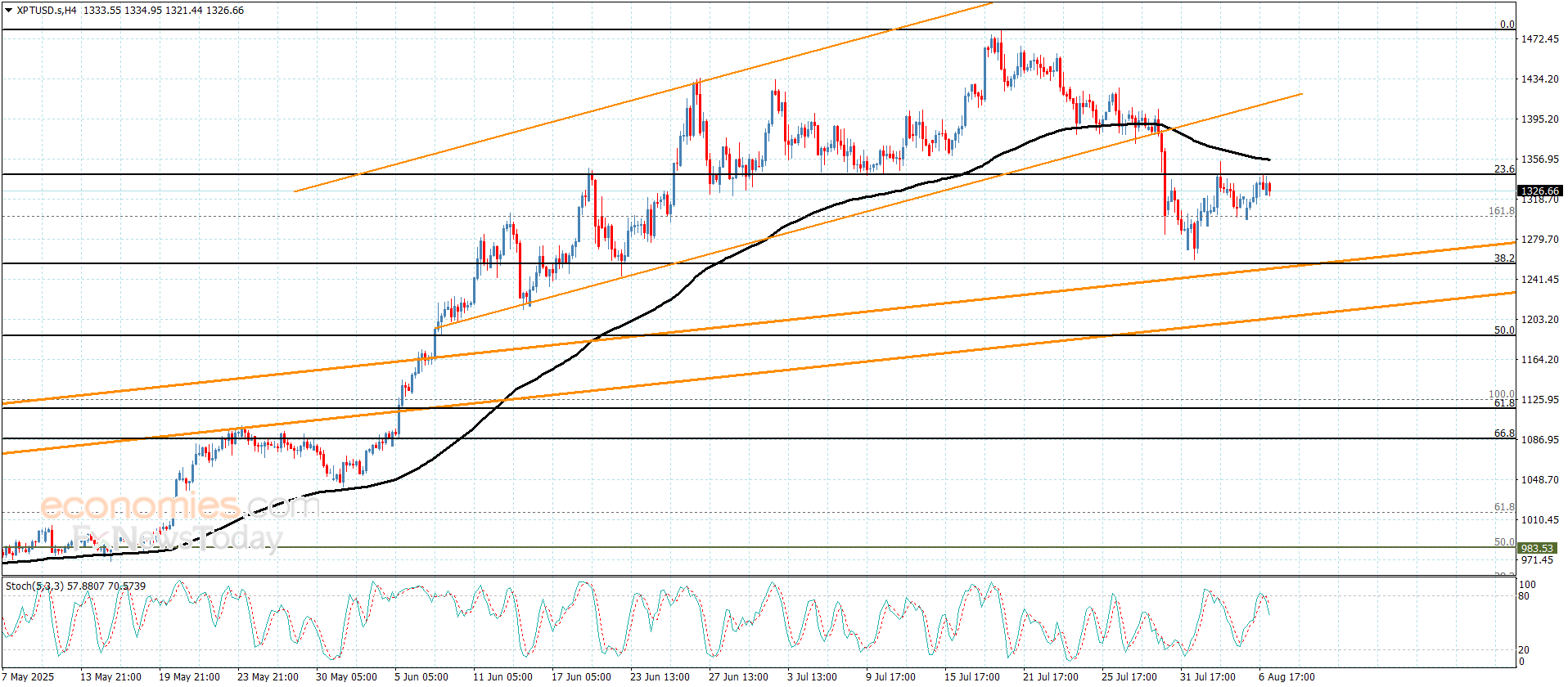
Platinum price began gathering positive momentum by stochastic stability above 20 level, to notice attacking the barrier at $1342.00, which forms a key for regaining the bullish bias of the current trading.
The contradiction between the moving average 55 with the attempt of regaining the bullish bias makes us monitor the price behavior and wait for the next close to confirm the expected trend of the upcoming trading, as breaching the barrier and holding above $1355.00 will reinforce the chances for achieving several gains that might begin at $1375.00 and $1415.00, while the breach will motivate the bearish correctional track, and there are chance for declining towards $1290.00.
The expected trading range for today is between $1325 and $1342.00
Trend forecast: Neutral
The EURJPY pair leaned clearly above the extra support at 170.45, activating with the main indicators, achieving some gains by its fluctuation above the intraday barrier at 171.90.
Noting that the stability of the trading above 171.90 level is important, to reinforce the chances for resuming the bullish attack, to expect the extension of the trading towards 172.65, then targeting the bullish channel’s resistance at 173.80, while the return below 171.90 will force it to form new bearish correctional trading before resuming the suggested targets.
The expected trading range for today is between 171.45 and 172.65
Trend forecast: Bullish
The current advance in the price of gold, beginning from the November swing low, shows an acceleration of bullish momentum. This can be seen by the rising slope of the trendlines. That may put the trend at greater risk as momentum becomes less sustainable, but the weekly chart shows the strong trend is intact. The recent decline that generated a new swing low at $3,268 found support and rallied from the 20-Week MA. That was the first test of support at that weekly moving average and gold responded in bullish fashion. A weekly bullish reversal triggered this week, and it will be confirmed on a weekly basis by a weekly close above last week’s high of $3,363.
An upside breakout of the triangle is indicated on a decisive rally above the recent swing high at $3,439. That would open the door to a challenge of the trend high at $3,500 and the potential for new record highs. However, given the distance to the apex of the triangle, consolidation could continue before a sustained breakout is attempted.
At the time, a vertical line on the chart shows August 21. That is a visual approximately of when 75% of the triangle has been filled. Typically, a breakout of a triangle will occur before that point is reached. And concurrently, the integrity of the pattern begins to weaken and therefore the potential response to a breakout, either up or down.
A key potential support area to watch would be around the 20-Day and 50-Day MA, currently at $3,353 and $3,347, respectively. Also, consider the possibility of a false breakdown through the bottom boundary line and then a quick recovery and rally.
For a look at all of today’s economic events, check out our economic calendar.
Gold price remains stable on Thursday, having flirted with the $3,400 mark early in Asian hours but retreating afterwards. The FX board is all about the US Dollar (USD) and United States (US) President Donald Trump’s tariffs.
Late on Wednesday, Trump said he will impose a 100% tariff on imports of semiconductors and chips, but not for companies that are building in the US. Also, he stepped up pressure on Russia, saying he would impose additional 25% levies on Chinese goods over China’s purchases of Russian oil. Earlier in the week, Trump hit India with extra tariffs of up to 50% for the same reason. Trump also threatened additional 15% levies on Japanese imports.
Other than that, the Bank of England (BoE) announced its decision on monetary policy. As widely anticipated, the central bank delivered a 25-basis-point (bp) cut, leaving the benchmark interest rate at 4.0%. The decision, however, was considered hawkish, as four out of nine Monetary Policy Committee (MPC) members opted for a no-change. Additionally, one of the cut voters preferred a 50 bps trim. The central bank repeated that it will maintain a gradual and careful approach to further withdrawal of monetary policy restraint.
On Friday, Canada will publish its monthly employment report, expected to show the country added 13.5K new jobs in July. The Unemployment Rate is foreseen ticking higher to 7% from the current 6.9%.
Federal Reserve (Fed) speakers will also gather attention amid mounting speculation that the central bank may trim interest rates in September.
XAU/USD resumed its advance after the US opening and trades at around $3,390 a troy ounce. The daily chart shows gold surpassed its previous weekly peak, but there was no major breakout, with the pair still struggling to extend gains. A mildly bullish 20 Simple Moving Average (SMA) keeps acting as dynamic support at around $3,350, while the 100 and 200 SMAs maintain their upward slopes below the shorter one, supportive of a bullish extension. Finally, technical indicators turned marginally higher within positive levels, skewing the risk to the upside despite lacking momentum.
Bulls are in charge in the near term. The XAU/USD pair 4-hour chart shows technical indicators resumed their advances within positive levels, while buyers keep defending the downside around a bullish 20 SMA now at $3,374.50. The longer moving averages remain flat below the shorter one, failing to provide clear directional clues. The XAU/USD needs to run past $3,407 and settle above the level to be able to extend gains heading into the weekly close.
Support levels: 3,374.50 3,350.00 3.338.60
Resistance levels: 3,407.75 3,420.10 3,414.65
Gold price (XAU/USD) struggles to break above the key level of $3,400.00 during the European trading session on Thursday. The precious metal hesitates to extend upside even as Federal Reserve (Fed) officials have shown support for interest rate cuts in the remainder of the year.
On Wednesday, Minneapolis Fed President Neel Kashkari, San Francisco Fed President Mary Daly and Fed Governor Lisa Cook argued in favor of reducing interest rates amid growing labor market concerns. “The economy is slowing and the Fed needs to respond to the slowing economy,” Kashkari said in an interview with CNBC. Kashkari added, “It may still be relevant in the near term to begin adjusting the policy rate, and two rate cuts this year still seem appropriate.”
The CME FedWatch tool showed that traders have almost fully priced in a 25 basis points (bps) interest rate reduction in the September policy meeting.
Theoretically, lower interest rates by the Fed bode well for non-yielding assets, such as Gold.
Meanwhile, resurfacing United States (US) President Donald Trump’s tariff fears are expected to improve the demand for safe-haven assets, such as Gold. On Wednesday, Trump stated that he could impose a penalty on China in the form of tariffs for buying Oil from Russia. The same day, Trump increased import duties on India by 25% for buying Russian Oil.
Gold price trades close to the upper boundary of the Symmetrical Triangle formation around $3,400, which is plotted from April’s high near $3,500. The lower boundary of the yellow metal is placed from the May’s low of $3,120.85.
The precious metal holds slightly above the 20-day Exponential Moving Average (EMA), which trades near $3,350, suggesting that the near-term trend is on the upside.
The 14-day Relative Strength Index (RSI) wobbles inside the 40.00-60.00, which indicates indecisiveness among market participants.
Looking down, the Gold price would fall towards the round-level support of $3,200 and the May 15 low at $3,121, if it breaks below the May 29 low of $3,245
Alternatively, the Gold price will enter uncharted territory if it breaks above the psychological level of $3,500 decisively. Potential resistances would be $3,550 and $3,600.
Gold has played a key role in human’s history as it has been widely used as a store of value and medium of exchange. Currently, apart from its shine and usage for jewelry, the precious metal is widely seen as a safe-haven asset, meaning that it is considered a good investment during turbulent times. Gold is also widely seen as a hedge against inflation and against depreciating currencies as it doesn’t rely on any specific issuer or government.
Central banks are the biggest Gold holders. In their aim to support their currencies in turbulent times, central banks tend to diversify their reserves and buy Gold to improve the perceived strength of the economy and the currency. High Gold reserves can be a source of trust for a country’s solvency. Central banks added 1,136 tonnes of Gold worth around $70 billion to their reserves in 2022, according to data from the World Gold Council. This is the highest yearly purchase since records began. Central banks from emerging economies such as China, India and Turkey are quickly increasing their Gold reserves.
Gold has an inverse correlation with the US Dollar and US Treasuries, which are both major reserve and safe-haven assets. When the Dollar depreciates, Gold tends to rise, enabling investors and central banks to diversify their assets in turbulent times. Gold is also inversely correlated with risk assets. A rally in the stock market tends to weaken Gold price, while sell-offs in riskier markets tend to favor the precious metal.
The price can move due to a wide range of factors. Geopolitical instability or fears of a deep recession can quickly make Gold price escalate due to its safe-haven status. As a yield-less asset, Gold tends to rise with lower interest rates, while higher cost of money usually weighs down on the yellow metal. Still, most moves depend on how the US Dollar (USD) behaves as the asset is priced in dollars (XAU/USD). A strong Dollar tends to keep the price of Gold controlled, whereas a weaker Dollar is likely to push Gold prices up.
The EURJPY pair leaned clearly above the extra support at 170.45, activating with the main indicators, achieving some gains by its fluctuation above the intraday barrier at 171.90.
Noting that the stability of the trading above 171.90 level is important, to reinforce the chances for resuming the bullish attack, to expect the extension of the trading towards 172.65, then targeting the bullish channel’s resistance at 173.80, while the return below 171.90 will force it to form new bearish correctional trading before resuming the suggested targets.
The expected trading range for today is between 171.45 and 172.65
Trend forecast: Bullish
Copper price didn’t move any thing until this moment, announcing its surrender to the dominance of the sideways bias temporarily until ending the contradiction between the main indicators, reminding you that the bullish scenario will remain valid, depending on the stability of the bullish channel’s support at $4.0500, besides the continuation of forming extra support at $4.2600 level, reducing the chances for suffering any extra losses.
While the price success in gaining the positive momentum will provide chance to begin achieving some gains, to expect its rally to $4.6300 initially, attempting to step above 100%Fibonacci correction extension level at $4.7500, to open the way for recording more of the gains in the upcoming period trading.
The expected trading range for today is between $4.2600 and $4.6300
Trend forecast: Bullish
Copper price didn’t move any thing until this moment, announcing its surrender to the dominance of the sideways bias temporarily until ending the contradiction between the main indicators, reminding you that the bullish scenario will remain valid, depending on the stability of the bullish channel’s support at $4.0500, besides the continuation of forming extra support at $4.2600 level, reducing the chances for suffering any extra losses.
While the price success in gaining the positive momentum will provide chance to begin achieving some gains, to expect its rally to $4.6300 initially, attempting to step above 100%Fibonacci correction extension level at $4.7500, to open the way for recording more of the gains in the upcoming period trading.
The expected trading range for today is between $4.2600 and $4.6300
Trend forecast: Bullish
Silver Price advances during the North American session, up by 0.39% as the Greenback weakens more than 0.50%, as revealed by the US Dollar Index (DXY). At the time of writing, the XAG/USD trades at $37.88 after hitting a low of $37.31.
Sentiment improved due to earnings and Trump’s threat to impose 100% duties on chips. However, an exemption was made for companies producing items in the US, as Apple CEO and Trump announced a fresh $100 billion investment in the country.
From a technical perspective, the Silver price is neutral-biased, from a price action point of view, capped on the upside by the 20-day SMA at $38.04. However, sentiment turned slightly bullish, as seen by the Relative Strength Index (RSI), which cracked the index neutral line three days ago.
If XAG/USD ends daily above the 20-day SMA, look for a rally toward $39.00. Further resistance lies above, with the July 25 high of $39.19, followed by the YTD peak at $39.52.
Conversely, if XAG/USD finishes the session below $38.00, this could prompt sellers to drive the grey metal below he August 5 daily low of $37.31, sponsoring a slide towards $37.00. On further strength, the grey metal could reach the 50-day SMA at $36.73.
Silver is a precious metal highly traded among investors. It has been historically used as a store of value and a medium of exchange. Although less popular than Gold, traders may turn to Silver to diversify their investment portfolio, for its intrinsic value or as a potential hedge during high-inflation periods. Investors can buy physical Silver, in coins or in bars, or trade it through vehicles such as Exchange Traded Funds, which track its price on international markets.
Silver prices can move due to a wide range of factors. Geopolitical instability or fears of a deep recession can make Silver price escalate due to its safe-haven status, although to a lesser extent than Gold’s. As a yieldless asset, Silver tends to rise with lower interest rates. Its moves also depend on how the US Dollar (USD) behaves as the asset is priced in dollars (XAG/USD). A strong Dollar tends to keep the price of Silver at bay, whereas a weaker Dollar is likely to propel prices up. Other factors such as investment demand, mining supply – Silver is much more abundant than Gold – and recycling rates can also affect prices.
Silver is widely used in industry, particularly in sectors such as electronics or solar energy, as it has one of the highest electric conductivity of all metals – more than Copper and Gold. A surge in demand can increase prices, while a decline tends to lower them. Dynamics in the US, Chinese and Indian economies can also contribute to price swings: for the US and particularly China, their big industrial sectors use Silver in various processes; in India, consumers’ demand for the precious metal for jewellery also plays a key role in setting prices.
Silver prices tend to follow Gold’s moves. When Gold prices rise, Silver typically follows suit, as their status as safe-haven assets is similar. The Gold/Silver ratio, which shows the number of ounces of Silver needed to equal the value of one ounce of Gold, may help to determine the relative valuation between both metals. Some investors may consider a high ratio as an indicator that Silver is undervalued, or Gold is overvalued. On the contrary, a low ratio might suggest that Gold is undervalued relative to Silver.