The main tag of Gold Today Price Articles.
You can use the search box below to find what you need.
[wd_asp id=1]
The main tag of Gold Today Price Articles.
You can use the search box below to find what you need.
[wd_asp id=1]
Silver Price advances during the North American session, up by 0.39% as the Greenback weakens more than 0.50%, as revealed by the US Dollar Index (DXY). At the time of writing, the XAG/USD trades at $37.88 after hitting a low of $37.31.
Sentiment improved due to earnings and Trump’s threat to impose 100% duties on chips. However, an exemption was made for companies producing items in the US, as Apple CEO and Trump announced a fresh $100 billion investment in the country.
From a technical perspective, the Silver price is neutral-biased, from a price action point of view, capped on the upside by the 20-day SMA at $38.04. However, sentiment turned slightly bullish, as seen by the Relative Strength Index (RSI), which cracked the index neutral line three days ago.
If XAG/USD ends daily above the 20-day SMA, look for a rally toward $39.00. Further resistance lies above, with the July 25 high of $39.19, followed by the YTD peak at $39.52.
Conversely, if XAG/USD finishes the session below $38.00, this could prompt sellers to drive the grey metal below he August 5 daily low of $37.31, sponsoring a slide towards $37.00. On further strength, the grey metal could reach the 50-day SMA at $36.73.
Silver is a precious metal highly traded among investors. It has been historically used as a store of value and a medium of exchange. Although less popular than Gold, traders may turn to Silver to diversify their investment portfolio, for its intrinsic value or as a potential hedge during high-inflation periods. Investors can buy physical Silver, in coins or in bars, or trade it through vehicles such as Exchange Traded Funds, which track its price on international markets.
Silver prices can move due to a wide range of factors. Geopolitical instability or fears of a deep recession can make Silver price escalate due to its safe-haven status, although to a lesser extent than Gold’s. As a yieldless asset, Silver tends to rise with lower interest rates. Its moves also depend on how the US Dollar (USD) behaves as the asset is priced in dollars (XAG/USD). A strong Dollar tends to keep the price of Silver at bay, whereas a weaker Dollar is likely to propel prices up. Other factors such as investment demand, mining supply – Silver is much more abundant than Gold – and recycling rates can also affect prices.
Silver is widely used in industry, particularly in sectors such as electronics or solar energy, as it has one of the highest electric conductivity of all metals – more than Copper and Gold. A surge in demand can increase prices, while a decline tends to lower them. Dynamics in the US, Chinese and Indian economies can also contribute to price swings: for the US and particularly China, their big industrial sectors use Silver in various processes; in India, consumers’ demand for the precious metal for jewellery also plays a key role in setting prices.
Silver prices tend to follow Gold’s moves. When Gold prices rise, Silver typically follows suit, as their status as safe-haven assets is similar. The Gold/Silver ratio, which shows the number of ounces of Silver needed to equal the value of one ounce of Gold, may help to determine the relative valuation between both metals. Some investors may consider a high ratio as an indicator that Silver is undervalued, or Gold is overvalued. On the contrary, a low ratio might suggest that Gold is undervalued relative to Silver.
Potential support is indicated around a long-term uptrend line and anchored volume weighted average price (AVWAP) line (light blue) begun from the 2024 trend low. The AVWAP line is now at $2.96, and it can be used like a moving average line. Notice that although natural gas dipped below the AVWAP briefly the past few days, it quickly recovered. There was only one daily close below that line, which was on Monday.
Given the long-term nature of the indicators marking support, a bottom may have been reached. Therefore, today’s upside breakout should be followed by additional signs of improving demand. If this scenario does not materialize and natural gas continues to test the support zone, a more substantial consolidation base may develop.
A sustained breakout above a recent interim swing high at $3.13 will provide the next sign of strength. But the more significant price level is around the lower swing high from July 29 at $3.19. That is also a weekly high. A sustained breakout above that level will trigger a bullish reversal as a lower swing high will be broken, and a weekly reversal will trigger as well. Today’s advance increases the chance that a higher swing low will be established but a rally above it will provide a stronger indication.
If the week ended today, a potentially weekly bull hammer would be established. That would provide another sign that the support zone may hold. Nonetheless, since there are only two more trading days to the week, the week may yet end with a bull hammer candlestick pattern. If it does, a breakout above the weekly high will provide a bullish reversal signal on the weekly chart starting next week.
For a look at all of today’s economic events, check out our economic calendar.
Gold price (XAU/USD) corrects to near $3,360.00 on Wednesday after a three-day winning streak. The precious metal retraces even as traders remain increasingly confident that the Federal Reserve (Fed) will resume its monetary-expansion cycle in the September policy meeting.
Lower interest rates by the Fed bode well for non-yielding assets, such as Gold.
Traders raised Fed dovish bets significantly as the United States (US) Nonfarm Payrolls (NFP) report for June has shown signs of a slowdown in the labor demand.
Meanwhile, US President Donald Trump has stated that he will announce Fed Governor Adriana Kugler’s replacement this week. Market experts believe that the entry of Trump’s candidate in the rate-setting committee will favor lower interest rates, given that Trump has criticized the Fed, especially Chairman Jerome Powel, a number of times for supporting a restrictive monetary policy stance.
Also, US President Trump has narrowed list of potential candidates as the successor of Jerome Powell. We’re also looking at the Fed chair, and that’s down to four people right now, Two Kevins and two other people,” Trump said in an interview with CNBC on Tuesday. His comments signal that White House economic adviser Kevin Hassett, former Fed Governor Kevin Warsh are potential candidates to step in place of Powell.
Gold price trades inside the Symmetrical Triangle formation, which indicates indecisiveness among market participants. The yellow metal oscillates around the 20-day Exponential Moving Average (EMA), which trades near $3,323, indicating a sideways trend.
The 14-day Relative Strength Index (RSI) wobbles inside the 40.00-60.00, suggesting a sharp volatility contraction.
Looking down, the Gold price would fall towards the round-level support of $3,200 and the May 15 low at $3,121, if it breaks below the May 29 low of $3,245
Alternatively, the Gold price will enter an uncharted territory if it breaks above the psychological level of $3,500 decisively. Potential resistances would be $3,550 and $3,600.
Gold has played a key role in human’s history as it has been widely used as a store of value and medium of exchange. Currently, apart from its shine and usage for jewelry, the precious metal is widely seen as a safe-haven asset, meaning that it is considered a good investment during turbulent times. Gold is also widely seen as a hedge against inflation and against depreciating currencies as it doesn’t rely on any specific issuer or government.
Central banks are the biggest Gold holders. In their aim to support their currencies in turbulent times, central banks tend to diversify their reserves and buy Gold to improve the perceived strength of the economy and the currency. High Gold reserves can be a source of trust for a country’s solvency. Central banks added 1,136 tonnes of Gold worth around $70 billion to their reserves in 2022, according to data from the World Gold Council. This is the highest yearly purchase since records began. Central banks from emerging economies such as China, India and Turkey are quickly increasing their Gold reserves.
Gold has an inverse correlation with the US Dollar and US Treasuries, which are both major reserve and safe-haven assets. When the Dollar depreciates, Gold tends to rise, enabling investors and central banks to diversify their assets in turbulent times. Gold is also inversely correlated with risk assets. A rally in the stock market tends to weaken Gold price, while sell-offs in riskier markets tend to favor the precious metal.
The price can move due to a wide range of factors. Geopolitical instability or fears of a deep recession can quickly make Gold price escalate due to its safe-haven status. As a yield-less asset, Gold tends to rise with lower interest rates, while higher cost of money usually weighs down on the yellow metal. Still, most moves depend on how the US Dollar (USD) behaves as the asset is priced in dollars (XAU/USD). A strong Dollar tends to keep the price of Gold controlled, whereas a weaker Dollar is likely to push Gold prices up.
The (Brent) price rose in its last intraday trading, due to the stability of the critical support level at $67.50, providing positive momentum that assisted it to achieve these gains, with the emergence of the positive signals on the (RSI), after reaching oversold levels.
This performance comes amid the price’s affection by breaking bullish trend line on the short-term basis, with the continuation of the negative pressure that comes from its trading below EMA50, forming dynamic resistance that prevents any recovery attempt on the near-term basis.
Get high-accuracy trading signals delivered directly to your Telegram. Subscribe to specialized packages tailored for the world’s top markets:
To view the full performance report for this week, visit the following link:
The (Brent) price rose in its last intraday trading, due to the stability of the critical support level at $67.50, providing positive momentum that assisted it to achieve these gains, with the emergence of the positive signals on the (RSI), after reaching oversold levels.
This performance comes amid the price’s affection by breaking bullish trend line on the short-term basis, with the continuation of the negative pressure that comes from its trading below EMA50, forming dynamic resistance that prevents any recovery attempt on the near-term basis.
Get high-accuracy trading signals delivered directly to your Telegram. Subscribe to specialized packages tailored for the world’s top markets:
To view the full performance report for this week, visit the following link:
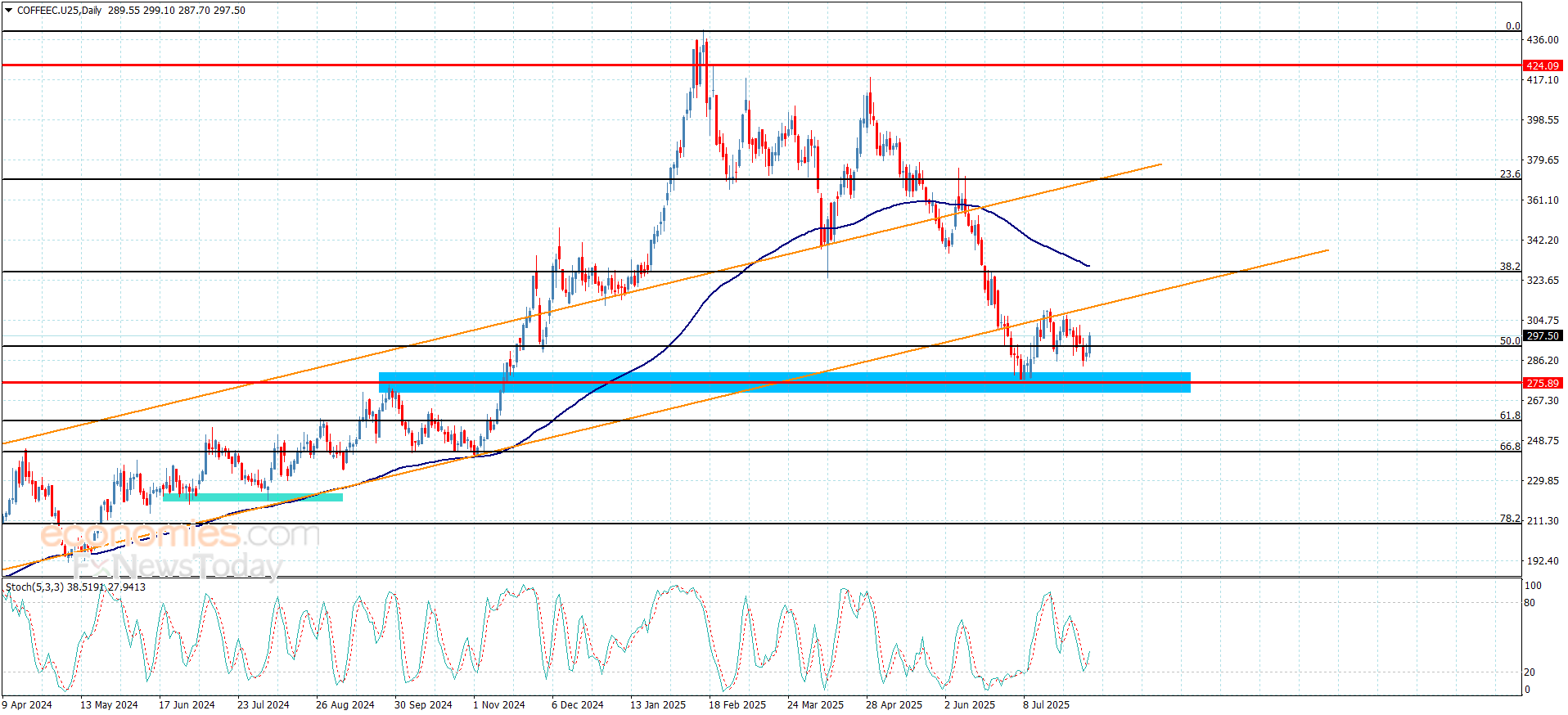
Despite the strong negative pressure on coffee prices due to its stability below the support of the broken minor channel’s support at 311.00 besides providing negative momentum by the main indicators, but its stability above the support base at 276.70 supports the chances for forming bullish waves, to fluctuate near 297.50.
Stochastic attempt to provide positive momentum that will increase the chances for targeting 311.00 level, surpassing it is important for regaining the bullish bias, then begin recording several gains by its rally to 328.00.
The expected trading range for today is between 284.00 and 311.00
Trend forecast: Bullish
Until gold breaks out of the triangle consolidation pattern, it will be trading inside the range. Since the range has been narrowing volatility has been declining. This can also be observed by the convergence of the two moving averages. That may be a clue that a potential spike in volatility is getting closer. The pattern is within a bull trend and near the top of the trend. Therefore, the expectation is for a bull breakout unless there are signs of pattern failure.
Notice that the pattern is an expansion of an original symmetrical triangle that is marked by dotted trendlines. Even though the earlier and smaller triangle had false breakouts, it is not unusual for a consolidation pattern to expand or evolve into another pattern. That doesn’t invalidate the current pattern.
Today’s bullish price action shows a continuation of an advance that targets the upper boundary of triangle. Key support would then be around the two moving averages and of course the price they represent will change. A triangle breakout is first indicated on a rise above the most recent swing high of $3,439 and further on a move above $3,451. Both price levels are also prior monthly highs and therefore a monthly breakout will also occur.
An initial new high target zone is indicated from around $3,3578 to $3,603 if a bullish breakout is sustained. Given the narrowing of the price range over several months, an upside breakout should be accompanied by a spike in momentum. If not, it could be a warning sign, as seen with the earlier and smaller triangle breakout.
For a look at all of today’s economic events, check out our economic calendar.
Weather remains a pivotal factor. According to NatGasWeather, U.S. demand is expected to be moderate through Thursday before a hotter pattern emerges. Highs in the mid-80s to 100s across much of the country are forecast for late this week and into next, potentially boosting cooling demand.
However, current conditions remain milder than ideal for strong rally attempts. Traders are weighing whether this upcoming heat will be enough to sustain prices above the psychological $3.00 level, especially with robust supplies still in play.
Monday’s selloff — a 15.1-cent drop to $2.932 — was fueled by a mix of bearish fundamentals. U.S. dry gas production hit 108.1 Bcf/d Monday, up 3.5% year-over-year, while demand fell 8% to 74.2 Bcf/d, according to BNEF.
Storage is another headwind: the latest EIA report showed a +48 Bcf injection, outpacing the five-year average of +24 Bcf, and pushing inventories to 6.7% above seasonal norms. The fall shoulder season also looms, historically a soft period for demand.
The Baker Hughes rig count adds further pressure, with gas rigs rising by two to 124 — the highest in two years — signaling continued production strength. At the same time, LNG export flows remain elevated at 15.3 Bcf/d, up 6.8% week-over-week, offering some relief to domestic balances.
Meanwhile, Edison Electric Institute data showed an 8.1% year-over-year increase in power generation for the week ending July 26, potentially supporting incremental gas burn for utilities.
Notice that a downward sloping consolidation pattern formed recently, showing a small descending channel. Given its location further into a downtrend and at a key long-term support zone, this pattern might have an impact like a bullish falling wedge. It is too early to say but something to watch as it could help identify a potential bullish reversal signal. Currently, a bullish reversal would be indicated on a rally above Friday’s high of $3.13. While a rise above Monday’s high of $3.08 will show strength, not enough to indicate that the advance might be sustainable.
The more fight there is between buyers and sellers near the bottom, the greater the potential for a reversal when it comes. Although there are lower targets for natural gas that might be reached, if a low was going to be established, it is in the area to do it. The AVWAP line shows $2.97, and it should be seen as an area of price. If a bullish reversal follows before a new trend low, then a new high swing low will be completed. That would be a bullish sign if it occurs.
A swing low from April at $2.86 found support and reversed from the AVWAP line. That low is also a monthly low and confirmed by a 20-Month MA, now at $2.85. Therefore, it is potentially significant, either for a bullish reversal or a breakdown. Either way, if $2.86 is approached, a breakdown from two long-term trend indicators will be violated. That would indicate the potential for further downward pressure in prices.
For a look at all of today’s economic events, check out our economic calendar.
Gold price maintains its positive momentum on Wednesday, reaching a fresh weekly high in the $3,390 area during American trading hours. The bright metal surged following the release of the United States (US) ISM Services Purchasing Managers’ Index (PMI), as the indicator came in worse than anticipated, barely printing at 50.1 in July, below the 50.8 posted in June and missing expectations of 51.5.
Meanwhile, US President Donald Trump threatens tariffs left and right: following news on Monday indicating massive levies on India, Trump said it would hit the Eurozone with tariffs of 35% if they fail to fulfil their commitments.
Additionally, the personal war between the US President and Federal Reserve (Fed) Chair Jerome Powell continues. On the one hand, he said that Treasury Secretary Scott Bessent is not a candidate to lead the Fed, as he should remain in his current position. On the other hand, he is working on replacing Fed Governor Adriana Kugler, who unexpectedly resigned, effective on Friday, with a candidate who advocates for interest rate cuts.
The poor performance of Wall Street following dismal US data and higher US Treasury yields reflects the souring mood.
The American macroeconomic calendar has little to offer on Wednesday, while the upcoming Asian session will bring the New Zealand monthly employment report. Later in the day, the EU will publish June Retail Sales.
The daily chart for the XAU/USD pair shows it met buyers around a mildly bullish 20 Simple Moving Average (SMA) for a second consecutive day, with the indicator currently at around $3,347. The same chart shows the 100 and 200 SMAs maintain their bullish slopes below the shorter one, in line with the bulls’ dominance. Technical indicators, however, barely hold above their midlines, lacking directional strength. Overall, the risk skews to the upside, but the momentum is missing.
The near-term picture seems more encouraging for bulls. In the 4-hour chart, the XAU/USD pair bottomed around a flat 100 SMA, while a bullish 20 SMA aims to cross above it, usually a sign of directional continuation. Finally, technical indicators resumed their advances near overbought readings, hinting at persistent upward pressure.
Support levels: 3,362.10 3,347.00 3.338.60
Resistance levels: 3,396.90 3,407.75 3,420.10