The main tag of Gold Today Price Articles.
You can use the search box below to find what you need.
[wd_asp id=1]
The main tag of Gold Today Price Articles.
You can use the search box below to find what you need.
[wd_asp id=1]
Platinum price formed some bullish waves, to hit $1355.00 level, to bounce quickly to settle below the barrier at $1342.00 level, affected by stochastic negativity, which approaches from 50 level as appears in the above image.
The stability of this barrier will force the price to delay the bullish attempts, to increase the chances for forming new bearish correctional waves to target $1290.00 level reaching 38.2%Fibonacci correction level at $1255.00, while breaching it will open the way for activating the bullish attack to target $1366.00 level initially reaching the resistance at $1400.00.
The expected trading range for today is between $1290.00 and $1342.00
Trend forecast: Bearish
Gold price is flirting with weekly highs near $3,380 in the Asian trading hours on Tuesday, with buyers looking forward to the US ISM Services PMI data for a fresh boost.
A surprisingly strong China’s Caixin Services PMI data, which came in at 52.6 in July, bolstered risk appetite.
Meanwhile, increased bets that the US Federal Reserve (Fed) will lower interest rates in September continue to underpin risk sentiment at the expense of the US Dollar (USD), keeping the non-yielding Gold price afloat.
Strong US labor data combined with San Francisco Fed President Mary Daly’s dovish remarks have almost sealed in a September Fed rate cut, with markets now pricing in a 90.5% probability of such a move, the CME Group’s FedWatch Tool shows.
The Bureau of Labor Statistics (BLS) reported Friday that the US economy added 73,000 jobs for July, above the June revision of 14,000 but below even the meagre estimate for a gain of 110,000. The Unemployment Rate ticked higher to 4.2% in the month, as expected.
Daly said on Monday, “we may do fewer than two cuts. The more likely thing is we need to do more.
“The job market is not precariously weak, but it is softening, and further softening would be unwelcome,” she added.
Additionally, concerns over the Fed’s independence and the credibility of economic data remain a drag on the Greenback.
US President Donald Trump fired the US Labor Department’s statistical leader, Erika L. McEntarfer, after the weak jobs report on Friday.
Markets believe that the dismissal of BLS Commissioner Erika McEntarfer may be part of a broader strategy to undermine the credibility of official inflation data, eventually impacting the Fed’s independence.
These factors render positive for the bright metal, supporting its recovery from monthly troughs.
The next leg higher in Gold price, however, depends on the US ISM Services PMI data for July, which is seen rising to 51.5 from 50.8 in June.
Strong ISM data could shake off some of the recent dovishness surrounding the Fed’s next policy, lifting the USD while fuelling a brief corrective decline in Gold price.
A slowdown in the services sector could intensify concerns over the US economic resilience amid weakening labor market conditions, which could trigger a fresh USD downtrend, boosting the bullion.
Gold traders will also closely scrutinize trade headlines and Fedspeak for fresh trading incentives.
The daily chart shows that the technical setup remains in favor of Gold buyers.
The 14-day Relative Strength Index (RSI) is sitting above the midline, currently near 55, suggesting that any dip could be quickly bought into.
Adding credence to the bullish potential, the 21-day is primed to cross the 50-day SMA for upside, which if materialized on a daily closing basis will confirm a Bull Cross.
Gold buyers need a daily candlestick closing above the rising trendline support at $3,380 to regain the $3,400 threshold. Further, the $3,440 static resistance will come into play once again.
Conversely, strong support is placed at the 21-day SMA and 50-day SMA confluence near $3,345. A sustained move below that level will open up further downside toward the $3,300 round figure. The last line of defense for Gold buyers is the 100-day SMA at $3,279.
The Institute for Supply Management (ISM) Services Purchasing Managers Index (PMI), released on a monthly basis, is a leading indicator gauging business activity in the US services sector, which makes up most of the economy. The indicator is obtained from a survey of supply executives across the US based on information they have collected within their respective organizations. Survey responses reflect the change, if any, in the current month compared to the previous month. A reading above 50 indicates that the services economy is generally expanding, a bullish sign for the US Dollar (USD). A reading below 50 signals that services sector activity is generally declining, which is seen as bearish for USD.
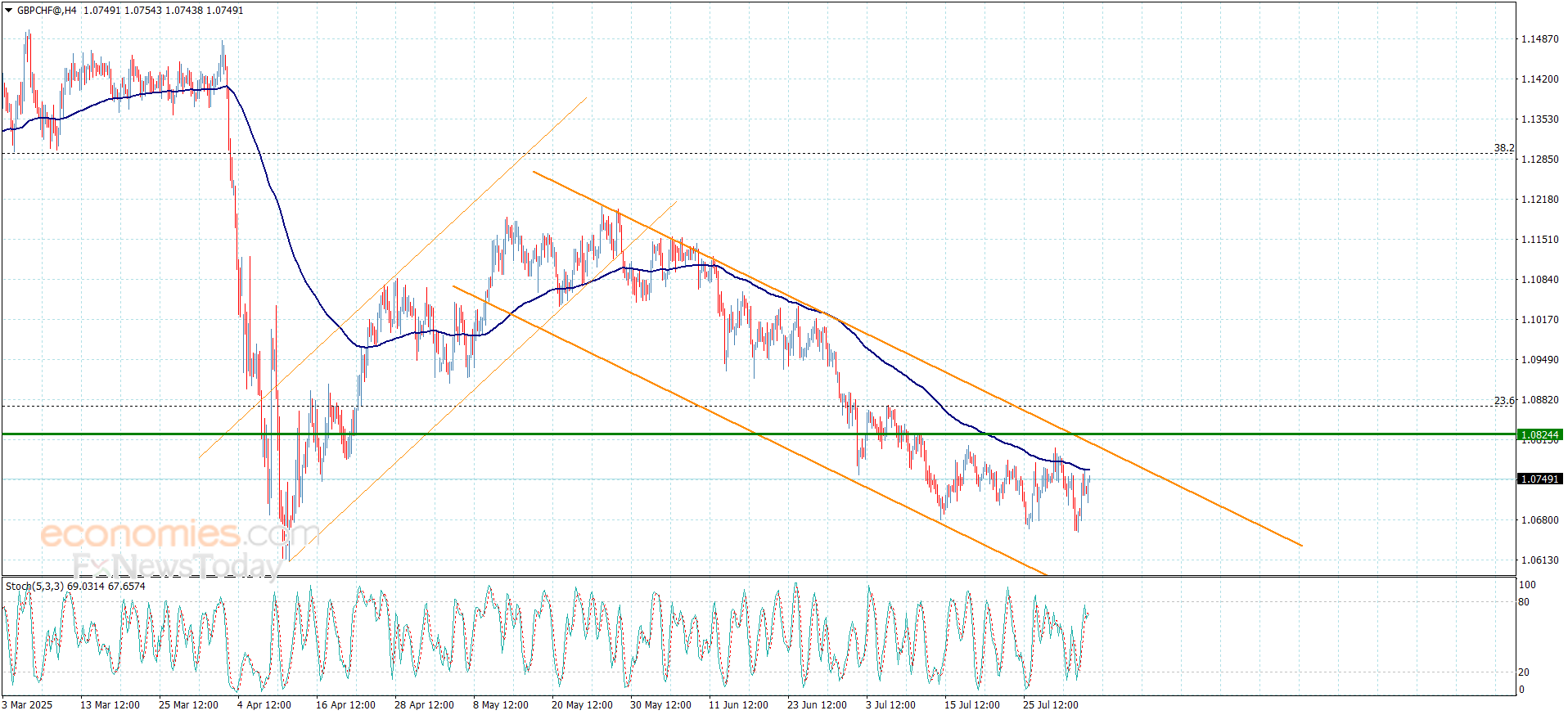
The GBPCHF price formed some bullish correctional trading, to approach from the moving average of 55 near 1.0765, taking advantage of providing positive momentum by stochastic, to retest an important barrier again.
The main stability within the bearish channel’s levels, which forms an extension for the main resistance at 1.0810 level besides forming an extra barrier at 1.0775 level, these factors make us wait for gathering the negative momentum, which allows it to renew the negative attempts that might target 1.0710 and 1.0660.
The expected trading range for today is between 1.0770 and 1.0710
Trend forecast: Bearish
Copper price forced to provide more of the sideways trading, delaying its bullish attempts due to the contradiction between the main indicators by stochastic reach below 50 level, the main stability above the bullish channel’s support at $4.0500, besides the attempt of forming an extra support at $4.2600 level, we will keep our bullish suggestion in the current period trading, to wait for achieving some gains by its rally to $4.6300 reaching the next barrier near $4.7500.
Note that breaking the extra support will confirm the chances for providing strong pressure on the mentioned bullish channel’s support, to keep monitoring the price behavior according to this level by detecting the main trend in the upcoming period trading.
The expected trading range for today is between $4.2600 and $4.6300
Trend forecast: Bullish
Platinum price formed some bullish waves, to hit $1355.00 level, to bounce quickly to settle below the barrier at $1342.00 level, affected by stochastic negativity, which approaches from 50 level as appears in the above image.
The stability of this barrier will force the price to delay the bullish attempts, to increase the chances for forming new bearish correctional waves to target $1290.00 level reaching 38.2%Fibonacci correction level at $1255.00, while breaching it will open the way for activating the bullish attack to target $1366.00 level initially reaching the resistance at $1400.00.
The expected trading range for today is between $1290.00 and $1342.00
Trend forecast: Bearish
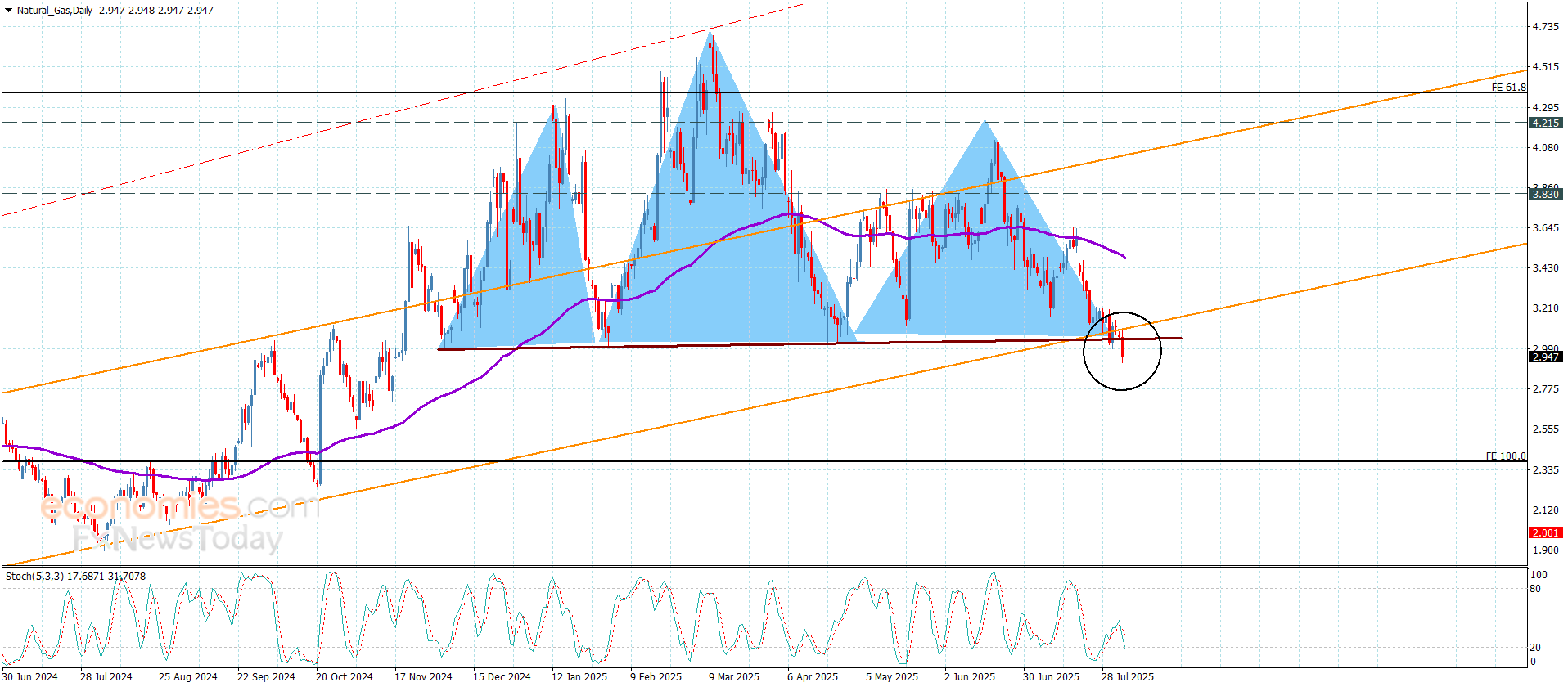
Furthermore, a bearish monthly breakdown (not shown) triggered today as last month’s low of $2.97 was breached. That put natural gas at four-month low and falling. Prior monthly support was seen at the $2.86 low in April, and it looks likely to be challenged if downward pressure remains. That is a five-month low. The trajectory of the current decline also looks like it may be heading to a test of support around the 20-Month MA, now at $2.85. Since the two price levels are so close together, that price zone deserves particular attention, if it is approached.
In addition, there is an initial target for a falling ABCD pattern (purple) at $2.63. That is where there will be symmetry in price compared to the first leg down (AB). Once that occurs a key potential pivot is identified. Finally, there is a second 78.6% retracement level, a little lower at $2.53. It measures a larger upswing than the prior 78.6% level.
An alternative to the above bearish scenario would be a relatively quick recovery of the AVWAP line and a daily close above it. That should then be followed by a recovery of the long-term uptrend line and a close above it, as well as above the prior trend low at $2.97. A bearish closing price today, in the lower third of the day’s range, keeps the sellers in charge and the lower price targets in sight.
For a look at all of today’s economic events, check out our economic calendar.
Spot Gold extended its Friday recovery, peaking at $3,385.41 after Wall Street’s opening. The US Dollar (USD) maintained the sour tone triggered by dismal United States (US) employment-related data, which fueled hopes the Federal Reserve (Fed) could trim the benchmark interest rate when it meets in September.
Additionally, US President Donald Trump announced it will “substantially” raise tariffs on India amid the latter buying Russian oil and selling it into the Open Market, according to a post shared in Truth Social. Earlier in the day, Trump claimed the July Nonfarm Payrolls (NFP) was rigged, to make “a great Republican Success look less stellar!!!,” once again, subtly threatening to replace Fed Chair Jerome Powell.
Data-wise, the US reported that June Factory Orders shrank by 4.8% slightly better than the 4.9% decline anticipated, although much worse than the May 8.3% advance. Other than that, financial markets seem to have finished digesting the poor employment report, with global stocks turning green.
The focus on Tuesday will be on the US ISM Services Purchasing Managers’ Index (PMI). The index is foreseen at 51.5 in July, improving from the 50.8 posted in June.
The daily chart for XAU/USD shows bulls hold the grip, but lack conviction. Gold trades above all its moving averages, with a flat 20 Simple Moving Average (SMA) providing intraday support at around $3,345. The 100 and 200 SMAs, in the meantime, maintain their upward slopes below the shorter one. Technical indicators, however, have lost their bullish strength within neutral levels, barely holding above their midlines.
The XAU/USD pair trades well above all its moving averages in the 4-hour chart, with a bullish 20 SMA advancing below directionless 100 and 200 SMAs. Technical indicators, in the meantime, have lost their upward strength, but hold near overbought readings. The 100 SMA, in the meantime, lies at around $3,348, reinforcing the support area.
Support levels: 3,362.10 3,345.00 3.338.60
Resistance levels: 3,385.20 3,396.90 3,407.75
Silver (XAG/USD) struggles to capitalize on Friday’s modest recovery gains and oscillates in a range at the start of a new week as softer US NFP-inspired US Dollar (USD) selling now seems to have abated. The white metal currently trades around the $37.00 mark and remains within striking distance of a four-week low touched last Thursday.
From a technical perspective, this week’s breakdown below a nearly two-month-old ascending channel support, which coincided with the 200-period Simple Moving Average (SMA) on the 4-hour chart, was seen as a key trigger for the XAG/USD bears. This, along with negative oscillators on daily/4-hour charts, suggests that the path of least resistance for the commodity remains to the downside.
Hence, any subsequent recovery is more likely to confront a stiff barrier near the $37.35 region (200-period SMA on the 4-hour chart). This is followed by the ascending channel support breakpoint, around the $37.60 region, which should act as a pivotal point, which, if cleared, might trigger a short-covering rally and allow the XAG/USD to climb to the $38.00 mark en route to the $38.30-$38.35 region.
On the flip side, the multi-week low, around the $36.20 area, now seems to protect the immediate downside ahead of the $36.00 round figure. Some follow-through selling will reaffirm the negative bias and drag the XAG/USD to the next relevant support near the $35.50 zone. The downward trajectory could extend further towards challenging the $35.00 psychological mark.
Silver is a precious metal highly traded among investors. It has been historically used as a store of value and a medium of exchange. Although less popular than Gold, traders may turn to Silver to diversify their investment portfolio, for its intrinsic value or as a potential hedge during high-inflation periods. Investors can buy physical Silver, in coins or in bars, or trade it through vehicles such as Exchange Traded Funds, which track its price on international markets.
Silver prices can move due to a wide range of factors. Geopolitical instability or fears of a deep recession can make Silver price escalate due to its safe-haven status, although to a lesser extent than Gold’s. As a yieldless asset, Silver tends to rise with lower interest rates. Its moves also depend on how the US Dollar (USD) behaves as the asset is priced in dollars (XAG/USD). A strong Dollar tends to keep the price of Silver at bay, whereas a weaker Dollar is likely to propel prices up. Other factors such as investment demand, mining supply – Silver is much more abundant than Gold – and recycling rates can also affect prices.
Silver is widely used in industry, particularly in sectors such as electronics or solar energy, as it has one of the highest electric conductivity of all metals – more than Copper and Gold. A surge in demand can increase prices, while a decline tends to lower them. Dynamics in the US, Chinese and Indian economies can also contribute to price swings: for the US and particularly China, their big industrial sectors use Silver in various processes; in India, consumers’ demand for the precious metal for jewellery also plays a key role in setting prices.
Silver prices tend to follow Gold’s moves. When Gold prices rise, Silver typically follows suit, as their status as safe-haven assets is similar. The Gold/Silver ratio, which shows the number of ounces of Silver needed to equal the value of one ounce of Gold, may help to determine the relative valuation between both metals. Some investors may consider a high ratio as an indicator that Silver is undervalued, or Gold is overvalued. On the contrary, a low ratio might suggest that Gold is undervalued relative to Silver.
The Gold price (XAU/USD) edges lower to around $3,360, snapping the two-day winning streak during the early Asian session on Monday. Nonetheless, weak US job data and tariff fears might weigh on the US Dollar (USD) and help limit the USD-denominated commodity’s losses.
The yellow metal loses traction due to the rebound in the Greenback. The potential upside for Gold might be limited as an underwhelming US Nonfarm Payrolls (NFP) data boosted expectations of a Federal Reserve (Fed) rate cut.
The US NFP rose by 73,000 in July, versus a 14,000 increase (revised from 147,000) prior, the US Bureau of Labor Statistics (BLS) revealed on Friday. This figure came in below the market consensus of 110,000. Meanwhile, the US Unemployment Rate ticked higher to 4.2% in July from 4.1% in June, as expected.
“Payrolls numbers came in below expectations, but a little higher than the market was printing. So, this gives a better probability that the Federal Reserve will cut (rates) later in the year,” said Bart Melek, head of commodity strategies at TD Securities.
Furthermore, fresh tariff announcements and uncertainty over US trade policies spur safe-haven demand. On Friday, US President Donald Trump hit many countries with new levies, causing shock and confusion. Investors will closely monitor the developments surrounding US tariffs announcement.
Trump and Canadian Prime Minister Mark Carney will likely talk “over the next number of days” after the U.S. imposed a 35% tariff on goods not covered by the US-Mexico-Canada trade agreement. Tariff pause extension between the US and China, the world’s two largest economies, will also be closely watched. Any signs of renewed trade tensions could boost the precious metal.
Gold has played a key role in human’s history as it has been widely used as a store of value and medium of exchange. Currently, apart from its shine and usage for jewelry, the precious metal is widely seen as a safe-haven asset, meaning that it is considered a good investment during turbulent times. Gold is also widely seen as a hedge against inflation and against depreciating currencies as it doesn’t rely on any specific issuer or government.
Central banks are the biggest Gold holders. In their aim to support their currencies in turbulent times, central banks tend to diversify their reserves and buy Gold to improve the perceived strength of the economy and the currency. High Gold reserves can be a source of trust for a country’s solvency. Central banks added 1,136 tonnes of Gold worth around $70 billion to their reserves in 2022, according to data from the World Gold Council. This is the highest yearly purchase since records began. Central banks from emerging economies such as China, India and Turkey are quickly increasing their Gold reserves.
Gold has an inverse correlation with the US Dollar and US Treasuries, which are both major reserve and safe-haven assets. When the Dollar depreciates, Gold tends to rise, enabling investors and central banks to diversify their assets in turbulent times. Gold is also inversely correlated with risk assets. A rally in the stock market tends to weaken Gold price, while sell-offs in riskier markets tend to favor the precious metal.
The price can move due to a wide range of factors. Geopolitical instability or fears of a deep recession can quickly make Gold price escalate due to its safe-haven status. As a yield-less asset, Gold tends to rise with lower interest rates, while higher cost of money usually weighs down on the yellow metal. Still, most moves depend on how the US Dollar (USD) behaves as the asset is priced in dollars (XAU/USD). A strong Dollar tends to keep the price of Gold controlled, whereas a weaker Dollar is likely to push Gold prices up.
The GBPJPY pair didn’t settle above the support of the minor bullish channel at 198.70, forcing it to suffer deep losses by its decline to 195.35, facing the moving average 55 that supports the stability of 78.2%Fibonacci correction level as appears in the above image.
Noticing the beginning of forming bullish waves since this morning, but it couldn’t regain the bullish bias until surpassing the obstacle at 196.60, which allows it to resume the rise and achieve extra gains that might extend to 197.05 and 197.40, while the decline below 195.35 and holding below it will confirm its surrender to the bearish bias domination, which forces it to suffer extra losses by reaching 194.55.
The expected trading range for today is between 195.70 and 196.90
Trend forecast: Bullish