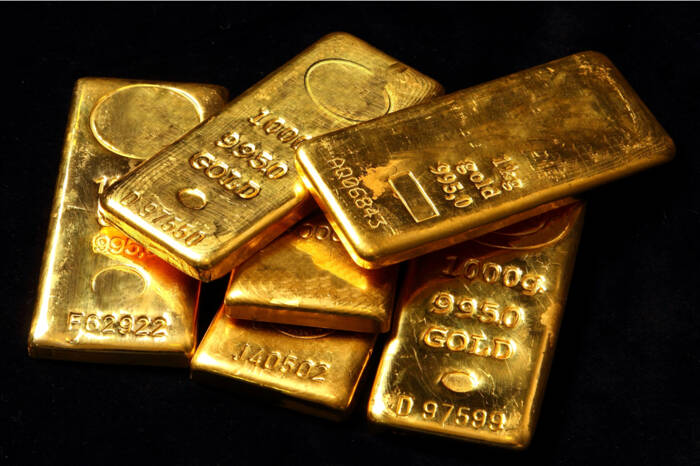
The main tag of Gold Today Price Articles.
You can use the search box below to find what you need.
[wd_asp id=1]
The main tag of Gold Today Price Articles.
You can use the search box below to find what you need.
[wd_asp id=1]
Near-term resistance is clear at today’s high of $3,366. Therefore, a decisive breakout above that level has gold heading towards a prior lower swing high at $3,396. And it has a good chance of busting through there and continuing to a test of resistance around the recent swing high of $3,451. Slow momentum has been a concern since a trendline breakout triggered on June 2.
That rally subsequently fizzled following the $3,451 high, with gold eventually falling back below the 20-Day MA, where it remains. Therefore, another reclaim of the 20-Day line should be met with some enthusiasm from buyers as indicated by bullish price momentum. And there is the potential for volatility to increase.
Notice that the most recent bounce from support at the 20-Day MA (purple) in early-June was followed by a relatively sharp three-day advance. It ended with a bearish outside day, like today. This only becomes relevant if Tuesday’s support fails and bearish momentum rises. Volatility should increase soon given the convergence of the 20-Day and 50-Day MAs recently. They are now the closest to one another since the beginning of the current upswing that began in January. That could help pump up a bull breakout.
For a look at all of today’s economic events, check out our economic calendar.
Bearish behavior today did not confirm that one-day bullish reversal breakout that triggered yesterday. It puts recent support, with a low of $3.29, at further risk of being broken. But Wednesday’s low of $3.37 would need to fail before Tuesday’s low is approached. In addition, notice that the 50-Day MA (orange) shows an area of resistance near Thursday and Wednesday highs. There has been no confirmation of strength with a daily close above that line. Although natural gas is holding a significant support area, it needs to turn up and stay up.
This is the third time since April that support around the 200-Day line has rejected price to the upside. That behavior adds to the significance of the long-term dynamic trend indicator. Therefore, a decisive drop back below that line shows a failure of the 200-Day MA as support and a breakdown from a significant support level.
Looking at the bigger picture of the current advance shows similar characteristics to a bear flag. Therefore, the breakdown of the 200-Day line is also a bearish trigger for the three-month rising trend channel. There is potential trendline support nearby though and a continuation lower could quickly find support. If not at the line, then certainly the 78.6% Fibonacci retracement area at $3,134
The next bullish sign will be on a rally above today’s high of $3.57. If strength continues from there, an interim swing high at $3.75 is next in line, followed by the first May swing high at $3.84. But a clear reversal from the bottom channel line has the potential to rise towards the top of the channel. There are several Fibonacci levels nearby from $5.35 to $4.46.
For a look at all of today’s economic events, check out our economic calendar.
Silver price revisits two-week high near $36.80 during European trading hours on Thursday. The white metal trades firmly ahead of the United States (US) Nonfarm Payrolls (NFP) data for June, which will be published at 12:30 GMT.
The US official employment data will significantly influence market expectations for the Federal Reserve’s (Fed) monetary policy outlook as officials have lately warned of downside labor market risks.
Economists expect US employers to have added 110K fresh workers, fewer than 139K in May. The Unemployment Rate is estimated to have accelerated to 4.3% from the prior reading of 4.2%. Soft labor market data could bolster market expectations that the Fed will reduce interest rates in the policy meeting later this month.
Lower interest rates by the Fed bode well for non-yielding assets, such as Silver.
Latest US ADP Employment figures suggests that the official labor market data could be weaker. The data showed on Wednesday that the US private sector laid-off 33K employees in June, while they were expected to hire 95K fresh workers. Additionally, the May reading was also revised lower to 29K from 37K.
“Though layoffs continue to be rare, a hesitancy to hire and a reluctance to replace departing workers led to job losses last month,” Nela Richardson, chief economist at ADP, said.
On the global front, US President Donald trump has announced that his team has struck a trade agreement with Vietnam. This comes at a time when the July 9 tariff deadline is approaching.
Theoretically, improving global trade conditions diminish demand for safe-haven assets, such as Silver. However, the Silver price remains firm as the Asian country is not one of top major trading partners of the US with whom it is still negotiating bilateral deals.
Silver price strengthens after a breakout of the Descending Triangle chart pattern formed on a four-hour time. Theoretically, the breakout of the above-mentioned chart pattern often leads to a volatility expansion, which results in higher volume and wider ticks on the upside.
The downward-sloping trendline of the Descending Triangle formation is plotted from the June 18 high of $37.32, while the horizontal support is marked from the June 20 low of $35.51.
The 14-period Relative Strength Index (RSI) breaks above 60.00. A fresh bullish momentum would trigger if the RSI holds above that level.
Looking down, the March 28 high around $34.60 will act as key support for the Silver price. On the upside, the fresh over-a-decade high around $37.32 will be the key barrier.
Silver is a precious metal highly traded among investors. It has been historically used as a store of value and a medium of exchange. Although less popular than Gold, traders may turn to Silver to diversify their investment portfolio, for its intrinsic value or as a potential hedge during high-inflation periods. Investors can buy physical Silver, in coins or in bars, or trade it through vehicles such as Exchange Traded Funds, which track its price on international markets.
Silver prices can move due to a wide range of factors. Geopolitical instability or fears of a deep recession can make Silver price escalate due to its safe-haven status, although to a lesser extent than Gold’s. As a yieldless asset, Silver tends to rise with lower interest rates. Its moves also depend on how the US Dollar (USD) behaves as the asset is priced in dollars (XAG/USD). A strong Dollar tends to keep the price of Silver at bay, whereas a weaker Dollar is likely to propel prices up. Other factors such as investment demand, mining supply – Silver is much more abundant than Gold – and recycling rates can also affect prices.
Silver is widely used in industry, particularly in sectors such as electronics or solar energy, as it has one of the highest electric conductivity of all metals – more than Copper and Gold. A surge in demand can increase prices, while a decline tends to lower them. Dynamics in the US, Chinese and Indian economies can also contribute to price swings: for the US and particularly China, their big industrial sectors use Silver in various processes; in India, consumers’ demand for the precious metal for jewellery also plays a key role in setting prices.
Silver prices tend to follow Gold’s moves. When Gold prices rise, Silver typically follows suit, as their status as safe-haven assets is similar. The Gold/Silver ratio, which shows the number of ounces of Silver needed to equal the value of one ounce of Gold, may help to determine the relative valuation between both metals. Some investors may consider a high ratio as an indicator that Silver is undervalued, or Gold is overvalued. On the contrary, a low ratio might suggest that Gold is undervalued relative to Silver.
Silver (XAG/USD) followed suit, retreating 0.33% to $36.43 after briefly testing near-weekly highs. The pullback came as markets interpreted the trade developments as a signal of easing global tensions, prompting modest rotation out of defensive assets like gold and silver.
Despite the softer tone, both metals remain underpinned by rising expectations of a dovish shift from the Federal Reserve. The ADP private employment report showed a surprise loss of 33,000 jobs in June—the first monthly decline in more than two years. This follows a weaker-than-expected JOLTS report earlier in the week, reinforcing signs of cooling in the U.S. labour market.
“The labor market is clearly softening, and the Fed may not wait much longer to respond,” said Sarah Mendez, senior macro strategist at Alta Investments. “A weak NFP print on Friday could accelerate expectations of a rate cut as early as September.”
As of Thursday, Fed funds futures suggest a 25% probability of a July rate cut, with market pricing implying a 75% chance of easing by the September FOMC meeting.
While trade optimism has trimmed near-term upside, underlying macro uncertainty and dovish policy shifts continue to anchor demand for precious metals. Friday’s Nonfarm Payrolls report is expected to be the next major catalyst, with markets bracing for increased volatility.
Gold hovers near $3,366 as traders await U.S. jobs data. Silver holds above $36.33. Fed rate cut bets limit downside despite risk-on sentiment.
The EURJPY pair didn’t move any thing since yesterday’s trading, to keep fluctuating below the barrier at 169.85 due to its neediness to the positive momentum, but the main stability within the bullish channel’s levels and the continuation of forming extra support at 168.05 level, these factors make us keep the bullish suggestion to keep waiting for gathering extra positive momentum, to ease the mission of breaching the barrier and reaching the next main target near 170.65.
Note that the decline below the mentioned extra support will force it to activate the bearish correctional track, which forces it to suffer several losses by reaching 167.55 followed by the next support at 166.40 level.
The expected trading range for today is between 168.70 and 170.55
Trend forecast: Bullish
Resistance was seen around the 20-Day MA, now at $3,349, and it was on Tuesday as well. Tuesday’s high of $3,358 needs to be exceeded for the next sign of strength but a daily close today above the 20-Day MA will also confirm strength. That will put gold in a solid position to head toward an interim lower swing high of $3,396 and it looks likely to rise above it. That price level is also a weekly high. So, a breakout above $3,396 will give bullish signals on both time frames.
The recent lower swing high of $3,451 is the next important price level to assess the condition of the long-term bull trend. If sustained resistance is seen around that price area again, it could lead to additional consolidation before gold attempts another upside breakout. Nonetheless, the integrity of the bull trend has been retained overall, following a brief drop below dynamic support of the uptrend line and 50-Day MA.
A recovery back into a rising trend channel (blue lines) that began on Tuesday is bullish behavior for the short-term and it aligns with the larger pattern showing strong bullish momentum. Therefore, there is the potential for upside momentum to accelerate if the $3,451 high is exceeded. This does not mean it will happen in the foreseeable future, just that it could. If the record high at $3,500 is broken then initial higher targets look to be around $3,578, $3,603, and $3,664.
Although this week will be a shorter for gold futures given a U.S. holiday, gold looks likely to end the week in a bullish position near the highs of the week. If that occurs it would provide another sign of strength, with the high for the week being the near-term important resistance level to watch.
For a look at all of today’s economic events, check out our economic calendar.
The GBPJPY pair is under strong bearish pressure, which forces it to resume the bearish correctional attack, facing the support of the bullish channel’s support at 195.35, to settle above it to stop the negative bleeding in the current period, to rally towards 195.95.
Note that surpassing 196.45 level is important to confirm its readiness to renew the bullish attempts, to expect attacking the extra barrier at 197.45, while the continuation of the negative pressure and breaking the current support will force it to suffer new losses, to wait for reaching 194.20, then attempts to press on the EMA50 that is located near 193.55.
The expected trading range for today is between 195.55 and 197.45
Trend forecast: Bullish
Platinum price activated the bullish rally by surpassing the extra barrier at $1366.00 reaching $1433.00, then bounces below2.618%Fibonacci extended level at $1420.00 forming bearish correctional waves.
The stability of the price within the bullish channel’s levels, accompanied by the continuation of forming strong extra support at $1330.00 level reinforces the dominance of the bullish track, to wait for breaching $1420.00 level, opening the way for reaching new bullish stations that might extend to $1458.00 reaching $1507 in the upcoming period trading.
The expected trading range for today is between $1375.00 and $1458.00
Trend forecast: Bullish
The silver price printed solid gains on Wednesday, up 1.40%, yet it remains consolidating within the $36.00-$36.60 range for the second consecutive day. A positive market mood and broad US Dollar strength capped the grey metal’s advance.
From a technical standpoint, XAG/USD remains upward biased, even though it has failed to print a new higher high since June 18, when Silver hit a yearly peak of $37.31. At the same time, the latest cycle low reached on June 23 at $35.82, remains respected. This, along with bulls gathering momentum as portrayed by the Relative Strength Index (RSI), suggests further upside is expected.
With that said, the first resistance level for XAG/USD is $37.00. If surpassed, the next stop would be the yearly peak of $37.31, ahead of testing the February 29, 2012, peak at $37.49. A breach of the latter will expose $38.00
On the other hand, Silver could take a negative turn if the spot price drops below $36.00, paving the way for a test of $35.82. Once hurdled, the next stop would be $35.00, before challenging the 50-day Simple Moving Average (SMA) at $34.24.
Silver is a precious metal highly traded among investors. It has been historically used as a store of value and a medium of exchange. Although less popular than Gold, traders may turn to Silver to diversify their investment portfolio, for its intrinsic value or as a potential hedge during high-inflation periods. Investors can buy physical Silver, in coins or in bars, or trade it through vehicles such as Exchange Traded Funds, which track its price on international markets.
Silver prices can move due to a wide range of factors. Geopolitical instability or fears of a deep recession can make Silver price escalate due to its safe-haven status, although to a lesser extent than Gold’s. As a yieldless asset, Silver tends to rise with lower interest rates. Its moves also depend on how the US Dollar (USD) behaves as the asset is priced in dollars (XAG/USD). A strong Dollar tends to keep the price of Silver at bay, whereas a weaker Dollar is likely to propel prices up. Other factors such as investment demand, mining supply – Silver is much more abundant than Gold – and recycling rates can also affect prices.
Silver is widely used in industry, particularly in sectors such as electronics or solar energy, as it has one of the highest electric conductivity of all metals – more than Copper and Gold. A surge in demand can increase prices, while a decline tends to lower them. Dynamics in the US, Chinese and Indian economies can also contribute to price swings: for the US and particularly China, their big industrial sectors use Silver in various processes; in India, consumers’ demand for the precious metal for jewellery also plays a key role in setting prices.
Silver prices tend to follow Gold’s moves. When Gold prices rise, Silver typically follows suit, as their status as safe-haven assets is similar. The Gold/Silver ratio, which shows the number of ounces of Silver needed to equal the value of one ounce of Gold, may help to determine the relative valuation between both metals. Some investors may consider a high ratio as an indicator that Silver is undervalued, or Gold is overvalued. On the contrary, a low ratio might suggest that Gold is undervalued relative to Silver.
Important DisclaimersThe content provided on the website includes general news and publications, our personal analysis and opinions, and contents provided by third parties, which are intended for educational and research purposes only. It does not constitute, and should not be read as, any recommendation or advice to take any action whatsoever, including to make any investment or buy any product. When making any financial decision, you should perform your own due diligence checks, apply your own discretion and consult your competent advisors. The content of the website is not personally directed to you, and we does not take into account your financial situation or needs.The information contained in this website is not necessarily provided in real-time nor is it necessarily accurate. Prices provided herein may be provided by market makers and not by exchanges.Any trading or other financial decision you make shall be at your full responsibility, and you must not rely on any information provided through the website. FX Empire does not provide any warranty regarding any of the information contained in the website, and shall bear no responsibility for any trading losses you might incur as a result of using any information contained in the website.The website may include advertisements and other promotional contents, and FX Empire may receive compensation from third parties in connection with the content. FX Empire does not endorse any third party or recommends using any third party’s services, and does not assume responsibility for your use of any such third party’s website or services.FX Empire and its employees, officers, subsidiaries and associates, are not liable nor shall they be held liable for any loss or damage resulting from your use of the website or reliance on the information provided on this website.Risk DisclaimersThis website includes information about cryptocurrencies, contracts for difference (CFDs) and other financial instruments, and about brokers, exchanges and other entities trading in such instruments. Both cryptocurrencies and CFDs are complex instruments and come with a high risk of losing money. You should carefully consider whether you understand how these instruments work and whether you can afford to take the high risk of losing your money.FX Empire encourages you to perform your own research before making any investment decision, and to avoid investing in any financial instrument which you do not fully understand how it works and what are the risks involved.