The main tag of Gold Today Price Articles.
You can use the search box below to find what you need.
[wd_asp id=1]
The main tag of Gold Today Price Articles.
You can use the search box below to find what you need.
[wd_asp id=1]
Silver price finished Monday’s session with minimal gains as the US Dollar’s (USD) sell-off extended for the beginning of the week, even though financial markets in the United States (US) and the United Kingdom (UK) remained closed for holidays. At the time of writing, XAG/USD trades at $33.47.
The grey metal remains consolidating, though slightly tilted to the upside. Stir resistance is seen at $33.68, the April 25 high, but a decisive breach of that level paves the way for testing at $34.00. Once these two levels are cleared, look for a challenge of the March 26 peak of $34.58.
For a bearish scenario, XAG/USD needs to slide below the May 23 swing low of $32.90. This opens the path to challenge the 50-day Simple Moving Average (SMA) at $32.74. A decisive break will expose the 100-day SMA at $32.11, followed by the 200-day SMA at $31.40.
Despite being bullish, the Relative Strength Index (RSI) is flat, indicating sideways price action. However, price action and RSI suggest that further upside is likely.
Silver is a precious metal highly traded among investors. It has been historically used as a store of value and a medium of exchange. Although less popular than Gold, traders may turn to Silver to diversify their investment portfolio, for its intrinsic value or as a potential hedge during high-inflation periods. Investors can buy physical Silver, in coins or in bars, or trade it through vehicles such as Exchange Traded Funds, which track its price on international markets.
Silver prices can move due to a wide range of factors. Geopolitical instability or fears of a deep recession can make Silver price escalate due to its safe-haven status, although to a lesser extent than Gold’s. As a yieldless asset, Silver tends to rise with lower interest rates. Its moves also depend on how the US Dollar (USD) behaves as the asset is priced in dollars (XAG/USD). A strong Dollar tends to keep the price of Silver at bay, whereas a weaker Dollar is likely to propel prices up. Other factors such as investment demand, mining supply – Silver is much more abundant than Gold – and recycling rates can also affect prices.
Silver is widely used in industry, particularly in sectors such as electronics or solar energy, as it has one of the highest electric conductivity of all metals – more than Copper and Gold. A surge in demand can increase prices, while a decline tends to lower them. Dynamics in the US, Chinese and Indian economies can also contribute to price swings: for the US and particularly China, their big industrial sectors use Silver in various processes; in India, consumers’ demand for the precious metal for jewellery also plays a key role in setting prices.
Silver prices tend to follow Gold’s moves. When Gold prices rise, Silver typically follows suit, as their status as safe-haven assets is similar. The Gold/Silver ratio, which shows the number of ounces of Silver needed to equal the value of one ounce of Gold, may help to determine the relative valuation between both metals. Some investors may consider a high ratio as an indicator that Silver is undervalued, or Gold is overvalued. On the contrary, a low ratio might suggest that Gold is undervalued relative to Silver.
Spot Gold trades firmly above the $3,300 level, marginally down on a daily basis. The mood was generally positive throughout the first half of the day, as speculative interest welcomed tariffs-related news. United States (US) President Trump said on Sunday that 50% levies on European imports would be delayed until July 9, following talks between Trump and European Commission President Ursula von der Leyen.
Most Asian and European indexes closed in the green, reflecting the better mood, although American markets were out on holidays, as the US celebrated Memorial Day. A scarce macroeconomic calendar added to the ongoing quietness across financial markets.
Things will turn a bit more interesting on Tuesday, as the US will release April Durable Goods Orders and May Consumer Confidence, alongside other minor figures. Recent US data showed the economy remains resilient despite concerns about the impact of tariffs on growth and inflation.
The daily chart for the XAU/USD pair shows it has lost its upward momentum, but also that the bearish case has no support. The pair keeps developing above all its moving averages, with a flat 20 Simple Moving Average (SMA) providing support at around $3,288.75. At the same time, technical indicators turned south, with the Momentum indicator heading lower below its 100 level. Still, the pair would need to lose the $3,300 mark to actually discourage buyers and attract additional selling interest.
In the near term, and according to the 4-hour chart, however, bulls retain control. Technical indicators are holding within positive levels, although lacking directional strength. At the same time, the 20 SMA maintains a modest bullish slope above the 100 and 200 SMAs, while providing near term support at around the intraday low i n the $3,320 region.
Support levels: 3,322.35 3.208.65 3,288.75
Resistance levels: 3,351.70 3,365.80 3,381.20
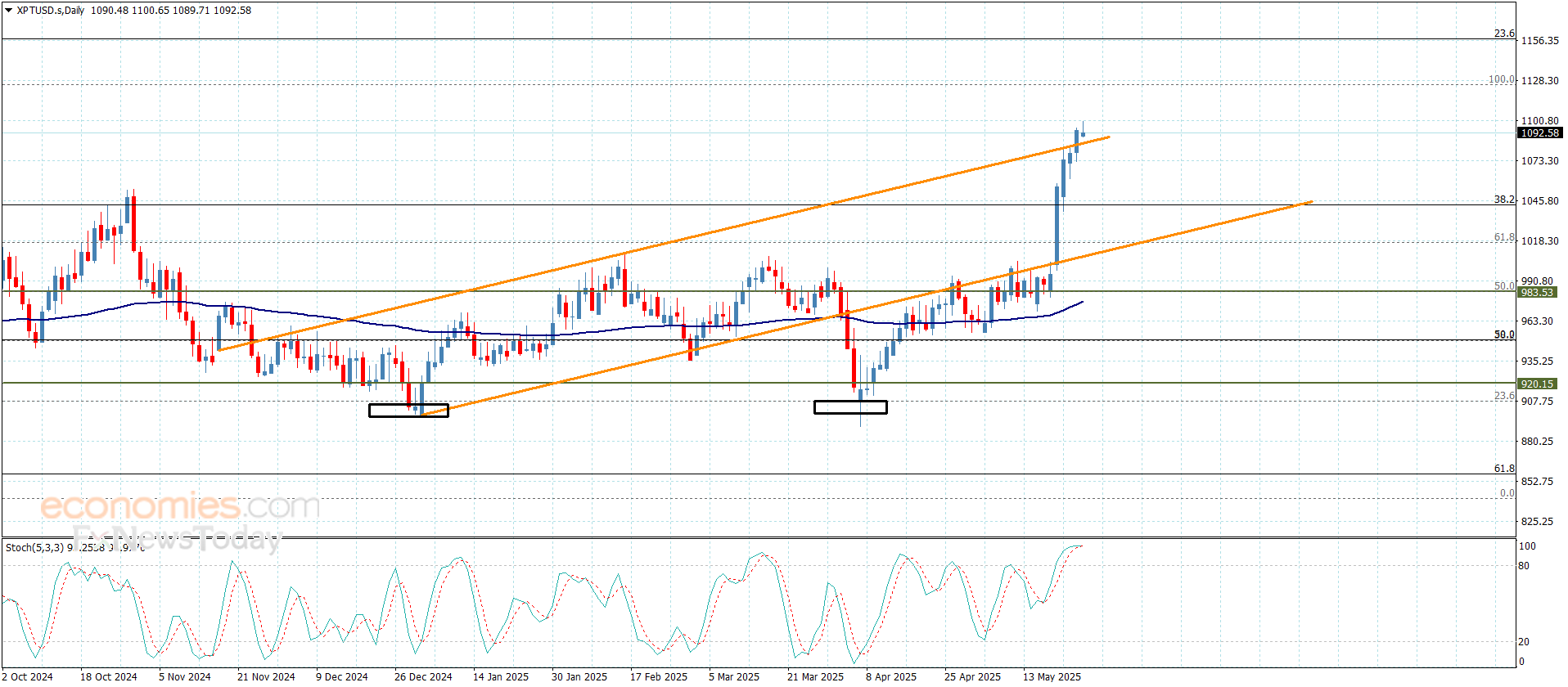
Platinum price reached the initial extra target at $1100.00, to begin providing sideways trading, due to its neediness to the positive momentum by the stochastic attempt to exit the overbought level.
The suggested scenario depends on the stability of $1080.00 level, which represents the extra support, the stability of the support will increase the chances for renewing the bullish attempts, which might target $1125.00 level, while reaching below this support will increase the chances for renewing the bullish attempts, targeting $1125.00, while reaching below the support will delay the bullish rally, and there is a chance for forming correctional trading, which might target $1068.00 and $1060.00 level.
The expected trading range for today is between $1080.00 and $1125.00
Trend forecast: Bullish
Do you need help in trading decisions? Do you want to learn how to start trading?
Join Economies.com VIP Club and benefit from over 15 years of market analysis expertise and get:
Special Offer: Subscribe to the Economies.com VIP channel and get also a free subscription to a trusted trading signals channel provided by Best Trading Signal.
Silver price (XAG/USD) remains steady after registering more than 1% gains in the previous session, trading around $33.40 per troy ounce during the European hours on Monday. Safe-haven demand for precious metals, including Silver, weakened due to easing trade war between the United States (US) and the European Union (EU).
The risk sentiment improves US President Donald Trump extended the tariff deadline on the European Union (EU) from June 1 to July 9. Trump stepped back after threatening to impose a 50% tariff on imports from the European Union.
However, the downside of the Silver price could be limited as the safe-haven demand would strengthen amid growing uncertainty surrounding the US economy. US fiscal deficit could increase further when Trump’s “One Big Beautiful Bill” passes on Senate floor.
On Sunday, US Senator Ron Johnson said in an interview on CNN, “I think we have enough votes to stop the process until the President gets serious about spending reduction and reducing the deficit.” “My primary focus now is spending. This is completely unacceptable. Current projections are a $2.2 trillion per year deficit,” Johnson added.
Moreover, Silver attracted buyers after Moody’s downgraded the US credit rating from Aaa to Aa1. Moody’s now projects US federal debt to climb to around 134% of GDP by 2035, up from 98% in 2023, with the budget deficit expected to widen to nearly 9% of GDP.
Chicago Federal Reserve (Fed) President Austan Goolsbee noted on Friday that adjustments in the Fed’s interest rates are likely to be delayed due to Trump’s latest tariff threats. Meanwhile, Kansas City Fed President Jeffrey Schmid said that policymakers will gauge hard data before deciding on interest rate decisions, and the Fed needs to be careful how much emphasis it puts on soft data.
Silver is a precious metal highly traded among investors. It has been historically used as a store of value and a medium of exchange. Although less popular than Gold, traders may turn to Silver to diversify their investment portfolio, for its intrinsic value or as a potential hedge during high-inflation periods. Investors can buy physical Silver, in coins or in bars, or trade it through vehicles such as Exchange Traded Funds, which track its price on international markets.
Silver prices can move due to a wide range of factors. Geopolitical instability or fears of a deep recession can make Silver price escalate due to its safe-haven status, although to a lesser extent than Gold’s. As a yieldless asset, Silver tends to rise with lower interest rates. Its moves also depend on how the US Dollar (USD) behaves as the asset is priced in dollars (XAG/USD). A strong Dollar tends to keep the price of Silver at bay, whereas a weaker Dollar is likely to propel prices up. Other factors such as investment demand, mining supply – Silver is much more abundant than Gold – and recycling rates can also affect prices.
Silver is widely used in industry, particularly in sectors such as electronics or solar energy, as it has one of the highest electric conductivity of all metals – more than Copper and Gold. A surge in demand can increase prices, while a decline tends to lower them. Dynamics in the US, Chinese and Indian economies can also contribute to price swings: for the US and particularly China, their big industrial sectors use Silver in various processes; in India, consumers’ demand for the precious metal for jewellery also plays a key role in setting prices.
Silver prices tend to follow Gold’s moves. When Gold prices rise, Silver typically follows suit, as their status as safe-haven assets is similar. The Gold/Silver ratio, which shows the number of ounces of Silver needed to equal the value of one ounce of Gold, may help to determine the relative valuation between both metals. Some investors may consider a high ratio as an indicator that Silver is undervalued, or Gold is overvalued. On the contrary, a low ratio might suggest that Gold is undervalued relative to Silver.
Trump’s decision to extend the deadline for 50% tariffs on EU goods to July 9 briefly reduced geopolitical tension. Over the weekend, the U.S. President said he agreed to an extension after a phone call with European Commission President Ursula von der Leyen, calling it a “privilege” to accommodate ongoing trade talks. This move countered last week’s aggressive rhetoric, when Trump threatened a “straight 50% tariff” and floated a 25% levy on Apple iPhones made outside the U.S.
Despite Monday’s softness, gold remains well bid above key support at $3,166.46 and $3,018.52. Last week, gold posted its strongest weekly performance in six weeks, rising 4.8% to $3,358.13. A drop in the U.S. dollar index—down 1.5% for the week—reflected intensifying concerns about the U.S. fiscal position. Traders continue to rotate out of dollar-denominated assets, with net short positions swelling to $17.3 billion.
Market anxiety over ballooning U.S. deficits intensified after Moody’s downgraded U.S. sovereign credit and the House passed Trump’s tax-heavy spending bill. The CBO projects this could swell the deficit by nearly $4 trillion. Long-end yields surged, with the 30-year Treasury yield hitting 5.14%, raising fears of debt monetization and inflation. As a result, gold gained favor over traditional U.S. assets.
China’s net gold imports via Hong Kong more than doubled in April, reaching the highest levels since March. This uptick in physical demand underscores global investor interest in gold as a hedge against both policy risk and currency depreciation.
The GBPJPY pair began today’s trading with clear positivity, getting advantage of the unionism of the main indicators for providing positive momentum, to notice achieving some gains by its current stability above the obstacle at 193.30 level.
Therefore, forming extra support at 192.50 level makes us keep the bullish suggestion, reminding you that the extra targets is located near 194.60 level reaching 23.6%Fibonacci correction level at 195.65.
The expected trading range for today is between 192.60 and 194.60
Trend forecast: Bullish
Do you need help in trading decisions? Do you want to learn how to start trading?
Join Economies.com VIP Club and benefit from over 15 years of market analysis expertise and get:
Special Offer: Subscribe to the Economies.com VIP channel and get also a free subscription to a trusted trading signals channel provided by Best Trading Signal.
The (USDJPY) price witnessed fluctuated trading in the intraday levels, rising temporarily affected by the stability of the key support level at 142.40, gaining positive momentum to attempt to recover some of its previous losses, at the same time it attempts to offload some of its clear oversold condition on the (RSI), especially with the beginning pf positive overlapping signals, it seems that the sellers is the dominant on the price move, it bounced quickly preparing for breaking this key support, amid its trading alongside a minor bearish trend on the short-term basis.
Do you need help in trading decisions? Do you want to learn how to start trading?
Join Economies.com VIP Club and benefit from over 15 years of market analysis expertise and get:
Special Offer: Subscribe to the Economies.com VIP channel and get also a free subscription to a trusted trading signals channel provided by Best Trading Signal.
Platinum price reached the initial extra target at $1100.00, to begin providing sideways trading, due to its neediness to the positive momentum by the stochastic attempt to exit the overbought level.
The suggested scenario depends on the stability of $1080.00 level, which represents the extra support, the stability of the support will increase the chances for renewing the bullish attempts, which might target $1125.00 level, while reaching below this support will increase the chances for renewing the bullish attempts, targeting $1125.00, while reaching below the support will delay the bullish rally, and there is a chance for forming correctional trading, which might target $1068.00 and $1060.00 level.
The expected trading range for today is between $1080.00 and $1125.00
Trend forecast: Bullish
Do you need help in trading decisions? Do you want to learn how to start trading?
Join Economies.com VIP Club and benefit from over 15 years of market analysis expertise and get:
Special Offer: Subscribe to the Economies.com VIP channel and get also a free subscription to a trusted trading signals channel provided by Best Trading Signal.
Silver price (XAG/USD) edges higher after registering losses over 1% in the previous session, hovering around $33.10 per troy ounce during the Asian trading hours on Friday. The manufacturing-sensitive commodities, including Silver, faced challenges due to growing concerns regarding the increase in the fiscal deficit in the United States (US). However, rising safe-haven demand over these fiscal concerns could offset the demand-related threat surrounding such commodities.
On Thursday, US President Donald Trump’s “One Big Beautiful Bill” passed the US House of Representatives and is on its way to the Senate floor. The US House of Representatives approved Trump’s budget by one vote. The proposal is expected to increase the deficit by $3.8 billion, as it would deliver tax breaks on tip income and US-manufactured car loans, according to the Congressional Budget Office (CBO).
Silver attracts sellers as uncertain US economic conditions, along with tariff concerns, undermine strong momentum for the photovoltaic industry. Silver is used in various industrial applications, such as electronics, solar panels, and automotive components.
In the first quarter of 2025, China’s wind and solar capacity rose to nearly 1,500 GW due to a 60GW jump in photovoltaic power. Given China’s status as one of the world’s largest manufacturing hubs, the country’s industrial demand for Silver is significant. Moreover, solar power output in Europe also surged by 30% annually in the first quarter.
Moody’s downgraded the US credit rating from Aaa to Aa1 and predicted that US federal debt is expected to climb to around 134% of GDP by 2035, up from 98% in 2023, with the budget deficit expected to widen to nearly 9% of GDP. This deterioration is attributed to rising debt-servicing costs, expanding entitlement programs, and falling tax revenues.
Silver is a precious metal highly traded among investors. It has been historically used as a store of value and a medium of exchange. Although less popular than Gold, traders may turn to Silver to diversify their investment portfolio, for its intrinsic value or as a potential hedge during high-inflation periods. Investors can buy physical Silver, in coins or in bars, or trade it through vehicles such as Exchange Traded Funds, which track its price on international markets.
Silver prices can move due to a wide range of factors. Geopolitical instability or fears of a deep recession can make Silver price escalate due to its safe-haven status, although to a lesser extent than Gold’s. As a yieldless asset, Silver tends to rise with lower interest rates. Its moves also depend on how the US Dollar (USD) behaves as the asset is priced in dollars (XAG/USD). A strong Dollar tends to keep the price of Silver at bay, whereas a weaker Dollar is likely to propel prices up. Other factors such as investment demand, mining supply – Silver is much more abundant than Gold – and recycling rates can also affect prices.
Silver is widely used in industry, particularly in sectors such as electronics or solar energy, as it has one of the highest electric conductivity of all metals – more than Copper and Gold. A surge in demand can increase prices, while a decline tends to lower them. Dynamics in the US, Chinese and Indian economies can also contribute to price swings: for the US and particularly China, their big industrial sectors use Silver in various processes; in India, consumers’ demand for the precious metal for jewellery also plays a key role in setting prices.
Silver prices tend to follow Gold’s moves. When Gold prices rise, Silver typically follows suit, as their status as safe-haven assets is similar. The Gold/Silver ratio, which shows the number of ounces of Silver needed to equal the value of one ounce of Gold, may help to determine the relative valuation between both metals. Some investors may consider a high ratio as an indicator that Silver is undervalued, or Gold is overvalued. On the contrary, a low ratio might suggest that Gold is undervalued relative to Silver.
The Gold price (XAU/USD) attracts some sellers to near $3,335 during the early Asian session on Monday. The de-escalation of the trade war provides some support to the yellow metal. The FOMC Minute will be the highlight later on Wednesday.
On Sunday, US President Donald Trump said that he agreed to an extension on the tariff deadline on the European Union (EU) until July 9, rescinding his threat of a 50% tariff from June 1. The easing fears of a global trade war drag the precious metal lower.
However, traders will closely monitor the developments surrounding US-Japan trade deals and other major economies’ trade deals for fresh impetus. Any signs of escalating trade tensions could boost the safe-haven flows, benefitting the precious metal.
Renewed inflation concerns and a US credit rating downgrade boost could underpin the Gold price. Moody’s downgraded the US long-held ‘Aaa’ credit rating to ‘Aa1.’ The downgrade added fuel to a weakening US Dollar (USD) and lifted the USD-denominated Gold price.
Jigar Trivedi, Senior Research Analyst at Reliance Securities, expects the rise in gold prices to continue into the month of June 2025. Trivedi emphasized key drivers like the US credit downgrade, continued Chinese central bank gold purchases, and trade tensions.
Gold has played a key role in human’s history as it has been widely used as a store of value and medium of exchange. Currently, apart from its shine and usage for jewelry, the precious metal is widely seen as a safe-haven asset, meaning that it is considered a good investment during turbulent times. Gold is also widely seen as a hedge against inflation and against depreciating currencies as it doesn’t rely on any specific issuer or government.
Central banks are the biggest Gold holders. In their aim to support their currencies in turbulent times, central banks tend to diversify their reserves and buy Gold to improve the perceived strength of the economy and the currency. High Gold reserves can be a source of trust for a country’s solvency. Central banks added 1,136 tonnes of Gold worth around $70 billion to their reserves in 2022, according to data from the World Gold Council. This is the highest yearly purchase since records began. Central banks from emerging economies such as China, India and Turkey are quickly increasing their Gold reserves.
Gold has an inverse correlation with the US Dollar and US Treasuries, which are both major reserve and safe-haven assets. When the Dollar depreciates, Gold tends to rise, enabling investors and central banks to diversify their assets in turbulent times. Gold is also inversely correlated with risk assets. A rally in the stock market tends to weaken Gold price, while sell-offs in riskier markets tend to favor the precious metal.
The price can move due to a wide range of factors. Geopolitical instability or fears of a deep recession can quickly make Gold price escalate due to its safe-haven status. As a yield-less asset, Gold tends to rise with lower interest rates, while higher cost of money usually weighs down on the yellow metal. Still, most moves depend on how the US Dollar (USD) behaves as the asset is priced in dollars (XAU/USD). A strong Dollar tends to keep the price of Gold controlled, whereas a weaker Dollar is likely to push Gold prices up.