The main tag of Gold Today Price Articles.
You can use the search box below to find what you need.
[wd_asp id=1]
The main tag of Gold Today Price Articles.
You can use the search box below to find what you need.
[wd_asp id=1]
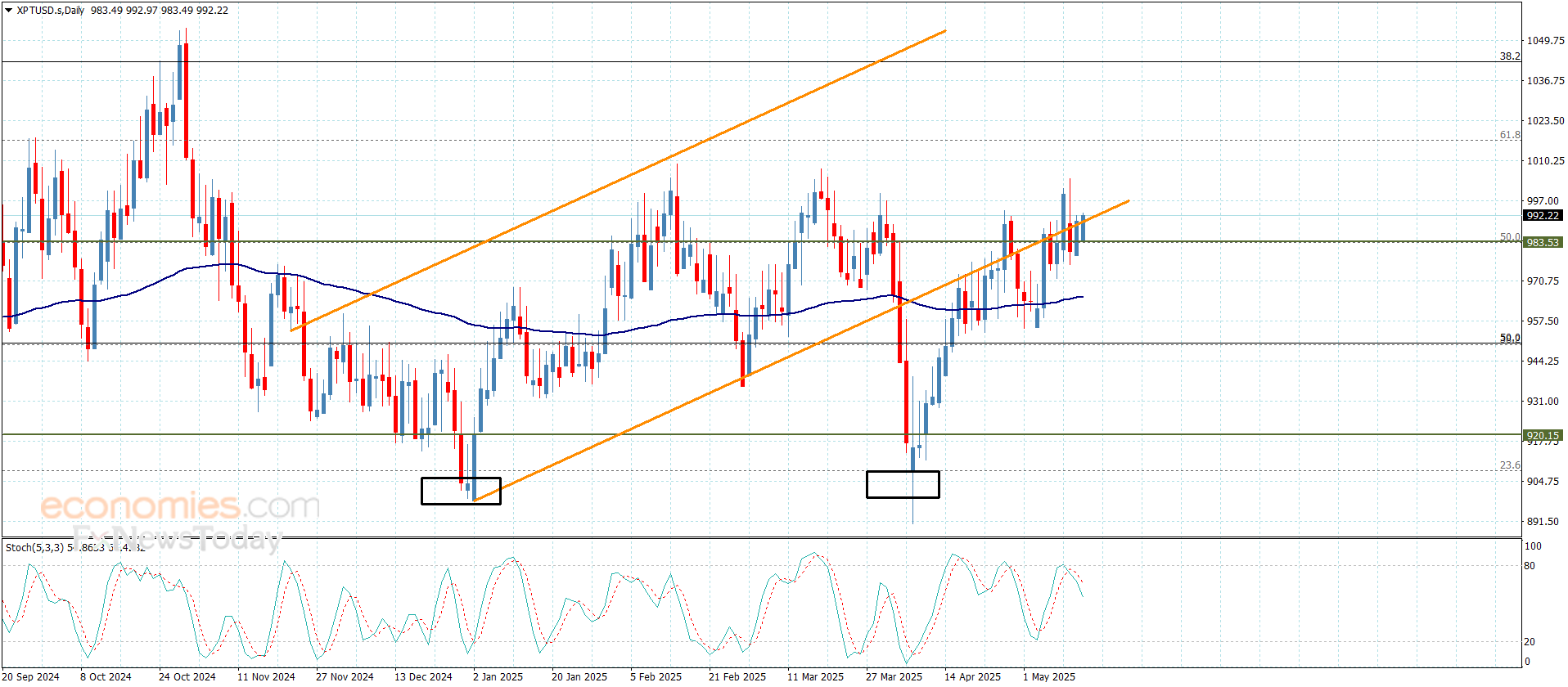
Platinum price forced to provide slow sideways trading, due to the continuation of the main indicators’ contradiction, to keep its fluctuation near the $991.00 level, while the continuation of forming sold barrier at $1005.00 level will increase the chances for activating the negative track, to attack the moving average 55 at $965.00, then press on the support at $950.00.
While regaining the bullish bias requires forming a strong bullish rally, to surpass 61.8% Fibonacci correction level at to confirm its readiness to record new gains that begin at $1027.00, to confirm its readiness to record new gains that begin at $ 1027.00 and $1040.00.
The expected trading range for today is between $965.00 and $ 1000.00
Trend forecast: Bearish
Do you need help in trading decisions? Do you want to learn how to start trading?
Join Economies.com VIP Club and benefit from over 15 years of market analysis expertise and get:
Special Offer: Subscribe to the Economies.com VIP channel and get also a free subscription to a trusted trading signals channel provided by Best Trading Signal.
Platinum price forced to provide slow sideways trading, due to the continuation of the main indicators’ contradiction, to keep its fluctuation near the $991.00 level, while the continuation of forming sold barrier at $1005.00 level will increase the chances for activating the negative track, to attack the moving average 55 at $965.00, then press on the support at $950.00.
While regaining the bullish bias requires forming a strong bullish rally, to surpass 61.8% Fibonacci correction level at to confirm its readiness to record new gains that begin at $1027.00, to confirm its readiness to record new gains that begin at $ 1027.00 and $1040.00.
The expected trading range for today is between $965.00 and $ 1000.00
Trend forecast: Bearish
Do you need help in trading decisions? Do you want to learn how to start trading?
Join Economies.com VIP Club and benefit from over 15 years of market analysis expertise and get:
Special Offer: Subscribe to the Economies.com VIP channel and get also a free subscription to a trusted trading signals channel provided by Best Trading Signal.
The Gold price (XAU/USD) trades in negative territory around $3,245 during the early Asian session on Wednesday. Improved risk appetite in the financial markets due to a tariff deal between the United States (US) and China weighs on the yellow metal, a safe-haven asset. Traders will focus on the Fedspeak later on Wednesday.
The US and China, the world’s two largest economies, agreed to reduce tariffs on each other after two days of negotiations in Geneva, Switzerland. The US lowered tariffs on Chinese imports to 30% from 145%, while China cut tariffs on US imports to 10% from 125%. These positive developments boost market sentiment and undermine the precious metal.
Additionally, easing tensions between India and Pakistan also weighed on the Gold price. The ceasefire remained intact in Jammu and Kashmir and across border towns overnight, following India’s Prime Minister Narendra Modi’s stern message to terrorists and Pakistan. Modi said on Monday that India will not tolerate any “nuclear blackmail.” He added that operations against Pakistan have only been paused, and the future will depend on their behavior.
“Gold and silver showed a heavy selloff at the start of the new week amid a trade deal between the US and China in Switzerland. The dollar index and the US bond yields jumped after the announcement of trade deals. The Indo-Pak ceasefire over the weekend also eases safe-haven buying for precious metals,” Manoj Kumar Jain of Prithvifinmart Commodity Research observed.
Nonetheless, any signs of escalation between India and Pakistan, along with the economic uncertainty triggered by US President Donald Trump’s tariff policies, could boost the safe-haven flows, benefiting the Gold price.
Gold has played a key role in human’s history as it has been widely used as a store of value and medium of exchange. Currently, apart from its shine and usage for jewelry, the precious metal is widely seen as a safe-haven asset, meaning that it is considered a good investment during turbulent times. Gold is also widely seen as a hedge against inflation and against depreciating currencies as it doesn’t rely on any specific issuer or government.
Central banks are the biggest Gold holders. In their aim to support their currencies in turbulent times, central banks tend to diversify their reserves and buy Gold to improve the perceived strength of the economy and the currency. High Gold reserves can be a source of trust for a country’s solvency. Central banks added 1,136 tonnes of Gold worth around $70 billion to their reserves in 2022, according to data from the World Gold Council. This is the highest yearly purchase since records began. Central banks from emerging economies such as China, India and Turkey are quickly increasing their Gold reserves.
Gold has an inverse correlation with the US Dollar and US Treasuries, which are both major reserve and safe-haven assets. When the Dollar depreciates, Gold tends to rise, enabling investors and central banks to diversify their assets in turbulent times. Gold is also inversely correlated with risk assets. A rally in the stock market tends to weaken Gold price, while sell-offs in riskier markets tend to favor the precious metal.
The price can move due to a wide range of factors. Geopolitical instability or fears of a deep recession can quickly make Gold price escalate due to its safe-haven status. As a yield-less asset, Gold tends to rise with lower interest rates, while higher cost of money usually weighs down on the yellow metal. Still, most moves depend on how the US Dollar (USD) behaves as the asset is priced in dollars (XAU/USD). A strong Dollar tends to keep the price of Gold controlled, whereas a weaker Dollar is likely to push Gold prices up.
Silver price edged up 0.95% on Tuesday as the Greenback finished the session below the 101.00 figure, according to the US Dollar Index (DXY), which tracks the performance of the buck’s value against a basket of six currencies. At the time of writing, as the Asian session begins, XAG/USD trades at $32.92, registering modest gains near the $33.00 figure.
The Silver technical outlook suggests that further consolidation lies ahead, with stir resistance found at the psychological $33.00 figure. However, momentum indicators like the Relative Strength Index (RSI), despite remaining bullish, turned flattish as indecision sinks on traders.
For a bullish resumption, buyers need to reclaim $33.00 and clear the latest swing high reached on May 7 at $33.25. Once surpassed, $33.50 emerges as next resistance, followed by the April 28 high of $33.68. A breach of the latter will expose $34.00.
Conversely, if XAG/USD drifts below the 50-day Simple Moving Average (SMA) of $32.75, a move towards the 100-day SMA at $31.89 is likely. On further weakness, the bulls’ following line of defense would be the 200-day SMA at $31.28.
Silver is a precious metal highly traded among investors. It has been historically used as a store of value and a medium of exchange. Although less popular than Gold, traders may turn to Silver to diversify their investment portfolio, for its intrinsic value or as a potential hedge during high-inflation periods. Investors can buy physical Silver, in coins or in bars, or trade it through vehicles such as Exchange Traded Funds, which track its price on international markets.
Silver prices can move due to a wide range of factors. Geopolitical instability or fears of a deep recession can make Silver price escalate due to its safe-haven status, although to a lesser extent than Gold’s. As a yieldless asset, Silver tends to rise with lower interest rates. Its moves also depend on how the US Dollar (USD) behaves as the asset is priced in dollars (XAG/USD). A strong Dollar tends to keep the price of Silver at bay, whereas a weaker Dollar is likely to propel prices up. Other factors such as investment demand, mining supply – Silver is much more abundant than Gold – and recycling rates can also affect prices.
Silver is widely used in industry, particularly in sectors such as electronics or solar energy, as it has one of the highest electric conductivity of all metals – more than Copper and Gold. A surge in demand can increase prices, while a decline tends to lower them. Dynamics in the US, Chinese and Indian economies can also contribute to price swings: for the US and particularly China, their big industrial sectors use Silver in various processes; in India, consumers’ demand for the precious metal for jewellery also plays a key role in setting prices.
Silver prices tend to follow Gold’s moves. When Gold prices rise, Silver typically follows suit, as their status as safe-haven assets is similar. The Gold/Silver ratio, which shows the number of ounces of Silver needed to equal the value of one ounce of Gold, may help to determine the relative valuation between both metals. Some investors may consider a high ratio as an indicator that Silver is undervalued, or Gold is overvalued. On the contrary, a low ratio might suggest that Gold is undervalued relative to Silver.
Resistance was seen near recent highs that are marked by several indicators that converged around a price zone. If the price of natural gas was going to pullback further from recent highs, now would be the time to do it. It is important to recognize that since the April 24 swing low of $2.86, there have been only two previous pullbacks of one day each. Anything more than one day pullback would be a change in that pattern and possibly an indication of a slowdown in bullish momentum.
As of yesterday’s high, of $3.84, the price of natural gas had risen by $0.98 or 34.4% in only 12 days. Since a significant potential resistance zone has been reached a deeper bearish pullback would not be a surprise. If an advance above this week’s high is to be sustained, a period of consolidation or larger pullback could provide preparation time for demand to build.
The 38.2% Fibonacci retracement is at $3.47 and provides an initial downside target. And it can be considered along with a prior pullback low of $3.42. That low is part of the price structure of the near-term uptrend. Therefore, it has some significance, particularly if it fails to hold as support. The potentially significant support area around the 20-Day MA is now at $3.37 and is the next lower target if $3.42 fails to hold.
For a look at all of today’s economic events, check out our economic calendar.
Spot Gold consolidates losses on Tuesday, holding above the $3,200 mark yet unable to recover the ground lost on Monday. Financial markets retain the positive mood triggered by news of de-escalating trade tensions between the United States (US) and China, as both countries agreed to reduced tariffs on each other for 90 days.
Other than that, the US released the April Consumer Price Index (CPI), which rose by 2.3% compared to a year earlier, easing from the previous 2.4%. The core annual reading, in the meantime, remained unchanged at 2.8%. Finally, the monthly CPI was up 0.2%, above the previous -0.1% but below the 0.3% anticipated by market players.
The upbeat mood weighed on the Greenback, leading to a modest XAU/USD advance. Meanwhile, Wall Street trades mixed. The Dow Jones Industrial Average is down roughly 0.40%, still positive for the week after adding over 1,000 points on Monday. The Nasdaq Composite and the S&P 500 post intraday gains, with the latter turning positive for the year.
XAU/USD hovers around $3,250, and the daily chart shows a limited upward potential. The pair keeps developing below a flat 20 Simple Moving Average (SMA), providing dynamic resistance at around $3,316.70. The 100 and 200 SMAs maintain their upward slopes far below the current level, suggesting bulls have not yet given up. Finally, technical indicators stand in neutral territory, with the Relative Strength Index (RSI) indicator consolidating at around 50, failing to provide clear directional clues.
In the near term, and according to the 4-hour chart, a mildly bullish 200 SMA at around $3.225.40 provides support for a second consecutive day, yet at the same time, the 20 SMA accelerated south above the current level and after crossing below a flat 100 SMA, in line with increased selling interest. Technical indicators, in the meantime, consolidate within negative levels, also supporting a bearish extension, particularly if the pair finally breaks below the mentioned 200 SMA.
Support levels: 3,241.90 3,225.40 3,212.85
Resistance levels: 3,265.40 3,281.60 3,305.65
Goldman Sachs sees upside risk to its Brent and WTI oil price forecast in 2025 and 2026 from recent trade de-escalation, it said in a note on Tuesday.
The bank estimates around $3-4 per barrel of upside risk to its Brent and WTI oil price forecast of $60/bbl and $56/bbl respectively for the rest of 2025, and $56/bbl and $52/bbl respectively in 2026.
The United States and China said on Monday that they would pause their tariffs for 90 days. Following the talks in Geneva over the weekend, the United States said it will cut tariffs on Chinese imports to 30% from 145% while China said it would cut duties on U.S. imports to 10% from 125%.
Goldman said that reduced recession risk has also reduced the probability of very low oil prices, although solid supply growth outside U.S. shale may still push prices significantly lower.
The Organization of the Petroleum Exporting Countries and its allies, called OPEC+, are planning to boost oil exports in May and June, which is seen as possibly limiting oil’s upside.
Oil prices fell to a four-year low last month on investor worries that the U.S.-China trade war could depress economic growth and oil demand.
The bank said that while it sees some upside risk to its oil price forecasts, it still expects a significant hit from tariffs to U.S. real income, global GDP, and global oil demand.
Brent crude BRN1! futures were trading at $66.77/bbl by 1443 GMT, while U.S. West Texas Intermediate (WTI) crude  CL1! was at $63.85/bbl.
The rebound was fueled by a successful retest of a retracement zone between $3228.38 and $3164.23. Buyers also defended the May 1 swing bottom at $3201.95, temporarily halting the bearish momentum. However, the upside appears limited without a move through resistance between $3318.50 and $3351.08, where sellers are likely to re-emerge.
A break below $3201.95 would shift the main trend to down on the daily swing chart and target the next major level at $3145.00—the 50-day moving average. This moving average could act as both a technical magnet and a key sentiment indicator for the rest of the year.
Gold’s sharp decline on Monday followed the announcement of a temporary U.S.-China tariff truce. The U.S. agreed to reduce import duties from 145% to 30%, while China cut tariffs from 125% to 10%. The agreement eased trade tensions and fueled a rally in global equities, while the U.S. dollar surged to a one-month high—both factors that undercut gold’s appeal.
Traders are now focused on the April U.S. Consumer Price Index report, which could shape expectations for Fed policy. Barclays projects headline CPI to rise 0.3% month-over-month (2.3% year-over-year), with core CPI up 0.2% (2.8% year-over-year). Although tariffs were implemented in early April, economists expect little immediate impact on prices due to exemptions and advanced shipments that likely front-loaded inflationary pressure into Q1.
A softer-than-expected CPI print could take pressure off the Fed and weaken the dollar, offering short-term support for gold. However, any upside surprise would likely reinforce expectations for tighter policy, boosting yields and dragging on gold.
The (USDJPY) price declined in its recent intraday trading, affected by the stability of the current resistance level at 148.13, gathering the gains of its last rises, attempting to gain positive momentum that might assist it to keep the solid bullish correctional wave, besides its attempt to offload some of its clear overbought conditions on the (RSI), especially with the emergence of negative overlapping signal from it.
The domination of the bullish correctional trend supports the price, accompanied by its upcoming intraday trading, especially when breaching the resistance at 148.13, to target the next resistance at 150.00.
Do you need help in trading decisions? Do you want to learn how to start trading?
Join Economies.com VIP Club and benefit from over 15 years of market analysis expertise and get:
Special Offer: Subscribe to the Economies.com VIP channel and get also a free subscription to a trusted trading signals channel provided by Best Trading Signal.
Crude oil futures tumbled over the past week, falling more than 6% as concerns over weakening global demand and a resurgent supply outlook weighed on sentiment. West Texas Intermediate (WTI) briefly hit a low of $56.39 before recovering to $59.24 by Thursday’s close. While dip-buying provided short-term support, the underlying market tone remains distinctly bearish as fundamental pressures intensify.
China Demand Slowdown Fuels Bearish Sentiment
Fresh economic data from China delivered a major blow to oil bulls. The country’s official manufacturing PMI slumped to 49.0 in April, signaling contraction and raising alarm over the health of the world’s largest crude importer. Of particular concern was the new export orders index, which plunged to its weakest level since 2012 outside of pandemic anomalies. Analysts responded by slashing full-year growth forecasts to just 3.5%, casting doubt on sustainable Chinese demand.
Though China’s March crude imports surged, analysts argue this was driven more by pre-sanctions stockpiling than any uptick in consumption. With Beijing’s fiscal stimulus measures struggling to gain traction, traders are increasingly skeptical of China’s ability to sustain meaningful crude demand growth in the near term.
Trade War Escalation Undermines Global Oil Demand Expectations
U.S.-China trade tensions are exacerbating the fragile demand picture. A fresh round of tariffs and retaliatory measures has heightened fears of a global…