The main tag of Gold Today Price Articles.
You can use the search box below to find what you need.
[wd_asp id=1]
The main tag of Gold Today Price Articles.
You can use the search box below to find what you need.
[wd_asp id=1]
Gold price is extending its bearish momentum into a third consecutive day early Thursday, languishing near two-week lows. Trade headlines have yet again overshadowed the US economic data, significantly impacting the traditional safe-haven Gold price.
The US Dollar (USD) builds on its recovery, capitalizing on the latest remarks from US President Donald Trump, stating that he has “potential” trade deals with India, South Korea and Japan and that there is a very good chance of reaching an agreement with China.
These optimistic comments on the trade front lift risk sentiment and trigger a fresh leg down in the USD-denominated Gold price, diminishing its haven appeal. Hopes over a likely US-China trade war de-escalation continue to act as a headwind for the bright metal.
Meanwhile, markets shrug off the rejection of a bipartisan measure to block Trump’s tariffs by the Senate and the earlier comments from US Trade Representative Jamieson Greer, citing that no official talks were happening with China.
All in all, Gold’s fate hinges on the sentiment surrounding trade developments, as any reaction to the US economic data releases remains short-lived. Traders will also look to the US ISM Manufacturing PMI and Jobless Claims data for some trading incentives ahead of Friday’s Nonfarm Payrolls (NFP) showdown.
The first look of the US annualized Gross Domestic Product (GDP) on Wednesday showed that the US economy contracted for the first time in three months to 0.3% in the first quarter of 2025 as US firms frontloaded to get ahead of the US levies, resulting in an imports surge.
Meanwhile, the core Personal Consumption Expenditures (PCE) Price Index, which excludes volatile food and energy prices, rose 2.6% in March, down from the 3% increase reported in February.
Gold price jumped briefly above $3,300 following the US GDP and inflation data but failed to sustain the rebound on Trump’s conciliatory remarks following the bleak GDP reading. The US President said in his Truth Social post that “this will take a while, has NOTHING TO DO WITH TARIFFS, only that he left us with bad numbers, but when the boom begins, it will be like no other. BE PATIENT!!!”
At the time of writing, Gold price extends the downside break of a three-week-long rising channel confirmed on Wednesday.
Gold price settled well below the rising trendline support, then at $3,351, on Wednesday, paving the way for more downside.
The 14-day Relative Strength Index (RSI) has stretched its descent, currently testing the midline near 53.50. The leading indicator remains above 50, keeping some hopes alive for Gold buyers.
Gold price must defend the critical 21-day Simple Moving Average (SMA) at $3,230 on a daily closing basis to keep the doors open for a turnaround.
If the latter holds the fort, Gold buyers could test the rising channel support-now-resistance at $3,383 on the road to recovery.
However, recapturing the previous day’s high of $3,328 is critical at first.
On the other hand, if sellers crack the 21-day SMA at $3,230 on a sustained basis, a fresh decline toward the $3,150 psychological level cannot be ruled out.
The 50-day SMA at $3,081 will be next on sellers’ radars.
Generally speaking, a trade war is an economic conflict between two or more countries due to extreme protectionism on one end. It implies the creation of trade barriers, such as tariffs, which result in counter-barriers, escalating import costs, and hence the cost of living.
An economic conflict between the United States (US) and China began early in 2018, when President Donald Trump set trade barriers on China, claiming unfair commercial practices and intellectual property theft from the Asian giant. China took retaliatory action, imposing tariffs on multiple US goods, such as automobiles and soybeans. Tensions escalated until the two countries signed the US-China Phase One trade deal in January 2020. The agreement required structural reforms and other changes to China’s economic and trade regime and pretended to restore stability and trust between the two nations. However, the Coronavirus pandemic took the focus out of the conflict. Yet, it is worth mentioning that President Joe Biden, who took office after Trump, kept tariffs in place and even added some additional levies.
The return of Donald Trump to the White House as the 47th US President has sparked a fresh wave of tensions between the two countries. During the 2024 election campaign, Trump pledged to impose 60% tariffs on China once he returned to office, which he did on January 20, 2025. With Trump back, the US-China trade war is meant to resume where it was left, with tit-for-tat policies affecting the global economic landscape amid disruptions in global supply chains, resulting in a reduction in spending, particularly investment, and directly feeding into the Consumer Price Index inflation.
Spot Gold fell throughout the first half of the day, extending its intraday slump to a fresh weekly low of $3,267.01. The XAU/USD pair traded on sentiment, falling after the release of tepid United States (US) data.
On the one hand, the April ADP Employment Change report showed that the private sector added measly 62K new job positions, much worse than the 108K expected, while below the previous 147K. On the other hand, the preliminary estimate of the US Q1 Gross Domestic Product (GDP) also missed expectations, as the economy contracted at an annualized pace of 0.3% against the anticipated 0.4% expansion, and sharply down from the previous 2.4%.
Wall Street fell as an immediate reaction to the news, with the US Dollar (USD) reacting unevenly across the FX board, gaining ground against commodity-linked currencies and the bright metal.
However, stocks quickly changed course, and so did XAU/USD, as the US March Personal Consumption Expenditures (PCE) Price Index brought some optimism. PCE inflation was up 0.5% on a monthly basis and 2.3% from a year earlier, slightly above expectations yet shrinking from the February levels. At the time being, US indexes remain in the red, but are well off early lows. While the USD came under selling pressure.
The upcoming Asian session will bring the Bank of Japan’s (BoJ) monetary policy decision. Japanese officials are likely to keep interest rates on hold amid trade-war-related uncertainties. The Japanese yen (JPY) is likely to turn south with the expected decision and a suspected downgrade to economic prospects, which could result in an extra near-term USD impulse.
The XAU/USD pair recovered the $3,300 mark and currently hovers around $3,310, with the upside limited. In the daily chart, the pair trades above all its moving averages, with a bullish 20 Simple Moving Average (SMA) providing relevant dynamic support at around $3,230. The 100 and 200 SMAs advance below it, while technical indicators extend their slides within positive levels, suggesting buyers remain sidelined.
In the near term, and according to the 4-hour chart, the XAU/USD pair is neutral. The bright metal hovers around a directionless 20 SMA, although the longer moving averages advance below the mentioned intraday low, suggesting a limited bearish potential. Finally, technical indicators turned flat at around their midlines, failing to provide clear directional clues.
Support levels: 3,301.40 3,288.70 3,267.00
Resistance levels: 3,327.90 3,344.60 3,358.10
Generally speaking, a trade war is an economic conflict between two or more countries due to extreme protectionism on one end. It implies the creation of trade barriers, such as tariffs, which result in counter-barriers, escalating import costs, and hence the cost of living.
An economic conflict between the United States (US) and China began early in 2018, when President Donald Trump set trade barriers on China, claiming unfair commercial practices and intellectual property theft from the Asian giant. China took retaliatory action, imposing tariffs on multiple US goods, such as automobiles and soybeans. Tensions escalated until the two countries signed the US-China Phase One trade deal in January 2020. The agreement required structural reforms and other changes to China’s economic and trade regime and pretended to restore stability and trust between the two nations. However, the Coronavirus pandemic took the focus out of the conflict. Yet, it is worth mentioning that President Joe Biden, who took office after Trump, kept tariffs in place and even added some additional levies.
The return of Donald Trump to the White House as the 47th US President has sparked a fresh wave of tensions between the two countries. During the 2024 election campaign, Trump pledged to impose 60% tariffs on China once he returned to office, which he did on January 20, 2025. With Trump back, the US-China trade war is meant to resume where it was left, with tit-for-tat policies affecting the global economic landscape amid disruptions in global supply chains, resulting in a reduction in spending, particularly investment, and directly feeding into the Consumer Price Index inflation.
There is a recent weekly high and low at $3.23 to $3.19 where there could be signs of support. But if that fails as support natural gas may be heading for a possible test of the 200-Day MA, now at $3.09. Also, there is this week’s low at $3.05. Since a drop below that level after this week would indicate a failure of the weekly bullish reversal that was established this week, it seems unlikely. Therefore, the current expectation would be for support to be found at the 200-Day line or above it if a deeper pullback follows today.
Nevertheless, the are reasons to believe that a bottom for the bearish correction was established last week at $2.86. That was right at support identified by the anchored volume weighted average price (AVWAP) that began from the long-term trend low established in February 2024. Despite the one-day pullback, a decisive advance above today’s high would indicate a possible bullish continuation before a deeper pullback. Strength would be confirmed on a rally above Tuesday’s high of $3.46. Since the 20-Day MA is at today’s high of $3.40, it would be reclaimed on a breakout above today’s high.
Higher initial targets look to start around $3.61 to $3.64. The upper end of the range was the peak in 2023 and the top of a large symmetrical triangle formation that subsequently formed. However, more significant price levels are around the AVWAP level from the recent trend high on March 10 around $3.76 and the 50-Day MA, now at $3.82. The advance that began this week is a counter-trend rally within a downtrend pattern and therefore rallies will be heading up into a consolidation zone that presents a range of potential selling pressure.
For a look at all of today’s economic events, check out our economic calendar.
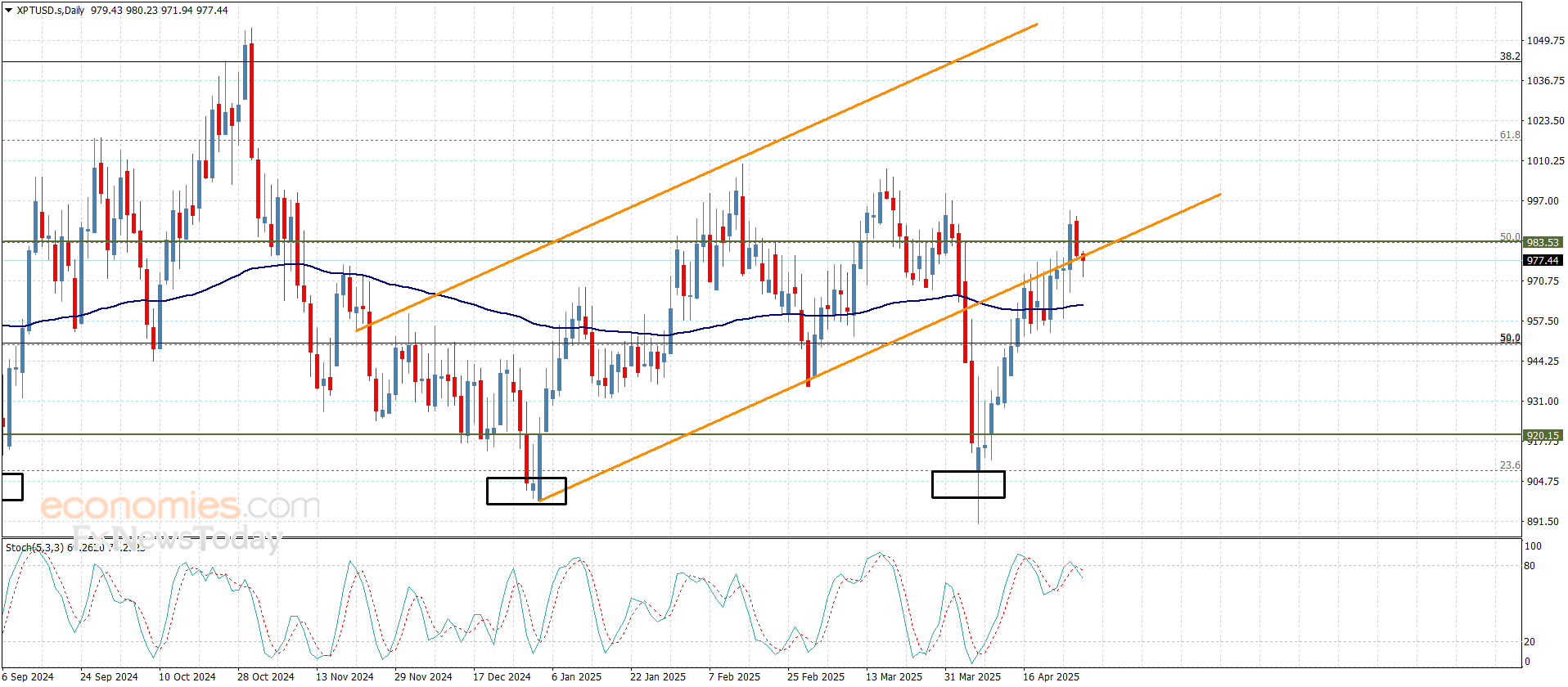
Blackrock’s stock price (BLK) rose in latest intraday trading, testing the downward trend line in the short term, and coinciding with touching the resistance of the 50-day SMA, bolstering the strength of this area as a resistance against the stock’s gains, especially with negative signals streaming from the Stochastic after reaching overbought levels compared to the price’s movements.
Therefore we expect the price to decline the first support at $887.00, provided the pivotal resistance of $929.00 holds on.
Today’s price forecast: Bearish
Do you need help in trading decisions? Do you want to learn how to start trading?
Join Economies.com VIP Club and benefit from over 15 years of market analysis expertise and get:
Special Offer: Subscribe to the Economies.com VIP channel and get also a free subscription to a trusted trading signals channel provided by Best Trading Signal.
The dollar index climbed 0.2%, driven by positive signals from U.S. trade policy and typical month-end demand. President Trump signed executive orders on Tuesday aimed at easing the burden of auto tariffs, while administration officials confirmed a trade deal has been reached with at least one foreign partner.
Treasury Secretary Scott Bessent also suggested additional agreements with countries like India and South Korea are underway. The improved outlook helped the greenback recover ground, pressuring gold by increasing its cost in other currencies.
Although trade tensions have eased, the gold market has not broken down. China’s move to suspend tariffs on several U.S. goods, including ethane and some semiconductor products, signaled softening positions on both sides. However, the limited downside in gold suggests markets remain cautious, with investors still using the metal as a hedge against policy uncertainty and broader economic weakness.
Traders are watching for today’s U.S. GDP report, expected to show zero growth, and the March PCE inflation reading forecast at 2.2%. These data points are crucial for shaping Fed policy expectations. Weaker readings could support gold by pushing yields and the dollar lower, while stronger numbers might raise rate hike bets, making non-yielding assets like gold less attractive.
Gold price holds lower ground in Asian trading on Wednesday, but remains within a familiar range. Gold traders eagerly await the release of the US first-quarter Gross Domestic Product (GDP) data for a fresh directional impetus.
The first look of the US annualised GDP is expected to show a 0.4% growth in Q1 2025, down from a robust 2.4% expansion in the final quarter of 2024. Goldman Sachs economists expect a negative 0.2% growth.
The expected significant slowdown in the US growth could be attributed to a likely import surge as US firms stocked up on inventory to get ahead of the US tariffs.
If the world’s largest economy shows an unexpected contraction, it would refuel recession fears and bring back bets for aggressive Fed rate cuts to the table, reviving the US Dollar (USD) downtrend. This, in turn, would lift the Gold price back toward record highs.
However, a smaller-than-expected cooldown in the US economy growth could provide a brief relief to broader markets and the US Dollar (USD), allowing Gold sellers to build on their corrective downside.
However, traders will remain cautious and refrain from creating fresh directional positions in the Gold price heading toward Friday’s US Nonfarm Payrolls (NFP) data, limiting any reaction in Gold price.
The US NFP data will help markets assess if there has been any material impact of US tariffs on the labor market.
Markets will also scrutinize the quarterly core Personal Consumption Expenditures (PCE) Price Index data that will be released alongside the GDP figures.
In the meantime, the Greenback defends gains as markets take stock of the recent tariffs headlines. US President Donald Trump signed an executive order on Tuesday to ease the impact of his auto tariffs. Meanwhile, Trump has adjusted the 25% tariffs on auto parts, which were set to take effect on May 3.
Markets also find some consolation from chatter surrounding progress on trade deals between the US and some of its Asian trading partners.
Gold price has defended the three-week-long rising channel support so far this week, currently testing the water underneath.
The 14-day Relative Strength Index (RSI) still holds above the midline, cushioning any downside in Gold price.
To confirm a downside break of the rising channel pattern, Gold price must find acceptance below the rising trendline support, now at $3,351, on a daily closing basis.
The next support aligns at the $3,300 round level, below which the $3,260 demand area will be tested.
A sustained break below the latter will put the 21-day Simple Moving Average (SMA) at $3,224 to the test, followed by the 50-day SMA at $3,075.
Conversely, Gold buyers must find a firm foothold above the channel support-turned-resistance at $3,351 to revive the uptrend toward the $3,370 static resistance.
A sustained recovery will target the $3,400 and the record high of $3,500 thereafter.
Gold has played a key role in human’s history as it has been widely used as a store of value and medium of exchange. Currently, apart from its shine and usage for jewelry, the precious metal is widely seen as a safe-haven asset, meaning that it is considered a good investment during turbulent times. Gold is also widely seen as a hedge against inflation and against depreciating currencies as it doesn’t rely on any specific issuer or government.
Central banks are the biggest Gold holders. In their aim to support their currencies in turbulent times, central banks tend to diversify their reserves and buy Gold to improve the perceived strength of the economy and the currency. High Gold reserves can be a source of trust for a country’s solvency. Central banks added 1,136 tonnes of Gold worth around $70 billion to their reserves in 2022, according to data from the World Gold Council. This is the highest yearly purchase since records began. Central banks from emerging economies such as China, India and Turkey are quickly increasing their Gold reserves.
Gold has an inverse correlation with the US Dollar and US Treasuries, which are both major reserve and safe-haven assets. When the Dollar depreciates, Gold tends to rise, enabling investors and central banks to diversify their assets in turbulent times. Gold is also inversely correlated with risk assets. A rally in the stock market tends to weaken Gold price, while sell-offs in riskier markets tend to favor the precious metal.
The price can move due to a wide range of factors. Geopolitical instability or fears of a deep recession can quickly make Gold price escalate due to its safe-haven status. As a yield-less asset, Gold tends to rise with lower interest rates, while higher cost of money usually weighs down on the yellow metal. Still, most moves depend on how the US Dollar (USD) behaves as the asset is priced in dollars (XAU/USD). A strong Dollar tends to keep the price of Gold controlled, whereas a weaker Dollar is likely to push Gold prices up.
The GBPJPY pair remains affected by the negativity on the moving average 55 by forming an extra barrier at 191.55, which forces it to provide more of the sideways trading, to fluctuate near the support at 190.50.
Noting that stochastic exit from the overbought level might increase the negative pressures, which forces the price to break the current support, to confirm its return to the bearish track, to suffer several losses by reaching 189.70 and 188.60, while confirming the bullish scenario needs a clear breach to 191.55, and holding above it to begin achieving gains, which might be near 192.40 reaching 193.15.
The expected trading range for today is between 190.50 and 191.55
Trend forecast: Sideways
Do you need help in trading decisions? Do you want to learn how to start trading?
Join Economies.com VIP Club and benefit from over 15 years of market analysis expertise and get:
Special Offer: Subscribe to the Economies.com VIP channel and get also a free subscription to a trusted trading signals channel provided by Best Trading Signal.
The (GBPUSD) price witnessed calm downside moves in its last trading on the intraday levels, affected by the stability of the critical resistance at 1.3420, and the main overview remains prefer the positivity, especially with the stability of the price above EMA50, which reinforces the chances for a bullish rebound any moment, to attempt to gain positive momentum that might assist it to breach this resistance.
The continuation of the trading alongside a bullish bias line on the short-term basis, besides the emergence of the positive signals on the (RSI), suggesting a potential regain for the positive momentum, which increases the possibilities from breaching the mentioned resistance.
Do you need help in trading decisions? Do you want to learn how to start trading?
Join Economies.com VIP Club and benefit from over 15 years of market analysis expertise and get:
Special Offer: Subscribe to the Economies.com VIP channel and get also a free subscription to a trusted trading signals channel provided by Best Trading Signal.
The (GBPUSD) price witnessed calm downside moves in its last trading on the intraday levels, affected by the stability of the critical resistance at 1.3420, and the main overview remains prefer the positivity, especially with the stability of the price above EMA50, which reinforces the chances for a bullish rebound any moment, to attempt to gain positive momentum that might assist it to breach this resistance.
The continuation of the trading alongside a bullish bias line on the short-term basis, besides the emergence of the positive signals on the (RSI), suggesting a potential regain for the positive momentum, which increases the possibilities from breaching the mentioned resistance.
Do you need help in trading decisions? Do you want to learn how to start trading?
Join Economies.com VIP Club and benefit from over 15 years of market analysis expertise and get:
Special Offer: Subscribe to the Economies.com VIP channel and get also a free subscription to a trusted trading signals channel provided by Best Trading Signal.
The GBPJPY pair remains affected by the negativity on the moving average 55 by forming an extra barrier at 191.55, which forces it to provide more of the sideways trading, to fluctuate near the support at 190.50.
Noting that stochastic exit from the overbought level might increase the negative pressures, which forces the price to break the current support, to confirm its return to the bearish track, to suffer several losses by reaching 189.70 and 188.60, while confirming the bullish scenario needs a clear breach to 191.55, and holding above it to begin achieving gains, which might be near 192.40 reaching 193.15.
The expected trading range for today is between 190.50 and 191.55
Trend forecast: Sideways
Do you need help in trading decisions? Do you want to learn how to start trading?
Join Economies.com VIP Club and benefit from over 15 years of market analysis expertise and get:
Special Offer: Subscribe to the Economies.com VIP channel and get also a free subscription to a trusted trading signals channel provided by Best Trading Signal.