The main tag of Gold Today Price Articles.
You can use the search box below to find what you need.
[wd_asp id=1]
The main tag of Gold Today Price Articles.
You can use the search box below to find what you need.
[wd_asp id=1]
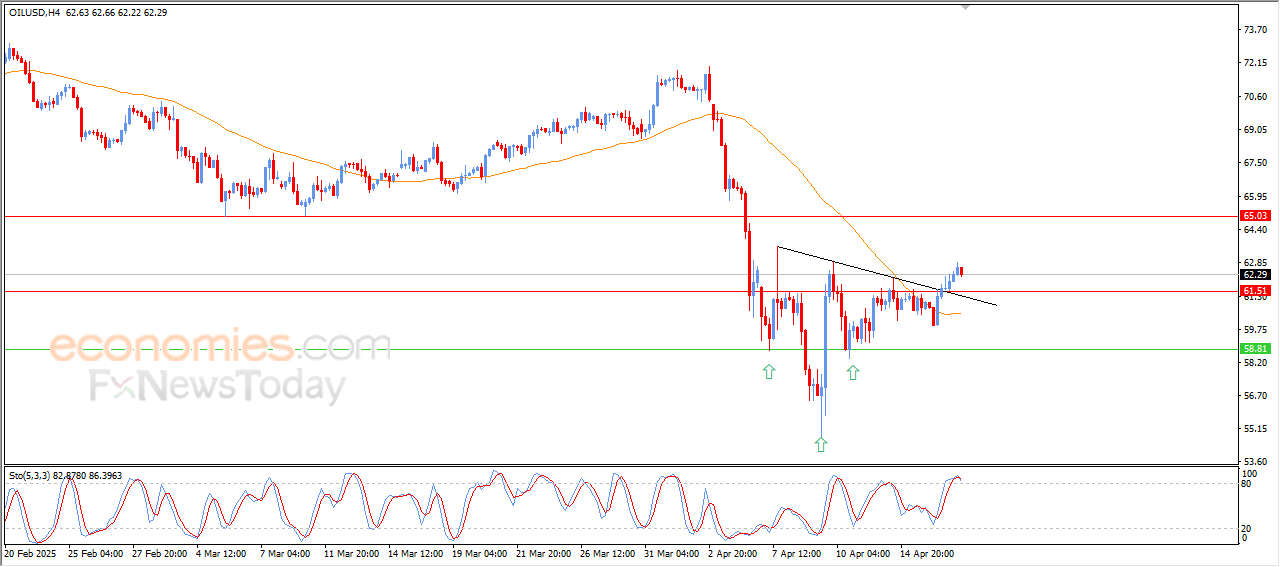
Given the sharp five-day decline to a low of $55.23 that ended last week, there is a strong case to be made for a sharp countertrend rally as well. Crude oil fell by $17.25 or 23.8% following the April 2 high of $72.49, measured to last week’s low and the low of the bearish correction. It has been consolidating off that bottom until the upside breakout that triggered today. Certainly, there can still be some backing and filling within this week’s price range of $60.40 to $64.72, before an advance might continue.
But this week will end with a higher weekly high and higher weekly low, a sign that buyers are stepping in more aggressively than they have recently. Furthermore, today’s bullish advance follows a bullish outside day from Wednesday, another bullish sign. Traders and investors will likely see short-term weakness as an opportunity given the new bullish signals in crude oil.
The first key upside target zone is from the confluence of several indicators from $65.40 to $65.89. Prior lows and now potential support are at $65.40 to $65.65, while the 20-Day MA, now at $65.72, and the 61.8% Fibonacci retracement at $65.89 complete the price range. A little higher is the initial 100% target from a rising ABCD pattern (not shown) that completes at $67.08. Subsequently, there is the 78.6% Fibonacci retracement at $68.79, which is joined by the 127.2% extended target for the ABCD pattern at $69.31.
For a look at all of today’s economic events, check out our economic calendar.
Gold price retreated further from its record high on Thursday, trading as low as $3,284.10 early in the American session. The US Dollar (USD) maintained its bearish bias against all major rivals throughout the day, with XAU/USD easing on the back of profit-taking. The pair, however, bounced from the mentioned low and regained the $3,300 mark ahead of the long Easter weekend.
It was quite a busy day, despite limited reactions across the FX board. On the one hand, the European Central Bank (ECB) announced its monetary policy decision. As widely anticipated, ECB officials trimmed the three benchmark interest rates by 25 basis points (bps) each. Officials refrained from giving clear hints on what’s next for monetary policy, yet highlighted the risks related to the trade war while noting uncertainty remains high.
On the other hand, United States (US) President Donald Trump jumped into social media and took aim at Federal Reserve (Fed) Chairman Jerome Powell, complaining he is moving too slow on interest rate cuts while stating that his “termination cannot come fast enough.”
Trump’s words came as an answer to Powell’s speech on Wednesday, warning of the potential consequences of the Trump administration’s trade war, while reiterating that the central bank plans to hold interest rates steady for now.
On a positive note, the White House welcomed talks with Mexico and Canada regarding a trade deal, albeit no specific details were offered.
Other than that, Wall Street trades mixed, with the Dow Jones Industrial Average (DJIA) sharply down but the Nasdaq and the S&P 500 holding on to modest gains.
The daily chart for the XAU/USD pair shows it posted a higher high and a higher low, maintaining the bullish trend alive despite the intraday slide. At the same time, technical indicators eased from extreme readings, but remain in overbought territory. Finally, the pair trades above all its moving averages, with a bullish 20 Simple Moving Average (SMA) currently at $3,114.60.
Support levels:3,317.20 3,305.65 3,292.80
Resistance levels 3,335.00 3,350.00 3,375.00
The U.S. Energy Information Administration (EIA) increased its Henry Hub natural gas spot price forecast for 2025 and 2026 in its latest short term energy outlook (STEO), which was released on April 10.
According to its April STEO, the EIA now sees the Henry Hub spot price averaging $4.27 per million British thermal units (MMBtu) in 2025 and $4.60 per MMBtu in 2026. In its previous STEO, which was released in March, the EIA saw the Henry Hub spot price averaging $4.19 per MMBtu in 2025 and $4.47 per MMBtu in 2026.
The EIA projected in its April STEO that the Henry Hub spot price will come in at $3.93 per MMBtu in the second quarter of 2025, $4.34 per MMBtu in the third quarter, $4.68 per MMBtu in the fourth quarter, $4.93 per MMBtu in the first quarter of next year, $4.18 per MMBtu in the second quarter, $4.61 per MMBtu in the third quarter, and $4.66 per MMBtu in the fourth quarter.
The EIA highlighted in its latest STEO that the Henry Hub spot price averaged $4.15 per MMBtu in the first quarter of 2025 and $2.19 per MMBtu overall in 2024.
In its March STEO, the EIA projected that the Henry Hub spot price would average $3.88 per MMBtu in the second quarter of this year, $4.30 per MMBtu in the third quarter, $4.49 per MMBtu in the fourth quarter, $4.66 per MMBtu in the first quarter of 2026, $4.13 per MMBtu in the second quarter, $4.50 per MMBtu in the third quarter, and $4.60 per MMBtu in the fourth quarter of next year.
The EIA’s March STEO projected that the Henry Hub spot price would average $4.11 per MMBtu in the first quarter of 2025. This STEO also highlighted that the commodity came in at $2.19 per MMBtu overall in 2024.
“A colder than normal January and February this winter heating season resulted in more natural gas than average being withdrawn from natural gas storage,” the EIA said in its latest STEO.
“We estimate more than 1,600 billion cubic feet (Bcf) of natural gas was withdrawn in the first quarter of 2025 (1Q25), or 21 percent more than the five-year (2019 – 2024) average,” it added.
“At the end of March, which marks the end of the U.S. natural gas storage withdrawal season (November – March), we estimate that U.S. working natural gas in underground storage totaled just over 1,800 Bcf, or four percent less than the five-year average,” it continued.
The EIA highlighted in the STEO that it expects higher natural gas prices this year compared with 2024, which it said “will encourage producers in the Appalachia and Haynesville regions to increase production”.
“Dry natural gas production averages about 105 Bcfpd in 2Q25 in our forecast, nearly three Bcfpd more than the same period in 2024,” the EIA noted in its April STEO.
“The U.S. benchmark Henry Hub price averages more than $3.90 per MMBtu in 2Q25 in our forecast, almost 90 percent higher compared with 2Q24. We expect the Henry Hub price to average about $4.30 per MMBtu in 2025 and nearly $4.60 per MMBtu in 2026,” it added.
“We expect natural gas injections into storage to be higher than average early in the natural gas injection season (April – October),” it continued.
The EIA went on to reveal, however, that it expects injections to fall below the five-year average “beginning in midsummer when natural gas use in the electric power sector picks up”.
“We forecast U.S. natural gas inventories will end the injection season on October 31 with three percent less natural gas in storage than the five-year average, with about 3,660 Bcf in storage,” it added.
A research note sent to Rigzone by the JPM Commodities Research team on April 12 showed that J.P. Morgan expected the average U.S. natural gas Henry Hub price to average $3.80 per MMBtu in 2025 and $3.31 per MMBtu in 2026.
J.P. Morgan saw the commodity coming in at $3.90 per MMBtu in the second quarter of this year, $4.00 in the third quarter, $3.75 per MMBtu in the fourth quarter, $3.50 per MMBtu in the first quarter of next year, $3.00 in the second quarter, $3.25 per MMBtu in the third quarter, and $3.50 per MMBtu in the fourth quarter, the report highlighted.
A BMI report sent to Rigzone by the Fitch Group on April 11 showed that BMI expected the front month natural gas Henry Hub price to average $3.40 per MMBtu this year and $3.80 per MMBtu next year.
A Standard Chartered Bank report sent to Rigzone by Standard Chartered Bank Commodities Research Head Paul Horsnell on April 8 showed that Standard Chartered expected the NYMEX basis Henry Hub nearby future U.S. natural gas price to average $3.35 per MMBtu in 2025 and $3.30 per MMBtu in 2026.
Standard Chartered Bank saw the commodity averaging $3.50 per MMBtu across the second and third quarters of this year, $3.20 per MMBtu across the fourth quarter of 2025 and first quarter of 2026, $3.70 per MMBtu in the second quarter of 2026, and $3.50 per MMBtu in the third quarter of next year, according to the report.
To contact the author, email andreas.exarheas@rigzone.com
The GBPJPY pair activated the negative attack in yesterday’s trading, achieving the initial negative target by hitting 187.55 level, then it rebounded to settle above 38.2%Fibonacci correction level at 188.00, to gather the required negative momentum to confirm the continuation of the bearish trend in the upcoming trading.
In general, the bearish scenario would remain valid if the trading settled below the main resistance at 189.90, as confirming breaking 188.00 level makes us expect targeting new negative stations, and 186.50 level represents the next target for the negative trading, while the attempt of breaching the mentioned resistance will cancel the bearish suggestion in the near trading, as there is a chance for achieving some gains by the price rally towards 190.50 initially.
The expected trading range for today is between 186.50 and 189.20
Trend forecast: Bearish
Do you need help in trading decisions? Do you want to learn how to start trading?
Join Economies.com VIP Club and benefit from over 15 years of market analysis expertise and get:
Special Offer: Subscribe to the Economies.com VIP channel and get also a free subscription to a trusted trading signals channel provided by Best Trading Signal.
Silver price (XAG/USD) falls sharply to near $32.50 in Thursday’s European session after failing to extend a 10-day rally above the key resistance of $33.00. The white metal corrects as the US Dollar (USD) strives to gain ground near its recent lows. The US Dollar Index (DXY), which tracks the Greenback’s value against six major currencies, attracts some bids near its three-year low of 99.00.
The USD Index rebounds slightly as decent progress in negotiations on a trade deal between the United States (US) and Japan has eased some uncertainty over the domestic economic outlook. “A Great Honour to have just met with the Japanese Delegation on Trade. Big Progress!” US President Donald Trump wrote in a post on Truth.Social platform on Wednesday.
This appears to be a meaningful sign that Trump wants favorable bilateral trades over hefty reciprocal tariff policies. More positive outcomes of trade negotiations by Washington with other trading partners will be favorable for the US Dollar. Such a scenario will diminish the global economic uncertainty, which would lead to a decline in demand for safe-haven assets, such as Silver.
Additionally, slight hawkish commentary from Federal Reserve (Fed) Chair Jerome Powell on the monetary policy outlook has also forced traders to book profits in the Silver price. On Wednesday, Powell said in a speech at the Economic Club of Chicago that the Fed seeks more clarity on the economic outlook before making any policy adjustments. Fed’s support for a restrictive monetary policy stance bodes poorly for non-yielding assets, such as Silver.
Meanwhile, the escalated trade war between China and the US will keep the downside in the Silver price limited. Beijing has shown a willingness for trade talks with Washington, but with respect and mutual understanding.
Silver price holds above the 20-day Exponential Moving Average (EMA) near $32.28, suggesting that the near-term outlook is bullish. The white metal aims to revisit the October 22 high of $34.87.
The 14-day Relative Strength Index (RSI) delivers a V-shape recovery after turning oversold below 30.00. The momentum oscillator is expected to find resistance near 60.00.
A fresh upside would appear in the counter if the Silver price breaks above the April 16 high of $33.12. The move will unlock targets of the October 22 high of $34.87 and an over-decade high of $35.50.
On the flip side, a downside move by the Silver price below the April 14 low of $31.74 will expose it to the April 11 low of $30.90, followed by the psychological level of $30.00
Silver is a precious metal highly traded among investors. It has been historically used as a store of value and a medium of exchange. Although less popular than Gold, traders may turn to Silver to diversify their investment portfolio, for its intrinsic value or as a potential hedge during high-inflation periods. Investors can buy physical Silver, in coins or in bars, or trade it through vehicles such as Exchange Traded Funds, which track its price on international markets.
Silver prices can move due to a wide range of factors. Geopolitical instability or fears of a deep recession can make Silver price escalate due to its safe-haven status, although to a lesser extent than Gold’s. As a yieldless asset, Silver tends to rise with lower interest rates. Its moves also depend on how the US Dollar (USD) behaves as the asset is priced in dollars (XAG/USD). A strong Dollar tends to keep the price of Silver at bay, whereas a weaker Dollar is likely to propel prices up. Other factors such as investment demand, mining supply – Silver is much more abundant than Gold – and recycling rates can also affect prices.
Silver is widely used in industry, particularly in sectors such as electronics or solar energy, as it has one of the highest electric conductivity of all metals – more than Copper and Gold. A surge in demand can increase prices, while a decline tends to lower them. Dynamics in the US, Chinese and Indian economies can also contribute to price swings: for the US and particularly China, their big industrial sectors use Silver in various processes; in India, consumers’ demand for the precious metal for jewellery also plays a key role in setting prices.
Silver prices tend to follow Gold’s moves. When Gold prices rise, Silver typically follows suit, as their status as safe-haven assets is similar. The Gold/Silver ratio, which shows the number of ounces of Silver needed to equal the value of one ounce of Gold, may help to determine the relative valuation between both metals. Some investors may consider a high ratio as an indicator that Silver is undervalued, or Gold is overvalued. On the contrary, a low ratio might suggest that Gold is undervalued relative to Silver.
The
EURCAD provided bullish trading recently, to settle above the previously broken bullish channel’s support at1.5625 and record some gains by its stability near 1.578
The price success to settle above the mentioned support and stochastic attempt to provide positive momentum, will increase the efficiency of the bullish track, to expect attacking the barrier at 1.5880 soon, and surpassing it will ease the mission of recording new gains that might begin at 1.5980, while the price return to settle below the bullish channel’s support will cancel the bullish suggestion, which pushes the price to suffer several losses by reaching 1.5510 and 1.5390.
The expected trading range for today is between 1.5700 and 1.5880
Trend forecast: Bullish
Do you need help in trading decisions? Do you want to learn how to start trading?
Join Economies.com VIP Club and benefit from over 15 years of market analysis expertise and get:
Special Offer: Subscribe to the Economies.com VIP channel and get also a free subscription to a trusted trading signals channel provided by Best Trading Signal.
Copper price provided a positive signal this morning by hitting the $4,7200 level, but its neediness to the positive momentum pushed it to return to provide new sideways fluctuated moves below 50%Fibonacci correction level at $4.6600.
Breaching the current barrier is important for reinforcing the chances for resuming the bullish attack, which might target $4.7500 level, reaching 61.8%Fibonacci correction level at $4.8200.
The expected trading range for today is between $4.5800 and $4.7500
Trend forecast: Bullish
Do you need help in trading decisions? Do you want to learn how to start trading?
Join Economies.com VIP Club and benefit from over 15 years of market analysis expertise and get:
Special Offer: Subscribe to the Economies.com VIP channel and get also a free subscription to a trusted trading signals channel provided by Best Trading Signal.
Silver (XAG/USD) is trading around $32.30 per troy ounce during Thursday’s Asian session, paring some of its gains from the previous day. The precious metal is under pressure as global risk sentiment improves following US President Donald Trump’s announcement of exemptions for key technology products from newly proposed “reciprocal” tariffs.
The exemptions, which cover smartphones, computers, semiconductors, solar cells, and flat-panel displays, primarily benefit goods manufactured in China. However, Silver’s downside remains limited as Trump simultaneously launched a probe into potential tariffs on critical minerals, further escalating trade tensions with China. The investigation also extends to sectors like copper, pharmaceuticals, lumber, and semiconductors, highlighting the US’s limited domestic production capacity in these areas.
Safe-haven demand for Silver is also underpinned by persistent uncertainty around US trade policy, along with subdued demand for the US Dollar (USD) and Treasury securities. The US Dollar Index (DXY) hovers around 99.50, while yields on 2-year and 10-year US Treasury notes stand at 3.80% and 4.30%, respectively.
Meanwhile, dovish signals from major central banks continue to support non-yielding assets like bullion. Softer-than-expected inflation in the US, Canada, UK, India, and the Euro Area in March—alongside the PBoC’s potential rate cut this quarter—further bolsters the case for precious metals.
Silver is a precious metal highly traded among investors. It has been historically used as a store of value and a medium of exchange. Although less popular than Gold, traders may turn to Silver to diversify their investment portfolio, for its intrinsic value or as a potential hedge during high-inflation periods. Investors can buy physical Silver, in coins or in bars, or trade it through vehicles such as Exchange Traded Funds, which track its price on international markets.
Silver prices can move due to a wide range of factors. Geopolitical instability or fears of a deep recession can make Silver price escalate due to its safe-haven status, although to a lesser extent than Gold’s. As a yieldless asset, Silver tends to rise with lower interest rates. Its moves also depend on how the US Dollar (USD) behaves as the asset is priced in dollars (XAG/USD). A strong Dollar tends to keep the price of Silver at bay, whereas a weaker Dollar is likely to propel prices up. Other factors such as investment demand, mining supply – Silver is much more abundant than Gold – and recycling rates can also affect prices.
Silver is widely used in industry, particularly in sectors such as electronics or solar energy, as it has one of the highest electric conductivity of all metals – more than Copper and Gold. A surge in demand can increase prices, while a decline tends to lower them. Dynamics in the US, Chinese and Indian economies can also contribute to price swings: for the US and particularly China, their big industrial sectors use Silver in various processes; in India, consumers’ demand for the precious metal for jewellery also plays a key role in setting prices.
Silver prices tend to follow Gold’s moves. When Gold prices rise, Silver typically follows suit, as their status as safe-haven assets is similar. The Gold/Silver ratio, which shows the number of ounces of Silver needed to equal the value of one ounce of Gold, may help to determine the relative valuation between both metals. Some investors may consider a high ratio as an indicator that Silver is undervalued, or Gold is overvalued. On the contrary, a low ratio might suggest that Gold is undervalued relative to Silver.
Gold price has paused its record run to near the $3,360 region early Thursday as buyers digest this week’s tariff play by US President Donald Trump heading into a light Holy Friday.
This week, the resumption of the Gold price record-setting rally could be mainly linked to the escalation of US-China trade war and the uncertainty over US tariffs’ implementation across all its major trading partners.
Increased demand for safe-haven assets and unabated fears over a potential recession in the United States (US) continued to power Gold price advance.
“Chip stocks across the globe were pummelled on Wednesday after Dutch giant ASML warned that tariffs were increasing uncertainty around its outlook for 2025 and 2026. Also weighing on sentiment was the American artificial intelligence (AI) pioneer Nvidia warning of a $5.5 billion hit after Washington restricted exports of its AI processor tailored for China,” per Reuters.
Aggravating US-Sino trade tensions, China reportedly instructed its airlines not to take any more deliveries of Boeing Co planes, Bloomberg reported.
However, US Federal Reserve (Fed) Chair Jerome Powell’s cautious stance on the interest rate outlook and the US-Japan constructive trade talks remain a headwind for the bright metal, providing some reprieve to the US Dollar (USD).
At the Economic Club of Chicago on Wednesday, Powell said, “for the time being, we are well-positioned to wait for greater clarity before considering any adjustments to our policy stance.” Powell warned of increased stagflation risks due to the likely impact of the US tariffs.
Meanwhile, Japan’s Prime Minister (PM) Shigeru Ishiba said on Thursday that talks with the US were constructive, adding that the government will continue to consider trade negotiations a top priority.
In the day ahead, Gold price could see a corrective decline as traders might take profits off the table on their Gold longs ahead of the Good Friday holiday-thinned markets. Amid tariffs uncertainty, markets will prefer to reposition, gearing up for more tariff headlines next week.
In the meantime, the focus will remain on the meeting between Trump and Italy’s PM Giorgia Meloni, due later on Thursday. Bloomberg News reported on Tuesday that the European Union (EU) expects most of the US import tariffs to remain in place after little progress was made in the latest talks.
Meanwhile, Gold traders will also take cues from the mid-tier weekly US Jobless Claims and housing data.
The daily chart shows that the 14-day Relative Strength Index (RSI) stays heavily overbought, currently near 75, hinting at a likely correction.
However, if Gold buyers find acceptance above the $3,350 level on a daily closing basis, the next upside target will be seen at the $3,400 threshold.
Conversely, the corrective decline could initially test the $3,300 demand area, below which the $3,250 psychological level could come into play.
Further south, Gold sellers will keep sight on the $3,200 mark.
Gold has played a key role in human’s history as it has been widely used as a store of value and medium of exchange. Currently, apart from its shine and usage for jewelry, the precious metal is widely seen as a safe-haven asset, meaning that it is considered a good investment during turbulent times. Gold is also widely seen as a hedge against inflation and against depreciating currencies as it doesn’t rely on any specific issuer or government.
Central banks are the biggest Gold holders. In their aim to support their currencies in turbulent times, central banks tend to diversify their reserves and buy Gold to improve the perceived strength of the economy and the currency. High Gold reserves can be a source of trust for a country’s solvency. Central banks added 1,136 tonnes of Gold worth around $70 billion to their reserves in 2022, according to data from the World Gold Council. This is the highest yearly purchase since records began. Central banks from emerging economies such as China, India and Turkey are quickly increasing their Gold reserves.
Gold has an inverse correlation with the US Dollar and US Treasuries, which are both major reserve and safe-haven assets. When the Dollar depreciates, Gold tends to rise, enabling investors and central banks to diversify their assets in turbulent times. Gold is also inversely correlated with risk assets. A rally in the stock market tends to weaken Gold price, while sell-offs in riskier markets tend to favor the precious metal.
The price can move due to a wide range of factors. Geopolitical instability or fears of a deep recession can quickly make Gold price escalate due to its safe-haven status. As a yield-less asset, Gold tends to rise with lower interest rates, while higher cost of money usually weighs down on the yellow metal. Still, most moves depend on how the US Dollar (USD) behaves as the asset is priced in dollars (XAU/USD). A strong Dollar tends to keep the price of Gold controlled, whereas a weaker Dollar is likely to push Gold prices up.
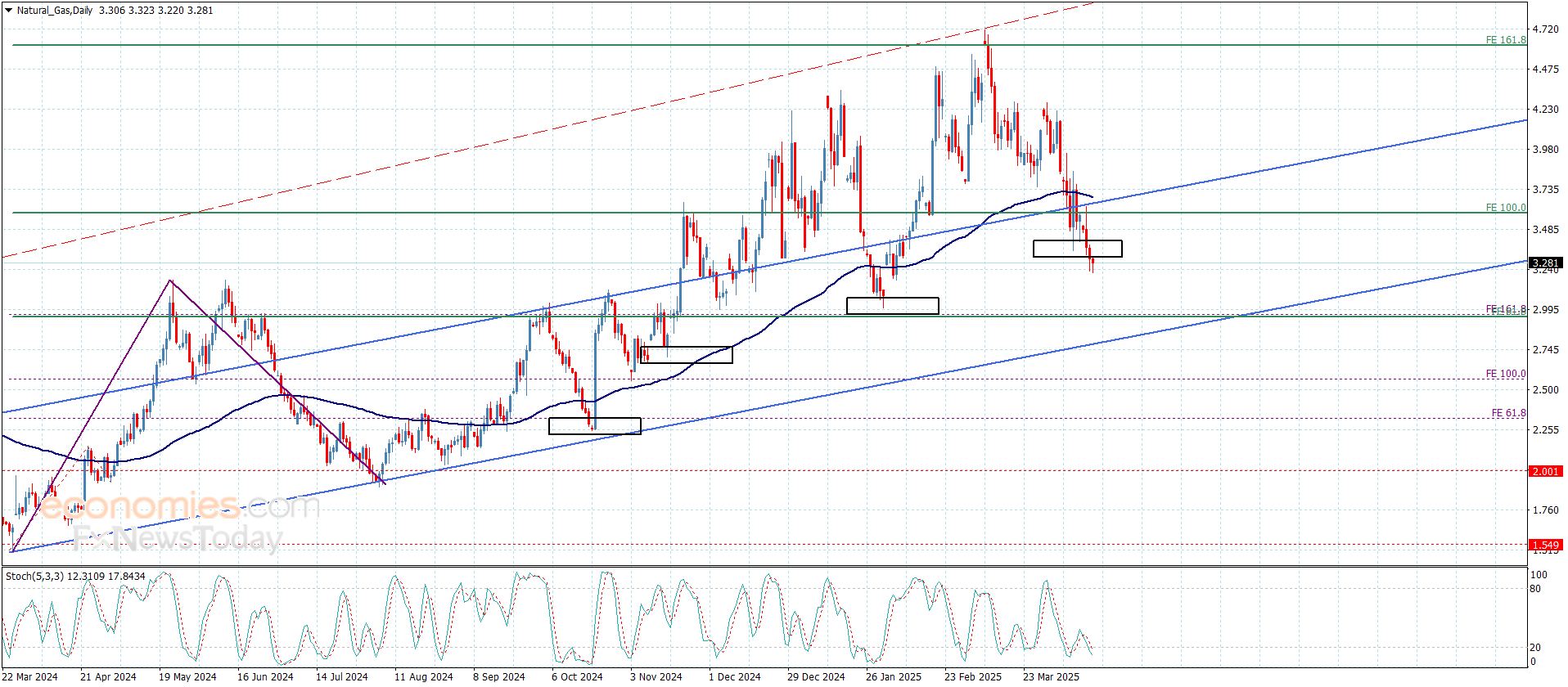
Although a minor bearish trend continuation signal triggered today, there remains a possibility that support around the 88.6% retracement at $3.21 could hold. Notice that the lower end (25% extended) of a descending trend channel (blue lines) is nearby, and it represents an area of potential support as well. That would change on a decisive drop below today’s low. Notice that today’s high found resistance at the bottom of a lower channel line, in blue. Since that line was previously identifying support, today’s price action recognized it as resistance. This is a bearish sign as a downtrend typically progresses in this manner.
A one-day bullish reversal above today’s high of $3.32 may start to change the near-term bearish outlook if it leads to a daily close above that price level. Otherwise, a decline below today’s low signals another continuation signal and improves the chance that the next lower potential support zone is tested. It starts with the completion of a falling ABCD pattern at $3.08. That is where the change in price in the two downswings of the current correction match. Once there is a match, a potential pivot level is identified, in this case support.
The 200-Day MA is slightly below that target at $3.06 and is rising. Therefore, it could converge with the ABCD pattern target upon approach. Since the 200-Day MA is a long-term trend indicator, it takes priority over the pattern target. But if the two indicators identify the same or a very similar price level, that price level gains in significance. Since the 200-Day MA hasn’t been approached as support since October 2024, it should do so if touched soon. Bearish momentum has dominated since the lower swing high (C), so natural gas would be approaching that potential support area potentially near the end of the trend.
For a look at all of today’s economic events, check out our economic calendar.