The main tag of Gold Today Price Articles.
You can use the search box below to find what you need.
[wd_asp id=1]
The main tag of Gold Today Price Articles.
You can use the search box below to find what you need.
[wd_asp id=1]
The crude oil price move downside in its recent intraday trading, affected by the negative pressure that comes from the EMA50, besides the stability of the stubborn resistance level at $61.50, attempting to gain some of the positive momentum that might assist breaching the resistance and surpassing its negative pressures.
To get our more detailed analysis and 100% accurate signals provided by Best Trading Signal, subscribe to Economies.com VIP Club through the link below!
Gold prices held above the $3,200 mark on Tuesday, with the bright metal trading uneventfully around $3,220 a troy ounce. Financial markets maintain an optimistic mood on Tuesday, as no news is good news. United States (US) President Donald Trump has, so far, refrained from fresh threats of tariffs, while speculative interest hopes he could announce another round of exceptions, cooling down speculation that the trade war will dent global growth.
The shortened week due to the Easter holidays adds to the market’s quietness, although the US Dollar (USD) remains out of investors’ radar. The USD trades unevenly across the FX board, yet not far from its recent multi-month lows. Speculative interest still believes Trump’s levies will negatively affect economic progress in the world’s largest economy, while pushing price pressures higher.
The Bank of Canada (BoC) is set to announce its monetary policy decision on Wednesday, while the European Central Bank (ECB) will follow on Thursday. Other than that, the macroeconomic calendar has nothing relevant to offer. The BoC is expected to remain on hold, while the ECB will likely trim interest rates by 25 basis points (bps) each. The focus will be in both cases on policymakers’ views of the trade war and its impact on their future decisions.
Technically, the daily chart for the XAU/USD pair shows that bulls have just paused, yet are far from giving up. Technical indicators resumed their advances within overbought levels, although with limited strength, given that the pair remains below the record high posted last Friday. Meanwhile, the pair stands above all its moving averages, which maintain solid bullish slopes, in line with the dominant bullish trend.
The near-term picture shows that, while technical indicators corrected extreme readings, the XAU/USD pair is consolidating. The 4-hour chart reading suggests XAU/USD could soon resume its run. At the same time, a firmly bullish 20 Simple Moving Average (SMA) provided intraday support, while extending its advance above also bullish 100 and 200 SMAs.
Support levels:3,214.60 3,193.30 3,181.15
Resistance levels 3,231.60 3,245.75 3,260.00
The CHFJPY succeeded to activate the bullish attack by its repeated stability above the breached bearish channel’s resistance at 173.95, which represents a strong support against the bullish attempts, to notice achieving several positive gains by reaching 176.45.
The current sideways fluctuation caused by stochastic attempt to exit the overbought level, which makes us wait for gathering extra positive momentum in the current trading, reinforcing the chances for attacking 176.75 barrier, and surpassing it will reinforce recording extra gains by reaching 177.40.
The expected trading range for today is between 174.85 and 176.70
Trend forecast: Bullish
The USDJPY price rose during its recent intraday trading, supported by the stability of the key support level at 142.25, providing temporary bullish momentum, especially with the emergence of positive signals from the Relative Strength Index (RSI), supporting the pair’s attempts to recover some of its previous losses.
Despite this rise, the overall trend remains bearish on the short-term basis, with the pair still trading along a minor bearish trend line, besides the continuation of the negative pressure as it remains below the EMA50.
To get our more detailed analysis and 100% accurate signals provided by Best Trading Signal, subscribe to Economies.com VIP Club through the link below!
Platinum price formed a new bullish rally achieving $958.00 level, then rebound directly to settle near the barrier at $950.00 level, affected by the continuation of the contradiction between the main indicators.
The price might be forced to form mixed sideways trading, but the main stability above the support level at $920.00 represents a main factor that motivates the bullish trading, reminding you that the main targets settled near $966,00, and surpassing it will confirm regaining the main bullish bias, by its stability within the bullish channel’s levels that appear in the above image.
The expected trading range for today is between $940,00 and $966.00
Trend forecast: Bullish
Ethereum’s price (ETHUSD) settled with a slight decline in its most recent intraday trades, pressured by negative signals from the Relative Strength Index (RSI) after reaching overbought areas, as an attempt to gain positive momentum that may help it breach the key resistance level at $1,636, coinciding with attacking a minor bearish bias on a short-term basis. The move is supported by continued positive support, due to trading above the EMA50.
To get our more detailed analysis and 100% accurate signals provided by Best Trading Signal, subscribe to Economies.com VIP Club through the link below!
Gold price is bouncing back toward the record highs of $3,246 set on Monday as buyers fight back control despite a sense of calm across the financial markets early Tuesday.
The US bond market seems to have stabilized after a brutal last week as the benchmark 10-year US Treasury bond yields fell about 10 basis points (bps), reversing a part of the recent 50 bps relentless rally.
Investors take a breather, pausing the rotation out of the US assets, digesting the ongoing back-and-forth on US President Donald Trump’s tariff headlines while bracing for the earnings results from top American banks and tech companies.
The risk reset allows the US Dollar (USD) to find its feet following the massive sell-off to three-year troughs.
US President Donald Trump said on Monday he was considering modifying the 25% tariffs imposed on foreign auto and auto parts imports from Mexico, Canada and other places, noting that car companies “need a little bit of time because they’re going to make ’em here.”
This comes after the Trump administration announced exemptions on some technology imports, including smartphones, computers, laptops and disc drives, from reciprocal tariffs imposed on China. But Trump clarified that these products will be subject to the 20% existing tariffs on China, not the steep 145% tariffs. Trump said he “will announce the tariff rate for semiconductors over the next week.”
However, markets continue to remain wary amid uncertainty over Trump’s trade policies, and his constant backpedalling on tariffs raises worries over the global economic outlook, keeping the sentiment around the traditional Gold price underpinned.
Further, increased dovish bets surrounding the US Federal Reserve (Fed) interest rate cuts also continue to act as a tailwind for the non-yielding Gold price. Fed Governor Christopher Waller said Monday that “the Trump administration’s tariff policies are a major shock to the US economy that could lead the Fed to cut rates to head off recession even if inflation remains high,” per Reuters.
Meanwhile, markets ignored comments from Atlanta Fed Bank President Raphael Bostic, who suggested that the US central bank should stay on hold until there is more clarity. They continued pricing in about 85 bps of rate cuts by December, with an 80% probability that the Fed will hold rates at its May 7 policy meeting.
Gold price also draws support from increased investment flows into China’s physically backed gold exchange-traded funds (ETFs) so far this month, according to the latest data published by the World Gold Council (WGC).
Looking ahead, the further upside in Gold price will likely remain at the mercy of Trump’s tariff headlines and the upcoming Fedspeak as the US calendar remains devoid of top-tier economic data publication.
Investors also remain unnerved ahead of China’s first-quarter Gross Domestic Product (GDP) data release on Wednesday, which could significantly impact the broader market sentiment and the Gold price action.
On Monday, China Customs reported a 12.4% surge in the country’s exports in March from a year earlier as Chinese companies rushed to ship goods before higher US tariffs took effect.
The daily chart shows that the 14-day Relative Strength Index (RSI) hovers just below the overbought region, currently near 69, pointing to more gains in the near term. T
The record high of $3,246 is the immediate topside barrier for Gold buyers. Scaling that level will open the door toward the $3,300 mark
Alternatively, the initial support aligns at the $3,200 threshold, below which the April 11 low of $3,176 will be challenged.
Additional declines could test the $3,100 round level, followed by the 21-day Simple Moving Average (SMA) resistance-turned-support at $3,084.
Gold has played a key role in human’s history as it has been widely used as a store of value and medium of exchange. Currently, apart from its shine and usage for jewelry, the precious metal is widely seen as a safe-haven asset, meaning that it is considered a good investment during turbulent times. Gold is also widely seen as a hedge against inflation and against depreciating currencies as it doesn’t rely on any specific issuer or government.
Central banks are the biggest Gold holders. In their aim to support their currencies in turbulent times, central banks tend to diversify their reserves and buy Gold to improve the perceived strength of the economy and the currency. High Gold reserves can be a source of trust for a country’s solvency. Central banks added 1,136 tonnes of Gold worth around $70 billion to their reserves in 2022, according to data from the World Gold Council. This is the highest yearly purchase since records began. Central banks from emerging economies such as China, India and Turkey are quickly increasing their Gold reserves.
Gold has an inverse correlation with the US Dollar and US Treasuries, which are both major reserve and safe-haven assets. When the Dollar depreciates, Gold tends to rise, enabling investors and central banks to diversify their assets in turbulent times. Gold is also inversely correlated with risk assets. A rally in the stock market tends to weaken Gold price, while sell-offs in riskier markets tend to favor the precious metal.
The price can move due to a wide range of factors. Geopolitical instability or fears of a deep recession can quickly make Gold price escalate due to its safe-haven status. As a yield-less asset, Gold tends to rise with lower interest rates, while higher cost of money usually weighs down on the yellow metal. Still, most moves depend on how the US Dollar (USD) behaves as the asset is priced in dollars (XAU/USD). A strong Dollar tends to keep the price of Gold controlled, whereas a weaker Dollar is likely to push Gold prices up.
Trading continues near the lows of the day at the time of this writing and natural gas looks poised to close in the lower third of the day’s trading range. Currently, the low for the day is $3.31. Monday’s session began with a brief rally above Friday’s high to a high of $3.61. A retest of resistance around the center line of a falling parallel trend channel occurred before sellers took back control. A bearish outside day subsequently formed as Friday’s low was busted. Furthermore, the lower line of the descending parallel channel has also failed to hold as support.
This puts natural gas in a position to possibly test support around the 200-Day MA, now at $3.05. There are several other indicators pointing out that price zone as possible support. A falling ABCD pattern completes at $3.08, while a 61.8% Fibonacci retracement level is at $3.03, coinciding with support from the January 31 swing low at $2.99. In addition, a breakout of a symmetrical triangle pattern triggered on a move above $3.02 in November. Therefore, along with the last-January swing low, the current decline may provide a retest of that breakout zone.
The 200-Day MA was last reclaimed in September of last year and that was followed by a successful test of the line as support later in October. Since then, the price of natural gas has not approached the 200-Day line. Therefore, given the indicator confluence around the 200-Day line, the expectation is for support to be seen. Moreover, although a decline below the line is a bearish sign. Natural gas has been falling since a high of $4.90 and it may run out of bearish momentum by the time it tests the 200-Day MA.
For a look at all of today’s economic events, check out our economic calendar.
Bitcoin price (BTCUSD) settles after a slight rise in its recent intraday trading, after witnessing fluctuated trading all day, attempting to breach the stubborn resistance level at $84,500, supported by the dominance of the bullish correctional trend on the short- term basis, accompanied by the positive signals that appear on the (RSI).
To get our more detailed analysis and 100% accurate signals provided by Best Trading Signal, subscribe to Economies.com VIP Club through the link below!
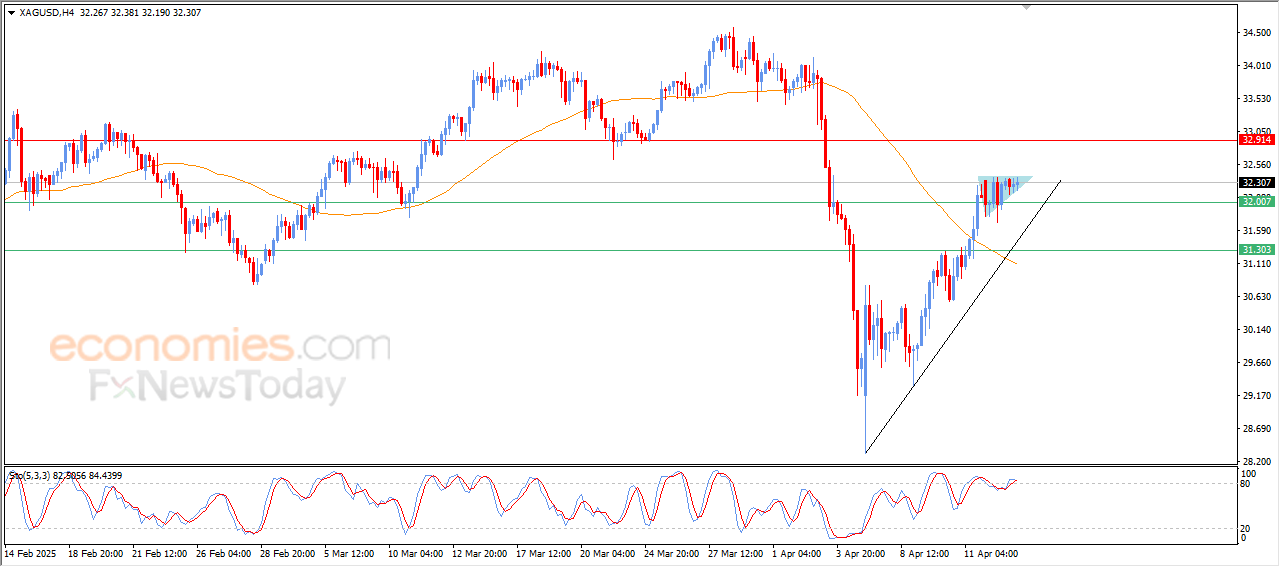
Friday’s advance to a high of $32.31 completed a 61.8% Fibonacci retracement at $32.19 and tested resistance at another trendline. The day ended at the high of the day and at the trendline but above the Fibonacci level. Signs of strength continued Monday, today, as silver traded in the top half of last Friday’s wide range day. It is on track to close strong, near the highs of the day and possibly above last week’s high. Therefore, a daily close above $32.31 will confirm the bull trend continuation signal.
Nevertheless, in the short-term silver may be extended as it challenges a key resistance zone. In particular, the 50-Day MA is at $32.51. It was a key trend indicator showing potential support until it failed on April 3, as silver fell sharply through the 20-Day MA, the 50-Day MA, and an uptrend line in one day. The decline was confirmed with a daily close below the trendline.
Prior support of the uptrend was successfully tested as resistance last Friday and then again today. Since silver has advanced by as much as $4.08 or 14.4% as of today’s high, bullish momentum may not be strong enough to reclaim the 50-Day MA and keep rising. A pullback or consolidation may come first. That was a relatively sharp advance in a short amount of time.
However, if silver can reclaim the 50-Day line and then keep rising, the 20-Day MA could see signs of resistance, now at $32.66, and the 78.6% retracement is at $33.25. Either price level could see signs of resistance. A daily close above the 50-Day MA will show continued strength and improve the chance of siler continuing higher.
For a look at all of today’s economic events, check out our economic calendar.