The main tag of Gold Today Price Articles.
You can use the search box below to find what you need.
[wd_asp id=1]
The main tag of Gold Today Price Articles.
You can use the search box below to find what you need.
[wd_asp id=1]
Platinum price was little changed despite a host of positive factors, especially positive signals from major indicators, with the price engaging in sideways trading near $990.00, while being impacted by the formation of $1000.00 as an important barrier.
The price will likely continue to trade sideways, with a potential of some negative waves towards $976.00 and $964, however, a breach of the aforementioned barrier would open the door for more gains towards $1017.
Expected trading range today is between the $975.00 support and the $1000 resistance.
Today’s price forecast: Sideways within an upward path
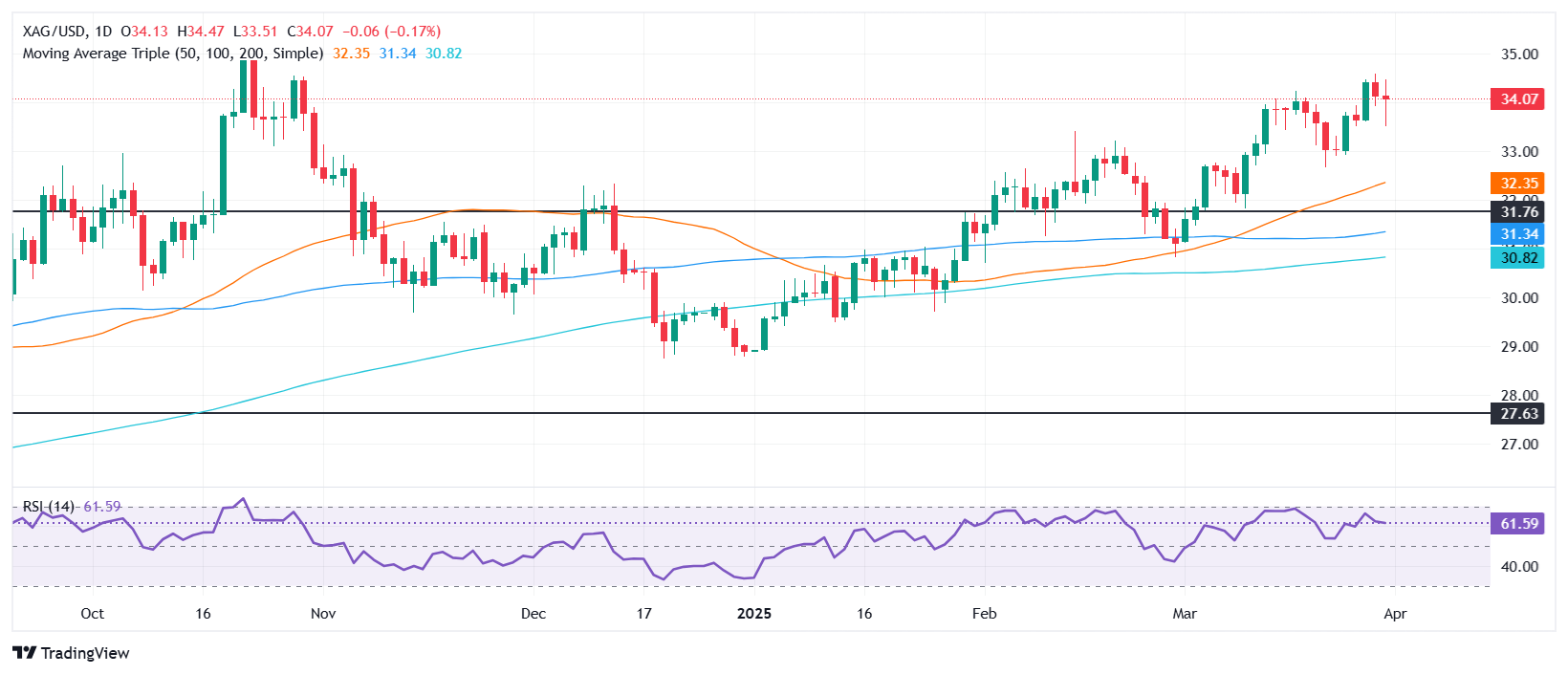
Silver (XAG/USD) oscillates in a narrow trading band following the previous day’s good two-way price moves, though it holds above the $34.00 mark through the Asian session on Tuesday. Moreover, the white metal remains close to a multi-month high, around the $34.60 area touched last Friday.
Looking at the broader picture, the recent strong positive move witnessed since the beginning of 2025 has been along an upward-sloping channel. This points to a well-established short-term uptrend. Furthermore, oscillators on the daily chart are holding comfortably in positive territory and are still away from being in the overbought zone. This, in turn, suggests that the path of least resistance for the XAG/USD is to the upside.
Hence, a move beyond the year-to-date high around the $34.60 area, towards retesting a multi-year peak near the $34.85 region touched in October, looks like a distinct possibility. The latter now coincides with the top boundary of the aforementioned trend channel, which if cleared decisively will be seen as a fresh trigger for bulls and set the stage for a further near-term appreciating move for the XAG/USD.
On the flip side, any corrective pullback might continue to attract some dip-buyers and remain limited near the overnight swing low, around mid-$33.00s. A convincing break below, however, might prompt some technical selling and drag the XAG/USD to the $33.00 round figure, en route to the $32.65 region and the $32.00 mark. The latter represents the lower end of the ascending trend channel and should act as a strong base for the commodity.
Silver is a precious metal highly traded among investors. It has been historically used as a store of value and a medium of exchange. Although less popular than Gold, traders may turn to Silver to diversify their investment portfolio, for its intrinsic value or as a potential hedge during high-inflation periods. Investors can buy physical Silver, in coins or in bars, or trade it through vehicles such as Exchange Traded Funds, which track its price on international markets.
Silver prices can move due to a wide range of factors. Geopolitical instability or fears of a deep recession can make Silver price escalate due to its safe-haven status, although to a lesser extent than Gold’s. As a yieldless asset, Silver tends to rise with lower interest rates. Its moves also depend on how the US Dollar (USD) behaves as the asset is priced in dollars (XAG/USD). A strong Dollar tends to keep the price of Silver at bay, whereas a weaker Dollar is likely to propel prices up. Other factors such as investment demand, mining supply – Silver is much more abundant than Gold – and recycling rates can also affect prices.
Silver is widely used in industry, particularly in sectors such as electronics or solar energy, as it has one of the highest electric conductivity of all metals – more than Copper and Gold. A surge in demand can increase prices, while a decline tends to lower them. Dynamics in the US, Chinese and Indian economies can also contribute to price swings: for the US and particularly China, their big industrial sectors use Silver in various processes; in India, consumers’ demand for the precious metal for jewellery also plays a key role in setting prices.
Silver prices tend to follow Gold’s moves. When Gold prices rise, Silver typically follows suit, as their status as safe-haven assets is similar. The Gold/Silver ratio, which shows the number of ounces of Silver needed to equal the value of one ounce of Gold, may help to determine the relative valuation between both metals. Some investors may consider a high ratio as an indicator that Silver is undervalued, or Gold is overvalued. On the contrary, a low ratio might suggest that Gold is undervalued relative to Silver.
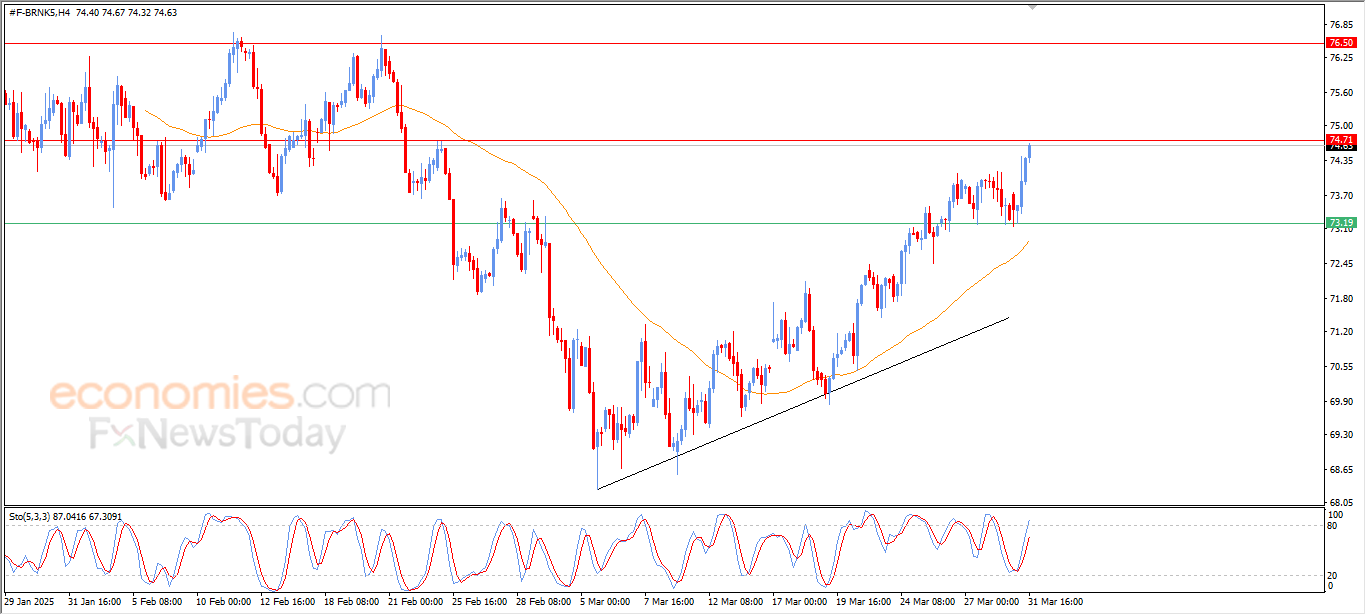
US crude oil price kept rising in latest intraday trading, after considerable gains yesterday that pushed the price to February highs, while buoyed by the dominance of the upward correctional trend in the short term as the price trades alongside the trend line, with positive support due to trading above the 50-candle SMA.
However, we’re noticing a slowdown in the pace of gains in latest intraday trading due to profit-taking, while the price tries to vent off overbought saturation from the Stochastic, as negative signals emerge from it.
To get our more detailed analysis and 100% accurate signals provided by Best Trading Signal, subscribe to Economies.com VIP Club through the link below!
Gold price closes in on the $3,150 psychological mark in Asian trading on Tuesday, extending its record rally. Gold buyers eagerly await the US announcement of “reciprocal tariffs” on Wednesday for a fresh directional impetus. In the meantime, tariff updates and top-tier US data will likely keep them entertained.
The traditional safe-haven Gold price sees a fresh leg higher early Tuesday after pulling back slightly from record highs in the late American session on Monday. Tensions over Wednesday’s US tariff announcement and its economic fallout reignited after President Donald Trump rejected plans for narrower tariffs late Monday, noting that his reciprocal tariffs plan will target all other countries.
US Treasury Secretary Scott Bessent singled out what he called the “Dirty 15” — the 15% of countries that trade heavily with the US and have high tariffs. Bessent added that Trump will announce these tariffs on April 2 at 19:00 GMT.
Renewed tensions surrounding the scope of the ‘reciprocal tariffs’ fuelled a fresh bout of US Dollar (USD) selling as the trade barriers are expected to dent the US economic prospects.
A potential US stagflation could prompt the Federal Reserve (Fed) to deliver aggressive interest rate cuts. This narrative weighs heavily on the USD and the US Treasury bond yields, while the Gold price challenges record highs.
The bright metal also capitalises on increased buying from central banks and rising exchange-traded funds (ETF) inflows amid the market unrest and panic. Gold price remains on course for its strongest quarter since 1986.
However, the Gold price could witness another pullback in the sessions ahead if traders adjust their long positions in anticipation of Trump’s ‘Liberation Day’ on April 2. Markets could also use the US economic data releases as an excuse to take profits off the table, bracing for Trump’s ‘reciprocal tariffs,’ which are expected to induce intense volatility.
The daily chart indicates that the 14-day Relative Strength Index (RSI) remains in the highly overbought region, currently at 78.50, suggesting that buyers may be exhausted.
Therefore, a brief pullback could ensue, dragging Gold price back toward the $3,100 round level.
The next relevant support is seen at the previous day’s low of $3,077, below which the $3,050 psychological barrier will be tested.
On the flip side, Gold buyers need to find acceptance above the $3,150 threshold to initiate a fresh advance toward the $3,200 level.
Gold has played a key role in human’s history as it has been widely used as a store of value and medium of exchange. Currently, apart from its shine and usage for jewelry, the precious metal is widely seen as a safe-haven asset, meaning that it is considered a good investment during turbulent times. Gold is also widely seen as a hedge against inflation and against depreciating currencies as it doesn’t rely on any specific issuer or government.
Central banks are the biggest Gold holders. In their aim to support their currencies in turbulent times, central banks tend to diversify their reserves and buy Gold to improve the perceived strength of the economy and the currency. High Gold reserves can be a source of trust for a country’s solvency. Central banks added 1,136 tonnes of Gold worth around $70 billion to their reserves in 2022, according to data from the World Gold Council. This is the highest yearly purchase since records began. Central banks from emerging economies such as China, India and Turkey are quickly increasing their Gold reserves.
Gold has an inverse correlation with the US Dollar and US Treasuries, which are both major reserve and safe-haven assets. When the Dollar depreciates, Gold tends to rise, enabling investors and central banks to diversify their assets in turbulent times. Gold is also inversely correlated with risk assets. A rally in the stock market tends to weaken Gold price, while sell-offs in riskier markets tend to favor the precious metal.
The price can move due to a wide range of factors. Geopolitical instability or fears of a deep recession can quickly make Gold price escalate due to its safe-haven status. As a yield-less asset, Gold tends to rise with lower interest rates, while higher cost of money usually weighs down on the yellow metal. Still, most moves depend on how the US Dollar (USD) behaves as the asset is priced in dollars (XAU/USD). A strong Dollar tends to keep the price of Gold controlled, whereas a weaker Dollar is likely to push Gold prices up.
An initial target from the bull wedge is the beginning of the wedge at $4.26. That target was essentially satisfied today. Nonetheless, that doesn’t mean the advance is over, but maybe natural gas takes a rest first via a pullback or consolidation before attempting higher prices. Also, when adding the height in price to the breakout level, an alternative potential target of $4.40 is established. As with all targets they are estimates that may or may not be reached.
A decline below Monday’s low of $4.055 is a sign of further short-term weakening that could lead to a move lower to test prior resistance areas as support. Two initial price areas to watch for signs of support include prior support from the mid-March interim swing low at $3.96, and the 50-Day MA, now at $3.87. It is interesting to note that the breakout of the top line of the wedge occurred at a similar price area.
Following the reclaim of the 50-Day MA on February 13, the 50-Day line successfully tested as support in early-March and a higher swing low was established. Although the recent decline failed to find support at the 50-Day MA, the subsequent quick bullish recovery can be viewed as a successful test of support at the 50-Day line.
For a look at all of today’s economic events, check out our economic calendar.
Silver price falls slightly after hitting a daily high of $34.46, trading at $34.02 amid a strong US Dollar and falling US Treasury yields.
Market mood improved slightly, but traders are awaiting April 2, US Liberation Day, on which US President Donald Trump is expected to unveil tariffs. Speculation suggests that the US will apply 20% universal tariffs.
Silver remains upward biased, despite retreating somewhat as a ‘high wave candle’ forms. After climbing over 5% in the last four days, indecision keeps buyers and sellers from opening fresh aggressive bets, as they could be awaiting the closing price.
If XAG/USD closes above $34, this could be bullish and pave the way for further upside. The first resistance will be the year-to-date (YTD) high of $34.58. On further strength, the next ceiling level would be $35.00, followed by the October 2012 peak at $35.40.
Conversely, if XAG/USD falls below $34.00, the first support will be the March 31 low of $33.51, followed by the $33.00 figure.
Silver is a precious metal highly traded among investors. It has been historically used as a store of value and a medium of exchange. Although less popular than Gold, traders may turn to Silver to diversify their investment portfolio, for its intrinsic value or as a potential hedge during high-inflation periods. Investors can buy physical Silver, in coins or in bars, or trade it through vehicles such as Exchange Traded Funds, which track its price on international markets.
Silver prices can move due to a wide range of factors. Geopolitical instability or fears of a deep recession can make Silver price escalate due to its safe-haven status, although to a lesser extent than Gold’s. As a yieldless asset, Silver tends to rise with lower interest rates. Its moves also depend on how the US Dollar (USD) behaves as the asset is priced in dollars (XAG/USD). A strong Dollar tends to keep the price of Silver at bay, whereas a weaker Dollar is likely to propel prices up. Other factors such as investment demand, mining supply – Silver is much more abundant than Gold – and recycling rates can also affect prices.
Silver is widely used in industry, particularly in sectors such as electronics or solar energy, as it has one of the highest electric conductivity of all metals – more than Copper and Gold. A surge in demand can increase prices, while a decline tends to lower them. Dynamics in the US, Chinese and Indian economies can also contribute to price swings: for the US and particularly China, their big industrial sectors use Silver in various processes; in India, consumers’ demand for the precious metal for jewellery also plays a key role in setting prices.
Silver prices tend to follow Gold’s moves. When Gold prices rise, Silver typically follows suit, as their status as safe-haven assets is similar. The Gold/Silver ratio, which shows the number of ounces of Silver needed to equal the value of one ounce of Gold, may help to determine the relative valuation between both metals. Some investors may consider a high ratio as an indicator that Silver is undervalued, or Gold is overvalued. On the contrary, a low ratio might suggest that Gold is undervalued relative to Silver.
Disclaimer: For information purposes only. Past performance is not indicative of future results.
Gold price resumed its advance in latest intraday trading after trying to collect some recent profits and gather positive momentum to regain its footing, after reaching our price target of $3120, amid the complete dominance of the upward trend, while the price trades alongside the secondary short-term trend line.
To get our more detailed analysis and 100% accurate signals provided by Best Trading Signal, subscribe to Economies.com VIP Club through the link below!
Fears dominated financial markets at the weekly opening, resulting in XAU/USD reaching an all-time high of $3,128.14. A near-term pullback attracted buyers, and Gold retains most of its early gains in the mid-American session.
Demand for the bright metal is directly related to market fears. Concerns revolve around United States (US) President Donald Trump’s tariffs. Market players are not only worried about the upcoming reciprocal tariffs announced for April 2, but also about fresh levies on Oil.
Trump offered an interview to NBC earlier in the day, and said he was “very angry” with Russian President Vladimir Putin, after the latter criticized the credibility of their Ukrainian counterpart Volodymyr Zelenskyy. Trump added that if he believes Russia is responsible for not reaching a ceasefire with Ukraine, he may impose secondary tariffs on Russian oil.
Secondary tariffs had already been announced on Venezuela, with Trump saying that he would place additional levies on countries that bought oil and gas from the South American country. Speculative interest rushed away from high-yielding stocks, with global indexes falling under strong selling pressure amid concerns that tariffs will have a negative impact on worldwide economic growth.
Data-wise, the focus this week will be on US employment-related data. The country will release the JOLTS Job Openings report on Tuesday and the ADP Employment Change survey on Wednesday. Finally on Friday, the country will release the March Nonfarm Payrolls (NFP) report.
From a technical point of view, the daily chart for the XAU/USD pair shows it’s up for a third consecutive session, and despite overbought readings, there are no technical signs of a directional change. The pair develops far above all its moving averages, with a bullish 20 Simple Moving Average (SMA) gaining upward traction and currently at around $2,991.20. In the meantime, technical indicators stand at extreme levels, partially losing their bullish strength, yet still heading north.
The 4-hour chart for the XAU/USD pair shows indicators retreating from their tops, but are still at extreme overbought readings. At the same time, all moving averages aim north, with the 20 SMA accelerating further north at around $3,065.90. Buyers are still taking their chances on dips, although a steeper corrective slide is not out of the picture, given the extreme overbought conditions in multiple time frames.
Support levels: 3,107.40 3,095.50 3,082.90
Resistance levels: 3,128.50 3,145.00 3,160.00
Notice on the chart that last week’s new near-term trend high of $33.59 found resistance at the confluence of several indicators. They include the completion of a 100% target for a rising ABCD pattern at $34.51, and two trendlines that mark the top of rising parallel trend channels. There is a larger uptrend that begins from the August 2022 lows and a shorter advance starting from the December lows.
It can be argued that one of the top channel lines may not be in the perfect location. But the fact that the two lines converged around the same price at the time that silver was approaching, and then resistance was seen, followed by a one-day bearish reversal today, shows why confluence can be so useful.
Since the 20-Day MA was reclaimed on March 11 there has been only one dip to test is at as support. That happened on March 21, and it established a higher swing low. Since resistance has been seen from a high of $34.59, a successful test of support at or above the 20-Day MA, now at $33.35, seems possible. If price is rejected from the area around the 20-Day line, it would be bullish for the short-term uptrend that starts from the late-February higher swing low (C).
That swing low found support around the 50-Day MA. If this or a similar scenario unfolds then silver may continue to challenge highs and resistance around the top channel lines. Whether that could lead to a sustainable advance or not remains to be seen. It is important to add that silver ended last week at its highest weekly closing price since October 2012. This is consistent with the bullish long-term patterns in the price of silver.
For a look at all of today’s economic events, check out our economic calendar.
Even as the Stochastic continues to send out negative signals, as the price holds its ground above $5.00, it underpins the upward trend, however the price might engage in some sideways trading to gather enough momentum and rush towards $5.150, then target the major resistance at $5.340.
However, a breach of $5.00 would send the price towards more correctional negative trades towards $4.9200, then $4.8100.
Expected trading range today is between $5.000 and
$5.1500.
Today’s price forecast: Bullish