The main tag of Gold Today Price Articles.
You can use the search box below to find what you need.
[wd_asp id=1]
The main tag of Gold Today Price Articles.
You can use the search box below to find what you need.
[wd_asp id=1]
Copper prices are influenced by a variety of factors, but they can be broadly categorised into the following five key drivers:
Copper is closely tied to economic growth, making it a reliable barometer for global health. Indicators such as GDP growth, industrial production, and manufacturing activity directly influence demand. Infrastructure projects, urbanisation, and the transition to renewable energy – like EVs and wind turbines – further fuel demand during periods of economic expansion.
Supply disruptions, such as labour strikes, declining ore grades, or natural disasters, can tighten the market and drive up prices. Major producers like Chile and Peru dominate global supply, meaning any instability in these regions significantly impacts copper availability and pricing.
Investor behaviour plays a major role in copper price fluctuations. Optimism about future demand, driven by trends like the energy transition, can create bullish momentum, while negative sentiment tied to economic slowdowns can cause prices to drop. Speculative activity in futures markets often amplifies these trends.
Geopolitical events, trade policies, and currency fluctuations significantly influence copper prices. Tensions between major economies, tariffs, and export restrictions can disrupt global trade flows, while a stronger US dollar often makes copper more expensive for non-dollar economies.
Monetary policies, particularly interest rate decisions, indirectly impact copper demand. Low interest rates encourage borrowing and investment in infrastructure, boosting demand. Conversely, rising interest rates or inflation can curb economic activity and reduce the need for industrial metals.
When it comes to copper’s historical performance, the brown metal has been a valuable resource for millennia, with its use dating back to ancient civilisations for tools, weapons, and currency. While no formal markets existed in early history, copper’s utility ensured its consistent demand.
In modern history, copper prices began to fluctuate with industrialisation. By the 1930s, copper traded at around $0.10 per pound during the Great Depression, following a steep decline from earlier highs. The post-World War II era saw steady growth in demand due to electrification and industrial expansion, with prices averaging between $0.30 and $0.60 per pound through the mid-20th century.
The 2000s marked a significant turning point. Copper prices surged from under $0.80 per pound in 2003 to nearly $4.00 by 2008, driven by China’s rapid industrialisation. However, the 2008 global financial crisis caused prices to plummet to around $1.40 per pound before rebounding quickly as infrastructure investment picked up. By 2011, copper reached over $4.50 per pound.
More recently, the energy transition and growing demand for electric vehicles (EVs) have sustained elevated copper prices. In May 2021, copper peaked at $4.80 per pound, fuelled by supply constraints and optimism around renewable energy projects. However, economic slowdowns in China, rising inflation, and monetary tightening have created price volatility. Over the past few years, copper prices have fluctuated between $3.50 and $4.50 per pound.
Today, copper remains a vital industrial asset, with its performance influenced by global economic activity, sustainability trends, and technological advancements. Its role in the green energy transition ensures its long-term significance, offering opportunities for traders to capitalise on price movements.
When approaching your copper trading strategy, it’s essential to recognise the opportunities and risks associated with this vital industrial metal. Copper’s role as an economic indicator and its importance in industries like construction, electronics, and renewable energy make it a dynamic asset to trade. Developing a robust trading strategy aligned with your goals, experience, and risk tolerance is critical for navigating its price volatility.
A well-planned trading strategy can help you open, manage, and close positions more effectively while minimising potential losses. Copper traders often combine technical analysis and fundamental insights to determine optimal entry and exit points.
Technical strategies for copper rely on chart indicators to track price movements, identify patterns, and generate buy or sell signals. For instance:
These tools allow traders to interpret historical price data. Remember that past performance is not a reliable indicator of future results
Price action trading focuses on analysing copper’s historical price movements to anticipate future trends. For example:
Copper’s liquidity and volatility make this strategy a potential choice for short-term traders.
Trend trading involves taking long-term positions based on the direction of copper’s price trend. Traders may choose to:
Go long during periods of rising prices, driven by factors such as increased demand for electric vehicles or renewable energy infrastructure.
Short copper during economic slowdowns or increased supply from major producers like Chile and Peru.
Fundamental factors, such as China’s economic performance or changes in mining output, play a critical role in this strategy.
News trading capitalises on market-moving events that influence copper prices. Examples include:
Geopolitical events: labour strikes in major copper-producing nations can tighten supply and push prices higher.
Economic data: strong manufacturing data from China often signals rising copper demand, leading to price increases.
Weather disruptions: natural disasters affecting mines can lead to supply constraints.
Staying updated on news and analysis is crucial for implementing this strategy effectively.
Range trading identifies support and resistance levels within which copper prices fluctuate. For instance, if copper is trading in a range of $3.50-$4.50:
Support level: prices near $3.50 per pound (an undervalued zone).
Resistance level: prices nearing $4.50 per pound (an overbought zone).
Using tools like Bollinger Bands, traders buy at support and sell at resistance, leveraging copper’s historical price behaviour.
Breakout trading targets opportunities when copper prices move outside of established ranges, signaling potential volatility. For example:
Breakouts often occur due to significant market catalysts, such as policy changes in China or major supply disruptions.
Fundamental trading in copper focuses on analysing supply-demand dynamics rather than relying solely on technical indicators. You can consider:
Going long on copper during periods of strong economic growth or increased infrastructure investment.
Shorting copper when global demand slows or mining output increases significantly.
This strategy requires a deep understanding of macroeconomic trends, particularly those tied to industrial production and the energy transition.
Diversify your strategies: instead of relying on a single approach, consider a mix of strategies based on market conditions. For instance, position trading might work well in a bullish market, while trend trading can be effective in volatile conditions.
Stay educated: regularly update your knowledge of market trends, economic indicators, and sector performance. Enrolling in commodity trading courses or following expert analysts can deepen your expertise.
Disclaimer: All figures included in the above examples are for illustrative purposes only and do not reflect actual market data or real account conditions.
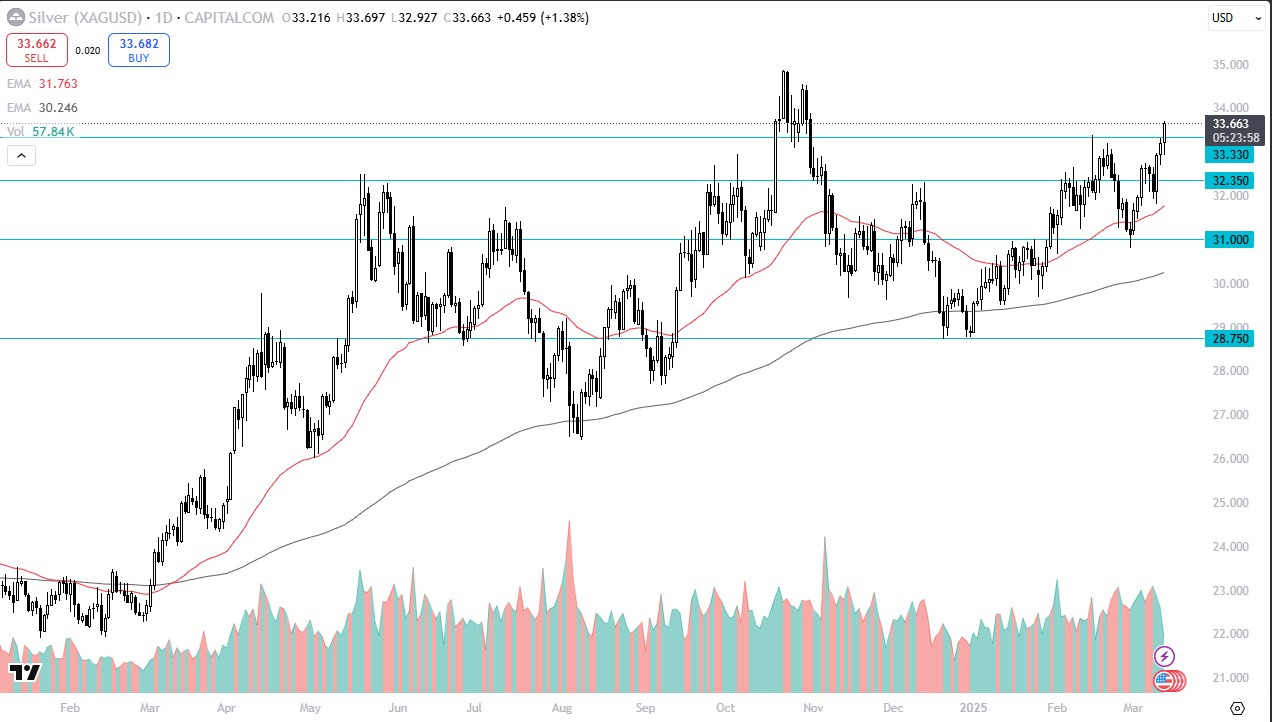
With gold breaking out, it seems like it dragged silver right along with it. All things being equal, this is a market that is not at all-time highs by any stretch of the equation, but it looks to me as if this is a market that is going to do everything it can to get to the $35 level. Even if we were to break down from here, I suspect that there are plenty of buyers underneath that will continue to jump into the silver market, so it becomes more or less a “buy on the dips” scenario.

The technical analysis for the XAG/USD is rather bullish, as you can imagine, and if the market were to pull back at any juncture, I anticipate that there should be plenty of people willing to get involved and start taking advantage of “cheap ounces of silver.” If we can break above the $35 level, then we could have a massive move to the upside just waiting to happen. On the other hand, if we do pull back, I suspect that there are plenty of buyers at the $33.33 level, and then again at the $32.35 level.
At this point in time, I have no interest whatsoever in trying to short the silver market, because it is far too strong, and I think it would be foolish to try to get bearish at this point, even if we do need some type of pullback in order to attract traders sooner or later.
Ready to trade our daily Forex forecast? Here’s a list of some of the Top Silver Trading Brokers to choose from.
The EURJPY pair formed new decline yesterday to achieve the first negative target at 160.00, forming new additional support line, to push it to form temporary positive rebound and settle near 161.05.
Now, stochastic attempt to provide the negative momentum and the stability of 161.60 barrier allow us to keep the negative overview, waiting to attack 160.00 level again, while breaking it will open the way to target new negative stations that might extend towards 159.30 and 158.85 levels.
The expected trading range for today is between 160.00 and 161.60
Trend forecast: Bearish
Barclays on Friday lowered its 2025 Brent oil price forecast by $9 per barrel to $74 per barrel, citing a softer demand outlook amid elevated economic uncertainty.
Brent crude futures were trading around $70 a barrel on Friday, after settling 1.5% lower in the previous session. U.S. West Texas Intermediate crude CL1! was at around $67 a barrel.
“We turn neutral on oil prices relative to the curve and consensus, as we revise down our 2025 demand outlook 510,000 barrels per day due to soft high-frequency indicators and elevated economic uncertainty,” analysts at Barclays said in a note.
“However, we do not turn bearish relative to the curve, as inventories are low and still declining, and risks to the supply outlook are also skewed to the downside, due to price-sensitive producers pulling back and geopolitical tensions,” it said.
The International Energy Agency warned on Thursday that global oil supply could exceed demand by around 600,000 barrels per day this year, due to growth led by the U.S. and weaker-than-expected global demand.
Barclays, which expects U.S. crude output to rise by 200,000 barrels per day by the end of the fourth quarter from the year-earlier period, also lowered its oil demand outlook sharply and now expects growth of 900,000 barrels per day for the full year.
Gold price is hanging close to a new record high set on Thursday, biding time before the next move higher to clinch the $3,000 threshold for the first time.
Amid another record-rally, Gold price will likely book the second weekly gain, up roughly 2.5% so far this week. US President Donald Trump’s induced trade war, along with increased expectations of monetary policy easing by the US Federal Reserve (Fed), sponsored the Gold price upsurge.
However, Gold buyers appear to turn cautious as the recent rally paused just shy of the $3,000 psychological hurdle. Traders could use that as an excuse to take profits off the table on their Gold long positions before next week’s Fed policy announcements.
The renewed demand from the US Dollar (USD) and the US Treasury bond yields also act as a headwind to the upbeat momentum in Gold price. The improvement in risk sentiment on an aversion to the US government shutdown and hopes of a US-Canada trade truce diminish the demand for the US government bonds, lifting the US Treasury bond yields and the USD.
US Senate Democratic Leader Chuck Schumer said late Thursday, “I will vote to keep the government open, and not shut it down.” Meanwhile, Ontario Premier Doug Ford said there will be another meeting next week between Canadian and American trade officials, following his meeting with US Commerce Secretary Howard Lutnick.
Doug added, “we’re having very productive conversations and they’re turning out very, very well.”
In the day ahead, it remains to be seen if risk sentiment remains in a sweet spot as escalating trade tensions between the US and the European Union (EU) could haunt markets, reviving the safe-haven appeal of the Gold price.
Amid an escalating trade war, the EU responded to blanket US tariffs on steel and aluminium by imposing a 50% tax on American whiskey exports, prompting Trump to threaten a 200% tariff on imports of European wines and spirits.
If fears over global trade war intensify, they will likely raise risks of a recession and the odds of the Fed lowering rates further, fuelling a fresh downswing in the USD while boosting Gold price to fresh lifetime highs.
Markets also weigh in on the US-Russia talks for a ceasefire in the Ukraine conflict. Russian President Vladimir Putin said on Thursday that he agreed in principle with US proposals to halt the fighting but said he wanted to address the “root causes of the conflict”.
“We need to discuss this with our American partners – perhaps a call with Donald Trump,” Putin added.
The US Consumer Sentiment and Inflation Expectations data will play second fiddle to the tariff and geopolitical headlines heading into the weekend.
Gold price confirmed an upside break of an ascending triangle formation after closing Thursday above the horizontal trendline resistance at $2,956.
Gold buyers need to scale the $3,000 psychological barrier to extend the record-rally toward the $3,050 mark.
The 14-day Relative Strength Index (RSI) sits just beneath the overbought region, which is currently near 68 and keeps buyers hopeful.
Therefore, any retracement in Gold price will likely be quickly bought amid bargain hurting.
On a corrective downside, Gold price could challenge the previous triangle resistance-turned-support at $2,919.
The last line of defense for buyers is at the triangle support line, pegged at $2,898.
Tariffs are customs duties levied on certain merchandise imports or a category of products. Tariffs are designed to help local producers and manufacturers be more competitive in the market by providing a price advantage over similar goods that can be imported. Tariffs are widely used as tools of protectionism, along with trade barriers and import quotas.
Although tariffs and taxes both generate government revenue to fund public goods and services, they have several distinctions. Tariffs are prepaid at the port of entry, while taxes are paid at the time of purchase. Taxes are imposed on individual taxpayers and businesses, while tariffs are paid by importers.
There are two schools of thought among economists regarding the usage of tariffs. While some argue that tariffs are necessary to protect domestic industries and address trade imbalances, others see them as a harmful tool that could potentially drive prices higher over the long term and lead to a damaging trade war by encouraging tit-for-tat tariffs.
During the run-up to the presidential election in November 2024, Donald Trump made it clear that he intends to use tariffs to support the US economy and American producers. In 2024, Mexico, China and Canada accounted for 42% of total US imports. In this period, Mexico stood out as the top exporter with $466.6 billion, according to the US Census Bureau. Hence, Trump wants to focus on these three nations when imposing tariffs. He also plans to use the revenue generated through tariffs to lower personal income taxes.
Important DisclaimersThe content provided on the website includes general news and publications, our personal analysis and opinions, and contents provided by third parties, which are intended for educational and research purposes only. It does not constitute, and should not be read as, any recommendation or advice to take any action whatsoever, including to make any investment or buy any product. When making any financial decision, you should perform your own due diligence checks, apply your own discretion and consult your competent advisors. The content of the website is not personally directed to you, and we does not take into account your financial situation or needs.The information contained in this website is not necessarily provided in real-time nor is it necessarily accurate. Prices provided herein may be provided by market makers and not by exchanges.Any trading or other financial decision you make shall be at your full responsibility, and you must not rely on any information provided through the website. FX Empire does not provide any warranty regarding any of the information contained in the website, and shall bear no responsibility for any trading losses you might incur as a result of using any information contained in the website.The website may include advertisements and other promotional contents, and FX Empire may receive compensation from third parties in connection with the content. FX Empire does not endorse any third party or recommends using any third party’s services, and does not assume responsibility for your use of any such third party’s website or services.FX Empire and its employees, officers, subsidiaries and associates, are not liable nor shall they be held liable for any loss or damage resulting from your use of the website or reliance on the information provided on this website.Risk DisclaimersThis website includes information about cryptocurrencies, contracts for difference (CFDs) and other financial instruments, and about brokers, exchanges and other entities trading in such instruments. Both cryptocurrencies and CFDs are complex instruments and come with a high risk of losing money. You should carefully consider whether you understand how these instruments work and whether you can afford to take the high risk of losing your money.FX Empire encourages you to perform your own research before making any investment decision, and to avoid investing in any financial instrument which you do not fully understand how it works and what are the risks involved.
The GBPJPY pair ended the recent sideways fluctuation by providing positive close above the additional support at 190.60, to start reacting to stochastic positivity by rallying towards 192.30 now and reinforce the chances of renewing the bullish attempts.
Facing continuous positive pressures will assist to target 50% Fibonacci correction level at 193.25 soon, and breaching this barrier will confirm its preparation to achieve additional gains by rallying towards 193.80 and 194.40 levels.
The expected trading range for today is between 191.20 and 193.25
Trend forecast: Bullish
Platinum price confirmed its surrender to the domination of the bullish bias by rallying above 50% Fibonacci correction level at 983.00$ yesterday, to notice forming new bullish waves and achieve the target at 998.00$.
The frequent stability above 983.00$ and the major indicators that provide the positive momentum will increase the efficiency of the bullish rally, to keep waiting to target new positive stations by targeting 1005.00$ followed by reaching the next barrier at 1017.00$.
The expected trading range for today is between 983.00$ and 1005.00$
Trend forecast: Bullish
May arabica coffee (KCK25) today is down -4.80 (-1.24%), and May ICE robusta coffee (RMK25) is down -91 (-1.68%).
Coffee prices today extended Thursday’s sharp losses on forecasts for rain in Brazil. Somar Meteorologia said Thursday that dry and hot weather in Brazil for the rest of this week will give way to several days of showers next week, easing dry conditions.
Commodity Bulletin: From crude oil to coffee, this FREE newsletter is for industry pros and rookies alike
Robusta coffee is also under pressure after Vietnam’s General Statistics Office reported Thursday that Vietnam’s Feb coffee exports rose +6.6% y/y to 169,000 MT. Also, the outlook for rain in Vietnam is weighing on coffee prices, with forecasts showing a chance of rain every day for the next week in Vietnam’s Central Highlands, the country’s largest coffee-growing region.
A rebound in coffee inventories is bearish for coffee prices after ICE-monitored robusta coffee inventories rose to a 1-month high today of 4,356 lots. Meanwhile, ICE-monitored arabica coffee inventories slid to a 9-1/4 month low on February 18 at 758,514 bags, although they have since recovered to a 2-week high of 809,128 bags as of last Thursday.
Last Monday, Somar Meteorologia reported that Brazil’s biggest arabica coffee growing area of Minas Gerais received 11.4 mm the week ended February 22, or 24% of the historical average. This past Monday’s rain report was delayed by the Brazilian Carnival holiday. Brazil is the world’s biggest arabica coffee growing country.
In a bullish factor, an increased percentage of Brazil’s coffee harvest has already been sold compared with previous years, meaning less supply is still available. Safras & Mercado reported last Monday that producers sold 88% of Brazil’s 2024/25 coffee harvest as of February 11, faster than last year’s comparable year-earlier figure of 79% and the 5-year average of 82%. Meanwhile, sales of the 2025/26 crop have been slow at 13% of the crop, well behind the 4-year average of 22%, which suggests a lack of new supply and an unwillingness of producers to sell.
Continued supply fears have supported coffee prices. Cecafe reported on February 12 that Brazil’s January green coffee exports fell -1.6% y/y to 3.98 million bags. Also, on January 28, Conab, Brazil’s government crop forecasting agency, forecasted that Brazil’s 2025/26 coffee crop would fall -4.4% y/y to a 3-year low of 51.81 million bags. Conab also cut its 2024 Brazil coffee crop estimate by -1.1% to 54.2 million bags from a September estimate of 54.8 million bags.
The impact of dry El Nino weather last year may lead to longer-term coffee crop damage in South and Central America. Rainfall in Brazil has consistently been below average since last April, damaging coffee trees during the all-important flowering stage and reducing the prospects for Brazil’s 2025/26 arabica coffee crop. Brazil has been facing the driest weather since 1981, according to the natural disaster monitoring center Cemaden. Also, Colombia, the world’s second-largest arabica producer, is slowly recovering from the El Nino-spurred drought last year.
Robusta coffee prices are underpinned by reduced robusta production. Due to drought, Vietnam’s coffee production in the 2023/24 crop year dropped by -20% to 1.472 MMT, the smallest crop in four years. The USDA FAS on May 31 projected that Vietnam’s robusta coffee production in the new marketing year of 2024/25 will dip slightly to 27.9 million bags from 28 million bags in the 2023/24 season. In addition, Vietnam’s General Statistics Office reported on January 10 that 2024 Vietnam coffee exports fell -17.1% y/y to 1.35 MMT. Conversely, the Vietnam Coffee and Cocoa Association on December 3 raised its 2024/25 Vietnam coffee production estimate to 28 million bags from an October estimate of 27 million bags.
News of larger global coffee exports is bearish for prices. Conab reported on February 4 that Brazil’s 2024 coffee exports rose +28.8% y/y to a record 50.5 million bags. However, ICO reported on February 6 that Dec global coffee exports fell -12.4% y/y to 10.73 million bags, and Oct-Dec global coffee exports fell -0.8% y/y to 32.25 million bags.
The USDA’s biannual report on December 18 was mixed for coffee prices. The USDA’s Foreign Agriculture Service (FAS) projected that world coffee production in 2024/25 will increase +4.0% y/y to 174.855 million bags, with a +1.5% increase in arabica production to 97.845 million bags and a +7.5% increase in robusta production to 77.01 million bags. The USDA’s FAS forecasts that 2024/25 ending stocks will fall by -6.6% to a 25-year low of 20.867 million bags from 22.347 million bags in 2023/24. Separately, the USDA’s FAS on November 22 projected Brazil’s 2024/25 coffee production at 66.4 MMT, below its previous forecast of 69.9 MMT. The USDA’s FAS projects Brazil’s coffee inventories at 1.2 million bags at the end of the 2024/25 season in June, down -26% y/y.
For the 2025/26 marketing year, Volcafe on December 17 cut its 2025/26 Brazil arabica coffee production estimate to 34.4 million bags, down by about 11 million bags from a September estimate after a crop tour revealed the severity of an extended drought in Brazil. Volcafe projects a global 2025/26 arabica coffee deficit of -8.5 million bags, wider than the -5.5 million bag deficit for 2024/25 and the fifth consecutive year of deficits.
On the date of publication,
did not have (either directly or indirectly) positions in any of the securities mentioned in this article. All information and data in this article is solely for informational purposes. For more information please view the Barchart Disclosure Policy
here.
More news from Barchart
The views and opinions expressed herein are the views and opinions of the author and do not necessarily reflect those of Nasdaq, Inc.
Brent oil price faced strong negative pressures in the previous sessions to break 70.75$ and settle below it, noticing that the price attempts to rise again, approaching the mentioned level, while stochastic loses its positive momentum clearly to enter the overbought areas.
To review the full report, and to get our more detailed analysis and 100% accurate signals provided by Best Trading Signal, subscribe to Economies.com VIP Club through the link below!