The main tag of Gold Today Price Articles.
You can use the search box below to find what you need.
[wd_asp id=1]
The main tag of Gold Today Price Articles.
You can use the search box below to find what you need.
[wd_asp id=1]
Recent support around $65.50 has some significance as it is near support from September of last year at $65.65, prior to the current decline, was the low price for crude oil since May of 2023. Following the 2023 low traded price, crude oil rallied to a peak of $95.50 before progressing lower and establishing a slow downtrend of lower swing highs and lower swing lows. Therefore, the drop to $65.50 recently established a slightly new low for the bear trend.
There are reasons to believe that support may be retained at that low and lead to at least a bounce before being challenged again. For one, the bearish correction from the $80.76 mid-January high was the deepest bearish correction of the prior four larger corrections, but not by much. There was an 18.3% decline from an August swing high, which was the largest decline of the four.
Although a bullish signal will be generated on a breakout of the double bottom, a potentially significant resistance zone is slightly higher from around $68.74 to $68.82. However, the 20-Day MA trend indicator, currently at $69.26, marks a more significant price area, along with a downtrend line. Since it is falling the 20-Day line may be within the price zone by the time it is approached. Subsequently, a lower swing high is at $70.81.
For a look at all of today’s economic events, check out our economic calendar.
Support around the 50-Day MA was successfully tested as support during the prior bearish decline following the January swing high. Therefore, if the trend breakdown continues lower then natural gas looks to be targeting the 50-Day MA (orange), now at $3.83. A sustained decline below the 20-Day MA enhances the potential for a test of support of the next higher moving average. There is also potential support around the recent swing low at $3.74.
It is joined by the 61.8% retracement at $3.72. A decline below that low will trigger a bearish reversal of the short bull trend that began from the late-January swing low at $2.99. Notice that the 20-Day MA has stayed above the 50-Day line since the 20-Day crossed above the 50-Day in September of last year, other than for a brief period recently. The bullish crossover followed a swing low at $1.88 in late August, which began a new upswing of a larger developing bull trend.
Also, since the immediate trendline may have been broken, the next lower trendline becomes a potential target. Notice that the lower rising trendlines show an acceleration in bullish momentum as the uptrend from the February 2024 bottom progressed. The most recent trendline shows an unsustainable rate of price appreciation. Since there has been a clearly bearish reaction following another test of resistance around the top of a rising parallel trend channel, there is the possibility that the next lower trendline may be tested before the current decline is complete.
For a look at all of today’s economic events, check out our economic calendar.
Silver price (XAG/USD) trades close to near the monthly high of $33.40 in North American trading hours on Thursday. The white metal strengthens as cooling United States (US) consumer and producer inflationary pressures pave the way for the Federal Reserve (Fed) to cut interest rates in the June policy meeting.
The US Producer Price Index (PPI) report showed that the headline and core producer inflation decelerated at a faster-than-expected pace to 3.2% and 3.4%, respectively, in 12 months to February. Month-on-month headline PPI remained flat while the core figure deflated by 0.1%.
On Wednesday, the US headline and core Consumer Price Index (CPI) rose by 2.8% and 3.1%, respectively, in February slower than their estimates and their prior releases.
Last week, Fed Chair Jerome Powell stated that the restrictive monetary policy stance won’t long last “if the labor market unexpectedly weakens or inflation falls more than expected”. The scenario of lower interest rates by the Fed bodes well for non-yielding assets, such as Silver.
On the global front, escalating economic risks due to US President Donald Trump’s tariff agenda have also improved the safe-haven demand of the Silver price. On Wednesday, Trump confirmed that he will respond to counter-tariffs from the European Union (EU). Such a scenario would result in the EU-US trade war, which will diminish the risk appetite of investors significantly.
The cautious market sentiment has also increased the safe-haven demand of the US Dollar (USD) but US economic risks and soft CPI report have capped its upside. The US Dollar Index (DXY), which tracks the Greenback’s value against six major currencies, rises to near 103.80 from its four-month low of 103.20, which it posted on Tuesday.
Silver price trades near the horizontal border of the Ascending Triangle chart pattern on a daily timeframe, which is placed from the February 14 high of $33.40. The upward-sloping border is placed from the December 31 low of $28.78. The above-mentioned chart pattern indicates indecisiveness among market participants.
The 20-day Exponential Moving Average (EMA) near $32.30, continues to support the Silver price.
The 14-day Relative Strength Index (RSI) climbs above 60.00. A bullish momentum would trigger if the RSI sustains above that level.
Looking down, the psychological level of $30.00 will act as key support for the Silver price. While, the October 22 high of $34.87 will be the major barrier.
Silver is a precious metal highly traded among investors. It has been historically used as a store of value and a medium of exchange. Although less popular than Gold, traders may turn to Silver to diversify their investment portfolio, for its intrinsic value or as a potential hedge during high-inflation periods. Investors can buy physical Silver, in coins or in bars, or trade it through vehicles such as Exchange Traded Funds, which track its price on international markets.
Silver prices can move due to a wide range of factors. Geopolitical instability or fears of a deep recession can make Silver price escalate due to its safe-haven status, although to a lesser extent than Gold’s. As a yieldless asset, Silver tends to rise with lower interest rates. Its moves also depend on how the US Dollar (USD) behaves as the asset is priced in dollars (XAG/USD). A strong Dollar tends to keep the price of Silver at bay, whereas a weaker Dollar is likely to propel prices up. Other factors such as investment demand, mining supply – Silver is much more abundant than Gold – and recycling rates can also affect prices.
Silver is widely used in industry, particularly in sectors such as electronics or solar energy, as it has one of the highest electric conductivity of all metals – more than Copper and Gold. A surge in demand can increase prices, while a decline tends to lower them. Dynamics in the US, Chinese and Indian economies can also contribute to price swings: for the US and particularly China, their big industrial sectors use Silver in various processes; in India, consumers’ demand for the precious metal for jewellery also plays a key role in setting prices.
Silver prices tend to follow Gold’s moves. When Gold prices rise, Silver typically follows suit, as their status as safe-haven assets is similar. The Gold/Silver ratio, which shows the number of ounces of Silver needed to equal the value of one ounce of Gold, may help to determine the relative valuation between both metals. Some investors may consider a high ratio as an indicator that Silver is undervalued, or Gold is overvalued. On the contrary, a low ratio might suggest that Gold is undervalued relative to Silver.
Gold prices (XAU/USD) advanced for a third consecutive day on Thursday, soaring to all-time highs past the $2,980 mark per troy ounce and setting the stage for a potential test of the psychological $3,000 threshold.
The precious metal’s steady climb has entered its second straight week, with gold posting gains in the first three months of the new year. Looking at the bigger picture, the yellow metal has only recorded monthly losses four times since 2024.
Since President Trump’s inauguration on January 20, US trade policy has taken center stage. However, the lack of a clear direction—highlighted by announcements of new tariffs followed by abrupt reversals—has heightened uncertainty among market participants, who see the administration’s trade stance as anything but firm.
This ongoing back-and-forth in the tariff narrative has driven investors toward safe-haven assets, giving gold an extra push and bringing the $3,000 milestone into sight.
Meanwhile, US inflation gauges—both the Consumer Price Index (CPI) and Producer Price Index (PPI)—eased slightly in February, fueling speculation that the Federal Reserve (Fed) could resume its easing cycle in the near future. On the flip side, softening inflation also suggests a slowing economy, bolstering concerns about a possible recession in light of recent weakness in US fundamentals.
For now, negotiations aimed at ending the Russia-Ukraine conflict are ongoing, but no concrete outcome has emerged. Should a ceasefire scenario materialize, gold could face a setback as the removal of geopolitical risk might prompt a move back into riskier assets.
Gold’s next big target on the upside is its record high of $2,983 reached on March 13. Should these levels be breached, Fibonacci projections point to potential milestones at $3,254, $3,396, and $3,600.
On the downside, the first line of defense lies at the weekly low of $2,832 (February 28), followed by the interim 55-day and 100-day SMAs t $2,805 and $2,741, respectively. Down from here emerges the ky 200-day SMA at $2,610, which precedes the November’s low of $2,536 (November 14).
While the Relative Strength Index (RSI) remains on the rise beyond 67, the Average Directional Index (ADX) near 25 indicates a fairly decent strength of the trend.
Gold daily chart
Silver price faces negative pressure now to approach testing the key support base 32.86$, and as we mentioned this morning, the price needs to hold above this level to keep the positive scenario active, as breaking it will push the price to suffer more losses on the intraday basis, while the expected bullish wave targets start at 33.35$ and extend to 33.75$.
To review the full report, and to get our more detailed analysis and 100% accurate signals provided by Best Trading Signal, subscribe to Economies.com VIP Club through the link below!
Natural gas price surrendered to stochastic negativity by crawling below the additional support at 4.180$ yesterday, hinting postponing the bullish attack to notice suffering some losses by reaching 4.020$.
The temporary negative trades might extend towards 3.900$ to face the minor bullish channel’s support line that forms the key to detect the next main trend, as the stability of the support line will reinforce the chances of activating the bullish attempts to push it to target 4.350$ level, while breaking the support will confirm moving to the negative track, to suffer new losses by moving towards 3.750$ and 3.630$ levels.
The expected trading range for today is between 3.900$ and 4.250$
Trend forecast: Bullish
Bitcoin price (BTCUSD) tested 80474.40$ level and kept its stability above it, to start rising and moving away from this level, to hint heading to build bullish wave on the intraday basis, and by taking a deeper look at the chart, we find that the price is forming inverted head and shoulders’ pattern that appears on the minor image.
To review the full report, and to get our more detailed analysis and 100% accurate signals provided by Best Trading Signal, subscribe to Economies.com VIP Club through the link below!
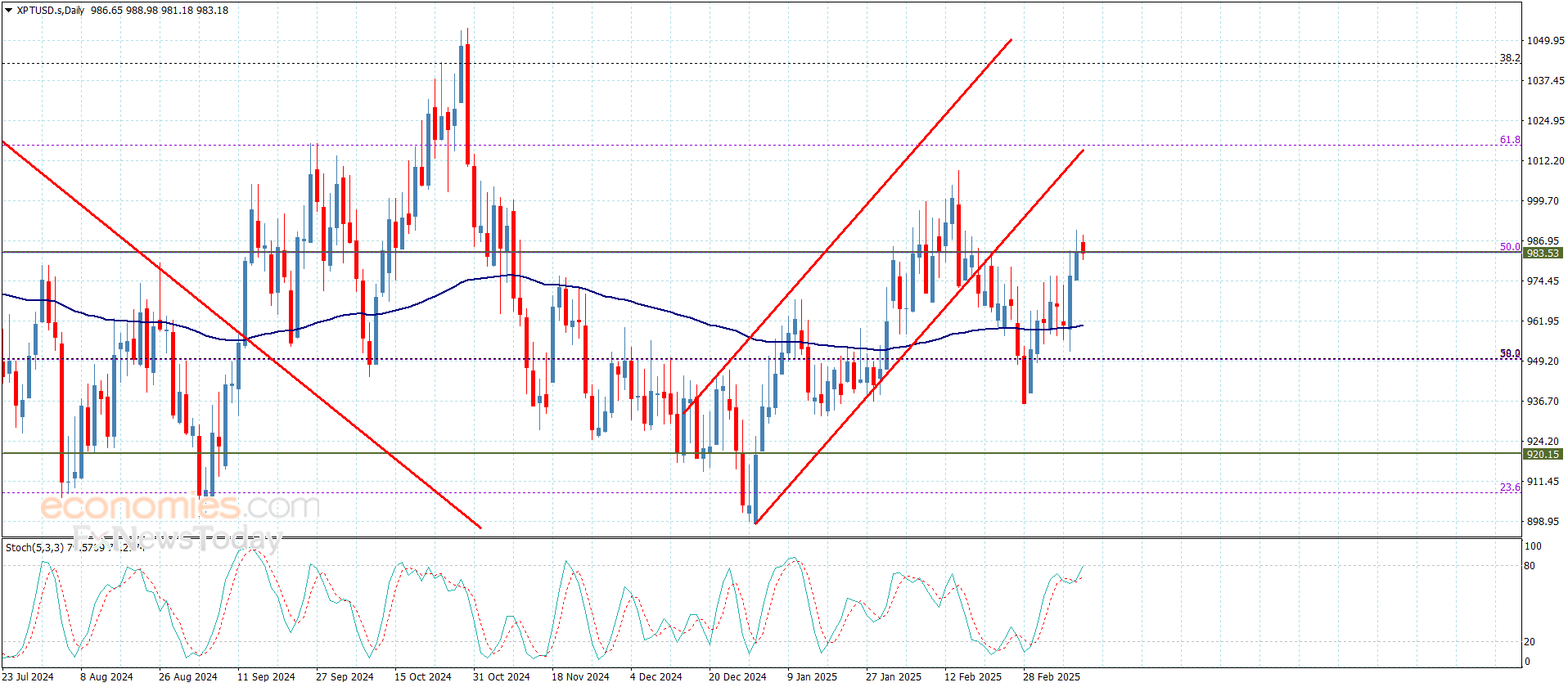
Platinum price touched 990.00$ level during the last bullish rally and formed some sideways trades by fluctuating near 983.00$ level that formed an obstacle against the bullish attempts recently.
We notice stochastic attempt to crawl towards the overbought areas to increase the chances of gaining the additional positive momentum to manage to resume the bullish attack, waiting to target 998.00$ level soon, followed by reaching the next target at 1012.00$, assuring the importance of holding above 968.00$ that forms additional support against the bullish attempts.
The expected trading range for today is between 974.00$ and 998.00$
Trend forecast: Bullish
Silver price (XAG/USD) continues its upward momentum for the third consecutive session, hovering around $33.30 per troy ounce during Asian trading hours on Thursday. The precious metal benefits from growing safe-haven demand amid escalating trade tensions and mounting concerns over a potential United States (US) recession.
Trade tensions intensified after US President Donald Trump imposed higher tariffs on steel and aluminum imports, heightening economic uncertainty and boosting Silver’s appeal as a safe-haven asset. Trump also described the economy as being in a “transition period,” signaling a possible slowdown. Investors interpreted his comments as an early warning of potential economic turbulence ahead.
The non-interest-bearing commodities including Silver gained traction as the US inflation cooled more than anticipated in February, raising speculation that the Federal Reserve (Fed) might cut interest rates sooner than expected.
US monthly headline inflation slowed to 0.2% in February from 0.5% in January, while core inflation eased to 0.2%, below the forecasted 0.3%. On an annual basis, headline inflation declined to 2.8% from 3.0%, while core inflation slipped to 3.1% from 3.3%. Market participants are now awaiting Thursday’s US Producer Price Index (PPI) data and weekly jobless claims for further economic cues.
Additionally, demand for dollar-denominated Silver could rise as the US Dollar (USD) remains under pressure due to cooling inflation. A weaker Greenback makes commodities more affordable for foreign buyers. At the time of writing, the US Dollar Index (DXY), which measures the USD against six major currencies, remains steady around 103.50.
Silver is a precious metal highly traded among investors. It has been historically used as a store of value and a medium of exchange. Although less popular than Gold, traders may turn to Silver to diversify their investment portfolio, for its intrinsic value or as a potential hedge during high-inflation periods. Investors can buy physical Silver, in coins or in bars, or trade it through vehicles such as Exchange Traded Funds, which track its price on international markets.
Silver prices can move due to a wide range of factors. Geopolitical instability or fears of a deep recession can make Silver price escalate due to its safe-haven status, although to a lesser extent than Gold’s. As a yieldless asset, Silver tends to rise with lower interest rates. Its moves also depend on how the US Dollar (USD) behaves as the asset is priced in dollars (XAG/USD). A strong Dollar tends to keep the price of Silver at bay, whereas a weaker Dollar is likely to propel prices up. Other factors such as investment demand, mining supply – Silver is much more abundant than Gold – and recycling rates can also affect prices.
Silver is widely used in industry, particularly in sectors such as electronics or solar energy, as it has one of the highest electric conductivity of all metals – more than Copper and Gold. A surge in demand can increase prices, while a decline tends to lower them. Dynamics in the US, Chinese and Indian economies can also contribute to price swings: for the US and particularly China, their big industrial sectors use Silver in various processes; in India, consumers’ demand for the precious metal for jewellery also plays a key role in setting prices.
Silver prices tend to follow Gold’s moves. When Gold prices rise, Silver typically follows suit, as their status as safe-haven assets is similar. The Gold/Silver ratio, which shows the number of ounces of Silver needed to equal the value of one ounce of Gold, may help to determine the relative valuation between both metals. Some investors may consider a high ratio as an indicator that Silver is undervalued, or Gold is overvalued. On the contrary, a low ratio might suggest that Gold is undervalued relative to Silver.
Silver price settles near the ne waited target at 33.35$, and we suggest the continuation of the bullish bias to surpass this level and achieve more gains in the upcoming sessions, reminding you that the next station reaches 33.75$.
To review the full report, and to get our more detailed analysis and 100% accurate signals provided by Best Trading Signal, subscribe to Economies.com VIP Club through the link below!