The main tag of Gold Today Price Articles.
You can use the search box below to find what you need.
[wd_asp id=1]
The main tag of Gold Today Price Articles.
You can use the search box below to find what you need.
[wd_asp id=1]
Silver (XAG/USD) reverses an Asian session dip to the $31.85-$31.80 region, or a four-day low, and climbs to a fresh daily high in the last hour. The white metal currently trades around the $32.15-$32.20 area, up nearly 0.20% for the day, and for now, seems to have snapped a three-day losing streak.
However, mixed technical indicators on the daily chart warrant some caution for bullish traders and positioning for a further appreciating move. Hence, any subsequent move up could face stiff resistance and remain capped near the $32.65-$32.70 region. The said hurdle might now act as a key pivotal point, which if cleared decisively could allow the XAG/USD to reclaim the $33.00 mark and climb further towards the February monthly swing high around the $33.40 area.
Some follow-through buying should pave the way for additional gains towards the next relevant hurdle near the $33.60-$33.70 area. The XAG/USD might then surpass the $34.00 round figure and extend the momentum further towards the $34.50-$34.55 resistance zone before aiming to challenge the multi-year high, closer to the $35.00 psychological mark touched in October 2024.
On the flip side, the Asian session low, around the $31.85-$31.80 region, could offer some support, below which the XAG/USD could slide to the $31.25-$31.20 area. The downward trajectory might eventually drag the XAG/USD to the 100-day Exponential Moving Average (EMA) pivotal support, currently pegged near the $31.10-$31.00 region. This is followed by the late February low, around the $30.80 area, which if broken might shift the bias in favor of bearish traders.
The subsequent downfall has the potential to drag the XAG/USD towards the $30.00 psychological mark en route to the $29.55-$29.50 support and sub-$29.00 levels, or the year-to-date low touched in January.
Silver is a precious metal highly traded among investors. It has been historically used as a store of value and a medium of exchange. Although less popular than Gold, traders may turn to Silver to diversify their investment portfolio, for its intrinsic value or as a potential hedge during high-inflation periods. Investors can buy physical Silver, in coins or in bars, or trade it through vehicles such as Exchange Traded Funds, which track its price on international markets.
Silver prices can move due to a wide range of factors. Geopolitical instability or fears of a deep recession can make Silver price escalate due to its safe-haven status, although to a lesser extent than Gold’s. As a yieldless asset, Silver tends to rise with lower interest rates. Its moves also depend on how the US Dollar (USD) behaves as the asset is priced in dollars (XAG/USD). A strong Dollar tends to keep the price of Silver at bay, whereas a weaker Dollar is likely to propel prices up. Other factors such as investment demand, mining supply – Silver is much more abundant than Gold – and recycling rates can also affect prices.
Silver is widely used in industry, particularly in sectors such as electronics or solar energy, as it has one of the highest electric conductivity of all metals – more than Copper and Gold. A surge in demand can increase prices, while a decline tends to lower them. Dynamics in the US, Chinese and Indian economies can also contribute to price swings: for the US and particularly China, their big industrial sectors use Silver in various processes; in India, consumers’ demand for the precious metal for jewellery also plays a key role in setting prices.
Silver prices tend to follow Gold’s moves. When Gold prices rise, Silver typically follows suit, as their status as safe-haven assets is similar. The Gold/Silver ratio, which shows the number of ounces of Silver needed to equal the value of one ounce of Gold, may help to determine the relative valuation between both metals. Some investors may consider a high ratio as an indicator that Silver is undervalued, or Gold is overvalued. On the contrary, a low ratio might suggest that Gold is undervalued relative to Silver.
Crude oil price bounced downwards strongly to succeed reaching our first waited negative target at 65.25$, reinforcing the expectations of continuing the bearish trend in the upcoming period, organized inside the bearish channel that appears on the chart, which supports the chances of achieving more negative targets.
To review the full report, and to get our more detailed analysis and 100% accurate signals provided by Best Trading Signal, subscribe to Economies.com VIP Club through the link below!
Gold price is licking its wounds below $2,900 early Tuesday, following three consecutive days of sellers’ rejoicing. All eyes now turn to the US economic data releases for fresh trading impetus, with the JOLTS Job Openings data due later on Tuesday, while the key Consumer Price Index (CPI) report will be published on Wednesday.
Gold traders resorted to profit-taking on their long positions, gearing up for the high-impact US inflation data this week and contributing to the recent losses in the bright metal. No further developments on the trade policies front by US President Donald Trump also gave an excuse to take profits off the table.
Due to Trump’s protectionism, markets remain wary of mounting concerns over a potential US recession, which could prompt the US Federal Reserve (Fed) to proceed with the interest rate cuts this year. This narrative keeps the bearish pressure intact on the US Dollar (USD) and the US Treasury bond yields, limiting the downside in the Gold price.
In a Fox News interview on Sunday, President Trump talked about a “period of transition” while declining to predict whether his tariffs would result in a US recession, which has weighed heavily on risk sentiment. He said they are “looking at a lot of things concerning tariffs on Russia.
President Trump issued a fresh tariff threat on Canadian lumber on Friday, noting that it may or may not come today, or on Monday, or on Tuesday.
Meanwhile, China’s up to 15% tariffs on US farm products took effect on Monday. Increased risks of a tit-for-tat tariff war globally will continue to keep Gold buyers hopeful.
However, Gold prices could face headwinds if the US-Ukraine Summit in Saudi Arabia later on Tuesday culminates with a bilateral minerals deal, eventually leading to the end of the Ukraine-Russia conflict.
Tensions remain high heading into the US-Ukraine peace talks since a February 28 Oval Office meeting between Ukraine’s President Volodymyr Zelenskyy and Trump descended into an argument, leading to the US suspending all military aid to Ukraine.
Gold markets will also take account of the US JOLTS Job Openings data after Friday’s disappointing February labor market report. The data could impact the US dollar’s performance and influence the Gold price movement.
Despite closing Monday below the 21-day Simple Moving Average (SMA), then at $2,911, the Gold price remains a ‘buy-the-dips’ trade.
The 14-day Relative Strength Index (RSI) points higher above the 50 level, backing the bullish potential.
Immediate resistance is at the 21-day SMA, now at $2,909. Acceptance above that level will challenge the February 26 high of $2,930.
The next topside barriers are at an all-time high of $2,956 and the $2,970 round level.
If Gold sellers refuse to give up, immediate support is seen at the $2,850 psychological barrier, below which the demand area near $2,835 could be a tough nut to crack.
Additional declines will likely test the 50-day SMA at $2,810.
(This story was corrected on March 11 at 3:26 GMT to say that “Gold price bounces to near $2,900,” not Gold price nurses losses below $2,900.)
Gold has played a key role in human’s history as it has been widely used as a store of value and medium of exchange. Currently, apart from its shine and usage for jewelry, the precious metal is widely seen as a safe-haven asset, meaning that it is considered a good investment during turbulent times. Gold is also widely seen as a hedge against inflation and against depreciating currencies as it doesn’t rely on any specific issuer or government.
Central banks are the biggest Gold holders. In their aim to support their currencies in turbulent times, central banks tend to diversify their reserves and buy Gold to improve the perceived strength of the economy and the currency. High Gold reserves can be a source of trust for a country’s solvency. Central banks added 1,136 tonnes of Gold worth around $70 billion to their reserves in 2022, according to data from the World Gold Council. This is the highest yearly purchase since records began. Central banks from emerging economies such as China, India and Turkey are quickly increasing their Gold reserves.
Gold has an inverse correlation with the US Dollar and US Treasuries, which are both major reserve and safe-haven assets. When the Dollar depreciates, Gold tends to rise, enabling investors and central banks to diversify their assets in turbulent times. Gold is also inversely correlated with risk assets. A rally in the stock market tends to weaken Gold price, while sell-offs in riskier markets tend to favor the precious metal.
The price can move due to a wide range of factors. Geopolitical instability or fears of a deep recession can quickly make Gold price escalate due to its safe-haven status. As a yield-less asset, Gold tends to rise with lower interest rates, while higher cost of money usually weighs down on the yellow metal. Still, most moves depend on how the US Dollar (USD) behaves as the asset is priced in dollars (XAU/USD). A strong Dollar tends to keep the price of Gold controlled, whereas a weaker Dollar is likely to push Gold prices up.
Silver price drops over 1.20% on Monday even though US Treasury bond yields drop and the Greenback post minuscule gains. At the time of writing, the XAG/USD trades at $32.08 after reaching a high of $32.66.
The price of silver has fallen below last Friday’s low of 32.11, with sellers eyeing the $31.00 handle. If XAG/USD closes on a daily basis below $32.00, look for a test of strong support at the confluence of the 100 and 50-day Simple Moving Averages (SMAs) at $31.22. A breach of the latter will expose $31.00 a troy ounce and clear the path to challenge the 200-day SMA at $30.50.
The Relative Strength Index (RSI) aims downwards to indicate that bulls had lost steam. Nevertheless, the RSI remains above its neutral level, indicating that bears are not out of the woods.
Therefore, if XAG/USD climbs past $32.50, the next resistance would be the 32.76 March 6 peak, followed by the $33.00 mark. Bulls could challenge the February 14 $33.39 mark, ahead of $34.00 if surpassed.
Silver is a precious metal highly traded among investors. It has been historically used as a store of value and a medium of exchange. Although less popular than Gold, traders may turn to Silver to diversify their investment portfolio, for its intrinsic value or as a potential hedge during high-inflation periods. Investors can buy physical Silver, in coins or in bars, or trade it through vehicles such as Exchange Traded Funds, which track its price on international markets.
Silver prices can move due to a wide range of factors. Geopolitical instability or fears of a deep recession can make Silver price escalate due to its safe-haven status, although to a lesser extent than Gold’s. As a yieldless asset, Silver tends to rise with lower interest rates. Its moves also depend on how the US Dollar (USD) behaves as the asset is priced in dollars (XAG/USD). A strong Dollar tends to keep the price of Silver at bay, whereas a weaker Dollar is likely to propel prices up. Other factors such as investment demand, mining supply – Silver is much more abundant than Gold – and recycling rates can also affect prices.
Silver is widely used in industry, particularly in sectors such as electronics or solar energy, as it has one of the highest electric conductivity of all metals – more than Copper and Gold. A surge in demand can increase prices, while a decline tends to lower them. Dynamics in the US, Chinese and Indian economies can also contribute to price swings: for the US and particularly China, their big industrial sectors use Silver in various processes; in India, consumers’ demand for the precious metal for jewellery also plays a key role in setting prices.
Silver prices tend to follow Gold’s moves. When Gold prices rise, Silver typically follows suit, as their status as safe-haven assets is similar. The Gold/Silver ratio, which shows the number of ounces of Silver needed to equal the value of one ounce of Gold, may help to determine the relative valuation between both metals. Some investors may consider a high ratio as an indicator that Silver is undervalued, or Gold is overvalued. On the contrary, a low ratio might suggest that Gold is undervalued relative to Silver.
Although the candlestick pattern shows sellers in charge near the end of the trading session, the pattern doesn’t trigger until there is a drop below today’s low. Nonetheless, today’s price action is short-term bearish since it follows the breakout of a long-term pattern. Rather than seeing interest increase following the breakout, the candle pattern shows demand dissipating. In other words, the bullish signal was not confirmed, and it is therefore the breakout is subject to failure.
The breakout showed strength initially as the 38.2% Fibonacci retracement at $4.77 of the full downtrend that began from the 2022 peak was exceeded without hesitation. Subsequently, resistance was seen just below the next higher potential resistance zone defined by a November 2018 peak at $4.93 and a 78.6% target from a rising ABCD pattern (purple) at $4.97.
The ABCD pattern looks for price symmetry or a harmonic relationship between the second leg up (CD) and the first upswing (AB). Typically, a 100% relationship identifies a potentially key pivot level. That is where the price gains between the two swings are similar. Also, Fibonacci relationships are used to provide other potential pivots. The 78.6% level deserves attention today given the bearish reaction following the day’s high.
It looks like the spike high occurred due to an order imbalance shortly after the opening of Monday’s session, as it largely occurred within one-minute. A bearish pullback began immediately after the high was reached. This might mean that the failed breakout has less of a lagging effect than it might otherwise if demand was stronger initially. Nonetheless, key support remains the 20-Day MA, which is now at $4.04.
For a look at all of today’s economic events, check out our economic calendar.
Spot Gold trades with a softer tone on Monday, piercing the $2,900 mark during American trading hours, albeit confined to familiar levels for a fifth consecutive day. The US Dollar (USD) found near-term demand despite a risk-averse environment. Global stock markets trade in the red at the beginning of the week, maintaining the focus on United States (US) President Donald Trump’s trade war.
The absence of relevant macroeconomic news fueled sentiment-related trading, albeit prevalent demand for safety kept XAU/USD between a rock and a hard place. Later in the week, the US will publish February Consumer Price Index (CPI) figures, with inflation foreseen easing modestly from January levels but still holding above the Federal Reserve’s (Fed) 2% goal.
Other than that, the Bank of Canada (BoC) will announce its decision on monetary policy on Wednesday. The BoC is widely anticipated to trim interest rates by 25 basis points (bps), to 2.75%, moving one step closer to the neutral rate.
From a technical point of view, the daily chart for XAU/USD shows the bright metal remains below a now flat 20 Simple Moving Average (SMA), providing dynamic resistance at around $2,910.00. The longer moving averages keep heading north far below the current level, suggesting bulls maintain control in the long run. Technical indicators, in the meantime, turned lower at around their midlines, suggesting the pair may extend its corrective decline before finding fresh buying interest.
In the near term, and according to the 4-hour chart, the XAU/USD pair is at risk of extending its slide. Converging 20 and 100 SMAs provide resistance in the $2,910 region, while a bullish 200 SMA hovers at around $2,867, providing support. Finally, technical indicators remain within negative levels, although with uneven strength. Still, additional declines are likely on a break below $2,881.80, March 4 intraday low.
Support levels:2,881.80 2,867.10 2,854.95
Resistance levels: 2,910.00 2,927.90 2,941.40
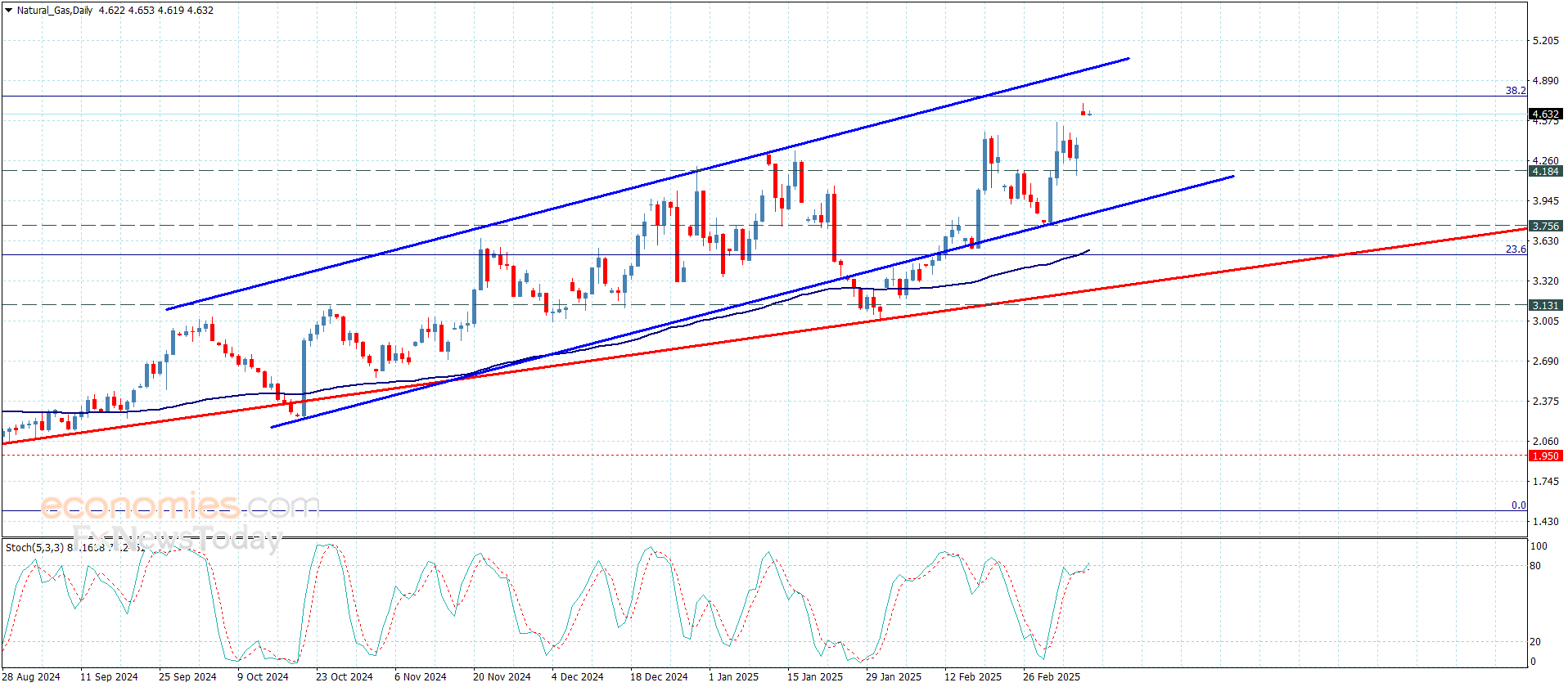
Under normal circumstances, if you had told me natural gas was trading at $4.62 in the middle of March, I would have been probably somebody who would ask you, are we in a war? Well, it turns out we are and it turns out that the sides fighting each other, although one be a proxy, are still doing business. So, there you go.
I do think eventually we will sell off quite drastically. Like I said, I’ve been on the sidelines for a while now. I’m just waiting for the signal. I just haven’t had it. There’s been a couple of attempts at breaking natural gas down. We just haven’t seen it successful yet, but to come in and buy after this type of move, especially those who got in at $4.88, later in the same day, they’re getting exactly what they deserve for chasing.
Again, when you look at this from a historical standpoint, this is a pretty extended move, and therefore, I think you have to probably look at this through the prism of a market that’s just really stretching into an area that could cause a lot of resistance. But we’ll just have to wait and see. I prefer shorting. I just don’t have the price action to confirm that. So, I’m on the sidelines.
For a look at all of today’s economic events, check out our economic calendar.
The EURJPY pair kept its stability below the MA55 at 160.90 on last Friday, to continue forming solid obstacle against resuming the bullish attack and notice forming sideways trades by settling near 160.00.
We remind you that the stability of the additional support 158.85 allows us to wait to gather the required positive momentum to surpass the current obstacle and target new positive stations that start at 161.65 and 162.00, while facing strong negative pressures and crawling below the additional support will force it to suffer big losses that might extend towards 158.30 followed by reaching the next support at 157.30.
The expected trading range for today is between 159.40 and 160.90
Trend forecast: Bullish
Silver price shows sideways trades since morning, and as long as the price is above 32.25$, our bullish overview will remain valid and active for today, supported by the EMA50 that carries the price from below, reminding you that our targets begin at 32.86$ and extend to 33.35$ after breaching the previous level.
To review the full report, and to get our more detailed analysis and 100% accurate signals provided by Best Trading Signal, subscribe to Economies.com VIP Club through the link below!
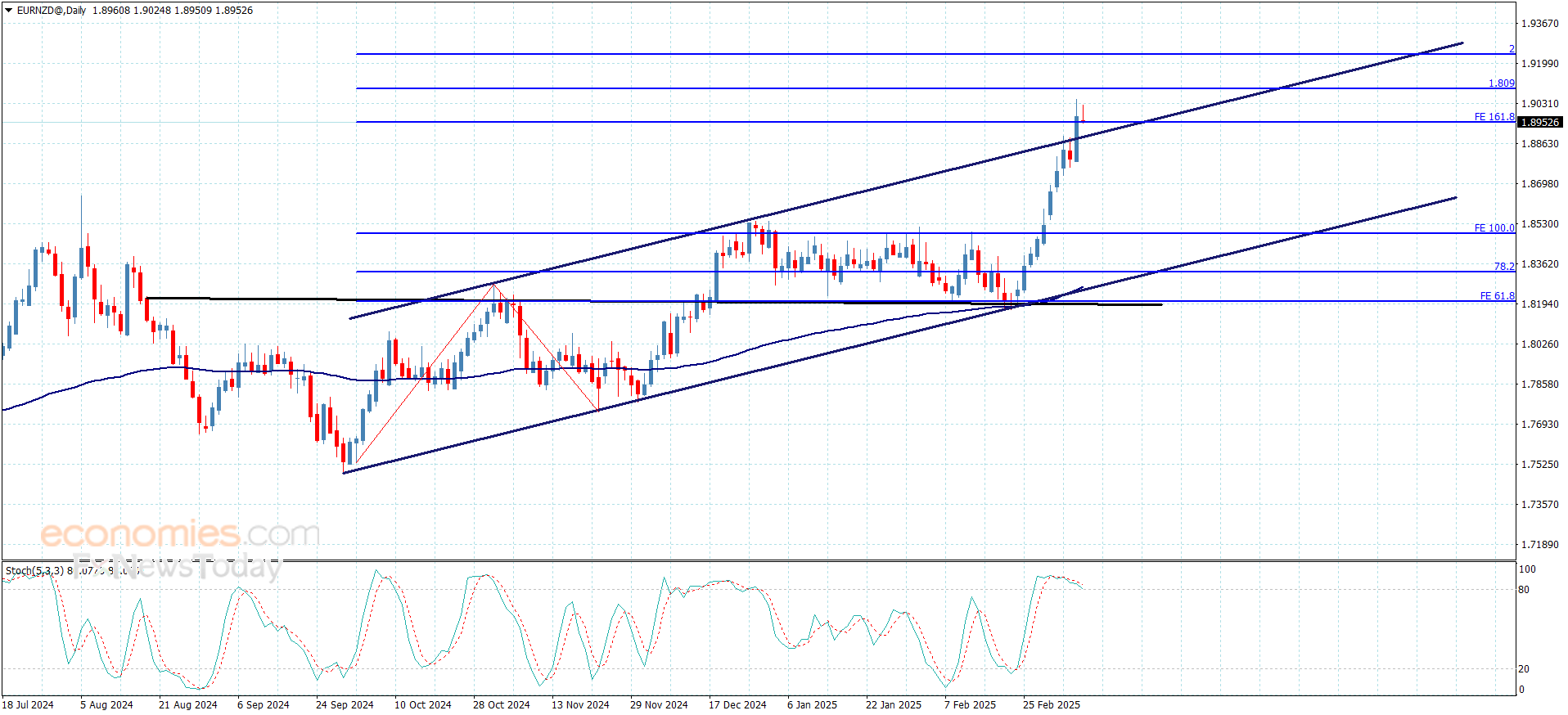
The EURNZD price formed strong bullish rally on last Friday to surpass the bullish channel’s resistance line at 1.8880, achieving big gains by reaching 1.9050, while the current sideways fluctuation is caused by stochastic attempt to exit the overbought areas, to keep waiting to gather the additional positive momentum soon followed by starting to target new positive stations that might extend towards 1.9090 followed by reaching 1.230.
Note that declining below the breached resistance will postpone the bullish attack for now to start activating the correctional bearish track before reaching the suggested targets.
The expected trading range for today is between 1.8900 and 1.9100
Trend forecast: Bullish