The main tag of Gold Today Price Articles.
You can use the search box below to find what you need.
[wd_asp id=1]
The main tag of Gold Today Price Articles.
You can use the search box below to find what you need.
[wd_asp id=1]
Spot Gold trades uneventfully at around the $2,900 threshold, as United States (US) markets are closed due to the President’s Day holiday. Canada also celebrates a holiday called Family Day, although banks in some provinces remain open. Nevertheless, market activity is restrained, with choppy action across the FX board.
The US Dollar (USD) retains the weak tone triggered last week by relief headlines, as US President Donald Trump refrained from announcing detailed reciprocal tariffs. At the beginning of the week, President Trump announced levies on all aluminium and steel imports of 25% and threatened to unveil more taxes later in the week, which he finally did not.
Meanwhile, higher-than-anticipated US inflation reaffirmed the Federal Reserve’s (Fed) hawkishness, adding pressure on the USD. The US macroeconomic calendar includes this week the Federal Open Market Committee (FOMC) Minutes from the January meeting.
From a technical point of view, the XAU/USD pair remains bullish. The daily chart shows that the pair consolidates at the lower end of Friday’s range, yet it also develops above all its moving averages, with a bullish 20 Simple Moving Average (SMA) providing dynamic support at around $2,826. The 100 and 200 SMAs remain far below the shorter one but retain their upward slopes. Technical indicators, in the meantime, retreated from extreme overbought readings but lost their downward strength well into positive levels.
In the near term, and according to the 4-hour chart, however, the XAU/USD pair is neutral-to-bearish. A flat 20 SMA provides immediate resistance at $2,908.10, while technical indicators lack directional strength yet hold below their midlines, suggesting buying interest is scarce. Finally, the 100 and 200 SMAs continue to advance below the current level, but far to become relevant in the near term.
Support levels: 2,889.80 2,876.90 2,863.50
Resistance levels: 2,908.10 2,925.10 2,942.50
Today’s pullback found support at a low of $3.55. That was a successful test of support around the 50-Day MA, currently at $3.57. A little lower is a range from $3.51 to $4.49, which combines the 20-Day MA at $3.51 and the 38.2% Fibonacci retracement level at $4.49. It provides the first more significant support level and is the minimum expected retracement from Fibonacci analysis.
That would be the first price zone where the possibility of a bullish reversal improves. Although it is only one day, the fact that support was seen around the 50-Day line is a bullish sign and it shows the market recognizing the level.
Nonetheless, a deeper pullback to test the lower support level would not be a surprise. The rally from the $2.99 low in December showed underlying strength as natural gas had gained $0.81 or 27.0% as of last week’s high. Strength was retained through much of the advance as evidenced by only one relatively minor pullback represented by a lower daily low. And the bigger picture in natural gas remains bullish as the uptrend price structure has not been violated.
The near-term uptrend adjusted the angle of ascent to align with the uptrend line that starts from the swing low from August 2024. Notice that the line was confirmed as support with the recent swing low of $2.99. That swing low provided a third touch of the trendline. Clearly, support was seen from that low as it led to a bullish reversal and rally.
For a look at all of today’s economic events, check out our economic calendar.
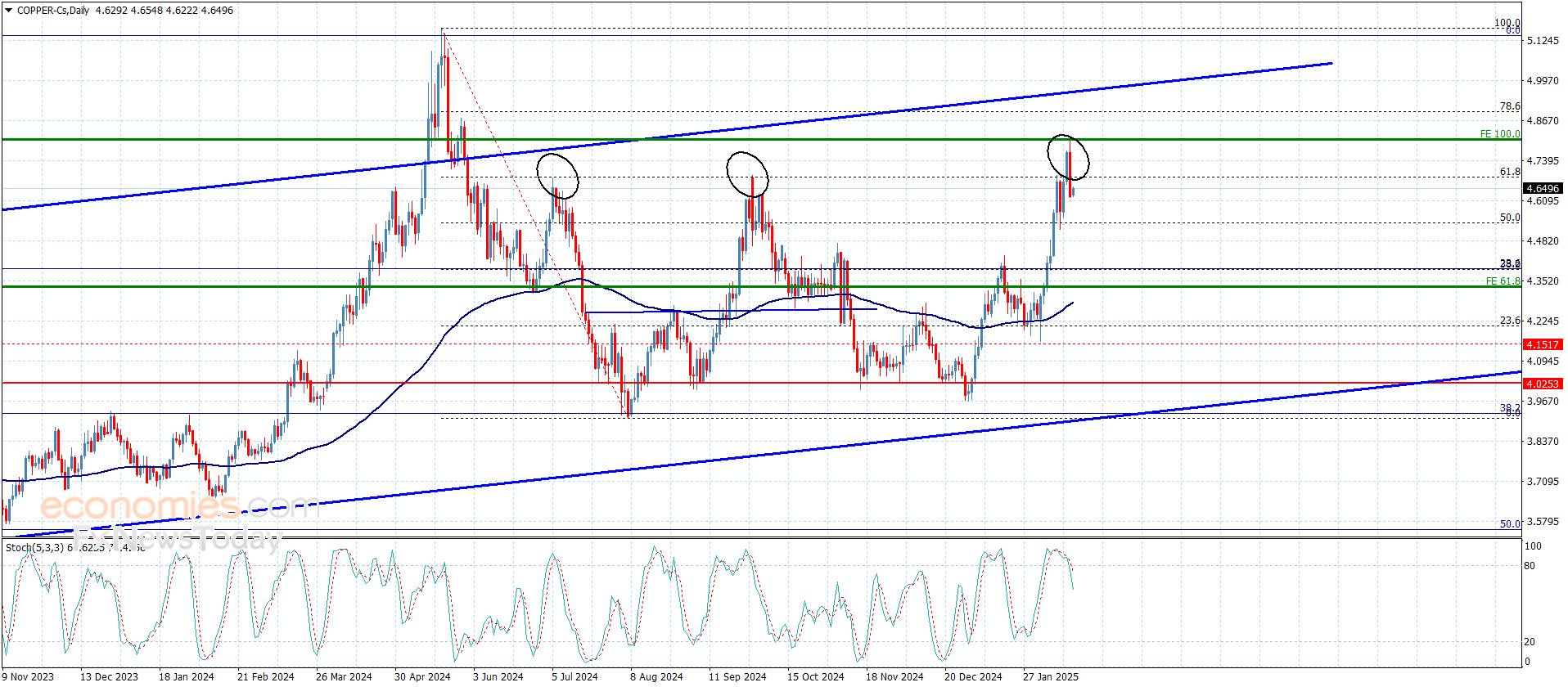
Copper price failed to resume the bullish attack after facing 4.8100$ barrier, to activate the correctional track by crawling towards 4.6200$ now.
The frequent stability below the mentioned barrier and stochastic attempt to provide the negative momentum support the domination of the correctional bias, to expect crawling towards 4.5600$ and 4.5200$ levels soon, while breaching the barrier will open the way to record new gains that might start at 4.8900$.
The expected trading range for today is between 4.5600$ and 4.7400$
Trend forecast: Bearish
Silver (XAG/USD) attracts dip-buyers near the $31.90 region at the start of a new week and stalls its retracement slide from the highest level since October 30, around the $33.35-$33.40 area touched on Friday. The white metal sticks to positive bias through the first half of the European session and currently trades around the $32.35 zone, up nearly 0.50% for the day.
From a technical perspective, the recent breakout through the 100-day Simple Moving Average (SMA) and the emergence of fresh buying on Monday favor bullish traders. Moreover, positive oscillators on the daily chart suggest that the path of least resistance for the XAG/USD remains to the upside. That said, it will still be prudent to wait for some follow-through strength beyond the $32.55 horizontal barrier before positioning for any further gains.
The XAG/USD might then aim to conquer the $33.00 round figure and climb further towards retesting Friday’s swing high, around the $33.35-$33.40 region. The momentum could extend further towards the $34.00 mark en route to the next relevant hurdle near the $34.45 zone and the $35.00 neighborhood, or the multi-year peak touched in October.
On the flip side, weakness below the Asian session low, around the $31.90 area, might still be seen as a buying opportunity and remain limited near the 100-day SMA, currently pegged near the $31.20 region. Some follow-through selling, leading to a slide below the $31.00 mark, might shift the near-term bias in favor of bearish traders and pave the way for deeper losses. The XAG/USD might then test the $30.25 support before eventually dropping to the $30.00 psychological mark en route to the $29.55-$29.50 horizontal zone.
Silver is a precious metal highly traded among investors. It has been historically used as a store of value and a medium of exchange. Although less popular than Gold, traders may turn to Silver to diversify their investment portfolio, for its intrinsic value or as a potential hedge during high-inflation periods. Investors can buy physical Silver, in coins or in bars, or trade it through vehicles such as Exchange Traded Funds, which track its price on international markets.
Silver prices can move due to a wide range of factors. Geopolitical instability or fears of a deep recession can make Silver price escalate due to its safe-haven status, although to a lesser extent than Gold’s. As a yieldless asset, Silver tends to rise with lower interest rates. Its moves also depend on how the US Dollar (USD) behaves as the asset is priced in dollars (XAG/USD). A strong Dollar tends to keep the price of Silver at bay, whereas a weaker Dollar is likely to propel prices up. Other factors such as investment demand, mining supply – Silver is much more abundant than Gold – and recycling rates can also affect prices.
Silver is widely used in industry, particularly in sectors such as electronics or solar energy, as it has one of the highest electric conductivity of all metals – more than Copper and Gold. A surge in demand can increase prices, while a decline tends to lower them. Dynamics in the US, Chinese and Indian economies can also contribute to price swings: for the US and particularly China, their big industrial sectors use Silver in various processes; in India, consumers’ demand for the precious metal for jewellery also plays a key role in setting prices.
Silver prices tend to follow Gold’s moves. When Gold prices rise, Silver typically follows suit, as their status as safe-haven assets is similar. The Gold/Silver ratio, which shows the number of ounces of Silver needed to equal the value of one ounce of Gold, may help to determine the relative valuation between both metals. Some investors may consider a high ratio as an indicator that Silver is undervalued, or Gold is overvalued. On the contrary, a low ratio might suggest that Gold is undervalued relative to Silver.
Super Mario Computer’s stock price (SMCI) rallied in the intraday levels, buoyed by trading above the 50-day SMA, amid the dominance of the upward correctional wave in the short term. However, despite the stock’s gains, it’s still moving alongside the main downward trend line in the medium-term, with negative signals from the RSI after reaching overbought levels.
Therefore we stand neutral until the stock moves on the pivotal resistance of $51.00, and in case of a breach, it’ll open the door for more gains, thus targeting the resistance of $74.00.
Trend forecast for today: Neutral
Gold price is back on the bids early Monday, reversing a part of Friday’s profit-taking decline. The further upside in Gold price depends on the upcoming US-Russia talks and developments around US President Donald Trump’s tariff plans amid a US holiday-led thin market conditions.
Having registered eight straight weeks of gains, Gold price kicks off a fresh week on a positive note, underpinned by the sustained weakness in the US Dollar (USD) and the US Treasury bond yields.
Markets remain expectant that the Russia-Ukraine conflict could end soon as US President Donald Trump is scheduled to hold a meeting with Russian President Vladimir Putin in Saudi Arabia on Tuesday.
Prospects of diminishing geopolitical risks weigh on the USD, supporting the renewed upswing in Gold price. The Greenback also suffers from the increase in revival of bets surrounding two interest rate cuts by the US Federal Reserve (Fed) this year, following Friday’s dismal Retail Sales data.
Data showed that Retail Sales declined 0.9% over the month in January, compared to the estimated drop of 0.1%. This marked the biggest month-on-month (MoM) decrease since early 2023, rekindling expectations for two rate Fed cuts in 2025.
Discouraging triggered a fresh sell-off in the US Treasury bond yields across the curve, in turn, smashing the US Dollar despite some weakness in Wall Street indices on Friday. Gold price, however, failed to capitalize on US data-led USD weakness as markets resorted to profit-taking on their Gold longs after the record run.
Traders also preferred to cash in on the Gold price record rally ahead of the upcoming US-Russia meeting and the Minutes of the Fed’s January meeting.
At the moment, Gold price also derives strength from tensions around a looming tariff war between the US and the European Union (EU). “The European Commission would explore tough import limits on certain foods made to different standards to protect its farmers, echoing US President Donald Trump’s reciprocal trade policy,” the Financial Times (FT) reported on Sunday.
It’s worth mentioning that Gold price could be subject to intense volatility in the day ahead as a US national holiday will likely exaggerate moves. Speeches will from Fed officials Christopher Waller, Patrick Harker and Michelle Bowman will be closely scrutinized before Wednesday’s Fed Minutes.
The daily chart shows that Gold price defended the rising trendline support, then at $2,885.
The 14-day Relative Strength Index (RSI) has eased from the overbought territory to trade in the bullish zone, currently near 69.
If the rebound gathers strength, Gold buyers will aim for the record high of $2,943. Ahead of that, the February 12 high of $2,909 could test bearish commitments.
The next relevant resistance is seen at the $2,970 round level.
Should sellers crack the February low of $2,864 decisively, a fresh downside could initiate toward the $2,850 psychological barrier.
Further south, the 21-day Simple Moving Average (SMA) at $2,822 could come into play.
Gold has played a key role in human’s history as it has been widely used as a store of value and medium of exchange. Currently, apart from its shine and usage for jewelry, the precious metal is widely seen as a safe-haven asset, meaning that it is considered a good investment during turbulent times. Gold is also widely seen as a hedge against inflation and against depreciating currencies as it doesn’t rely on any specific issuer or government.
Central banks are the biggest Gold holders. In their aim to support their currencies in turbulent times, central banks tend to diversify their reserves and buy Gold to improve the perceived strength of the economy and the currency. High Gold reserves can be a source of trust for a country’s solvency. Central banks added 1,136 tonnes of Gold worth around $70 billion to their reserves in 2022, according to data from the World Gold Council. This is the highest yearly purchase since records began. Central banks from emerging economies such as China, India and Turkey are quickly increasing their Gold reserves.
Gold has an inverse correlation with the US Dollar and US Treasuries, which are both major reserve and safe-haven assets. When the Dollar depreciates, Gold tends to rise, enabling investors and central banks to diversify their assets in turbulent times. Gold is also inversely correlated with risk assets. A rally in the stock market tends to weaken Gold price, while sell-offs in riskier markets tend to favor the precious metal.
The price can move due to a wide range of factors. Geopolitical instability or fears of a deep recession can quickly make Gold price escalate due to its safe-haven status. As a yield-less asset, Gold tends to rise with lower interest rates, while higher cost of money usually weighs down on the yellow metal. Still, most moves depend on how the US Dollar (USD) behaves as the asset is priced in dollars (XAU/USD). A strong Dollar tends to keep the price of Gold controlled, whereas a weaker Dollar is likely to push Gold prices up.
In its latest short term energy outlook (STEO), which was released on February 11, the U.S. Energy Information Administration (EIA) increased its Henry Hub spot price forecast for 2025 and 2026.
According to its February STEO, the EIA now sees the Henry Hub spot price averaging $3.79 per million British thermal units (MMBtu) in 2025 and $4.16 per MMBtu in 2026. The EIA’s previous STEO, which was released in January, saw the Henry Hub spot price averaging $3.14 per MMBtu in 2025 and $3.97 per MMBtu in 2026.
The EIA projected in its latest STEO that the Henry Hub spot price will come in at $3.70 per MMBtu in the first quarter of this year, $3.39 per MMBtu in the second quarter, $3.95 per MMBtu in the third quarter, $4.11 per MMBtu in the fourth quarter, $4.26 per MMBtu in the first quarter of next year, $3.81 per MMBtu in the second quarter, $4.21 per MMBtu in the third quarter, and $4.35 per MMBtu in the fourth quarter.
In its previous STEO, the EIA projected that the Henry Hub spot price would average $3.21 per MMBtu in the first quarter of 2025, $2.59 per MMBtu in the second quarter, $3.18 per MMBtu in the third quarter, $3.59 per MMBtu in the fourth quarter, $4.03 per MMBtu in the first quarter of 2026, $3.63 per MMBtu in the second quarter, $4.06 per MMBtu in the third quarter, and $4.17 per MMBtu in the fourth quarter.
The EIA noted in its February STEO that the Henry Hub spot price averaged $4.13 per MMBtu in January. It highlighted that this was up more than $1.00 from the December average of $3.01 per MMBtu.
“The above-average withdrawals from underground natural gas storage in January caused prices to rise,” the EIA said in its latest STEO.
“The Henry Hub spot price reached a high of $9.86 per MMBtu on January 17 ahead of a cold snap that was expected to affect much of the United States over the mid-month holiday weekend,” it added.
“The 37 percent uptick in the monthly average Henry Hub price in January from December, combined with our forecast of below-average storage inventories through the end of 2025, increased the annual average 2025 price in our forecast by around 65 cents compared with our January Short-Term Energy Outlook,” it continued.
In its February STEO, the EIA warned that weather is always a risk to its Henry Hub price forecast during the winter heating season.
“An additional risk over the forecast period includes timing of new liquefied natural gas production that developers expect to start up over the next two years,” the EIA added.
“We expect China’s imposition of tariffs on U.S. LNG to have a limited effect on U.S. LNG exports. With ample demand for LNG globally, we expect that any LNG not purchased by China would be imported elsewhere,” it continued.
A report sent to Rigzone by Standard Chartered Bank Commodities Research Head Paul Horsnell on February 11 showed that Standard Chartered expected the nearby future NYMEX basis Henry Hub U.S. natural gas price to average $3.20 per MMBtu in the first quarter of 2025, $3.50 per MMBtu across the second and third quarters, and $2.80 per MMBtu in the fourth quarter. The company saw the commodity averaging $3.30 per MMBtu overall in 2026, the report showed.
In a BMI report sent to Rigzone by the Fitch Group on February 10, BMI, a unit of Fitch Solutions, projected that the Henry Hub price will average $3.4 per MMBtu in 2025 and $3.8 per MMBtu in 2026. A Bloomberg consensus included in the report forecast that the Henry Hub price will average $3.4 per MMBtu this year and $3.7 per MMBtu in 2026.
A research note sent to Rigzone by the JPM Commodities Research team on February 7 showed that J.P. Morgan saw the U.S. natural gas henry hub price averaging $3.50 per MMBtu in 2025 and $3.94 per MMBtu in 2026.
To contact the author, email andreas.exarheas@rigzone.com
Natural gas price started to activate the bearish track after providing negative closings below 3.820$ resistance line to notice crawling towards the first negative target at 3.620$.
Now, stochastic exit from the overbought areas allows us to expect gathering the additional negative momentum to confirm its preparation to provide new bearish waves and target 3.520$ level, while regaining the bullish bias requires forming strong bullish rally and settle above the mentioned resistance.
The expected trading range for today is between 3.520$ and 3.690$
Trend forecast: Bearish
Silver price (XAG/USD) recovers its recent losses registered in the previous session, trading near $32.40 per troy ounce during Monday’s Asian session. A daily chart analysis suggests a continued bullish trend, as the metal price moves upward within an ascending channel.
The XAG/USD pair continues to trade above the nine-day and 14-day Exponential Moving Averages (EMAs), indicating robust short-term momentum. Moreover, the 14-day Relative Strength Index (RSI) remains above the 50 level, reinforcing the overall bullish outlook.
Silver price may face initial resistance near the upper boundary of the ascending channel at the $33.10 level, followed by the four-month high of $33.40, which was reached on February 14.
On the downside, support is located at the nine-day EMA around $32.08, followed by the 14-day EMA at $31.85, and the lower boundary of the ascending channel at $31.60. A break below this critical support zone could undermine the bullish outlook, potentially exposing the XAG/USD pair to further declines toward its five-month low of $28.74, which was recorded on December 19.
Silver is a precious metal highly traded among investors. It has been historically used as a store of value and a medium of exchange. Although less popular than Gold, traders may turn to Silver to diversify their investment portfolio, for its intrinsic value or as a potential hedge during high-inflation periods. Investors can buy physical Silver, in coins or in bars, or trade it through vehicles such as Exchange Traded Funds, which track its price on international markets.
Silver prices can move due to a wide range of factors. Geopolitical instability or fears of a deep recession can make Silver price escalate due to its safe-haven status, although to a lesser extent than Gold’s. As a yieldless asset, Silver tends to rise with lower interest rates. Its moves also depend on how the US Dollar (USD) behaves as the asset is priced in dollars (XAG/USD). A strong Dollar tends to keep the price of Silver at bay, whereas a weaker Dollar is likely to propel prices up. Other factors such as investment demand, mining supply – Silver is much more abundant than Gold – and recycling rates can also affect prices.
Silver is widely used in industry, particularly in sectors such as electronics or solar energy, as it has one of the highest electric conductivity of all metals – more than Copper and Gold. A surge in demand can increase prices, while a decline tends to lower them. Dynamics in the US, Chinese and Indian economies can also contribute to price swings: for the US and particularly China, their big industrial sectors use Silver in various processes; in India, consumers’ demand for the precious metal for jewellery also plays a key role in setting prices.
Silver prices tend to follow Gold’s moves. When Gold prices rise, Silver typically follows suit, as their status as safe-haven assets is similar. The Gold/Silver ratio, which shows the number of ounces of Silver needed to equal the value of one ounce of Gold, may help to determine the relative valuation between both metals. Some investors may consider a high ratio as an indicator that Silver is undervalued, or Gold is overvalued. On the contrary, a low ratio might suggest that Gold is undervalued relative to Silver.
Coffee price started to form correctional bearish waves after facing 438.00$ barrier, to notice activating the attempts to gain profits by crawling towards 411.00, while the intraday negativity is caused by stochastic decline below 50 level, which allows us to suggest forming mixed trades until gathering the positive momentum again, to confirm the domination of the bullish scenario on the near-term and medium-term basis.
The frequent stability above 399.00$ support line confirms keeping the bullish track, to expect gathering additional positive momentum and renew the pressure on the mentioned barrier, while surpassing it will push the price to record new historical highs that might start at 447.00$ and 454.00$.
The expected trading range for today is between 431.00 and 407.00
Trend forecast: Bullish