The main tag of Gold Today Price Articles.
You can use the search box below to find what you need.
[wd_asp id=1]
The main tag of Gold Today Price Articles.
You can use the search box below to find what you need.
[wd_asp id=1]
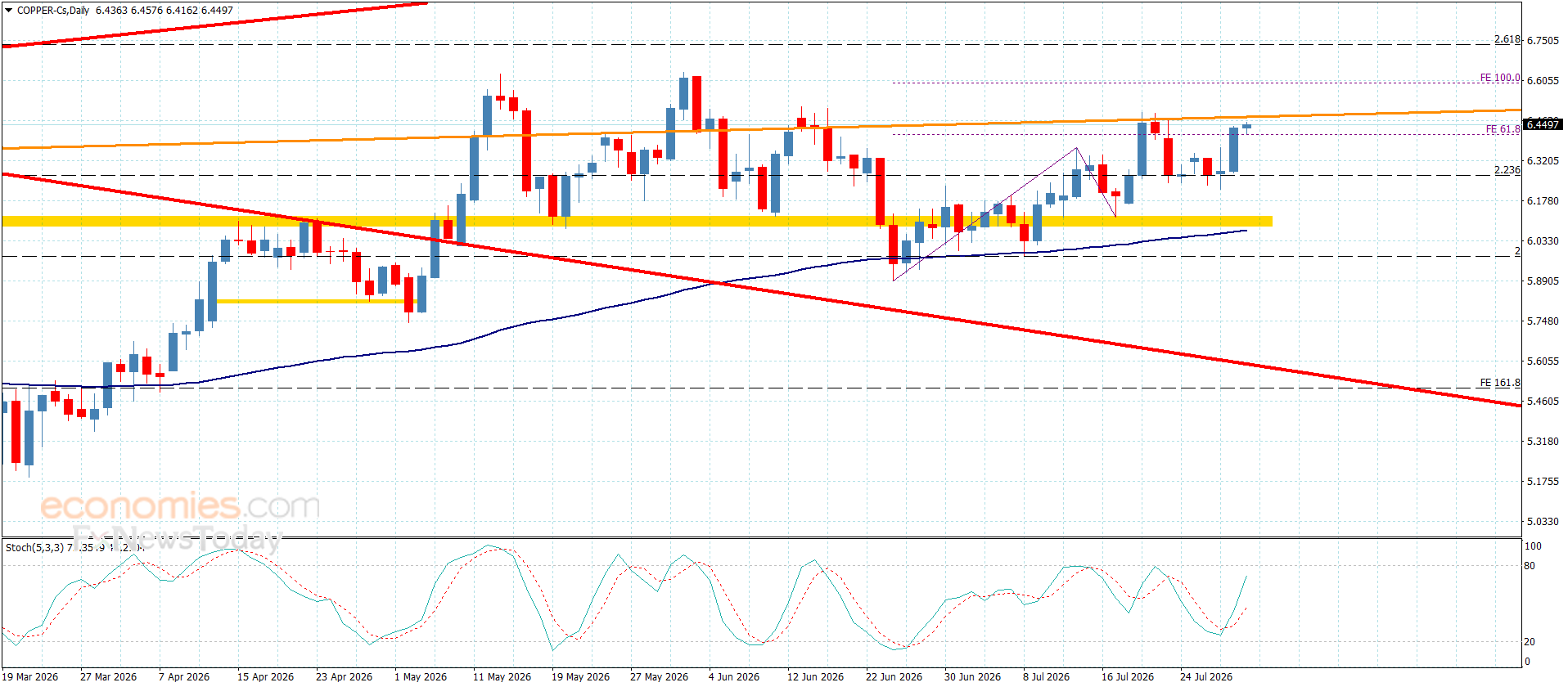
Copper price continues to move sideways in the intraday session, as it remains confined between the stable resistance barrier near $6.5100, while the $6.1000 level continues to form important support against attempts to resume the corrective decline. The price has remained stable since yesterday’s trading near the $6.4500 level.
Continued price fluctuation below the resistance barrier supports the possibility of renewed corrective attempts, with the price expected to move initially toward $6.2800, before retesting the previously mentioned support level. However, a breakout above this barrier and sustained trading above it would open the way for further positive targets, initially toward $6.5950, followed by $6.7310.
The expected trading range for today is between $6.3000 and $6.5100
Trend forecast: Bearish
Welcome, my fellow traders! I have prepared a price forecast for the USCrude, XAUUSD, and EURUSD using a combination of the margin zones method and technical analysis. Based on the market analysis, I suggest entry signals for intraday traders.
Crude remains under selling pressure.
The article covers the following subjects:
USCrude: Oil remains under selling pressure, with the downside target at 77.14.
XAUUSD: Gold continues to trade in a short-term downtrend.
EURUSD: The euro is undergoing a correction.
Oil remains under selling pressure, with the next downside target at 77.14. If the price slides below this level, the Gold Zone of 76.63–76.24 will likely be tested. If sellers push the price below that area, the next downside target becomes the 72.07–71.26 Target Zone.
On the upside, if the price violates the resistance B of 83.57–82.99, it would signal a shift in the short-term trend from bearish to bullish.
Watch the market.
Gold remains in a short-term downtrend, with the primary downside target at 3,959. Today, short positions opened at the resistance B of 4,113–4,128 can be maintained.
If gold breaks through the resistance B, a bullish short-term trend may start. In that case, buying opportunities could be considered tomorrow, with the 4,267–4,298 Target Zone as the upside objective.
Hold short trades opened at resistance B 4,113–4,128. TakeProfit: 3,959. StopLoss: at breakeven.
The euro is correcting lower and approaching the support A of 1.1466–1.1474. If this zone holds, long positions can be considered, with initial targets at 1.1512 and 1.1558. Should the price break through 1.1558, it may climb further to the Target Zone of 1.1576–1.1601.
If the support A is pierced, the correction could extend to the support B of 1.1420–1.1432, which marks the boundary of the current trend. This zone may also offer opportunities to open long positions.
Buy near support A 1.1466–1.1474. TakeProfit: 1.1512, 1.1558. StopLoss: 1.1445.
Would you like to learn more about technical analysis methods and principles? Explore our comprehensive guide.
P.S. Did you like my article? Share it in social networks: it will be the best “thank you” 🙂
Useful links:
The content of this article reflects the author’s opinion and does not necessarily reflect the official position of LiteFinance broker. The material published on this page is provided for informational purposes only and should not be considered as the provision of investment advice for the purposes of Directive 2014/65/EU.
According to copyright law, this article is considered intellectual property, which includes a prohibition on copying and distributing it without consent.
Domestic coffee prices today
Coffee prices today in the domestic market decreased slightly compared to the previous day. According to giacaphe. com, coffee prices on August 4th averaged 96,500 VND/kg, down 100 VND/kg. The highest price in key Central Highlands regions was recorded at 96,500 VND/kg.
In Lam Dong, coffee prices today reached 96,000 VND/kg, unchanged from the previous day. This is the lowest level in the regions.
In Gia Lai and Dak Lak, coffee prices were also recorded at 96,500 VND/kg, unchanged compared to the previous day.
The old Dak Nong area recorded a level of 96,500 VND/kg, down 200 VND/kg compared to the previous session. This is one of the regions with high prices in the survey table.
World coffee prices
In the world market, coffee prices fluctuated in opposite directions in the most recent session.
According to Barchart, the September 2026 Arabica futures contract closed down 12.60 US cents/lb, equivalent to 3.79%, to 319.50 US cents/lb.
Conversely, the September 2026 Robusta futures contract increased by 4 USD/ton, equivalent to 0.11%, to 3,786 USD/ton. The increase range is very narrow, showing that Robusta was almost sideways in the session.
This development shows that downward pressure is concentrated in Arabica, while Robusta still maintains a slight green color. For the Vietnamese market, the 0.11% increase in Robusta is not enough to create a clear pull for domestic purchasing prices.
Coffee price assessment
Domestic coffee prices slightly decreased in the context of the world market disagreement. Arabica fell sharply, while Robusta only slightly increased, causing the domestic price level to have no clear recovery momentum.
Arabica is under pressure as drier weather in Brazilian coffee growing areas may help increase harvest progress.
In the opposite direction, Brazil’s slower harvest progress than the same period is still a price support factor. According to information from Barchart, harvests of Cooxupe cooperative members reached 58.3% as of July 24, lower than 67% in the same period last year; Safras & Mercado also recorded Brazil’s harvest reaching 64% as of July 15, lower than 77% in the same period and the 5-year average of 70%.
Regarding domestic weather, the National Center for Hydro-Meteorological Forecasting said that on the day and night of August 4, the Central Highlands area will have showers and thunderstorms in some places; especially in the late afternoon and evening, there will be showers and scattered thunderstorms. Lowest temperature 20-23 degrees C, highest 28-31 degrees C, in some places above 31 degrees C.
This season’s thunderstorms need to be monitored in terms of garden care, pest and disease prevention, and goods preservation.
In the coming sessions, the diễn biến of Robusta London, USD/VND exchange rate, inventory and demand for export purchases will continue to dominate domestic coffee prices.
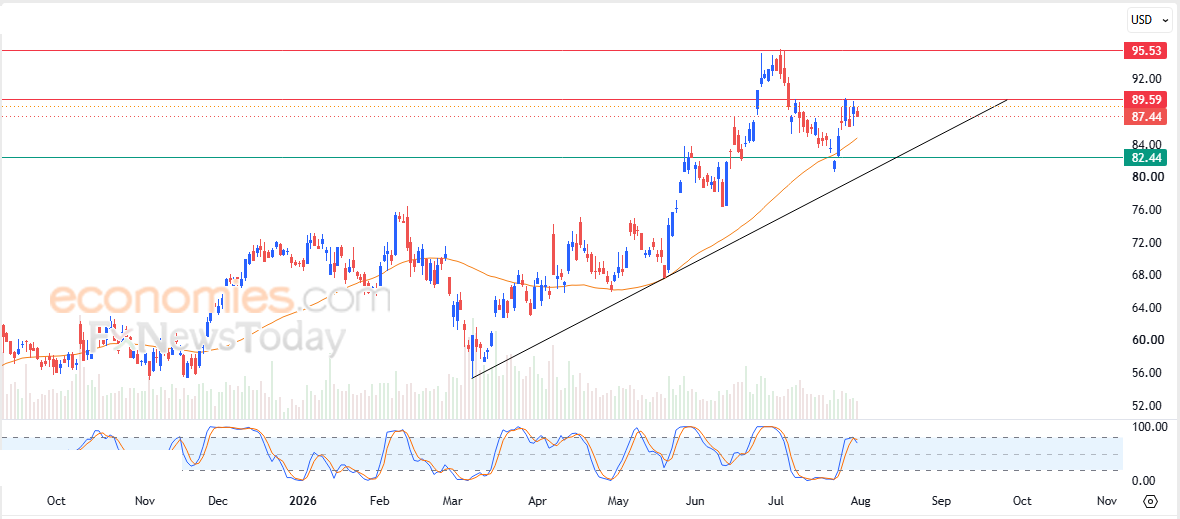
Delta Air Lines, Inc. (DAL) edged lower in recent intraday trading after the stock once again held below the current resistance level at $89.60. This pullback appears to be allowing the stock to rebuild positive momentum that could support a breakout above that resistance. At the same time, the stock is working off part of its overbought conditions on the momentum indicators, although fresh bearish signals have started to emerge. Despite this, the broader technical outlook remains constructive, with the stock continuing to trade above its 50-day Simple Moving Average (SMA), which is acting as dynamic support and reinforcing the primary short-term uptrend. Price action also continues to follow an ascending trendline that supports the prevailing bullish trend.
Therefore, our outlook remains bullish for the stock’s upcoming trading sessions, particularly if it breaks above the key resistance level at $89.60. Under this scenario, the stock is expected to target the next major resistance level at $95.50.
Today’s price forecast: Bullish.
Silver price (XAG/USD) rises after registering modest gains in the previous day, trading around $58.20 per troy ounce during the Asian hours on Monday. Silver prices climb as market sentiment shifted following statements from US President Donald Trump, who announced that peace talks with Iran are set to resume on Monday. The prospect of diplomacy helped send oil prices lower, offering relief to investors concerned about rising inflation and the broader outlook for interest rates.
President Trump noted that key Middle Eastern allies, including Saudi Arabia, had urged him to halt planned military strikes in favor of a diplomatic solution, while he reiterated his call for the immediate reopening of the Strait of Hormuz.
Beyond geopolitical developments, investors are turning their attention to a busy week of US labor market data, anchored by Friday’s closely watched monthly jobs report. This economic focus comes on the heels of the Federal Reserve’s recent decision to hold interest rates steady.
However, that decision was not unanimous; three Fed officials dissented, cautioning that delaying action could force the central bank into more aggressive policy tightening down the road. In response to these mixed signals, financial markets are currently pricing in roughly a 68% chance of a 25 basis point rate hike at the Fed’s upcoming September meeting.
According to analysts at Commerzbank, the outlook for the other bullion, gold, remains constrained by the policy path in the US. They argue that “the persistent expectation of Fed interest rate rises should counteract any rise in the gold price,” with ongoing tightening expectations limiting the scope for a sustained move higher even after the recent post-meeting spike.
Silver is a precious metal highly traded among investors. It has been historically used as a store of value and a medium of exchange. Although less popular than Gold, traders may turn to Silver to diversify their investment portfolio, for its intrinsic value or as a potential hedge during high-inflation periods. Investors can buy physical Silver, in coins or in bars, or trade it through vehicles such as Exchange Traded Funds, which track its price on international markets.
Silver prices can move due to a wide range of factors. Geopolitical instability or fears of a deep recession can make Silver price escalate due to its safe-haven status, although to a lesser extent than Gold’s. As a yieldless asset, Silver tends to rise with lower interest rates. Its moves also depend on how the US Dollar (USD) behaves as the asset is priced in dollars (XAG/USD). A strong Dollar tends to keep the price of Silver at bay, whereas a weaker Dollar is likely to propel prices up. Other factors such as investment demand, mining supply – Silver is much more abundant than Gold – and recycling rates can also affect prices.
Silver is widely used in industry, particularly in sectors such as electronics or solar energy, as it has one of the highest electric conductivity of all metals – more than Copper and Gold. A surge in demand can increase prices, while a decline tends to lower them. Dynamics in the US, Chinese and Indian economies can also contribute to price swings: for the US and particularly China, their big industrial sectors use Silver in various processes; in India, consumers’ demand for the precious metal for jewellery also plays a key role in setting prices.
Silver prices tend to follow Gold’s moves. When Gold prices rise, Silver typically follows suit, as their status as safe-haven assets is similar. The Gold/Silver ratio, which shows the number of ounces of Silver needed to equal the value of one ounce of Gold, may help to determine the relative valuation between both metals. Some investors may consider a high ratio as an indicator that Silver is undervalued, or Gold is overvalued. On the contrary, a low ratio might suggest that Gold is undervalued relative to Silver.
Domestic coffee prices today
Coffee prices today in the domestic market decreased slightly compared to the previous session. According to giacaphe. com, coffee prices on August 3rd averaged 96,600 VND/kg, down 200 VND/kg. The highest price in key Central Highlands regions was recorded at 96,700 VND/kg.
In Lam Dong, coffee prices today reached 96,000 VND/kg, down 200 VND/kg compared to the previous session. This is the region with the lowest price in the detailed update table.
In Gia Lai, coffee prices were recorded at 96,500 VND/kg, down 200 VND/kg compared to the previous day.
The old Dak Nong area recorded a level of 96,700 VND/kg, belonging to the highest group among the surveyed areas.
After the rebound in early August, domestic coffee prices have turned down slightly. The decrease of 200 VND/kg is not large, but it shows that the domestic market still does not have a clear breakthrough to return to the area close to 99,000 VND/kg as at the end of July.
World coffee prices
In the world market, coffee prices increased in the most recent trading session, but Robusta’s increase range is very narrow.
According to Barchart, the September 2026 Arabica futures contract closed up 9.05 US cents/lb, equivalent to 2.80%. This is a much stronger increase than Robusta.
In the same session, the September 2026 Robusta futures contract increased by 2 USD/ton, equivalent to 0.05%, to 3.782 USD/ton. This increase shows that Robusta is almost sideways, although still maintaining green color.
Coffee price assessment
Domestic coffee prices slightly decreased even though the world market just had an increase session. The deviation is in Robusta: Arabica increased sharply, but Robusta London only increased by 0.05%, not enough to create a clear pulling force for domestic purchase prices.
Arabica increased due to short-term supply constraints, in the context of Arabica stocks certified on ICE continuously decreasing for about 4.5 months and falling to a 2.5-year low.
Meanwhile, heavy rain was recorded in the Minas Gerais region of Brazil and slower harvest progress than the same period were factors supporting coffee prices in the recent session. However, this factor is more clearly reflected in Arabica, while Robusta fluctuates narrowly.
Regarding domestic weather, the National Center for Hydro-Meteorological Forecasting said that on the day and night of August 3rd, the Central Highlands area will have showers and thunderstorms in some places; especially in the late afternoon and evening, there will be scattered showers and thunderstorms in some places. The lowest temperature is 20-23 degrees Celsius, the highest is 28-31 degrees Celsius, in some places above 31 degrees Celsius. This season’s thunderstorms need to be monitored in the garden care, pest and disease prevention and goods preservation stages.
In the coming sessions, the diễn biến of Robusta London, USD/VND exchange rate, inventory and demand for export purchases will continue to dominate the domestic price level.
TradingKey – As of the Asian session on August 3, WTI crude oil ( USOIL) prices fell sharply, breaking below the $80 mark during intraday trading, with an intraday decline of over 9%, while Brent crude ( UKOIL) also plunged by over 8%. Last week, the crude oil market was supported by the risk of Middle East crude oil supply disruptions, but last Saturday Trump said he would suspend a new round of military strikes on Iran. Coupled with OPEC+ announcing a continuation of production increases, crude oil prices opened under pressure this week and fell back.
The direct cause of today’s decline in WTI crude oil was US President Donald Trump signaling a fresh de-escalation in the US-Iran situation. Trump stated that after Iran and some Middle Eastern countries requested more time to reach an agreement, the US decided to temporarily hold off on launching new military strikes against Iran and plans to push for negotiations to achieve a full restoration of navigation in the Strait of Hormuz, while also resolving the Iranian nuclear issue. Trump also noted that US-Iran talks would begin on Monday, but did not announce the location of the talks, the participants, or a clear deadline for reaching an agreement.
This statement significantly eased market concerns over a further escalation of the conflict. Previously, the conflict between the US and Iran had repeatedly escalated, with multiple oil tankers attacked near Oman and the Strait of Hormuz, prompting some shipping companies to reduce entry into the Persian Gulf, which led to cumulative gains of over 20% for both WTI and Brent crude in July. Now that the US has put military action on hold, the market has begun betting that shipping conditions in the strait could improve, driving oil prices to quickly give back some of their war risk premium.
The latest statement from the Iranian side also signaled some willingness to negotiate. Iran’s Ministry of Foreign Affairs stated that Iran is close to reaching an agreement with Oman on a new shipping route for the Strait of Hormuz, which will take into account the sovereignty, security, and navigation needs of both sides. However, Iran also emphasized that this does not mean the strait will return to the fully open state it was in before the conflict broke out.
In addition, OPEC+’s latest decision to increase production has also added downward pressure on oil prices. Saudi Arabia, Russia, Iraq, Kuwait, Kazakhstan, Algeria, and Oman have decided to raise their crude oil production targets by 188,000 barrels per day starting in September. This means OPEC+ is further unwinding the voluntary production cuts implemented in 2023 and signaling increased supply to the market.
WTI crude oil price daily chart, Source: TradingView
Looking at the daily chart of WTI crude oil, oil prices gap-opened sharply lower today and broke below the key $80 psychological level, indicating that the previous upward trend driven by geopolitical risks has clearly cooled down. As $80 is an important psychological support for the market, breaking below it now may turn it into short-term resistance, and market sentiment has temporarily shifted from bull-dominated to bear-dominated.
On the downside, the primary support for WTI crude oil is in the $79-$78 range. If oil prices can find support in this area, a short-term technical rebound may occur to retest the $80 level. If $78 is decisively broken, oil prices may head further down to test $76.
On the upside, $80 to $81 has become the first line of resistance. If there is a lack of progress in US-Iran negotiations, or if another tanker attack occurs in the Strait of Hormuz, WTI may reclaim $81 and rebound toward the $83-$85 range.
This content was translated using AI and reviewed for clarity. It is for informational purposes only.
Gold (XAU/USD) is trading close to $4,064 ahead of the U.S. ISM Manufacturing PMI, the first significant economic data of the week. Focus will also be on the Non-Farm Payrolls on Friday, which are poised to alter the case for the Federal Reserve, the Treasury yields and the U.S. dollar. According to Reuters, the labor-market data are anticipated to be the key data for the week as traders are focusing on the data after central bank communications last week. (Link Reuters article)
The week for Gold starts with prices consolidating as traders are ready for various impactful U.S. economic releases. While central bank purchasing continues to add support in the long-term; for the Gold price, the fixture in the short term is if the data will be supportive or detrimental to the Fed expectations.
The ISM Manufacturing PMI that will be released today is the first major data point of the week with the potential to impact Gold prices. This manufacturing survey will be the first of many, with job openings JOLTS, ADP, ISM Services PMI, initial jobless claims, and the Non-Farm Payrolls on Friday.
A PMI result that shows Gold in a more positive light would be a negative result for PMI, which would signal a negative result for Treasury yields and a stronger dollar. Stronger PMI data would most likely lead to a stronger dollar and lower demand for Gold.
Reuters has reported that the Gold market is reacting to U.S. macro data, especially after the Fed’s decision to keep rates on hold.
As per the Gold Demand Trends Report Q2 2026, published by the World Gold Council, total gold demand was 1,269 tonnes for the quarter. Total first-half demand was 2,522 tonnes, and first-half demand was estimated at a record high of $380 billion.
Buying by the official sector was the strongest market pillar. Central banks bought 289 tonnes, up 62% year on year. Poland bought 51 tonnes, and China purchased 33 tonnes.
As Western ETF flows are sensitive to interest-rate expectations, the World Gold Council also expects that investment demand, especially through the OTC markets and in Asia, will be the more significant demand driver in the second half of 2026.
Supply conditions in the market continue to be supportive. For the second quarter, mine production rose by just under 2%, reaching 966 tonnes. In contrast, an observed reduction in selling, due to a consolidation in prices, saw a 6% decline in recycling.
Due to the extended development times of new mining projects, the World Gold Council projects only limited supply growth for the rest of the year.
While there are periodic changes in investment demand, supply for gold remains relatively tight and provides structural underpinning for the metal.
Since the previous report, Gold has established another higher low and has left bullish signs. Gold is still holding above $4,061, the 50-day MA, and buyers are holding above the $4,057 support. The upper boundary of the triangle is $4,112 and sellers are present at this resistance.
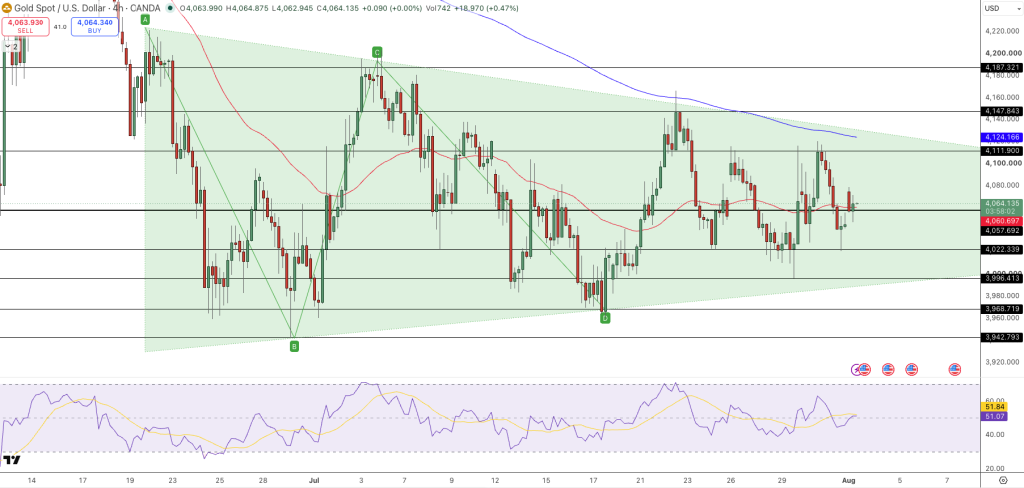
Currently we see a neutral RSI at 51. Typically this indicates price consolidation. A break above $4,112 will bring new targets, as the next resistance would be $4,148, followed by $4,187. If the buyers do not hold the $4,057 support, the $4,022, $4,996 and $4,968 support zones will be the new targets. Resistance levels are currently at $4,112, $4,148, and $4,187; while support is at $4,057, $4,022, $3,996, and $3,968.
A break and hold above $4,112 will create a buy signal. A target of $4,148 and a second target of $4,187 will be set, while placing a stop loss for this trade below $4,057. The outlook for Gold is cautiously bullish until it breaks below $4,057; however, a break above $4,112 is required to validate this bullish leg.
Gold is in consolidation until the ISM Manufacturing PMI today and the Non-Farm Payrolls on Friday. These upcoming reports will likely affect the Fed and the US Dollar, all of which affect the price of Gold.
As a hedge against inflation, central banks are still diversifying their reserves. The World Gold Council noted 289 tonnes were purchased in Q2 2026. (Attach WGC report here)
Target resistance is $4,112, $4,148, and $4,187. Supports are $4,057, $4,022, and $3,996.

Arslan Ali Butt
Lead Markets Analyst – Multi-Asset (FX, Commodities, Crypto)
Arslan Ali Butt serves as the Lead Commodities and Indices Analyst, bringing a wealth of expertise to the field. With an MBA in Behavioral Finance and active progress towards a Ph.D., Arslan possesses a deep understanding of market dynamics.
His professional journey includes a significant role as a senior analyst at a leading brokerage firm, complementing his extensive experience as a market analyst and day trader. Adept in educating others, Arslan has a commendable track record as an instructor and public speaker.
His incisive analyses, particularly within the realms of cryptocurrency and forex markets, are showcased across esteemed financial publications such as ForexCrunch, InsideBitcoins, and EconomyWatch, solidifying his reputation in the financial community.
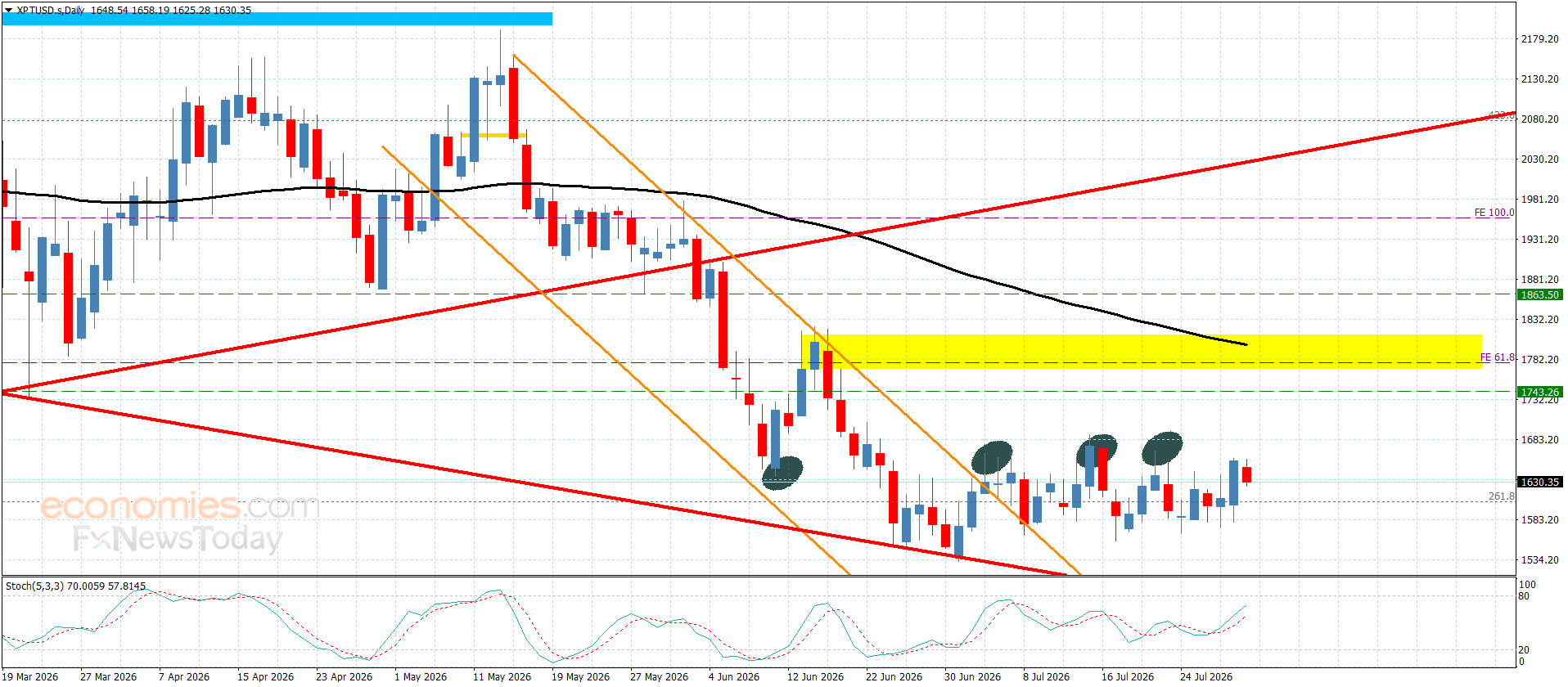
Platinum price formed a bullish wave during yesterday’s trading, targeting the $1,670.00 level, while maintaining its negative stability below the additional resistance barrier at $1,690.00. This confirms the price’s adherence to the bearish corrective scenario. Therefore, we emphasize the importance of gathering negative momentum during the current trading sessions, which would facilitate the move toward the initial corrective targets at $1,550.00 and $1,515.00, respectively.
However, if the price comes under renewed positive pressure and breaks above the $1,690.00 level, it would force the bearish attack to be postponed, giving the price an opportunity to achieve further intraday gains by moving toward $1,730.00, followed by the key resistance barrier near $1,790.00.
The expected trading range for today is between $1550.00 and $1680.00
Trend forecast: Bearish
World oil prices today
In the past week, world gasoline and oil prices turned down. WTI crude oil from 85.15 USD/barrel at the end of last week fell to 84.67 USD/barrel at the end of this week. Overall last week, WTI oil prices decreased by 0.48 USD/barrel, equivalent to a decrease of 0.56% compared to the end of last week.
Brent oil fell from 96.78 USD/barrel at the end of last week to 90.12 USD/barrel at the end of this week. Over the past week, Brent oil prices fell 6.66 USD/barrel, equivalent to a decrease of about 6.88% compared to the end of last week.
World oil prices this week fluctuated sharply amid new developments related to tensions in the Middle East. In the first sessions of the week, oil prices fell sharply to their lowest level in more than a week after the US temporarily suspended airstrikes against Iran, raising expectations for a diplomatic solution that could help resume oil transportation across the Strait of Hormuz soon.
However, the decline is not long-lasting as risks to supply are still present. The flow of ships through the Strait of Hormuz continues to be low, while Houthi attacks in the Red Sea still disrupt maritime operations.
In addition, the risk of unsafety in the Bab el-Mandeb Strait – a strategic transport route connecting the Red Sea with the Gulf of Aden – continues to increase, threatening Saudi Arabia’s oil exports and international trade flows.
Oil prices also received support from information that OPEC+ is likely to temporarily suspend its production increase plan for three months, starting from October 2026, after completing the roadmap to restore previously voluntarily cut production.
Domestic gasoline prices today
On August 2nd, retail gasoline and oil prices according to the price list announced by Petrolimex in region 1 and region 2 are as follows:
The above domestic retail gasoline and oil prices are adjusted by Petrolimex according to the inter-ministry of Industry and Trade – Finance’s management period from 3:00 PM on July 30th.
Gasoline and oil discount today
– Tu Luc Petroleum Joint Stock Company 1:
+ Diesel oil 0.05S – II: 50 VND/liter;
+ E10 RON 95-III gasoline: 200 VND/liter
– MIPEC Petroleum Trading and Trading Co., Ltd. – MIPEC Petro (applied to the Northern region):
+ E10 gasoline: 100 VND/liter.
+ Diesel oil 0.05S-II: 100 VND/liter.
Domestic gasoline and oil price forecast for the next period
According to a representative of a gasoline and oil business, it is predicted that in the next price adjustment period, retail gasoline and oil prices may increase slightly.
In which:
– E10 gasoline increases by about 0-50 VND/liter
– E5 RON 92 – II gasoline increased by about 100 VND/liter;
– Diesel oil increased by about 300 VND/liter.
Today’s gasoline and oil prices are for reference only and may change according to market developments.
Refer to more articles about gasoline and oil prices HERE.