The main tag of Gold Today Price Articles.
You can use the search box below to find what you need.
[wd_asp id=1]
The main tag of Gold Today Price Articles.
You can use the search box below to find what you need.
[wd_asp id=1]
Gold price (XAU/USD) trades in positive territory around $4,075 during the early Asia session on Monday. The precious metal edges higher as expectations for a Federal Reserve (Fed) rate cut rise after comments from John Williams. The US September Producer Price Index (PPI) and Retail Sales reports will be in the spotlight later on Tuesday.
New York Fed President John Williams said on Friday that the US central bank could still trim interest rates in the near term without jeopardizing its inflation goal. Markets are now pricing in nearly a 74% chance of a rate cut at the Fed’s December meeting, up from 40% last week, according to the CME FedWatch tool. Lower interest rates could reduce the opportunity cost of holding Gold, supporting the non-yielding precious metal.
Meanwhile, other Fed officials maintained a hawkish stance, with Dallas Fed President Lorie Logan and Boston Fed President Susan Collins calling for leaving the policy rate on hold “for a time.”
Traders will take more cues from the mixed economic signals and the delayed release of key inflation data. The US PPI inflation and Retail sales data are due on Tuesday. The headline PPI is expected to show an increase of 0.3% MoM in September, while the Retail Sales are projected to show a rise of 0.4% MoM during the same report period. Any signs of hotter inflation could dampen hopes for Fed rate cuts. This, in turn, could lift the US Dollar (USD) and weigh on the USD-denominated commodity price.
Gold has played a key role in human’s history as it has been widely used as a store of value and medium of exchange. Currently, apart from its shine and usage for jewelry, the precious metal is widely seen as a safe-haven asset, meaning that it is considered a good investment during turbulent times. Gold is also widely seen as a hedge against inflation and against depreciating currencies as it doesn’t rely on any specific issuer or government.
Central banks are the biggest Gold holders. In their aim to support their currencies in turbulent times, central banks tend to diversify their reserves and buy Gold to improve the perceived strength of the economy and the currency. High Gold reserves can be a source of trust for a country’s solvency. Central banks added 1,136 tonnes of Gold worth around $70 billion to their reserves in 2022, according to data from the World Gold Council. This is the highest yearly purchase since records began. Central banks from emerging economies such as China, India and Turkey are quickly increasing their Gold reserves.
Gold has an inverse correlation with the US Dollar and US Treasuries, which are both major reserve and safe-haven assets. When the Dollar depreciates, Gold tends to rise, enabling investors and central banks to diversify their assets in turbulent times. Gold is also inversely correlated with risk assets. A rally in the stock market tends to weaken Gold price, while sell-offs in riskier markets tend to favor the precious metal.
The price can move due to a wide range of factors. Geopolitical instability or fears of a deep recession can quickly make Gold price escalate due to its safe-haven status. As a yield-less asset, Gold tends to rise with lower interest rates, while higher cost of money usually weighs down on the yellow metal. Still, most moves depend on how the US Dollar (USD) behaves as the asset is priced in dollars (XAU/USD). A strong Dollar tends to keep the price of Gold controlled, whereas a weaker Dollar is likely to push Gold prices up.
Gold (XAU/USD) is consolidating near $4,040 per ounce, holding just above critical support at $4,000, after retreating nearly 7% from its October 20 all-time high of $4,380. The metal’s recent slump marks its steepest decline since April, driven by renewed strength in the U.S. dollar (DXY 100.1), aggressive Treasury yields, and heavy liquidation from speculative longs following last month’s retail euphoria. The move coincides with turbulence across the mining sector, where Barrick Gold Corp (NYSE:GOLD) is under pressure from Elliott Management and investors calling for structural changes amid declining output and internal turmoil.
Gold’s chart structure has shifted into a symmetrical consolidation pattern, anchored between $4,000 and $4,100, after breaking down from the October double-top. Despite volatility, higher lows from $3,950 to $4,020 continue to build a potential base. According to current trading data, support at $4,000 has been tested five times over the past six sessions without a daily close below it, underscoring its technical significance. Should that level fail, the next support zone lies at $3,895–$3,916, while on the upside, $4,145–$4,161 and $4,250 serve as resistance. Sustained movement above $4,250 would reopen a path toward $4,380 and possibly $4,500, a key psychological mark.
Momentum indicators remain mixed: the RSI hovers near 48, showing loss of bullish momentum without clear capitulation, while MACD signals flattening. The ADX at 29 indicates a consolidating, rather than trending, environment—consistent with coiling behavior before a potential breakout.
In Southeast Asia, demand for physical gold remains intense. In Kuala Lumpur, jeweler data shows 916 gold priced at RM595 per gram, while 999.9 gold fetches around RM625–RM640, even after retreating from October’s RM680 peak. Despite the dip, Habib Jewels and other major retailers report 20% higher sales in 2025 than last year, with queues forming as buyers exchange jewelry for profit or reinvest in gold bars. Retailers are serving 50–100 customers daily, doubling weekday volume from 2024.
Buyers are split between profit-taking and accumulation. Some anticipate further gains, targeting RM700–RM1,000 per gram by 2026. Public Gold, one of Malaysia’s largest digital investment platforms, reports a surge in online gold purchases as households seek to hedge inflation and currency risk.
The broader macro setup remains pivotal. Gold’s correlation with the S&P 500 (INDEXSP:.INX) has turned positive again in 2025, meaning both assets move in sync amid U.S. growth uncertainty. The Federal Reserve’s decision to delay any policy easing into 2026, confirmed by Morgan Stanley (NYSE:MS) forecasts, limits upside momentum for non-yielding assets. Additionally, rising Japanese bond yields, concerns over an AI-driven equity bubble, and fears of a global market correction have amplified volatility.
Still, gold remains resilient compared to broader risk assets. The CBOE Volatility Index (VIX) surged 11% this week, while gold held within its range, suggesting steady haven interest. Inflation pressures from energy and food remain persistent, keeping real yields tight and dampening speculative buying.
While gold prices hover near $4,000, miners are facing a reckoning. Barrick Gold Corp (NYSE:GOLD)—valued near $64 billion—is under activist scrutiny following the abrupt exit of CEO Mark Bristow and the entry of Elliott Management, which has reportedly taken a $700 million stake. The hedge fund’s push for restructuring, possibly splitting the company into separate North American and global units, follows a series of setbacks, including safety incidents, declining production, and geopolitical risk from its $9 billion Reko Diq copper-gold project in Pakistan.
Barrick’s share price has lagged peers like Agnico Eagle Mines (NYSE:AEM) and AngloGold Ashanti (NYSE:AU), trading at lower valuation multiples despite record bullion prices. Interim CEO Mark Hill has shifted focus to Nevada operations, integrating its Pueblo Viejo mine and emphasizing safety improvements after three fatalities across sites this year. Investors expect clarity before year-end on potential asset divestments or a merger with Newmont Corp (NYSE:NEM), which already shares ownership of key assets.
Silver (XAG/USD) amplifies the pressure, sliding over 10% since its October peak. The metal’s double-top pattern suggests deeper retracement potential, with downside targets near $41 per ounce. The technical correlation between gold and silver remains strong, meaning a silver breakdown often precedes extended weakness in XAU/USD. Analysts view the A-B-C corrective wave in silver as a cautionary signal for gold bulls expecting a quick rebound.
ETF holdings show defensive behavior. SPDR Gold Shares (NYSEARCA:GLD) reported modest outflows of $327 million last week, while iShares Gold Trust (NYSEARCA:IAU) saw $95 million in inflows, suggesting portfolio rebalancing rather than mass liquidation. Institutional investors are rotating from leverage-based products to physical-backed funds amid tightening liquidity conditions.
Retail sentiment, on the other hand, is deeply polarized—fear of missing another rally competes with the desire to lock profits. The gold-to-silver ratio, now above 95, remains elevated, signaling risk aversion and preference for core safe-haven exposure over industrial-linked metals.
Despite its near-term consolidation, gold retains its hedge status across multiple jurisdictions. Central banks, led by China, Turkey, and India, have collectively purchased over 460 tons year-to-date, according to IMF data. China’s opaque reserve accumulation policy remains a key driver—its quiet acquisitions throughout Q3 supported gold’s early rally past $4,000 before October’s selloff.
Meanwhile, private-sector gold accumulation in emerging markets continues. Digital platforms in Southeast Asia report transaction growth exceeding 35% year-over-year, a sign that retail confidence remains strong despite volatility. In Malaysia and Thailand, gold remains a cultural and financial hedge, underpinning long-term demand even as global markets flirt with panic.
From a technical and macro standpoint, gold’s near-term direction hinges on the $4,000 support threshold. A daily close below it risks a breakdown toward $3,895–$3,900, while sustained trade above $4,100–$4,150 could mark the beginning of a new rally cycle toward $4,250 and eventually $4,380.
Institutional positioning leans neutral but biased toward accumulation on dips. If central banks maintain gold buying pace and the Fed signals even mild dovishness in Q1 2026, XAU/USD could regain its bullish footing.
At current levels near $4,040, the risk-reward balance favors a Hold outlook—technically cautious, fundamentally supported. The consolidation between $3,950 and $4,150 remains a potential launchpad for renewed momentum once macro clarity returns. Gold’s behavior against the S&P 500 (INDEXSP:.INX) and NASDAQ:IXIC correlation will serve as the next barometer for investor risk tolerance as 2025 draws to a volatile close.
Gold (XAU/USD) is trading near $4,065 per ounce, maintaining a steady range after retreating from the record high of $4,294 reached in October 2025. The metal has corrected about 5.4% over the past month as traders digest mixed signals from the Federal Reserve, a stronger dollar, and resilient U.S. yields. Despite the pullback, gold remains up over 45% year-to-date, underscoring its strength as the top-performing major asset of 2025.
Since October, gold has fallen by roughly $230 per ounce, sliding from $4,294 to $4,065 amid tightening liquidity and a temporary rebound in the U.S. dollar. The Dollar Index (DXY) climbed toward 100.5, while the 10-year Treasury yield stabilized at 4.06%, curbing speculative inflows into precious metals. The correction coincided with a sharp depreciation of emerging-market currencies, including the Indian Rupee, which hit ₹89.43 per USD — indirectly cushioning gold prices in local terms. Analysts attribute the drop to profit-taking after the record surge and the fading probability of a December rate cut, which swap markets now estimate at 40%, down from 73% two weeks ago.
Gold’s technical pattern has formed a symmetrical triangle, reflecting consolidation after the vertical rally. Support remains firm near $4,000 to $4,044, tested repeatedly during the week without a single daily close below that zone. The next support cluster lies at $3,895–$3,916, marking the level where buyers are likely to re-enter aggressively. On the upside, short-term resistance is seen around $4,145 to $4,161, followed by a critical breakout barrier at $4,250. A confirmed close above that level would open the door toward $4,380–$4,500, which aligns with the next Fibonacci projection and psychological extension target.
The 50-day moving average currently sits near $4,088, the 100-day at $3,960, and the 200-day at $3,752, keeping the medium-term trend decisively bullish. The RSI on the daily chart holds near 52, suggesting neutral momentum with a slight upward bias. As long as $4,000 holds, the broader trajectory remains constructive.
The gold market is anchored to expectations around U.S. monetary policy. New York Fed President John Williams recently signaled openness to a rate cut “in the near term,” giving short-term support to gold. However, Chicago Fed President Austan Goolsbee cautioned against early easing, warning that inflation progress has “begun to move in the wrong direction.” These conflicting statements have kept gold confined to its current $4,000–$4,150 corridor ahead of the December 9-10 FOMC meeting. A decisive dovish tilt could reignite a rally; conversely, a firm “higher for longer” message would expose gold to renewed downside pressure toward $3,900.
Underlying fundamentals remain exceptionally strong. Data from the World Gold Council show that global demand reached 1,249 tonnes in Q2 2025, up 3% year-on-year, while central banks added 166 tonnes to their reserves. Institutional investors continue to treat gold as a structural hedge against fiscal imbalance and currency debasement. The iShares Global Gold Index ETF (TSX:XGD) has gained over 100% YTD, and the Sprott Physical Gold Trust (TSX:PHYS) reported steady inflows through October despite temporary profit-taking. This reinforces that gold’s investor base is not purely speculative but strategically anchored to long-term macro hedging.
Gold miners continue to amplify the metal’s performance due to strong operational leverage. IAMGOLD (TSX:IMG), with production costs near $2,500 per ounce, has benefited disproportionately — its stock is up 135% YTD, far exceeding the 54% rise in gold prices earlier this year. Sierra Madre Gold & Silver (TSXV:SM) posted a 24% quarter-on-quarter revenue jump to $3.59 million in Q2 2025, with realized prices averaging $3,271 per ounce and cash costs at $23.32 per silver-equivalent ounce. At current gold prices above $4,000, margin expansion across miners remains significant, suggesting continued earnings strength if prices stay near current levels.
Geopolitical dynamics remain a persistent catalyst for gold. The tentative U.S.–Russia–Ukraine peace proposal temporarily reduced haven flows but failed to shift the longer-term narrative of global instability. In Asia, renewed trade friction between India and the U.S. added uncertainty, keeping gold demand steady in key consumption hubs. The Pakistan market mirrored international trends, with 24-karat gold rising $23 per ounce to $4,065, equivalent to an increase of Rs 2,300 per tola. Rising silver prices — now near $49.98 per ounce — underline a broader defensive allocation across precious metals.
Gold is consolidating within a healthy bullish channel. If $4,000 continues to hold, technical projections favor a retest of $4,250 in the coming weeks, followed by potential extension toward $4,380–$4,500 if the Fed confirms a rate-cut path. A breakdown below $3,895 would trigger short-term cooling but would not compromise the longer-term uptrend unless $3,750 is breached.
According to Ponmudi R. (Enrich Money), short-term targets range between $4,100–$4,160, while the medium-term view caps resistance near $4,210–$4,250. He emphasizes that dips below $3,970 could attract value-based buying, especially from central banks and Asian wholesalers. The Dollar Index’s resistance at 100.50 remains critical; failure to break higher would likely support renewed gold strength through December.
Gold remains a macro-hedge asset supported by central-bank demand, real-yield compression, and high geopolitical tension. The correction from $4,294 to $4,065 reflects consolidation, not exhaustion. Current data suggest accumulation is favored between $4,000 and $4,050, with stop levels just under $3,895 and upside targets between $4,250 and $4,450.
The long-term drivers — monetary debasement, fiscal deficits exceeding 120% of GDP across G7 economies, and rising production costs — continue to underpin a structural bullish outlook.
Trading News Verdict:
Gold (XAU/USD): HOLD → Bullish Bias Above $4,000 | Breakout Target $4,450
Current Price: $4,065
Support: $3,895 / $4,044
Resistance: $4,161 / $4,250 / $4,380
Record High: $4,294 (October 2025)
Central Bank Purchases: 166 tonnes (Q2 2025)
Dollar Index: 100.5 — Key Resistance
Price has spent the entire week testing the critical confluence of the 61.8% Fibonacci retracement at $4,023 and the 20-day average near $4,041. A short-term uptrend line cuts through the range, adding dynamic context to this high-density support zone.
Weekly support arrives at the rising 10-week average near $3,988, mirroring the daily 50-day average at $3,981. Both longer-term benchmarks sit only marginally below current price and remain untested since their August reclaim.
The $3,998 higher interim swing low established Tuesday stays intact so far. As long as it holds, the uptrend structure from October’s $3,886 base remains valid, bolstered by the recent 10-day/20-day bullish cross and 20-day reclaim.
Last week’s lower swing high at $4,245 and closing in the lower half of the week’s range created a potential shooting star. Validation requires a weekly close below last week’s $3,997 low, which would deliver strong bearish momentum and threaten the 50-day line. However, for active traders, an initial dip may provide a valid signal.
A weekly push above $4,133 targets last week’s high, then the $4,381 October record. Recent momentum slowdown, however, makes extended consolidation beyond this week a realistic possibility.
Gold’s inside week places the 20-day/61.8% confluence as the immediate pivot. Hold $3,998–$3,997 to protect the higher-low sequence and favor eventual continuation higher; a weekly close below $3,997 activates the shooting star and targets the untested 50-day near $3,981. Until proven otherwise, dips into this zone remain buyable in the structural bull trend.
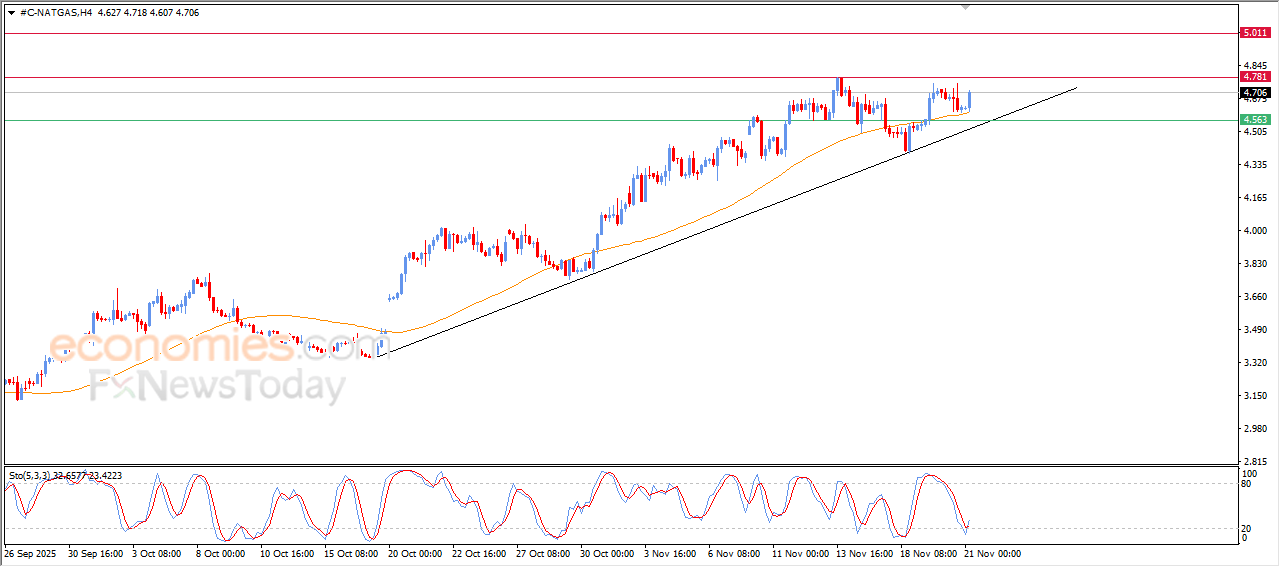
Natural gas price rose in its last trading on the intraday basis, due to its leaning on the support of EMA50, gaining bullish momentum that helped it to achieve these last gains, preparing to attack the key resistance at $4.75, amid the dominance of the main bullish trend on the short-term basis and its trading alongside supportive trend line for this trend, besides the emergence of the positive signals on the relative strength indicators, after reaching oversold levels.
Therefore, we suggest a rise in its upcoming intraday trading, especially when breaching $4.75, to target its main resistance at $5.00.
The expected trading range for today is between $4.55 and $5.00
Trend forecast: Bullish
Gold is struggling for a direction, while trading under the $4,100 mark early Friday, although remaining confined in a familiar range. Despite the range-play, Gold is set to end the week on a subdued note.
Markets remain wary about whether the US Federal Reserve (Fed) will cut or not cut interest rates in December, especially after the dated September US employment report released Thursday.
The headline US Nonfarm Payrolls (NFP) rose by 119,000 in September, following a 4,000 decrease (revised from +22,000) recorded in August. The reading outpaced the market forecast of 50,000.
Meanwhile, the Unemployment Rate rose to 4.4% from 4.3% in this period. The mixed data provided an ambiguous picture of the Fed’s path forward on interest rates.
However, markets continued to price in about a 40% chance that the Fed will lower rates next month as policymakers remained cautious on further monetary policy easing.
“Cleveland Fed President Beth Hammack warned on Thursday that cutting rates further right now carries a wide range of risks for the economy. Fed Governor Lisa Cook sees a risk of outsized asset price declines.”
The hawkish sentiment surrounding the Fed is weighing on non-yielding assets such as Gold. But Gold’s downside appears cushioned by the tech sell-off on Wall Street and later in the Asian markets as the solid Nvidia earnings-led rally faded.
Expectations of a massive economic stimulus package due to be unveiled by Japan’s government later on Friday also help keep Gold buyers hopeful. The package is estimated to be worth over JPY 20 trillion, the biggest since COVID-19.
Traders now eagerly await the S&P Global preliminary PMI data for November from the United States (US) for fresh insights on the health of the US economy The data could help markets reprice Fed rate cut expectations, eventually impacting Gold price action.
The US Manufacturing PMI is set to fall to 52 in November from 52.5 in October. The Services PMI is likely to stay unchanged at 54.8 in the reported period.
In the daily chart, XAU/USD trades at $4,065.29. The 50-, 100-, and 200-day Simple Moving Averages (SMAs) advance while price holds above them, maintaining a bullish bias. The 21-day SMA has flattened and edged lower, with $4,044.66 offering nearby dynamic support. The Relative Strength Index (RSI) stands at 52.00 (neutral), reflecting balanced momentum after the recent rebound.
Measured from the $4,381.17 high to the $3,885.84 low, the 38.2% retracement at $4,075.05 acts as near-term resistance, and a daily close above it would open the 50% retracement at $4,133.50. With momentum neutral and trend support intact, the path of least resistance would improve on a break of this barrier, while failure to clear it would keep gains capped and risk a return to the rising averages.
(The technical analysis of this story was written with the help of an AI tool)
Monetary policy in the US is shaped by the Federal Reserve (Fed). The Fed has two mandates: to achieve price stability and foster full employment. Its primary tool to achieve these goals is by adjusting interest rates.
When prices are rising too quickly and inflation is above the Fed’s 2% target, it raises interest rates, increasing borrowing costs throughout the economy. This results in a stronger US Dollar (USD) as it makes the US a more attractive place for international investors to park their money.
When inflation falls below 2% or the Unemployment Rate is too high, the Fed may lower interest rates to encourage borrowing, which weighs on the Greenback.
The Federal Reserve (Fed) holds eight policy meetings a year, where the Federal Open Market Committee (FOMC) assesses economic conditions and makes monetary policy decisions.
The FOMC is attended by twelve Fed officials – the seven members of the Board of Governors, the president of the Federal Reserve Bank of New York, and four of the remaining eleven regional Reserve Bank presidents, who serve one-year terms on a rotating basis.
In extreme situations, the Federal Reserve may resort to a policy named Quantitative Easing (QE). QE is the process by which the Fed substantially increases the flow of credit in a stuck financial system.
It is a non-standard policy measure used during crises or when inflation is extremely low. It was the Fed’s weapon of choice during the Great Financial Crisis in 2008. It involves the Fed printing more Dollars and using them to buy high grade bonds from financial institutions. QE usually weakens the US Dollar.
Quantitative tightening (QT) is the reverse process of QE, whereby the Federal Reserve stops buying bonds from financial institutions and does not reinvest the principal from the bonds it holds maturing, to purchase new bonds. It is usually positive for the value of the US Dollar.
Oil prices fell sharply again on Friday, November 21, 2025, extending a three‑day losing streak and dragging benchmarks to around four‑year lows as traders reacted to possible peace talks between Russia and Ukraine, fresh U.S. sanctions on Russian oil majors, and mounting fears of a global supply glut.
By late morning in Europe, Brent crude futures were trading around $62 a barrel, while U.S. West Texas Intermediate (WTI) hovered just under $58, down roughly 2% on the day and on course for weekly losses of about 3–4%. [1]
Both benchmarks are now roughly 15–25% below their peaks from early 2025 and close to the lowest levels seen since 2021, according to market data and independent price trackers. [2]
Different price services quote slightly different intraday levels, but today’s trading range is tightly clustered:
Price services such as Trading Economics and other real‑time platforms also show Brent near $62.4 and “Crude Oil” (WTI) near $57.9, confirming the broad picture of a market grinding lower. [5]
Several commentators describe these levels as fresh four‑year lows, after a steady slide from above $80 per barrel at the start of 2025. [6]
Today’s move is not about a single headline. Instead, it’s a convergence of geopolitical shifts, macroeconomic worries, and supply‑demand fundamentals.
Oil markets have carried a “war premium” since Russia’s invasion of Ukraine, reflecting fears of prolonged supply disruptions. That premium is being squeezed.
Even though no agreement is guaranteed, analysts quoted across multiple outlets caution that even the possibility of a peace deal is enough to shave off some of crude’s risk premium and tilt sentiment bearish. [9]
At the same time, U.S. sanctions on Russian oil giants Rosneft and Lukoil formally take effect today, adding a new twist. [10]
In theory this should support prices by tightening supply. But several analysts note that:
The result: markets see the sanctions as messy but not (yet) a severe supply shock, especially if peace efforts succeed in stabilizing the region.
Underlying today’s sell‑off is a growing consensus that supply is running ahead of demand:
OPEC+ has tried to lean against the glut narrative. In early November, the group agreed to:
However, with Brent hovering near $62 despite those steps, traders appear unconvinced that the cuts so far are enough to clear looming surpluses.
Macro conditions are also leaning against crude:
Commentary from macro‑focused outlets notes that investors are in “risk‑off” mode, selling stocks, high‑yield assets, and commodities in tandem as they reassess how long higher rates may persist into 2026. [20]
Fundamentally, U.S. inventory data this week was mildly supportive for crude — but not enough to offset the bearish macro picture.
The latest weekly report from the U.S. Energy Information Administration (EIA), as summarized by Rigzone, showed that: [21]
Analysts described the report as showing a “tighter crude balance but softer product demand” — hardly the recipe for a sustained rally when traders are already fretting about 2026 oversupply.
For households and transport‑heavy sectors, sub‑$60 WTI and low‑$60s Brent are good news:
Lower fuel costs also benefit:
The flip side: today’s oil price is painful for many producers.
The broader energy sector has been volatile all week, with equity indices tracking oil prices lower as investors reassess earnings forecasts for 2026 under a “lower for longer” price scenario. [25]
Countries heavily dependent on imported crude are juggling price advantages against geopolitical pressure:
The short‑term impact is likely to be higher logistical complexity rather than outright shortages, but over time such shifts could alter regional pricing dynamics and freight costs.
Beyond fundamentals, chart‑watchers say the technical picture for crude has turned decisively bearish:
The message from the charts: unless a fresh catalyst emerges — whether geopolitical or economic — momentum currently favors the bears.
Looking beyond today’s close, several key themes will shape the next leg for oil prices:
For now, the balance of evidence points to an oil market tilted toward oversupply, with prices under pressure from both improved geopolitical visibility and a less dovish central‑bank outlook. Unless that calculus changes, traders and policymakers alike may need to get used to Brent in the low‑$60s and WTI in the high‑$50s as the new normal — at least heading into the start of 2026.
What is the Brent oil price today, 21 November 2025?
Brent crude has traded around $62 per barrel, with most price services quoting levels between about $61.9 and $62.5during Friday’s European session. [35]
What is today’s WTI crude price?
WTI crude has been quoted in the $57.5–58.0 per barrel range, down roughly 2% from Thursday’s close and on track for a third straight daily decline. [36]
Why are oil prices falling today?
The drop reflects hopes for a Russia–Ukraine peace deal, new yet manageable sanctions on Russian oil giants, worries about a 2026 supply glut, a stronger U.S. dollar as Fed rate‑cut hopes fade, and an EIA report showing only modest U.S. crude stock draws alongside soft product demand. [37]
Crude Oil Prices Explained – WTI vs Brent
1. www.reuters.com, 2. www.polyestertime.com, 3. www.reuters.com, 4. www.reuters.com, 5. tradingeconomics.com, 6. www.polyestertime.com, 7. www.reuters.com, 8. www.reuters.com, 9. www.reuters.com, 10. www.reuters.com, 11. timesofindia.indiatimes.com, 12. timesofindia.indiatimes.com, 13. www.polyestertime.com, 14. www.iea.org, 15. www.polyestertime.com, 16. www.aljazeera.com, 17. www.reuters.com, 18. www.reuters.com, 19. dmarketforces.com, 20. markets.financialcontent.com, 21. www.rigzone.com, 22. www.polyestertime.com, 23. www.polyestertime.com, 24. www.polyestertime.com, 25. markets.financialcontent.com, 26. timesofindia.indiatimes.com, 27. www.fxempire.com, 28. www.fxempire.com, 29. www.fxempire.com, 30. www.reuters.com, 31. timesofindia.indiatimes.com, 32. www.reuters.com, 33. dmarketforces.com, 34. www.iea.org, 35. www.reuters.com, 36. www.reuters.com, 37. www.reuters.com
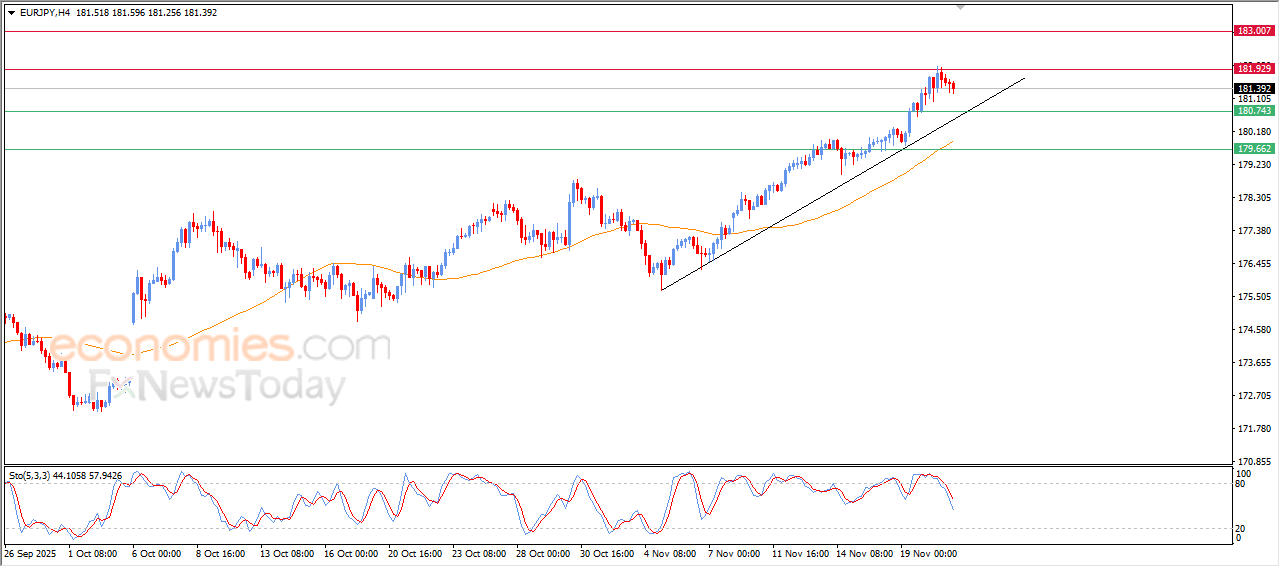
The EURJPY pair declined slightly in the last intraday levels, amid the emergence of the negative signals on the relative strength indicators, after reaching overbought levels, to gain bullish momentum that might help it to recover and rise again, amid the dominance of the main bullish trend and its trading alongside supportive trend line, and there is continued dynamic support due to its trading above EMA50, reinforcing the chances of its recovery in the upcoming perio.
Therefore, our expectations suggest a rise in the upcoming intraday trading, especially when breaching the key resistance at 181.90, targeting its next resistance at 183.00.
The expected trading range for today is between 180.75 and 183.00
Trend forecast: Bullish
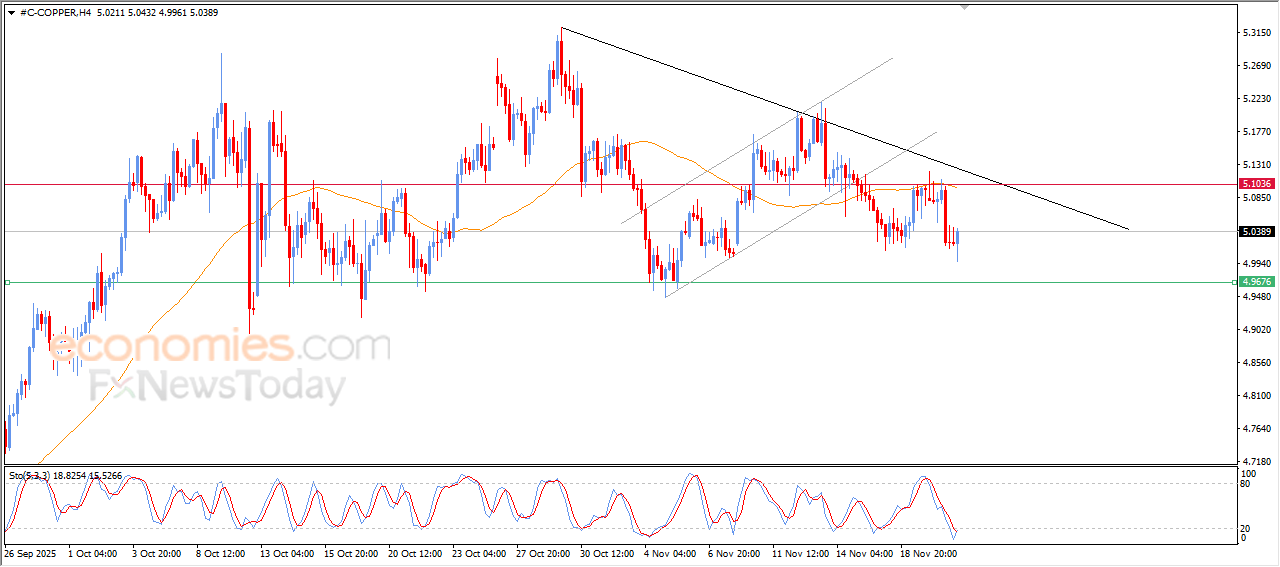
Copper price rose in attempt to recover its previous losses, and it attempts to recover some of its losses, attempting to offload some of its clear overbought conditions, especially with the emergence of positive overlapping signals, amid the continuation of the negative pressure due to its trading below EMA50, reinforcing the dominance and stability of the bearish corrective trend on the short-term basis with its trading alongside supportive trend line.
Therefore, our expectations suggest a decline in their last trading on an intraday basis, if the resistance settles at $55.10, to target the key support level at $4.95.
The expected trading range for today is between $4.95 and $5.10
Trend forecast: Bearish
Silver price (XAG/USD) revisits the weekly low around $49.50 during the European trading session on Friday. The white metal faces selling pressure as traders remain confident that the Federal Reserve (Fed) will not cut interest rates in the December policy meeting.
According to the CME FedWatch tool, the probability of the Fed cutting interest rates by 25 basis points (bps) to 3.50%-3.75% in the December meeting is 35.5%.
The scenario in which the Fed holds interest rates steady bodes poorly for non-yielding assets, such as Silver.
Fed dovish expectations stay lower as officials remain concerned over rising inflation risks to the upside. On Thursday, Cleveland Fed Bank President Beth Hammack stated that high inflation is the “real issue” of the economy, adding that “inflation is still too high and trending in wrong direction”, which calls for the need to keep the monetary policy “somewhat restrictive”.
Meanwhile, the rising United States (US) jobless rate has also failed to intensify Fed dovish expectations meaningfully. The US Nonfarm Payrolls (NFP) data for September showed on Thursday that the Unemployment Rate rose to 4.4%.
In Friday’s session, investors will focus on the flash US S&P Global Purchasing Managers’ Index (PMI) data for November, which will be published at 14:45 GMT.
Silver price struggles to hold the 20-day Exponential Moving Average (EMA), which trades around $49.50.
The 14-day Relative Strength Index (RSI) returns inside the 40.00-60.00 range, suggesting indecisiveness among investors about the near-term outlook.
Looking down, the September 23 high of $44.47 would remain a key support. On the upside, the all-time high of $54.50 might act as key barrier.
Silver is a precious metal highly traded among investors. It has been historically used as a store of value and a medium of exchange. Although less popular than Gold, traders may turn to Silver to diversify their investment portfolio, for its intrinsic value or as a potential hedge during high-inflation periods. Investors can buy physical Silver, in coins or in bars, or trade it through vehicles such as Exchange Traded Funds, which track its price on international markets.
Silver prices can move due to a wide range of factors. Geopolitical instability or fears of a deep recession can make Silver price escalate due to its safe-haven status, although to a lesser extent than Gold’s. As a yieldless asset, Silver tends to rise with lower interest rates. Its moves also depend on how the US Dollar (USD) behaves as the asset is priced in dollars (XAG/USD). A strong Dollar tends to keep the price of Silver at bay, whereas a weaker Dollar is likely to propel prices up. Other factors such as investment demand, mining supply – Silver is much more abundant than Gold – and recycling rates can also affect prices.
Silver is widely used in industry, particularly in sectors such as electronics or solar energy, as it has one of the highest electric conductivity of all metals – more than Copper and Gold. A surge in demand can increase prices, while a decline tends to lower them. Dynamics in the US, Chinese and Indian economies can also contribute to price swings: for the US and particularly China, their big industrial sectors use Silver in various processes; in India, consumers’ demand for the precious metal for jewellery also plays a key role in setting prices.
Silver prices tend to follow Gold’s moves. When Gold prices rise, Silver typically follows suit, as their status as safe-haven assets is similar. The Gold/Silver ratio, which shows the number of ounces of Silver needed to equal the value of one ounce of Gold, may help to determine the relative valuation between both metals. Some investors may consider a high ratio as an indicator that Silver is undervalued, or Gold is overvalued. On the contrary, a low ratio might suggest that Gold is undervalued relative to Silver.