The main tag of Gold Today Price Articles.
You can use the search box below to find what you need.
[wd_asp id=1]
The main tag of Gold Today Price Articles.
You can use the search box below to find what you need.
[wd_asp id=1]
Today marks the third consecutive day of lower daily highs, signaling continued downward pressure. Key dynamic resistance is the 10-day moving average at $4,005. Its position relative to this week’s highs shows gold weakening, as today’s high sits further below the line. Unless there is a sustained advance above Tuesday’s high of $4,006, price behavior suggests further tests of support and the potential for a break below the recent swing low of $3,886.
Yesterday, gold broke down from a bear flag pattern, closing below the lower boundary line to confirm the breakdown. Bearish follow-through would be signaled on a drop below Tuesday’s low. The next lower target would then be the recent swing low, followed by a potential support zone near the confluence of the 50-day average, now at $4,856 and rising, and a 50% retracement level at $3,846. If that zone fails to attract buyers, a drop through could see gold fall toward the 61.8% Fibonacci retracement at $3,720. Note the centerline of a rising trend channel as well — support could emerge in its region.
The lower end of the bearish retracement is anticipated around the 50-day average since it has not been tested as support since reclaimed in August and the 20-day has failed. Typically, the first pullback to the 50-day line will show some signs of support even if it doesn’t lead to a bullish reversal. Even if the 50-day is breached, the centerline may represent a price zone for support.
Recently the 200-day average started to rise above the bottom channel line begun from the February lows. Since it is rising, it should stay around or above the line and presents further confirmation of potential support at the lower end of the channel.
The breakout above $4,006 is key to shift momentum — above it tests resistance at the 20-day average, below risks $3,886. The bear flag and 10-day rejection favor sellers. If sellers persist the 50-day average support keeps the trend, while a break eyes $3,720. Today’s bounce, although showing gains, needs to lead to a breakout above $4,006 before there is confidence that buyers can sustain control.
For a look at all of today’s economic events, check out our economic calendar.
Gold’s momentum has entered one of its most volatile phases of 2025, with spot XAU/USD slipping to $3,934.77 per ounce, its sharpest single-day fall in a week, as the U.S. dollar extended its longest winning streak since July. Traders recalibrated expectations for the Federal Reserve’s next policy step, reawakening debate over how long real yields can restrain the precious metal’s 160% rally since January. Despite the short-term slide, gold remains up over 50% year-to-date, outperforming most major asset classes as capital floods into bullion-backed ETFs and physical demand resurges from Asia to North America.
The Bloomberg Dollar Spot Index climbed for a seventh straight session, pulling gold down nearly 1.7% as of late New York trading. The dollar’s advance came as U.S. Treasury yields rebounded—10-year yield near 4.15% and 2-year at 3.63%—after Fed Chair Jerome Powell’s warning that markets were “premature” to expect further cuts in December. That single remark erased more than $100 from gold’s intraday highs and halted a four-day recovery streak.
The XAU/USD technical chart now shows immediate support near $3,870, corresponding to the 50-day EMA, and the next deeper floor at $3,672, aligned with the 100-day EMA. Resistance remains capped between $4,100–$4,250, where sellers have emerged in each of the last three sessions.
The shift in tone from the Federal Reserve—now pricing just a 66% probability of a December cut, down from 90% last week—has added friction to gold’s upward momentum. However, fiscal data tells a very different story. The U.S. national debt hit $38 trillion, expanding at nearly 7% annually, while the government continues to inject liquidity through elevated deficit spending and bond issuance.
According to independent analysis, the correlation between U.S. debt growth and gold prices since 2021 stands at 0.90, one of the strongest in history. That relationship implies that, with debt compounding by roughly $3 trillion per year, gold’s fair value trajectory could point toward $4,400 per ounce in 2026—around 10% higher than current levels—if real yields fail to contain inflation risk.
Data from the World Gold Council reveals that U.S. demand for gold surged 58% year-on-year to 186 tonnes in Q3, dominated by institutional investment through ETFs. North American gold-backed ETFs absorbed 137 tonnes (≈$16 billion) in inflows last quarter—62% of global totals—pushing total U.S. holdings to 1,922 tonnes worth approximately $236 billion.
Funds like SPDR Gold Shares (NYSEARCA: GLD) and iShares Gold Trust (NYSEARCA: IAU) led the charge, adding 140 tonnes and 88 tonnes respectively, lifting assets under management to $125 billion for GLD and $59 billion for IAU. The surge in ETF flows more than offset a 64% year-on-year slump in physical bar and coin purchases, underscoring how institutional hedging has replaced retail buying as the main driver of price action.
The momentum behind gold’s 2025 run has also produced record turnover. COMEX futures and options averaged $104 billion (≈915 tonnes) in daily notional volume in Q3—up 35% year-over-year—while October saw a parabolic rise to $208 billion (≈1,587 tonnes) per day, a 51% month-on-month jump. Gold recorded 13 new all-time highs in Q3 and 11 more in October, reaching its 50th record of the year before retracing 8%.
This volatility reflects a structural rebalancing: traders are increasingly rotating out of high-valuation equities into hard assets as the Nasdaq Composite faces correction pressure. The XAU/USD correlation to the S&P 500 has turned negative (−0.32), confirming gold’s re-emergence as a hedge rather than a momentum trade.
While investment flows dominate the current narrative, consumer demand tells a contrasting story. U.S. jewelry consumption fell 12% year-on-year to 25 tonnes, and bar-and-coin demand dropped 64% to just 7 tonnes, the weakest since 2017. Yet global retail behavior is shifting:
Costco’s gold bar sales have surged, prompting expansion into smaller fractional sizes.
U.S. dealers report that refineries are running near full capacity, with premiums on small-format bars rising due to tight supply.
Chinese demand remains elevated, with the Shanghai Gold Exchange reporting record vault inflows as Cambodia and other Southeast Asian nations began storing reserves in Chinese facilities—a strategic diversification away from U.S. custody.
The rally has transformed the economics of gold producers. Kinross Gold Corporation (NYSE: K) reported Q3 2025 adjusted EPS of $0.44 and record free cash flow of $687 million, underpinned by 504,000 ounces produced at a $1,145 per-ounce cost. Its average realized gold price of $3,458/oz delivered margins exceeding $2,300 per ounce, marking one of the highest in the industry.
With $1.7 billion in cash, $3.4 billion in liquidity, and a net cash position of nearly $500 million, Kinross plans to redeem $500 million in 2027 senior notes, saving $35 million in interest. The company also raised shareholder returns to $750 million in 2025, combining buybacks and dividends.
Other miners followed suit:
Iamgold (NYSE:IAG) delivered record quarterly output of 190,000 ounces, with year-to-date production reaching 524,000 ounces.
Blue Gold Resources secured $140 million to restart its Ghana mine after resolving a lease dispute.
Aya Gold & Silver (TSX: AYA) valued its Moroccan Boumadine project at $3 billion, planning six open pits and three underground mines across an 11-year life cycle.
These moves signal that miners are using the high-price environment to strengthen balance sheets, extend reserves, and hedge against future cost inflation.
Gold remains locked in a consolidation corridor between $3,870 and $4,100, oscillating above its 20-day EMA at $4,009 and 50-day EMA at $3,870. The Parabolic SAR still prints above price—indicating short-term selling pressure—but volume distribution suggests accumulation rather than panic. A sustained close above $4,100 could trigger a retest of $4,250, while a breach below $3,870 risks a slide toward $3,672, coinciding with the 100-day EMA.
Longer-term charts remain distinctly bullish: the 200-day EMA sits far lower at $3,399, confirming a multi-quarter uptrend. The RSI at 52 reflects neutral momentum, giving traders scope for renewed buying once macro data align.
Global equity turbulence has kept gold anchored as a preferred safe-haven. With the AI-heavy Nasdaq 100 down 4.3% this month and U.S. job and ISM data showing mixed signals, investors are hedging against both deflationary slowdown and renewed inflation. The ADP private payrolls came in below expectations at +145,000, while the ISM Services PMI fell to 51.8, reinforcing the narrative that the Fed’s tightening cycle may already have peaked.
Still, inflation expectations remain sticky: 5-year breakeven inflation stands at 2.43%, keeping real yields in check. That tension between a hawkish Fed and growing fiscal deterioration continues to underpin the bullish case for XAU/USD in the medium term.
With the U.S. debt-to-GDP ratio now exceeding 127%, the link between fiscal policy and gold demand has become self-reinforcing. Investors see gold not merely as a hedge, but as an alternative reserve asset in a global system drowning in negative real yield. The empirical correlation (R = 0.90) between gold prices and U.S. debt since 2021 implies that every $1 trillion increase in federal debt translates to a $110–$130 rise in gold per ounce, assuming constant velocity in monetary aggregates.
At the current trajectory, this model forecasts gold near $4,400–$4,500 by mid-2026, even under stable inflation—an outcome consistent with Bloomberg consensus projections calling for $4,000 average in Q4 2025 and $4,500–$5,000 for 2026.
The CFTC’s Commitment of Traders (COT) data shows managed-money net longs at +213,000 contracts, down 8% week-on-week but still near multi-year highs. Meanwhile, retail trader sentiment on futures platforms has turned moderately bearish, typically a contrarian bullish signal. The Gold Volatility Index (GVZ) sits at 21.7, well above its 2024 average of 15.9, reflecting the ongoing tug-of-war between tightening monetary policy and liquidity injections through debt financing.
The near-term tone may remain choppy, with XAU/USD trading between $3,870–$4,250, but the fundamental and structural backdrop remains firmly supportive. Fiscal expansion, de-dollarization flows, and geopolitical uncertainty—paired with limited mining supply growth—are setting the stage for another leg higher once the Fed’s pause transitions into cuts.
At this point, gold remains a Buy on dips, especially between $3,870–$3,950, with a medium-term target of $4,400–$4,500 and structural support at $3,672. The bias remains bullish, not for speculative breakout but for preservation and real-return hedging.
Rating: BUY (Accumulation Zone: $3,870–$3,950 | Target: $4,400–$4,500 | Support: $3,672 | Resistance: $4,250)
Sentiment: Medium-Term Bullish | Short-Term Neutral to Slightly Bearish | Long-Term Bullish
Crude oil prices slipped further on Wednesday, with West Texas Intermediate (CL=F) futures down 1.27% to $59.79 per barrel, while Brent (BZ=F) dropped 1.15% to $63.70 — marking one of the weakest weekly starts since mid-August. Traders cited fragile demand in Asia and renewed signs of oversupply as the primary drag, with the U.S. dollar’s resilience adding additional downward pressure on dollar-denominated commodities.
Data from the American Petroleum Institute (API) revealed an unexpected 6.5-million-barrel build in U.S. crude inventories for the week ending October 31, amplifying bearish sentiment across the futures curve. As of early November, U.S. stockpiles have increased by 3.6 million barrels year-to-date, while gasoline inventories dropped 5.65 million barrels, highlighting a diverging picture between refined product consumption and crude accumulation. The Department of Energy (DoE) confirmed a 500,000-barrel addition to the Strategic Petroleum Reserve (SPR), raising reserves to 409.6 million barrels — a symbolic step in the ongoing effort to rebuild post-Biden era drawdowns.
While OPEC+ has paused planned output hikes until early 2026 following its modest December adjustment, the group’s production restraint is being overshadowed by increasing non-OPEC supply. The U.S. Energy Information Administration (EIA) reported domestic output at 13.64 million barrels per day (bpd) — a record level and 109,000 bpd higher than January 2025. Meanwhile, Kazakhstan’s Tengiz field maintenance trimmed national production by 10%, offering only temporary support to prices.
At the same time, Iraq canceled Lukoil cargoes due to tightened U.S. sanctions on Russian oil firms, disrupting trade flows and complicating OPEC+ coordination. Nevertheless, traders remain skeptical that these geopolitical disruptions will offset the structural oversupply building in global shipping data. According to Gunvor Group co-founder Torbjörn Törnqvist, “unprecedented volumes” of oil are now stored on tankers as sanctions on Russia and Iran reroute millions of barrels into “floating storage,” creating what analysts at Mercuria estimate to be a 1–2 million bpd surplus heading into Q1 2026.
Despite the near-term weakness, Abu Dhabi National Oil Company (ADNOC) executives reaffirmed a structurally bullish long-term view. Speaking at ADIPEC 2025, ADNOC Upstream CEO Musabbeh Al Kaabi projected that global oil demand will stay above 100 million barrels per day well into the 2040s, driven by aviation, petrochemical growth, and energy-intensive industries like AI data centers. The UAE’s production capacity stands at 4.85 million bpd, targeting 5 million bpd by 2027, supported by expansion at the Upper Zakum field, which could hit 1.5 million bpd ahead of schedule.
ADNOC’s chief, Sultan Al Jaber, emphasized that the world requires $4 trillion in annual investment in grids, data centers, and new energy infrastructure, underscoring the interplay between fossil and renewable demand. He noted that while renewables are expected to double by 2040, oil and LNG will remain central, with LNG projected to grow 50% and jet fuel demand up 30% over the same period. This long-term foundation offers critical support to producers with low-cost, low-emission barrels, a group in which the UAE, Saudi Aramco, and ExxonMobil remain dominant.
The sanctions-driven reshuffling of crude trade is now producing measurable distortions. Commodity traders report a rapid increase in “oil on water” volumes, estimated at over 200 million barrels, as sanctioned crude from Russia and Iran struggles to find destination markets. Gunvor and Mercuria both warn that if sanctions are lifted suddenly, a flood of delayed cargoes could overwhelm markets, driving Brent temporarily below $60 per barrel.
At the same time, Libya announced a new onshore oil discovery, while Nigeria reaffirmed its target of 2 million bpd production by 2027. Meanwhile, Eni (BIT:ENI) and Petronas formed a $15 billion upstream joint venture across Malaysia and Indonesia, further expanding Asian supply capacity. The balance between sanctioned oil constraints and fresh project ramp-ups is therefore delicate — but tilting toward oversupply for now.
The WTI curve has flattened notably, with front-month spreads near −$0.35, indicating weak near-term demand. U.S. refiner margins have slipped below $17 per barrel, down from over $25 earlier this quarter, reflecting narrowing profits from gasoline and diesel. The Mars US blend fell 1.34% to $70.71, and Louisiana Light dipped to $62.79, confirming pressure on Gulf Coast benchmarks.
Gasoline futures at $1.911 per gallon and natural gas (NG=F) at $4.256/MMBtu (−2.0%) both signal declining consumer energy appetite. The OPEC basket sits at $65.43 (−1.59%), below the key $67.50 comfort threshold that most cartel members use as their fiscal breakeven reference.
In contrast to the weakening spot market, Saudi Aramco (TADAWUL:2222) reported a Q3 profit of $28 billion, up 6% quarter-on-quarter, supported by higher upstream volumes and improved operational efficiency. ExxonMobil (NYSE:XOM) and Chevron (NYSE:CVX) also exceeded forecasts, with Exxon confirming that Upper Zakum output expansion remains on track, and Chevron’s Hess acquisition boosting Q3 output beyond expectations.
Energy supermajors continue to consolidate upstream exposure while trimming exposure to high-cost, carbon-intensive projects. This dynamic is creating a bifurcated energy market — integrated producers thriving, while smaller shale drillers retreat as prices slide below $60.
From a technical standpoint, WTI (CL=F) faces resistance near the 50-day EMA ($62), while Brent (BZ=F) remains capped around $65–$66. Momentum oscillators confirm downside bias, with RSI at 38 and MACD negative, signaling risk of further weakness toward $58.50–$57.90 short-term.
However, the longer-term structure suggests stabilization within a $5 range, as physical fundamentals limit deeper collapses. Short-term rallies are viewed as selling opportunities, yet long-term investors could begin accumulating at sub-$60 levels — especially if geopolitical disruptions or OPEC+ interventions materialize. The market’s immediate trajectory remains bearish, but structural demand exceeding 100 million bpd beyond 2040 underpins a long-term bullish thesis.
The TradingNews.com analysis categorizes current oil market dynamics as short-term bearish, long-term bullish accumulation zone. Near-term downside remains possible toward $58 WTI / $62 Brent, driven by weak Asian demand, strong dollar pressure, and bloated inventories. Yet, consistent producer discipline and ADNOC’s long-term projections suggest eventual rebalancing.
Recommendation: HOLD for institutional investors; BUY on dips below $58 WTI for long-term exposure.
Gold traded within a well-defined range throughout the first half of Wednesday, now hovering around $3,980 per troy ounce in the American session. The lack of a clear catalyst kept investors in cautious mode, although the US Dollar (USD) retained its positive tone across the FX board.
Finally, the United States (US) released the ADP Employment Change survey, which showed that the private sector added 42,000 new job positions in October, better than the upwardly revised -29,000 posted in September.
Additionally, the ISM Services Purchasing Managers’ Index (PMI) improved to 52.4 in October, much better than the previous 50 or the expected 50.8. Upon closer examination, the Prices Paid Index, which tracks inflation, increased to 70.0 from 69.4, while the Employment Index rose to 48.2 from 47.2. Finally, the New Orders Index rose to 56.2, from 50.4.
Aside from that, speculative interest kept a close eye on the US elections. Democrats notched victories in multiple states, not good news for President Donald Trump, who blamed GOP losses on the ongoing shutdown. Indeed, California, Virginia, and most likely New Jersey have new Democratic governors, while New York City voted for progressive Zohran Mamdani and his affordability platform.
Meanwhile, Wall Street reversed Tuesday’s losses, and the three major indexes trade in the green after the positive surprise provided by data, although gains are modest. Overall, market players seem cautiously optimistic and willing to continue betting on the Greenback.
In the 4-hour chart, the XAU/USD pair is currently trading at around $3,980, up $19 for the day. From a technical point of view, a bearish 20 Simple Moving Average (SMA) at $3,986 contained advances, while converging with a marginally bullish 200 SMA, the latter at $3,996. Further up, the 100 SMA acts as resistance at $4,095.Technical indicators, in the meantime, reflect the lack of directional strength. The Momentum indicator recovered but remains below its midline, while the Relative Strength Index (RSI) indicator holds flat at 48.
In the daily chart, the XAU/USD is developing below the 20-day Simple Moving Average, which currently stands at $4,084. However, the pair is above the longer ones with the 100-day SMA at $3,602 and the 200-day SMA at $3,365 acting as mid-term dynamic supports. At the same time, the Momentum indicator plunged below its midline, and maintaining its downward strength, while the RSI indicator remains directionless at around its 50 level, skewing the risk to the downside without confirming an imminent slide.
(This content was partially created with the help of an AI tool)
Natural Gas Price Trends Analysis in North America: Q3 2025 Break Down
Natural Gas Prices in United States:
As of Q3 2025, the average Natural Gas price in the USA is USD 3.81/MMBtu. Natural Gas prices are generally stable because of the seasonal fluctuations in demand described in the Natural Gas Price Index Report. Supply and demand are stable. Production has not been subject to major fluctuations, and U.S. prices are mostly stable according to Natural Gas Price Historical Data. Regional price variations are caused by differences in storage and heating demand.
Get the Real-Time Prices Analysis: https://www.imarcgroup.com/natural-gas-pricing-report/requestsample
Note: The analysis can be tailored to align with the customer’s specific needs.
Natural Gas Price Trends Analysis in APAC: Q3 2025 Overview
Natural Gas Prices in China:
During the third quarter of 2025, Natural Gas prices in China stayed at USD 2.72/MMBtu following the Natural Gas Price Index Report because the government supports renewable energy investments and imports LNG. Natural Gas prices stabilized according to historical data since earlier fluctuations occurred because industrial demand increased, and supply chains adjusted.
Regional Analysis: The price analysis can be extended to provide detailed natural gas price information for the following list of countries.
China, India, Indonesia, Pakistan, Bangladesh, Japan, Philippines, Vietnam, Thailand, South Korea, Malaysia, Nepal, Taiwan, Sri Lanka, Hongkong, Singapore, Australia, and New Zealand, among other Asian countries.
Natural Gas Price Trends Analysis in MEA: Q3 2025 Overview
Natural Gas Prices in Saudi Arabia:
Saudi Arabia’s Natural Gas prices reflect stable domestic conditions and policies toward diversification of energy sources, maintaining its price of USD 2.75/MMBtu in Q3 2025. Production trends, particularly in the petrochemical sector which sustained consumption levels, also contributed to this price stability. Compared with Natural Gas Price Historical Data, the country has cheap extraction and investments in infrastructure that provide long-term stability.
Regional Analysis: The price analysis can be extended to provide detailed natural gas price information for the following list of countries.
Saudi Arabia, UAE, Israel, Iran, South Africa, Nigeria, Oman, Kuwait, Qatar, Iraq, Egypt, Algeria, and Morocco, among other Middle Eastern and African countries.
Natural Gas Price Trends in Europe: Q3 2025 Overview
Caustic Soda Prices in Germany:
In Germany, Natural Gas spot prices reached USD 11.6/MMBtu in Q3 2025, mainly due to a further decrease in imports, and increasing geopolitical pressure. The Natural Gas Price Index Report shows the continued dependence on foreign suppliers in the European markets. Natural Gas Price Historical Data shows gas prices in Germany during the last two years were more volatile than usual due to shortages on the global natural gas market.
Regional Analysis: The price analysis can be expanded to include detailed natural gas price data for a wide range of European countries:
such as Germany, France, the United Kingdom, Italy, Spain, Russia, Turkey, the Netherlands, Poland, Sweden, Belgium, Austria, Ireland, Switzerland, Norway, Denmark, Romania, Finland, the Czech Republic, Portugal, and Greece, along with other European nations.
Natural Gas Price Trends Analysis in APAC: Q3 2025 Overview
Natural Gas Prices in India:
The average price for Natural Gas in India during Q3 2025 was USD 4.70/MMBtu. Market prices were stable because of Industrial and power sector demand. Import and domestic production balance were some of the factors mentioned in Natural Gas Price Index Report. Natural Gas Price Historical Data has seen its prices slowly increasing and this can be traced to India’s push towards cleaner energy and infrastructure development in the nation.
Regional Analysis: The price analysis can be extended to provide detailed natural gas price information for the following list of countries.
China, India, Indonesia, Pakistan, Bangladesh, Japan, Philippines, Vietnam, Thailand, South Korea, Malaysia, Nepal, Taiwan, Sri Lanka, Hongkong, Singapore, Australia, and New Zealand, among other Asian countries.
Latest News & Recent Developments: Natural Gas Prices Trend, Index, History & Forecast
The global natural gas market in 2025 has experienced notable price adjustments across regions, influenced by seasonal patterns, production trends, and LNG trade dynamics. After an initial softening in mid-2025, the market faces renewed volatility as demand and supply fundamentals evolve.
Regional Price Insights
• United States: Natural gas prices averaged USD 3.81/MMBtu in September 2025, easing due to mild weather, strong shale output, and high storage levels. The U.S. Energy Information Administration (EIA) anticipates prices stabilizing around USD 3.42/MMBtu in 2025 and rising to USD 3.94/MMBtu in 2026 as winter demand recovers.
• Europe: Prices fell to around USD 11.6/MMBtu in Germany, supported by high storage levels and improved LNG supply chains. Robust imports and reduced industrial demand kept prices subdued.
• Asia-Pacific: In China and India, moderate consumption growth and steady LNG inflows stabilized prices near USD 2.72-4.70/MMBtu in Q3 2025. Mild seasonal conditions and strategic storage releases curtailed volatility.
• Middle East & Africa: Government-controlled pricing mechanisms in Saudi Arabia (~USD 2.75/MMBtu) ensured price stability, supported by strong domestic production and policy-driven resource allocation.
• Latin America: Prices remained steady as domestic production expanded in Brazil and Argentina, while LNG imports in Chile and Mexico balanced consumption fluctuations.
Key Market Drivers
• Ample Storage & Production: Elevated storage levels in the U.S. and Europe, alongside higher LNG terminal capacity, have eased supply concerns.
• Seasonal Moderation: Mild temperatures and stable industrial consumption slowed demand rebound.
• LNG Expansion: New LNG projects, coupled with improved trade efficiency, are gradually tightening the market.
• Regulatory Support: Policies promoting energy transition and industrial decarbonization continue to shape regional pricing.
Future Outlook (2025-2026)
• The EIA forecasts Henry Hub prices to range between USD 3.4-4.0/MMBtu, rising to USD 4.1-4.3/MMBtu by 2026 as global LNG exports and demand strengthen.
• European natural gas prices (TTF) are expected to average around USD 13-14/MMBtu in 2025, influenced by import competition and renewable energy integration.
• Asian markets remain steady through 2026, with consumption recovery in power generation and industrial sectors supporting moderate increases.
The market outlook suggests a balanced but sensitive pricing environment, where weather variability, LNG trade patterns, and policy-driven transitions will determine future price direction.
Speak to An Analyst: https://www.imarcgroup.com/request?type=report&id=22409&flag=C
Key Coverage:
• Market Analysis
• Market Breakup by Region
• Demand Supply Analysis by Type
• Demand Supply Analysis by Application
• Demand Supply Analysis of Raw Materials
• Price Analysis
o Spot Prices by Major Ports
o Price Breakup
o Price Trends by Region
o Factors influencing the Price Trends
• Market Drivers, Restraints, and Opportunities
• Competitive Landscape
• Recent Developments
• Global Event Analysis
How IMARC Pricing Database Can Help
The latest IMARC Group study, Natural Gas Prices, Trend, Chart, Demand, Market Analysis, News, Historical and Forecast Data 2025 Edition, presents a detailed analysis of Natural Gas price trend, offering key insights into global Natural Gas market dynamics. This report includes comprehensive price charts, which trace historical data and highlights major shifts in the market.
The analysis delves into the factors driving these trends, including raw material costs, production fluctuations, and geopolitical influences. Moreover, the report examines Natural Gas demand, illustrating how consumer behaviour and industrial needs affect overall market dynamics. By exploring the intricate relationship between supply and demand, the prices report uncovers critical factors influencing current and future prices.
About Us:
IMARC Group is a global management consulting firm that provides a comprehensive suite of services to support market entry and expansion efforts. The company offers detailed market assessments, feasibility studies, regulatory approvals and licensing support, and pricing analysis, including spot pricing and regional price trends. Its expertise spans demand-supply analysis alongside regional insights covering Asia-Pacific, Europe, North America, Latin America, and the Middle East and Africa. IMARC also specializes in competitive landscape evaluations, profiling key market players, and conducting research into market drivers, restraints, and opportunities. IMARC’s data-driven approach helps businesses navigate complex markets with precision and confidence.
Contact Us:
IMARC Group
134 N 4th St. Brooklyn, NY 11249, USA
Email: sales[@]imarcgroup.com
Tel No:(D) +91 120 433 0800
United States: +1-201971-6302
This release was published on openPR.

Gold price rate today analysis, forecast and prediction indicate a steady recovery after recent declines. Spot gold rose 0.9% to $3,966.65 per ounce by 0713 GMT. The rise follows a fall of more than 1.5% on Tuesday when bullion touched its lowest level since October 30.
U.S. gold futures for December delivery increased by 0.4% to $3,975.30 per ounce. The U.S. dollar remained slightly below its three-month high recorded in the previous session.
According to Jigar Trivedi, senior currency analyst at Reliance Securities, the latest rise in gold prices reflects bargain buying and a general risk-off sentiment in global markets. This sentiment is supporting safe-haven demand for gold.
Asian stocks extended losses in early trading, following overnight declines on Wall Street. Investor concerns over stretched valuations continued to reduce confidence across markets.
Trivedi added that gold might face pressure if upcoming ADP data indicates stronger employment growth. A higher employment figure could reduce the likelihood of another rate cut this year. He also suggested that if the data exceeds expectations, gold could test levels near $3,900 per ounce.
The U.S. Federal Reserve recently cut interest rates. Fed Chair Jerome Powell suggested it might be the last rate reduction for this year. Following the announcement, the likelihood of another rate cut in December dropped from over 90% to around 69%, according to the CME FedWatch Tool. Officials at the Federal Reserve have shared mixed views on how to interpret current economic data, particularly as some U.S. government reports are delayed due to a potential government shutdown. The lack of new data is shifting investor attention to non-official sources, including the ADP National Employment Report expected later today.
Gold usually performs well when interest rates are low and economic uncertainty rises. The current market trend shows investors using gold as a hedge against potential risks and inflation concerns.
Despite today’s rise, gold remains below its recent record high of $4,381.21 reached on October 20. Since that peak, the metal has dropped by nearly 10%. Market participants remain cautious, balancing between expectations of further rate adjustments and signals from economic data releases.
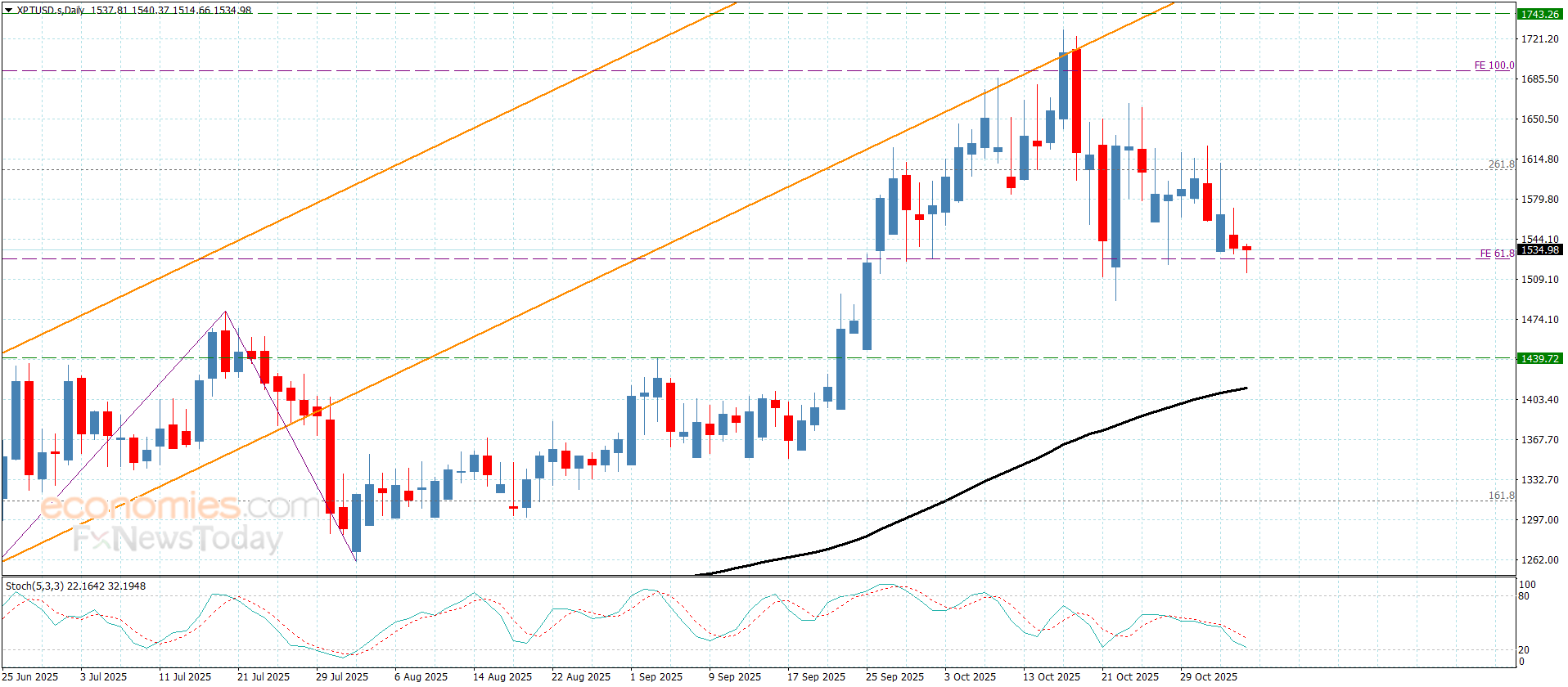
Alongside gold, other precious metals also registered small gains. Spot silver increased by 1.1% to $47.61 per ounce. Platinum prices rose 0.4% to $1,541.17 per ounce. Palladium also moved higher by 0.5% to $1,398.28 per ounce.
Analysts note that these movements are linked to the broader recovery in commodity markets, as investors reposition portfolios amid shifting global financial conditions.
Based on the gold price rate today analysis, forecast and prediction, the near-term outlook for gold will depend on U.S. economic data, inflation expectations, and central bank policy signals. If inflation remains stable and employment data supports economic growth, gold may face downward pressure. However, if data reflects slowing growth or further policy easing, demand for gold could strengthen again.
Market experts continue to monitor the ADP report and upcoming Federal Reserve statements to gauge gold’s next direction. Until clarity emerges, price fluctuations are expected to remain within the current range.
Q2. What is the short-term outlook for gold price rate today analysis, forecast and prediction?
The short-term outlook depends on U.S. economic data and Federal Reserve policy. Prices may rise if economic growth slows or interest rate cuts continue.
Gold (XAU/USD) is trading higher on Wednesday, supported by increasing demand for safe assets, with traders spooked by the sell-off in global equity markets. The precious metal bounced up from Tuesday’s lows in the area of $3,930 to session highs above $3,970 in the early European session, although it remains halfway through the last two weeks’ trading range.
Safe-haven assets remain buoyed on Wednesday following significant declines in the major Wall Street equity indices, which have spread through Asia and Europe. Concerns about an AI bubble resurfaced this week, as the CEOs from some of the US largest banks warned of a significant correction as geopolitical tensions increase.
The precious metal, however, remains trapped within previous ranges, as the hawkish tilt by Federal Reserve (Fed) Chairman Jerome Powell and the wide division among the central bank’s policymakers has prompted investors to reassess their bets for a December rate cut. This is providing support to US Treasury yields and the US Dollar, and keeping Gold’s recovery attempts limited so far.
In the US, the Government shutdown enters its fifth week, on track to become the largest in history, depriving the market and the Fed of key data to decide monetary policy. The release of the ADP Employment Change, thus, is likely to gain particular relevance later today. The market consensus anticipates a 25,000 increase on private payrolls in October, after a 32,000 decline in September, still at levels well below the nearly 150,000 new jobs averaged from 2010 to 2025.
Later on the day, the US ISM Services PMI is expected to show a mild recovery of the sector’s activity, with October’s reading increasing to 50.8 from the 50.0 level in September.
Gold has played a key role in human’s history as it has been widely used as a store of value and medium of exchange. Currently, apart from its shine and usage for jewelry, the precious metal is widely seen as a safe-haven asset, meaning that it is considered a good investment during turbulent times. Gold is also widely seen as a hedge against inflation and against depreciating currencies as it doesn’t rely on any specific issuer or government.
Central banks are the biggest Gold holders. In their aim to support their currencies in turbulent times, central banks tend to diversify their reserves and buy Gold to improve the perceived strength of the economy and the currency. High Gold reserves can be a source of trust for a country’s solvency. Central banks added 1,136 tonnes of Gold worth around $70 billion to their reserves in 2022, according to data from the World Gold Council. This is the highest yearly purchase since records began. Central banks from emerging economies such as China, India and Turkey are quickly increasing their Gold reserves.
Gold has an inverse correlation with the US Dollar and US Treasuries, which are both major reserve and safe-haven assets. When the Dollar depreciates, Gold tends to rise, enabling investors and central banks to diversify their assets in turbulent times. Gold is also inversely correlated with risk assets. A rally in the stock market tends to weaken Gold price, while sell-offs in riskier markets tend to favor the precious metal.
The price can move due to a wide range of factors. Geopolitical instability or fears of a deep recession can quickly make Gold price escalate due to its safe-haven status. As a yield-less asset, Gold tends to rise with lower interest rates, while higher cost of money usually weighs down on the yellow metal. Still, most moves depend on how the US Dollar (USD) behaves as the asset is priced in dollars (XAU/USD). A strong Dollar tends to keep the price of Gold controlled, whereas a weaker Dollar is likely to push Gold prices up.
The EURJPY pair activated the bearish corrective track by reaching the extra support at 177.05, by the above image, we notice suffering some losses by attacking 176.50 level, to form mixed trading by its stability near 176.35.
Note that the continuation of the price fluctuation below the broken support and providing negative momentum by stochastic that supports the chances of resuming the negative corrective attempts, which might target 175.15 level reaching the support of the bullish channel at 174.45.
The expected trading range for today is between 175.15 and 176.65
Trend forecast: Bearish by the stability of 177.05
The (ETHUSD) price rose in its last trading on the intraday basis, in an attempt to recover some of its previous losses, attempting to offload some of its clear oversold conditions on the relative strength indicators, amid the effect of breaking the critical support of $3,435, this support represents our expected target in our previous analysis, amid the dominance of the main bearish trend on the short-term basis and its trading alongside supportive minor trend line for this track.
Get high-accuracy trading signals delivered directly to your Telegram. Subscribe to specialized packages tailored for the world’s top markets:
Full VIP signals performance report for 20-31, October 2025:
Gold is licking its wounds near $3,950 in Asian trades on Wednesday, following a 1.80% decline seen on Tuesday. Traders look forward to the US ADP employment data and the US ISM Services PMI report for fresh trading impetus.
Gold buyers are coming up for some air early Wednesday, as the US Dollar (USD) pauses its intense buying momentum witnessed in the US last session.
The extension of the Wall Street tech sell-off into Asian markets keeps investors on edge, allowing Gold to attempt a tepid recovery.
However, the monthly US ADP jobs report and the US ISM Services PMI will determine the next big wave in Gold, as the data will help shape the market expectations of future interest rate cuts by the US Federal Reserve (Fed), impacting non-yielding assets such as Gold.
Last week, the Fed’s cautious rate cut prompted traders to scale back their bets on a December rate reduction, with markets continuing to price in a less than 70% chance of such a move, according to the CME Group’s FedWatch Tool.
On Tuesday, the USD received a double booster shot and stretched its recent rally due to reduced dovish Fed expectations and broad risk aversion that revived the safe-haven demand for the Greenback.
Traders witnessed a wave of exhaustion following the Artificial Intelligence (AI) driven record rally in global stocks. US tech stocks tumbled, drowning the major indices, with investors selling Gold to cover their losses in equity markets.
Gold resumed its corrective downside, surrendering critical support levels to challenge levels below the $3,950 mark.
The daily chart suggests that the bearish potential remains intact for Gold as the 14-day Relative Strength Index (RSI) holds below the midline.
Additionally, Gold closed Tuesday below the critical support at $3,972, the 38.2% Fibonacci Retracement level of the parabolic rise to the record high that began on August 19.
If buyers manage to reclaim the latter on a sustained basis on the renewed upside, the door will open up toward the $4,000 threshold.
The $4,050 psychological level will offer stiff resistance further north.
Conversely, the immediate support is seen at the October 28 low of $3,887, below which the $3,850 demand area will come into play.
That zone is the confluence of the 50-day Simple Moving Average (SMA) and the 50% Fibo level of the same advance.
Gold has played a key role in human’s history as it has been widely used as a store of value and medium of exchange. Currently, apart from its shine and usage for jewelry, the precious metal is widely seen as a safe-haven asset, meaning that it is considered a good investment during turbulent times. Gold is also widely seen as a hedge against inflation and against depreciating currencies as it doesn’t rely on any specific issuer or government.
Central banks are the biggest Gold holders. In their aim to support their currencies in turbulent times, central banks tend to diversify their reserves and buy Gold to improve the perceived strength of the economy and the currency. High Gold reserves can be a source of trust for a country’s solvency. Central banks added 1,136 tonnes of Gold worth around $70 billion to their reserves in 2022, according to data from the World Gold Council. This is the highest yearly purchase since records began. Central banks from emerging economies such as China, India and Turkey are quickly increasing their Gold reserves.
Gold has an inverse correlation with the US Dollar and US Treasuries, which are both major reserve and safe-haven assets. When the Dollar depreciates, Gold tends to rise, enabling investors and central banks to diversify their assets in turbulent times. Gold is also inversely correlated with risk assets. A rally in the stock market tends to weaken Gold price, while sell-offs in riskier markets tend to favor the precious metal.
The price can move due to a wide range of factors. Geopolitical instability or fears of a deep recession can quickly make Gold price escalate due to its safe-haven status. As a yield-less asset, Gold tends to rise with lower interest rates, while higher cost of money usually weighs down on the yellow metal. Still, most moves depend on how the US Dollar (USD) behaves as the asset is priced in dollars (XAU/USD). A strong Dollar tends to keep the price of Gold controlled, whereas a weaker Dollar is likely to push Gold prices up.