The main tag of Gold Today Price Articles.
You can use the search box below to find what you need.
[wd_asp id=1]
The main tag of Gold Today Price Articles.
You can use the search box below to find what you need.
[wd_asp id=1]
Gold (XAU/USD) is trading just above $4,000 per ounce, down from its early October high of $4,314, as renewed dollar strength and a more hawkish Federal Reserve tone weigh on the metal. It currently fluctuates between $4,004 and $4,028, marking the first time this month it slipped under the key $4,000 level. The drop came after Fed Chair Jerome Powell suggested that the latest 0.25% rate cut might be the last for 2025, causing traders to sharply lower their expectations for another December cut—from 90% to about 70%. That shift in sentiment has slowed gold’s Q3 rally and pressured prices lower. Meanwhile, the U.S. Dollar Index (DXY) remains firm near 99.9, its highest reading since August, creating a direct headwind for bullion.
The Federal Reserve’s tightening tone and stable 10-year Treasury yield at 4.31% have reduced gold’s appeal in the short term by increasing the opportunity cost of holding a non-yielding asset. Simultaneously, improved risk sentiment after the Trump–Xi tariff truce extension reduced safe-haven demand, while easing U.S.–China tensions limited geopolitical inflows into gold. The impact was compounded by China’s decision to end tax incentives on domestic gold sales, curbing demand from small jewelry traders and retail investors. Despite this, large-scale institutional and central bank purchases continue to provide long-term structural support. Central bank reserves tied to gold have now exceeded $1.5 trillion, highlighting the continued trend of diversification away from the U.S. dollar.
Technically, gold’s price action remains confined to a consolidation channel between $3,850 and $4,100. The 20-day EMA sits near $4,021.87, while the 50-day and 100-day EMAs overlap between $3,860–$3,880, forming the short-term demand zone. The $3,850 mark is a key pivot—if it holds, buyers could drive a rebound toward $4,250–$4,314, the recent October peak. A break below that level, however, opens the door for deeper corrections toward $3,660. The RSI has cooled from an overbought 80 to a neutral 54, suggesting consolidation rather than trend reversal. A close above $4,100 would trigger the next bullish breakout toward $4,450–$4,500, while a drop below $3,850 would confirm a short-term downtrend.
Fundamentally, gold’s structural outlook remains bullish despite this pause. Central banks across emerging and developed economies continue adding to reserves, accumulating roughly $220 billion in 2025 alone. This accumulation reflects concern over global debt—now exceeding $35 trillion in the U.S.—and inflation expectations that remain anchored near 2.9% for 2026. Real yields are still near zero, preserving gold’s long-term attractiveness as a strategic hedge. These macro imbalances, combined with slowing growth and high government borrowing, continue to anchor gold’s role as an inflation shield and portfolio stabilizer even as speculative flows soften.
China’s withdrawal of retail tax benefits for domestic gold sales temporarily pressured demand, particularly among small-scale dealers. However, premiums on the Shanghai Gold Exchange remain elevated at roughly $45 per ounce, showing that underlying demand persists. In India, festival season buying continues to support regional markets, with dealers reporting stable trade volumes at approximately $3,970 per ounce, reinforcing global price resilience below $4,000. These strong physical flows, combined with institutional accumulation, indicate that dips toward $3,850 are being viewed as buying opportunities by large market participants.
The strength in the dollar has created a tug-of-war across precious metals. Silver (XAG/USD), currently at $48.66, remains near its 2025 peak of $53.34, outpacing gold’s percentage gains for the year. The gold-to-silver ratio of 82:1 indicates silver’s relative undervaluation, often a bullish signal for gold in the medium term. However, near-term movements remain dictated by the DXY, which could soften if upcoming U.S. CPI or ISM manufacturing data show weakness, potentially reigniting gold’s next upward leg toward $4,250 and beyond.
Data from the CFTC show speculative funds trimming long exposure by 7% over the past two weeks, with short positions increasing to 28,500 contracts. However, long-term investors remain committed, as ETF holdings like SPDR Gold Shares (GLD) stand firm at 879 tonnes, just 0.2% lower than the previous month. This indicates that while short-term traders are locking profits, strategic investors are maintaining core positions. The resilience of institutional demand contrasts with the heavy liquidation seen in earlier market cycles, emphasizing that this correction is part of a broader accumulation phase.
The market’s immediate focus is whether gold can maintain support between $3,850 and $3,880 amid renewed Treasury yield strength. A move above $4,100 could open the door toward $4,250–$4,314, while a breakdown below $3,850 exposes $3,660, and potentially $3,500 if momentum accelerates. The long-term anchor remains the 200-day EMA near $3,388, the lower bound of the current bullish cycle. Traders are now watching upcoming inflation data, job numbers, and Fed commentary for clues on whether the next breakout occurs before year-end or in early 2026.
Gold is in a cooling phase after a historic run through 2025, and this consolidation is more technical than fundamental. The broader bull cycle remains intact, supported by central bank diversification, long-term inflation hedging, and systemic fiscal pressure. The inability to reclaim $4,100 keeps short-term momentum subdued, but once regained, it could catalyze the next advance toward $4,500 and eventually $5,000.
The overall stance for XAU/USD remains HOLD. Short-term tone is neutral to mildly bearish toward $3,850–$3,880, while medium-term direction points upward. The next sustainable breakout is likely once the market clears $4,100–$4,250, with structural targets at $4,450–$4,500, extending toward $5,000 if real yields continue to ease and global reserve accumulation accelerates
Natural gas price approached its last bullish rally at $4.210, which forced it to form sideways trading, affected by stochastic exit from the overbought level, to settle near $4.110.
Reminding you that the stability of the trading above the extra support level at $3.830 confirms the continuation of the positive trading in the near and medium period, which makes us wait for gathering extra bullish momentum, to ease the mission of reaching the bullish channel’s resistance at $4.320, which forms a key for detecting the main trend in the upcoming trading.
The expected trading range for today is between $4.060 and $4.320
Trend forecast: Bullish
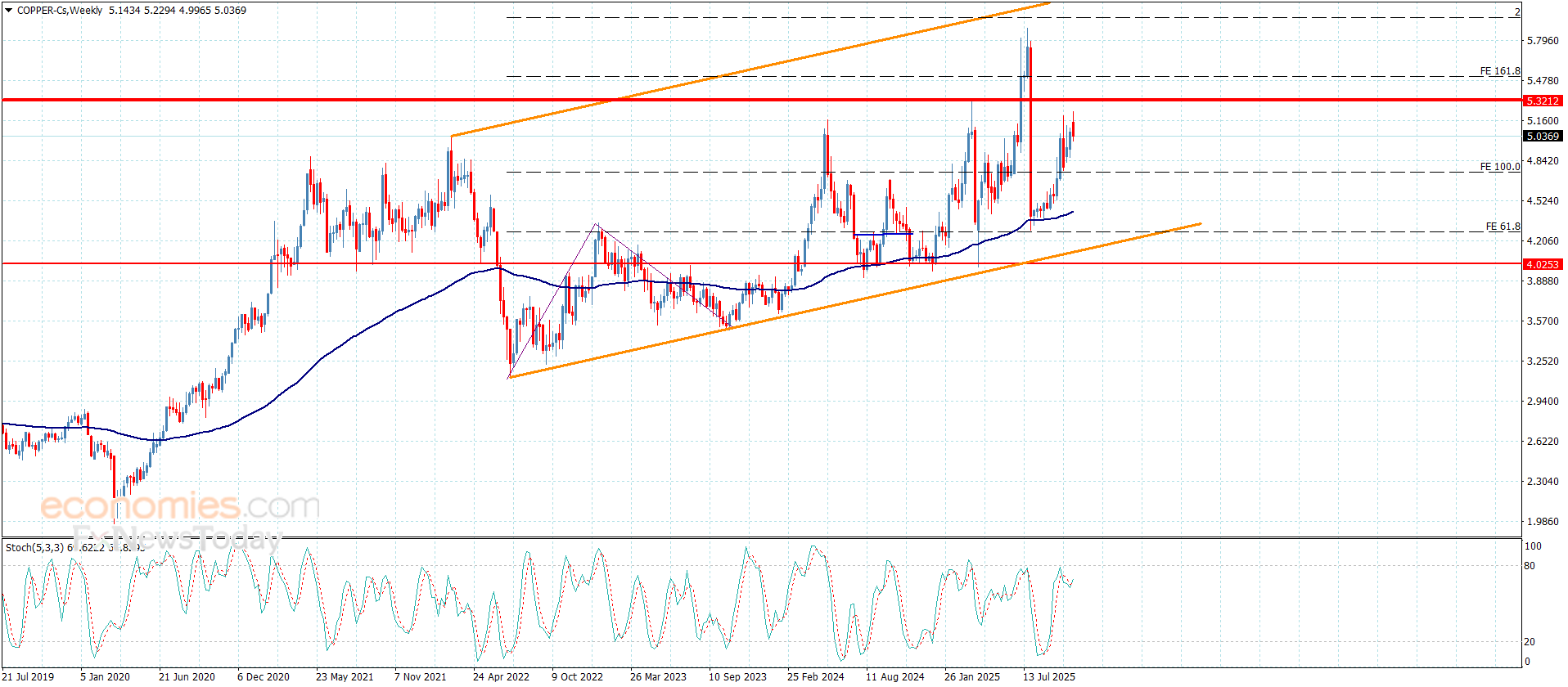
Copper price remains affected by the stability of the extra barrier near $5.2000, reducing the chances of resuming the bullish attack, providing more sideways trading by its stability near $5.0500.
Reminding you that the bullish scenario will remain valid if the price settles above the support at $4.7500, to increase the chances of gathering the required positive momentum to surpass the barrier and target extra positive stations that might begin at $5.3200, while reaching below this support and providing negative close will force it to provide bearish corrective trading, to suffer clear losses by reaching $4.5100 and $4.3500.
The expected trading range for today is between $4.9000 and $5.2000
Trend forecast: Fluctuated within the bullish trend
Gold has reverted to the $4,000 threshold in Asian trades on Monday, but buyers trade with caution, awaiting the private data releases from the United States (US). The US ISM Manufacturing PMI is due later in the day.
Safe-haven flows return at the start of the week on Monday, as investors fret over the economic impact of the prolonged US government shutdown, which is set to become the longest on record.
Further, weak Chinese private Manufacturing PMI data and renewed US-China trade risks weigh on sentiment. The RatingDog China General Manufacturing PMI, compiled by S&P Global, declined to 50.6 in October from the six-month high of 51.2 in September, missing markets’ expectations of 50.9.
Meanwhile, US President Donald Trump came out on the wires and noted that he plans to block China from obtaining Nvidia’s most advanced semiconductor technology, per CBS News.
His comments could refuel US-China trade tensions that were eased last week following the meeting between Trump and Chinese President Xi Jinping last Thursday on the sidelines of the APEC Summit in South Korea.
The prevalent risk-averse market environment injects life into the traditional store of value, Gold, after it continued its previous downside in the early hours.
Additionally, a pause in the US Dollar’s winning streak helps Gold stage a decent comeback.
Later in the day, Gold traders will closely monitor the US ISM Manufacturing PMI data, in the absence of any official publication of statistics, for fresh hints on the health of the American economy, especially after the cautious interest rate cut by the US Federal Reserve (Fed) last week.
Markets are now pricing in a 69% probability of a 25 bps Fed rate cut in December compared with a 91.7% chance a week ago, the CME Group’s FedWatch tool shows.
That being said, the US-China trade headlines and speeches from Fed officials will also be eyed for any impact on risk sentiment, eventually affecting the safe-haven Gold.
The daily chart shows that Gold price is flirting with the $4,000 barrier, after having closed the week above it on Friday.
Adding credence to the upside bias, the 14-day Relative Strength Index (RSI) stays bullish, while sitting just above the 50 level.
If the renewed upside extends, buyers will target the $4,050 psychological level, followed by the 21-day Simple Moving Average (SMA) at $4,082
The next critical resistance is aligned at $4,129 – the 23.6% Fibonacci Retracement level of the parabolic rise to the record high that began on August 19.
Conversely, the immediate support is seen at the 38.2% Fibo level at $3,973, below which a test of the 50% Fibo of $3,847 will be inevitable.
Thereafter, the 50-day SMA at $3,833 will come to the rescue of buyers. A sustained break below the latter will put the $3,800 level at risk.
The Institute for Supply Management (ISM) Manufacturing Purchasing Managers Index (PMI), released on a monthly basis, is a leading indicator gauging business activity in the US manufacturing sector. The indicator is obtained from a survey of manufacturing supply executives based on information they have collected within their respective organizations. Survey responses reflect the change, if any, in the current month compared to the previous month. A reading above 50 indicates that the manufacturing economy is generally expanding, a bullish sign for the US Dollar (USD). A reading below 50 signals that factory activity is generally declining, which is seen as bearish for USD.
Silver price settled higher in its last intraday trading, after a series of consecutive gains, the price successfully breached bearish corrective trendline, leading it to surpass the resistance of its EMA50, to get rid of its negative pressure, on the other hand, this rise led the relative strength indicators to reach overbought levels, which may obstruct the continuation of these gains on the near-term basis, especially with the emergence of negative overlapping signals.
Get high-accuracy trading signals delivered directly to your Telegram. Subscribe to specialized packages tailored for the world’s top markets:
Full VIP signals performance report for 13-17, October 2025:
View Full Performance Report Telegram (https://t.me/besttradingsignalstocksbot?start=p88d632b0-66dd-11f0-a948-13815052d5ae)
The 20-day line, now at $4,086, was decisively breached last week, triggering a bearish retracement low at $3,886 — a critical support level. The breakdown was accompanied by additional bearish developments, including a drop below the top of a near-term rising trend channel and the prior low of $4,003. With key support now broken, the current upswing is testing that former support as resistance, but bulls have shown little conviction, barely extending beyond a tight three-day range sitting directly on support.
Rallies into the 10-day line at $4,070 and 20-day average at $4,086 form a formidable resistance zone. Expect resistance to turn price back down and fail the rally. The 10-day, now below the 20-day, takes on greater significance as dynamic resistance. A sustained advance above the 20-day would target the top rising channel line and a prior three-day resistance shelf from $4,144 to $4,161, where sellers could reassert control.
The pattern strongly suggests at least another leg down before the correction completes. If the 20-day cannot be reached, it signals persistent overhanging selling pressure likely resolving to the downside. The 20-day’s long-standing role as dynamic support since August’s advance makes the dynamics of the first pullback higher particularly significant — a test as resistance is expected before sellers regain full control and push lower.
The close below $3,972 is decisive — below it risks $3,886, above it tests $4,086. Resistance caps rallies, but failure to reach the 20-day flags deeper weakness. Watch $4,070-$4,086 closely — a break opens $4,144, while rejection targets lower support. The bearish crossover and weak rally favor sellers until proven otherwise.
For a look at all of today’s economic events, check out our economic calendar.
Why is the U.S. natural gas price rising today?
That was the question Rigzone asked Phil Flynn, a senior market analyst at the PRICE Futures Group, in an exclusive interview on Friday.
In response, Flynn told Rigzone that Thursday’s natural gas injection “was right in line” and added that “now we are getting forecasts indicating colder conditions for late October and early November”, which he outlined “have led to increased purchasing activity in major U.S. regions, including the Midwest and Northeast”.
“We saw initial weather models suggested a return of warmer temperatures, momentarily dampening the rally. Subsequent projections of below-normal temperatures have renewed bullish market sentiment,” Flynn added.
“This trend is consistent with global developments. Cold weather across Europe and Asia is reducing inventories, with European stocks declining by 11 percent since early October and supporting elevated benchmark prices such as Henry Hub,” he continued.
In its latest weekly natural gas storage report, which was released on Thursday and included data for the week ending October 24, the U.S. Energy Information Administration (EIA) noted that working gas in storage was 3,882 billion cubic feet as of October 24, according to its estimates.
“This represents a net increase of 74 billion cubic feet from the previous week,” the EIA said in that report.
“Stocks were 29 billion cubic feet higher than last year at this time and 171 billion cubic feet above the five-year average of 3,711 billion cubic feet. At 3,882 billion cubic feet, total working gas is within the five-year historical range,” it added.
When he was asked why the U.S. natural gas price is rising today in a separate exclusive interview on Friday, Art Hogan, Chief Market Strategist at B. Riley Wealth, pointed out that “U.S. natural gas futures successfully tested the important support level of $3.27 earlier this week and now has risen past $4.1 per MMBtu [million British thermal units], the highest in seven months”.
“Expectations of colder weather in the U.S. ahead of the winter supported demand for gas-intensive heating. Meanwhile, the average flow of gas to the eight big U.S. LNG export plants were at 16.5 billion cubic feet per day in October, well above the 15.7 billion cubic feet per day from the previous month to set up a fresh record ahead of the turn of the month,” he added.
Hogan went on to state that “high LNG flows were aligned with added demand from Europe as the gradual shun of Russian gas coincided with lower stocks in gas trading hubs, while the U.S. Presidential administration pressed for pledges of U.S. energy imports for Asian countries negotiating trade deals”.
In an EBW Analytics Group report sent to Rigzone by the EBW team on Friday, Eli Rubin, an energy analyst at the company, said the December natural gas contract “is nearing technical resistance at the 100-day moving average of $4.13 per MMBtu for the first time since June, with the market transitioning away from storage oversupply fears toward a robust structural winter narrative”.
“Fundamentally, though, the near to medium term remains very well supplied,” Rubin said in that report.
Rubin highlighted in this report that “daily LNG is skyrocketing, with early-cycle nominations smashing record highs by 0.6 billion cubic feet per day”.
“Strong Gulf Coast demand drove Henry Hub spot prices to $3.45 per MMBtu – the highest level since mid-July,” he added.
In the report, Rubin went on to state that “December contract strength, despite this week’s 25 billion cubic foot bearish weather shift and storage on track to surpass 3,950 billion cubic feet, signals upside momentum – and risks that early-winter optimism may exceed fundamentals”.
“While higher supply and technical resistance may slow upside … momentum appears quite strong into November,” he said.
To contact the author, email andreas.exarheas@rigzone.com
Used primarily as a bargaining tool to encourage Putin to return to the negotiating table regarding the Russia-Ukraine conflict, markets are seriously questioning the effectiveness of recent sanctions.
While predictably, the Kremlin made comments shortly after the announcement to suggest that the domestic Russian oil industry would be unaffected by new American sanctions, markets are now taking these comments more seriously.
This goes double for Vladimir Putin, who went on record to say he would not be “cowed” by other nations into making concessions about Ukraine, while simultaneously boasting about the success of new nuclear technology.
While it is understandable that Trump wants to target Russian fossil fuels, with the three largest companies by market cap in Russia, Lukoil, Rosneft, and Gazprom, all being energy corporations, it will take more supply-side risk to secure higher pricing for WTI, which is on pace for its worst yearly performance since 2020.
As expected, the level of risk premium priced into WTI markets has reduced significantly this week, not only due to the above, but also because of the market’s inherent nature: sudden news events often cause the markets to overreact.
Coffee beans in canvas sack by Bragin Alexey via Shutterstock
December arabica coffee (KCZ25) today is down -2.30 (-0.59%), and January ICE robusta coffee (RMF26) is down -7 (-0.15%).
Coffee prices are under pressure today but remain above Tuesday’s 2-week lows. Prices are sliding amid forecasts of rain this week in key coffee-growing areas of Brazil, which would partially alleviate the dry conditions from last week. Somar Meteorologia reported Monday that Brazil’s largest arabica coffee-growing area, Minas Gerais, received only 0.3 mm of rain during the week ended October 24, or 1% of the historical average.
Arabica coffee prices are also being undercut by speculation that the US may soon lift its 50% tariff on Brazilian coffee. On Monday, Brazil’s President Luiz Inacio Lula da Silva said he had a “surprisingly good” meeting with President Trump and said there could be a “definitive solution” on US-Brazil trade within days.
Shrinking ICE coffee inventories are supportive for prices. The 50% tariffs imposed on US imports from Brazil have led to a sharp drawdown in ICE coffee inventories. ICE-monitored arabica inventories fell to a 1.5-year low of 446,475 bags on Wednesday, and ICE robusta coffee inventories fell to a 3.25-month low of 6,111 lots. American buyers are voiding new contracts for Brazilian coffee purchases due to the 50% tariffs on US imports from Brazil, thereby tightening US supplies, as about a third of America’s unroasted coffee comes from Brazil.
Last Thursday, arabica coffee rallied to an 8.5-month nearest-futures high due to concern that excessive dry conditions in Brazil during the critical flowering period for coffee trees will threaten the 2026/27 coffee crop. According to the Bloomberg Brazil Weather Analysis, coffee-producing regions in Brazil have been experiencing an intense drought, with the state of Minas Gerais recording only about 70% of its average rainfall over the past month.
Coffee prices garnered support after the National Oceanic and Atmospheric Administration (NOAA) on September 16 increased the likelihood to 71% of a La Niña weather system in the southern hemisphere from October to December, which could bring excessive dry weather to Brazil and harm the 2026/27 coffee crop. Brazil is the world’s largest producer of arabica coffee.
Robusta coffee is under pressure from increased Vietnamese supplies. The Vietnam National Statistics Office reported on October 13 that Vietnam’s Jan-Sep 2025 coffee exports rose +10.9% y/y to 1.230 MMT. Also, Vietnam’s 2025/26 coffee production is projected to climb +6% y/y to 1.76 MMT, or 29.4 million bags, a 4-year high. In addition, the Vietnam Coffee and Cocoa Association (Vicofa) said last Friday that Vietnam’s coffee output in 2025/26 will be 10% higher than the previous crop year if weather conditions remain favorable. Vietnam is the world’s largest producer of robusta coffee.
Larger coffee exports are bearish for prices after the International Coffee Organization (ICO) reported on October 6 that global coffee exports for the current marketing year (Oct-Aug) rose +0.2% y/y to 127.92 million bags, indicating adequate exports and supplies.
Coffee prices found support after Conab, Brazil’s crop forecasting agency, cut its Brazil 2025 arabica coffee crop estimate on September 4 by -4.9% to 35.2 million bags from a May forecast of 37.0 million bags. Conab also reduced its total Brazil 2025 coffee production estimate by 0.9% to 55.2 million bags, from a May estimate of 55.7 million bags.
The USDA’s Foreign Agriculture Service (FAS) projected on June 25 that world coffee production in 2025/26 will increase by +2.5% y/y to a record 178.68 million bags, with a -1.7% decrease in arabica production to 97.022 million bags and a +7.9% increase in robusta production to 81.658 million bags. FAS forecasted that Brazil’s 2025/26 coffee production will increase by +0.5% y/y to 65 million bags and that Vietnam’s 2025/26 coffee output will rise by 6.9% y/y to a 4-year high of 31 million bags. FAS forecasts that 2025/26 ending stocks will climb by +4.9% to 22.819 million bags from 21.752 million bags in 2024/25.
On the date of publication,
did not have (either directly or indirectly) positions in any of the securities mentioned in this article. All information and data in this article is solely for informational purposes.
For more information please view the Barchart Disclosure Policy
here.
Binance Coin (BNBUSD) declined slightly in its latest intraday trading under continued negative pressure from trading below the 50-day SMA and within the dominance of a short-term corrective bearish trend, with trading along a descending line. Meanwhile, the relative strength indicators have reached extremely overbought levels compared to the price movement, accompanied by the early appearance of a bearish crossover, which further intensifies the negative pressure around the cryptocurrency.
Therefore, we expect the cryptocurrency to decline in its upcoming intraday trading as long as the resistance level of $1,181.90 holds, targeting the key support level of $1,020.50.
Today’s price forecast: Bearish.