The main tag of Gold Today Price Articles.
You can use the search box below to find what you need.
[wd_asp id=1]
The main tag of Gold Today Price Articles.
You can use the search box below to find what you need.
[wd_asp id=1]
Gold is consolidating weekly losses in Asian trades on Friday, having stalled Thursday’s turnaround just shy of the $4,050 mark.
Gold buyers seem to catch a breather following the previous upswing before the end-of-the-week and – month profit-taking wave creeps back in.
Markets resorted to taking profits off the table after the recent tremendous correction in Gold in anticipation of a potential US-China trade deal, while taking account of a less dovish US Federal Reserve (Fed) monetary policy decision.
The Fed on Wednesday delivered the expected 25 basis points (bps) interest rate cut, with Chair Jerome Powell noting that policymakers are likely to become more cautious if it deprives them of further job and inflation reports.
Markets are now pricing in a 72.8% probability of a 25 bps Fed rate cut in December compared with a 91.1% chance a week ago, the CME Group’s FedWatch tool shows.
The Gold rebound was also powered by the latest World Gold Council report that showed, “global gold demand rose 3% year-on-year to 1,313 metric tons, the highest quarterly number on record, in the third quarter as investment demand soared,” per Reuters.
What remains to be seen is if Gold could regain the recovery momentum as the US Dollar (USD) stands tall at two-month highs against its major currency rivals.
Additionally, the continued contraction in the Chinese manufacturing sector weighs negatively on Gold. China is the world’s top yellow metal consumer. The official Manufacturing purchasing managers’ index (PMI) fell to 49.0 in October from 49.8 in September, a six-month low.
That said, the downside in Gold will likely be cushioned by lingering US economic and fiscal concerns as the government shutdown shows no signs of reopening and markets are flying blind amid the data drought.
The daily chart shows that Gold price recaptured the $4,000 barrier on a closing basis on Thursday, reviving the bullish potential.
Adding credence to the upside bias, the 14-day Relative Strength Index (RSI) stays bullish after breaking above the 50 level.
The important resistance levels to watch now are the $4,050 psychological level and the 21-day Simple Moving Average (SMA) at $4,078, followed by $4,129 – the 23.6% Fibo level of the same ascent.
To the downside, the immediate support is seen at the 38.2% Fibo level at $3,973, below which a test of the 50% Fibo of $3,847 will be inevitable
Deeper declines will challenge the 50-day SMA at $3,822.
Gold has played a key role in human’s history as it has been widely used as a store of value and medium of exchange. Currently, apart from its shine and usage for jewelry, the precious metal is widely seen as a safe-haven asset, meaning that it is considered a good investment during turbulent times. Gold is also widely seen as a hedge against inflation and against depreciating currencies as it doesn’t rely on any specific issuer or government.
Central banks are the biggest Gold holders. In their aim to support their currencies in turbulent times, central banks tend to diversify their reserves and buy Gold to improve the perceived strength of the economy and the currency. High Gold reserves can be a source of trust for a country’s solvency. Central banks added 1,136 tonnes of Gold worth around $70 billion to their reserves in 2022, according to data from the World Gold Council. This is the highest yearly purchase since records began. Central banks from emerging economies such as China, India and Turkey are quickly increasing their Gold reserves.
Gold has an inverse correlation with the US Dollar and US Treasuries, which are both major reserve and safe-haven assets. When the Dollar depreciates, Gold tends to rise, enabling investors and central banks to diversify their assets in turbulent times. Gold is also inversely correlated with risk assets. A rally in the stock market tends to weaken Gold price, while sell-offs in riskier markets tend to favor the precious metal.
The price can move due to a wide range of factors. Geopolitical instability or fears of a deep recession can quickly make Gold price escalate due to its safe-haven status. As a yield-less asset, Gold tends to rise with lower interest rates, while higher cost of money usually weighs down on the yellow metal. Still, most moves depend on how the US Dollar (USD) behaves as the asset is priced in dollars (XAU/USD). A strong Dollar tends to keep the price of Gold controlled, whereas a weaker Dollar is likely to push Gold prices up.
The EURJPY pair formed strong bullish rally, taking advantage of the positive factors that are represented by its stability above the extra support at 177.05 besides the main indicators attempt to provide positive momentum, to notice recording the initial target by reaching 178.80.
No escape from renewing the bullish attempts, to attempt to breach 178.80 level and hold above to open the way for recording extra gains that might extend towards 179.35 reaching 180.00, forming temporary psychological barrier against the bullish trading.
The expected trading range for today is between 177.70 and 179.35
Trend forecast: Bullish
Copper price attempted to activate the bullish trend, to end it after reaching the barrier at$5.2000, which forces it to decline correctively to settle near$5.0400.
We expect providing mixed trading, but its main stability within the bullish channel’s levels by forming extra support at $4.7500 level will increase the chances of gathering positive momentum, to repeat the attempts to achieve extra gains that might extend to $5.3200 and $5.5000.
The expected trading range for today is between $4.9200 and $5.2200
Trend forecast fluctuated within the bullish track
Silver price (XAG/USD) extends its gains for the second successive session, trading around $48.00 per troy ounce during the European hours on Monday. The price of the grey metal declines due to weakened safe-haven demand, driven by the progress in the United States (US)-China trade negotiations. Silver prices also decline as profit-taking emerges amid concerns of overvaluation following the metal’s surge to record highs.
The risk-on sentiment improves after reports that top negotiators from the US and China have reached a consensus on major disputes and paved the way for Presidents Donald Trump and Xi Jinping to meet on Thursday to finalize a trade deal. Officials in Malaysia announced after two days of talks that both sides had agreed on key issues, including export controls, fentanyl, and shipping levies.
Moreover, US Treasury Secretary Scott Bessent told CBS News that President Trump’s threat to impose 100% tariffs on Chinese goods “is effectively off the table.” Bessent added that China has agreed to make “substantial” soybean purchases and to postpone its rare-earth export controls “for a year while they re-examine it.”
The downside of the non-interest-bearing Silver could be restrained as softer recent US inflation data for September support the likelihood of a rate cut by the US Federal Reserve (Fed) this week. The CME FedWatch Tool indicates that markets are now pricing in nearly a 97% chance of a Fed rate cut in October and a 96% possibility of another reduction in December. It is worth noting that returns on interest-bearing assets decline when interest rates fall. This makes non-yielding assets such as Silver more appealing, since investors aren’t missing out on as much interest income by holding them.
Silver is a precious metal highly traded among investors. It has been historically used as a store of value and a medium of exchange. Although less popular than Gold, traders may turn to Silver to diversify their investment portfolio, for its intrinsic value or as a potential hedge during high-inflation periods. Investors can buy physical Silver, in coins or in bars, or trade it through vehicles such as Exchange Traded Funds, which track its price on international markets.
Silver prices can move due to a wide range of factors. Geopolitical instability or fears of a deep recession can make Silver price escalate due to its safe-haven status, although to a lesser extent than Gold’s. As a yieldless asset, Silver tends to rise with lower interest rates. Its moves also depend on how the US Dollar (USD) behaves as the asset is priced in dollars (XAG/USD). A strong Dollar tends to keep the price of Silver at bay, whereas a weaker Dollar is likely to propel prices up. Other factors such as investment demand, mining supply – Silver is much more abundant than Gold – and recycling rates can also affect prices.
Silver is widely used in industry, particularly in sectors such as electronics or solar energy, as it has one of the highest electric conductivity of all metals – more than Copper and Gold. A surge in demand can increase prices, while a decline tends to lower them. Dynamics in the US, Chinese and Indian economies can also contribute to price swings: for the US and particularly China, their big industrial sectors use Silver in various processes; in India, consumers’ demand for the precious metal for jewellery also plays a key role in setting prices.
Silver prices tend to follow Gold’s moves. When Gold prices rise, Silver typically follows suit, as their status as safe-haven assets is similar. The Gold/Silver ratio, which shows the number of ounces of Silver needed to equal the value of one ounce of Gold, may help to determine the relative valuation between both metals. Some investors may consider a high ratio as an indicator that Silver is undervalued, or Gold is overvalued. On the contrary, a low ratio might suggest that Gold is undervalued relative to Silver.
The $4,079 area gains strength as resistance from the nearby top rising channel line and falling 10-day average. The 10-day is converging with the 20-day after touching the channel line today. Once below the 20-day, it becomes key short-term resistance. Monday’s $4,109 high and last Friday’s $4,144 high cap the zone.
Gold fell below the 20-day average on Monday, closing under it for the first time since August 22’s reclaim. No swing back to test it as resistance has occurred yet. Yesterday’s attempt met quick pushback. A more substantial advance into the zone could precede further bearish pullback or consolidation.
The next lower target is the 50% retracement at $3,846 and 50-day average at $3,808, rising. The 50% level is bolstered by a prior three-day sideways move that acted as resistance, now potential support. Convergence of the 50-day and 50% retracement may hint at timing — watch when they align.
The close near $4,027 is key — above it targets $4,079, below risks $3,918. The 20-day and channel line cap rebounds, but a test there could set up deeper pullback to $3,846. Monitor 50-day convergence for support clues — today’s strength favors buyers short-term if resistance holds.
For a look at all of today’s economic events, check out our economic calendar.
The advance decisively broke through a potential resistance zone from $3.92 to $3.93, consisting of a 127.2% rising ABCD pattern target and 88.6% Fibonacci retracement. This clearance removes a significant hurdle and puts natural gas in position to challenge prior resistance at the June swing high. Exceeding this level would trigger a bullish signal, breaking a swing high from the downtrend structure and confirming a shift in momentum.
Key near-term support is today’s $3.79 low. The $3.92-$3.93 range, now former resistance, can also be monitored for signs of flipping to support. Since there was minimal pushback at that zone, a confirmed bull breakout could solidify it as a new floor. Wednesday’s $3.75 low provides another short-term support level if tested, offering buyers a chance to defend.
Natural gas is showing clear signs of resuming the long-term bull trend that began from 2024’s low. The long-term uptrend line was recently recovered, along with a downtrend line. Prices now trade above the 200-day average after remaining below it since early August, reinforcing underlying demand and structural improvement.
Clearing the 127.2% ABCD target opens the 161.8% extended Fibonacci target at $4.21 — the higher potential target for the current advance from August’s low. This would require surpassing the June swing high. A strong weekly close would further solidify the bullish posture, though a pullback remains possible before reaching $4.21.
The $3.79 close is critical — above it targets the June high, below risks $3.75. The 200-day average marks maximum downside if support fails. Today’s strength favors continuation — watch the June high for reversal confirmation. Pullbacks may offer entry opportunities if trendlines and the 200-day hold firm.
For a look at all of today’s economic events, check out our economic calendar.
Spot Gold managed to recover some ground on Thursday, trading around the $4,000 mark at the time of writing. The advance was limited, however, by broad demand for the US Dollar (USD). Following the Federal Reserve (Fed) hawkish interest rate cut on Wednesday, the Bank of Japan (BoJ) decided to leave rates unchanged as widely anticipated. However, BoJ Governor Kazuo Ueda delivered some dovish remarks that sent the Japanese Yen sharply lower, while providing additional impetus to the USD.
The Greenback also benefited from headlines indicating that the United States (US) and China reached a trade deal, de-escalating recent tensions. US President Donald Trump met Chinese leader Xi Jinping and agreed on rolling back some of their recent punitive actions. Trump announced it would immediately reduce fentanyl-related tariffs to 10%, and that China will resume buying soybean and agricultural products. Trump also mentioned they reached an agreement on chips and rate earths, although without much detail.
Other than that, the European Central Bank (ECB) also announced its monetary policy decision, leaving interest rates unchanged, as widely anticipated. President Christine Lagarde repeated that the central bank is in a good place and showed no urge to modify the monetary policy.
Finally, it is worth remembering that the US government remains on pause, amid the lack of funding. The US Senate seems in no rush to agree on a bill, which is costing the well-being of thousands of federal employees.
In the 4-hour chart, XAU/USD is currently trading at around $4,002, holding on to solid intraday gains. A bearish 20 SMA slides south at $3,973, sitting just above the 200 SMA, and both are below the current level, providing support. The 100 SMA at $4,109 is marginally easing and acts as immediate resistance. At the same time, the Momentum indicator stands just above its 100 line, suggesting the bearish impulse is losing traction. As for the RSI, it remains flat around 49, reflecting the absence of directional strength despite the intraday bounce. A decisive clearance of the 100 SMA resistance at $4,109 would unlock additional upside, whereas failure to top that level keeps risks skewed toward a pullback to the 20 SMA support at $3,973 ahead of $3,956.
In the daily chart, a bullish 20 SMA rallies above the longer ones, suggesting buyers still hold the broader grip; the 20 SMA stands at $4,080 and now acts as immediate resistance. The 100 SMA is also bullish, advancing to $3,578, while the 200 SMA rises to $3,340, both of which underpin the long-term bullish bias. Finally, the Momentum indicator has managed to bounce from its recent lows, but remains within negative levels, while the RSI indicator has recovered to 51edging back toward neutrality; the uptick hints at tentative buying interest.
(This content was partially created with the help of an AI tool)
Natural gas price surrendered to stochastic negativity, threatening the stability of the extra support at $3.830, suffering intraday losses by hitting $3.770 level, then attempts to settle above this support to confirm the dominance of the previously suggested bullish bias.
We recommend waiting for providing new bullish close for the upcoming four hours’ time frame above the current support, which reinforces the chances of forming several bullish waves, to target $4.050 level, reaching the barrier near $4.210, while facing new bearish pressures will confirm activating the bearish corrective track, which forces it to suffer more losses by targeting $3.690 and $3.550 level.
The expected trading range for today is between $3.800 and $4.050
Trend forecast: Bullish
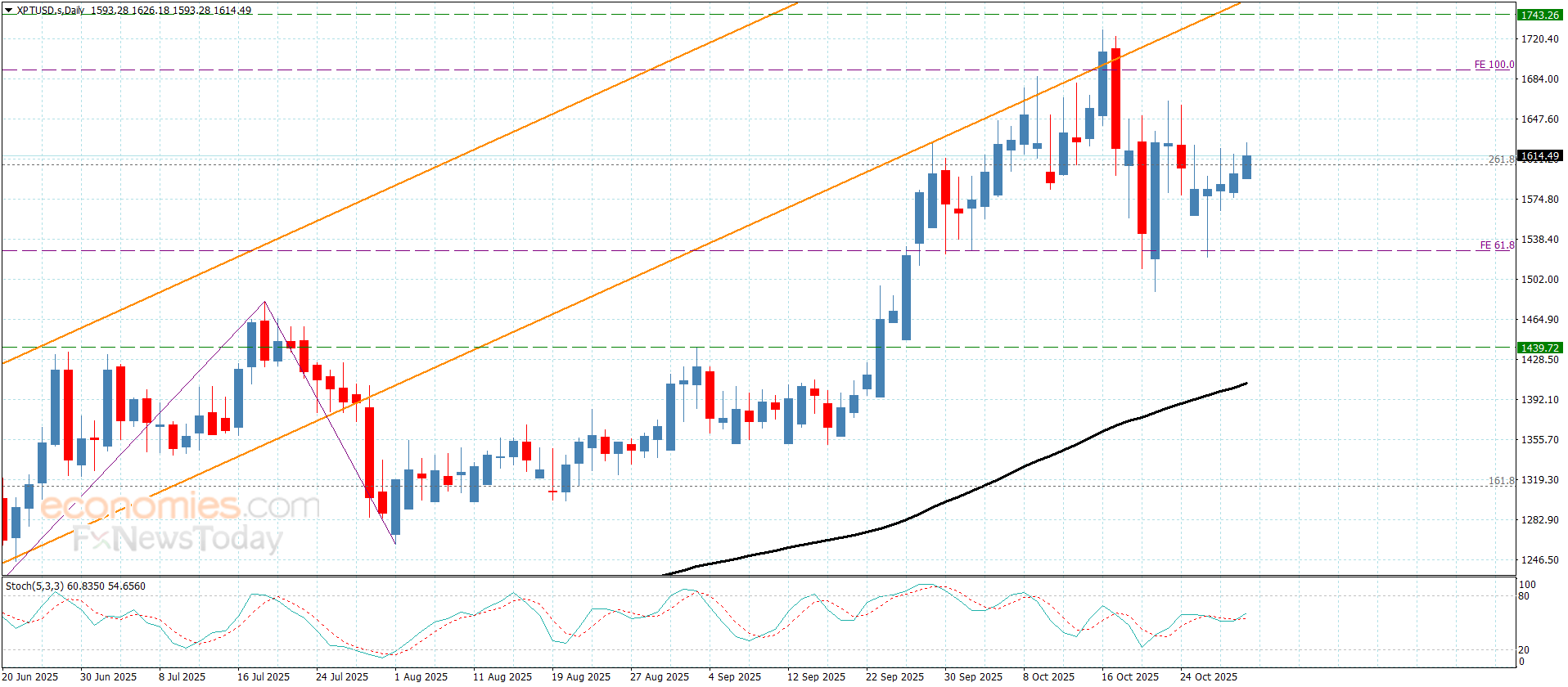
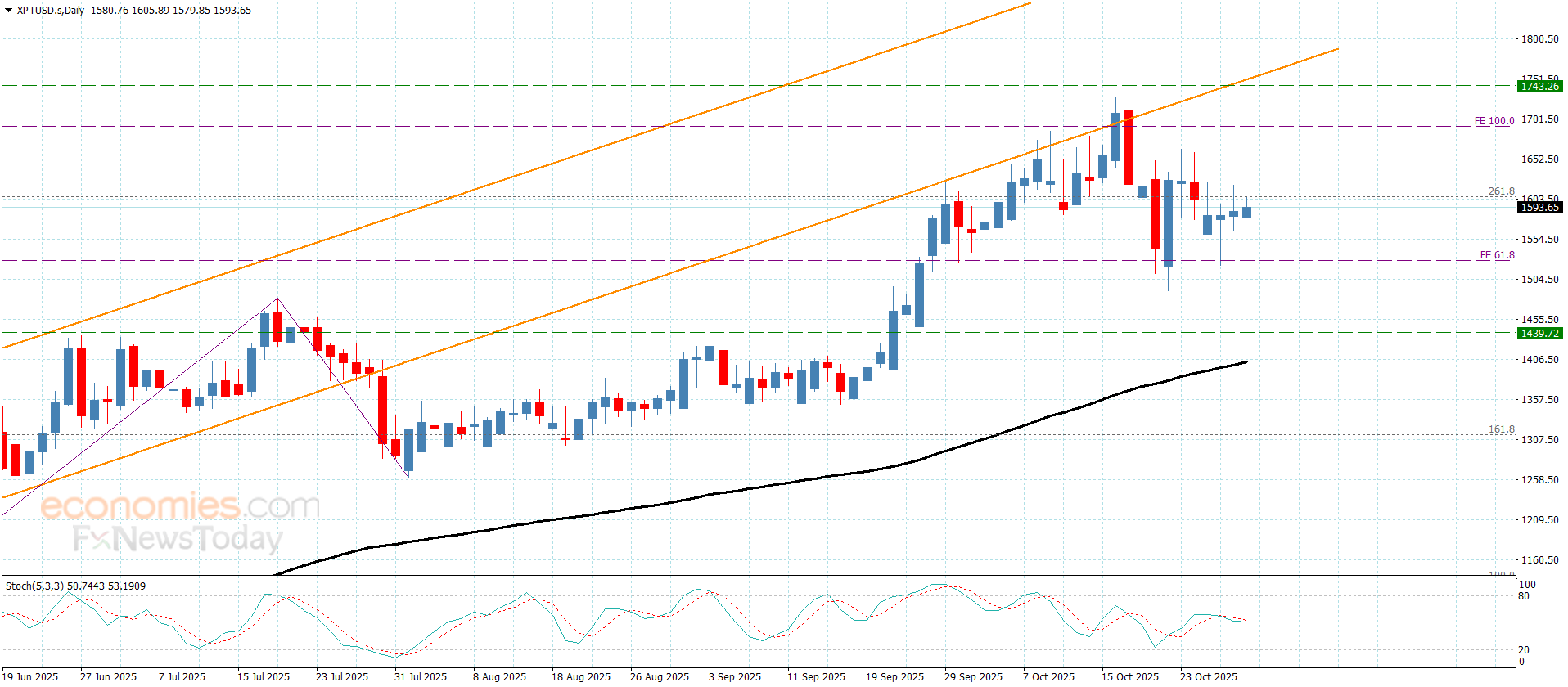
Platinum price didn’t move anything in yesterday’s trading, due to the repeated confinement between the extra support at $1525.00, while $1605.00 level keeps forming a barrier against the attempts of activating the previously suggested bullish trend.
Providing more of the sideways trading until breaching the current barrier and holding above it, to confirm its readiness to record some gains by its rally towards $1665.00 and $1695.00, while breaking the support and holding below it will force the price to suffer new losses towards $1470.00 reaching the next support near $1440.00.
The expected trading range for today is between $1530.00 and $1605.00
Trend forecast: Sideways
Gold is once again attempting a bounce above $3,900 as buyers try their luck for the third consecutive day in Asian trading this Thursday.
Gold remains confined within a familiar range, despite the critical US Federal Reserve (Fed) monetary policy decision-induced volatility seen on Wednesday.
The bright metal briefly regained the $4,000 barrier after the Fed delivered on the expected 25 basis points (bps) interest rate cut.
However, the upswing was quickly reversed as the US Dollar (USD) staged an impressive comeback following Fed Chair Jerome Powell’s commentary during the press conference.
Powell noted that policymakers are likely to become more cautious if it deprives them of further job and inflation reports, per Reuters.
His words tempered bets for another rate cut by the Fed next month, with markets now pricing in a 67.8% probability that the Fed will hold rates at the December 10 meeting, compared with a 9.1% chance seen pre-Fed announcements, the CME Group’s FedWatch tool shows.
Early Thursday, Gold buyers have come up for some air after four consecutive days of losses, eagerly awaiting the outcome of the highly anticipated meeting between US President Donald Trump and his Chinese counterpart Xi Jinping in South Korea, that is now underway.
The recent US-China trade talks have signalled a potential deal is in the offing at this meeting, especially after a preliminary consensus on topics including export controls, fentanyl and shipping levies was reached by both sides during their two-day talks in Malaysia.
Failure to reach a trade agreement by the top leaders could send risk sentiment into a tailspin, reviving the safe-haven demand for Gold. On the contrary, if both sides boast about progress toward a trade deal or stike one, Gold could be hammered as risk flows will take over.
In case an outright trade deal is not reached, the specifics of the meetings and details of any progress made would be closely scrutinized by markets.
On Wednesday, President Trump said that he expects to reduce US tariffs on Chinese goods in exchange for Beijing’s commitment to curb exports of fentanyl precursor chemicals.
Another catalyst that could drive Gold moves is the Bank of Japan (BoJ) policy announcements. Any surprises from the BoJ could trigger a sharp volatility in the USD/JPY pair, which could have a significant impact on the USD and the USD-denominated Gold.
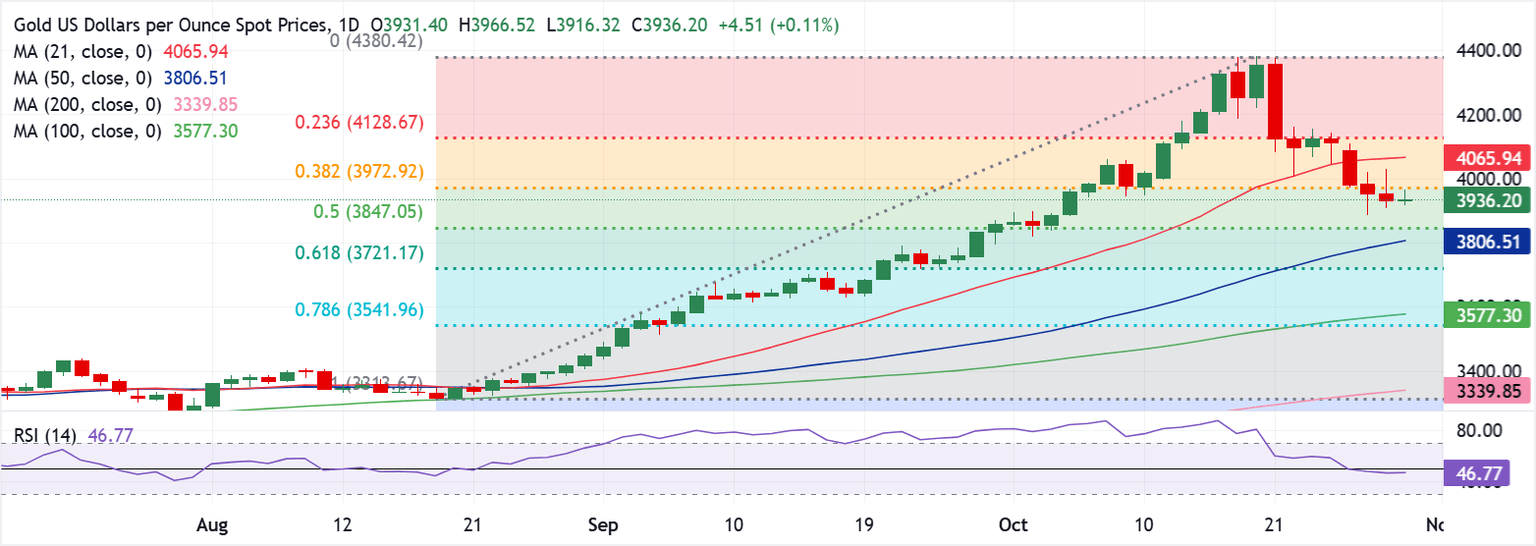
In the daily chart, XAU/USD is currently trading at around $3,938. A bullish 21 SMA advances above the longer ones, in line with the dominant bullish momentum; the 21 SMA stands at $4,066 and, being above spot, caps the immediate topside. Furthermore, the 50 SMA is also bullish, advancing below the shorter one; the 50 SMA stands at $3,807. Below spot, the 50 SMA at $3,807, the 100 SMA at $3,577 and the 200 SMA at $3,340 offer successive support levels, while the 21 SMA at $4,066 acts as resistance. The Relative Strength Index (14) has eased to 47, slipping below its neutral 50 mid-line after prior readings in extreme overbought territory; the latest uptick from 46 reduces bearish traction and favors consolidation as the broader moving-average structure remains positive.
Measuring the rally between $3,314 and $4,380, the 38.2% retracement stands at $3,973. With price currently beneath $3,973, initial resistance is located at $3,973, followed by $4,066 (21 SMA) and the 23.6% retracement at $4,129; a clearance of these levels would reassert the bullish sequence toward the top at $4,380. On the downside, support levels are $3,847 (50% retracement) ahead of $3,721 (61.8%), then $3,542 (78.6%) and $3,314 (100% of the measured upswing). As long as price holds above the rising 50 and 100 SMAs, pullbacks are likely to remain shallow, while a daily close back above $3,973 would be a near-term signal that buyers are regaining traction.
(This content was partially created with the help of an AI tool)
Generally speaking, a trade war is an economic conflict between two or more countries due to extreme protectionism on one end. It implies the creation of trade barriers, such as tariffs, which result in counter-barriers, escalating import costs, and hence the cost of living.
An economic conflict between the United States (US) and China began early in 2018, when President Donald Trump set trade barriers on China, claiming unfair commercial practices and intellectual property theft from the Asian giant. China took retaliatory action, imposing tariffs on multiple US goods, such as automobiles and soybeans. Tensions escalated until the two countries signed the US-China Phase One trade deal in January 2020. The agreement required structural reforms and other changes to China’s economic and trade regime and pretended to restore stability and trust between the two nations. However, the Coronavirus pandemic took the focus out of the conflict. Yet, it is worth mentioning that President Joe Biden, who took office after Trump, kept tariffs in place and even added some additional levies.
The return of Donald Trump to the White House as the 47th US President has sparked a fresh wave of tensions between the two countries. During the 2024 election campaign, Trump pledged to impose 60% tariffs on China once he returned to office, which he did on January 20, 2025. With Trump back, the US-China trade war is meant to resume where it was left, with tit-for-tat policies affecting the global economic landscape amid disruptions in global supply chains, resulting in a reduction in spending, particularly investment, and directly feeding into the Consumer Price Index inflation.