The main tag of Gold Today Price Articles.
You can use the search box below to find what you need.
[wd_asp id=1]
The main tag of Gold Today Price Articles.
You can use the search box below to find what you need.
[wd_asp id=1]
Analysts have revised their forecasts for 2025 and 2026, highlighting how international economic conditions, inflation expectations, and monetary strategies continue to shape the silver platinum palladium price rate today and its long-term outlook.
The silver platinum palladium price rate today reflects the changing global market sentiment as hopes rise for a U.S.-China trade agreement. Precious metal prices have seen a decline as investors shift towards riskier assets.
Spot gold prices dropped 1% to $3,941.65 per ounce as of 0652 GMT, reaching their lowest level since October 10. U.S. gold futures for December delivery also fell 1.5% to $3,957.50 per ounce.
KCM Trade Chief Market Analyst Tim Waterer said that easing tensions between the U.S. and China have weakened safe-haven demand, leading to a fall in gold prices.
Over the weekend, top economic officials from China and the United States discussed the framework for a potential trade agreement. The proposal is expected to be reviewed later this week by Presidents Donald Trump and Xi Jinping.
Waterer added that if both leaders reach a positive outcome, gold prices may continue facing downward pressure. However, he noted that any dovish tone from the U.S. Federal Reserve could support prices later in the week. During his Asia trip, President Trump announced several trade and critical minerals deals with Malaysia, Thailand, Vietnam, and Cambodia. He also expressed optimism about reaching an agreement with China.
Asian stock markets remained steady, supported by expectations of eased trade tensions. Investors are closely watching the U.S. Federal Reserve, which is expected to cut interest rates this week.
Market participants are awaiting comments from Fed Chair Jerome Powell for any signals about future policy direction.
The European Central Bank and the Bank of Japan are expected to maintain current rates in their upcoming meetings.
Gold has gained about 53% in 2025, reaching an all-time high of $4,381.21 per ounce on October 20. The increase was supported by economic uncertainty, rate-cut expectations, and consistent central bank buying.
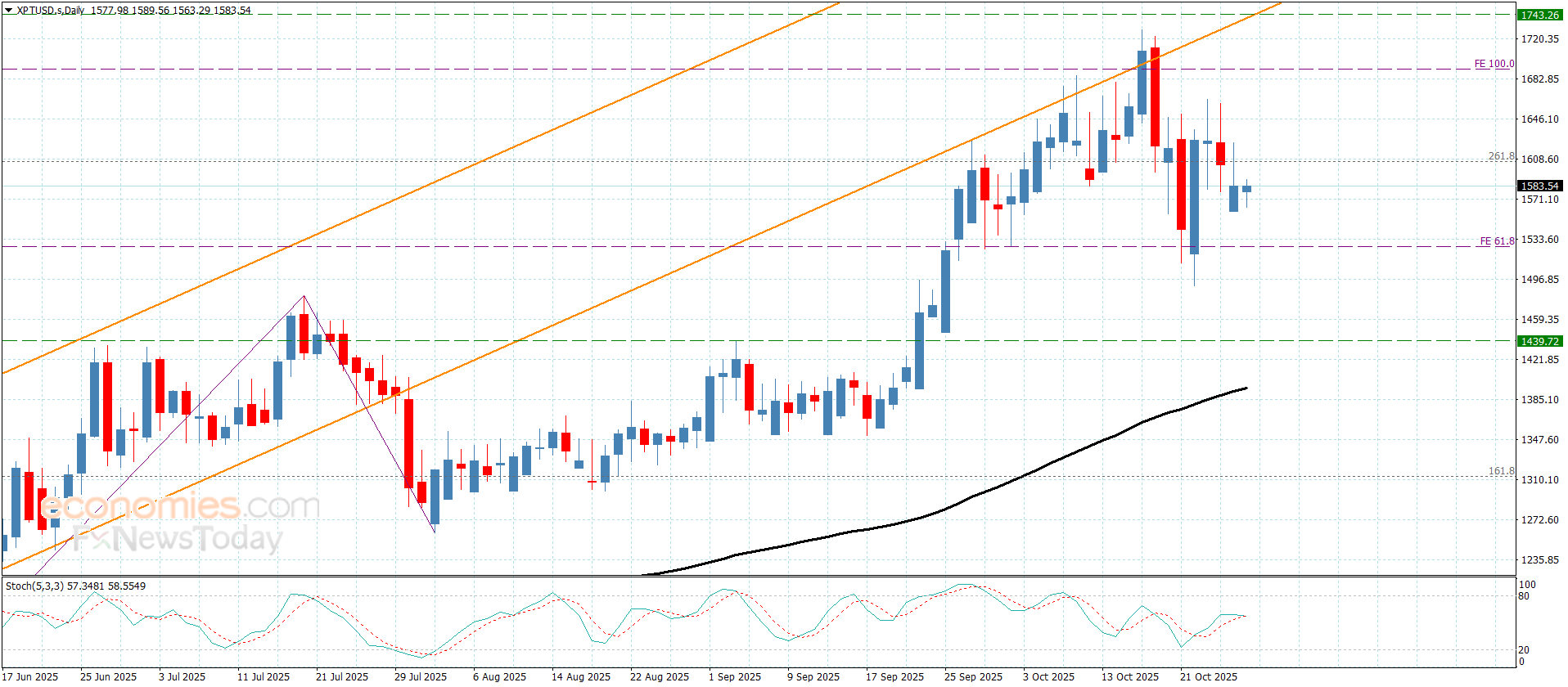
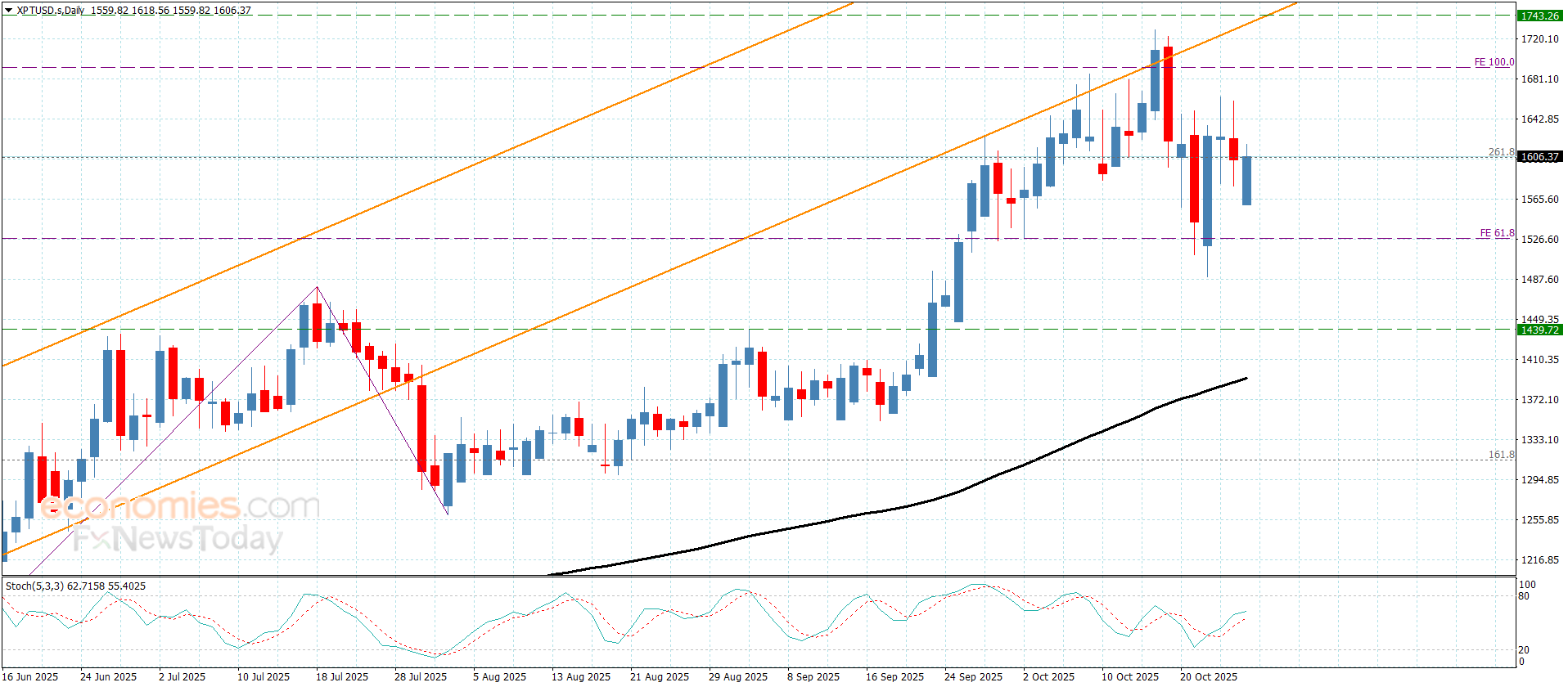
Other precious metals followed a similar trend. Spot silver declined by 0.8% to $46.51 per ounce, platinum dropped 2.6% to $1,549.85, and palladium slipped 1.2% to $1,385.50.
These metals have also been influenced by global trade shifts and changing investor sentiment.
Citi Bank recently lowered its short-term forecasts for both gold and silver. The bank cut its gold price target to $3,800 per ounce from $4,000 and silver forecast to $42 per ounce from $55.
Citi said this revision reflects reduced market uncertainty after progress in trade discussions involving the U.S., Malaysia, Thailand, Vietnam, and Cambodia, as well as signals from China about potential cooperation.
The bank noted that falling inflation expectations and easing geopolitical risks could slow the metal rally. However, the medium-term case for gold as a hedge against global instability remains intact.
| Agency/Bank | 2025 Forecast ($/oz) | 2026 Forecast ($/oz) | Outlook Summary |
| Citi | 3,400 | 3,250 | Short-term cut due to trade progress |
| JP Morgan | 3,468 | 4,753 | Sees recovery by late 2026 |
| HSBC | 3,455 | 4,600 | Stable year-end view |
| ANZ | 3,494 | 4,445 | Expect steady gains by 2026 |
| Bank of America | 3,352 | 4,438 | Raised 2026 target to $5,000 |
| Societe Generale | – | 5,000 | Expects rise by end of 2026 |
| Standard Chartered | – | 4,488 | Gradual increase |
| Goldman Sachs | 3,400 | 4,525 | Predicts $4,900 by December 2026 |
| Commerzbank | 4,000 | – | Sees $4,200 by end of 2025 |
| Deutsche Bank | 3,291 | 4,000 | Forecasts $4,300 by Q4 2026 |
| UBS | – | – | Expects lower real rates to support gold |
Silver platinum palladium price rate today prediction analysis and forecast indicate continued market adjustments based on global policy and trade decisions. The overall outlook depends on interest rate trends, inflation data, and geopolitical stability.
If global trade cooperation strengthens, prices may remain under pressure. However, any slowdown in growth or dovish central bank signals could renew investor interest in safe-haven metals.
Q1. What is the current silver platinum palladium price rate today?
Spot silver is $46.51 per ounce, platinum $1,549.85, and palladium $1,385.50, reflecting a general decline amid optimism about a potential U.S.-China trade deal.
Q2. What factors could influence silver platinum palladium prices in the coming months?
Prices will depend on central bank policies, global trade developments, inflation data, and investor sentiment regarding risk and safe-haven assets.
Investors are watching closely for signals from Fed Chair Jerome Powell’s press conference on Wednesday, where markets expect a more dovish tone amid slowing economic momentum. The Richmond Manufacturing Index and CB Consumer Confidence data due today will offer early clues on the health of the US economy, with consumer sentiment projected to edge down to 93.4 from 94.2.
Tomorrow’s Pending Home Sales data, forecast at 1.7% versus 4.0% previously, could further shape expectations about the Fed’s policy path.
Analysts at HSBC noted that “the Fed remains under pressure to strike a balance between curbing inflation and avoiding an unnecessary slowdown,” adding that dovish commentary could extend the rally in defensive assets like gold and silver.
Beyond the Fed, central banks in Europe and Japan are also expected to maintain policy stability, while improving signs of US–China trade cooperation have helped limit volatility.
Officials from both nations reportedly finalized the framework of a trade agreement ahead of a meeting between Presidents Trump and Xi later this week, an event markets hope will de-escalate tensions that have weighed on global trade flows.
Gold’s resilience this week reflects renewed hedging against macro uncertainty, while silver’s correlation with industrial demand remains a key focus. With traders balancing optimism over trade with caution ahead of policy shifts, both metals appear poised for moderate upside, contingent on the Fed’s tone and whether easing inflation expectations translate into sustained rate cuts through year-end.
Natural gas price provided mixed trading due to the contradiction between the main indicators, but its main stability within the bullish channel’s levels, by the continuation of forming extra support at $3.830 level, these factors support confirming the continuation of the positivity in the upcoming trading.
Therefore, we will keep waiting for gathering bullish momentum in the current period, reinforcing the chances of its rally towards the positive stations that are located near $4.210 reaching $4.330 resistance, while reaching below the extra support and holding below it might force it to provide strong corrective trading, forcing it to suffer big losses by reaching $3.550 initially.
The expected trading range for today is between $3.850 and $4.215
Trend forecast: Bullish
The (ETHUSD) price declined in its last intraday trading, amid the emergence of the negative signals on the relative strength indicators, after reaching overbought levels previously, to gather the gains of its previous rises, attempting to gain bullish momentum that might help it to recover and rise again, amid the dominance of the bullish corrective trend on the short-term basis and its trading alongside trendline that reinforces the stability of this track, especially with the relative strength indicates reaching exaggerated oversold levels compared to the price move, as a signal for the negative pressure decline.
Get high-accuracy trading signals delivered directly to your Telegram. Subscribe to specialized packages tailored for the world’s top markets:
Full VIP signals performance report for 13-17, October 2025:
View Full Performance Report Telegram (https://t.me/besttradingsignalstocksbot?start=p88d632b0-66dd-11f0-a948-13815052d5ae)
Gold is revering a part of the previous decline, challenging the $4,000 mark as safe-haven flows return heading into the two-day US Federal Reserve (Fed) monetary policy meeting.
Markets seem to have turned risk-averse, biding time before the Fed policy announcements on Wednesday. Further, nervousness sets in as key US tech titans are due to release their earnings reports later this week.
Meanwhile, the US Dollar (USD) is languishing in weekly lows against its six major currency rivals, as traders look to reposition amid the US-China trade deal optimism and ahead of the Fed event risk.
These factors offer fresh support to Gold, helping the bright metal stage a comeback after having fallen for two trading days in a row.
Gold tumbled over 3% on Monday, as markets ignored the traditional safe haven in search of higher returns on renewed hopes that the US and China will reach a trade deal when US President Donald Trump and his Chinese counterpart Xi Jinping meet on Thursday in South Korea.
All eyes are now on the Fed’s monetary policy verdict and the daily technical setup for fresh trading impetus, as the US government shows no signs of reopening.
Markets are almost fully pricing in two interest rate cuts this year, with a 25 basis points (bps) cut seen on Wednesday. Therefore, the main focus will be on the language in the policy statement and Fed Chairman Jerome Powell’s words for fresh hints on the central bank’s path forward on rates.
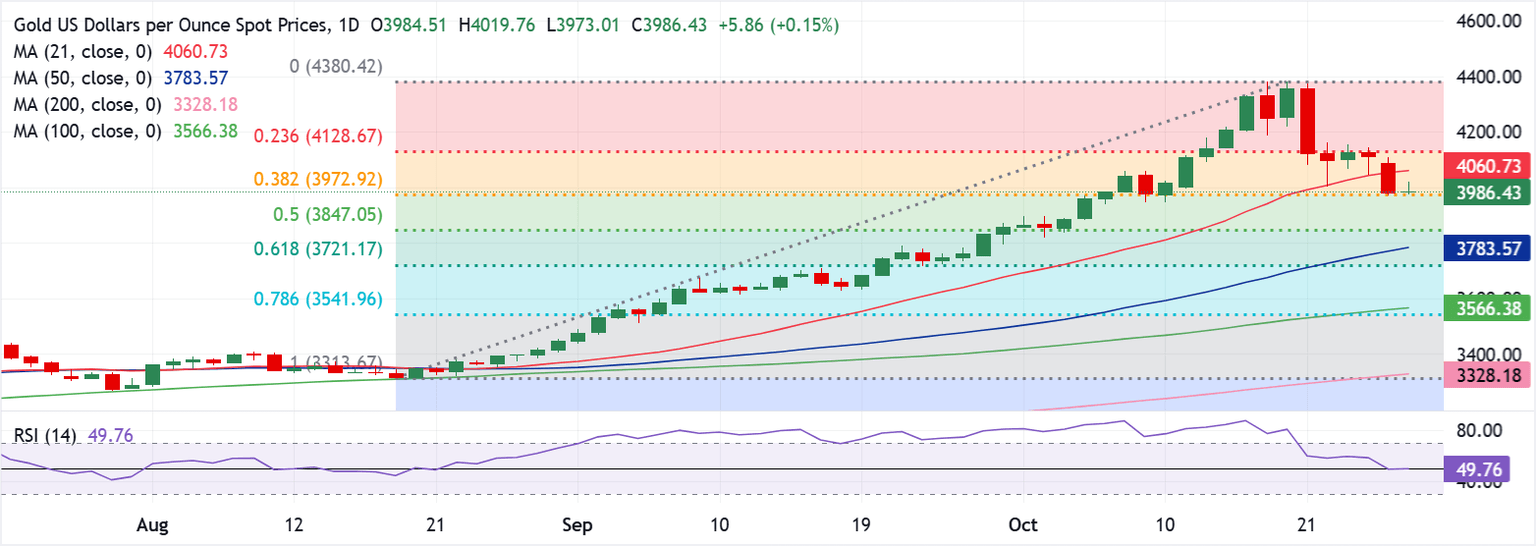
The daily shows that Gold price defends the critical support at $3,973, which is the 38.2% Fibonacci Retracement (Fibo) level of the parabolic rise that kicked off in mid-August.
So long as the abovementioned level is held, Gold buyers will likely remain hopeful.
Meanwhile, the 14-day Relative Strength Index (RSI) flirts with the midline, struggling to find acceptance above it.
If the 50 level is reclaimed on a sustained basis, Gold’s rebound could gather traction toward the 21-day Simple Moving Average (SMA) at $4,061.
Recapturing the latter is critical to stretch the recovery to near the $4,100 hurdle, where a bunch of healthy resistance levels align.
Additional upside will challenge the $4,150 psychological barrier.
Conversely, a daily candlestick closing below the 38.2% Fibo support at $3,973 will initiate a fresh downtrend toward the 50% Fibo level of $3,847.
Further south, the upward-sloping 50-day SMA at $3,784 could rescue buyers.
Gold has played a key role in human’s history as it has been widely used as a store of value and medium of exchange. Currently, apart from its shine and usage for jewelry, the precious metal is widely seen as a safe-haven asset, meaning that it is considered a good investment during turbulent times. Gold is also widely seen as a hedge against inflation and against depreciating currencies as it doesn’t rely on any specific issuer or government.
Central banks are the biggest Gold holders. In their aim to support their currencies in turbulent times, central banks tend to diversify their reserves and buy Gold to improve the perceived strength of the economy and the currency. High Gold reserves can be a source of trust for a country’s solvency. Central banks added 1,136 tonnes of Gold worth around $70 billion to their reserves in 2022, according to data from the World Gold Council. This is the highest yearly purchase since records began. Central banks from emerging economies such as China, India and Turkey are quickly increasing their Gold reserves.
Gold has an inverse correlation with the US Dollar and US Treasuries, which are both major reserve and safe-haven assets. When the Dollar depreciates, Gold tends to rise, enabling investors and central banks to diversify their assets in turbulent times. Gold is also inversely correlated with risk assets. A rally in the stock market tends to weaken Gold price, while sell-offs in riskier markets tend to favor the precious metal.
The price can move due to a wide range of factors. Geopolitical instability or fears of a deep recession can quickly make Gold price escalate due to its safe-haven status. As a yield-less asset, Gold tends to rise with lower interest rates, while higher cost of money usually weighs down on the yellow metal. Still, most moves depend on how the US Dollar (USD) behaves as the asset is priced in dollars (XAU/USD). A strong Dollar tends to keep the price of Gold controlled, whereas a weaker Dollar is likely to push Gold prices up.
The (Brent) price settled high during its last intraday trading, attempting to breach the current resistance level at $65.55, this resistance represents our expected target in our previous analysis, taking advantage of the dynamic support that is represented by its trading above EMA50, and under the dominance of strong bullish corrective wave on the short-term basis, noticing that the relative strength indicators have reached exaggerated oversold levels compared to the price move, providing big chance for forming positive divergence, intensifying the positive momentum in its upcoming trading.
Get high-accuracy trading signals delivered directly to your Telegram. Subscribe to specialized packages tailored for the world’s top markets:
Full VIP signals performance report for 13-17, October 2025:
View Full Performance Report Telegram (https://t.me/besttradingsignalstocksbot?start=p88d632b0-66dd-11f0-a948-13815052d5ae)
The recent $2.89 swing low (C) successfully tested the lower rising trend channel line, forming a higher swing low and setting up a potential new upswing. The 20-day average proved its strength as dynamic support today, with the rapid recovery from $3.26 showing clear buyer commitment. This level will serve as a critical anchor if resistance begins to crack, especially given its alignment with the channel’s structure.
The $3.46-$3.59 zone, anchored by the 200-day average and early-October’s $3.59 swing high, includes last week’s $3.57 peak, a $3.55 high from three weeks ago, and a 61.8% Fibonacci retracement at $3.55. Breaking this range is essential for higher targets, with $3.59 acting as the key breakout trigger. The market’s repeated tests highlight its significance.
A rising ABCD pattern targets $3.71, matching the prior AB leg’s advance. A $3.59 breakout would exceed the 61.8% retracement, easing the path to $3.71 and potentially the 78.6% retracement. A close above $3.40 today locks in the bullish reversal, putting $3.59 squarely in play and signaling stronger demand.
The $3.40 close is decisive—above it confirms strength and eyes $3.59, below it risks a retest of $3.26. The $3.46-$3.59 zone remains the battleground; a decisive break fuels $3.71 and a path toward $4.15 on a June high reclaim. Today’s action leans bullish—watch $3.59 for confirmation of the next leg higher. The 20-day average at $3.27 will be the first line of defense on any pullback.
For a look at all of today’s economic events, check out our economic calendar.
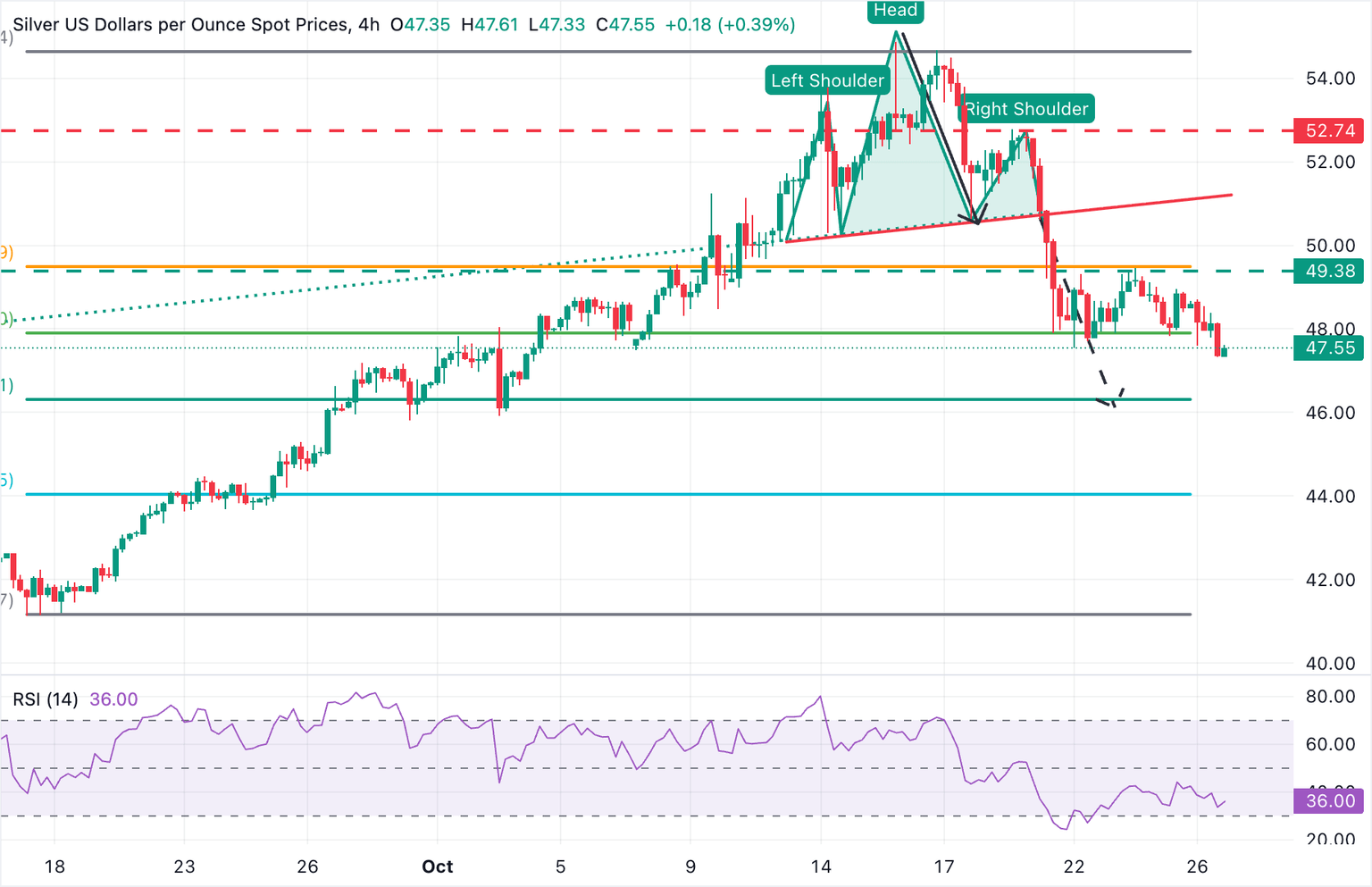
Silver (XAG/USD) extends losses on Monday amid a positive market sentiment, following upbeat reports regarding a potential China-US trade deal. The white metal’s reversal from mid-October highs above $54.00 is approaching the $47.00 level.
Precious metals are on their back foot. Comments by US President Donald PrumpTrumpp showing confidence that he will reach a good deal with his Chinese counterpart Xi have reinforced investors’ optimism earlier this morning, adding negative pressure on traditional safe-havens like Silver.
The technical picture shows price action below the neckline of a bearish Head & Shoulders, at the $50.71 area, with the pattern’s measured target, at the 61.8% Fibonacci retracement of the September-October rally, at the $46.35 area.
The mentioned Fibonacci level and the area around $46.00, where the pair was contained on September 30 and October 2, are likely to pose significant support. Below here, the next target is the 76.2% Fibonacci retracement of the same cycle, near $44.00.
To the upside, the October 22 and 23 highs, at the $49.40 area and the H&S neckline, right above $51, are likely to act as resistance now, ahead of the October 20 high at the $52.75 area.
Silver is a precious metal highly traded among investors. It has been historically used as a store of value and a medium of exchange. Although less popular than Gold, traders may turn to Silver to diversify their investment portfolio, for its intrinsic value or as a potential hedge during high-inflation periods. Investors can buy physical Silver, in coins or in bars, or trade it through vehicles such as Exchange Traded Funds, which track its price on international markets.
Silver prices can move due to a wide range of factors. Geopolitical instability or fears of a deep recession can make Silver price escalate due to its safe-haven status, although to a lesser extent than Gold’s. As a yieldless asset, Silver tends to rise with lower interest rates. Its moves also depend on how the US Dollar (USD) behaves as the asset is priced in dollars (XAG/USD). A strong Dollar tends to keep the price of Silver at bay, whereas a weaker Dollar is likely to propel prices up. Other factors such as investment demand, mining supply – Silver is much more abundant than Gold – and recycling rates can also affect prices.
Silver is widely used in industry, particularly in sectors such as electronics or solar energy, as it has one of the highest electric conductivity of all metals – more than Copper and Gold. A surge in demand can increase prices, while a decline tends to lower them. Dynamics in the US, Chinese and Indian economies can also contribute to price swings: for the US and particularly China, their big industrial sectors use Silver in various processes; in India, consumers’ demand for the precious metal for jewellery also plays a key role in setting prices.
Silver prices tend to follow Gold’s moves. When Gold prices rise, Silver typically follows suit, as their status as safe-haven assets is similar. The Gold/Silver ratio, which shows the number of ounces of Silver needed to equal the value of one ounce of Gold, may help to determine the relative valuation between both metals. Some investors may consider a high ratio as an indicator that Silver is undervalued, or Gold is overvalued. On the contrary, a low ratio might suggest that Gold is undervalued relative to Silver.
Spot Gold pierced the $4,000 level on Monday, as a better market mood trashed demand for the safe-haven metal. It currently trades near a fresh 3-week low of $3,971.63.
Relief came from trade-war-related headlines, as United States (US) Treasury Scott Bessent said that top US and China officials had drawn a framework ahead of US President Donald Trump and Chinese leader Xi Jinping meeting later this week. Such a framework, according to Bessent, will prevent fresh US tariffs on Chinese goods, and limit Beijing’s control on rate earths.
Wall Street surged amid confidence in a trade deal and ahead of the Federal Reserve (Fed) monetary policy announcement later this week. The central bank is widely anticipated to trim interest rates by 25 basis points (bps), the second cut in 2025. For companies, lower rates mean lower borrowing costs, hence, firmer stocks gains.
Other than that, the US government shutdown continues, meaning the macroeconomic calendar has little to offer apart from the Federal Open Market Committee (FOMC) decision.
In the 4-hour chart, XAU/USD is currently trading at $4004, down for a second consecutive day. Price action sits beneath the near-term averages, with a bearish 20 Simple Moving Average (SMA) sliding south and now below the 100 SMA, suggesting sellers hold the grip and hinting at additional slides ahead. The 20 SMA stands at $4,085, while the 100 SMA is advancing at $4,109, creating a layered resistance band at $4,085–$4,109. The broader outlook remains underpinned by the rising 200 SMA at $3,927, which acts as the first meaningful support beneath the market, but the inability to reclaim the 20 SMA keeps the short-term tone biased lower.
At the same time, the Momentum indicator remains deeply below the 100 mid-line, aiming higher yet not enough to confirm a steeper recovery ahead. The Relative Strength Index (RSI) indicator hovers at 36, still below the neutral 50 threshold but ticking higher versus the previous close, pointing to fading downside pressure and scope for consolidation. Even so, as long as XAU/USD fails to clear the 20 SMA at $4,085 and the 100 SMA at $4,109, the path of least resistance remains to the downside toward the rising 200 SMA at $3,927. A firm recovery above $4,085–$4,109 would temper the bearish bias and open the door for a more sustained corrective bounce.
In the daily chart, a bullish 20 SMA runs above the current level, providing dynamic resistance at $4,066, while the 100 SMA is bullish, advancing at $3,560. The 200 SMA is also edging higher at $3322, reinforcing the broader positive bias and offering a deeper support level. A sustained break back above the 20 SMA would likely reassert the upward bias and open the door to additional gains.
That said, short-term signals have softened, as the Momentum indicator has accelerated south firmly below its 100 line, flagging increased selling pressure and a corrective tone. The RSI has cooled sharply from prior overbought levels and now hovers at 51, just above the neutral 50 mark, pointing to waning upside traction. While the bearish momentum raises the risk of further dips toward the aforementioned moving-average supports, the rising longer SMAs suggest pullbacks may remain contained. A recovery through $4066 would tilt the near-term bias back to the upside, whereas failure to reclaim it keeps risks skewed toward a deeper test of the 100 SMA at $3560.
(This content was partially created with the help of an AI tool)
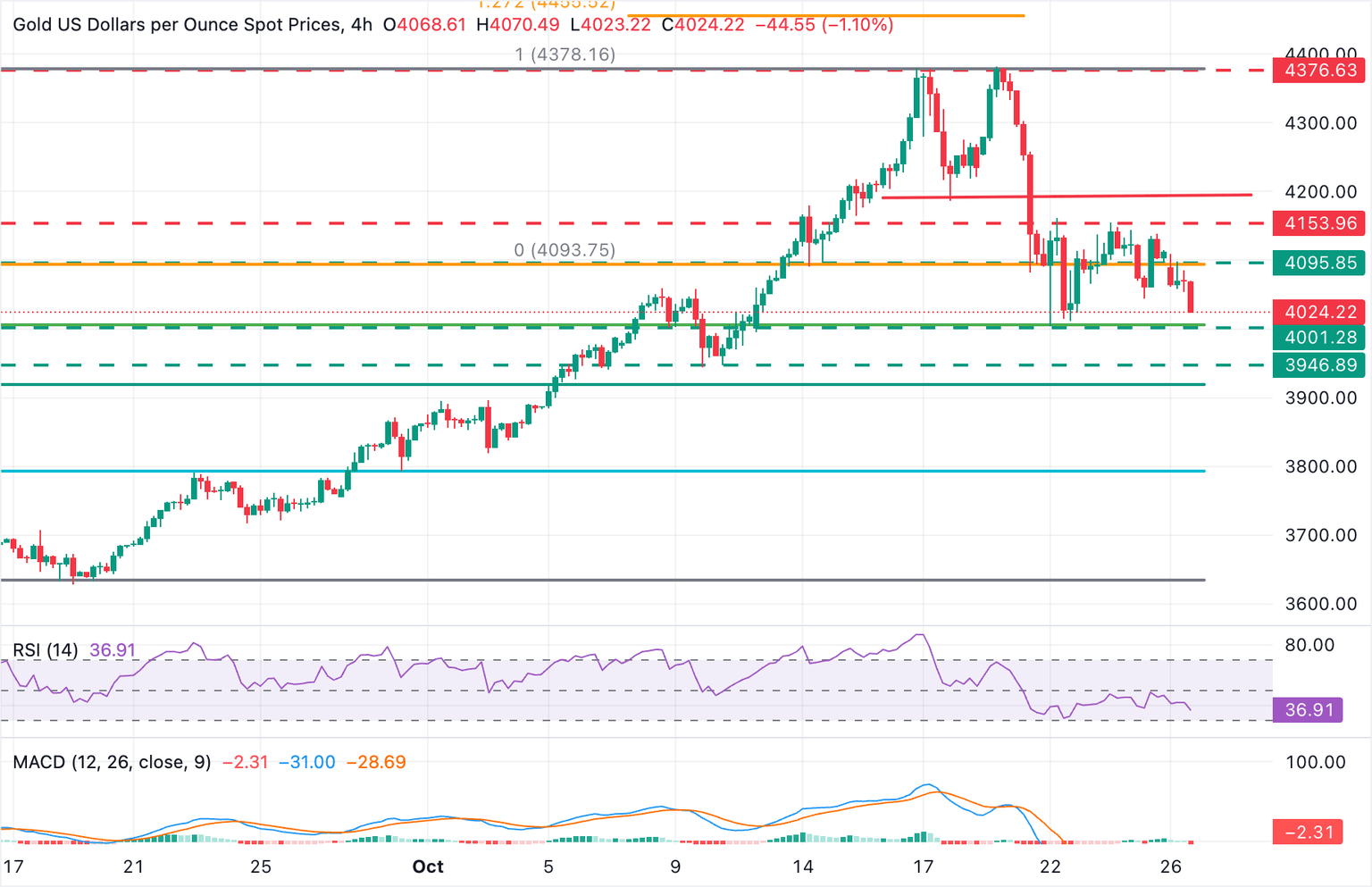
Gold remains on its back foot on Monday amid moderate risk appetite, amid market hopes of a trade deal between the US and China. The precious metal depreciated nearly 2% on Monday, trading at a short distance from the $4,000 support area.
Comments by US President Donald Trump, reiterating his optimism about the chances of reaching a good trade deal with Chinese President Xi Jinping at their meeting later this week, have calmed concerns about further restrictions on global trade and are buoying market sentiment.
From a technical perspective, a look at the 4-hour charts shows bears in control, as price action corrects lower from all-time highs near $4,400. Upside attempts remained capped well below a previous support level at $4,185 last week, highlighting the bearish momentum.
On the downside, immediate support is at the $4,000 psychological area, where bears were capped on October 22. This level closes the path towards the October 9 and 10 lows, at $3,945, and the 61.8% Fibonacci retracement of the September 18 – October 17 bullish run, a common target for corrections.
Upside attempts remain capped below $4.150 (October 22 and 23 highs), below here, the previous support at the mentioned $4185 area might hold bulls ahead of the all-time high, near $4,380
Further down, the $3945 area, where the pair found support on October 7, 9, and 10, emerges as the next target ahead of the October 2 low, at $3,845. To the upside, the intraday high at the $4,160 area and the October 17 low at $4,185 are closing the path towards the all-time high at $4,380.
Gold has played a key role in human’s history as it has been widely used as a store of value and medium of exchange. Currently, apart from its shine and usage for jewelry, the precious metal is widely seen as a safe-haven asset, meaning that it is considered a good investment during turbulent times. Gold is also widely seen as a hedge against inflation and against depreciating currencies as it doesn’t rely on any specific issuer or government.
Central banks are the biggest Gold holders. In their aim to support their currencies in turbulent times, central banks tend to diversify their reserves and buy Gold to improve the perceived strength of the economy and the currency. High Gold reserves can be a source of trust for a country’s solvency. Central banks added 1,136 tonnes of Gold worth around $70 billion to their reserves in 2022, according to data from the World Gold Council. This is the highest yearly purchase since records began. Central banks from emerging economies such as China, India and Turkey are quickly increasing their Gold reserves.
Gold has an inverse correlation with the US Dollar and US Treasuries, which are both major reserve and safe-haven assets. When the Dollar depreciates, Gold tends to rise, enabling investors and central banks to diversify their assets in turbulent times. Gold is also inversely correlated with risk assets. A rally in the stock market tends to weaken Gold price, while sell-offs in riskier markets tend to favor the precious metal.
The price can move due to a wide range of factors. Geopolitical instability or fears of a deep recession can quickly make Gold price escalate due to its safe-haven status. As a yield-less asset, Gold tends to rise with lower interest rates, while higher cost of money usually weighs down on the yellow metal. Still, most moves depend on how the US Dollar (USD) behaves as the asset is priced in dollars (XAU/USD). A strong Dollar tends to keep the price of Gold controlled, whereas a weaker Dollar is likely to push Gold prices up.