The main tag of Gold Today Price Articles.
You can use the search box below to find what you need.
[wd_asp id=1]
The main tag of Gold Today Price Articles.
You can use the search box below to find what you need.
[wd_asp id=1]
The price of (crude oil) declined in its last intraday trading, due to the stability of the stubborn resistance level at $61.75, attempting to gain bullish momentum that might help to breach this resistance, amid the dominance of bullish corrective wave on the short-term basis, supported by its continuous trading above its EMA50, reinforcing the chances of the price recovery in the upcoming period, especially with the relative strength indicators reaching oversold levels, exaggeratedly compared to the price move, indicating the beginning of forming bullish divergence.
Get high-accuracy trading signals delivered directly to your Telegram. Subscribe to specialized packages tailored for the world’s top markets:
Full VIP signals performance report for 13-17, October 2025:
View Full Performance Report Telegram (https://t.me/besttradingsignalstocksbot?start=p88d632b0-66dd-11f0-a948-13815052d5ae)
Gold is treading water around $4,080, trapped in a defined range between $4,004–$4,161, as traders prepare for the October 30 FOMC decision.
The market is no longer reacting to the rate cut itself — the CME FedWatch Tool shows a 96.7% probability that the Fed will cut rates by 25bps (4.25% → 4.00%), making the move fully priced in.
What’s not priced in, however, is the Fed’s tone during Powell’s press conference. If the Chair signals that more easing could follow — citing weaker growth or global risks — gold may find fresh fuel to break higher. But if Powell emphasizes caution or suggests a “cut and pause” approach, traders may see short-term profit-taking push prices back toward $4,000.
Adding to the complexity, US data remains disrupted by the government shutdown, with the Advance GDP report (forecast 3.0% vs 3.8% prior) expected hours after the FOMC. The combination of policy tone + GDP surprise could spark the next volatility burst in XAU/USD.

Fed Decision Timeline (UTC +8)
With the cut already priced, gold’s reaction hinges on the tone, not the decision:
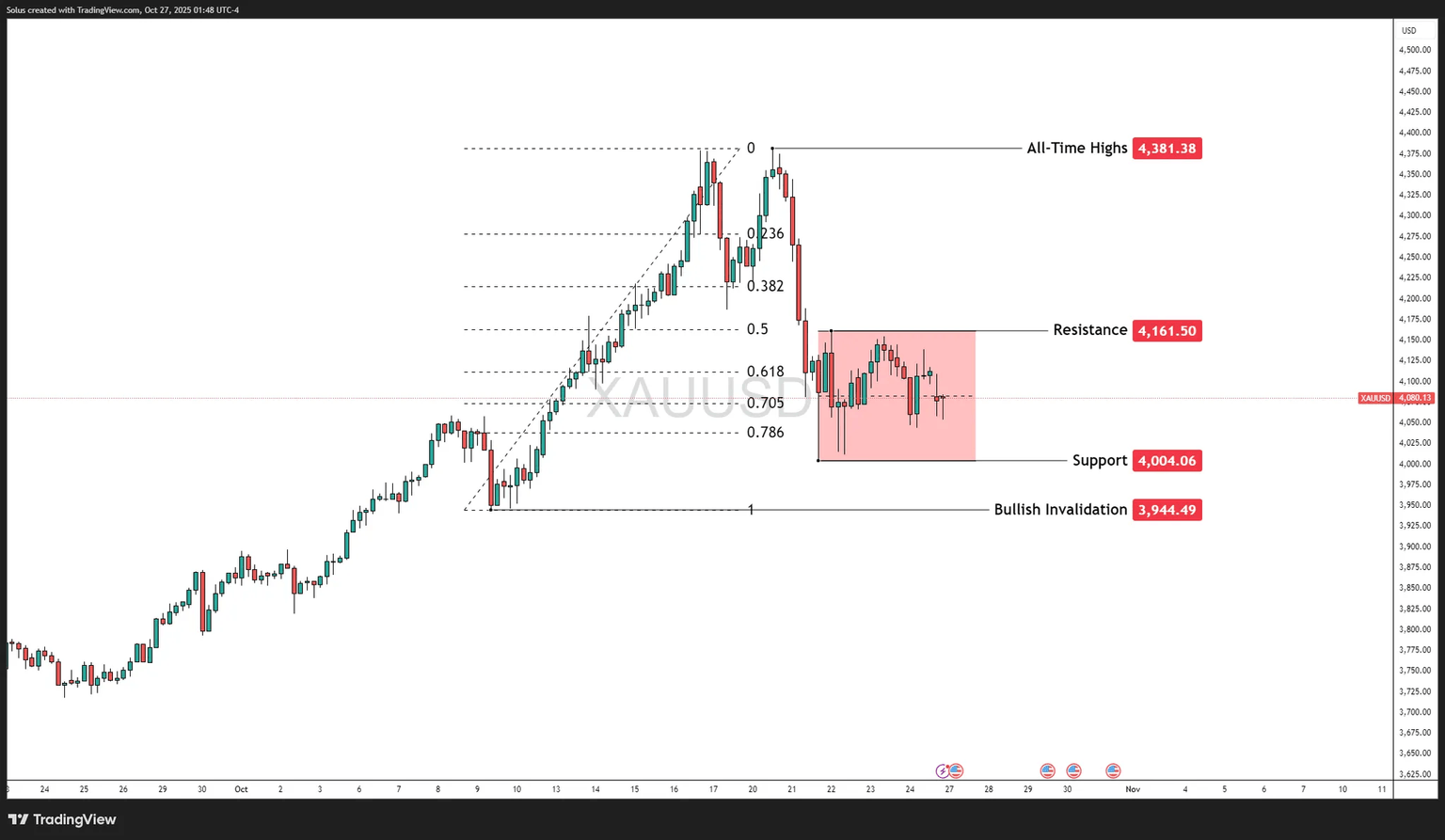
Gold remains in a sideways correction, holding firm above the 0.618–0.705 retracement zone of the October rally — a typical region for accumulation before continuation.
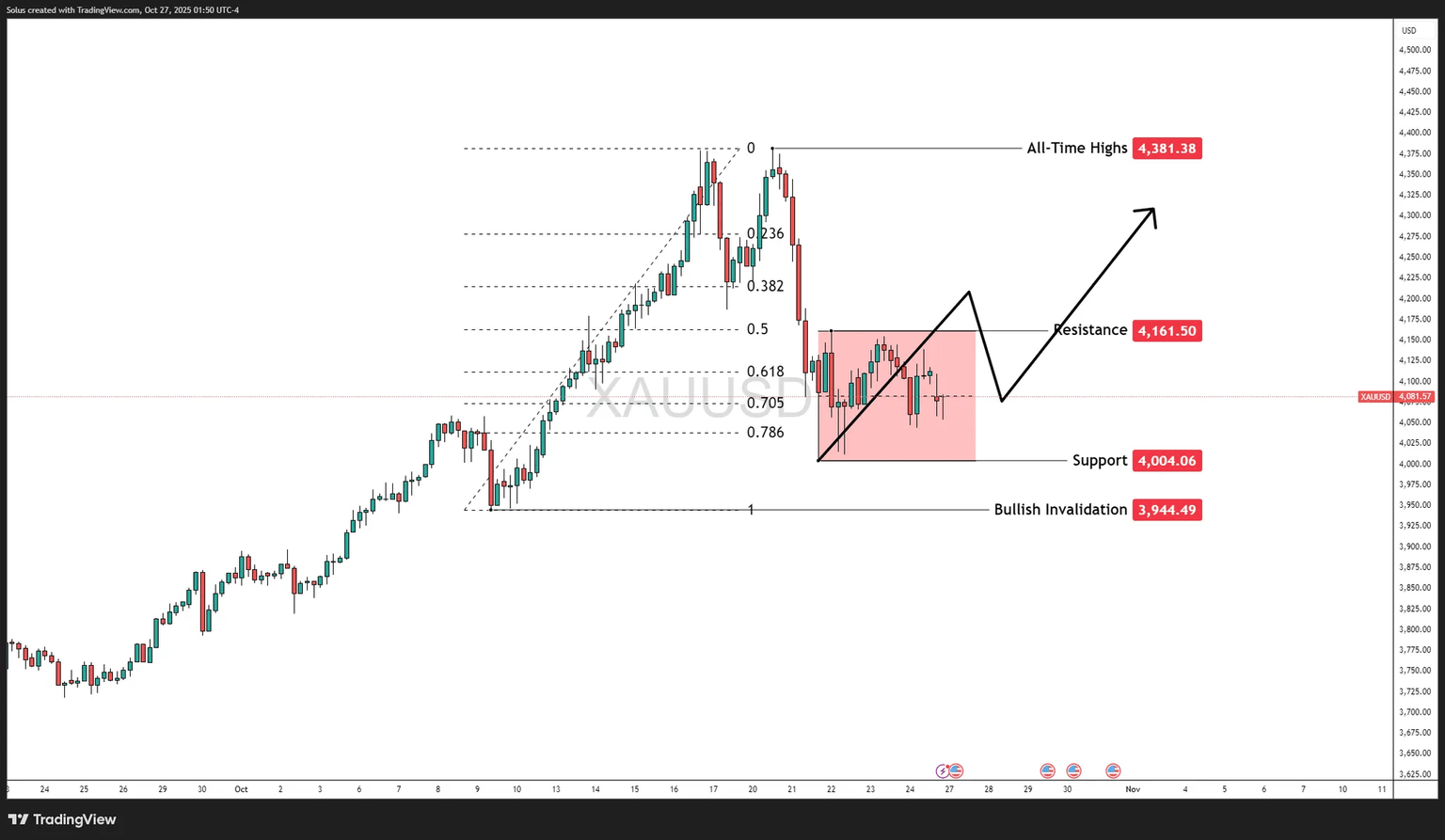
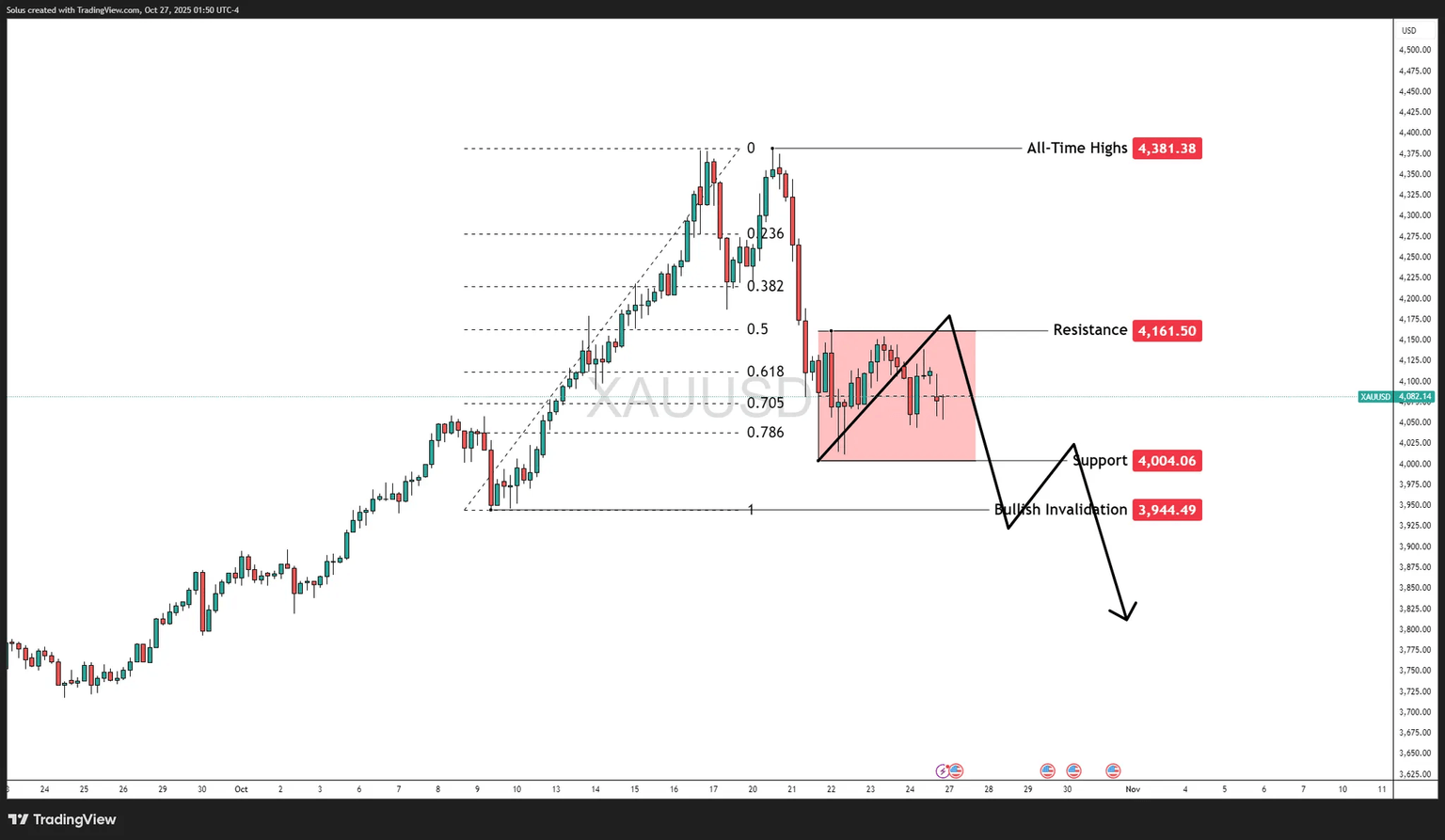
Gold’s macro structure remains bullish, but short-term sentiment is in pause mode.
The rate cut itself is no longer the story — the market has already moved past that. What truly matters now is how Powell frames this decision and whether he signals a broader easing cycle or a temporary adjustment.
Gold’s recent behavior tells the story of patience rather than panic: it’s holding ground above $4,000, respecting structure, and awaiting clarity. The consolidation between $4,004 and $4,161 isn’t weakness — it’s compression before expansion. Once direction is confirmed, the move could be sharp and decisive.
If Powell leans dovish, gold has every reason to resume its climb toward $4,300–$4,381, supported by central-bank accumulation, lower real yields, and safe-haven demand amid global uncertainty.
But if the Fed hints at a pause or slower easing path, a brief pullback below $4,000 would be natural — a reset, not a reversal.
For traders, this week is all about reaction, not prediction. Let the Fed’s tone set the tempo, and trade the breakout from structure, not inside the noise.
Gold’s trend remains constructively bullish, and the market seems to be simply waiting — not wondering — for its next cue.
In short: The Fed’s decision is priced in. Powell’s tone isn’t.
The next breakout in gold will tell us which narrative wins.
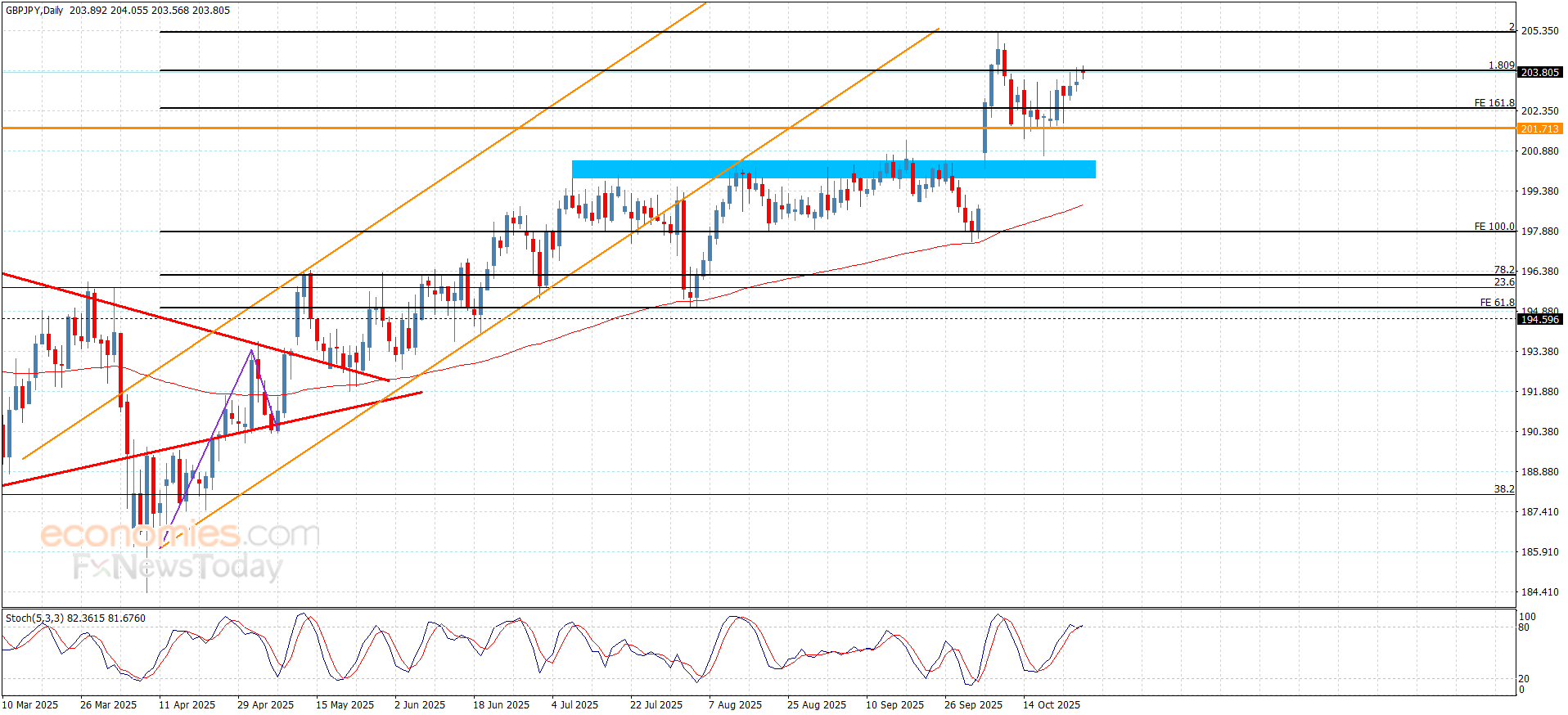
The GBPJPY pair keeps the bullish scenario by providing new pressure on the barrier at 203.95, to find an exit for resuming the previously awaited bullish attack, the attempt of forming extra support at 202.85 level will increase the extra targets by its rally towards 204.60 directly, reaching the next main target near 205.25.
Note that the stability of stochastic within the overbought level will reinforce the chances of gaining the required bullish momentum, to achieve the required breach and reaching the previously suggested targets.
The expected trading range for today is between 203.35 and 204.60
Trend forecast: Bullish
The GBPJPY pair keeps the bullish scenario by providing new pressure on the barrier at 203.95, to find an exit for resuming the previously awaited bullish attack, the attempt of forming extra support at 202.85 level will increase the extra targets by its rally towards 204.60 directly, reaching the next main target near 205.25.
Note that the stability of stochastic within the overbought level will reinforce the chances of gaining the required bullish momentum, to achieve the required breach and reaching the previously suggested targets.
The expected trading range for today is between 203.35 and 204.60
Trend forecast: Bullish
Gold extends its consolidative phase into a fourth trading day on Monday, after having failed once again above the $4,100 mark.
The latest leg down in Gold could be attributed to the renewed market optimism surrounding a US-China trade deal after a preliminary consensus on topics including export controls, fentanyl and shipping levies was reached by both sides during their two-day talks in Malaysia.
On Sunday, US Treasury Secretary Scott Bessent noted: “So I would expect that the threat of the 100% has gone away, as has the threat of the immediate imposition of the Chinese initiating a worldwide export control regime.”
In an ABC News interview, Bessent further said that China would delay its rare-earth restrictions “for a year while they reexamine it.”
These optimistic comments ramped up the odds of a trade deal likely to be reached when Trump and Chinese President Xi Jinping meet on Thursday in South Korea.
Risk flows extended into Asia on increased dovish bets surrounding the US Federal Reserve’s (Fed) easing outlook and the US-China trade deal hopes.
Markets are almost fully pricing in two interest rate cuts this year, with a 25 basis points (bps) cut seen on Wednesday.
On Friday, the Bureau of Labor Statistics (BLS) showed that the US Consumer Price Index (CPI rose 0.3% in September, which drove the annual inflation rate from 2.9% to 3%, the highest it’s been since January. The annual CPI inflation came in softer than the market forecast of 3.1%.
The US-China trade deal hopes seem to have offset the dovish Fed sentiment, undermining Gold price.
Moreover, investors continue to take profits off the table on their Gold longs ahead of the Fed’s two-day monetary policy meeting that begins on Tuesday.
Therefore, a further corrective decline cannot be ruled out in the upcoming sessions, as the US government shows no signs of reopening, and hence, trade and Fed sentiment continue to emerge as the key drivers for the bright metal.
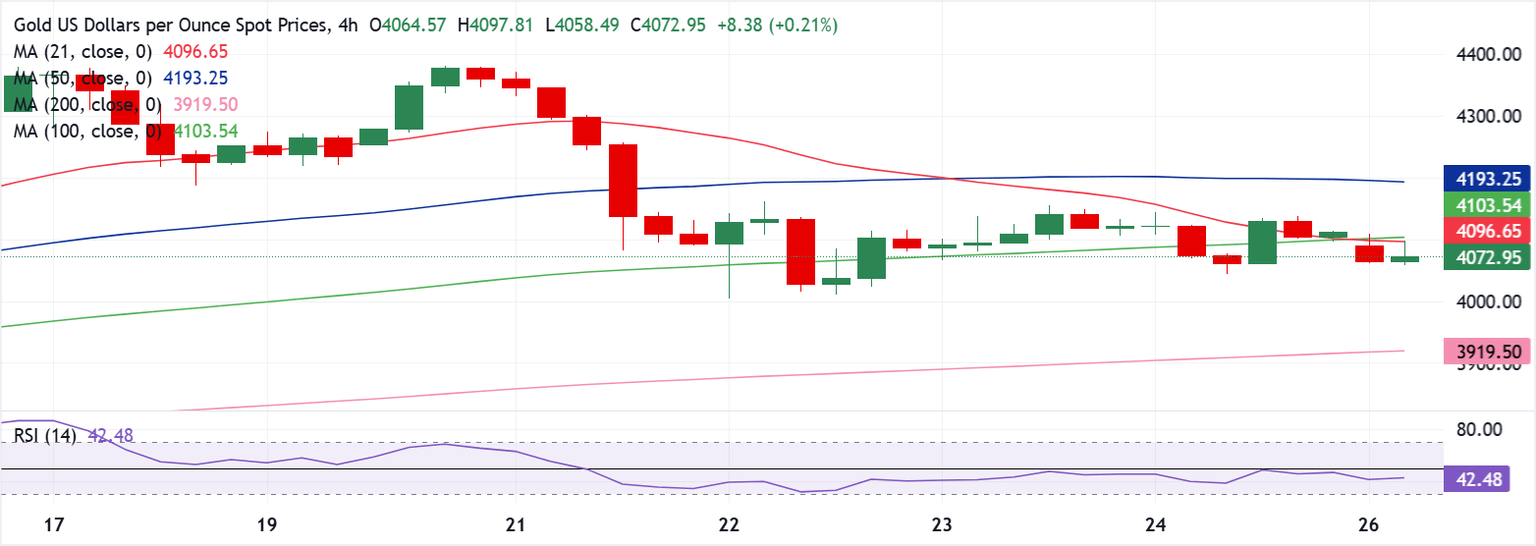
The four-hour chart shows that Gold price has once again breached the powerful support near $4,100.
That area is the confluence of the 21-Simple Moving Average (SMA) and the 100 SMA.
Meanwhile, the Relative Strength Index (RSI) stays below the midline, currently near 42.50.
Adding credence to the bearish bias, the 21 SMA closed below the 100 SMA on a four-hourly candlestick closing basis, validating a Bear Cross.
If the declines accelerate, Gold could challenge the $4,000 round level, below which the $3,950 psychological barrier will be targeted.
The next critical support is located at $3,920, the 200 SMA.
Alternatively, if buyers find a strong foothold above the aforesaid key support-turned-resistance at around $4,100, a fresh advance toward the $4,150 level could be in the offing.
Further north, Gold buyers could challenge the 50 SMA at $4,193.
Monetary policy in the US is shaped by the Federal Reserve (Fed). The Fed has two mandates: to achieve price stability and foster full employment. Its primary tool to achieve these goals is by adjusting interest rates.
When prices are rising too quickly and inflation is above the Fed’s 2% target, it raises interest rates, increasing borrowing costs throughout the economy. This results in a stronger US Dollar (USD) as it makes the US a more attractive place for international investors to park their money.
When inflation falls below 2% or the Unemployment Rate is too high, the Fed may lower interest rates to encourage borrowing, which weighs on the Greenback.
The Federal Reserve (Fed) holds eight policy meetings a year, where the Federal Open Market Committee (FOMC) assesses economic conditions and makes monetary policy decisions.
The FOMC is attended by twelve Fed officials – the seven members of the Board of Governors, the president of the Federal Reserve Bank of New York, and four of the remaining eleven regional Reserve Bank presidents, who serve one-year terms on a rotating basis.
In extreme situations, the Federal Reserve may resort to a policy named Quantitative Easing (QE). QE is the process by which the Fed substantially increases the flow of credit in a stuck financial system.
It is a non-standard policy measure used during crises or when inflation is extremely low. It was the Fed’s weapon of choice during the Great Financial Crisis in 2008. It involves the Fed printing more Dollars and using them to buy high grade bonds from financial institutions. QE usually weakens the US Dollar.
Quantitative tightening (QT) is the reverse process of QE, whereby the Federal Reserve stops buying bonds from financial institutions and does not reinvest the principal from the bonds it holds maturing, to purchase new bonds. It is usually positive for the value of the US Dollar.
Gold’s price architecture spans centuries of monetary regime shifts, but the current setup is as binary as any in modern history. The march from the Bretton Woods peg of $35/oz, through the 1971 convertibility break, to January 1980’s $850 spike and the 2011 breakout to $1,920 established the playbook: inflation shocks, currency debasement, and flight-to-quality episodes pull capital into XAU/USD. Fast forward to 2024–2025 and the same structural drivers just printed an all-time high at $4,381.44/oz, followed by a weekly settle at $4,114.12—a −$139.85, −3.29% decline that carved a weekly closing price reversal top. That pattern doesn’t automatically negate the uptrend, but it places the market on watch for a two-to-three week corrective phase unless buyers reassert control quickly.
Price expanded vertically into the record, then failed to hold gains as profit-taking hit precisely when the macro narrative looked most supportive. That failure is textbook for a reversal top: an upside exhaustion high early in the week, then a close below prior support despite bullish catalysts. If sellers press the advantage, XAU/USD opens room toward the first visible retracement pivot at $3,846.50, with a deeper Fibonacci waypoint at $3,720.25 (61.8%). Those aren’t arbitrary lines; they coincide with where late longs would be forced to decide whether to defend or liquidate, and where value-oriented buyers historically probe size.
The latest inflation print—core CPI +0.2% m/m, +3.0% y/y—locked in expectations for another 25 bp ease at the October 28–29 FOMC, taking the target range to 3.75%–4.00% with 98.3% market-implied odds. Crucially, the driver of policy isn’t a hot CPI; it’s labor risk. Payrolls momentum softened, prior months saw an aggregate ~900,000 downward revision, and August missed. Chair Powell’s messaging has shifted toward “insurance” cuts to preserve employment even if inflation lingers near 3%. That stance is historically constructive for gold because it depresses real yields and challenges the dollar’s carry appeal. The paradox is timing: gold pulled back in the same week the cut became a near-certainty, which tells you positioning was crowded and the market demanded fresh catalysts beyond “one more 25.”
Equities set fresh records into the weekend, while XAU/USD backed off its peak. The explanation is not that gold’s secular case cracked; it’s that the marginal liquidity impulse favored beta when tariff rhetoric cooled and risk appetite widened. The S&P 500 (+0.79%) and Nasdaq (+1.15%) extended gains as the 10-year U.S. Treasury hovered near 4.02%, siphoning flows from defensive sleeves. That rotation can unwind on a dime if the Fed under-delivers on dovish guidance, if forward QT language tightens financial conditions, or if the incoming backlog of economic releases (once the shutdown distortions clear) prints risk-off. Keep in view that spot gold still trades above $4,100 after a record, a resilience that indicates strategic demand hasn’t left—tactical profit-taking did.
The tape sent a bizarre signal set this month: gold near records, silver at $54.48 intra-month, and equities also at highs. That triad screams stagflation anxiety more than simple growth optimism. Inflation has re-accelerated from this year’s trough, drifting from 2.3% back to 3.0% y/y, while unemployment ticked up to 4.3%, the highest in four years, and headline job gains were revised sharply. Meanwhile, the national debt has ballooned to $37.6 trillion, and repeated shutdown risks keep fiscal confidence brittle. In that environment, it’s coherent for investors to bid risk for liquidity reasons and bid gold for policy and solvency insurance—until one of those impulses breaks.
If there’s an “insider transaction” equivalent in bullion, it’s central bank accumulation and ETF inventory behavior. The run to $4,381.44 occurred alongside heavy official-sector buying earlier in the cycle and persistent retail/institutional allocation via physically backed products. Last week’s downswing coincided with ETF outflows—classic profit-taking after a parabolic run—while price-sensitive official buyers are known to fade strength and reload into weakness. That mix is exactly what a reversal top captures: not an exodus, but a handoff from momentum money to balance-sheet buyers at lower prices. Watch whether those ETF outflows stabilize as XAU/USD tests the mid-$3,800s; that’s your confirmation that strong hands are re-engaging
Money supply expanded materially through the pandemic era, and although the impulse slowed during the 2022–2023 hiking cycle, the combination of balance-sheet policy and renewed cuts is re-steepening liquidity. With real yields easing from their peaks and the dollar unable to make new cycle highs, the opportunity cost of holding a non-yielding asset is falling again. Translate that into price regime terms: what $2,000 meant for resistance in 2020–2023 is what $4,000 is trying to become now—an area of battle that eventually flips into long-term support if policy remains accommodative. The fact that gold is consolidating above $4,000 after a blow-off attempt argues for regime change rather than a simple round-trip.
The nearest historical rhyme is the October 1979 drop from $444.50 to $365 that shook out weak longs before the sprint to $873 by January 1980. Obviously, today’s macro inputs differ, but the behavioral pattern—vertical extension, violent but contained shakeout, then trend resumption—fits a market where structural buyers dominate the medium term and speculators police the short term. The present reversal top serves the same function: clearing late momentum while leaving the secular thesis intact unless critical support breaks.
The immediate battleground is $4,112–$4,150. Hold that shelf into the FOMC and XAU/USD keeps a live shot at re-testing $4,250–$4,300 swiftly on a dovish press conference. Lose it decisively, and the market will seek $3,846.50, with spill risk to $3,720.25 if forced liquidation accelerates. The single sentence to parse from Powell: anything that softens the balance-sheet runoff path or amplifies labor-risk asymmetry relative to inflation risk. That’s the green light for duration and for gold. Conversely, a surprise nod to maintaining QT pace or a lean against forward-cut expectations would extend the correction.
Bitcoin’s break above $113,000–$114,000 coincided with gold’s reversal, aided by rate-cut odds near 98% and a rotation out of metals after an eight-week gold surge. Don’t over-fit that correlation. In 2020–2021 both assets rallied in tandem on liquidity, and in mid-2022 both fell as real yields spiked. The current divergence is a positioning story, not a verdict against XAU/USD. Should the Fed’s tone underwhelm risk assets or the backlog of macro data hit growth, the same liquidity that chased crypto and megacaps can snap back into bullion without warning.
The bear trigger is narrow but real: a hawkish surprise on QT or guidance that convinces the market the cutting path is shallower than priced, combined with continued ETF outflows and a weekly close below $3,846.50. The bull trigger is equally clear: reaffirmed easing path, labor-first mandate emphasis, and stabilization of ETF balances as central-bank and long-horizon buyers add into the mid-$3,800s. In the latter case, a swift reclaim of $4,200–$4,250 would put $4,381.44 back on the tape, and a clean weekly close above that high would open a measured move toward $4,600–$4,750 over the following legs.
The facts argue for bullish with discipline. All-time high at $4,381.44, weekly settle $4,114.12 (−3.29%), reversal top that likely enforces a time/price correction, CPI cool enough to validate the 98.3% cut probability, unemployment drifting up to 4.3%, and debt at $37.6T that anchors a robust structural bid for insurance assets. Tactically, respect the pattern: allow the market to test the $3,846.50–$3,900 demand zone; watch ETF outflows for stabilization; listen for any QT softening. As long as $3,720.25 holds on a weekly closing basis, the secular uptrend remains intact and pullbacks are opportunities, not warnings. My call, stated plainly: Gold (XAU/USD) — Buy / Bullish, accumulate into $3,850–$3,900, add on a dovish FOMC reclaim of $4,200+, and only downgrade to Hold on a weekly close beneath $3,720.
Friday’s inflation report came in cooler than expected. Core CPI rose just 0.2% month-over-month and 3.0% annually, reinforcing the view that the Federal Reserve will cut rates by 25 basis points at its October 28–29 meeting. The cut would lower the fed funds range to 3.75%–4.00%, and markets are still leaning toward a second cut in December.
Despite the dovish data, gold couldn’t regain traction. Broader risk appetite picked up as equities rallied on soft inflation and optimism around U.S.–China trade talks. Treasury yields climbed early in the week, and the dollar gained modestly, both contributing to gold’s downside pressure. The inability to hold weekly gains suggests buyers are now waiting for deeper value zones to re-enter.
The Fed’s easing path is now driven by labor market risks rather than inflation. Job creation has slowed sharply, with August’s payrolls missing estimates and prior data revised lower by over 900,000 jobs. Fed Chair Powell has framed the cuts as preemptive — aimed at preserving employment, even if inflation remains slightly above target.
This policy pivot still favors gold in the bigger picture, but right now the market is correcting. Traders are watching whether the Fed adds any signal of continued easing beyond October. If Powell sounds cautious or data-dependent, gold may stay under pressure short-term.
The closing price reversal top is not yet confirmed, but if sellers follow through this week, downside targets come into focus. A 2–3 week correction could unfold, with $3846.50 as the next likely target, followed by the 61.8% retracement at $3720.25. Until those levels are tested or the Fed delivers a strong dovish surprise, gold remains vulnerable to further profit-taking.
More Information in our Economic Calendar.
The 50-day line, aligned with the rising trend channel’s centerline, delivered a clear bullish reaction, forming a higher swing low. The quick recovery of the 20-day average and a downtrend line after their failure as support underscores buyer resolve. Such intraday reclamations signal strength, setting the stage for another test of recent highs.
Today’s high tested a long-term uptrend line, marking a significant pivot if cleared. The $3.46-$3.59 resistance zone, anchored by the 200-day average and October’s $3.59 swing high (B), has repelled three prior attempts. This first test of the 200-day as resistance since its July support failure adds weight. A fourth push could succeed, given today’s support response.
The rally from August’s low, the third counter-trend leg since July, eyes a higher swing high above $3.59 to confirm uptrend continuation. A rising ABCD pattern targets $3.71, matching the prior AB leg’s magnitude. Sustaining above $3.27 keeps bulls in control, with $3.46 the next hurdle.
The $3.27 close is key—above it locks in the hammer and targets $3.59, below it risks retesting $3.20. The 50-day support and quick recovery favor buyers, but $3.46-$3.59 remains a battleground. Today’s action hints at $3.71 potential if momentum holds—watch for breakout confirmation to fuel the next leg. Further up is the 78.6% Fibonacci retracement at $3.80.
For a look at all of today’s economic events, check out our economic calendar.

Gold, silver, platinum, and palladium price analysis and forecast indicate a correction phase in the global metals market. The movement reflects a mix of inflation data, central bank policy expectations, and geopolitical developments.
Gold prices fell on Friday, trimming earlier losses after softer-than-expected U.S. inflation data reinforced hopes for an upcoming Federal Reserve interest rate cut. Despite the rebound, gold is expected to post its first weekly decline in ten weeks.
Spot gold slipped 0.2% to $4,118.29 per ounce by 01:42 p.m. ET after an intraday drop of nearly 2%. It remains down by over 3% for the week. U.S. gold futures for December settled 0.2% lower at $4,137.8 per ounce.
Analyst Tai Wong stated that both gold and silver rose briefly after September’s core CPI came in slightly below expectations but predicted that the metals may face another dip before stabilizing.
Gold reached a record high of $4,381.21 earlier this week but dropped over 6% as investors booked profits and easing U.S.–China trade tensions reduced demand for safe-haven assets.
Spot silver fell 0.6% to $48.65 per ounce, recording a weekly loss of over 6%. The metal mirrored gold’s trend as market sentiment shifted toward optimism on trade relations and expectations of lower interest rates.
The U.S. Labor Department reported consumer prices rose 3.0% in the year through September, slightly under market forecasts. Investors now expect a Federal Reserve rate cut next week and possibly another in December.
Lower rates reduce the opportunity cost of holding non-yielding metals like gold and silver, leading to cautious trading.
The White House confirmed that President Donald Trump and Chinese President Xi Jinping will meet next week before the November 1 trade deadline. The planned meeting signaled possible easing of trade tensions that previously boosted safe-haven demand for gold.
Analyst Phillip Streible noted that if gold falls below $4,000, the next major support level could be near $3,850. Despite short-term weakness, gold has gained 55% in 2025 amid central bank buying, geopolitical tension, and rate-cut expectations.
Platinum slipped 1% to $1,608.77 per ounce, while palladium declined 0.5% to $1,450.05. Both metals tracked the broader trend in the precious metals market as traders adjusted positions ahead of next week’s U.S. policy announcement.
Rahul Kalantri, Vice President of Commodities at Mehta Equities, identified gold support at $4,055–4,005 and resistance at $4,135–4,160. Silver has support near $48.40–47.90 and resistance at $49.25–49.60.
In global trading, spot gold fell 0.2% to $4,118.68 per ounce as of 03:15 GMT. It marked a 3% weekly decline, the sharpest drop since mid-May. Silver also declined 0.6% to $48.62, its largest weekly fall since March.
The U.S. dollar index rose for a third consecutive session, making gold more expensive for holders of other currencies.
Gold, silver, platinum, and palladium prices are expected to stay under pressure until the Federal Reserve confirms its next rate cut. If inflation continues to ease, the metals market may stabilize. Analysts expect gold to find support near $4,000 and rebound if geopolitical risks or currency fluctuations increase.
Investors remain focused on the upcoming U.S. CPI data, potential rate decisions, and developments in U.S.–China trade relations, which continue to shape precious metal trends.
1. What caused the recent fall in gold, silver, platinum, and palladium prices?
The decline was caused by easing U.S.–China trade tensions, profit booking, and expectations of a Federal Reserve interest rate cut.
2. What is the gold price forecast for next week?
Analysts expect gold to find support near $4,000, with a possible rebound depending on U.S. inflation data and upcoming Federal Reserve decisions.
The 20-day average, now at $4,056, anchors support, with the channel line adding weight. The 10-day average at $4,185, once dynamic support, now acts as resistance, as seen Wednesday. Holding $4,044 keeps the bullish structure intact, but a break below risks a deeper correction.
A rally above Wednesday’s $4,161 high would trigger a bullish reversal from the three-day range, targeting higher prices within the $4,080-$4,375 zone. The 61.8% Fibonacci retracement at $4,237 and 78.6% at $4,300 are key levels, with $4,381 record high in sight if bulls dominate. A counter-trend bounce off support post-Tuesday’s selloff aligns with the channel’s validation.
Muted volatility could form a bear flag if the three-day range expands. A drop below $4,044 signals weakness, breaking the 20-day average, while sub-$4,003 confirms a stronger bearish move. With only one corrective leg so far, a bounce to a lower high could be followed by a second leg down.
The $4,056 close decides—above $4,161 fuels a $4,237 push, below $4,044 eyes $4,003. The hammer and channel support favor bulls, but $4,185 resistance may cap rallies. Watch for breakout strength or consolidation — $4,381 remains possible if momentum holds, but a bear flag warns of lower tests of support.
For a look at all of today’s economic events, check out our economic calendar.