The domestic coffee market entered Sunday (April 19) with a closing price lower than last week by about 600 VND/kg. The first trading session of the week started with a price threshold of 86,000 VND/kg. Then the price range continuously increased and peaked at 88,300 VND/kg. However, the high price range decreased sharply towards the end of the week, down to 85,100 VND/kg. This shows a fairly large fluctuation range, about 3,200 VND/kg.
Detailed purchase prices in key localities:
Dak Nong (old): Recorded price of 85. 200 VND/kg.
Dak Lak and Gia Lai: Maintain a trading level of 85,000 VND/kg.
Lam Dong: Anchored at the lowest level in the region at 84,500 VND/kg.
Compared to the peak of 96,600 VND/kg set on March 7, the current coffee price has evaporated by about 11,500 VND/kg.
Coffee price trend in the week from April 13-19. 4. Chart: Ha Linh
World coffee prices
On the London exchange, the price of online Robusta coffee for May 2026 futures contracts closed last week at $3,388/ton, down $64/ton compared to the previous week. July 2026 futures contracts fell $24/ton, to $3,263/ton.
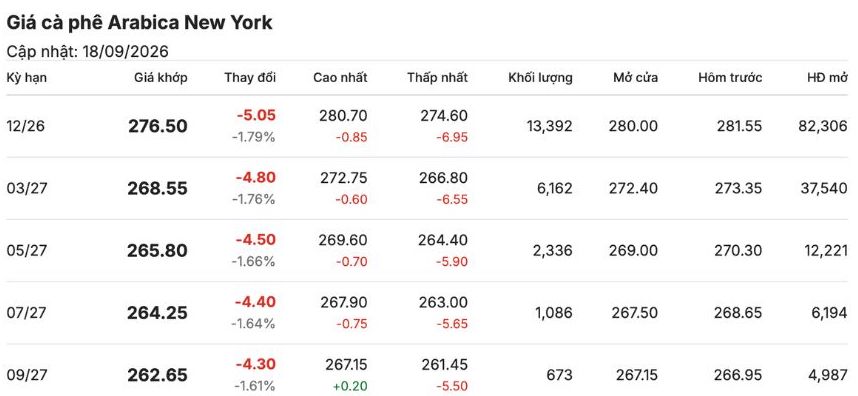
In the same direction, the New York Stock Exchange, Arabica coffee futures for May 2026 delivery fell 10.8 US cents/lb last week, reaching 289.3 US cents/lb. July 2026 contracts plummeted 11.65 US cents/lb, reaching 284.25 US cents/lb.
Market outlook
The world coffee market closed the last trading session of the week in red, extending the decline on both the London and New York exchanges as selling pressure increased in most trading terms.
This is also the second consecutive week that world coffee prices have ended in red, showing a rapid change in the supply-demand balance and macroeconomic factors. The reopening of the Strait of Hormuz has reduced oil prices by about 10%, thereby reducing global shipping costs.
When logistics pressure subsided, one of the important supports for agricultural product prices, including coffee, also weakened. At the same time, the market shifted to a state of less concern about supply shortages, causing speculative buying power to decrease significantly.
However, the market is not entirely negative. In Vietnam – the world’s largest Robusta supplier, the price decrease has stimulated buying demand. As of April 17, Robusta inventories managed by ICE continued to plummet, down to 3,838 lots. This is also the lowest level in 16 months – a factor limiting the market’s deep decline.
At 8:30 a.m. Eastern Time today, oil was priced at $96.18 per barrel with Brent serving as the benchmark (we’ll explain different benchmarks later in this article). That’s a drop of 88 cents compared with yesterday morning and around $28 higher than the price one year ago.
Oil price per barrel
% Change
Price of oil yesterday
$97.06
-0.90%
Price of oil 1 month ago
$103.47
-7.04%
Price of oil 1 year ago
$67.82
+41.81%
Price of oil yesterday
Oil price per barrel
$97.06
% Change
-0.90%
Price of oil 1 month ago
Oil price per barrel
$103.47
% Change
-7.04%
Price of oil 1 year ago
Oil price per barrel
$67.82
% Change
+41.81%
Will oil prices go up?
It’s impossible to forecast oil prices with detailed precision. Many different elements affect the market, but ultimately it boils down to supply and demand. When worries about economic recession, war, and other large-scale disruptions increase, oil’s path can shift fast.
How oil prices translate to gas pump prices
Gas prices at the pump don’t only track crude oil. They also include what it takes to refine and move that fuel, the taxes layered on top, and the extra markup your local station adds to stay in business.
Since crude oil generally makes up a majority of the per-gallon cost, changes in its price have an outsized impact. When oil surges, gas prices typically rise in tandem. But when oil retreats, gas prices often lag on the way down, a trend sometimes described as “rockets and feathers.”
The role of the U.S. Strategic Petroleum Reserve
In case of emergency, the U.S. has a store of crude oil known as the Strategic Petroleum Reserve. Its primary purpose is energy security in case of disaster (think sanctions, severe storm damage, even war). But it can also go a long way toward softening crippling price hikes during supply shocks.
It’s not a long-term answer and is more meant to provide temporary relief, assisting consumers and keeping critical parts of the economy running, like key industries, emergency services, public transportation, etc.
How oil and natural gas prices are linked
Both oil and natural gas are key sources of the energy we use every day. Because of this, a big change in oil prices can affect natural gas. For example, if oil prices increase, some industries may swap natural gas for some segments of their operations where possible, which increases demand for natural gas.
Historical performance of oil
To gauge oil’s performance, we often turn to two benchmarks:
Brent crude oil, the main global oil benchmark.
West Texas Intermediate (WTI), the main benchmark of North America
Between these two, Brent better represents global oil performance because it prices much of the world’s traded crude. And, it’s often the best way to track historical oil performance. In fact, even the U.S. Energy Information Administration now uses Brent as its primary reference in its Annual Energy Outlook.
Looking at the Brent benchmark across several decades, oil has been anything but steady. It’s seen spikes due to factors such as wars and supply cuts, and it’s also seen crashes from global recessions and an oversupply (called a “glut”). For example:
The early 1970s brought the first big oil shock when the Middle East cut exports and imposed an embargo on the U.S. and others during the Yom Kippur War.
Prices dropped in the mid-1980s for reasons such as lower demand and more non-OPEC oil producers entering the industry.
Prices spiked again in 2008 with increased global demand, but it soon plummeted alongside the global financial crisis.
During the 2020 COVID lockdown, oil demand collapsed like never before—bringing prices below $20 per barrel.
All to say, oil’s historical performance has been anything but smooth. Again, it’s hugely affected by wars, recessions, OPEC whims, evolving energy initiatives and policies, and much more.
Energy coverage from Fortune
Looking to stay up-to-date regarding the latest energy developments? Check out our recent coverage:
Frequently asked questions
How is the current price of oil per barrel actually determined?
The current price of oil per barrel depends largely on supply and demand, including news about potential future supply and demand (geopolitics, decisions made by OPEC+, etc.). In the U.S., prices also move based on how friendly an administration is to drilling, as it can affect future supply. For example, 2025 saw the Trump administration move to reopen more than 1.5 million acres in the Coastal Plain of the Arctic National Wildlife Refuge for oil and gas leasing, reversing the Biden administration’s policy of limiting oil drilling in the Arctic.
How often does the price of oil change during the day?
The price of oil updates constantly when the “futures” markets are open. A futures market is effectively an auction where people agree to buy or sell oil in the future. As long as people and companies are trading contracts, the oil price is changing.
How does U.S. shale oil production affect the current price of oil?
In short, shale is rock that contains oil and natural gas. Think of shale as energy yet to be tapped. The more shale the U.S. accesses, the more energy we’ll have—and the more easily oil prices can keep from spiking as much thanks to a greater supply.
How does the current price of oil impact inflation and the broader economy?
When oil is expensive, it tends to make everyday items cost more. This can be related to energy (your heating, gas utilities, etc.), but it’s also due to the logistics involved with making those items accessible to you. Shipping, for example, can affect the price of things at the grocery store, as it’s more expensive to get those products from warehouses and farms onto the shelf.
2026.04.17 2026.04.17 WTI Crude Oil: Elliott Wave Analysis and Forecast for 17.04.26–24.04.26
Alex Geutahttps://www.litefinance.org/blog/authors/alex-geuta/
The article covers the following subjects:
Major Takeaways
Main scenario: Consider long positions from corrections above 84.85 with a target of 115.70–126.00. A buy signal: the price holds above 84.85. Stop Loss: below 82.90, Take Profit: 115.70–126.00.
Alternative scenario: Breakout and consolidation below 84.85 will allow the asset to continue declining to the levels of 75.70–65.00. A sell signal: the level of 84.85 is broken to the downside. Stop Loss: above 86.50, Take Profit: 75.70–65.00.
Main scenario
Consider long positions from corrections above 84.85 with a target of 115.70–126.00.
Alternative scenario
Breakout and consolidation below the level of 84.85 will allow the asset to continue declining to the levels of 75.70–65.00.
Analysis
A descending correction (2) appears to have formed on the weekly chart, with wave C of (2) completed as its part. On the daily timeframe, an ascending third wave (3) has started unfolding, with the first wave of smaller degree 1 of (3) still developing as its part. On the H4 timeframe, wave v of 1 is developing, within which a local correction (iv) of v has been completed and wave (v) of v has started forming. If the presumption is correct, WTI will continue to rise to the levels of 115.70–126.00. The level of 84.85 is critical in this scenario as a breakout below it will enable the asset to continue declining to the levels of 75.70–65.00.
This forecast is based on the Elliott Wave Theory. When developing trading strategies, it is essential to consider fundamental factors, as the market situation can change at any time.
Price chart of USCRUDE in real time mode
The content of this article reflects the author’s opinion and does not necessarily reflect the official position of LiteFinance broker. The material published on this page is provided for informational purposes only and should not be considered as the provision of investment advice for the purposes of Directive 2014/65/EU.
According to copyright law, this article is considered intellectual property, which includes a prohibition on copying and distributing it without consent.
Spot gold daily chart shows bounce off bottom of falling channel. Source: TradingView
Resistance Layers Define Next Breakout or Rejection Zone
A lower swing high at $4,640, along with the 20-day moving average, identifies a lower short-term support zone, as a drop below it will signal likely further weakness. Since Friday was the first approach to the 50-day moving average to test it as resistance since it broke as support on March 18, resistance may persist. However, a decisive breakout above the 50-day average, followed by a daily close above it, would put the 78.6% Fibonacci retracement at $5,122 in sight. The downtrend line is nearby, and it also represents the top boundary of a falling trend channel. This is notable since the bottom boundary of the channel was confirmed as a support zone during the sharp March selloff.
Confluence Support Suggests Potential for Continuation
Gold is sitting on a strong support confluence zone consisting of the 10-day, 20-day, and 100-day moving averages, along with the top channel line of a long-term rising trend channel. This suggests that a breakout above the 50-day average may be possible before a drop below this zone. Once prior resistance becomes support, as seen with the three moving averages, the short-term bull trend is showing an intention to continue higher.
If you’d like to know more about how to trade gold and silver, please visit our educational area.
Copper price began its trading by losing the bullish momentum due to stochastic attempt to end the bullish rally, to settle again near $5.9700 level, which formed strong barrier in the previous trading.
The stability above $5.9700 supports the chances of gathering the required extra positive momentum to motivate the bullish rally that might target $6.1550 and $6.2500, while the decline below it might force it to provide temporary trading, to target $5.8100 before reaching the additional positive targets.
The expected trading range for today is between $5.9100 and $6.1550
Silver (XAG/USD) surges on Friday, trading around $82.60 at the time of writing, up 5.40% on the day as the US Dollar (USD) weakens and markets reassess the outlook for United States (US) monetary policy.
The rally in the precious metal comes as geopolitical tensions in the Middle East show signs of easing. Iran’s Foreign Minister Abbas Araghchi announced that the Strait of Hormuz has been declared completely open for commercial vessels during the current ceasefire period. The announcement marks a significant de-escalation after weeks of tensions around one of the world’s most strategic shipping routes.
Following the news, Oil prices dropped sharply as supply disruption fears faded. West Texas Intermediate (WTI) fell to around $80 per barrel, marking one of its steepest daily declines in recent weeks. The reopening of the strait is expected to restore more stable flows of Crude shipments through the Gulf, removing part of the geopolitical risk premium embedded in energy prices.
The decline in Oil prices is easing immediate inflation concerns and prompting investors to reassess the trajectory of the US monetary policy. Lower energy prices reduce pressure on consumer prices and increase the likelihood that the Federal Reserve (Fed) could deliver interest rate cuts later this year.
Markets are now pricing 38.2% chance of a 25-basis-point rate cut by year-end, up from 25.9% the previous day, according to the CME Fedwatch tool. Lower interest rates tend to support non-yielding assets such as precious metals, as they reduce the opportunity cost of holding them.
At the same time, the US Dollar remains under pressure. The US Dollar Index (DXY), which measures the Greenback against a basket of six major currencies, is trading near multi-week lows around 97.80. The softer USD is making Silver more attractive for international investors and reinforcing the metal’s upward momentum.
Despite improving global risk sentiment following the diplomatic developments, the weakening US Dollar and renewed expectations of monetary easing are providing strong support for precious metals. Investors will now closely monitor developments around potential US-Iran negotiations over the weekend, as well as upcoming comments from Fed officials ahead of the blackout period preceding the next Federal Open Market Committee (FOMC) meeting.
Silver FAQs
Silver is a precious metal highly traded among investors. It has been historically used as a store of value and a medium of exchange. Although less popular than Gold, traders may turn to Silver to diversify their investment portfolio, for its intrinsic value or as a potential hedge during high-inflation periods. Investors can buy physical Silver, in coins or in bars, or trade it through vehicles such as Exchange Traded Funds, which track its price on international markets.
Silver prices can move due to a wide range of factors. Geopolitical instability or fears of a deep recession can make Silver price escalate due to its safe-haven status, although to a lesser extent than Gold’s. As a yieldless asset, Silver tends to rise with lower interest rates. Its moves also depend on how the US Dollar (USD) behaves as the asset is priced in dollars (XAG/USD). A strong Dollar tends to keep the price of Silver at bay, whereas a weaker Dollar is likely to propel prices up. Other factors such as investment demand, mining supply – Silver is much more abundant than Gold – and recycling rates can also affect prices.
Silver is widely used in industry, particularly in sectors such as electronics or solar energy, as it has one of the highest electric conductivity of all metals – more than Copper and Gold. A surge in demand can increase prices, while a decline tends to lower them. Dynamics in the US, Chinese and Indian economies can also contribute to price swings: for the US and particularly China, their big industrial sectors use Silver in various processes; in India, consumers’ demand for the precious metal for jewellery also plays a key role in setting prices.
Silver prices tend to follow Gold’s moves. When Gold prices rise, Silver typically follows suit, as their status as safe-haven assets is similar. The Gold/Silver ratio, which shows the number of ounces of Silver needed to equal the value of one ounce of Gold, may help to determine the relative valuation between both metals. Some investors may consider a high ratio as an indicator that Silver is undervalued, or Gold is overvalued. On the contrary, a low ratio might suggest that Gold is undervalued relative to Silver.
The GBPJPY pair forced it to provide sideways trading by its stability near 215.50 level, affected by stochastic exit from the overbought levels, the price might be forced to provide some bearish corrective trading, however it couldn’t affect the main bullish track, depending on forming extra support level at 214.15 level.
Therefore, we will keep our main bullish scenario, to gather extra positive momentum, to ease the mission of reaching extra positive stations that might begin at 216.20 and 217.00.
The expected trading range for today is between 214.55 and 216.20
Copper price began its trading by losing the bullish momentum due to stochastic attempt to end the bullish rally, to settle again near $5.9700 level, which formed strong barrier in the previous trading.
The stability above $5.9700 supports the chances of gathering the required extra positive momentum to motivate the bullish rally that might target $6.1550 and $6.2500, while the decline below it might force it to provide temporary trading, to target $5.8100 before reaching the additional positive targets.
The expected trading range for today is between $5.9100 and $6.1550
Silver (XAG/USD) rebounds on Friday, trading around $79.40 at the time of writing and gaining 1.25% on the day. The Silver price remains close to the $79 mark as investors monitor geopolitical developments and monetary policy expectations in the United States (US).
The precious metal moves in a relatively cautious environment as markets await further details about a possible second round of negotiations between the US and Iran. Washington has indicated that talks with Tehran could resume before the expiration of the current two-week ceasefire scheduled for April 21. Investors are closely watching these developments, which could influence global risk sentiment and safe-haven flows.
US President Donald Trump recently expressed optimism that a diplomatic agreement with Iran could be close, stating that Tehran appears more willing to make concessions than in previous discussions. Reports suggest that negotiations could involve commitments related to Iran’s nuclear program and enriched uranium stockpiles.
Expectations of progress in diplomacy are contributing to persistent pressure on the US Dollar (USD). The US Dollar Index (DXY), which tracks the value of the Greenback against a basket of major currencies, is on track for a new weekly decline. A softer US currency tends to support commodities priced in USD, including Silver.
At the same time, easing tensions in the Middle East are weighing on Oil prices and moderating inflation expectations. This dynamic has encouraged traders to reinforce bets that the Federal Reserve (Fed) could adopt a more accommodative monetary policy stance in the coming months.
Lower interest rate expectations are generally supportive for non-yielding assets such as Silver. With yields potentially declining, the opportunity cost of holding precious metals decreases, which helps maintain investor demand for assets like XAG/USD in the current macroeconomic environment.
Silver FAQs
Silver is a precious metal highly traded among investors. It has been historically used as a store of value and a medium of exchange. Although less popular than Gold, traders may turn to Silver to diversify their investment portfolio, for its intrinsic value or as a potential hedge during high-inflation periods. Investors can buy physical Silver, in coins or in bars, or trade it through vehicles such as Exchange Traded Funds, which track its price on international markets.
Silver prices can move due to a wide range of factors. Geopolitical instability or fears of a deep recession can make Silver price escalate due to its safe-haven status, although to a lesser extent than Gold’s. As a yieldless asset, Silver tends to rise with lower interest rates. Its moves also depend on how the US Dollar (USD) behaves as the asset is priced in dollars (XAG/USD). A strong Dollar tends to keep the price of Silver at bay, whereas a weaker Dollar is likely to propel prices up. Other factors such as investment demand, mining supply – Silver is much more abundant than Gold – and recycling rates can also affect prices.
Silver is widely used in industry, particularly in sectors such as electronics or solar energy, as it has one of the highest electric conductivity of all metals – more than Copper and Gold. A surge in demand can increase prices, while a decline tends to lower them. Dynamics in the US, Chinese and Indian economies can also contribute to price swings: for the US and particularly China, their big industrial sectors use Silver in various processes; in India, consumers’ demand for the precious metal for jewellery also plays a key role in setting prices.
Silver prices tend to follow Gold’s moves. When Gold prices rise, Silver typically follows suit, as their status as safe-haven assets is similar. The Gold/Silver ratio, which shows the number of ounces of Silver needed to equal the value of one ounce of Gold, may help to determine the relative valuation between both metals. Some investors may consider a high ratio as an indicator that Silver is undervalued, or Gold is overvalued. On the contrary, a low ratio might suggest that Gold is undervalued relative to Silver.