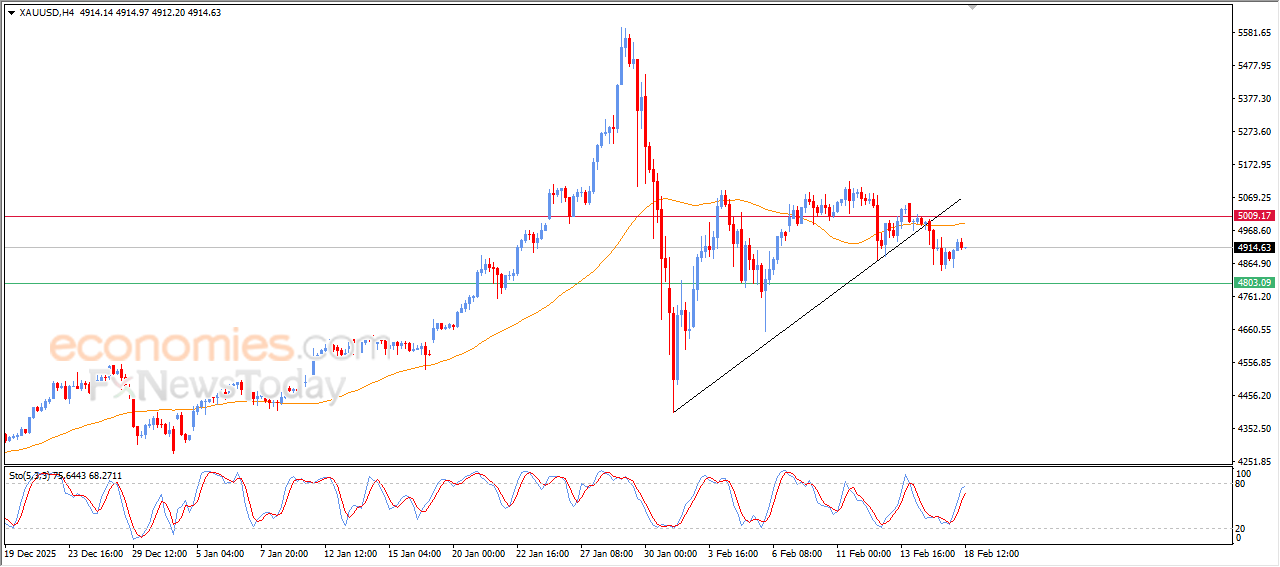
Natural gas price continued providing weak sideways trading, affected by the contradiction between the main indicators besides forming a significant obstacle against the attempts to renew the bullish attack, fluctuating near $3.850.
There is a chance for forming new bearish waves, to press on the moving average 55 at $3.450, and surpassing it might extend the losses towards $3.050, facing the extension of historical support, while the price success in surpassing $4.000 level and holding above it will allow it to renew the bullish attempts, to expect targeting $4.220 and $4.450 level.
The expected trading range for today is between $3.450 and $4.050
Copper price repeatedly provided sideways trading in the last period, affected by the contradiction between the main indicators, which forces it to settle below $5.9700 barrier, which obstructs the chances of resuming the bullish trend.
All that confirms the price surrender to sideways trading, to keep waiting to achieve the required breach, to open the way for recording new gains by its rally towards $6.1200 reaching the next target at $6.2400.
The expected trading range for today is between $5.7500 and $6.1200
Trend forecast: Sideways until achieving the breach
Natural gas price repeatedly provided negative close below the broken support at $4.100 level, forming a new resistance against the current trading, and stochastic attempt to provide negative momentum by reaching below 50 level will force the price to form new bearish waves, reaching $3.450 and surpassing it might force it to decline towards $3.220, to test high liquidity grab zones.
While the rally above $4.100 and providing bullish close will increase the chances of forming new bullish waves, to attempt to reach $3.370 initially, then waiting for targeting %38.2 Fibonacci correction level near $4.750.
The expected trading range for today is between $3.450 and $4.100
Silver price (XAG/USD) continues its winning streak for the fifth consecutive session, trading around $115.10 per troy ounce during the early European hours on Wednesday. Safe-haven silver rises toward its January 26 record high of $117.74 as investors shifted into defensive assets.
Precious metals, including Silver attract investors following President Donald Trump’s remarks that he is unconcerned about the USD’s recent slide, strengthened expectations that the administration is comfortable with a weaker greenback to boost export competitiveness.
Ongoing policy uncertainty in Washington, including tariff threats and challenges to the Federal Reserve’s (Fed) independence, along with the “Sell America” narrative, continues to dominate sentiment, further supporting gains in precious metals.
The Federal Reserve is expected to leave rates steady at 3.50%–3.75% after its two-day meeting on Wednesday, following three straight cuts in 2025. Attention will turn to the post-meeting press conference for signals on the policy path ahead.
Citi Commodities Research global head Maximillian J. Layton said that Silver is poised to extend its outperformance after breaking above $100.00 per troy ounce. Layton said bullish drivers, including elevated geopolitical risks and renewed concerns over Federal Reserve independence, are likely to persist in the near term. Citi has raised its three-month Silver price forecast to $150.00 from $100.00 previously, per Dow Jones Newswires.
In China, a pure-play Silver fund halted trading after a surge in demand drove its premium far above the value of its underlying assets. Silver has attracted strong retail interest as prices continue to rally, prompting manufacturers to shift production from jewelry toward one-kilogram Silver bars.
Silver FAQs
Silver is a precious metal highly traded among investors. It has been historically used as a store of value and a medium of exchange. Although less popular than Gold, traders may turn to Silver to diversify their investment portfolio, for its intrinsic value or as a potential hedge during high-inflation periods. Investors can buy physical Silver, in coins or in bars, or trade it through vehicles such as Exchange Traded Funds, which track its price on international markets.
Silver prices can move due to a wide range of factors. Geopolitical instability or fears of a deep recession can make Silver price escalate due to its safe-haven status, although to a lesser extent than Gold’s. As a yieldless asset, Silver tends to rise with lower interest rates. Its moves also depend on how the US Dollar (USD) behaves as the asset is priced in dollars (XAG/USD). A strong Dollar tends to keep the price of Silver at bay, whereas a weaker Dollar is likely to propel prices up. Other factors such as investment demand, mining supply – Silver is much more abundant than Gold – and recycling rates can also affect prices.
Silver is widely used in industry, particularly in sectors such as electronics or solar energy, as it has one of the highest electric conductivity of all metals – more than Copper and Gold. A surge in demand can increase prices, while a decline tends to lower them. Dynamics in the US, Chinese and Indian economies can also contribute to price swings: for the US and particularly China, their big industrial sectors use Silver in various processes; in India, consumers’ demand for the precious metal for jewellery also plays a key role in setting prices.
Silver prices tend to follow Gold’s moves. When Gold prices rise, Silver typically follows suit, as their status as safe-haven assets is similar. The Gold/Silver ratio, which shows the number of ounces of Silver needed to equal the value of one ounce of Gold, may help to determine the relative valuation between both metals. Some investors may consider a high ratio as an indicator that Silver is undervalued, or Gold is overvalued. On the contrary, a low ratio might suggest that Gold is undervalued relative to Silver.
The UK green coffee market saw a significant contraction in consumption and imports in 2024, with consumption falling to 120K tons and imports to 146K tons. However, exports surged by 34% to 26K tons. Brazil remains the dominant import source, while Germany, France, and Belgium are the top export destinations. The market value is forecast to grow at a CAGR of +1.6% to $588M by 2035, despite a modest volume CAGR of +0.2%. Import and export prices rose sharply in 2024, indicating changing market dynamics.
Key Findings
UK green coffee consumption dropped sharply to 120K tons in 2024, a -15.1% decrease from the previous year
Market value is forecast for modest growth with a +1.6% CAGR, projected to reach $588M by 2035
Brazil is the leading import source, supplying 44% of UK’s green coffee imports by volume
Exports grew robustly by 34% in 2024, with Germany, France, and Belgium as the primary destinations
Average import price increased significantly by 14% to $4,482 per ton in 2024
Market Forecast
Driven by rising demand for green coffee in the UK, the market is expected to start an upward consumption trend over the next decade. The performance of the market is forecast to increase slightly, with an anticipated CAGR of +0.2% for the period from 2024 to 2035, which is projected to bring the market volume to 123K tons by the end of 2035.
In value terms, the market is forecast to increase with an anticipated CAGR of +1.6% for the period from 2024 to 2035, which is projected to bring the market value to $588M (in nominal wholesale prices) by the end of 2035.
Consumption
United Kingdom’s Consumption of Green Coffee
In 2024, the amount of coffee (green) consumed in the UK fell rapidly to 120K tons, reducing by -15.1% compared with 2023. In general, consumption saw a slight setback. As a result, consumption reached the peak volume of 182K tons. From 2019 to 2024, the growth of the consumption failed to regain momentum.
The revenue of the green coffee market in the UK reduced to $496M in 2024, dropping by -7.2% against the previous year. This figure reflects the total revenues of producers and importers (excluding logistics costs, retail marketing costs, and retailers’ margins, which will be included in the final consumer price). Over the period under review, consumption, however, recorded a relatively flat trend pattern. As a result, consumption attained the peak level of $586M. From 2023 to 2024, the growth of the market remained at a somewhat lower figure.
Imports
United Kingdom’s Imports of Green Coffee
In 2024, imports of coffee (green) into the UK fell to 146K tons, waning by -9.2% on 2023 figures. In general, imports, however, showed a relatively flat trend pattern. The most prominent rate of growth was recorded in 2018 with an increase of 66%. As a result, imports reached the peak of 193K tons. From 2019 to 2024, the growth of imports remained at a somewhat lower figure.
In value terms, green coffee imports rose slightly to $654M in 2024. Over the period under review, total imports indicated a perceptible increase from 2013 to 2024: its value increased at an average annual rate of +3.3% over the last eleven-year period. The trend pattern, however, indicated some noticeable fluctuations being recorded throughout the analyzed period. Based on 2024 figures, imports decreased by -8.4% against 2022 indices. The pace of growth appeared the most rapid in 2022 with an increase of 57%. As a result, imports reached the peak of $714M. From 2023 to 2024, the growth of imports remained at a somewhat lower figure.
Imports By Country
In 2024, Brazil (65K tons) constituted the largest green coffee supplier to the UK, accounting for a 44% share of total imports. Moreover, green coffee imports from Brazil exceeded the figures recorded by the second-largest supplier, Vietnam (25K tons), threefold. The third position in this ranking was taken by Colombia (11K tons), with a 7.4% share.
From 2013 to 2024, the average annual growth rate of volume from Brazil stood at +6.9%. The remaining supplying countries recorded the following average annual rates of imports growth: Vietnam (-4.0% per year) and Colombia (-4.7% per year).
In value terms, Brazil ($258M) constituted the largest supplier of coffee (green) to the UK, comprising 39% of total imports. The second position in the ranking was held by Vietnam ($96M), with a 15% share of total imports. It was followed by Colombia, with a 9.2% share.
From 2013 to 2024, the average annual rate of growth in terms of value from Brazil stood at +8.7%. The remaining supplying countries recorded the following average annual rates of imports growth: Vietnam (+0.5% per year) and Colombia (-0.9% per year).
Import Prices By Country
In 2024, the average green coffee import price amounted to $4,482 per ton, increasing by 14% against the previous year. In general, import price indicated a pronounced increase from 2013 to 2024: its price increased at an average annual rate of +3.2% over the last eleven-year period. The trend pattern, however, indicated some noticeable fluctuations being recorded throughout the analyzed period. Based on 2024 figures, green coffee import price increased by +69.5% against 2019 indices. The growth pace was the most rapid in 2017 an increase of 45% against the previous year. The import price peaked in 2024 and is likely to see steady growth in years to come.
Average prices varied somewhat amongst the major supplying countries. In 2024, amid the top importers, the countries with the highest prices were Ethiopia ($5,774 per ton) and Colombia ($5,584 per ton), while the price for Vietnam ($3,864 per ton) and Indonesia ($3,952 per ton) were amongst the lowest.
From 2013 to 2024, the most notable rate of growth in terms of prices was attained by Vietnam (+4.7%), while the prices for the other major suppliers experienced more modest paces of growth.
Exports
United Kingdom’s Exports of Green Coffee
In 2024, approx. 26K tons of coffee (green) were exported from the UK; growing by 34% on the previous year. Overall, exports posted a resilient expansion. The most prominent rate of growth was recorded in 2022 with an increase of 101% against the previous year. The exports peaked in 2024 and are expected to retain growth in the near future.
In value terms, green coffee exports skyrocketed to $122M in 2024. Over the period under review, exports posted a buoyant increase. As a result, the exports reached the peak and are likely to continue growth in the immediate term.
Exports By Country
Germany (6.5K tons), France (6K tons) and Belgium (3.2K tons) were the main destinations of green coffee exports from the UK, together comprising 60% of total exports.
From 2013 to 2024, the most notable rate of growth in terms of shipments, amongst the main countries of destination, was attained by Belgium (with a CAGR of +65.3%), while the other leaders experienced more modest paces of growth.
In value terms, Germany ($29M), France ($25M) and Belgium ($15M) constituted the largest markets for green coffee exported from the UK worldwide, with a combined 56% share of total exports.
Belgium, with a CAGR of +59.4%, saw the highest rates of growth with regard to the value of exports, among the main countries of destination over the period under review, while shipments for the other leaders experienced more modest paces of growth.
Export Prices By Country
In 2024, the average green coffee export price amounted to $4,718 per ton, with an increase of 59% against the previous year. Over the period under review, the export price recorded a relatively flat trend pattern. The export price peaked at $5,684 per ton in 2014; however, from 2015 to 2024, the export prices failed to regain momentum.
There were significant differences in the average prices for the major external markets. In 2024, amid the top suppliers, the country with the highest price was Poland ($14,865 per ton), while the average price for exports to Italy ($3,837 per ton) was amongst the lowest.
From 2013 to 2024, the most notable rate of growth in terms of prices was recorded for supplies to Poland (+10.0%), while the prices for the other major destinations experienced more modest paces of growth.
This report provides a comprehensive view of the green coffee industry in the United Kingdom, tracking demand, supply, and trade flows across the national value chain. It explains how demand across key channels and end-use segments shapes consumption patterns, while also mapping the role of input availability, production efficiency, and regulatory standards on supply.
Beyond headline metrics, the study benchmarks prices, margins, and trade routes so you can see where value is created and how it moves between domestic suppliers and international partners. The analysis is designed to support strategic planning, market entry, portfolio prioritization, and risk management in the green coffee landscape in the United Kingdom.
Quick navigation
Key findings
Domestic demand is shaped by both household and industrial usage, with trade flows linking local supply to imports and exports.
Pricing dynamics reflect unit values, freight costs, exchange rates, and regulatory shifts that affect sourcing decisions.
Supply depends on input availability and production efficiency, creating a distinct national cost curve.
Market concentration varies by segment, creating different competitive landscapes and entry barriers.
The 2035 outlook highlights where capacity investment and demand growth are most aligned within the country.
Report scope
The report combines market sizing with trade intelligence and price analytics for the United Kingdom. It covers both historical performance and the forward outlook to 2035, allowing you to compare cycles, structural shifts, and policy impacts.
Market size and growth in value and volume terms
Consumption structure by end-use segments
Production capacity, output, and cost dynamics
Trade flows, exporters, importers, and balances
Price benchmarks, unit values, and margin signals
Competitive context and market entry conditions
Product coverage
Country coverage
Country profile and benchmarks
This report provides a consistent view of market size, trade balance, prices, and per-capita indicators for the United Kingdom. The profile highlights demand structure and trade position, enabling benchmarking against regional and global peers.
Methodology
The analysis is built on a multi-source framework that combines official statistics, trade records, company disclosures, and expert validation. Data are standardized, reconciled, and cross-checked to ensure consistency across time series.
International trade data (exports, imports, and mirror statistics)
National production and consumption statistics
Company-level information from financial filings and public releases
Price series and unit value benchmarks
Analyst review, outlier checks, and time-series validation
All data are normalized to a common product definition and mapped to a consistent set of codes. This ensures that comparisons across time are aligned and actionable.
Forecasts to 2035
The forecast horizon extends to 2035 and is based on a structured model that links green coffee demand and supply to macroeconomic indicators, trade patterns, and sector-specific drivers. The model captures both cyclical and structural factors and reflects known policy and technology shifts in the United Kingdom.
Historical baseline: 2012-2025
Forecast horizon: 2026-2035
Scenario-based sensitivity to income growth, substitution, and regulation
Capacity and investment outlook for major producing companies
Each projection is built from national historical patterns and the broader regional context, allowing the report to show where growth is concentrated and where risks are elevated.
Price analysis and trade dynamics
Prices are analyzed in detail, including export and import unit values, regional spreads, and changes in trade costs. The report highlights how seasonality, freight rates, exchange rates, and supply disruptions influence pricing and margins.
Price benchmarks by country and sub-region
Export and import unit value trends
Seasonality and calendar effects in trade flows
Price outlook to 2035 under baseline assumptions
Profiles of market participants
Key producers, exporters, and distributors are profiled with a focus on their operational scale, geographic footprint, product mix, and market positioning. This helps identify competitive pressure points, partnership opportunities, and routes to differentiation.
Business focus and production capabilities
Geographic reach and distribution networks
Cost structure and pricing strategy indicators
Compliance, certification, and sustainability context
How to use this report
Quantify domestic demand and identify the most attractive segments
Evaluate export opportunities and prioritize target destinations
Track price dynamics and protect margins
Benchmark performance against leading competitors
Build evidence-based forecasts for investment decisions
This report is designed for manufacturers, distributors, importers, wholesalers, investors, and advisors who need a clear, data-driven picture of green coffee dynamics in the United Kingdom.
FAQ
What is included in the green coffee market in the United Kingdom?
The market size aggregates consumption and trade data, presented in both value and volume terms.
How are the forecasts to 2035 built?
The projections combine historical trends with macroeconomic indicators, trade dynamics, and sector-specific drivers.
Does the report cover prices and margins?
Yes, it includes export and import unit values, regional spreads, and a pricing outlook to 2035.
Which benchmarks are included?
The report benchmarks market size, trade balance, prices, and per-capita indicators for the United Kingdom.
Can this report support market entry decisions?
Yes, it highlights demand hotspots, trade routes, pricing trends, and competitive context.
Surprisingly, his words pushed the dollar to its lowest level since February 2022. Therefore, the weaker dollar made Gold more attractive for investors looking for safe-haven assets.
Normally, a strong dollar attracts safe-haven buyers, but this time the dollar’s drop actually gave a boost to the Gold prices. Traders are now considering the weaker dollar as one of the main reasons behind Gold rise.
Geopolitical Tensions Boost Safe-Haven Demand
Apart from the weaker dollar, ongoing geopolitical tensions was seen as another key factor that helped gold to reach all time high. As we know, President Trump recently threatened to take control of Greenland, impose tariffs on Europe. He also warned that Canada could face 100% tariffs if it signs a trade deal with China. As a result, demand for Gold, seen as a safe-haven asset, has increased significantly.
Fed Decision in Focus for Markets
On the other hand, investors are closely watching the Federal Reserve’s interest rate decision scheduled on Wednesday. However, the Fed is expected to keep interest rates unchanged in the 3.50% to 3.75% range after cutting rates at three straight meetings late last year.
Hence, markets will pay close attention to Fed Chair Jerome Powell’s press conference. Any hawkish signals could limit further losses in the US dollar and weigh on Gold prices. In contrast to this, any dovish remarks could extend Gold’s rally even further.
Gold Price Forecast: XAU/USD Holds $5,235 as Bullish Channel Targets $5,410 Next
Natural gas price repeatedly provided negative close below the broken support at $4.100 level, forming a new resistance against the current trading, and stochastic attempt to provide negative momentum by reaching below 50 level will force the price to form new bearish waves, reaching $3.450 and surpassing it might force it to decline towards $3.220, to test high liquidity grab zones.
While the rally above $4.100 and providing bullish close will increase the chances of forming new bullish waves, to attempt to reach $3.370 initially, then waiting for targeting %38.2 Fibonacci correction level near $4.750.
The expected trading range for today is between $3.450 and $4.100
Copper price reached $5.9700 level yesterday to settle below it, affected by the continuation of the contradiction between the main indicators, especially by stochastic exit from the overbought level, which forces it to fluctuate in sideways range by its stability near $5.8300.
We expect the price to be affected by a state of instability due to the ongoing divergence of the main indicators, despite the presence of an opportunity to edge toward $5,720.00. However, exposure to negative pressure may force it to retest the solid support near $5,510.00, while surpassing this level and holding above it will reinforce the chances of recording new gains that might extend towards $6.1200 and $6.2400.
The expected trading range for today is between $5.7500 and $6.000
Gold (XAU/USD) has resumed its broader upside trend on Tuesday, and returns to levels near the all-time highs in the $5,100 area. Trade uncertainties, growing fears of a US government shutdown, and market expectations of further Fed easing are boosting demand for safe havens.
US President Trump brought concerns about its erratic trade policy back to the table after raising 10% tariffs on South Korea by 10%, following a trade rift with Canada on Monday and the EU last week. Meanwhile, US Senate Democrats are threatening to block funding for the Department of Homeland Security (DHS), in response for the killings in Minnesota, which would lead to a partial government shutdown.
Technical analysis: Gold bulls aim at levels above $5,100
The XAU/USD pair maintains its positive trend with bulls aiming for a retest of the $5,100 resistance area, although the indicators in the 4-hour chart are showing signals of an exhausted rally. The Moving Average Convergence Divergence (MACD) shows a bearish crossover near the zero line, with momentum slipping into negative territory, and the Relative Strength Index (RSI) is pulling back from overbought levels.
A rejection at $5,100 would suggest a double top, a bearish sign, and give bears hopes for a retest of Monday’s lows, at $4,990, looking for a corrective pullback towards the January 23 low in the $4,890 area. A successful break of the $5,100 level, on the contrary, would expose the 261.8% Fibonacci extension of the January 16-21 rally, at the $5,450 area.
(The technical analysis of this story was written with the help of an AI tool.)
Gold FAQs
Gold has played a key role in human’s history as it has been widely used as a store of value and medium of exchange. Currently, apart from its shine and usage for jewelry, the precious metal is widely seen as a safe-haven asset, meaning that it is considered a good investment during turbulent times. Gold is also widely seen as a hedge against inflation and against depreciating currencies as it doesn’t rely on any specific issuer or government.
Central banks are the biggest Gold holders. In their aim to support their currencies in turbulent times, central banks tend to diversify their reserves and buy Gold to improve the perceived strength of the economy and the currency. High Gold reserves can be a source of trust for a country’s solvency. Central banks added 1,136 tonnes of Gold worth around $70 billion to their reserves in 2022, according to data from the World Gold Council. This is the highest yearly purchase since records began. Central banks from emerging economies such as China, India and Turkey are quickly increasing their Gold reserves.
Gold has an inverse correlation with the US Dollar and US Treasuries, which are both major reserve and safe-haven assets. When the Dollar depreciates, Gold tends to rise, enabling investors and central banks to diversify their assets in turbulent times. Gold is also inversely correlated with risk assets. A rally in the stock market tends to weaken Gold price, while sell-offs in riskier markets tend to favor the precious metal.
The price can move due to a wide range of factors. Geopolitical instability or fears of a deep recession can quickly make Gold price escalate due to its safe-haven status. As a yield-less asset, Gold tends to rise with lower interest rates, while higher cost of money usually weighs down on the yellow metal. Still, most moves depend on how the US Dollar (USD) behaves as the asset is priced in dollars (XAU/USD). A strong Dollar tends to keep the price of Gold controlled, whereas a weaker Dollar is likely to push Gold prices up.
Silver price trades choppy on Tuesday, after extending its gains on Monday, sponsored by heightened geopolitical tensions and the US trade war with its allies, reigniting the ‘sell America’ trade during the day. XAG/USD trades at $108.00 after bouncing off daily lows of $103.00, modestly up 0.05%
XAG/USD Price Forecast: Technical outlook
Silver’s technical picture shows a parabolic uptrend, but it seems that buyers are losing steam, following a run-up near $118.00 on Monday. The day ended at $108.52, forming a ‘huge shooting star,’ a bearish candle.
Worth noting that the Relative Strength Index (RSI), although showing signs that buyers remain in charge, diverges from price action. The latter had achieved a series of higher highs, contrary to the RSI, which registered lower highs. Therefore, a negative divergence looms and could pave the way for a retracement.
For a bullish continuation, traders must clear $110.00 to remain hopeful for higher prices. Otherwise, a pullback looms, and it could be exacerbated if Silver prices drop below the $100.00 mark.
In that event, the first support for XAG/USD would be the January 23 daily low at $96.14, followed by the January 21 swing low at $90.46.
XAG/USD Price Chart – Daily
Silver Daily Chart
(This story was corrected on January 27 at 20:03 GMT to say that the Silver closing price on Monday was $108.52.)
Silver FAQs
Silver is a precious metal highly traded among investors. It has been historically used as a store of value and a medium of exchange. Although less popular than Gold, traders may turn to Silver to diversify their investment portfolio, for its intrinsic value or as a potential hedge during high-inflation periods. Investors can buy physical Silver, in coins or in bars, or trade it through vehicles such as Exchange Traded Funds, which track its price on international markets.
Silver prices can move due to a wide range of factors. Geopolitical instability or fears of a deep recession can make Silver price escalate due to its safe-haven status, although to a lesser extent than Gold’s. As a yieldless asset, Silver tends to rise with lower interest rates. Its moves also depend on how the US Dollar (USD) behaves as the asset is priced in dollars (XAG/USD). A strong Dollar tends to keep the price of Silver at bay, whereas a weaker Dollar is likely to propel prices up. Other factors such as investment demand, mining supply – Silver is much more abundant than Gold – and recycling rates can also affect prices.
Silver is widely used in industry, particularly in sectors such as electronics or solar energy, as it has one of the highest electric conductivity of all metals – more than Copper and Gold. A surge in demand can increase prices, while a decline tends to lower them. Dynamics in the US, Chinese and Indian economies can also contribute to price swings: for the US and particularly China, their big industrial sectors use Silver in various processes; in India, consumers’ demand for the precious metal for jewellery also plays a key role in setting prices.
Silver prices tend to follow Gold’s moves. When Gold prices rise, Silver typically follows suit, as their status as safe-haven assets is similar. The Gold/Silver ratio, which shows the number of ounces of Silver needed to equal the value of one ounce of Gold, may help to determine the relative valuation between both metals. Some investors may consider a high ratio as an indicator that Silver is undervalued, or Gold is overvalued. On the contrary, a low ratio might suggest that Gold is undervalued relative to Silver.