The main tag of Gold News Today Articles.
You can use the search box below to find what you need.
[wd_asp id=1]

26 05, 2026

Single Origin Coffee Pods Market in Japan | Report – IndexBox

By |2026-05-26T11:06:41+03:00May 26, 2026|Forex News, News|0 Comments


Japan Single Origin Coffee Pods Market 2026 Analysis and Forecast to 2035

Executive Summary

Key Findings

  • Premium Sub-segment Outperformance: The Japan Single Origin Coffee Pods segment is structurally outpacing the broader single-serve market, with value growth projected in the high single digits (7–9% CAGR) from 2026 to 2035. This compares to a 2–4% CAGR for standard coffee pods, driven by household premiumization and the maturing of specialty coffee culture.
  • Import-Driven Cost Volatility: Japan is fully dependent on green coffee imports, with Brazil, Colombia, and Ethiopia accounting for a majority of single-origin supply. The landed cost of specialty-grade beans is subject to significant currency and climate volatility, creating ±10–15% annual swings in raw material procurement budgets for Japanese roasters.
  • Sustainability as a Gatekeeper: Regulatory pressure under Japan’s Containers and Packaging Recycling Law and growing consumer expectations are forcing rapid innovation in pod materials. Mono-material aluminum and certified compostable capsules are gaining share over multi-material plastic pods, although infrastructure for composting remains limited.

Market Trends

  • Micro-lot and Traceability Narratives: Japanese consumers increasingly demand full traceability, driving adoption of direct-trade models and single-farm or cooperative-specific pods. QR code-enabled packaging linking to origin stories and brewing tips is becoming standard for premium pods, with estimated 35–45% of new SKUs launched in 2025–2026 incorporating digital traceability features.
  • DTC Subscription Expansion: Direct-to-consumer subscription models for Single Origin Coffee Pods are capturing 15–20% of online sales, providing roasters with predictable revenue streams and lower slotting fees. Churn rates remain an operational challenge, but lifetime value for subscriber households is estimated to be 2–3 times higher than non-subscribed buyers.
  • Cold Brew and Hybrid Formats: A niche but fast-growing trend is the development of single-origin pods optimized for cold brew brewing cycles and hybrid hot/cold machines. Japanese appliance makers have launched models supporting ambient-temperature extraction, and compatible single-origin capsules are entering the market at a premium price point of JPY 100–150 per pod.

Key Challenges

  • Cost Barrier to Mass Adoption: Single-origin pods typically retail at JPY 55–130 per unit versus JPY 30–45 for standard blends. This price gap limits repeat purchase to higher-income households (estimated top 25–30% by income tier) and constrains volume growth in a value-conscious inflation environment.
  • System Compatibility Fragmentation: The single-serve market in Japan is split across Nespresso (original and Vertuo), Dolce Gusto, Keurig K-Cup, and proprietary Japanese systems (MyCup, UCC, Key Coffee). Each format requires distinct pods and licenses, raising inventory complexity and R&D costs for single-origin producers who wish to serve multiple installed bases.
  • Sustainable Packaging Economics: Switching from conventional plastic/aluminum laminates to recyclable or compostable alternatives increases unit packaging cost by an estimated 20–40%. For a segment already carrying high raw material premiums, this margin compression is a persistent barrier to rapid sustainability transitions.

Market Overview

Japan ranks as the third largest coffee importer globally and maintains one of the most sophisticated single-serve coffee markets in the world. The broader coffee pod market has reached deep household penetration, estimated at ~25–30% of Japanese households owning a pod machine. Within this mature structure, the Single Origin Coffee Pods sub-segment represents a concentrated high-growth lane, defined by the intersection of Japan’s entrenched convenience culture and a deepening appreciation for specialty grade coffee.

The product profile for single-origin pods in Japan centers on tangible quality differentiation: origin-specific flavor profiles (e.g., Ethiopian Yirgacheffe floral notes, Colombian washed brightness), batch codes, and roasting dates prominently displayed on packaging. The market remains heavily weighted toward at-home consumption (~60–65% of volume), though office coffee service and hospitality channels are expanding as business travel recovers. Unlike blended pods which compete primarily on price, single-origin pods compete on taste, story, and ethical sourcing credentials, creating a distinct competitive dynamic cross-cutting the broader FMCG coffee category.

Market Size and Growth

While the total coffee pod market in Japan is maturing at a moderate pace, the Single Origin Coffee Pods segment is firmly in a growth phase. Industry tracking data suggests the sub-segment captured roughly 18–22% of total coffee pod market value in 2026, up from an estimated 12–15% in 2020. Volume growth has been supported by expanding machine compatibility and rising availability in both general trade and specialty retail. The segment is projected to expand at a 7–9% value CAGR from 2026 to 2035, outpacing the broader pod market by a factor of two to three.

This growth trajectory implies that by 2035, single-origin pods could represent 28–33% of the total pod value pool in Japan. Volume growth is expected to be softer, running in the 2–4% CAGR range, as the primary lever is value growth through mix shift and pricing power. The size of the addressable consumer base is expanding as younger demographics (25–40 age cohort) show higher willingness to pay for origin transparency and quality. Downside risks to growth include prolonged weakness in the yen increasing landed costs beyond consumer tolerance, and regulatory changes that could mandate costly packaging redesigns across the entire product lineup.

Demand by Segment and End Use

By Product Type: Arabica Single Origin dominates Japan’s pod market, accounting for approximately 85–90% of segment volume within the category. Within this, washed and natural process Ethiopian and Colombian lots are the most widely distributed, while Kenya and Guatemala hold strong positions among connoisseurs. Robusta Single Origin remains a very small niche (under 5%), primarily used in higher-caffeine blends for office environments. Specialty/Grade 1 certifications (SCA 80+ point scoring) are increasingly common, with roughly 30–40% of single-origin pod SKUs carrying some formal grading claim. Organic and Fair Trade certifications appear on ~20–25% of SKUs, and are a strong driver in the DTC channel where ethical sourcing is a core brand pillar.

By Application and End-Use Sector: At-home consumption is the largest demand pool, driven by convenience, remote work legacies, and the desire for café-quality drinks. The at-home segment accounts for an estimated 60–65% of single-origin pod volume, with households in the Tokyo metropolitan area and Kansai region showing the highest penetration rates. Office and workplace consumption represents ~15–20%, supported by office coffee service providers that stock premium capsules for break rooms and meeting rooms. Hospitality (hotels, inns) accounts for ~10–15%, heavily oriented toward guest experience and gift/souvenir sales. Foodservice (cafés and restaurants) uses single-origin pods as a consistency tool for pour-over alternatives, representing ~5–10% of volume but often commanding the highest unit prices through wholesale arrangements.

By Buyer Group: End-consumers are the primary demand unit, segmented between quality-motivated buyers (willing to pay JPY 70+ per pod) and occasional treat buyers. Procurement managers in offices and hotels prioritize reliability of supply and compatibility with existing machine fleets. Category managers at retail chains evaluate single-origin pods on velocity, gross margin per linear foot, and differentiation value relative to private-label alternatives. Foodservice distributors and e-commerce platform buyers both demand responsive logistics and short lead times, given the short shelf-life implied by fresh-roasted single-origin offerings.

Prices and Cost Drivers

Single Origin Coffee Pods exist in a multi-layer pricing stack that starts on the international green coffee market and ends on a retail shelf or subscription portal. At the upstream level, specialty-grade green coffee commands a significant premium over commodity-grade beans. Depending on origin and quality score, the raw coffee cost for a single-origin pod is typically 30–60% higher than for a standard blend. This cost is layered with Japan’s import duties (applied on green coffee, generally low under various EPAs but subject to customs clearance costs), fumigation, and warehousing at bonded facilities around Tokyo, Yokohama, and Kobe.

Manufacturing and packaging costs represent the next major layer. Japan’s labor costs are among the highest in Asia, driving nearly universal automation for roasting, grinding, dosing, and nitrogen-flushing for freshness pod sealing. Pod sealing technology varies by material: aluminum capsules (perceived as best for freshness and recyclability) require high-pressure sealing lines, while plastic and bio-based capsules use ultrasonic welding. The unit cost of packaging materials is significant, with sustainable alternatives adding 20–40% per pod compared to conventional multi-material laminates.

Brand premium and positioning account for the wide retail price variance. Established specialty roasters can command JPY 80–130 per pod by leveraging origin storytelling and rarity. Retail margins and slotting fees in Japan’s concentrated supermarket sector are high, often adding 30–50% to the manufacturer’s suggested retail price. Online vs. offline price differentials are material, with subscriptions typically offering a 10–20% per-unit discount relative to single-box purchases in physical stores.

Suppliers, Manufacturers and Competition

The competitive landscape for Single Origin Coffee Pods in Japan is a hybrid of global brand owners, domestic major roasters, and a growing cohort of specialty-focused challengers. Nestlé Japan, through its Nespresso and Starbucks by Nespresso formats, is widely recognized as the category leader in the premium single-serve space, commanding a significant share of the installed machine base. Nespresso’s own single-origin offerings (e.g., Ethiopia, Colombia) and its annual limited-edition series set a benchmark for quality and price that independent roasters must match or exceed in value. Domestic major roasters—UCC Holdings, Key Coffee, and AGF (Ajinomoto General Foods)—compete through a dual strategy: private label manufacturing for retailers and their own branded pod lines compatible with proprietary and Nespresso systems.

Specialty Coffee Roasters focused on DTC and high-end retail represent the most dynamic competitive tier. Companies like % Arabica, Blue Bottle Coffee (Nestlé-backed but operationally distinct in Japan), and independent roasters such as Single O, About Life Coffee, and Fuglen have introduced single-origin capsule lines that leverage their café credibility. These players operate at smaller scale but invest heavily in digital marketing and subscription logistics.

Value and private-label specialists, including major retailer brands (Aeon Topvalu, Seiyu, Don Quijote), offer single-origin pods at lower price points (JPY 45–65) by sourcing larger volumes of standard-grade single-origin beans (e.g., Brazil Santos, Vietnam Da Lat) and using simpler packaging. Contract manufacturing and white-label partners, concentrated in the Tokyo–Chiba and Kobe industrial corridors, provide filling and packaging services for brands that lack their own production lines.

This tier enables rapid SKU proliferation but introduces capacity constraints for small-batch, high-SKU-prolific runs that single-origin sourcing requires.

Domestic Production and Supply

Japan has no domestic green coffee bean production; all raw material is imported. However, the country possesses a highly developed and technologically advanced domestic roasting and pod manufacturing ecosystem. Domestic production, defined here as the conversion of imported green coffee into finished pods, accounts for an estimated 70–80% of the single-origin pods sold in Japan. The remaining 20–30% comprise fully imported roasted coffee pods, chiefly from Italy, Switzerland, and the United States. Domestic manufacturing offers several structural advantages: shorter lead times, the ability to offer fresher-roasted product (a key selling point for single-origin), and customization for Japan-specific pod formats and packaging sizes.

Production clusters are concentrated in the Kanto region (Tokyo, Yokohama, Chiba, Saitama) and the Kobe–Osaka corridor. These regions offer proximity to major ports, extensive cold-chain logistics, and a dense service base for industrial roasting and packaging equipment. Supply bottlenecks center on securing consistent, high-quality single-origin green coffee lots on annual contracts, particularly for high-demand origins such as Ethiopia Yirgacheffe and Kenya AA. Climate-driven supply disruptions and freight cost volatility remain chronic risks.

On the packaging side, the shift toward sustainable materials has created competition for supply of specialized barrier materials (e.g., PVDC-free aluminum laminates, PLA-based capsules) which are largely imported. Filling line capacity is generally adequate for steady-state demand, but the industry’s move toward smaller, more frequent production runs for limited-edition single origins strains overall line utilization and raises unit conversion costs.

Imports, Exports and Trade

Japan’s coffee import dependency is total. For the Single Origin Coffee Pods segment specifically, the key trade flow is the import of green coffee beans classified under HS 090111 (not roasted, not decaffeinated). Japan annually imports approximately 400,000–450,000 tonnes of green coffee, with Brazil (~30%), Vietnam (~20%), Colombia (~10%), and Indonesia (~10%) as the largest volume origins. For single-origin pods, the origin mix skews heavily toward higher-grade Arabicas: Colombia, Ethiopia, Kenya, Guatemala, and Costa Rica are disproportionately represented relative to their overall import share due to their specialty-grade availability and favorable consumer perception in Japan.

Imports of roasted coffee (HS 090121), including pre-packaged single-origin pods from foreign manufacturers, face a higher tariff rate than green coffee, which disincentivizes this channel for volume-focused players. However, European and American specialty roasters with strong brand equity (e.g., Illy, Peet’s, counter-culture) maintain a presence in Japan through a mix of direct import and local distribution partnerships. The Japanese market’s quality expectations and specific pod system formats mean that imported finished pods often require dedicated production lines or adaptation, further raising the effective trade barrier.

Exports of finished Single Origin Coffee Pods from Japan to other East Asian markets (South Korea, Taiwan, Hong Kong, China) represent a small but structurally growing trade flow, driven by demand for Japanese-branded premium consumer goods and the cachet of Japanese roasting expertise. Trade data likely under-reports this flow as it is often consolidated within broader coffee and confectionery export categories.

Distribution Channels and Buyers

Distribution of Single Origin Coffee Pods in Japan spans a complex multi-channel network reflecting the country’s dense retail infrastructure and sophisticated logistics sector. The primary channel is offline retail, consisting of supermarkets (e.g., Aeon, Ito-Yokado, Seiyu), convenience stores (7-Eleven, FamilyMart, Lawson), and department store food halls (Isetan, Takashimaya). Supermarkets hold the largest share by volume, leveraging wide shelf space and regular promotional cycles. Convenience stores are significant for impulse purchases and trial packs, though limited shelf space means they typically stock only 2–4 single-origin SKUs from major brands. Specialty coffee shops and lifestyle stores (e.g., Loft, Tokyu Hands) serve as discovery channels, offering unique rotating selections and high-margin single-origin pods.

Online retail is the fastest-growing distribution channel, estimated to account for 20–25% of segment sales by 2026, up from 10–15% pre-2020. Amazon Japan and Rakuten are the dominant platforms, with a growing share going to DTC websites operated by specialty roasters. Subscription models are prevalent online, providing recurring revenue and deep consumer data. B2B channels include office coffee service providers, foodservice distributors (Mitsubishi Shokuhin, Nippon Access, Sysco Japan), and hospitality procurement groups.

These buyers prioritize supply consistency, competitive pricing on high-volume origins, and compatibility with their installed machine base. Category managers in retail chains represent the most influential buyer group for brand access. They evaluate single-origin pods on category growth contribution, margin structure, and promotional support. Private-label buyers in this channel are aggressively expanding single-origin offerings to capture value-conscious consumers seeking premium taste.

Regulations and Standards

The regulatory environment for Single Origin Coffee Pods in Japan is defined by food safety, labeling, packaging recyclability, and certification standards. The Food Sanitation Act and Food Labeling Act govern all consumer-facing products, requiring accurate origin or country of origin labeling (for raw beans, a key claim for single-origin marketing), ingredient lists, allergen information, and roast date. Products claiming specific health or functional benefits require separate regulatory approval under the Foods with Function Claims (FFC) system, which is rarely used for coffee pods due to caffeine content constraints.

The Containers and Packaging Recycling Law imposes extended producer responsibility (EPR) obligations on manufacturers and importers. This law is a primary driver of packaging innovation, as multi-material laminate pods (plastic + aluminum + coffee grounds) are difficult to recycle in Japan’s highly sorted waste stream. Mono-material aluminum pods are increasingly favored because aluminum recycling in Japan is well-established and economically viable.

Certifications carry significant market value. JAS Organic certification is mandatory for any organic claim and requires inspection of the supply chain from farm to packer, which adds administrative cost but confers strong consumer trust in the Japanese market. Fair Trade, Rainforest Alliance, and Bird Friendly certifications are used extensively as differentiators for single-origin products, with Rainforest Alliance appearing on an estimated 30–35% of specialty pod SKUs. Patent and trademark law governs system compatibility.

While Nespresso’s foundational patents expired in some jurisdictions, Japanese patent law and the legal landscape around capsule system clones remain active. Producers must ensure their pod designs do not infringe on active utility or design patents held by machine manufacturers, particularly for newer systems such as Nespresso Vertuo and Keurig 2.0. Compliance with these regulations requires dedicated legal and technical staffing, representing a fixed cost that disproportionately impacts smaller specialty roasters entering the single-origin pod space.

Market Forecast to 2035

The Japan Single Origin Coffee Pods market is positioned for sustained expansion through the 2026–2035 forecast period, driven by favorable demographic shifts in taste preference, the continued penetration of pod machines in Japanese households, and the structural premiumization of the broader coffee market. Value growth is projected to run in the high single digits (7–9% CAGR), with volume growth tracking in the low to mid-single digits (2–4% CAGR). This implies that the average unit price will continue to rise as consumers trade up to higher-quality origins and as roasters pass through higher costs for sustainable packaging and certified sourcing. By 2035, single-origin pods could represent approximately 28–33% of the total coffee pod market value in Japan, up from an estimated 18–22% in 2026.

Key variables shaping the forecast include: (1) the trajectory of the Japanese yen against major origin currencies—prolonged yen weakness will compress roaster margins and may temper premiumization but is unlikely to reverse it; (2) the pace of sustainable packaging adoption—a regulatory mandate for recyclable packaging would accelerate the transition to aluminum and bio-based capsules, raising unit costs but also enhancing category sustainability credentials; (3) machine platform evolution—the next generation of home coffee machines will likely incorporate app-based customization and broader cold-brew compatibility, features well-suited to single-origin product lines.

Competitive dynamics are expected to intensify as private-label players improve the quality of their single-origin offerings and as more international specialty roasters enter the Japanese market through digital channels. The net effect is a market that remains attractive for premium-positioned brands, with healthy margins for those that successfully manage the complexities of origin sourcing, sustainable packaging, and multi-channel distribution. Volume growth will be gradual, but the structural shift toward higher value per pod creates a robust outlook for revenue expansion over the entire forecast horizon.

Market Opportunities

The most attractive growth opportunities in the Japan Single Origin Coffee Pods market center on the intersection of digital engagement, sustainability leadership, and under-penetrated B2B segments. Subscription-based DTC models represent a high-priority opportunity, allowing roasters to build direct relationships with consumers, stabilize demand forecasting, and increase lifetime value. The Japanese consumer’s comfort with subscription services across diverse categories provides a solid foundation for expansion in coffee pods. Innovators can differentiate by offering dynamic subscription algorithms that rotate origins based on user taste preferences and seasonal availability.

Sustainability presents a dual opportunity for cost leadership and brand elevation. First-mover advantage exists for brands that can deliver a fully compostable or highly recyclable single-origin pod without compromising on quality or pricing. Partnering with Japanese municipalities or waste management firms to create a closed-loop take-back program for used pods would align with the government’s broader circular economy goals and generate significant positive PR. The hospitality sector, particularly luxury hotels and traditional *ryokan*, is another major opportunity window.

These establishments are increasingly seeking localized premium amenities to enhance guest experience. A co-branded single-origin pod featuring the hotel’s design language and a story connecting the coffee origin to Japanese tea- or sake-making traditions could command high wholesale prices and build brand prestige.

Finally, there is a significant opportunity in the development of limited-edition and seasonal origin drops that mimic the “drop culture” of streetwear and collectibles. Japanese consumers have a demonstrated enthusiasm for limited-time offerings and rare product releases. A roaster capable of securing a exclusive contract for a microlot from a celebrated farm (e.g., Finca El Injerto, Hacienda La Esmeralda) and packaging it as a numbered, collectible pod set could generate outsized media attention and drive traffic for broader product lines.

These high-margin, low-volume releases serve as brand anchors that elevate the perceived value of the entire single-origin portfolio. The confluence of Japan’s cultural precision, its appreciation for craft, and its infrastructural readiness for premium single-serve coffee creates a fertile environment for targeted, innovative market plays through 2035.

High Reach / Scale

Focused / Niche

Value / Mainstream

Premium / Differentiated

Brand examples

Lavazza
Starbucks
McCafé

Scale + Value Leadership

Value and Private-Label Specialists
Mass-Market Portfolio Houses

Wins on reach, promo intensity, and shelf scale.

Brand examples

Nespresso
Illy
Peet’s Coffee

Scale + Premium Differentiation

Global Brand Owners and Category Leaders
Premium and Innovation-Led Challengers

Converts brand equity into price resilience and mix.

Brand examples

Private Label (e.g., Kirkland Signature, Amazon Solimo)
Café Bustelo

Focused / Value Niches

Specialty Coffee Roaster (DTC-focused)
Contract Manufacturing and White-Label Partners

Plays where local execution or partner-led scale matters.

Brand examples

Blue Bottle
Intelligentsia
Partners Coffee

Focused / Premium Growth Pockets

Value and Private-Label Specialists
Contract Manufacturing and White-Label Partners

Typical white space for challengers and premium extensions.

Grocery/Mass Retail

Leading examples

Starbucks
Lavazza
Private Label

The scale channel: volume, distribution, and shelf defense.

Demand Reach

Mass-market scale

Margin Quality

Tight / promo-heavy

Brand Control

Retailer-led

Specialty Retail

Leading examples

Nespresso Boutique
Illy
Local roasters

Wins where expertise, claims, and trust shape conversion.

Demand Reach

Targeted premium

Margin Quality

Higher / curated

Brand Control

Category-managed

Online DTC/Subscription

Leading examples

Atlas Coffee Club
Trade Coffee
Blue Bottle

Commercial role depends on assortment width, retailer leverage, and route-to-market execution.

Warehouse Clubs

Leading examples

Kirkland Signature
Starbucks

This channel usually matters for controlled launches, message consistency, and premium mix.

Private label/retailer brand

The scale channel: volume, distribution, and shelf defense.

Demand Reach

Mass-market scale

Margin Quality

Tight / promo-heavy

Brand Control

Retailer-led

This report is an independent strategic category study of the market for single origin coffee pods in Japan. It is designed for brand owners, general managers, category leaders, trade-marketing teams, e-commerce teams, retail partners, distributors, investors, and market entrants that need a clear read on where growth sits, which brands control the category, how pricing and promotion shape demand, and which channels matter most for scale and margin.

The framework is built for packaged coffee markets within consumer goods, where performance is driven by need states, shopper missions, brand hierarchies, price-pack architecture, retail execution, promotional intensity, and route-to-market control rather than by a narrow technical specification alone. It defines single origin coffee pods as Pre-portioned coffee grounds sealed in single-serve pods or capsules, designed for compatibility with specific brewing systems, sourced from a single geographic region or farm to emphasize traceability and distinct flavor profiles and maps the market through category boundaries, consumer segments, usage occasions, channel structure, brand and private-label positions, supply and availability logic, pricing and promotion mechanics, and country-level commercial roles. Historical analysis typically covers 2012 to 2025, with forward-looking scenarios through 2035.

What questions this report answers

This report is designed to answer the questions that matter most to brand, category, channel, and strategy teams in consumer-goods markets.

  1. Where category growth and margin pools really sit: how large the market is, which segments are growing, and which parts of the category carry the strongest commercial upside.
  2. What the category actually includes: where the scope boundary should be drawn relative to adjacent products, substitute baskets, and wider household or personal-care routines.
  3. Which commercial segments matter most: how the category should be cut by format, need state, shopper occasion, price tier, pack architecture, channel, and brand position.
  4. How shoppers enter, repeat, trade up, and switch: which need states and shopping missions create the strongest value pools, and what drives loyalty versus substitution.
  5. Which brands control volume, premium mix, and shelf power: how branded players, challengers, and private label differ in scale, positioning, channel strength, and claims authority.
  6. How pricing and promotion really work: how price ladders, pack-price logic, promotions, and channel margin structures shape revenue quality and competitive intensity.
  7. How supply and route-to-market affect performance: where manufacturing, private label, fulfillment, replenishment, and on-shelf availability create advantage or risk.
  8. Which countries and channels matter most for growth: where to build brand power, where to source or manufacture, and where the next wave of category expansion is likely to come from.
  9. Where the best white-space opportunities are: which segments, countries, channels, and assortment gaps are most attractive for entry, expansion, or portfolio repositioning.

What this report is about

At its core, this report explains how the market for single origin coffee pods actually works as a consumer category. It is built to show where demand comes from, which need states and shopper missions matter most, which brands and private-label players shape the category, which channels control visibility and conversion, and where pricing power, repeat purchase, and margin are actually created.

Rather than framing the category through narrow technical attributes, the study breaks it into decision-grade commercial layers: product format, benefit platform, shopper segment, purchase occasion, pack-price architecture, channel environment, promotional intensity, route-to-market control, and company archetype. It is therefore useful both for teams shaping portfolio strategy and for teams executing growth through End-consumer (household), Procurement manager (office/hotel), Category manager (retailer), Foodservice distributor, and E-commerce platform buyer.

The report also clarifies how value pools differ across Home brewing, Office coffee service, Hotel in-room dining, and Café backup/supplement, how premiumization and private label reshape category economics, how retail concentration and route-to-market design affect scale, and which countries matter most for brand building, sourcing, packaging, and channel expansion.

Research methodology and analytical framework

The report is based on an independent market-intelligence methodology that combines category reconstruction, public company evidence, retail and channel mapping, pricing review, and multi-layer triangulation. It is built for consumer categories where no single public dataset captures the real structure of demand, brand power, promotion, and channel control.

The evidence stack typically combines company disclosures, investor materials, brand and retailer product pages, e-commerce assortment checks, packaging and claims analysis, public pricing references, trade statistics where relevant, regulatory and labeling guidance, and observable route-to-market evidence from distributors, retailers, merchandisers, and marketplace ecosystems.

The analytical model then reconstructs the category across the layers that matter commercially: category scope, shopper need states, consumer segments, pack-price ladders, brand and private-label hierarchy, channel power, promotional intensity, route-to-market design, and country role differences.

Special attention is given to Convenience and speed of preparation, Traceability and origin storytelling, Premiumization and taste exploration, Compatibility with installed machine base, Sustainability claims (recyclable, compostable pods), and At-home café experience. The objective is not only to size the market, but to explain where value pools sit, which segments drive mix and repeat purchase, which channels shape growth, and how leading brands defend or expand their positions across End-consumer (household), Procurement manager (office/hotel), Category manager (retailer), Foodservice distributor, and E-commerce platform buyer.

The report does not rely on survey-based opinion as its core evidence base. Instead, it uses observable commercial signals and structured public evidence to build a decision-grade view for brand, category, retail, e-commerce, investment, and market-entry teams.

Commercial lenses used in this report

  • Need states, benefit platforms, and usage occasions: Home brewing, Office coffee service, Hotel in-room dining, and Café backup/supplement
  • Shopper segments and category entry points: Consumer Household, Commercial Office, Hospitality & Travel, and Foodservice
  • Channel, retail, and route-to-market structure: End-consumer (household), Procurement manager (office/hotel), Category manager (retailer), Foodservice distributor, and E-commerce platform buyer
  • Demand drivers, repeat-purchase logic, and premiumization signals: Convenience and speed of preparation, Traceability and origin storytelling, Premiumization and taste exploration, Compatibility with installed machine base, Sustainability claims (recyclable, compostable pods), and At-home café experience
  • Price ladders, promo mechanics, and pack-price architecture: Green coffee cost (origin, quality), Manufacturing & packaging cost, Brand premium & positioning, Retail margin & slotting fees, Promotional discounting & volume deals, and Online vs. offline channel price differential
  • Supply, replenishment, and execution watchpoints: Securing consistent, high-quality single-origin green coffee lots, Packaging material supply (especially sustainable alternatives), Machine system patent/licenses limiting compatibility, and Filling line capacity for small-batch, SKU-prolific runs

Product scope

This report defines single origin coffee pods as Pre-portioned coffee grounds sealed in single-serve pods or capsules, designed for compatibility with specific brewing systems, sourced from a single geographic region or farm to emphasize traceability and distinct flavor profiles and treats it as a branded consumer category rather than as a narrow technical product class. The objective is to capture the real commercial market that category, brand, trade-marketing, and channel teams are managing.

Scope is determined by how the category is sold, merchandised, priced, and chosen in market. That means the report follows product formats, claims, price tiers, pack architecture, need states, and retail environments that shape Home brewing, Office coffee service, Hotel in-room dining, and Café backup/supplement.

The study deliberately separates the category from adjacent baskets when they distort the economics or shopper logic of the market being measured. Typical exclusions therefore include Multi-origin/blended coffee pods, Instant coffee sachets, Whole bean coffee, Ground coffee for drip/filter, Coffee pods for office/bean-to-cup machines, Tea or other beverage pods, Coffee brewing machines and hardware, Coffee syrups and creamers, Coffee subscription services (as a standalone service), Coffee-related merchandise, and Ready-to-drink (RTD) canned/bottled coffee.

Product-Specific Inclusions

  • Single-origin coffee pods (roasted, ground, sealed)
  • Compatible with proprietary systems (Nespresso, Keurig, Dolce Gusto)
  • Compatible with open-standard systems (E.S.E. pods)
  • Third-party/compatible pods
  • Biodegradable/compostable pod formats
  • Private label/store brand pods

Product-Specific Exclusions and Boundaries

  • Multi-origin/blended coffee pods
  • Instant coffee sachets
  • Whole bean coffee
  • Ground coffee for drip/filter
  • Coffee pods for office/bean-to-cup machines
  • Tea or other beverage pods

Adjacent Products Explicitly Excluded

  • Coffee brewing machines and hardware
  • Coffee syrups and creamers
  • Coffee subscription services (as a standalone service)
  • Coffee-related merchandise
  • Ready-to-drink (RTD) canned/bottled coffee

Geographic coverage

The report provides focused coverage of the Japan market and positions Japan within the wider global consumer-goods industry structure.

The geographic analysis explains local consumer demand conditions, brand and private-label balance, retail concentration, pricing tiers, import dependence, and the country’s strategic role in the wider category.

Geographic and Country-Role Logic

  • Origin Countries (Brazil, Colombia, Ethiopia, etc.)
  • Roasting & Consumption Hubs (US, Germany, France, UK)
  • Re-export & Distribution Hubs (Netherlands, Belgium)
  • High-Growth Emerging Markets (China, Eastern Europe)

Who this report is for

This study is designed for strategic and commercial users across brand-led consumer categories, including:

  • general managers, brand leaders, and portfolio teams evaluating category attractiveness, pricing power, and whitespace;
  • category managers, trade-marketing teams, retail buyers, and e-commerce teams prioritizing assortment, promotion, and channel strategy;
  • insights, shopper-marketing, and innovation teams tracking need states, occasions, pack-price ladders, claims, and competitive messaging;
  • private-label and contract-manufacturing strategists assessing entry options, retailer leverage, and supply-side positioning;
  • distributors and route-to-market teams evaluating country and channel expansion priorities;
  • investors and strategy teams benchmarking competitive structure, premiumization, revenue quality, and margin logic.

Why this approach matters in consumer categories

In many brand-driven, channel-sensitive, and consumer-demand-led markets, official trade and production statistics are not sufficient on their own to describe the true market. Product boundaries may cut across multiple tariff codes, several product categories may be bundled into the same official classification, and a meaningful share of activity may take place through customized services, captive supply, platform relationships, or technically specialized channels that are not directly visible in standard statistical datasets.

For this reason, the report is designed as a modeled strategic market study. It uses official and public evidence wherever it is reliable and scope-compatible, but it does not force the market into a purely statistical framework when doing so would reduce analytical quality. Instead, it reconstructs the market through the logic of demand, supply, technology, country roles, and company behavior.

This makes the report particularly well suited to products that are innovation-intensive, technically differentiated, capacity-constrained, platform-dependent, or commercially structured around specialized buyer-supplier relationships rather than standardized commodity trade.

Typical outputs and analytical coverage

The report typically includes:

  • historical and forecast market size;
  • consumer-demand, shopper-mission, and need-state analysis;
  • category segmentation by format, benefit platform, channel, price tier, and pack architecture;
  • brand hierarchy, private-label pressure, and competitive-structure analysis;
  • route-to-market, retail, e-commerce, and availability logic;
  • pricing, promotion, trade-spend, and revenue-quality interpretation;
  • country role mapping for brand building, sourcing, and expansion;
  • major-brand and company archetypes;
  • strategic implications for brand owners, retailers, distributors, and investors.


Source link

25 05, 2026

XAG/USD Forecast Today 25/05: Silver Drifts Lower

By |2026-05-25T19:01:57+03:00May 25, 2026|Forex News, News|0 Comments


  • Silver continues to be very noisy on Friday as we have pulled back a bit despite the fact that interest rates have dropped.

  • The 50-day EMA just above continues to offer a little bit of resistance and therefore I think it does make a certain amount of sense that we just hang out in this region.

Quite frankly, I believe this is a market that given enough time probably has to make a bigger decision, but as we head into the weekend it’s difficult to get overly aggressive with anything, let alone a market that is extraordinarily volatile like silver.

Silver Continues to be Noisy

The XAG/USD market pulling back from here could open up the possibility of a test of the $70.00 level. The 200-day EMA sits just below there, and I think it opens up the possibility of even more support. To the upside, we have the $80.00 level, which of course is above the 50-day EMA.

The $80.00 level is essentially fair value from the longer-term consolidation range, which extends all the way to the $90.00 level. That $90.00 level I think is a target eventually, but it’s going to take a while to get there. If we were to break out above there, then I think you start to see silver behave extraordinarily bullish.

There is a lot of demand out there for the little bit of supply that we have for silver, but as long as interest rates remain relatively high, I think a lot of people are going to be very hesitant to buy a lot of silver. Furthermore, as we head into the weekend, we don’t know what the headlines will be, and therefore it makes sense that we have somewhat of a lackluster end.

Ready to trade our daily forex analysis and predictions? Here are the best Silver trading brokers to choose from.

Christopher Lewis has been trading Forex and has over 20 years experience in financial markets. Chris has been a regular contributor to Daily Forex since the early days of the site. He writes about Forex for several online publications, including FX Empire, Investing.com, and his own site, aptly named The Trader Guy. Chris favours technical analysis methods to identify his trades and likes to trade equity indices and commodities as well as Forex. He favours a longer-term trading style, and his trades often last for days or weeks.

As seen on: Pairs Of Aces Podcast,The Trader Guy, FXEmpire


Source link

25 05, 2026

Crude Oil Forecast Today 25/05: Below $100 (Video&Chart)

By |2026-05-25T15:00:42+03:00May 25, 2026|Forex News, News|0 Comments


  • The light sweet crude oil market has gone back and forth to show signs of hesitation, but at this point in time, we are sitting just below the $100 level.

  • We did bounce from the 50-day EMA and that does matter.

I think ultimately you have got a situation where if we can break above the $100 level, then $105 could be very real. Breaking below the 50-day EMA opens up a drop to the 50% Fibonacci retracement level of the bigger move going back several months, possibly even opening up a drop down to the 61.8% Fibonacci retracement level near the $86 level. The $105 level has proven to be very difficult, and if we can break above there, the $110 level is, in fact, where we go longer term.

Market Dynamics and Outlook

All things being equal, I expect a lot of choppy behavior out of oil because, quite frankly, we have got a bunch of people in the news throwing headlines around to move the markets and not really anything fundamentally driven other than the fact that there is going to be a shortage, no matter what people think or want.

A move above the $110 level opens up the possibility of a move to the $120 level before it is all said and done, but I do not see that happening yet. All things being equal, I do think that we are trying to find some type of summer range from which to trade in, and with that, I look at this as a market that, quite frankly, if we get an opportunity to buy the dip, you probably want to.

I just would not look for huge gains. I think finding a little bit of value in oil makes a certain amount of sense this time of year, but again, remember, this could be moved by the latest tweet or press conference, you just do not know.

Ready to trade daily crude oil price analysis? We’ve shortlisted the best Forex Oil trading brokers in the industry for you.

Christopher Lewis has been trading Forex and has over 20 years experience in financial markets. Chris has been a regular contributor to Daily Forex since the early days of the site. He writes about Forex for several online publications, including FX Empire, Investing.com, and his own site, aptly named The Trader Guy. Chris favours technical analysis methods to identify his trades and likes to trade equity indices and commodities as well as Forex. He favours a longer-term trading style, and his trades often last for days or weeks.

As seen on: Pairs Of Aces Podcast,The Trader Guy, FXEmpire


Source link

25 05, 2026

Coffee prices on May 25th: Turn around and slightly decrease

By |2026-05-25T10:59:59+03:00May 25, 2026|Forex News, News|0 Comments


Domestic coffee prices today

Opening the first trading session of the new week on May 25, 2026, the domestic coffee market did not maintain the excitement of the previous weekend. According to survey data, the purchase price of soybean kernels has simultaneously cooled down, losing from 300 to 400 VND/kg.

Dak Nong (old): Reduced by 400 VND, retreating to 87,700 VND/kg, but still continues to lead in purchasing prices throughout the region.

Dak Lak: Reduced by 400 VND, currently trading at the threshold of 87,600 VND/kg.

Gia Lai: Recorded a slight decrease of 300 VND, listed at the same level as Dak Lak at 87,600 VND/kg.

Lam Dong: Reduced by 400 VND, pushing the purchase price down to the lowest level in the region at 87,000 VND/kg.

Notably, pepper today also recorded a decrease of 1,000 VND, falling to the level of 141,000 VND/kg. Conversely, the USD/VND exchange rate at Vietcombank slightly increased by 2 VND, currently listed at 26,132 VND/USD.

World coffee prices

Due to time zone differences, as of noon today (Vietnam time), both ICE London and New York futures exchanges have not yet entered the official order matching session of Monday. Electronic boards are currently temporarily frozen, maintaining the opposite closing level of last Friday:

London Stock Exchange (Robusta): July futures (RMN26) anchored at a high of $3,456/ton (maintaining the breakthrough +57 USD from the end of the week).

New York Stock Exchange (Arabica): July futures (KCN26) sideways at 272.35 cents/lb (currently in the lowest price range in 1.5 years).

Coffee market outlook

The coffee market is currently caught between two opposing macroeconomic information flows, creating a fierce tug-of-war in investor sentiment:

The current high price of Robusta is greatly supported by the drought in Vietnam. According to the weather forecasting agency, rainfall in the Central Highlands in the past time is still very scattered and scarce, directly threatening the development of young coffee fruit trees. Severe drought has caused ponds and lakes in Gia Lai and many Central Highlands regions to dry up to the bottom, thousands of hectares of coffee and pepper fell into a state of thirst.

In addition, the “Super El Niño” specter (with a 67% probability of occurring according to NOAA) is raising concerns that the rainy season in Brazil will be delayed to September and October, with the risk of devastating the 2026/27 crop. Arabica inventories hitting a 3-month low (449,567 bags) is also a safe buffer zone to prevent prices from falling freely.

Although the weather is very risky, the actual crop season of Brazil is being assessed as extremely good. “Big players” such as Marex and StoneX continuously emphasize the production figure of 75.3 – 75.9 million bags, pushing the global surplus in 2026 to a record level of 10 million bags. At the same time, Vietnam’s export data increased sharply by 15.8% (reaching 810,000 tons in the first 4 months of the year) along with the fact that Robusta inventories on the London exchange have just recovered to a 6-week high (3,968 lots) are burdens hindering price increases.

The slight downward correction at the beginning of the week in the domestic market shows the caution of traders ahead of the new South American crop line pouring into the market.


Source link

25 05, 2026

Gold Price Forecast: XAU/USD keeps looking for direction above $4,500

By |2026-05-25T06:58:45+03:00May 25, 2026|Forex News, News|0 Comments


Gold (XAU/USD) trades lower for the second consecutive day on Friday, but remains contained within previous ranges, with downside attempts limited above the $4,500 line for now. Market volatility remains subdued on Friday, with traders awaiting developments from the US-Iran war to make investment decisions.

The confusing situation in the Middle East is providing moderate support to the safe-haven US Dollar, keeping the US Dollar Index (DXY) steady near six-week highs and Gold bulls in check.

The latest news reports that Tehran is reviewing a peace proposal submitted by the US, with both parties far apart on Iran’s nuclear activities and control of the Strait of Hormuz. US Secretary of State Marco Rubio, however, said on Thursday that there was  “some progress” in the talks with Tehran, which is feeding a moderate optimism

Technical Analysis: Gold is nearing the tip of a triangle pattern

XAU/USD trades at $4,522, holding a capped tone, with price action nearing the tip of a small triangle pattern. The Relative Strength Index (RSI) hovers around 45, hinting at consolidative, yet slightly negative momentum, while the Moving Average Convergence Divergence (MACD) stays in positive territory but has started to ease, suggesting that recent upside attempts are losing traction

Triangles are considered continuation patterns; thus, in this case, a bearish outcome is favoured. The base of the triangle is now at $4,500, but the key support area is the May 20 low near $4,450. A break of this level exposes late March lows at $4,350 and $4,306.

A confirmation above $4,580 (May 18 highs), on the other hand, would negate the bearish view and shift to the May 11 and 12 lows around the $4,650 ahead of May’s top in the $4,770 area.

(The technical analysis of this story was written with the help of an AI tool.)

Gold FAQs

Gold has played a key role in human’s history as it has been widely used as a store of value and medium of exchange. Currently, apart from its shine and usage for jewelry, the precious metal is widely seen as a safe-haven asset, meaning that it is considered a good investment during turbulent times. Gold is also widely seen as a hedge against inflation and against depreciating currencies as it doesn’t rely on any specific issuer or government.

Central banks are the biggest Gold holders. In their aim to support their currencies in turbulent times, central banks tend to diversify their reserves and buy Gold to improve the perceived strength of the economy and the currency. High Gold reserves can be a source of trust for a country’s solvency. Central banks added 1,136 tonnes of Gold worth around $70 billion to their reserves in 2022, according to data from the World Gold Council. This is the highest yearly purchase since records began. Central banks from emerging economies such as China, India and Turkey are quickly increasing their Gold reserves.

Gold has an inverse correlation with the US Dollar and US Treasuries, which are both major reserve and safe-haven assets. When the Dollar depreciates, Gold tends to rise, enabling investors and central banks to diversify their assets in turbulent times. Gold is also inversely correlated with risk assets. A rally in the stock market tends to weaken Gold price, while sell-offs in riskier markets tend to favor the precious metal.

The price can move due to a wide range of factors. Geopolitical instability or fears of a deep recession can quickly make Gold price escalate due to its safe-haven status. As a yield-less asset, Gold tends to rise with lower interest rates, while higher cost of money usually weighs down on the yellow metal. Still, most moves depend on how the US Dollar (USD) behaves as the asset is priced in dollars (XAU/USD). A strong Dollar tends to keep the price of Gold controlled, whereas a weaker Dollar is likely to push Gold prices up.


Source link

25 05, 2026

Decaf Coffee Variety Pack Market in Indonesia | Report – IndexBox

By |2026-05-25T02:57:28+03:00May 25, 2026|Forex News, News|0 Comments


Indonesia Decaf Coffee Variety Pack Market 2026 Analysis and Forecast to 2035

Executive Summary

Key Findings

  • The Indonesia decaf coffee variety pack market is at an early stage of development, with a current penetration of well under 5% of total coffee retail sales, but supported by a rapidly expanding health-conscious consumer base and premiumisation trends in the broader coffee category.
  • Import dependence is high at an estimated 80–90% of packaged decaf supply, as domestic decaffeination capacity is virtually absent; green bean imports from Brazil, Colombia, and Ethiopia are decaffeinated abroad, primarily in Europe and North America, before re-entering Indonesia.
  • Growth is expected to run in the high single digits to low teens annually from 2026 to 2035, with premium segments (Swiss Water Process, single-origin decaf, subscription discovery packs) expanding at roughly twice the rate of the mass-market decaf segment.

Market Trends

  • Health and wellness discourse is driving evening coffee consumption and caffeine reduction among Indonesian urban millennials and Gen Z, with decaf variety packs positioned as a solution for post-6 pm coffee occasions without sleep disruption.
  • Online subscription and discovery-box models are gaining traction, offering multi-origin decaf samplers that allow consumers to explore flavour profiles from different decaffeination methods—this format now represents 12–18% of decaf variety pack sales in Jakarta and other major cities.
  • Private-label decaf variety packs from modern grocery chains (Transmart, Hypermart, Ranch Market) are increasing shelf presence, typically priced 15–25% below branded equivalents, expanding the category to mid-income households previously priced out of specialty decaf.

Key Challenges

  • Supply chain complexity and high decaffeination premiums translate to retail price points 35–50% above equivalent regular coffee variety packs, limiting adoption in price-sensitive, large-volume consumer segments outside tier-1 cities.
  • SKU proliferation across grind types, roast levels, pack formats, and flavour variants strains small roasters and distributors, with average stock-keeping units per decaf variety pack brand growing 20–30% year-on-year, raising logistics and inventory costs.
  • Consumer awareness of decaf quality is low: a majority of Indonesian coffee drinkers associate decaf with inferior taste, requiring heavy educational marketing investment by brands to convert trial into repeat purchase.

Market Overview

Indonesia’s decaf coffee variety pack market sits at the intersection of two powerful consumer trends: rising specialty coffee culture and a growing desire to reduce daily caffeine intake. While Indonesia is a major global producer of arabica and robusta green beans, its domestic decaffeination processing infrastructure is negligible, meaning nearly all decaf coffee products consumed domestically rely on imported roasted or pre-blended decaf stock. The variety pack format—offering multiple origins, roast profiles, or brew methods (whole bean, ground, single-serve pods) in a single retail unit—is particularly suited to exploration-oriented consumers and gift-buying occasions.

The product is defined as a tangible consumer packaged good sold through modern grocery, specialty food stores, e‑commerce platforms, and direct-to-consumer subscription channels. Key decaffeination methods represented in the Indonesian market include Swiss Water Process, CO₂ decaffeination, and direct solvent processes, though chemical-free claims are increasingly used as a premium positioning tool. The market is heavily influenced by import dynamics, branding strategies, and the degree of consumer education about decaf quality, rather than by upstream agricultural factors. Demand is concentrated in Java, Bali, and Sumatra’s urban centres, with Jakarta alone accounting for an estimated 30–40% of national decaf variety pack sales.

Market Size and Growth

The overall Indonesia coffee retail market was valued in the range of USD 2.5–3.5 billion in 2025, with decaf coffee occupying a low-single-digit share. Decaf variety packs represent a subset of that decaf category, accounting for roughly 15–20% of decaf coffee sales by value, the rest being single-origin decaf bags or regular decaf blends. On a volume basis, the variety pack segment is estimated to have sold between 250 and 400 tonnes of decaf coffee equivalent in 2025, growing at a 12–15% compound rate over the prior three years, compared to 6–8% for the overall packaged coffee market.

From 2026 to 2035, demand is expected to maintain a trajectory of 9–13% annual growth in volume terms, driven by urbanisation, rising disposable incomes, and the mainstreaming of evening coffee consumption. The value growth rate will likely be higher, in the 11–16% range, as the mix shifts toward premium-process decaf and multi-format variety packs. By 2035, the segment could roughly triple in volume compared to 2026, though it will remain a niche—probably still below 3% of total coffee consumption in Indonesia—due to the strong cultural preference for traditional caffeinated coffee and the price premium of decaf.

Demand by Segment and End Use

Three format segments dominate the Indonesia decaf variety pack market. Ground decaf packs hold the largest share, approximately 40–45% of sales by volume, driven by compatibility with standard drip brewers and pour-over devices used in Indonesian households. Whole bean decaf packs account for 25–30%, favoured by specialty coffee enthusiasts who grind at home, while single-serve pod/capsule packs capture 18–22% and are the fastest-growing format, benefiting from the proliferation of Nespresso‑compatible and Dolce Gusto‑compatible systems in urban homes. Mixed-format discovery packs—containing a combination of whole bean, ground, and pods—represent less than 10% but carry the highest average selling price per gram and are heavily used in subscription and gift channels.

In terms of application, at-home consumption is the dominant end-use, accounting for 55–65% of variety pack sales. Office and workplace consumption (15–20%) is growing as corporate gifting programmes adopt decaf variety packs for wellness-focused employee incentives. Subscription/discovery services (10–15%) are the fastest channel, with monthly recurring deliveries of rotating decaf origins and methods. Hospitality and foodservice trial sizing (5–10%) remains small but strategically important for brand-building; hotels and upscale cafes use single-serve decaf packs as a guest amenity or tasting menu component.

Buyer groups span end consumers (direct-to-consumer e‑commerce and store purchases), grocery buyers managing category resets, specialty food store buyers, corporate procurement officers for gifting, and hotel food and beverage managers.

Prices and Cost Drivers

Retail pricing for decaf variety packs in Indonesia exhibits a wide range, from approximately IDR 45,000–60,000 per 250 g for a basic private‑label ground variety pack to IDR 120,000–200,000 per 250 g for a premium Swiss Water Process single‑origin whole bean discovery pack. The key cost drivers cascade from green bean commodity prices (arabica at approximately USD 2.50–4.00 per kg FOB origin), to the decaffeination premium (USD 1.00–2.50 per kg of green bean, depending on method and certification), to roasting, packaging, and branding margins. Variety packs incur additional costs from smaller batch sizes, multi‑origin sourcing, and custom packaging inserts.

The decaffeination premium is the single largest factor separating decaf from regular coffee prices. Chemical-free processes (Swiss Water, CO₂) command a 40–60% premium over conventional solvent decaf, and this differential is passed through to the retail level. Indonesian importers also face 5–10% import duties on finished roasted decaf coffee under HS codes 090121 and 090122, plus logistics costs from processing hubs in Switzerland, Germany, Canada, or the United States. As a result, decaf variety packs are priced 35–50% above equivalent regular coffee variety packs in Indonesian retail, which constrains adoption in lower‑income demographics but reinforces the premium “health and specialist” positioning that drives the higher‑margin segment.

Suppliers, Manufacturers and Competition

The competitive landscape in Indonesia’s decaf variety pack market consists of three archetypes. Global brand owners and category leaders—such as Nestlé (Nescafé Gold Decaf, Dolce Gusto Decaf capsules), JAB Holding (Jacobs, Douwe Egberts), and illy—leverage established distribution networks and brand trust, offering decaf variety packs primarily through modern trade and e‑commerce platforms. Their market share is estimated at 40–50% by value, driven by strong shelf presence and promotional spending.

Specialty coffee roasters and direct-to-consumer brands account for 25–35% of the market. These include Indonesian roasters such as Anomali Coffee, Tanamera Coffee, and Common Grounds, which source decaffeinated green beans from overseas, roast in‑country, and assemble variety packs for their own cafes and online stores. They compete on origin storytelling and process transparency. Private‑label and retailer‑brand decaf variety packs (10–15% share) are offered by major grocery chains and discounters, typically sourced from contract roasters in Singapore or Malaysia.

Online‑first subscription boxes, both local (e.g., Kopi Pack, Month & Co.) and international (Bean Box, Trade Coffee), represent the fastest-growing competitive segment, though still small in absolute share (5–10%). Competition is intensifying, with price promotions and free‑shipping offers being the primary tools to drive trial in a category where repeat purchase is still being established.

Domestic Production and Supply

Indonesia has no commercially significant domestic decaffeination plants. The country is a major producer of green coffee beans (ranked third or fourth globally), but virtually all beans destined for the domestic decaf market must be shipped to decaffeination facilities in Switzerland, Germany, Canada, or the United States for processing, then re‑imported as decaffeinated green beans or already roasted decaf coffee. A few specialty roasters, such as Tanamera Coffee, have experimented with small‑lot contract decaffeination runs in Europe and then bring the processed beans back to Indonesia for roasting and packaging.

The supply model is therefore import‑led. Monthly containerised shipments of decaffeinated green beans (typically 18–20 metric tonnes per container) arrive at Tanjung Priok (Jakarta) and Tanjung Perak (Surabaya) ports. Roasters in‑country perform the roasting, blending, grinding, and packaging functions required to assemble variety packs. Lead times from order of green decaf beans to finished packs on shelf range from 8 to 16 weeks, depending on shipping schedules and customs clearance. This structure makes the market vulnerable to global logistics disruptions and to capacity constraints at preferred decaffeination facilities, which often allocate capacity to larger Western buyers first. Domestic supply availability is thus a function of foreign processing capacity, not local agricultural output.

Imports, Exports and Trade

Indonesia is a net importer of decaffeinated coffee products. Customs data under HS codes 090121 (roasted, not decaffeinated) and 090122 (roasted, decaffeinated) indicate that over 90% of decaffeinated roasted coffee entering Indonesia comes from Switzerland, Germany, and the United States—countries that host the major decaffeination plants. Decaf variety packs, as manufactured consumer goods, are imported either as finished retail products (with branding and packaging already applied) or as bulk decaf roasted beans that are then packed locally. The latter route is preferred by domestic roasters because it allows customisation of the variety pack assortment and avoids higher duties on finished retail goods.

Trade flows are further complicated by the lack of preferential trade agreements between Indonesia and most decaffeination hubs, resulting in import duties of 5–10% on roasted decaf coffee plus 10% VAT. Re‑export of decaf coffee from Indonesia is negligible—the country’s role is that of a consumer market, not a processing hub. A small amount of decaf variety packs may be re‑exported to neighbouring countries (Singapore, Malaysia) as part of regional e‑commerce fulfilment, but this volume is below 2% of total imports. The trade structure underscores the market’s dependency on the efficiency and cost competitiveness of global decaffeination supply chains.

Distribution Channels and Buyers

Modern grocery retailers (hypermarkets, supermarkets, and convenience stores) are the primary distribution channel for decaf variety packs in Indonesia, accounting for 50–55% of sales. Chains such as Transmart, Hypermart, Superindo, and Ranch Market stock both branded and private‑label decaf variety packs in dedicated coffee aisles and health‑food sections. Specialty food stores and coffee shops (15–20%) serve as discovery channels where consumers first encounter premium decaf variety packs, often through in‑cafe retail displays. E‑commerce platforms, led by Tokopedia, Shopee, and Lazada, together capture 20–25% of sales, with the share rising 3–5 percentage points per year as online grocery adoption deepens in urban areas.

Direct‑to‑consumer subscription models represent the smallest but most dynamic channel (5–10%). These buyers are typically middle‑ to high‑income urban consumers aged 25–45, purchasing out of interest in wellness and coffee exploration rather than daily necessity. Business buyers include corporate procurement managers (for gifting), hotel F&B directors, and office coffee service operators. Each buyer group has distinct purchasing criteria: grocery category managers focus on rotation speed and margin, while corporate buyers prioritise packaging aesthetics and delivery reliability. The distribution landscape is fragmenting as DTC brands bypass traditional retail margins, pressuring established brand owners to invest in their own e‑commerce storefronts and subscription offerings.

Regulations and Standards

The primary regulatory framework for decaf coffee variety packs in Indonesia is the National Agency for Drug and Food Control (BPOM) regulation on processed food registration and labelling. All decaf coffee products must be registered with BPOM and bear a distribution permit number (MD/ML). Labelling requirements include a list of ingredients, nutrition information, net weight, and the declaration of “decaffeinated” if the caffeine content is below 0.1% on a dry‑weight basis. The use of specific decaffeination process claims (e.g., “Swiss Water Process”, “CO₂ decaffeinated”, “chemically free”) is permitted only if substantiated by a certificate of analysis from the processing facility. Misleading claims can result in permit suspension.

Additional voluntary certifications—Organic (SNI 6729 or international equivalents), Fair Trade, and Rainforest Alliance—are increasingly used as differentiators in the variety pack market, particularly by specialty roasters and DTC brands. The Indonesian National Standard (SNI) for coffee (SNI 01‑3542) sets limits on maximum allowable caffeine content for decaf (0.1% m/m), though enforcement in the variety pack segment relies on batch testing. E‑commerce regulations under Government Regulation No. 80/2019 require online sellers of processed foods to display BPOM registration numbers prominently.

As the category grows, BPOM is expected to issue more specific guidance on the labelling of variety packs that contain multiple roast profiles or origins, particularly regarding allergen cross‑contact and lot traceability across the pack’s components.

Market Forecast to 2035

Over the 2026–2035 forecast horizon, the Indonesia decaf coffee variety pack market is projected to grow at a compound annual rate of 10–14% in value terms, outpacing both the regular coffee market (6–8%) and the broader packaged food segment. By 2035, the segment’s volume could double to 2.5–3 times the 2026 level, driven by three structural factors: the expansion of the health‑conscious middle class, the maturation of coffee culture in secondary cities (Bandung, Surabaya, Medan, Makassar), and the normalisation of evening coffee occasions as part of Indonesian social life.

Premium sub‑segments—single‑origin decaf packs with chemical‑free process claims, subscription discovery boxes, and limited‑edition variety packs—will gain share from entry‑level private‑label products, potentially accounting for 55–65% of segment value by 2035. Single‑serve pod variety packs will grow at the fastest rate (15–18% CAGR), while whole bean and ground formats see steady 8–11% growth. The market will remain import‑dependent, but a moderate increase in local roasting and packing of decaf beans (sourced from foreign decaffeination plants) could reduce landed costs by 5–10% relative to fully imported finished packs. Competitive intensity will rise as global brand owners deepen local distribution and small roasters scale their DTC operations, leading to margin compression in the mid‑priced tier.

Market Opportunities

The most significant opportunity lies in consumer education and trial conversion. With decaf variety pack penetration still under 2% of coffee‑drinking households, investments in experiential marketing—pop‑up tasting kiosks, workplace samplers, and influencer‑led brewing tutorials—can unlock a substantial latent demand. The evening and after‑dinner coffee occasion is virtually untapped in Indonesia; positioning decaf variety packs as the “perfect night‑cap coffee” could create a new daily usage ritual. Subscription models, in particular, offer a recurring revenue stream and a data loop to understand flavour preferences across regions and roast profiles.

A second opportunity is in the premium gifting segment. The variety pack format, with its visual differentiation and sampling value, is ideally suited for corporate gifts, festive hampers, and wedding favours. Brands that develop elegant, customisable packaging with local design cues can command wholesale prices 40–60% above standard retail. Furthermore, as the foodservice sector recovers and expands, hotels and cafes looking to differentiate their amenity programmes will seek out exclusive decaf variety packs tailored to their brand identity.

Finally, there is a structural opening for a domestic decaffeination facility—potentially in Java near major ports—to reduce import lead times and costs, although the capital investment (USD 10–20 million for a moderate‑scale plant) and reliance on specialty‑grade green bean supply remain significant barriers. For now, the most accessible opportunities are in branding, distribution, and direct consumer engagement, rather than upstream processing.

High Reach / Scale

Focused / Niche

Value / Mainstream

Premium / Differentiated

Brand examples

Folgers Decaf Sampler
Maxwell House Decaf Pack

Scale + Value Leadership

Value and Private-Label Specialists
Mass-Market Portfolio Houses

Wins on reach, promo intensity, and shelf scale.

Brand examples

Starbucks Decaf Multi-Origin
Peet’s Decaf Variety

Scale + Premium Differentiation

Global Brand Owners and Category Leaders
Premium and Innovation-Led Challengers

Converts brand equity into price resilience and mix.

Brand examples

Private Label (Kroger, Amazon Solimo) Decaf Pack

Focused / Value Niches

Specialty Coffee Roaster & DTC Brand
DTC and E-Commerce Native Brands

Plays where local execution or partner-led scale matters.

Brand examples

Trade Coffee Decaf Discovery
Atlas Coffee Club Decaf Tour
Blue Bottle Decaf Sampler

Focused / Premium Growth Pockets

Online-First Subscription & Discovery Box Curator
Niche Health & Wellness Focused Brand

Typical white space for challengers and premium extensions.

Grocery Mass

Leading examples

Folgers
Maxwell House
Private Label

The scale channel: volume, distribution, and shelf defense.

Demand Reach

Mass-market scale

Margin Quality

Tight / promo-heavy

Brand Control

Retailer-led

Specialty Grocery

Leading examples

Starbucks
Peet’s
Counter Culture

Wins where expertise, claims, and trust shape conversion.

Demand Reach

Targeted premium

Margin Quality

Higher / curated

Brand Control

Category-managed

Direct-to-Consumer (Online)

Leading examples

Trade Coffee
Atlas Coffee Club
Blue Bottle

Best for test-and-learn, premium storytelling, and retention.

Demand Reach

High growth / targeted

Margin Quality

Variable / media-led

Brand Control

High data visibility

Club & Bulk

Leading examples

Kirkland Signature
Member’s Mark

This channel usually matters for controlled launches, message consistency, and premium mix.

Private Label/Retailer Packs

The scale channel: volume, distribution, and shelf defense.

Demand Reach

Mass-market scale

Margin Quality

Tight / promo-heavy

Brand Control

Retailer-led

This report is an independent strategic category study of the market for decaf coffee variety pack in Indonesia. It is designed for brand owners, general managers, category leaders, trade-marketing teams, e-commerce teams, retail partners, distributors, investors, and market entrants that need a clear read on where growth sits, which brands control the category, how pricing and promotion shape demand, and which channels matter most for scale and margin.

The framework is built for Packaged Coffee & Beverages markets within consumer goods, where performance is driven by need states, shopper missions, brand hierarchies, price-pack architecture, retail execution, promotional intensity, and route-to-market control rather than by a narrow technical specification alone. It defines decaf coffee variety pack as A curated assortment of decaffeinated coffee products, typically including multiple roast profiles, origins, or brewing formats, sold as a single SKU for consumer trial, convenience, or subscription and maps the market through category boundaries, consumer segments, usage occasions, channel structure, brand and private-label positions, supply and availability logic, pricing and promotion mechanics, and country-level commercial roles. Historical analysis typically covers 2012 to 2025, with forward-looking scenarios through 2035.

What questions this report answers

This report is designed to answer the questions that matter most to brand, category, channel, and strategy teams in consumer-goods markets.

  1. Where category growth and margin pools really sit: how large the market is, which segments are growing, and which parts of the category carry the strongest commercial upside.
  2. What the category actually includes: where the scope boundary should be drawn relative to adjacent products, substitute baskets, and wider household or personal-care routines.
  3. Which commercial segments matter most: how the category should be cut by format, need state, shopper occasion, price tier, pack architecture, channel, and brand position.
  4. How shoppers enter, repeat, trade up, and switch: which need states and shopping missions create the strongest value pools, and what drives loyalty versus substitution.
  5. Which brands control volume, premium mix, and shelf power: how branded players, challengers, and private label differ in scale, positioning, channel strength, and claims authority.
  6. How pricing and promotion really work: how price ladders, pack-price logic, promotions, and channel margin structures shape revenue quality and competitive intensity.
  7. How supply and route-to-market affect performance: where manufacturing, private label, fulfillment, replenishment, and on-shelf availability create advantage or risk.
  8. Which countries and channels matter most for growth: where to build brand power, where to source or manufacture, and where the next wave of category expansion is likely to come from.
  9. Where the best white-space opportunities are: which segments, countries, channels, and assortment gaps are most attractive for entry, expansion, or portfolio repositioning.

What this report is about

At its core, this report explains how the market for decaf coffee variety pack actually works as a consumer category. It is built to show where demand comes from, which need states and shopper missions matter most, which brands and private-label players shape the category, which channels control visibility and conversion, and where pricing power, repeat purchase, and margin are actually created.

Rather than framing the category through narrow technical attributes, the study breaks it into decision-grade commercial layers: product format, benefit platform, shopper segment, purchase occasion, pack-price architecture, channel environment, promotional intensity, route-to-market control, and company archetype. It is therefore useful both for teams shaping portfolio strategy and for teams executing growth through End Consumer (DTC), Grocery Retailer (Category Manager), Specialty Food Store Buyer, Corporate Procurement (Gifting), and Hospitality/Foodservice Buyer.

The report also clarifies how value pools differ across Daily caffeine-free consumption, Evening coffee occasion, Health-conscious & sensitive consumer routines, and Gifting & trial for new decaf drinkers, how premiumization and private label reshape category economics, how retail concentration and route-to-market design affect scale, and which countries matter most for brand building, sourcing, packaging, and channel expansion.

Research methodology and analytical framework

The report is based on an independent market-intelligence methodology that combines category reconstruction, public company evidence, retail and channel mapping, pricing review, and multi-layer triangulation. It is built for consumer categories where no single public dataset captures the real structure of demand, brand power, promotion, and channel control.

The evidence stack typically combines company disclosures, investor materials, brand and retailer product pages, e-commerce assortment checks, packaging and claims analysis, public pricing references, trade statistics where relevant, regulatory and labeling guidance, and observable route-to-market evidence from distributors, retailers, merchandisers, and marketplace ecosystems.

The analytical model then reconstructs the category across the layers that matter commercially: category scope, shopper need states, consumer segments, pack-price ladders, brand and private-label hierarchy, channel power, promotional intensity, route-to-market design, and country role differences.

Special attention is given to Health & wellness trends reducing caffeine intake, Evening/afternoon coffee occasion growth, Aging population & caffeine sensitivity, Premiumization & exploration in decaf segment, and Subscription & discovery box popularity. The objective is not only to size the market, but to explain where value pools sit, which segments drive mix and repeat purchase, which channels shape growth, and how leading brands defend or expand their positions across End Consumer (DTC), Grocery Retailer (Category Manager), Specialty Food Store Buyer, Corporate Procurement (Gifting), and Hospitality/Foodservice Buyer.

The report does not rely on survey-based opinion as its core evidence base. Instead, it uses observable commercial signals and structured public evidence to build a decision-grade view for brand, category, retail, e-commerce, investment, and market-entry teams.

Commercial lenses used in this report

  • Need states, benefit platforms, and usage occasions: Daily caffeine-free consumption, Evening coffee occasion, Health-conscious & sensitive consumer routines, and Gifting & trial for new decaf drinkers
  • Shopper segments and category entry points: Household/Residential, Office/Workplace, Hospitality (hotels, cafes), and Gifting & Corporate Gifting
  • Channel, retail, and route-to-market structure: End Consumer (DTC), Grocery Retailer (Category Manager), Specialty Food Store Buyer, Corporate Procurement (Gifting), and Hospitality/Foodservice Buyer
  • Demand drivers, repeat-purchase logic, and premiumization signals: Health & wellness trends reducing caffeine intake, Evening/afternoon coffee occasion growth, Aging population & caffeine sensitivity, Premiumization & exploration in decaf segment, and Subscription & discovery box popularity
  • Price ladders, promo mechanics, and pack-price architecture: Commodity Green Bean Cost, Decaffeination Premium, Roasting & Branding Margin, Retail/DTC Markup & Promotion, and Subscription/Convenience Premium
  • Supply, replenishment, and execution watchpoints: Limited specialty-grade decaf green bean supply, High cost & capacity constraints of chemical-free decaf methods, SKU complexity & low production runs for variety packs, and Packaging lead times for custom kits

Product scope

This report defines decaf coffee variety pack as A curated assortment of decaffeinated coffee products, typically including multiple roast profiles, origins, or brewing formats, sold as a single SKU for consumer trial, convenience, or subscription and treats it as a branded consumer category rather than as a narrow technical product class. The objective is to capture the real commercial market that category, brand, trade-marketing, and channel teams are managing.

Scope is determined by how the category is sold, merchandised, priced, and chosen in market. That means the report follows product formats, claims, price tiers, pack architecture, need states, and retail environments that shape Daily caffeine-free consumption, Evening coffee occasion, Health-conscious & sensitive consumer routines, and Gifting & trial for new decaf drinkers.

The study deliberately separates the category from adjacent baskets when they distort the economics or shopper logic of the market being measured. Typical exclusions therefore include Single-variety decaf coffee bags, Caffeinated coffee variety packs, Instant decaf coffee jars, Ready-to-drink (RTD) decaf coffee beverages, Decaf tea or other caffeine-free products, Coffee equipment & brewers, Coffee syrups & flavorings, Caffeinated coffee subscriptions, Specialty tea samplers, and Functional beverage packs.

Product-Specific Inclusions

  • Pre-packaged multi-SKU decaf coffee boxes/bags
  • Decaf coffee subscription sampler boxes
  • Decaf single-serve pod/pouch variety packs
  • Decaf whole bean and ground coffee samplers
  • Branded decaf discovery kits

Product-Specific Exclusions and Boundaries

  • Single-variety decaf coffee bags
  • Caffeinated coffee variety packs
  • Instant decaf coffee jars
  • Ready-to-drink (RTD) decaf coffee beverages
  • Decaf tea or other caffeine-free products

Adjacent Products Explicitly Excluded

  • Coffee equipment & brewers
  • Coffee syrups & flavorings
  • Caffeinated coffee subscriptions
  • Specialty tea samplers
  • Functional beverage packs

Geographic coverage

The report provides focused coverage of the Indonesia market and positions Indonesia within the wider global consumer-goods industry structure.

The geographic analysis explains local consumer demand conditions, brand and private-label balance, retail concentration, pricing tiers, import dependence, and the country’s strategic role in the wider category.

Geographic and Country-Role Logic

  • Origin Countries: Brazil, Colombia, Honduras (green bean production)
  • Processing Hubs: Switzerland, Germany, Canada, US (decaffeination plants)
  • Consumer Markets: US, Germany, UK, Japan, Canada (high decaf consumption)
  • DTC/Subscription Innovation Hubs: US, UK

Who this report is for

This study is designed for strategic and commercial users across brand-led consumer categories, including:

  • general managers, brand leaders, and portfolio teams evaluating category attractiveness, pricing power, and whitespace;
  • category managers, trade-marketing teams, retail buyers, and e-commerce teams prioritizing assortment, promotion, and channel strategy;
  • insights, shopper-marketing, and innovation teams tracking need states, occasions, pack-price ladders, claims, and competitive messaging;
  • private-label and contract-manufacturing strategists assessing entry options, retailer leverage, and supply-side positioning;
  • distributors and route-to-market teams evaluating country and channel expansion priorities;
  • investors and strategy teams benchmarking competitive structure, premiumization, revenue quality, and margin logic.

Why this approach matters in consumer categories

In many brand-driven, channel-sensitive, and consumer-demand-led markets, official trade and production statistics are not sufficient on their own to describe the true market. Product boundaries may cut across multiple tariff codes, several product categories may be bundled into the same official classification, and a meaningful share of activity may take place through customized services, captive supply, platform relationships, or technically specialized channels that are not directly visible in standard statistical datasets.

For this reason, the report is designed as a modeled strategic market study. It uses official and public evidence wherever it is reliable and scope-compatible, but it does not force the market into a purely statistical framework when doing so would reduce analytical quality. Instead, it reconstructs the market through the logic of demand, supply, technology, country roles, and company behavior.

This makes the report particularly well suited to products that are innovation-intensive, technically differentiated, capacity-constrained, platform-dependent, or commercially structured around specialized buyer-supplier relationships rather than standardized commodity trade.

Typical outputs and analytical coverage

The report typically includes:

  • historical and forecast market size;
  • consumer-demand, shopper-mission, and need-state analysis;
  • category segmentation by format, benefit platform, channel, price tier, and pack architecture;
  • brand hierarchy, private-label pressure, and competitive-structure analysis;
  • route-to-market, retail, e-commerce, and availability logic;
  • pricing, promotion, trade-spend, and revenue-quality interpretation;
  • country role mapping for brand building, sourcing, and expansion;
  • major-brand and company archetypes;
  • strategic implications for brand owners, retailers, distributors, and investors.


Source link

24 05, 2026

Weekly Forex Forecast – 24th to 29th of May 2026 (Charts)

By |2026-05-24T18:55:50+03:00May 24, 2026|Forex News, News|0 Comments


I wrote on 17th May that the best trades for the week would be:

  1. Long of Brent Crude Futures (or a suitable ETF) if we get a daily close above $114.46. This did not set up.

  2. Long of Gasoline Futures (or UGA ETF) following a daily close above $3.7382. This did not set up.

  3. Long of the US 10-Year Treasury Yield future. This gave a loss of 0.52%.

The overall loss of 0.52% last week averaged a per asset loss of 0.17%.

A summary of last week’s most important data in the market:

  1. US FOMC Meeting Minutesmarginally more hawkish than expected, so may have given a very slight tailwind for the USD.

  2. UK CPI (inflation) – lower than expected, with the annualized rate falling to 2.8%. This will take some pressure off the Bank of England and may have led the British Pound to a weaker price than it might otherwise have shown.

  3. Canadian CPI (inflation) – lower than expected, with the annualized rate falling to 2.8%. This will take some pressure off the Bank of Canada and may have led the Canadian Dollar to a weaker price than it might otherwise have shown.

  4. UK Flash Services & Manufacturing PMI – these growth indicators outperformed expectations, which may give investors a bit more confidence in the UK.

  5. Australia Unemployment Rate – this rose unexpectedly from 4.3% to 4.5%.

  6. UK Claimant Count Change (Unemployment Claims) – this was broadly in line with expectations.

Last week saw global stock markets edge higher, with the US Dow Jones 30 reaching a new record high, and other major indices close higher near their respective record highs, as did the major Japanese and South Korean stock indices. Markets are being led higher by strong earnings data and continuing bullish sentiment on the AI sector.

Bond yields generally remained elevated on inflation fears, although many yields came off their highs as both UK and Canadian inflation data came in lower than expected.

Crude Oil remained elevated as uncertainty continued over the ongoing standoff between the USA and Iran.

Crypto and Forex markets were relatively quiet. Commodities were mixed.

The news is dominated by an emerging confirmation by President Trump that the USA and Iran will shortly sign a memorandum of understanding. It seems that this will provide a 60-day period where the US blockade of Iran will end and the Strait of Hormuz will reopen, but the exact terms beyond that remain unclear.

The effect of this news, assuming the memorandum is shortly signed, will almost certainly be to send stock markets and risk assets higher as soon as markets open this week, while yields and crude oil will fall. In the Forex market, we are likely to see firm rises in the AUD/USD and AUD/JPY currency pair and cross.

Beyond that, the coming week’s most important data points, in order of likely importance, are:

  1. US Core PCE Price Index

  2. US Advance GDP

  3. Australian CPI (inflation)

  4. Reserve Bank of New Zealand Policy Meeting – no change to the Official Cash Rate is expected.

  5. Canadian GDP

Monday is a public holiday in the USA, the UK, Germany, France, and Switzerland.

Currency Price Changes and Interest Rates

For the month of May, as there is no clear trend in the US Dollar, I made no monthly forecast.

This week, I made no weekly forecast, as there were no unusual movements in the Forex market last week.

Volatility decreased last week, with only 15% of currency pairs moving by more than 1% in value. Next week’s volatility is likely to be higher as there are several high impact data items due, and the effect of the emerging deal between the USA and Iran.

You can trade these forecasts in a real or demo Forex brokerage account.

Key Support/Resistance Levels for Popular Pairs

Weekly Forex Forecast – 24th to 29th of May 2026 (Charts)

Key Support and Resistance Levels

US Dollar Index

The US Dollar printed an unusually small doji candlestick last week, which is suggestive of indecision or indifference by the market.

We have no long-term trend, and the greenback has been consolidating within its current range for an entire year now.

It is possible that the emerging news of a deal between the USA and Iran might reduce perceived inflationary pressure which could be a dovish influence upon Dollar yields, and this might send the Dollar lower over the coming week. However, several other currencies are facing the same situation as oil shock inflation feeds through everywhere, so as it is all relative, it might now have much influence.

What these factors point to is a Dollar which is likely to range slightly with unpredictable price action. It is not in a directionally tradable condition. Therefore, I think it makes sense to base trades over the coming week on other factors and to just ignore the US Dollar as a factor even if you are trading something priced in Dollars.

Weekly Forex Forecast – 24th to 29th of May 2026 (Charts)

US Dollar Index Weekly Price Chart

AUD/USD

The AUD/USD currency pair printed a doji candlestick last week, that was slightly bearish, although the price action is not far from the 3.5-year high price which this currency pair made three weeks ago. The price has been ranging between support and resistance, and this is probably because the world was waiting to see whether the USA and Iran would resume a kinetic war or reach some kind of deal to end the war and the entire standoff.

It now seems very likely that a deal, or at least the beginning of one, has been reached if not fully signed and agreed. I think it is very likely that this will cause a substantial improvement in risk sentiment, and as that happens, this pair will probably open with a gap higher when the Forex market opens for this week. Technical factors will initially be relatively unimportant but could become significant after a few hours if the price becomes over-extended.

This is a pair to keep your eye on if factors move towards progress of this deal. If the price breaks above its recent 3.5 year high, it will be trading in blue sky and could move higher with ease. The AUD/JPY currency cross could do even better in the same direction.

I see this currency pair as likely to advance over the coming week.

Weekly Forex Forecast – 24th to 29th of May 2026 (Charts)

AUD/USD Weekly Price Chart

S&P 500 Index

The S&P 500 Index rose firmly last week, closing not far below 7,500 which is near the record high it made just a couple of weeks ago.

It was driven higher by NVIDIA’s surprisingly excellent earnings data, and possibly by increased optimism over a deal between the USA and Iran to end the war.

Developments over this weekend have confirmed that some kind of deal, or at least the start of a deal, is probably extremely close, and if this is borne out, it will only send the market even higher, likely to new record highs where it will trade in blue sky.

The big round number at 7,500 might be acting as resistance, but once that is overcome, the price could go all the way to 8,000 before that happens again.

I think unless something goes awry with the deal, we will see this Index advance over the coming week, so I see this Index as a buy.

Weekly Forex Forecast – 24th to 29th of May 2026 (Charts)

S&P 500 Index Weekly Price Chart

NASDAQ 100 Index

Everything I wrote above about the S&P 500 Index applies even more strongly to the NASDAQ 100 Index, which is doing even better as it contains a stronger concentration of booming AI-driven companies. The bullish momentum is a little stronger here, and the NASDAQ 100 has a notably higher average annual return than the S&P 500 Index.

I see this Index as a buy.

Weekly Forex Forecast – 24th to 29th of May 2026 (Charts)

NASDAQ 100 Index Weekly Price Chart

Brent Crude Oil Futures

Brent Crude Oil futures fell over the week, mostly due to increasing expectations that the USA and Iran will conclude a deal that would end the blockade of the Strait of Hormuz by both parties.

These expectations seem to be justified now, with President Trump stating that a memorandum of understanding is all but signed, with the first step the reopening of the Strait and a normalization in the Gulf.

This is extremely likely to lead to a significant gap lower when the market opens this week.

Of course, the deal could fall apart. As more details of the deal and related negotiations are revealed, there will likely be more uncertainty, and a stabilization of price movement.

Overall, it looks likely that we will see a decline in the price over the coming week, but this is still a dangerous bet to make over several days.

Day traders might want to look for short trades here on short time frames when there is bearish momentum, especially early in the week.

Weekly Forex Forecast – 24th to 29th of May 2026 (Charts)

Brent Crude Oil Futures Weekly Price Chart

I see the best trades this week as:

  1. Long of the AUD/USD currency pair.

  2. Long of the S&P 500 Index.

  3. Long of the NASDAQ 100 Index.

Ready to trade our Forex weekly forecast? Check out our list of the top Forex brokers.


Source link

24 05, 2026

Decaf Coffee Variety Pack Market in China | Report – IndexBox

By |2026-05-24T14:54:22+03:00May 24, 2026|Forex News, News|0 Comments


This report is an independent strategic category study of the market for decaf coffee variety pack in China. It is designed for brand owners, general managers, category leaders, trade-marketing teams, e-commerce teams, retail partners, distributors, investors, and market entrants that need a clear read on where growth sits, which brands control the category, how pricing and promotion shape demand, and which channels matter most for scale and margin.

The framework is built for Packaged Coffee & Beverages markets within consumer goods, where performance is driven by need states, shopper missions, brand hierarchies, price-pack architecture, retail execution, promotional intensity, and route-to-market control rather than by a narrow technical specification alone. It defines decaf coffee variety pack as A curated assortment of decaffeinated coffee products, typically including multiple roast profiles, origins, or brewing formats, sold as a single SKU for consumer trial, convenience, or subscription and maps the market through category boundaries, consumer segments, usage occasions, channel structure, brand and private-label positions, supply and availability logic, pricing and promotion mechanics, and country-level commercial roles. Historical analysis typically covers 2012 to 2025, with forward-looking scenarios through 2035.

What questions this report answers

This report is designed to answer the questions that matter most to brand, category, channel, and strategy teams in consumer-goods markets.

  1. Where category growth and margin pools really sit: how large the market is, which segments are growing, and which parts of the category carry the strongest commercial upside.
  2. What the category actually includes: where the scope boundary should be drawn relative to adjacent products, substitute baskets, and wider household or personal-care routines.
  3. Which commercial segments matter most: how the category should be cut by format, need state, shopper occasion, price tier, pack architecture, channel, and brand position.
  4. How shoppers enter, repeat, trade up, and switch: which need states and shopping missions create the strongest value pools, and what drives loyalty versus substitution.
  5. Which brands control volume, premium mix, and shelf power: how branded players, challengers, and private label differ in scale, positioning, channel strength, and claims authority.
  6. How pricing and promotion really work: how price ladders, pack-price logic, promotions, and channel margin structures shape revenue quality and competitive intensity.
  7. How supply and route-to-market affect performance: where manufacturing, private label, fulfillment, replenishment, and on-shelf availability create advantage or risk.
  8. Which countries and channels matter most for growth: where to build brand power, where to source or manufacture, and where the next wave of category expansion is likely to come from.
  9. Where the best white-space opportunities are: which segments, countries, channels, and assortment gaps are most attractive for entry, expansion, or portfolio repositioning.

What this report is about

At its core, this report explains how the market for decaf coffee variety pack actually works as a consumer category. It is built to show where demand comes from, which need states and shopper missions matter most, which brands and private-label players shape the category, which channels control visibility and conversion, and where pricing power, repeat purchase, and margin are actually created.

Rather than framing the category through narrow technical attributes, the study breaks it into decision-grade commercial layers: product format, benefit platform, shopper segment, purchase occasion, pack-price architecture, channel environment, promotional intensity, route-to-market control, and company archetype. It is therefore useful both for teams shaping portfolio strategy and for teams executing growth through End Consumer (DTC), Grocery Retailer (Category Manager), Specialty Food Store Buyer, Corporate Procurement (Gifting), and Hospitality/Foodservice Buyer.

The report also clarifies how value pools differ across Daily caffeine-free consumption, Evening coffee occasion, Health-conscious & sensitive consumer routines, and Gifting & trial for new decaf drinkers, how premiumization and private label reshape category economics, how retail concentration and route-to-market design affect scale, and which countries matter most for brand building, sourcing, packaging, and channel expansion.

Research methodology and analytical framework

The report is based on an independent market-intelligence methodology that combines category reconstruction, public company evidence, retail and channel mapping, pricing review, and multi-layer triangulation. It is built for consumer categories where no single public dataset captures the real structure of demand, brand power, promotion, and channel control.

The evidence stack typically combines company disclosures, investor materials, brand and retailer product pages, e-commerce assortment checks, packaging and claims analysis, public pricing references, trade statistics where relevant, regulatory and labeling guidance, and observable route-to-market evidence from distributors, retailers, merchandisers, and marketplace ecosystems.

The analytical model then reconstructs the category across the layers that matter commercially: category scope, shopper need states, consumer segments, pack-price ladders, brand and private-label hierarchy, channel power, promotional intensity, route-to-market design, and country role differences.

Special attention is given to Health & wellness trends reducing caffeine intake, Evening/afternoon coffee occasion growth, Aging population & caffeine sensitivity, Premiumization & exploration in decaf segment, and Subscription & discovery box popularity. The objective is not only to size the market, but to explain where value pools sit, which segments drive mix and repeat purchase, which channels shape growth, and how leading brands defend or expand their positions across End Consumer (DTC), Grocery Retailer (Category Manager), Specialty Food Store Buyer, Corporate Procurement (Gifting), and Hospitality/Foodservice Buyer.

The report does not rely on survey-based opinion as its core evidence base. Instead, it uses observable commercial signals and structured public evidence to build a decision-grade view for brand, category, retail, e-commerce, investment, and market-entry teams.

Commercial lenses used in this report

  • Need states, benefit platforms, and usage occasions: Daily caffeine-free consumption, Evening coffee occasion, Health-conscious & sensitive consumer routines, and Gifting & trial for new decaf drinkers
  • Shopper segments and category entry points: Household/Residential, Office/Workplace, Hospitality (hotels, cafes), and Gifting & Corporate Gifting
  • Channel, retail, and route-to-market structure: End Consumer (DTC), Grocery Retailer (Category Manager), Specialty Food Store Buyer, Corporate Procurement (Gifting), and Hospitality/Foodservice Buyer
  • Demand drivers, repeat-purchase logic, and premiumization signals: Health & wellness trends reducing caffeine intake, Evening/afternoon coffee occasion growth, Aging population & caffeine sensitivity, Premiumization & exploration in decaf segment, and Subscription & discovery box popularity
  • Price ladders, promo mechanics, and pack-price architecture: Commodity Green Bean Cost, Decaffeination Premium, Roasting & Branding Margin, Retail/DTC Markup & Promotion, and Subscription/Convenience Premium
  • Supply, replenishment, and execution watchpoints: Limited specialty-grade decaf green bean supply, High cost & capacity constraints of chemical-free decaf methods, SKU complexity & low production runs for variety packs, and Packaging lead times for custom kits

Product scope

This report defines decaf coffee variety pack as A curated assortment of decaffeinated coffee products, typically including multiple roast profiles, origins, or brewing formats, sold as a single SKU for consumer trial, convenience, or subscription and treats it as a branded consumer category rather than as a narrow technical product class. The objective is to capture the real commercial market that category, brand, trade-marketing, and channel teams are managing.

Scope is determined by how the category is sold, merchandised, priced, and chosen in market. That means the report follows product formats, claims, price tiers, pack architecture, need states, and retail environments that shape Daily caffeine-free consumption, Evening coffee occasion, Health-conscious & sensitive consumer routines, and Gifting & trial for new decaf drinkers.

The study deliberately separates the category from adjacent baskets when they distort the economics or shopper logic of the market being measured. Typical exclusions therefore include Single-variety decaf coffee bags, Caffeinated coffee variety packs, Instant decaf coffee jars, Ready-to-drink (RTD) decaf coffee beverages, Decaf tea or other caffeine-free products, Coffee equipment & brewers, Coffee syrups & flavorings, Caffeinated coffee subscriptions, Specialty tea samplers, and Functional beverage packs.

Product-Specific Inclusions

  • Pre-packaged multi-SKU decaf coffee boxes/bags
  • Decaf coffee subscription sampler boxes
  • Decaf single-serve pod/pouch variety packs
  • Decaf whole bean and ground coffee samplers
  • Branded decaf discovery kits

Product-Specific Exclusions and Boundaries

  • Single-variety decaf coffee bags
  • Caffeinated coffee variety packs
  • Instant decaf coffee jars
  • Ready-to-drink (RTD) decaf coffee beverages
  • Decaf tea or other caffeine-free products

Adjacent Products Explicitly Excluded

  • Coffee equipment & brewers
  • Coffee syrups & flavorings
  • Caffeinated coffee subscriptions
  • Specialty tea samplers
  • Functional beverage packs

Geographic coverage

The report provides focused coverage of the China market and positions China within the wider global consumer-goods industry structure.

The geographic analysis explains local consumer demand conditions, brand and private-label balance, retail concentration, pricing tiers, import dependence, and the country’s strategic role in the wider category.

Geographic and Country-Role Logic

  • Origin Countries: Brazil, Colombia, Honduras (green bean production)
  • Processing Hubs: Switzerland, Germany, Canada, US (decaffeination plants)
  • Consumer Markets: US, Germany, UK, Japan, Canada (high decaf consumption)
  • DTC/Subscription Innovation Hubs: US, UK

Who this report is for

This study is designed for strategic and commercial users across brand-led consumer categories, including:

  • general managers, brand leaders, and portfolio teams evaluating category attractiveness, pricing power, and whitespace;
  • category managers, trade-marketing teams, retail buyers, and e-commerce teams prioritizing assortment, promotion, and channel strategy;
  • insights, shopper-marketing, and innovation teams tracking need states, occasions, pack-price ladders, claims, and competitive messaging;
  • private-label and contract-manufacturing strategists assessing entry options, retailer leverage, and supply-side positioning;
  • distributors and route-to-market teams evaluating country and channel expansion priorities;
  • investors and strategy teams benchmarking competitive structure, premiumization, revenue quality, and margin logic.

Why this approach matters in consumer categories

In many brand-driven, channel-sensitive, and consumer-demand-led markets, official trade and production statistics are not sufficient on their own to describe the true market. Product boundaries may cut across multiple tariff codes, several product categories may be bundled into the same official classification, and a meaningful share of activity may take place through customized services, captive supply, platform relationships, or technically specialized channels that are not directly visible in standard statistical datasets.

For this reason, the report is designed as a modeled strategic market study. It uses official and public evidence wherever it is reliable and scope-compatible, but it does not force the market into a purely statistical framework when doing so would reduce analytical quality. Instead, it reconstructs the market through the logic of demand, supply, technology, country roles, and company behavior.

This makes the report particularly well suited to products that are innovation-intensive, technically differentiated, capacity-constrained, platform-dependent, or commercially structured around specialized buyer-supplier relationships rather than standardized commodity trade.

Typical outputs and analytical coverage

The report typically includes:

  • historical and forecast market size;
  • consumer-demand, shopper-mission, and need-state analysis;
  • category segmentation by format, benefit platform, channel, price tier, and pack architecture;
  • brand hierarchy, private-label pressure, and competitive-structure analysis;
  • route-to-market, retail, e-commerce, and availability logic;
  • pricing, promotion, trade-spend, and revenue-quality interpretation;
  • country role mapping for brand building, sourcing, and expansion;
  • major-brand and company archetypes;
  • strategic implications for brand owners, retailers, distributors, and investors.


Source link

24 05, 2026

Current price of oil as of May 22, 2026

By |2026-05-24T10:53:50+03:00May 24, 2026|Forex News, News|0 Comments


At 9 a.m. Eastern Time today, oil was priced at $104.68 per barrel with Brent serving as the benchmark (we’ll explain different benchmarks later in this article). That’s a drop of $4.08 compared with yesterday morning and around $40.46 higher than the price one year ago.

Oil price per barrel % Change
Price of oil yesterday $108.76 -3.75%
Price of oil 1 month ago $99.89 +4.79%
Price of oil 1 year ago $64.22 +63.00%
Price of oil yesterday
Oil price per barrel $108.76
% Change -3.75%
Price of oil 1 month ago
Oil price per barrel $99.89
% Change +4.79%
Price of oil 1 year ago
Oil price per barrel $64.22
% Change +63.00%

Will oil prices go up?

It’s impossible to forecast oil prices with detailed precision. Many different elements affect the market, but ultimately it boils down to supply and demand. When worries about economic recession, war, and other large-scale disruptions increase, oil’s path can shift fast.

How oil prices translate to gas pump prices

Gas prices at the pump don’t only track crude oil. They also include what it takes to refine and move that fuel, the taxes layered on top, and the extra markup your local station adds to stay in business.

Since crude oil generally makes up a majority of the per-gallon cost, changes in its price have an outsized impact. When oil surges, gas prices typically rise in tandem. But when oil retreats, gas prices often lag on the way down, a trend sometimes described as “rockets and feathers.”

The role of the U.S. Strategic Petroleum Reserve

In case of emergency, the U.S. has a store of crude oil known as the Strategic Petroleum Reserve. Its primary purpose is energy security in case of disaster (think sanctions, severe storm damage, even war). But it can also go a long way toward softening crippling price hikes during supply shocks.

It’s not a long-term answer and is more meant to provide temporary relief, assisting consumers and keeping critical parts of the economy running, like key industries, emergency services, public transportation, etc.

How oil and natural gas prices are linked

Both oil and natural gas are key sources of the energy we use every day. Because of this, a big change in oil prices can affect natural gas. For example, if oil prices increase, some industries may swap natural gas for some segments of their operations where possible, which increases demand for natural gas.

Historical performance of oil

To gauge oil’s performance, we often turn to two benchmarks:

  • Brent crude oil, the main global oil benchmark.
  • West Texas Intermediate (WTI), the main benchmark of North America

Between these two, Brent better represents global oil performance because it prices much of the world’s traded crude. And, it’s often the best way to track historical oil performance. In fact, even the U.S. Energy Information Administration now uses Brent as its primary reference in its Annual Energy Outlook.

Looking at the Brent benchmark across several decades, oil has been anything but steady. It’s seen spikes due to factors such as wars and supply cuts, and it’s also seen crashes from global recessions and an oversupply (called a “glut”). For example:

  • The early 1970s brought the first big oil shock when the Middle East cut exports and imposed an embargo on the U.S. and others during the Yom Kippur War.
  • Prices dropped in the mid-1980s for reasons such as lower demand and more non-OPEC oil producers entering the industry.
  • Prices spiked again in 2008 with increased global demand, but it soon plummeted alongside the global financial crisis.
  • During the 2020 COVID lockdown, oil demand collapsed like never before—bringing prices below $20 per barrel.

All to say, oil’s historical performance has been anything but smooth. Again, it’s hugely affected by wars, recessions, OPEC whims, evolving energy initiatives and policies, and much more.

Energy coverage from Fortune

Looking to stay up-to-date regarding the latest energy developments? Check out our recent coverage:

Frequently asked questions

How is the current price of oil per barrel actually determined?

The current price of oil per barrel depends largely on supply and demand, including news about potential future supply and demand (geopolitics, decisions made by OPEC+, etc.). In the U.S., prices also move based on how friendly an administration is to drilling, as it can affect future supply. For example, 2025 saw the Trump administration move to reopen more than 1.5 million acres in the Coastal Plain of the Arctic National Wildlife Refuge for oil and gas leasing, reversing the Biden administration’s policy of limiting oil drilling in the Arctic.

How often does the price of oil change during the day?

The price of oil updates constantly when the “futures” markets are open. A futures market is effectively an auction where people agree to buy or sell oil in the future. As long as people and companies are trading contracts, the oil price is changing.

How does U.S. shale oil production affect the current price of oil?

In short, shale is rock that contains oil and natural gas. Think of shale as energy yet to be tapped. The more shale the U.S. accesses, the more energy we’ll have—and the more easily oil prices can keep from spiking as much thanks to a greater supply.

How does the current price of oil impact inflation and the broader economy?

When oil is expensive, it tends to make everyday items cost more. This can be related to energy (your heating, gas utilities, etc.), but it’s also due to the logistics involved with making those items accessible to you. Shipping, for example, can affect the price of things at the grocery store, as it’s more expensive to get those products from warehouses and farms onto the shelf.
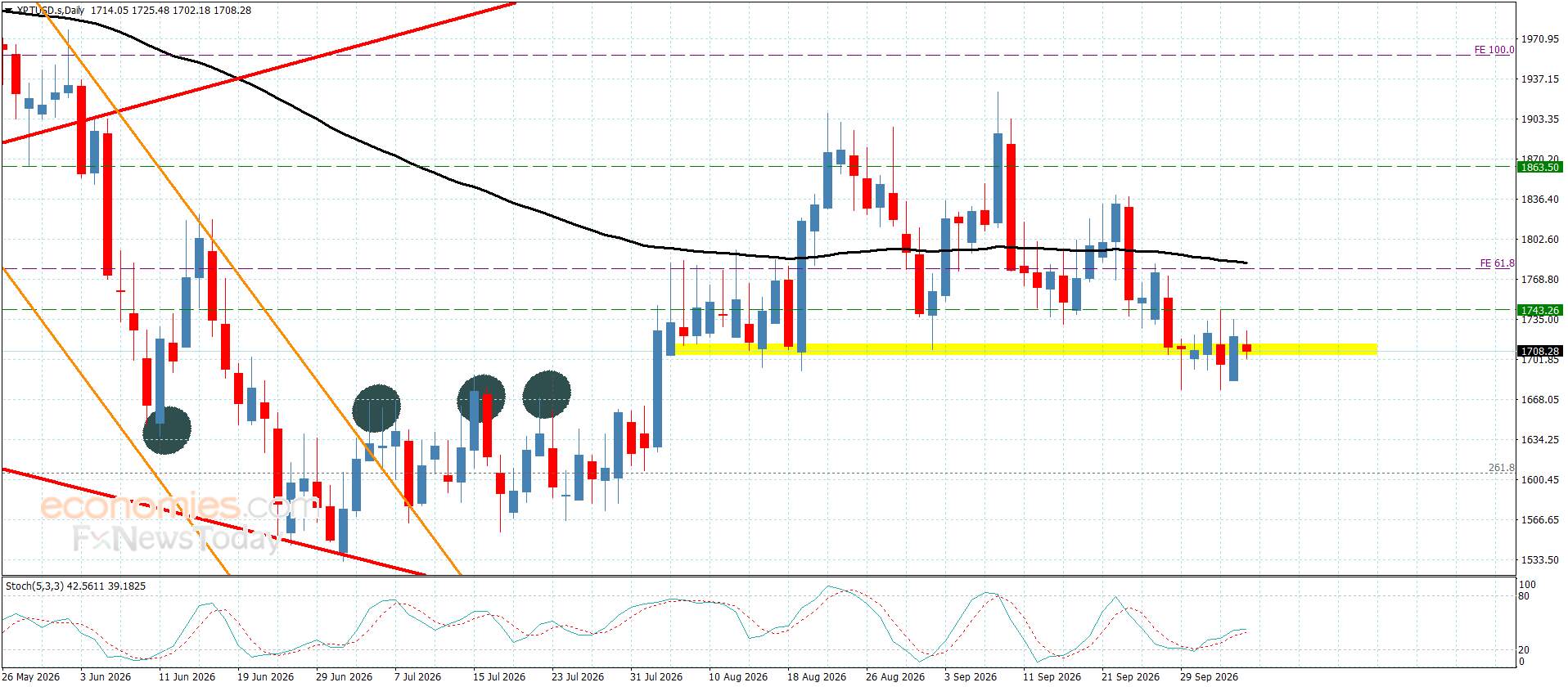



Source link

24 05, 2026

Copper price provides weak trading– Forecast today – 22-5-2026

By |2026-05-24T06:52:41+03:00May 24, 2026|Forex News, News|0 Comments


Copper price was forced to provide weak trading due to the continuation of the main indicators’ contradiction against the negative stability below the barrier at $6.3800 level, to force it to delay the corrective decline and hold near $6.2800 level.


Note that confirming the dominance of the bearish corrective trend needs to break the initial support at $6.1000, to ease the mission of the corrective stations, which might begin at $5.9500 and $58000, while surpassing the barrier will provide a chance for recording some gains, to expect attacking the resistance near $6.5800.


The expected trading range for today is between $6.1000 and$6.3500


Trend forecast: Bearish


Source link

Go to Top