US Dollar seesawing between gains and losses as investors assess Trump’s words.
The market mood improved despite global trade uncertainties triggered by the US.
XAU/USD keeps bouncing from sub $2,900 levels, bearish correction complete.
Following a slide towards $2,891 right after Wall Street’s opening, Gold price regained the $2,900 mark and trades around $2,910 as the United States (US) President Donald Trump offers a press conference.
The US Dollar (USD) spent the day within familiar levels, seesawing between gains and losses, slightly firmer across the FX board throughout the first half of the day amid a risk-averse environment. An improved mood, however, is weighing on the American currency, as the rally in government bonds stalled and yields recovered some of yesterday’s losses. The 10-year Treasury note currently offers 4.30%, up 2 basis points (bps) in the day.
Market players shrugged off discouraging US macroeconomic data released on Tuesday, as Consumer Confidence plummeted according to the CB monthly survey. Yet, at the same time, investors stand on their toes ahead of trade-related headlines. The US government is not only working with tariffs but also with potential rate mineral deals with Russia and Ukraine.
Looking ahead, the US will publish next Friday the January Personal Consumption Expenditures (PCE) Price Index, the Federal Reserve’s (Fed) favorite inflation gauge. Annual inflation, as measured by the PCE index, is foreseen at 2.5%, down from the 2.6% posted in December, while the core reading is also seen declining, from 2.8% to 2.6%. Such figures should be seen as good news and revive speculation the Fed could deliver a rate cut in the first semester of the year.
XAU/USD short-term technical outlook
From a technical point of view, the XAU/USD pair’s daily chart shows buyers are still taking their chances on dips. The pair bounced from around a firmly bullish 20 Simple Moving Average (SMA) which extends its advance beyond also bullish 100 and 200 SMAs. At the same time, technical indicators have pared their corrective slides from overbought levels and stabilized above their midlines, supporting the dominant bullish trend.
The near-term picture, however, shows a limited bullish potential. In the 4-hour chart, XAU/USD recovered twice from intraday dips below a bullish 100 SMA but remains below a mildly bearish 20 SMA. Finally, technical indicators remain below their midlines, although recovering modestly, not enough to anticipate additional gains. Gold needs to run past 2,936.20 to recover its near-term bullish poise.
Boeing’s company’s stock price (BA) fell in the intraday levels while trying to gather positive momentum to rise anew, amid the dominance of the upward correctional trend in the short term, while leaning on the support of the 50-day SMA, as the RSI reached oversold levels compared to the stock’s movements, hinting at positive divergence.
Therefore we expect the stock to return higher, targeting the pivotal resistance of $192.63, provided the support of $173.13 holds on.
Silver price may face initial resistance at the 14-day EMA near $32.12.
Daily chart analysis suggests a growing bearish outlook, as the metal remains below the ascending channel.
The initial support appears at the psychological level of $31.00.
Silver price (XAG/USD) halts its three-day losing streak, trading near $31.80 per troy ounce during the European session on Wednesday. Technical analysis on the daily chart indicates a developing bearish outlook, with the metal trading below the lower boundary of its ascending channel pattern.
Silver price also trades below the nine-day and 14-day Exponential Moving Averages (EMAs), signaling weakened short-term momentum. However, the 14-day Relative Strength Index (RSI) has bounced back above the 50 mark, indicating that bullish sentiment remains intact. Upcoming price action will provide clearer insight into the price’s directional trend.
To the downside, the XAG/USD pair may find initial support at the psychological level of $31.00. A decisive break below this mark could strengthen the bearish outlook, potentially pushing Silver’s price toward the five-month low of $28.74, last seen on December 19.
Silver price could encounter initial resistance at the 14-day EMA around $32.12, followed by the nine-day EMA near $32.19. A move back into the ascending channel pattern would restore the bullish outlook, potentially pushing the pair toward the four-month high of $33.40. A breakout above this level would strengthen the bullish bias, opening the door for the metal price to test the ascending channel’s upper boundary near $35.00.
XAG/USD: Daily Chart
Silver FAQs
Silver is a precious metal highly traded among investors. It has been historically used as a store of value and a medium of exchange. Although less popular than Gold, traders may turn to Silver to diversify their investment portfolio, for its intrinsic value or as a potential hedge during high-inflation periods. Investors can buy physical Silver, in coins or in bars, or trade it through vehicles such as Exchange Traded Funds, which track its price on international markets.
Silver prices can move due to a wide range of factors. Geopolitical instability or fears of a deep recession can make Silver price escalate due to its safe-haven status, although to a lesser extent than Gold’s. As a yieldless asset, Silver tends to rise with lower interest rates. Its moves also depend on how the US Dollar (USD) behaves as the asset is priced in dollars (XAG/USD). A strong Dollar tends to keep the price of Silver at bay, whereas a weaker Dollar is likely to propel prices up. Other factors such as investment demand, mining supply – Silver is much more abundant than Gold – and recycling rates can also affect prices.
Silver is widely used in industry, particularly in sectors such as electronics or solar energy, as it has one of the highest electric conductivity of all metals – more than Copper and Gold. A surge in demand can increase prices, while a decline tends to lower them. Dynamics in the US, Chinese and Indian economies can also contribute to price swings: for the US and particularly China, their big industrial sectors use Silver in various processes; in India, consumers’ demand for the precious metal for jewellery also plays a key role in setting prices.
Silver prices tend to follow Gold’s moves. When Gold prices rise, Silver typically follows suit, as their status as safe-haven assets is similar. The Gold/Silver ratio, which shows the number of ounces of Silver needed to equal the value of one ounce of Gold, may help to determine the relative valuation between both metals. Some investors may consider a high ratio as an indicator that Silver is undervalued, or Gold is overvalued. On the contrary, a low ratio might suggest that Gold is undervalued relative to Silver.
Oil Price Forecast Turns Bullish Amid U.S. Inventory Surprise
Oil markets got a jolt this week as prices ticked up in Asian trading on Wednesday, February 25, 2025. The rally came after a surprise drop in U.S. oil inventories, offering a glimmer of hope to traders who’ve been watching prices slide to two-month lows. Brent oil futures climbed 0.3% to $73.27 a barrel, while West Texas Intermediate (WTI) crude futures gained 0.4% to $69.17 a barrel. This uptick follows a rough patch—both contracts shed about $2 on Tuesday alone, rattled by shaky economic signals from the U.S. and Germany.
But don’t pop the champagne just yet. The oil price forecast remains clouded by bigger worries. A cooling global economy and threats of Trump tariffs are keeping traders on edge. Could this inventory draw signal tighter supplies ahead, or will demand fears and trade tensions drag prices back down? Let’s unpack what’s driving the oil price forecast today and what it means for markets.
U.S. Inventory Draw: A Rare Bright Spot
The American Petroleum Institute (API) dropped a bombshell Tuesday evening: U.S. oil inventories shrank by 0.6 million barrels for the week ending February 21. Analysts had braced for a 2.3-million-barrel build, so this unexpected draw flipped the script. It’s a small shift, sure, but in a market nursing losses, it’s enough to spark chatter about a tighter supply outlook.
Official data from the U.S. Energy Information Administration (EIA), due later today, will either confirm or contradict the API’s findings. Historically, API numbers often foreshadow EIA reports, so traders are cautiously optimistic. If the trend holds, the oil price forecast could see a short-term lift as supply concerns ease. Still, with 2024 marked by oversupply fears, this lone data point isn’t enough to rewrite the broader narrative—yet.
Economic Jitters Weigh on the Oil Price Forecast
Zoom out, and the picture gets murkier. The oil price forecast isn’t just about barrels in storage—it’s about demand, and that’s where the trouble brews. Tuesday’s $2 price drop wasn’t random; it followed weak economic data from two heavyweights: the U.S. and Germany. In the U.S., consumer confidence took a hit in February, hinting at slower spending in a nation that drives global growth. Across the Atlantic, Germany’s GDP contracted again, signaling trouble for Europe’s biggest economy.
Why does this matter? When wallets tighten, oil demand softens. Cars stay parked, factories slow, and shipping stalls. The oil price forecast hinges on economic health, and right now, the pulse is weak. Add in Trump tariffs, and you’ve got a recipe for uncertainty that’s tough to swallow. Prices might be up today, but the market’s jittery, and for good reason.
Trump Tariffs: The Wild Card in Oil Markets
Speaking of Trump tariffs, they’re the elephant in the room. President Donald Trump has been rattling sabers, threatening new trade barriers that could shake up global commerce. This week, he floated tariffs on copper and confirmed duties on Mexico and Canada will kick in next week. China, a massive oil importer, remains a prime target too. If Trump tariffs hit hard, they could choke China’s economy—and its thirst for crude.
The oil price forecast doesn’t like unpredictability, and Trump tariffs bring plenty of it. A trade war could slow global growth, shrink demand, and send oil prices tumbling. Tuesday’s two-month low reflects that fear. Yet, Wednesday’s rebound shows markets are still digesting the news, balancing tariff threats against supply-side surprises like the inventory draw. Traders are stuck in a tug-of-war, and the outcome’s anyone’s guess.
Brent and WTI Futures: Where Are They Headed?
Let’s zoom in on the trading action. Brent oil futures expiring in April nudged up to $73.27 a barrel—a modest 0.3% gain. Meanwhile, WTI crude futures hit $69.17 a barrel, up 0.4%. These are the benchmarks investors watch, and their moves shape the oil price forecast daily. Tuesday’s $2 plunge stung, but Wednesday’s recovery suggests some resilience.
For context, Brent reflects global oil dynamics, sourced from the North Sea, while WTI tracks U.S.-centric trends. Both are futures contracts, meaning traders bet on where prices are headed—say, Brent Oil Futures’s price in April. The inventory draw boosted both, but economic headwinds and Trump tariffs could cap gains. The oil price forecast here is a tightrope walk between supply hope and demand dread.
Alt Text: A chart showing the latest oil price forecast with Brent and WTI futures rising after a U.S. inventory draw.
What’s Next for the Oil Price Forecast This Week?
This week’s a big one for data nerds. Thursday brings U.S. fourth-quarter GDP numbers, a snapshot of how the world’s biggest economy fared late last year. Friday ups the ante with the PCE price index—the Federal Reserve’s go-to inflation gauge—plus German inflation figures. These releases will either fuel or douse the oil price forecast.
If GDP disappoints, expect demand worries to deepen, dragging oil prices lower. A hot PCE reading could stoke fears of tighter Fed policy, another blow to growth. German inflation, meanwhile, hints at Europe’s trajectory. The oil price forecast thrives on clarity, but these reports might just muddy the waters further. Traders are glued to their screens, and for good reason.
China’s Role in the Oil Price Forecast
China’s a linchpin in this story. As the world’s top oil importer, its demand swings markets. Trump tariffs targeting Beijing could kneecap its economy, curbing crude purchases. The news of potential copper tariffs this week only amps up the pressure. If China stumbles, the oil price forecast takes a hit—fewer barrels shipped means lower prices.
But it’s not all doom. China’s been diversifying supply chains and boosting domestic production. Still, Trump tariffs loom large, and any slowdown there ripples globally. The oil price forecast can’t ignore this giant, especially with trade tensions heating up.
Historical Context: 2024’s Rocky Ride
Step back to 2024, and oil’s had a tough go. Prices started the year with promise but slumped as supply piled up and demand softened. The API’s latest draw is a blip against that backdrop—0.6 million barrels shaved off a glut doesn’t erase months of oversupply angst. The oil price forecast for 2025 hinges on whether this week’s uptick is a turning point or a false dawn.
Trump tariffs didn’t help last year either. Threats turned into action, rattling markets and fueling economic unease. Pair that with a global growth slowdown, and you see why oil’s nursing losses. The question now: can a tighter U.S. supply outlook shift the oil price forecast, or are we stuck in a rut?
Why the Oil Price Forecast Matters to Traders
For Markets.com readers, the oil price forecast isn’t just news—it’s opportunity. Brent and WTI futures are tradable instruments, and every tick matters. A bullish forecast might mean buying in, betting on tighter supplies. A bearish one, driven by Trump tariffs or weak GDP, could signal a sell-off. Timing’s everything, and this week’s data dump will test traders’ nerves.
Oil’s volatility draws a crowd. It’s tied to inflation, currencies, and equities—when oil moves, markets feel it. The oil price forecast gives you the edge, whether you’re hedging or speculating. With Trump tariffs in play, that edge feels sharper than ever.
Global Demand Outlook: A Closer Look
Beyond the U.S. and China, demand’s faltering elsewhere. Germany’s GDP woes signal a European slowdown, a red flag for oil consumption. Emerging markets, too, face headwinds as Trump tariffs threaten trade flows. The oil price forecast doesn’t live in a vacuum—global growth sets the tone.
Yet, there’s nuance. Warmer weather could cut heating oil use, while a manufacturing rebound might lift diesel demand. The oil price forecast weighs these variables, but right now, the scale tips toward caution. Economic jitters and trade friction aren’t fading anytime soon.
Supply Side: Beyond the U.S. Draw
The U.S. inventory drop stole headlines, but supply’s a global game. OPEC’s sitting tight, with no big cuts announced. Non-OPEC producers like Canada and Brazil keep pumping, adding barrels to the mix. The oil price forecast can’t ignore this flood, even if U.S. stocks dip.
Wednesday’s API data sparked hope, but it’s a drop in the bucket—literally. A 0.6-million-barrel draw pales against yearly trends. The oil price forecast needs more than one-off surprises to turn bullish long-term. Trump tariffs could shift supply chains, too, but that’s a slow burn.
Investor Sentiment: Fear vs. Hope
Markets run on emotion as much as data. Right now, sentiment’s split. The inventory draw offers hope—maybe supplies won’t drown prices after all. But Trump tariffs and economic gloom fuel fear, keeping bulls in check. The oil price forecast reflects this push-pull, with Wednesday’s gains a tentative step forward.
Social media’s buzzing too. Posts on X show traders debating: “Is this a dead cat bounce, or the start of something?” Sentiment’s fragile, and the oil price forecast hangs in the balance. One bad GDP print could tip it.
How Trump Tariffs Could Reshape Oil Markets
Let’s double-click on Trump tariffs. Copper’s in the crosshairs now, but oil’s not immune. Tariffs on Mexico and Canada, set for next week, could hike transport costs—think higher gasoline prices at the pump. China’s the big domino, though. If Trump tariffs slam its factories, crude demand drops fast.
The oil price forecast has to factor this in. Trade wars don’t just hit GDP—they hit oil directly. Look at 2018: tariffs sparked volatility, and prices yo-yoed. History says Trump tariffs mean turbulence, and 2025’s shaping up the same.
What Analysts Are Saying
Experts are split. Some see the inventory draw as a lifeline, nudging the oil price forecast up short-term. Others warn Trump tariffs and economic data could swamp any gains. “We’re in wait-and-see mode,” one analyst told Markets.com. “Friday’s PCE could be the decider.”
Data backs both sides. Brent’s $73.27 and WTI’s $69.17 show resilience, but Tuesday’s $2 drop screams caution. The oil price forecast isn’t crystal clear—it’s a puzzle, and this week’s pieces are still falling into place.
Your Move: Trading the Oil Price Forecast
So, where do you stand? If you’re trading Brent or WTI on Markets.com, this week’s a rollercoaster. The oil price forecast suggests upside if EIA confirms the draw and GDP holds steady. But Trump tariffs and inflation data could flip the script. Stay nimble—oil’s never dull.
Check the Brent and WTI futures pages on Markets.com for live updates. The oil price forecast evolves daily, and timing’s your edge. Whether you’re in for the long haul or a quick scalp, this market’s got room to run—or stumble.
Wrapping Up: The Oil Price Forecast in Flux
Oil’s at a crossroads. Wednesday’s rally off a two-month low feels good, but the oil price forecast isn’t set in stone. A U.S. inventory draw offers a lifeline, yet Trump tariffs and economic jitters loom large. With GDP, PCE, and German inflation data dropping soon, clarity’s coming—fast.
For now, Brent and WTI futures are holding firm, but the oil price forecast teeters. Will supply tighten enough to lift prices, or will demand fears and trade tensions win out? Stick with Markets.com’s News section—we’ll keep you posted as the oil price forecast unfolds.
When considering shares, indices, forex (foreign exchange) and commodities for trading and price predictions, remember that trading CFDs involves a significant degree of risk and could result in capital loss.
Past performance is not indicative of any future results. This information is provided for informative purposes only and should not be construed to be investment advice.
Gold price holds the previous rebound from weekly lows early Wednesday.
Fresh haven demand on tariff uncertainty and US economic woes underpin Gold price.
Gold buyers stay hopeful amid bullish daily RSI, while the 21-day SMA at $2,883 holds.
Gold price struggles to build on Tuesday’s rebound in the Asian session on Wednesday. Gold buyers try their luck as safe-haven flows return on US President Donald Trump’s tariff uncertainty and weak US economic prospects.
Gold price bounces after the profit-taking slide
It was a classic case of profit-taking in Gold price on Tuesday, following a fresh record high of $2,956 set on Monday. Further, Gold price lost ground after the Hong Kong Census and Statistics Department showed that China’s total Gold imports via Hong Kong in January fell 44.8% from December to their lowest point since April 2022.
However, Gold buyers managed to stage a decent comeback in the mid-American session, courtesy of the weak US Conference Board (CB) Consumer Confidence data that sparked US economic concerns and weighed heavily on the US Dollar (USD) alongside the US Treasury bond yields.
US Consumer Confidence Index declined 7 points, its largest fall since August 2021, to 98.3, well below the Reuters estimate of 102.5.
Early Wednesday, Gold price sustains Tuesday’s late rebound as the tariff deadline on Canada and Mexico draws close. Meanwhile, underlying fears over a potential trade war continue to underpin the haven demand for the traditional store of value – Gold, keeping the downside short-lived.
Markets also weigh Trump’s ordering a new probe into possible new tariffs on copper imports to rebuild US production of the red metal.
US President signed an order on Tuesday, directing Commerce Secretary Howard Lutnick to start a new national security probe under Section 232 of the Trade Expansion Act of 1962, the same law that Trump used in his first term to impose 25% global tariffs on steel and aluminium.
The Gold price upswing, however, could face headwinds from a modest rebound in the Greenback and the US Treasury bond yields following the US House approval of the Republican Budget plan, which will likely advance Trump’s tax plans
Additionally, the optimism over the US-Sino meeting on tariffs also thwart the Gold price uptick but trade war concerns could continue to fuel dip-buying in the metal. Speeches from Fed policymakers could also provide some impetus to the non-interest-bearing Gold price due to a lack of top-tier US economic data releases on Wednesday.
Gold price technical analysis: Daily chart
Despite the previous corrective decline, Gold price defended the 21-day Simple Moving Average (SMA) at $2,883.
The 14-day Relative Strength Index (RSI) has stalled its descent to turn higher, currently near 64, pointing to the additional upside.
Gold buyers could retest the all-time highs at $2,956 if the rebound gathers steam. The next topside barriers are seen at the $2,970 resistance and the $3,000 threshold.
On the flip side, the immediate support is seen at the $2,900 round level, below which the 21-day SMA at $2,883 will be challenged again.
Further south, the February 14 low of $2,877 will be tested.
Gold FAQs
Gold has played a key role in human’s history as it has been widely used as a store of value and medium of exchange. Currently, apart from its shine and usage for jewelry, the precious metal is widely seen as a safe-haven asset, meaning that it is considered a good investment during turbulent times. Gold is also widely seen as a hedge against inflation and against depreciating currencies as it doesn’t rely on any specific issuer or government.
Central banks are the biggest Gold holders. In their aim to support their currencies in turbulent times, central banks tend to diversify their reserves and buy Gold to improve the perceived strength of the economy and the currency. High Gold reserves can be a source of trust for a country’s solvency. Central banks added 1,136 tonnes of Gold worth around $70 billion to their reserves in 2022, according to data from the World Gold Council. This is the highest yearly purchase since records began. Central banks from emerging economies such as China, India and Turkey are quickly increasing their Gold reserves.
Gold has an inverse correlation with the US Dollar and US Treasuries, which are both major reserve and safe-haven assets. When the Dollar depreciates, Gold tends to rise, enabling investors and central banks to diversify their assets in turbulent times. Gold is also inversely correlated with risk assets. A rally in the stock market tends to weaken Gold price, while sell-offs in riskier markets tend to favor the precious metal.
The price can move due to a wide range of factors. Geopolitical instability or fears of a deep recession can quickly make Gold price escalate due to its safe-haven status. As a yield-less asset, Gold tends to rise with lower interest rates, while higher cost of money usually weighs down on the yellow metal. Still, most moves depend on how the US Dollar (USD) behaves as the asset is priced in dollars (XAU/USD). A strong Dollar tends to keep the price of Gold controlled, whereas a weaker Dollar is likely to push Gold prices up.
Silver price edges higher to near $31.75 in Wednesday’s Asian session, adding 0.35% on the day.
The positive view of Silver prevails above the key 100-day EMA with the bullish RSI indicator.
The immediate resistance level emerges at $33.00; the first downside target to watch is 31.25.
Silver price (XAG/USD) attracts some buyers to around $31.75, snapping the three-day losing streak during the Asian trading hours on Wednesday. The uncertainty and worries about US President Donald Trump’s tariffs boost the Silver price, a safe-haven asset.
Technically, the bullish trend of Silver remains in place as the commodity is well-supported above the key 100-day Exponential Moving Average (EMA) on the daily chart. However, further consolidation cannot be ruled out as the 14-day Relative Strength Index (RSI) hovers around the midline near 50.0, displaying a neutral momentum in the near term.
The first upside target for white metal emerges at $33.00, representing the psychological level and the upper boundary of the Bollinger Band. Any follow-through buying above this level could pave the way to $33.40, the high of February 14. Further north, the next hurdle to watch is 34.55, the high of October 29, 2024.
On the flip side, the initial support level for Silver price is seen at 31.25, the lower limit of the Bollinger Band. Sustained trading below the mentioned level could see a drop to the key contention level at $31.00, the round mark and the 100-day EMA. The additional downside filter to watch is $29.70, the low of January 27.
Silver price (XAG/USD) Daily Chart
Silver FAQs
Silver is a precious metal highly traded among investors. It has been historically used as a store of value and a medium of exchange. Although less popular than Gold, traders may turn to Silver to diversify their investment portfolio, for its intrinsic value or as a potential hedge during high-inflation periods. Investors can buy physical Silver, in coins or in bars, or trade it through vehicles such as Exchange Traded Funds, which track its price on international markets.
Silver prices can move due to a wide range of factors. Geopolitical instability or fears of a deep recession can make Silver price escalate due to its safe-haven status, although to a lesser extent than Gold’s. As a yieldless asset, Silver tends to rise with lower interest rates. Its moves also depend on how the US Dollar (USD) behaves as the asset is priced in dollars (XAG/USD). A strong Dollar tends to keep the price of Silver at bay, whereas a weaker Dollar is likely to propel prices up. Other factors such as investment demand, mining supply – Silver is much more abundant than Gold – and recycling rates can also affect prices.
Silver is widely used in industry, particularly in sectors such as electronics or solar energy, as it has one of the highest electric conductivity of all metals – more than Copper and Gold. A surge in demand can increase prices, while a decline tends to lower them. Dynamics in the US, Chinese and Indian economies can also contribute to price swings: for the US and particularly China, their big industrial sectors use Silver in various processes; in India, consumers’ demand for the precious metal for jewellery also plays a key role in setting prices.
Silver prices tend to follow Gold’s moves. When Gold prices rise, Silver typically follows suit, as their status as safe-haven assets is similar. The Gold/Silver ratio, which shows the number of ounces of Silver needed to equal the value of one ounce of Gold, may help to determine the relative valuation between both metals. Some investors may consider a high ratio as an indicator that Silver is undervalued, or Gold is overvalued. On the contrary, a low ratio might suggest that Gold is undervalued relative to Silver.
Gold price faced additional negative pressures to confirm breaking the bullish channel’s support line, to head towards achieving bearish correction on the intraday basis, targeting testing 2868.80$ as a next negative station, which represents 23.6% Fibonacci correction level for the rise measured from 2583.75$ to 2956.90$.
Natural gas price took advantage of the minor bullish channel’s support line stability at 3.950$ to start forming new bullish waves and achieve some gains by reaching 4.190$, to close the recent gap.
The contradiction between the major indicators might push the price to form some sideways trades until gathering the required positive momentum to record more gains by rallying towards 4.300$ first, followed by repeating the pressure on 4.500$ high.
The expected trading range for today is between 4.050$ and 4.300$
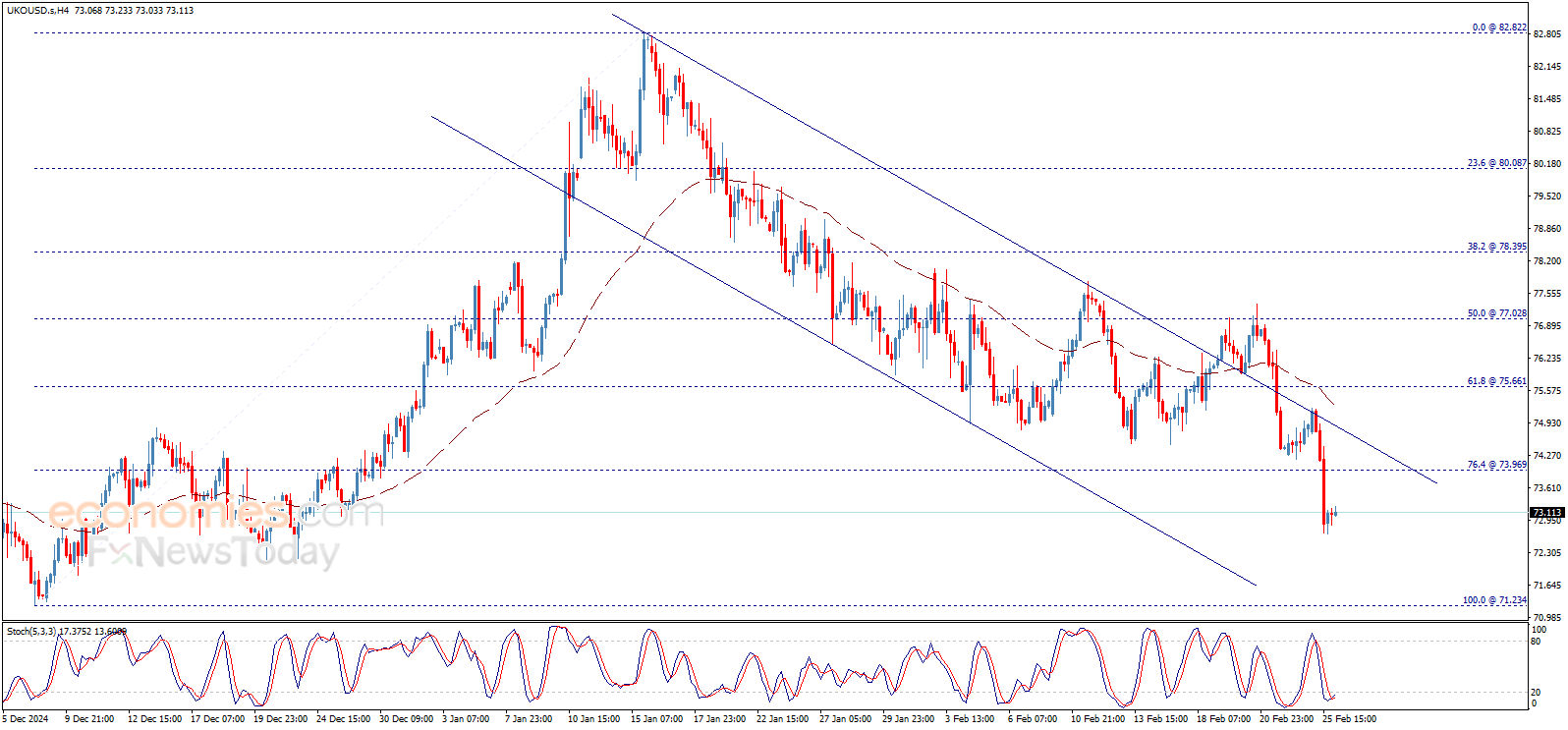
Crude oil price settles at 69.00$ after the strong decline that it witnessed in the previous sessions, noticing that the price resumes the main bearish track within the bearish channel that appears on the chart, which supports the chances of continuing the decline on the intraday and short term basis and head to achieve more negative targets.
At today’s low, the price of crude oil had decreased by $11.80 or 14.6% from the recent swing high at $80.76. On a relative basis, that put it at the low end of bearish corrections that have occurred since the April 2024 peak. There were four corrections identified since then that ranged from a decline of 14.7% to 18.3%. These measured moves indicate that the current correction may be close to completing and that crude oil may have a little more to fall before the correction is complete.
Monthly Bearish Reversal Points to Lower Prices
Crude oil triggered a monthly bearish reversal earlier this month (not shown) and it continues to trade near the lows of the month. This shows aggressive selling with lower monthly support in a range from around $67.11 to $66.65. Given the decisiveness of the bearish retracement, these lower price levels may yet be tested before a notable bounce. There are three more trading days before the end of February, which means that crude is at risk of ending the month in a bearish position, near the lows of the month.
Nearing Key Price Levels
Although the lower trendline provides a potential support line, the next lower support zone is from $67.11 to $66.86. That range is determined by two previous interim swing lows that were established late last year. They represent a more significant support area since a drop below that price range more clearly indicates a possible continuation of the larger bear trend.
Since the $131.31 swing high in March 2022 crude oil has been in a downtrend with a series of lower swing highs and lower swing lows. However, a new lower swing low for the downtrend was attempted in September with a decline to $65.65. But that decline failed to fall below the earlier swing low at $63.67 from May 2023. The September support zone could be challenged if the $66.86 price area fails to hold as support.
For a look at all of today’s economic events, check out our economic calendar.