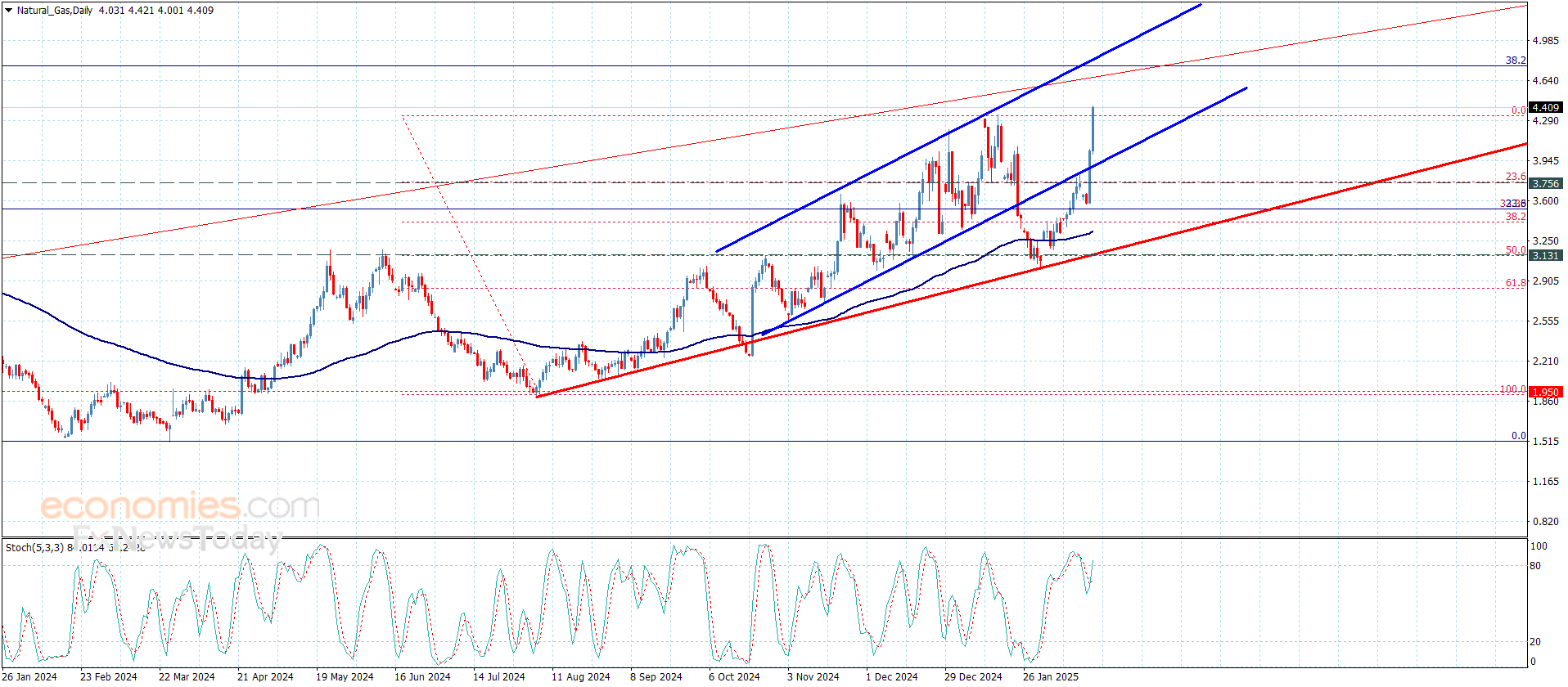
Natural gas is poised to close weak for the day, below the halfway point for the day’s trading range. And that is after a successful test of resistance at the bottom of the internal uptrend line. Along with the 20-Day MA line, the trendline identified dynamic support for the uptrend. The trendline needs to be reclaimed before natural gas has a chance to proceed higher.
Possible Retracement Bottom
Recent price action in natural gas leaves several nearby price levels to key off. There is today’s high of 3.115 and the low of 3.035. Also, the 20-Day MA is at 3.06 and the swing low is at 2.98. Today’s high and the swing low are the more critical price levels as a move through either should determine the next direction. Either natural gas continues to rally in alignment with the larger bullish trend or, the bearish correction is not over until lower price levels are tested as support.
A continuation of the rally is signaled on an advance above today’s high of 3.115. That should confirm a bullish reversal and put natural gas in a position to continue to rise and eventually test recent highs, if not break through them. If today’s high is exceeded, then a reclaim of Tuesday’s high at 3.22 will provide the next sign of strength and therefore points to a continuation higher.
Below 2.98 May Lead Lower
On the downside, the next lower target zone is around the convergence of several price targets. There is the top boundary line of a large symmetrical triangle pattern, an extended downside target for the falling ABCD pattern at 2.90, and the 78.6% Fibonacci retracement at 2.875.
For a look at all of today’s economic events, check out our economic calendar.
Tepid United States employment-related data hit the US Dollar ahead of the NFP release.
Wall Street is under pressure but not far below record highs.
XAU/USD trades with a soft tone in the $2,630 region, could well reach fresh weekly lows.
Spot Gold kept trading uneventfully around the $2,650 mark throughout the first half of the day, with limited action across financial boards. The US Dollar (USD) was under pressure after the United States (US) released tepid employment-related data ahead of the release of the November Nonfarm Payrolls (NFP) report on Friday.
Initial Jobless Claims for the week ending November 29 rose to 224K, above the215K from the previous week and above the market’s expectations. Additionally, the US reported that US-based employers announced 57,727 cuts in November, a 3.8% increase from the 55,597 cuts announced one month prior, according to the Challenger Job Cuts report.
Nevertheless, the USD trimmed part of its losses and surged against Gold amid the poor performance of Wall Street. Following a mixed close among Asian and European indexes, US ones came under selling pressure right after the opening, suggesting a cautious mood.
XAU/USD short-term technical outlook
XAU/USD nears its weekly low posted on Monday at $2,621.77, and technical readings in the daily chart suggest the pair may extend its slide, albeit a break below such a low is needed. Gold is pressuring a bearish 20 Simple Moving Average (SMA), the latter at around $2,630, while the 100 SMA turns flat at around $2,580, reflecting receding buying interest. At the same time, technical indicators turned south, although the Momentum indicator holds within positive levels while the Relative Strength Index (RSI) indicator stands at neutral levels, suggesting a limited bearish potential.
In the near term, and according to the 4-hour chart, XAU/USD is neutral-to-bearish. The pair pressures a flat 100 SMA after breaking below an also directionless 20 SMA. Technical indicators aim lower with uneven strength but gain ground below their midlines. A bearish breakout is on the cards, although it may wait until after the release of the US NFP report.
Gold price trades sideways near $2,650 as investors await the US NFP data for fresh interest rate guidance.
The Fed is expected to cut interest rates by 25 bps in its policy meeting on December 18.
Gold price wobbles near $2,650 from almost a week.
Gold price (XAU/USD) trades in a tight range around $2,650.00 in Thursday’s European session. The precious metal struggles for a direction as investors have sidelined ahead of the United States (US) Nonfarm Payrolls (NFP) data for November, which will be released on Friday.
The labor market data will significantly influence market expectations for the likely interest rate decision by the Federal Reserve (Fed) in its monetary policy meeting on December 18. Currently, financial market participants expect the Fed to cut interest rates by 25 basis points (bps) to 4.25%-4.50%, according to the CME FedWatch tool.
Economists expect the US economy to have added 200K fresh workers, significantly higher than 12K in October. The NFP report stated that payroll employment estimates in some industries were affected by the hurricanes last month. The Unemployment Rate is estimated to have increased to 4.2% from the former release of 4.1%. Investors will also pay close attention to the US Average Hourly Earnings data to get cues about the current status of wage growth.
The downside in the Gold price is expected to remain well-supported amid tensions between Russia and Ukraine. Historically, the appeal of the Gold price has strengthened amid heightening geopolitical tensions.
Meanwhile, the US Dollar Index (DXY), which tracks the Greenback’s value against six major currencies, ticks down to near 106.20. 10-year US Treasury yields advance to near 4.21%.
Gold technical analysis
Gold price trades back and forth near the upward-sloping trendline around $2,650, which is plotted from the February low of $1,984.00 on a daily timeframe. The precious metal wobbles near the 20-day Exponential Moving Average (EMA) around $2,650.00.
The 14-day Relative Strength Index (RSI) oscillates in the 40.00-60.00 range, suggesting a sideways trend.
Looking down, the November low of $2,536.87 will be the key support for Gold price bulls. On the upside, the October high of $2,790 will act as key resistance.
Gold daily chart
Gold FAQs
Gold has played a key role in human’s history as it has been widely used as a store of value and medium of exchange. Currently, apart from its shine and usage for jewelry, the precious metal is widely seen as a safe-haven asset, meaning that it is considered a good investment during turbulent times. Gold is also widely seen as a hedge against inflation and against depreciating currencies as it doesn’t rely on any specific issuer or government.
Central banks are the biggest Gold holders. In their aim to support their currencies in turbulent times, central banks tend to diversify their reserves and buy Gold to improve the perceived strength of the economy and the currency. High Gold reserves can be a source of trust for a country’s solvency. Central banks added 1,136 tonnes of Gold worth around $70 billion to their reserves in 2022, according to data from the World Gold Council. This is the highest yearly purchase since records began. Central banks from emerging economies such as China, India and Turkey are quickly increasing their Gold reserves.
Gold has an inverse correlation with the US Dollar and US Treasuries, which are both major reserve and safe-haven assets. When the Dollar depreciates, Gold tends to rise, enabling investors and central banks to diversify their assets in turbulent times. Gold is also inversely correlated with risk assets. A rally in the stock market tends to weaken Gold price, while sell-offs in riskier markets tend to favor the precious metal.
The price can move due to a wide range of factors. Geopolitical instability or fears of a deep recession can quickly make Gold price escalate due to its safe-haven status. As a yield-less asset, Gold tends to rise with lower interest rates, while higher cost of money usually weighs down on the yellow metal. Still, most moves depend on how the US Dollar (USD) behaves as the asset is priced in dollars (XAU/USD). A strong Dollar tends to keep the price of Gold controlled, whereas a weaker Dollar is likely to push Gold prices up.
Silver price attracts some sellers to near $31.20 in Thursday’s early European session, down 0.30% on the day.
The cautious approach to rate cuts by the Fed drags the Silver price lower.
Rising industrial demand for Silver might help limit its losses.
The Silver price (XAG/USD) drifts lower to around $31.20, snapping the two-day winning streak during the early European session on Thursday. The cautious stance on cutting rates by the Federal Reserve (Fed) weighs on the white metal.
Federal Chair Jerome Powell said on Wednesday that the US economy’s strength means the US central bank can afford to be a little more cautious” about decisions on rate moves. Joseph Brusuelas, chief economist at RSM US, noted that he doesn’t expect further rate cuts after the December meeting until March 2025 at the earliest.
The rising bets of less aggressive Fed rate cuts could support the Greenback and undermine the USD-denominated commodity price. The markets are now pricing in a 76% chance that the central bank would cut rates by a quarter point at its December 17-18 meeting, according to the CME FedWatch tool.
On the other hand, the silver market is expected to experience a supply deficit for the fourth consecutive year due to robust demand. This, in turn, might provide some support to the Silver price. Carsten Fritsch, a precious metals analyst at Commerzbank, said, “Silver demand for photovoltaics has more than doubled in the last three years and now almost equals the demand for bars and coins.” Fritsch added that the rising industrial demand is likely to boost physical silver demand this year, reaching its second-highest level after 2022.
Silver FAQs
Silver is a precious metal highly traded among investors. It has been historically used as a store of value and a medium of exchange. Although less popular than Gold, traders may turn to Silver to diversify their investment portfolio, for its intrinsic value or as a potential hedge during high-inflation periods. Investors can buy physical Silver, in coins or in bars, or trade it through vehicles such as Exchange Traded Funds, which track its price on international markets.
Silver prices can move due to a wide range of factors. Geopolitical instability or fears of a deep recession can make Silver price escalate due to its safe-haven status, although to a lesser extent than Gold’s. As a yieldless asset, Silver tends to rise with lower interest rates. Its moves also depend on how the US Dollar (USD) behaves as the asset is priced in dollars (XAG/USD). A strong Dollar tends to keep the price of Silver at bay, whereas a weaker Dollar is likely to propel prices up. Other factors such as investment demand, mining supply – Silver is much more abundant than Gold – and recycling rates can also affect prices.
Silver is widely used in industry, particularly in sectors such as electronics or solar energy, as it has one of the highest electric conductivity of all metals – more than Copper and Gold. A surge in demand can increase prices, while a decline tends to lower them. Dynamics in the US, Chinese and Indian economies can also contribute to price swings: for the US and particularly China, their big industrial sectors use Silver in various processes; in India, consumers’ demand for the precious metal for jewellery also plays a key role in setting prices.
Silver prices tend to follow Gold’s moves. When Gold prices rise, Silver typically follows suit, as their status as safe-haven assets is similar. The Gold/Silver ratio, which shows the number of ounces of Silver needed to equal the value of one ounce of Gold, may help to determine the relative valuation between both metals. Some investors may consider a high ratio as an indicator that Silver is undervalued, or Gold is overvalued. On the contrary, a low ratio might suggest that Gold is undervalued relative to Silver.
Gold price remains confined in a tight range between two key technical barriers.
The US dollar and treasury yields attempt recovery after the Fed Chair Powell slump.
Gold price lacks a clear directional bias amid a neutral daily RSI, eyeing US Nonfarm Payrolls.
Gold’s price continues with its narrow range struggle at around $2,650 early Thursday, stalling Federal Reserve (Fed) Chairman Jerome Powell’s speech-led uptick. The focus now remains on the US Jobless Claims data due later in the day in the lead-up to the all-important Nonfarm Payrolls (NFP) data.
Gold price fails to defend Powell-led bid
Gold buyers seem to have turned cautious yet again, as the US Dollar (USD) and US Treasury bond yields recover from the overnight slump fuelled by Powell’s optimistic comments on the US economy at the New York Times’ DealBook Summit.
Powell said in his speech that “Growth is definitely stronger than we thought, and inflation is coming a little higher,” Powell said at the event. “The good news is that we can afford to be a little more cautious as we try to find neutral,” he added, referring to the neutral interest rate.
His comments powered the Wall Street indices to fresh highs on increased ‘soft-landing’ hopes, weighing on the safe-haven US Dollar while boosting Gold price. Fed Chair Jerome Powell’s words, however, failed to alter the market’s pricing of 25 basis points (bps) interest rate cut later this month, which weighed heavily on the US Treasury bond yields across the curve, aiding the rebound in Gold price.
Markets continue pricing in a 73% probability of a Dec Fed rate reduction, the CME Group’s FedWatch Tool shows, more or less the same as a day ago.
During the first half of Wednesday’s trading, Gold price struggled amid a modest US Dollar upswing, courtesy of a risk-averse market mood on China’s economic concerns, looming US-Sino trade tensions and geopolitical risks.
Looking ahead, the broader market sentiment will play a pivotal role in the Gold price action but traders could refrain from placing fresh directional bets on the bright metal, anticipating the high-impact US labor market report on Friday. Data released by the ADP showed Wednesday that US private sector employment grew by 146,000 jobs last month, lower than the 150,000 figure that analysts expected.
Markets will also pay close attention to any developments on the global trade front and Middle East geopolitics, which could significantly impact risk sentiment and the USD-sensitive Gold price. Earlier on, an adviser to US President-elect Donald Trump said that Trump “wants to implement an Israel-Gaza cease-fire deal Gaza without delay and before January 20.”
Gold price technical analysis: Daily chart
The daily chart shows that Gold’s price remains stuck between the critical short-term 21-day Simple Moving Average (SMA) at $2,636 and the 50-day SMA at $2,669.
The 14-day Relative Strength Index (RSI) sits just beneath the 50 level, suggesting a lack of clear directional bias.
The previous week’s Bear Cross still remains a threat to Gold buyers.
Recapturing the 50-day SMA resistance at $2,669 on a daily closing basis is critical for buyers to affirm the recovery.
The next relevant resistance aligns at $2,700, above which the November 25 high of $2,721 will be tested.
Conversely, Gold sellers must find a foothold below the 21-day SMA at $2,636 to crack the $2,621 static support.
The previous week’s low of $2,605 will be the line in the sand for Gold buyers.
Gold FAQs
Gold has played a key role in human’s history as it has been widely used as a store of value and medium of exchange. Currently, apart from its shine and usage for jewelry, the precious metal is widely seen as a safe-haven asset, meaning that it is considered a good investment during turbulent times. Gold is also widely seen as a hedge against inflation and against depreciating currencies as it doesn’t rely on any specific issuer or government.
Central banks are the biggest Gold holders. In their aim to support their currencies in turbulent times, central banks tend to diversify their reserves and buy Gold to improve the perceived strength of the economy and the currency. High Gold reserves can be a source of trust for a country’s solvency. Central banks added 1,136 tonnes of Gold worth around $70 billion to their reserves in 2022, according to data from the World Gold Council. This is the highest yearly purchase since records began. Central banks from emerging economies such as China, India and Turkey are quickly increasing their Gold reserves.
Gold has an inverse correlation with the US Dollar and US Treasuries, which are both major reserve and safe-haven assets. When the Dollar depreciates, Gold tends to rise, enabling investors and central banks to diversify their assets in turbulent times. Gold is also inversely correlated with risk assets. A rally in the stock market tends to weaken Gold price, while sell-offs in riskier markets tend to favor the precious metal.
The price can move due to a wide range of factors. Geopolitical instability or fears of a deep recession can quickly make Gold price escalate due to its safe-haven status. As a yield-less asset, Gold tends to rise with lower interest rates, while higher cost of money usually weighs down on the yellow metal. Still, most moves depend on how the US Dollar (USD) behaves as the asset is priced in dollars (XAU/USD). A strong Dollar tends to keep the price of Gold controlled, whereas a weaker Dollar is likely to push Gold prices up.
Gold prices rebound off uptrend support- December opening-range in focus
XAU/USD threat remains for larger correction with broader uptrend
Resistance 2736 (key), 2804, 2900– Support 2607, 2532, 2450/82 (key)
Gold prices are virtually unchanged since the start of the week with XAU/USD trading just above multi-year slope support. The focus now shifts to the December opening-range with the broader uptrend still vulnerable to a deeper correction while below the record high-close. Battle lines drawn on the XAU/USD weekly technical chart.
Review my latest Weekly Strategy Webinar for an in-depth breakdown of this gold setup and more. Join live on Monday’s at 8:30am EST.
Technical Outlook: In last month’s Gold Weekly Price Forecast we noted that the gold sell-off was, “testing initial trend support at the median-line- risk for near-term price inflection here.” XAU/USD surged nearly 7.3% off those lows before exhausting into the close of the month. A decline of nearly 4.3% rebounded off the 61.8% retracement of the November rally at 2607 last week with price holding a tight range (virtually unchanged) into the weekly / monthly open.
Weekly resistance is eyed with the record high-week close (HWC) at 2736– a breach / close above this threshold is needed to mark uptrend resumption towards subsequent resistance objectives at 2.618% extension of the 2022 range breakout at 2804 and 2900 / the upper parallel.
Support remains at 2607 with a break / close below the median-line needed to suggest a more significant correction is underway. Subsequent support objectives rests with the August high at 2532 and 2450/82- a region defined by the April high and the 38.2% retracement of the 2024 yearly range. Losses should be limited to this zone for the 2022 uptrend to remain viable with a close below the 52-week moving average (currently ~2361) ultimately needed to suggest a larger trend reversal is underway / put the bears in control.
Bottom line: Gold is trading just above multi-year uptrend support into the start of the month and while the broader outlook remains constructive, the advance may be vulnerable to a larger correction within the broader uptrend. From a trading standpoint the immediate focus is on a breakout of the 2607-2736 range for guidance.
Keep in mind that we are in in the early throws of the December opening-range with US non-farm payrolls on tap Friday. Stay nimble into the release and watch the weekly close for guidance here. Review my latest Gold Short-term Outlook for a closer look at the near-term XAU/USD technical trade levels.
Key US Economic Data Releases
Economic Calendar – latest economic developments and upcoming event risk.
Active Weekly Technical Charts
— Written by Michael Boutros, Sr Technical Strategist with FOREX.com
Given the confluence of indicators pointing to potential support around 3.04 to 3.02 and the intraday recovery, there is a chance that today’s low ends the short-term correction. A return to the breakout level of 3.02 is typical as prior resistance levels are tested as support. The decisive rally above 3.02, a prior swing high, on November 20 triggered a bullish breakout of a symmetrical triangle pattern.
Once triggered the price of natural gas reclaimed the next two higher swings that construct the top of the triangle formation at 3.16 and 3.39, before peaking at a new trend high of 3.56. The 2023 peak is a little further up at 3.64. That was the highest traded price since January 2023.
Top Boundary Line of Triangle May Yet be Tested
Regardless of the potential for the 3.02 support zone to hold, there is also the top boundary line of the triangle a little lower, around 2.92, depending on when it might be reached. The line also defined resistance at the top of the triangle. It could still be tested as support. The line is joined by 2.90 and 2.88, the 127.2% extended target for the falling ABCD pattern and the 78.6% retracement level, respectively.
Daily Close Above 3.02 Wound Show Strength
A daily close above 3.02 would provide a small indication of strength that would need follow-through, and further still on a close above 3.04. Nonetheless, a bullish reversal would not be indicated until there was an advance above today’s low of 3.08, assuming there is not a new low for the current bearish retracement beforehand.
For a look at all of today’s economic events, check out our economic calendar.
Silver price recovers strongly from $30.50 after US ADP Employment Change data misses estimates by a slight margin.
Investors await Fed Powell’s speech for fresh guidance about the likely interest rate path.
Traders expect the Fed to cut interest rates by 25 bps to 4.25%-4.50% on December 18.
Silver price (XAG/USD) recovers in a V-shape manner from the key support of $30.50 in Wednesday’s North American session and refreshes an intraday high near $31.20 after the release of the United States (US) ADP Employment Change data for November. The agency reported that the private sector hired fresh 146K workers, marginally missed estimates of 150K but was significantly lower from the former release of 184K, downwardly revised from 233K.
However, the private sector employment data has not weighed much on the US Dollar (USD). The US Dollar Index (DXY), which tracks the Greenback’s value against six major currencies, surrenders nominal gains but holds the key support of 106.50. 10-year US Treasury yields hold onto gains near 4.27%.
Historically, higher yields on interest-bearing assets increase the opportunity cost of holding an investment in non-yielding assets, such as Silver. But it doesn’t appear in this case, suggesting that geopolitical tensions continue to maintain safe-haven demand.
According to Reuters, the Hamas internal statement has reported that the group has information that Israel intends to carry out a hostage rescue operation similar to Israel’s June nuseirat operation in Gaza, a move that could derail the ceasefire between Iran and Israel. The appeal of the Silver price strengthens in a heightened geopolitical environment.
Going forward, investors will focus on Federal Reserve (Fed) Chair Jerome Powell’s speech at the New York Times DealBook Summit for fresh guidance on interest rates. The probability for the Fed to cut interest rates by 25 basis points (bps) to 4.25%-4.50% is 74%, while the rest favors leaving them unchanged at their current levels, according to the CME FedWatch tool.
Silver technical analysis
Silver price strives to extend recovery above the 20-day Exponential Moving Average (EMA), which trades around $31.30.
The 14-day Relative Strength Index (RSI) oscillates in the 40.00-60.00 range, suggesting a sideways trend.
Looking down, the upward-sloping trendline around $29.50, which is plotted from the February 29 low of $22.30 on a daily timeframe, would act as key support for the Silver price. On the upside, the horizontal support plotted from the May 21 high of $32.50 would be the resistance zone.
Silver daily chart
Silver FAQs
Silver is a precious metal highly traded among investors. It has been historically used as a store of value and a medium of exchange. Although less popular than Gold, traders may turn to Silver to diversify their investment portfolio, for its intrinsic value or as a potential hedge during high-inflation periods. Investors can buy physical Silver, in coins or in bars, or trade it through vehicles such as Exchange Traded Funds, which track its price on international markets.
Silver prices can move due to a wide range of factors. Geopolitical instability or fears of a deep recession can make Silver price escalate due to its safe-haven status, although to a lesser extent than Gold’s. As a yieldless asset, Silver tends to rise with lower interest rates. Its moves also depend on how the US Dollar (USD) behaves as the asset is priced in dollars (XAG/USD). A strong Dollar tends to keep the price of Silver at bay, whereas a weaker Dollar is likely to propel prices up. Other factors such as investment demand, mining supply – Silver is much more abundant than Gold – and recycling rates can also affect prices.
Silver is widely used in industry, particularly in sectors such as electronics or solar energy, as it has one of the highest electric conductivity of all metals – more than Copper and Gold. A surge in demand can increase prices, while a decline tends to lower them. Dynamics in the US, Chinese and Indian economies can also contribute to price swings: for the US and particularly China, their big industrial sectors use Silver in various processes; in India, consumers’ demand for the precious metal for jewellery also plays a key role in setting prices.
Silver prices tend to follow Gold’s moves. When Gold prices rise, Silver typically follows suit, as their status as safe-haven assets is similar. The Gold/Silver ratio, which shows the number of ounces of Silver needed to equal the value of one ounce of Gold, may help to determine the relative valuation between both metals. Some investors may consider a high ratio as an indicator that Silver is undervalued, or Gold is overvalued. On the contrary, a low ratio might suggest that Gold is undervalued relative to Silver.
Central banks’ leaders and US macroeconomic data set the market’s tone.
The US Dollar seesaws between gains and losses ahead of Fed Powell’s words.
XAU/USD extends its consolidative phase with no directional strength in sight.
Back and forth among financial markets did not impact Gold price on Wednesday, with the bright metal stuck around $2,650 a troy ounce. The US Dollar seesawed between gains and losses, on the one hand, backed by political jitters weighing on the mood, and on the other hand, losing ground on the back of tepid United States (US) data.
Also, central banks’ chiefs affected markets. Bank of England (BoE) Governor Andrew Bailey was the first to publicly appear, saying markets should expect the United Kingdom (UK) to keep cutting rates gradually next year as inflation eases. He added that the disinflation process is well embedded but that there’s more to do.
Next was European Central Bank (ECB) President Christine Lagarde, who testified before the European Parliament’s Committee on Economic and Monetary Affairs. Lagarde said that the economic growth in the EU will be weaker in the near term, adding the recovery should start to gather “some steam.” She added inflation is expected to temporarily increase in the last quarter of the year, and decline to target in the course of the next one.
Data-wise, the US released the ADP Employment Change report, showing the private sector added 146,000 new positions in November, below the 150,000 expected. Additionally, the ISM Services Purchasing Managers Index (PMI), which unexpectedly fell to 52.1 in November from 56 in the previous month, also missed the expected 55.5.
Still pending is a speech from Federal Reserve’s (Fed) Chairman Jerome Powell, due to participate in a moderated discussion at the New York Times DealBook Summit. The next first tier-event will take place on Friday, when the US will release the November Nonfarm Payrolls (NFP) report.
XAU/USD short-term technical outlook
From a technical point of view, XAU/USD has made no progress. The daily chart shows it has held within familiar levels for a seventh consecutive trading day, albeit finding intraday support around a now flat 20 Simple Moving Average (SMA). The 100 and 200 SMAs advance below the current level but lose their upward strength. Finally, technical indicators remain within positive levels, with uneven upward strength, not enough to confirm a bullish extension.
In the near term, and according to the 4-hour chart, XAU/USD is neutral. All moving averages are flat, with the 200 SMA at around $2,678.35 and the shorter ones below the current level. Technical indicators stand above their midlines but lack directional strength. Gold may keep consolidating ahead of upcoming central banks’ meetings scheduled throughout the upcoming two weeks.
This makes a huge difference, due to the fact that the futures markets of course have the most liquidity during the US session.
Furthermore, it’s worth noting that the contract that you are trading in is more likely than not a derivative of the Henry Hub Natural Gas contract, which reflects the price of natural gas delivered from Henry, Louisiana.
There is a cyclical trade to be had here, as it is typical for the winter months to bring in more demand for natural gas for heating. Most of the northeastern part of the United States uses natural gas for heating, or at least some type of other gas such as propane, so these markets do tend to move somewhat in tandem. Ultimately, I think you’ve got a situation where natural gas will continue to be thought of as a potential value play, at least on each and every dip.
The Cycle
The cycle will end sooner or later, but it is worth noting that the market participants out there will probably continue to push this market higher over the next month or 2. After a while, then you have to start looking at the futures markets that are pricing in spring temperatures, which obviously will start to warm up and therefore it makes a certain amount of sense that the market will start to fall again. This is something I do every year, and the share of course will be any different. The market had been somewhat straight up in the air for a while, so a little bit of consolidation between the $3.00 level and the $3.40 level, certainly makes a certain amount of sense. After all, the $3.40 level had been a massive barrier previously.