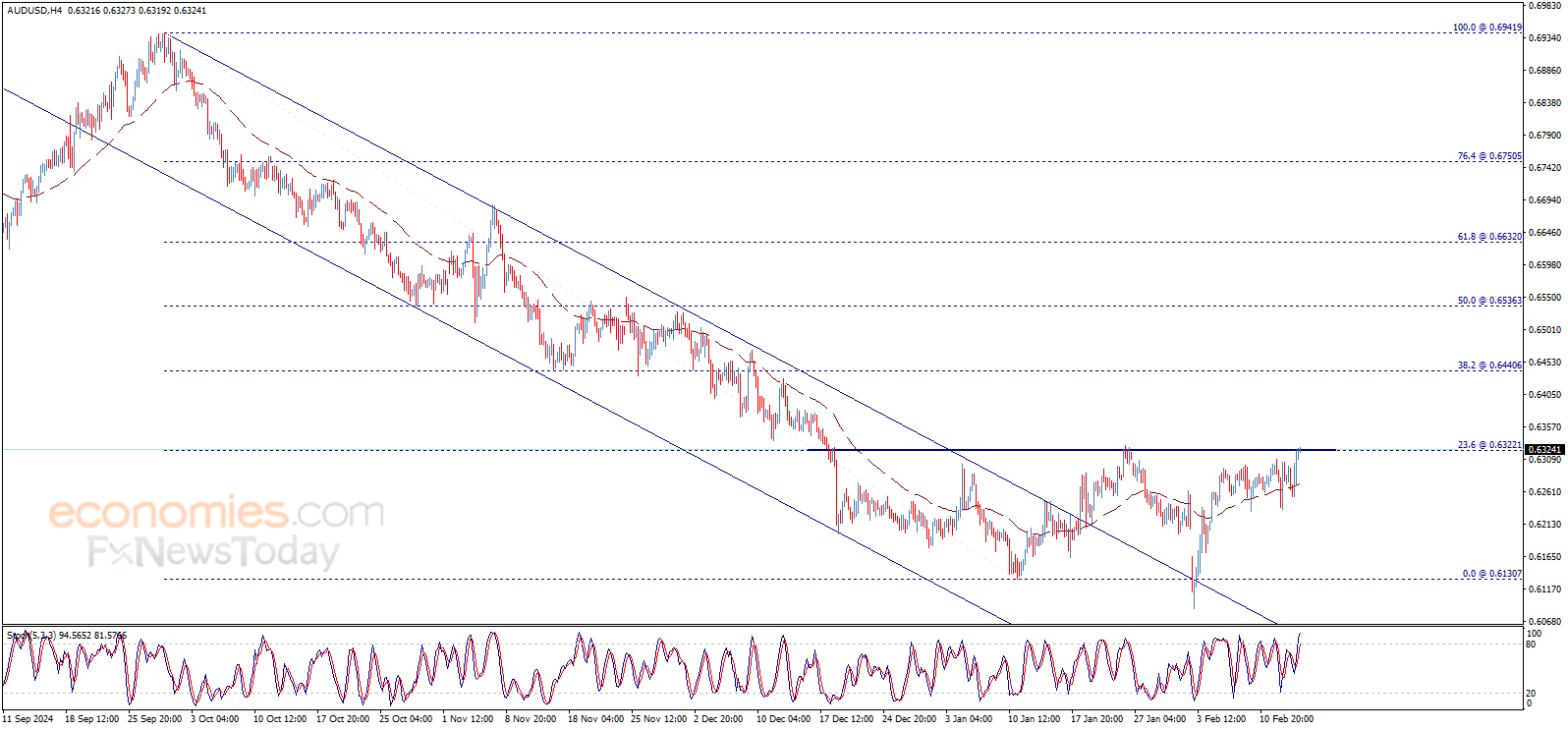
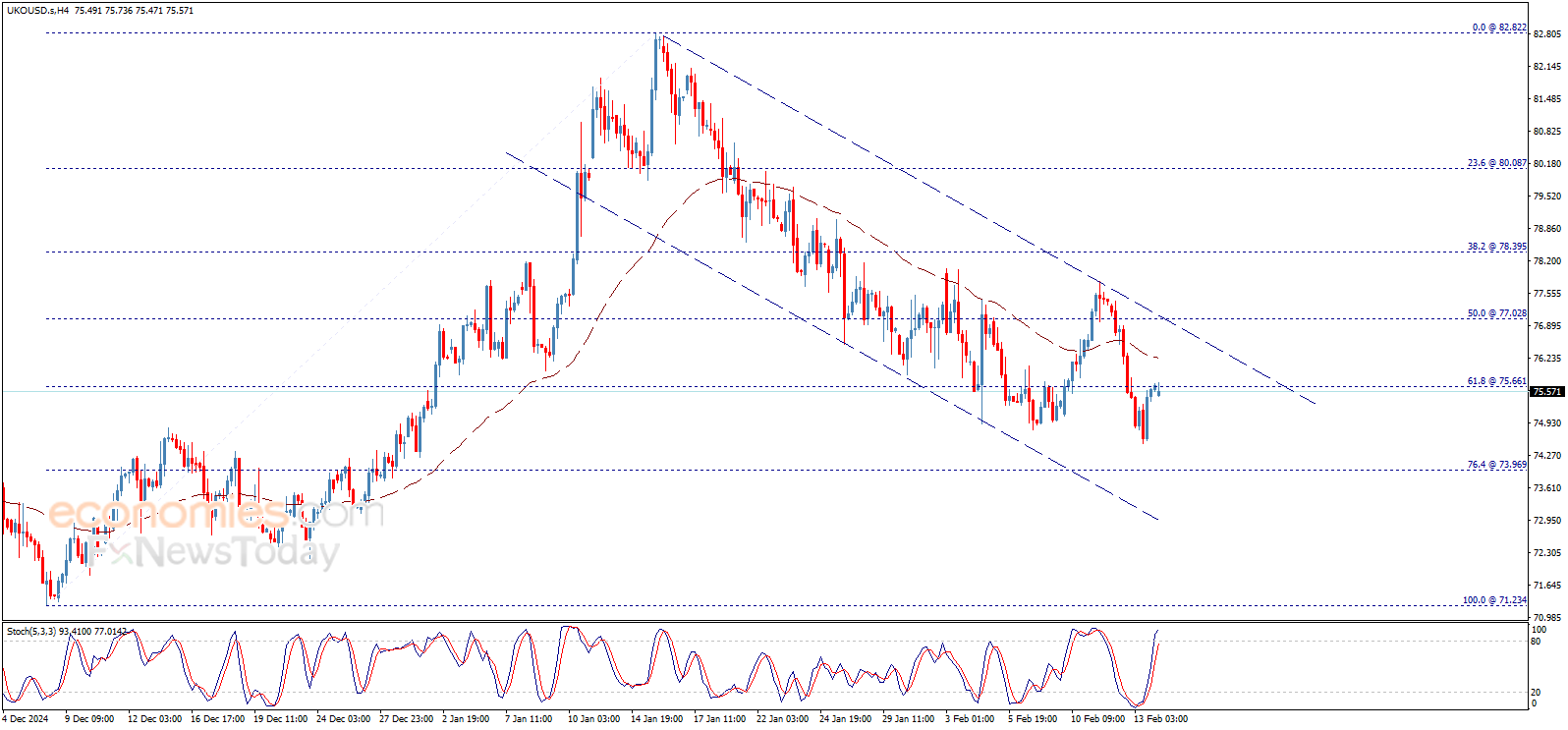
Silver price provides more bullish bias to approach the intraday bullish channel’s resistance line that appears on the chart, which meets the waited target at 32.86$, getting continuous positive support by the EMA50, to reinforce the chances of continuing the rise in the upcoming sessions.
Are you looking for more comprehensive and exclusive analysis? Join the Economies VIP Telegram Channel
Packages for 5 Instruments of Your Choice
Packages with Unlimited Instruments
What You Get When You Subscribe
Daily market analysis and detailed explanation of signals
Price Bullish/Bearish trends and expected trading range
Midday and end-of-day updates
Live economic news alerts
Exclusive educational content (for beginners and professionals)
Further weakness towards lower potential support levels may follow a drop below today’s low of $3.64. Potential support around the 20-Day and 50-Day MA, currently from $3.53 to $3.56 will likely be tested. Notice that the 20-Day line crossed below the 50-Day line today. That relationship should continue to provide clues going forward. Natural gas completed a $1.38 or 31.6% bearish correction at the $2.99 low two weeks ago. Given the subsequent $0.81 or 27% advance, as of today’s high, it wouldn’t be surprising to see a rest before it may be ready to proceed higher.
Lower Support
Other price levels to watch for support include the prior interim swing high at $3.39 from early January and this week’s low at $3.35. The $3.39 price level is confirmed by the 50% retracement of the recent advance, which is $3.40. Further down is the 61.8% Fibonacci retracement at $3.03. The $3.30 price level is also the two-week low. Notice that in both cases, there are two indicators pointing to the same of similar price area.
Long-term Bull Trend Remains Intact
In the bigger picture, long-term bullish signals triggered the last quarter of 2024. There was the breakout of a large symmetrical triangle pattern and a bullish reversal of the long-term downtrend. The expectation is for the bull trend starting from the low of $1.52 to eventually continue once the correction is complete.
Notice that the recent swing low that followed the $4.37, an almost two-year high, successfully found support around the initial bull breakout area of $3.02. The subsequent bullish reaction indicates the low was likely significant and it established a higher swing high for the price structure of the uptrend.
For a look at all of today’s economic events, check out our economic calendar.
Today’s price action will leave a small possible double top. The neckline and breakdown level were at Tuesday’s low of $2,864. However, that price area is currently the next potential support level. Another bearish piece of evidence from today is that it is a key reversal day that generated the second top of a possible double top pattern. Once the bearish evidence starts to stack up, the potential for a bearish correction strengthens.
Weekly Chart is Bearish
Moreover, on the weekly chart, gold is set to complete a bearish shooting star candlestick pattern this week. Therefore, a bearish weekly reversal signal will be triggered on a drop below this week’s low of $2,853. That would put gold in a position to test the 20-Day MA, now at $2,817. Notice that since the 20-Day line was reclaimed in early-January, the price of gold has stayed above the line. The line has not been tested as support since then.
Certainly, it is likely to represent support during the current bearish correction, if it does continue. If not, the most recent new high breakout level is at $2,790 and support may be seen around that price area. There is also monthly support a little lower at $2,772. Those two price levels can be considered as a potential support range from $2,790 to $2,772.
Test of Support at 20-Day MA Possible
Given current price patterns, including a bullish monthly breakout that triggered this month, a bearish correction should not negate the longer bullish pattern unless there is a drop below this month’s low of 2,772. Although the month is not yet complete, that low is also a weekly low and a drop below it is bearish on its own. However, for the intermediate bullish view to be retained the 20-Day MA should show support and lead to a bullish reversal.
For a look at all of today’s economic events, check out our economic calendar.
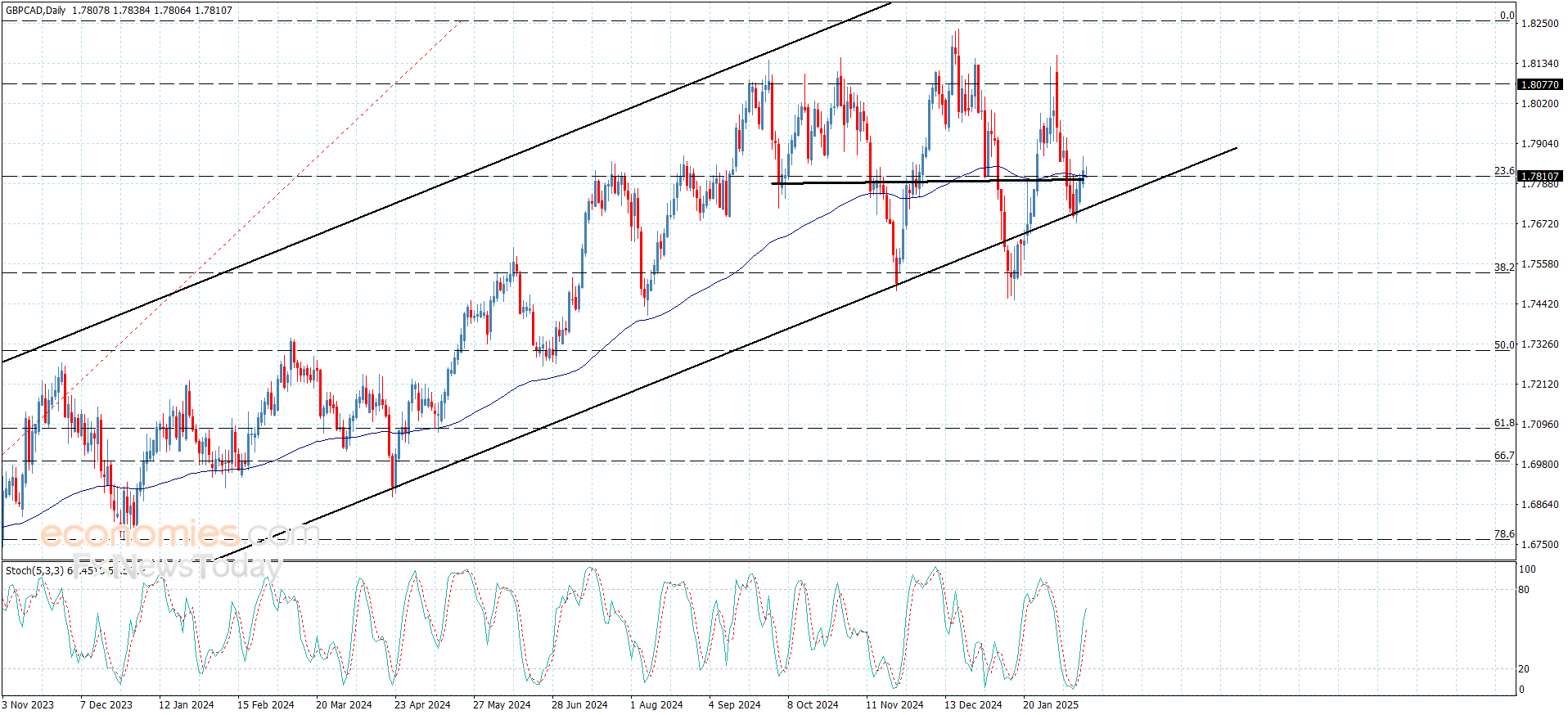
The GBPCAD price ended the correctional bearish decline by providing positive close above the bullish channel’s support line at 1.7700, to notice forming many bullish waves and achieve some gains by touching 1.7860 level followed by fluctuating near the MA55 at 1.7800.
The main stability within the bullish channel and stochastic positive momentum signals will increase the chances of gaining the positive momentum, to keep our bullish overview that might target 1.7890 followed by reaching 1.7960.
The expected trading range for today is between 1.7780 and 1.7890
Copper price confirmed its surrender to the bullish scenario by settling above the breached resistance that forms additional support now at 4.6900$, to notice approaching the first target at 4.8050$.
The price might form some sideways trades due to stochastic fluctuation within the overbought areas, to keep waiting to gather the positive momentum to ease the mission of surpassing 4.8050$ and reach new stations that might start at 4.8900$ and 4.9500$.
The expected trading range for today is between 4.7500$ and 4.8500$
Silver price soars to near $33.30 despite multiple headwinds.
US Trump didn’t reveal a detailed reciprocal tariff plan on Thursday.
The Fed is expected to hold interest rates steady in the next three policy meetings.
Silver price (XAG/USD) surges over 2.5% to near $33.30 in Friday’s North American session, the highest level seen in more than three months. The white metal soars even though risks of a global trade war have paused temporarily and the Federal Reserve (Fed) is expected to maintain a restrictive monetary policy stance for longer.
US President Donald Trump seems short of imposing reciprocal tariffs than what market participants had anticipated. Investors had expected that Trump could unveil a detailed plan of reciprocal tariffs on Thursday. The assumption was based on his tweet at his Truth Social account that “Three great weeks, perhaps the best ever, but today is the big one: reciprocal tariffs!!! Make America great again!!!”, which came in early North American trading hours on Thursday.
However, Trump only passed an order to the Commerce and Treasury departments to prepare a plan on reciprocity, which confirmed that tariffs are not happening, at least for now.
This scenario diminished fears of global uncertainty, which is technically not favorable for the Silver price.
The impact of a delay in Trump’s reciprocal tariffs is visible on the US Dollar (USD), with the US Dollar Index (DXY) revisiting the four-week low around 106.80.
According to the CME FedWatch tool, the Fed is expected to keep interest rates steady in the next three policy meetings.
Silver technical analysis
Silver price breaks strongly above the key resistance of $32.50, which is plotted from the December 9 high. The outlook of the white metal was already bullish as the 20-day Exponential Moving Average (EMA) has been sloping higher, which trades around $31.60.
The 14-day Relative Strength Index (RSI) oscillates in the 60.00-80.00 range, suggesting that the momentum is strongly bullish.
Looking down, the December 9 high of $32.50 will be the key support for the Silver price. While, the October 31 high of $33.90 will be the key barrier.
Silver daily chart
Silver FAQs
Silver is a precious metal highly traded among investors. It has been historically used as a store of value and a medium of exchange. Although less popular than Gold, traders may turn to Silver to diversify their investment portfolio, for its intrinsic value or as a potential hedge during high-inflation periods. Investors can buy physical Silver, in coins or in bars, or trade it through vehicles such as Exchange Traded Funds, which track its price on international markets.
Silver prices can move due to a wide range of factors. Geopolitical instability or fears of a deep recession can make Silver price escalate due to its safe-haven status, although to a lesser extent than Gold’s. As a yieldless asset, Silver tends to rise with lower interest rates. Its moves also depend on how the US Dollar (USD) behaves as the asset is priced in dollars (XAG/USD). A strong Dollar tends to keep the price of Silver at bay, whereas a weaker Dollar is likely to propel prices up. Other factors such as investment demand, mining supply – Silver is much more abundant than Gold – and recycling rates can also affect prices.
Silver is widely used in industry, particularly in sectors such as electronics or solar energy, as it has one of the highest electric conductivity of all metals – more than Copper and Gold. A surge in demand can increase prices, while a decline tends to lower them. Dynamics in the US, Chinese and Indian economies can also contribute to price swings: for the US and particularly China, their big industrial sectors use Silver in various processes; in India, consumers’ demand for the precious metal for jewellery also plays a key role in setting prices.
Silver prices tend to follow Gold’s moves. When Gold prices rise, Silver typically follows suit, as their status as safe-haven assets is similar. The Gold/Silver ratio, which shows the number of ounces of Silver needed to equal the value of one ounce of Gold, may help to determine the relative valuation between both metals. Some investors may consider a high ratio as an indicator that Silver is undervalued, or Gold is overvalued. On the contrary, a low ratio might suggest that Gold is undervalued relative to Silver.
Gold price takes a breather on Friday as traders brace for profit-taking.
The US Dollar licks wounds with US Treasury yields on cautious optimism and dovish Fed bets.
Gold price could retreat to the daily support line at $2,892 amid overbought RSI.
Gold price is taking a breather while holding near $2,930 early Friday, having witnessed two straight days of impressive gains.
Gold price consolidates weekly gains
Despite the pause, Gold price remains on track to book its seventh straight weekly gain, mainly supported by US President Donald Trump’s reciprocal tariffs updates and increased expectations that the US Federal Reserve (Fed) could stick with its easing trajectory this year.
Following a hot January US Consumer Price Index (CPI) data, the Producer Price Index (PPI) also surprised markets to the upside. However, the index’s components cooled down, reinforcing dovish expectations around the Fed’s rate cut prospects.
Reuters reported, “Following the PPI data, US rate futures priced in 31 basis points (bps) of easing this year, compared with 27 bps late on Wednesday, according to LSEG calculations. The next rate reduction is expected either at the October or December meeting.”
This led to a sharp sell-off in the US Treasury bond yields and the US Dollar (USD), benefiting the non-yielding Gold price.
Additionally, the narrative that the plan for Trump’s reciprocal tariffs is in the works and would not be imposed immediately relieved global stocks and weighed heavily on the haven demand for the USD across the board, pushing Gold price northward.
Gold traders shrugged off prospects of Russia-Ukraine peace talks as the focus remained on Trump’s tariffs and the US inflation data.
On Thursday, the Kremlin came out with a statement that “there is a political will on both sides to engage in dialogue and search for a settlement when asked about a possible Russia-Ukraine peace deal.
Looking ahead, Gold price could see a profit-taking decline as traders cash in their Gold longs after this week’s record rally and heading into a long weekend. Fresh developments surrounding Trump’s tariffs and the broader market sentiment will continue playing a pivotal role in the Gold price direction.
The high-impact US Retail Sales data will be also closely followed for fresh cues on the Fed’s policy outlook and the value of the USD, eventually impacting Gold price.
Gold price technical analysis: Daily chart
The daily chart shows that Gold price could pull back briefly toward the rising trendline support at $2,892.
The 14-day Relative Strength Index (RSI) has turned flat while holding within the overbought territory, suggesting a fresh dip could be in the offing.
If the selling pressure intensifies below the abovementioned support level, the Gold price could accelerate the downside toward the $2,850 psychological barrier.
Conversely, if the upside momentum regains traction, Gold buyers will challenge the record high of $2,943.
The next relevant resistance is seen at the $3,000 round level.
Gold FAQs
Gold has played a key role in human’s history as it has been widely used as a store of value and medium of exchange. Currently, apart from its shine and usage for jewelry, the precious metal is widely seen as a safe-haven asset, meaning that it is considered a good investment during turbulent times. Gold is also widely seen as a hedge against inflation and against depreciating currencies as it doesn’t rely on any specific issuer or government.
Central banks are the biggest Gold holders. In their aim to support their currencies in turbulent times, central banks tend to diversify their reserves and buy Gold to improve the perceived strength of the economy and the currency. High Gold reserves can be a source of trust for a country’s solvency. Central banks added 1,136 tonnes of Gold worth around $70 billion to their reserves in 2022, according to data from the World Gold Council. This is the highest yearly purchase since records began. Central banks from emerging economies such as China, India and Turkey are quickly increasing their Gold reserves.
Gold has an inverse correlation with the US Dollar and US Treasuries, which are both major reserve and safe-haven assets. When the Dollar depreciates, Gold tends to rise, enabling investors and central banks to diversify their assets in turbulent times. Gold is also inversely correlated with risk assets. A rally in the stock market tends to weaken Gold price, while sell-offs in riskier markets tend to favor the precious metal.
The price can move due to a wide range of factors. Geopolitical instability or fears of a deep recession can quickly make Gold price escalate due to its safe-haven status. As a yield-less asset, Gold tends to rise with lower interest rates, while higher cost of money usually weighs down on the yellow metal. Still, most moves depend on how the US Dollar (USD) behaves as the asset is priced in dollars (XAU/USD). A strong Dollar tends to keep the price of Gold controlled, whereas a weaker Dollar is likely to push Gold prices up.
Natural gas price continued its bullish rally to record 3.800$ level yesterday, approaching the major resistance to push it to form temporary negative rebound by fluctuating near 3.710$.
Note that the continuous fluctuation below the current resistance and stochastic exit from the overbought areas might increase the negative pressures on the price, to expect crawling towards 3.620$ level soon, followed by attempting to test the additional support at 3.520$.
The expected trading range for today is between 3.620$ and 3.830$
Silver price provides more bullish bias to approach the intraday bullish channel’s resistance line that appears on the chart, which meets the waited target at 32.86$, getting continuous positive support by the EMA50, to reinforce the chances of continuing the rise in the upcoming sessions.
Are you looking for more comprehensive and exclusive analysis? Join the Economies VIP Telegram Channel
Packages for 5 Instruments of Your Choice
Packages with Unlimited Instruments
What You Get When You Subscribe
Daily market analysis and detailed explanation of signals
Price Bullish/Bearish trends and expected trading range
Midday and end-of-day updates
Live economic news alerts
Exclusive educational content (for beginners and professionals)
Expectations about upcoming US President Donald Trump announcement lifted the mood.
The United States will publish January Retail Sales on Friday.
XAU/USD stable above $2,900 and with scope to retest its record high.
Spot Gold keeps grinding higher on Thursday, currently trading at around $2,920 a troy ounce. Financial markets turned optimistic in early Asia session amid hopes the conflict between Russia and Ukraine could come to an end with the intervention of the United States (US).
Risk appetite was further fueled by market talks pointing at US President Donald Trump announcing gradual tariffs later in the day. Trump imposed 25% tariffs on all steel and aluminium imports to the country at the beginning of the week and anticipated another round of levies to be announced later today. CNBC reported that such fresh tariffs would not come into effect today, adding that there would be a delay of “some months.”
Meanwhile, Trump announced through social media that he will give a news conference on reciprocal tariffs today at 13:00 EST or 18:00 GMT.
Data-wise, market players ignored higher-than-anticipated US Producer Price Index (PPI) data. Inflation at wholesale levels rose by 0.4% on a monthly basis in January, vs the 0.3% anticipated by market players. From a year earlier, the PPI was up 3.5% against expectations of a 3.2% advance. Initial Jobless Claims, on the other hand, rose by less than expected, up 213K in the week ended February 7. On Friday, the macroeconomic calendar will include January US Retail Sales.
XAU/USD short-term technical outlook
The XAU/USD pair has recovered its bullish tone, posting a higher high and a higher low on a daily basis. The same chart shows technical indicators consolidate within overbought territory, somehow hinting at a corrective slide yet far from confirming it. Finally, the pair keeps developing above all its moving averages, with a bullish 20 Simple Moving Average (SMA) advancing beyond the 100 and 200 SMAs while providing mid-term dynamic support at around $2,808.30.
In the near term, and according to the 4-hour chart, the risk skews to the upside. The XAU/USD pair is finding intraday support at around a mildly bullish 20 SMA, currently at $2,904.60. The 100 and 200 SMAs, in the meantime, keep advancing far below the shorter one. Finally, technical indicators turned north within positive levels, favoring another leg north.