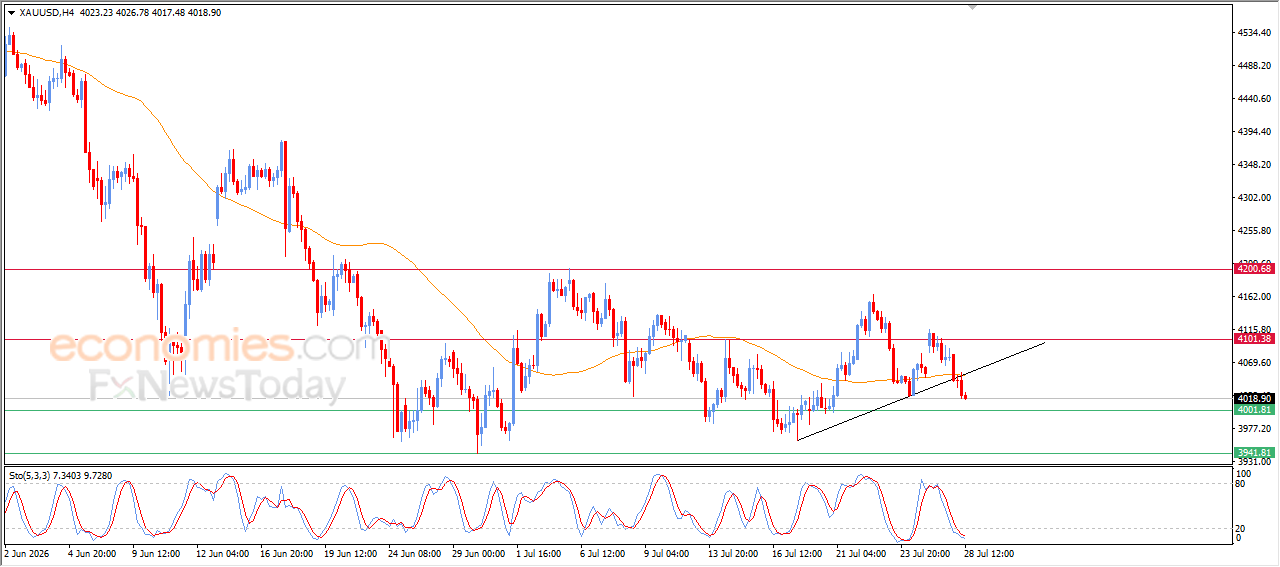
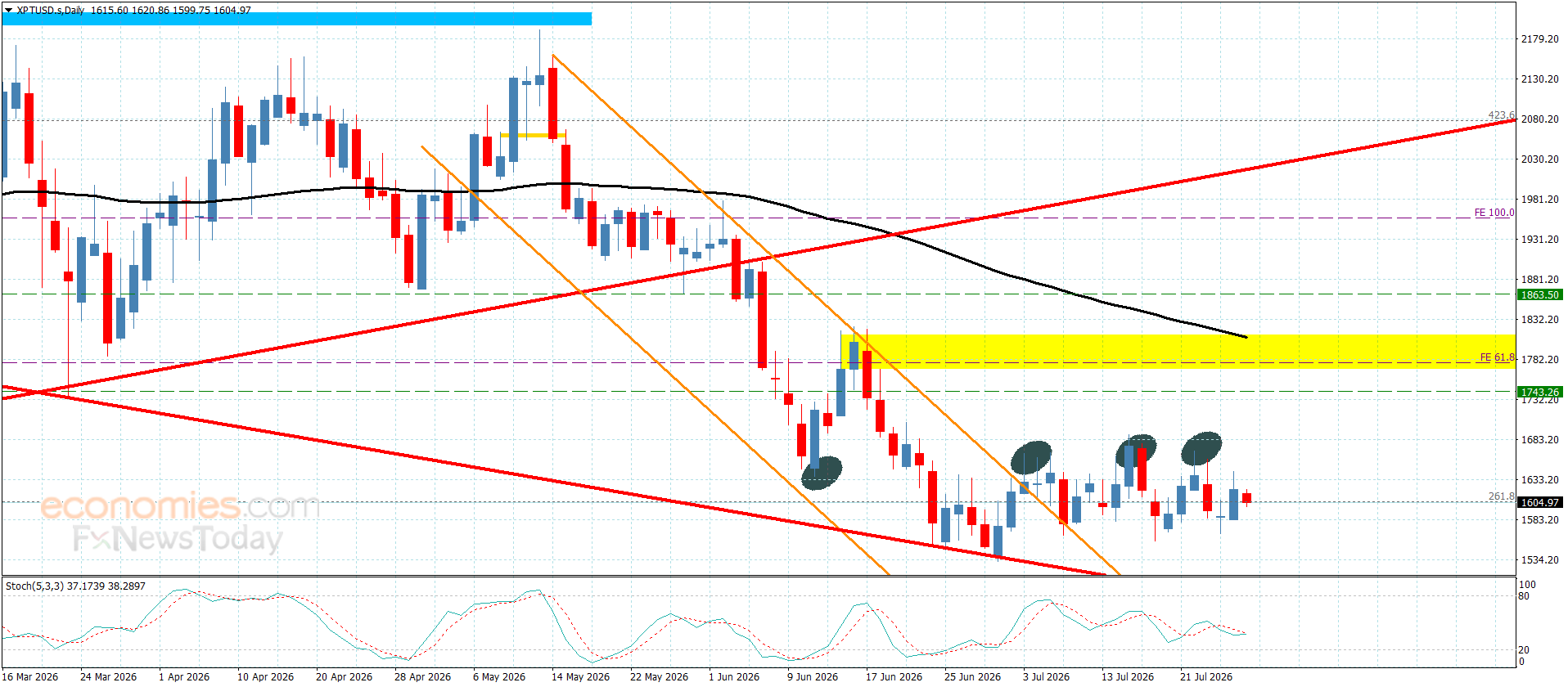
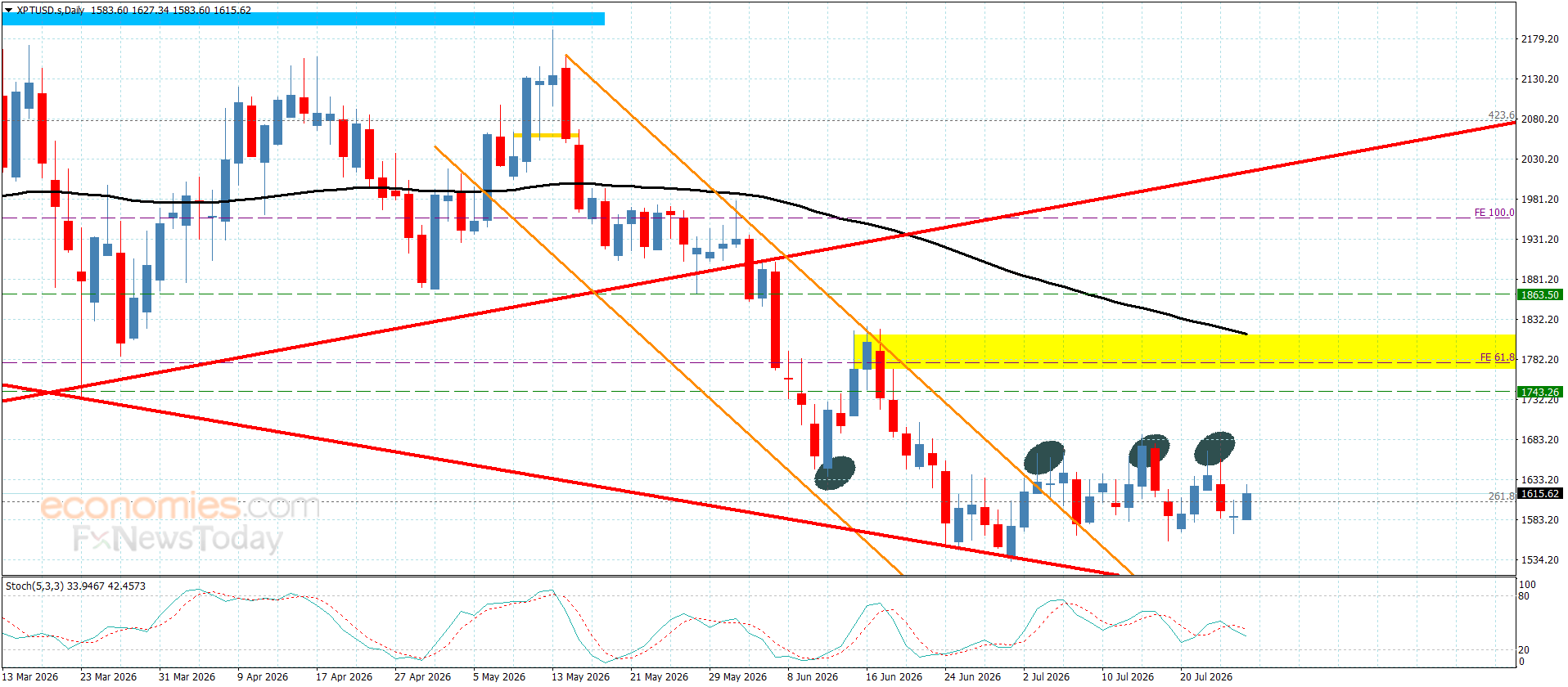
Gold prices deepened its losses during their latest intraday trading, breaking a bullish corrective trend line on the short-term basis, accompanied by surpassing EMA50’s support, intensifying the negative pressures and suggesting more losses in the near upcoming period, especially with the emergence of the negative signals from the relative strength indicators, despite reaching oversold levels.
Register now to be able to add articles to your reading list.
” aria-hidden=”true”>
Silver prices fell towards $57.20 per ounce on Tuesday as a stronger US dollar and growing expectations of tighter Federal Reserve policy outweighed support from another year of structural supply deficits. With the Fed set to announce its latest policy decision on Wednesday, traders are watching whether XAG/USD can hold the key $56.81 Fibonacci support before the next directional move.
Stronger Dollar and Fed Expectations Pressure Silver
Silver came under renewed selling pressure as investors reduced exposure ahead of the Federal Reserve’s two-day policy meeting. Spot silver traded near $57.23 per ounce, down around 2% on the day, extending its retreat after briefly approaching the $60 mark last week. The stronger US dollar remained the primary headwind, making dollar-denominated precious metals more expensive for overseas buyers.
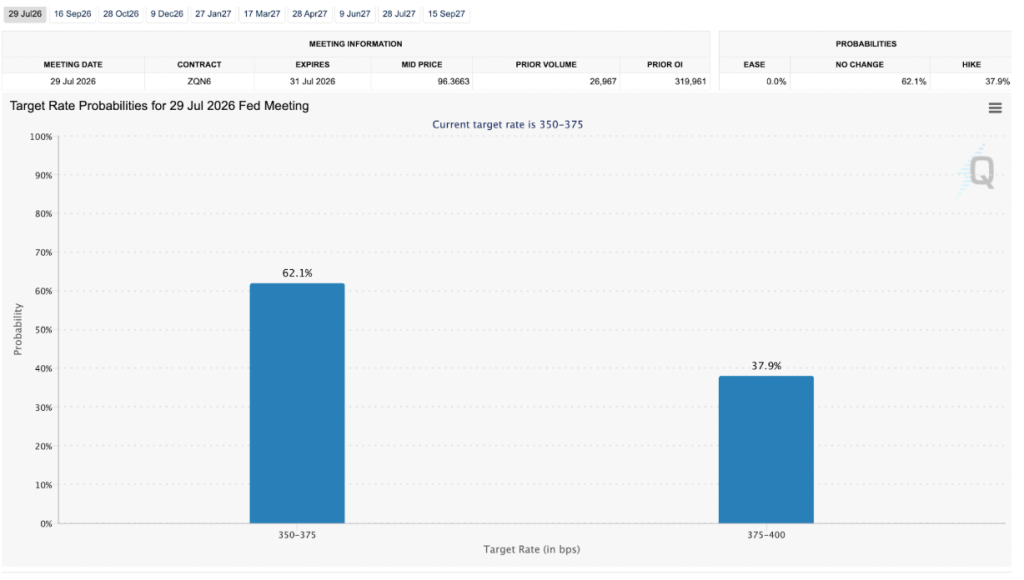
Markets are increasingly focused on the Fed’s policy guidance rather than the rate decision itself. According to CME FedWatch, investors assign a 62% probability that policymakers will leave interest rates unchanged this week, while the likelihood of a 25-basis-point increase has climbed to 38%, up sharply from around 16% a week ago. Markets are also pricing roughly an 81% chance of a September rate increase, reflecting expectations that inflation risks remain elevated.
Source: CME FedWatch
Higher interest rates generally reduce the appeal of non-yielding assets such as silver by increasing returns on cash and government bonds. A hawkish statement from the Fed could therefore keep pressure on both silver and gold, even if rates remain unchanged this week.
Industrial Demand and Supply Deficits Continue to Support the Long-Term Outlook
Unlike gold, silver derives much of its value from industrial demand, particularly in electronics, renewable energy, electric vehicles and advanced manufacturing. While concerns over slower global growth have weighed on industrial metals in recent weeks, the long-term supply picture remains supportive.
The Silver Institute expects the global silver market to record its sixth consecutive annual supply deficit in 2026. Its latest estimates indicate the market could remain undersupplied by approximately 46.3 million ounces, even after modest improvements in mine production and recycling. Earlier projections had suggested a deficit closer to 67 million ounces, highlighting that global consumption continues to exceed newly available supply.
Physical investment demand also remains resilient. The Silver Institute forecasts demand for silver coins and bars to increase by roughly 20% to around 227 million ounces this year, the strongest level in three years. Although industrial fabrication is expected to soften slightly, silver continues to benefit from growing demand across electrical infrastructure, electronics and clean energy technologies.
Another supportive factor comes from India, where tighter import restrictions and higher import duties have significantly reduced silver imports, creating regional shortages and lifting domestic premiums above international benchmark prices.
Economic Data Could Drive the Next Move
Following Wednesday’s Fed decision, attention will quickly shift to Thursday’s US GDP, personal income, spending and Core PCE inflation reports. The Core PCE index remains the Federal Reserve’s preferred inflation gauge, and any upside surprise could reinforce expectations for another rate increase in September.
Conversely, softer economic growth or easing inflation would weaken the US dollar and improve the outlook for precious metals, particularly silver, which tends to react more sharply than gold to changes in monetary policy expectations.
Silver Price Forecast: Can XAG/USD Hold the $56.81 Fibonacci Support?
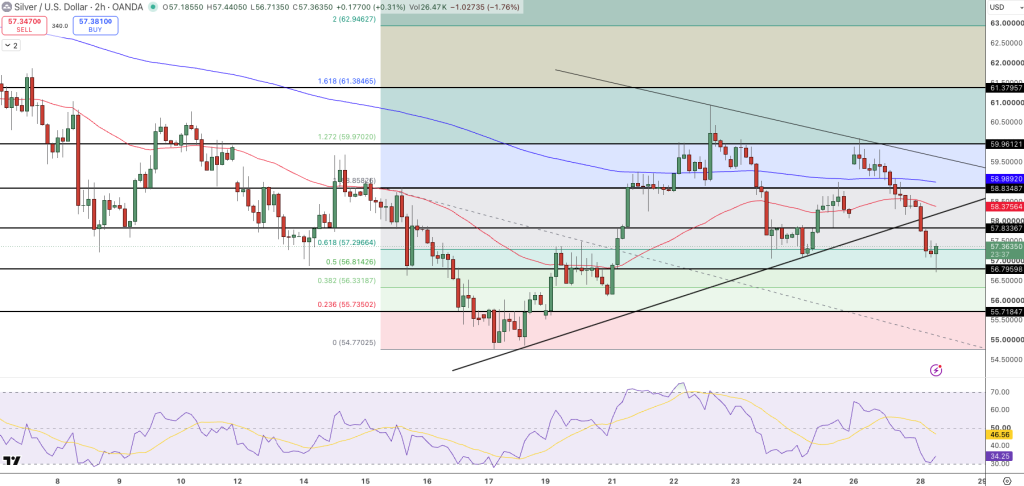
Silver’s technical picture has weakened after breaking below the ascending trendline that supported the rally from the July 17 low. The decline has brought prices towards the 50% Fibonacci retracement at $56.81, where buyers have begun to emerge. However, the recovery remains tentative as XAG/USD continues to trade below both the former trendline and its key moving averages.
Silver Price Chart – Source: Tradingview
The 50-period EMA at $58.38 has turned lower and now acts as immediate resistance, while the 200-period EMA at $58.99 remains firmly above price, confirming that sellers retain short-term control. Meanwhile, the RSI has fallen to around 34, approaching oversold territory but not yet signalling a confirmed bullish reversal.
A sustained recovery above $58.34 would improve the near-term outlook and expose the 200-period EMA at $58.99, followed by the descending trendline near $59.96. If buyers regain control above these levels, the next upside objective comes in at $61.38.
On the downside, $56.81 remains the first key support. A decisive break below this Fibonacci level would expose $56.33, followed by $55.72, while a deeper correction could extend towards $54.77.
Bearish scenario: A confirmed break below $56.81 could accelerate losses towards $56.33, followed by $55.72 and $54.77.
FAQs
Why is silver falling today?
Silver is under pressure because the US dollar has strengthened ahead of the Federal Reserve’s policy decision, reducing demand for non-yielding precious metals and increasing the cost of silver for international buyers.
Why does industrial demand matter for silver?
Unlike gold, more than half of global silver consumption comes from industrial applications, including electronics, solar panels, electric vehicles and electrical infrastructure. Economic growth expectations therefore have a greater influence on silver prices.
Can the long-term supply deficit support silver prices?
Yes. The Silver Institute expects another annual supply deficit in 2026, with global demand continuing to exceed mine production and recycling. Persistent shortages could provide longer-term support once monetary policy uncertainty begins to ease.
Arslan Ali Butt
Lead Markets Analyst – Multi-Asset (FX, Commodities, Crypto)
Arslan Ali Butt serves as the Lead Commodities and Indices Analyst, bringing a wealth of expertise to the field. With an MBA in Behavioral Finance and active progress towards a Ph.D., Arslan possesses a deep understanding of market dynamics.
His professional journey includes a significant role as a senior analyst at a leading brokerage firm, complementing his extensive experience as a market analyst and day trader. Adept in educating others, Arslan has a commendable track record as an instructor and public speaker.
His incisive analyses, particularly within the realms of cryptocurrency and forex markets, are showcased across esteemed financial publications such as ForexCrunch, InsideBitcoins, and EconomyWatch, solidifying his reputation in the financial community.
The GBPJPY pair remains affected by the contradiction of the main indicators, delaying the bullish trend and it settles near the initial support level at 217.65 level, facing the moving average 55.
Reminding you that the positive scenario will remain valid by holding above 216.55 level, which forms initial main support against the bullish attempts, therefore, we will keep waiting for gathering positive momentum to help it form bullish waves, to target 218.65 level and surpassing this barrier will extend the trading towards 219.40 reaching 220.00.
The expected trading range for today is between 217.30 and 218.65
UK Stock Market Forecast Today (July 28 2026): The prospects of the UK equity market continue to remain positive as the FTSE 100 Index has managed to rise to a five-month peak of 10,781.75, helped by better global sentiment and lower levels of anxiety regarding inflation. The main reason for this positive shift is the sharp fall in the price level of global crude oil, where the price of Brent crude oil declined below $91 a barrel owing to a brief pause in US-Iran military disputes.
UK Stock Market Forecast Today (July 28): FTSE 100 Market Outlook
The gain in FTSE 100 index was largely due to the fall in the price of crude oil by 6% on account of the reduced geopolitical tension between the US and Iran. Reduced oil prices have helped to ease concerns about increased fuel prices and domestic inflationary pressures, and an improvement in risk appetite around the world has led to buying in stocks of leading companies in the UK. Volatility in the market could persist in the coming period on account of geopolitical events and earnings reports.
You Might Be Interested In
FTSE 100 Previous Market Performance
Date
FTSE 100 Close
Open
High
Low
Volume
Change
27-07-2026
10,781.75
10,736.14
10,820.94
10,736.14
1.03B
+0.42%
24-07-2026
10,736.23
10,638.86
10,738.83
10,599.10
714.33M
+0.91%
23-07-2026
10,639.17
10,716.99
10,720.33
10,610.38
852.71M
-0.73%
22-07-2026
10,716.97
10,585.87
10,763.44
10,568.72
726.90M
+1.24%
21-07-2026
10,585.91
10,524.25
10,585.91
10,483.14
719.75M
+0.58%
20-07-2026
10,524.76
10,600.27
10,600.27
10,512.76
860.37M
-0.71%
17-07-2026
10,600.37
10,572.39
10,623.69
10,527.65
771.64M
+0.27%
Key Factors to Watch in UK Stock Market Today
Developments in Middle East geopolitical tensions
Brent crude oil price movement
Global inflation trends
Bank of England interest rate outlook
Movement in the British pound against the US dollar
Corporate earnings announcements
Performance of global equity markets
FTSE Major Indices: Why They Matter
Index
Importance
FTSE 100
Tracks the UK’s largest listed companies and global businesses
FTSE 250
Reflects UK-focused mid-cap companies and domestic economic sentiment
FTSE All-Share
Represents a broader picture of UK equities
AIM All-Share
Covers smaller and growth-oriented companies
UK Stocks to Watch Today
The shares in the UK will continue to be in the spotlight today on account of the influence of the significant drop in the global prices for crude oil, the publication of interim results from major companies, and the diminishing of the geopolitical risks owing to the temporary easing of tensions between the United States and Iran.
Stock
Key Developments
Unilever (ULVR)
Unilever is attracting investor attention after reporting a strong performance, with underlying sales growth of 4.8% in the first half of the year. The growth was supported by improved core volumes, while the planned separation of its Unilever Foods division remains on schedule.
AstraZeneca (AZN)
AstraZeneca continues to gain momentum after posting better-than-expected earnings, with H1 revenue rising 9%. Positive survival data from trials of its gastric cancer treatment has emerged as a major growth driver for the pharmaceutical giant.
Games Workshop (GAW)
Games Workshop is expected to see increased trading activity after announcing an interim dividend of £1.40 per share, drawing attention from income-focused investors.
DCC plc (DCC)
DCC remains in focus after agreeing to the £5.75 billion acquisition of DCC Energy by KKR and ECP, marking a major strategic development for the company.
Investors will continue to monitor energy prices, corporate earnings, and global risk sentiment for further direction in UK equities.
What Should Investors Know?
The key lesson for any investor is that creating long-term value is not dependent on anticipating the market moves but rather on being disciplined, taking care of the risks, and letting the investments compound over time. Reinvestment of earnings allows an investor to grow exponentially over time, whereas diversification into various assets prevents an individual from facing losses. Investors need to be aware of the fact that excess cash held by them becomes less valuable due to increasing inflation levels. Excessive investment costs can prove detrimental for the investment returns.
Disclaimer: This article is for informational purposes only and does not constitute financial advice. Investors should consult a qualified financial advisor before making investment decisions. Stock market investments are subject to market risks.
Ni news for copper price due to the contradiction of the main indicators, providing weak sideways trading by its stability near $6.3000 level, confined between $6.5100 barrier and $6.1000 level.
Stochastic approach from 20 level makes us expect forming some bullish bearish corrective waves, attempting to reach $6.2000, attacking the previously mentioned support, which represents initial key to confirm the suggested targets in the upcoming trading.
The expected trading range for today is between $6.1000 and $6.4100
Silver gains more than 2% and trades around $59.45 as renewed demand for precious metals supports prices.
Hopes of de-escalation between the United States and Iran send Oil prices sharply lower, easing inflation concerns.
Markets now turn their attention to the Federal Reserve’s monetary policy decision on Wednesday.
Silver (XAG/USD) rallies on Monday and trades around $59.45 at the time of writing, up 2.27% on the day. The white metal benefits from a sharp decline in Oil prices following renewed hopes for de-escalation between the United States (US) and Iran, a backdrop that strengthens expectations of a more accommodative monetary policy from major central banks.
Military tensions between the two countries have paused after US Ambassador to the United Nations Mike Waltz said US President Donald Trump had decided to suspend military strikes to allow more time for diplomacy. According to Reuters, an Iranian official also stated that Tehran would halt its attacks as long as Washington does the same.
This development is weighing heavily on Oil prices, with West Texas Intermediate (WTI) falling by nearly 8% at the time of press. Lower energy prices help ease concerns over persistently high inflation, reducing the likelihood of additional monetary tightening and supporting non-yielding assets such as Silver.
At the same time, lower US Treasury yields and a weaker US Dollar (USD) are providing additional support to the precious metal. Investors have scaled back expectations for further interest rate hikes as inflation risks linked to energy prices continue to fade.
Market attention now turns to the Federal Reserve (Fed) monetary policy decision on Wednesday. The central bank is widely expected to leave interest rates unchanged, but investors will closely scrutinize the policy statement and Chair Jerome Powell’s remarks for further clues about the future path of monetary policy.
Silver FAQs
Silver is a precious metal highly traded among investors. It has been historically used as a store of value and a medium of exchange. Although less popular than Gold, traders may turn to Silver to diversify their investment portfolio, for its intrinsic value or as a potential hedge during high-inflation periods. Investors can buy physical Silver, in coins or in bars, or trade it through vehicles such as Exchange Traded Funds, which track its price on international markets.
Silver prices can move due to a wide range of factors. Geopolitical instability or fears of a deep recession can make Silver price escalate due to its safe-haven status, although to a lesser extent than Gold’s. As a yieldless asset, Silver tends to rise with lower interest rates. Its moves also depend on how the US Dollar (USD) behaves as the asset is priced in dollars (XAG/USD). A strong Dollar tends to keep the price of Silver at bay, whereas a weaker Dollar is likely to propel prices up. Other factors such as investment demand, mining supply – Silver is much more abundant than Gold – and recycling rates can also affect prices.
Silver is widely used in industry, particularly in sectors such as electronics or solar energy, as it has one of the highest electric conductivity of all metals – more than Copper and Gold. A surge in demand can increase prices, while a decline tends to lower them. Dynamics in the US, Chinese and Indian economies can also contribute to price swings: for the US and particularly China, their big industrial sectors use Silver in various processes; in India, consumers’ demand for the precious metal for jewellery also plays a key role in setting prices.
Silver prices tend to follow Gold’s moves. When Gold prices rise, Silver typically follows suit, as their status as safe-haven assets is similar. The Gold/Silver ratio, which shows the number of ounces of Silver needed to equal the value of one ounce of Gold, may help to determine the relative valuation between both metals. Some investors may consider a high ratio as an indicator that Silver is undervalued, or Gold is overvalued. On the contrary, a low ratio might suggest that Gold is undervalued relative to Silver.
Coffee prices today in the domestic market remain stable compared to the previous session. According to the updated table on July 27, the purchase price in the Central Highlands ranges from 95,300-96,000 VND/kg.
In Dak Lak, coffee prices are recorded at 95,800 VND/kg. Gia Lai also has a purchase price of 95,800 VND/kg.
In Lam Dong, coffee prices are at 95,300 VND/kg, the lowest among the surveyed areas.
The old Dak Nong area, now belonging to Lam Dong province, continues to have the highest price, reaching 96,000 VND/kg.
Domestic coffee prices are currently flat after the previous recovery session. Compared to the end of last week, the price level is still about 1,900 VND/kg lower, showing that the market has not escaped the short-term correction.
World coffee prices
In the world market, data recorded on July 27th showed no new fluctuations in the main terms.
On the London exchange, the September 2026 Robusta futures contract remained at $3,757/ton. The November 2026 term remained at $3,738/ton.
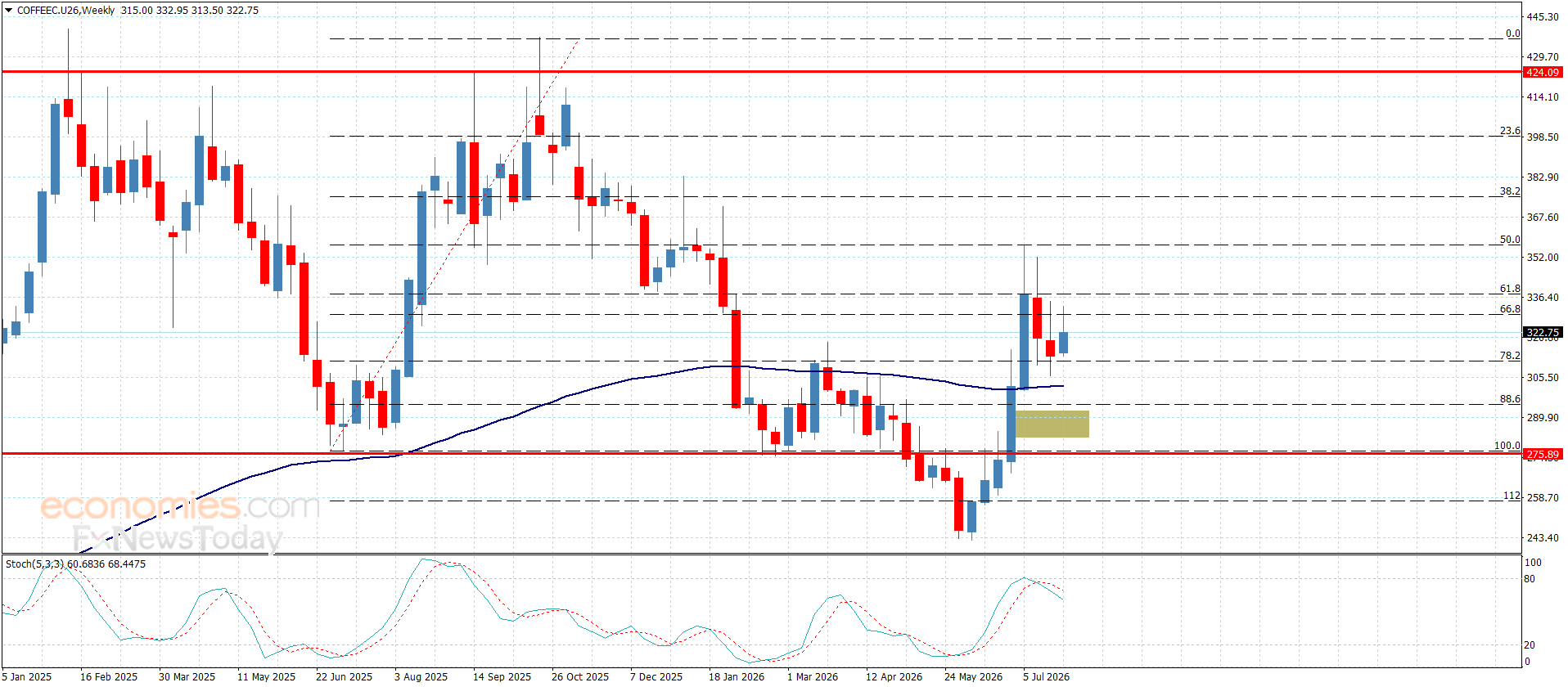
On the New York floor, the Arabica contract for September 2026 is at 313.80 US cents/lb. The December 2026 term is kept at 298.05 US cents/lb.
Compared to the most recent session, some price tables recorded Robusta July futures decreasing, while longer-term futures recovered; Arabica slightly increased in the main terms.
Coffee price assessment
Domestic coffee prices went sideways around the 96,000 VND/kg range after the recovery session, but were still significantly lower than the approaching 99,000 VND/kg range previously recorded.
From a global market perspective, the International Coffee Organization (ICO) said that the average ICO aggregate price index in June 2026 reached 248.90 US cents/lb, down 2.8% compared to May 2026. This shows that world coffee prices are still under adjustment pressure after a period of strong increase.
With Robusta, the Coffee Annual report of the Foreign Agricultural Services Agency of the US Department of Agriculture (USDA/FAS) forecasts that Vietnam’s coffee production in the 2026-2027 crop year will reach 32.5 million bags converted to green beans. The prospect of increased supply continues to be a factor that can curb the upward momentum in the medium term.
Regarding the weather, the Central Highlands is in the rainy season. The National Center for Hydro-Meteorological Forecasting forecasts that the Central Highlands region will have showers and thunderstorms in some places; especially in the afternoon and night, there will be rain, moderate rain and scattered thunderstorms, locally heavy rain, concentrated in the South.
In the coming sessions, developments on the London exchange, New York exchange, USD/VND exchange rate, inventory and demand for export purchases will continue to dominate the market.
TradingKey – As of the Asian session on July 27, gold prices ( XAUUSD) opened with a strong gap up today and maintained its upward momentum intraday, briefly breaking through $4,100 during the session to hit a high of $4,116. From a market perspective, gold prices rebounded after being weighed down last week by surging oil prices and expectations of Federal Reserve interest rate hikes. The primary driver was signs of a pause in clashes between the U.S. and Iran, which caused international oil prices to fall sharply, easing market concerns that energy prices would push up U.S. inflation.
From a fundamental perspective, the core factor influencing gold price trends recently has been the US-Iran situation. Previously, the escalating conflict between the US and Iran over the Strait of Hormuz and Gulf shipping security pushed Brent crude prices above $100 at one point. The market worried that rising energy prices would drive US inflation back up and force the Federal Reserve to maintain high interest rates for longer, or even keep the possibility of further rate hikes on the table, putting downward pressure on gold.
However, the US-Iran situation showed clear signs of cooling over the weekend. According to reports, Iran stated that as long as the US stops its attacks, Iran will also suspend its own attacks; meanwhile, the US has also suspended its bombing campaign against Iran. The latest reactions from both sides have temporarily pushed the US-Iran conflict into a de-escalation phase, easing market concerns over supply disruption risks in the Strait of Hormuz. Consequently, oil prices fell sharply, with Brent crude ( UKOIL) falling over 13% at one point today, and WTI crude ( USOIL) falling over 7%. The drop in oil prices is indirectly positive for gold, as falling energy prices help ease inflation expectations and weaken market bets on aggressive Fed rate hikes.
Brent crude price trend, Source: TradingView
It is worth noting that the risks of the US-Iran situation have not been truly resolved. Although both sides have suspended fire, this is currently a temporary de-escalation rather than a lasting peace agreement. The core conflicts between the US and Iran over transit rights in the Strait of Hormuz, Iran’s military capabilities, and its regional influence remain unresolved. Meanwhile, Yemen’s Houthi rebels continue to attack energy facilities along Saudi Arabia’s Red Sea coast, indicating that Middle East energy transit risks have not fully subsided. Should vessels in the Gulf or Red Sea routes be attacked again, or if port blockades or military retaliation occur in the future, oil prices could rebound, and gold could once again fall under pressure.
In addition, the Federal Reserve’s July interest rate meeting is coming up this week. The Fed will hold its interest rate policy meeting from July 28 to 29, and the market widely expects a high probability of rates being held steady, though uncertainty remains over whether it will hike rates in September. If Federal Reserve Chairman Kevin Warsh emphasizes falling oil prices and easing inflationary pressures in his post-meeting speech, gold may continue to benefit; however, if he continues to emphasize that inflation remains above target and the Fed should not rush to cut rates for the time being, the upside for gold prices will remain capped.
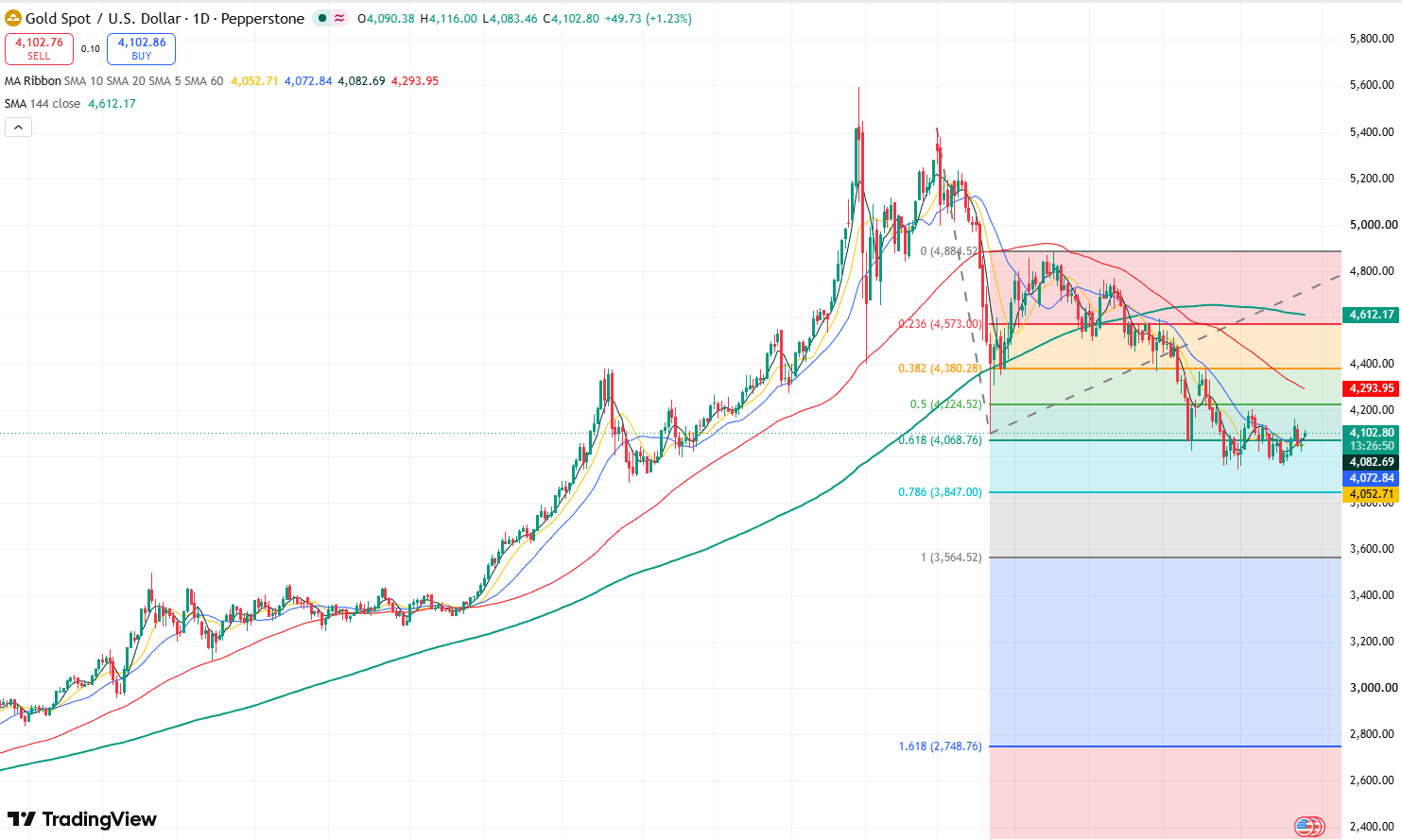
Gold price daily chart, Source: TradingView
Looking at gold’s daily chart, today’s gold price opened nearly $40 higher, supported by positive news of easing US-Iran tensions, indicating that market bullish sentiment has been boosted by the news, which may support a continued short-term rise in gold prices. Meanwhile, the moving average system shows that the gold price trend was previously suppressed by the 20-day moving average, but the recent trend has successfully broken through the resistance of the 20-day moving average, demonstrating that the market’s bullish momentum has been further strengthened.
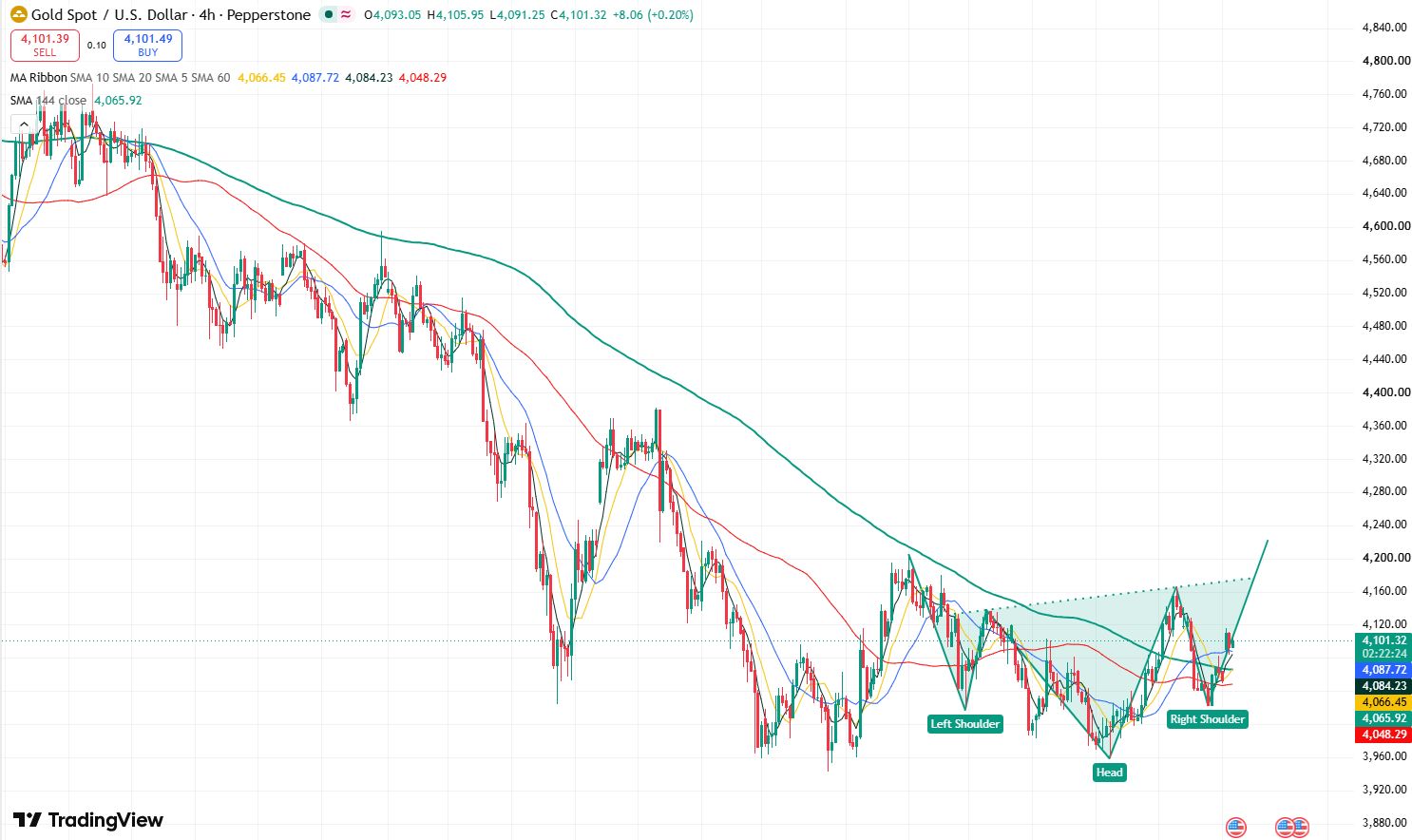
Gold price 4-hour chart, Source: TradingView
Looking at gold’s 4-hour chart, gold’s candlestick structure has formed an inverse head and shoulders pattern, which means that gold’s bullish momentum has been significantly enhanced, and the gold price will continue to rise in the short term. The primary upside target will be to break above the $4,200 resistance level, with the next hurdle at the $4,300 mark. If the gold price can break through $4,300, it will further test the key resistance level at $4,380.
On the downside, the primary support level for gold to watch is around $4,084. If this level is breached, the gold price may move downward to fill today’s gap, potentially falling back to around $4,050. If it continues to fall, it may further test the support level near $4,020.
This content was translated using AI and reviewed for clarity. It is for informational purposes only.
Natural gas price remains surrounded by strong factors that are represented by stability below the resistance of $3.350 besides forming extra barrier at $3.200 level, to confirm its surrender to the previously suggested bearish scenario.
The fluctuation near $2.880 level is caused by the attempt of gathering the required negative momentum to confirm breaking the barrier at $2.820, to ease the mission of resuming the bearish trend by reaching $2.620, where breaking it will confirm its move to a new negative station, to expect forming extra target at $2.620 support.
The expected trading range for today is between $2.620 and $3.100
Copper price is affected by some negative factors, starting by the stability below $6.5100 barrier, besides the continuation of providing negative momentum by stochastic, forcing it to delay the bullish attempts and providing negative fluctuation by holding near $62700.
The continuation of the negative pressure might push the price to retest the initial support at $6.1000, where breaking it will confirm the dominance of the bearish corrective bias in the upcoming trading, to expect forming initial corrective target at $5.9200 level, while breaching the barrier and holding above it will reinforce the chances of recording new gains by its rally towards $6.5900 initially.
The expected trading range for today is between $6.1000 and $6.4100