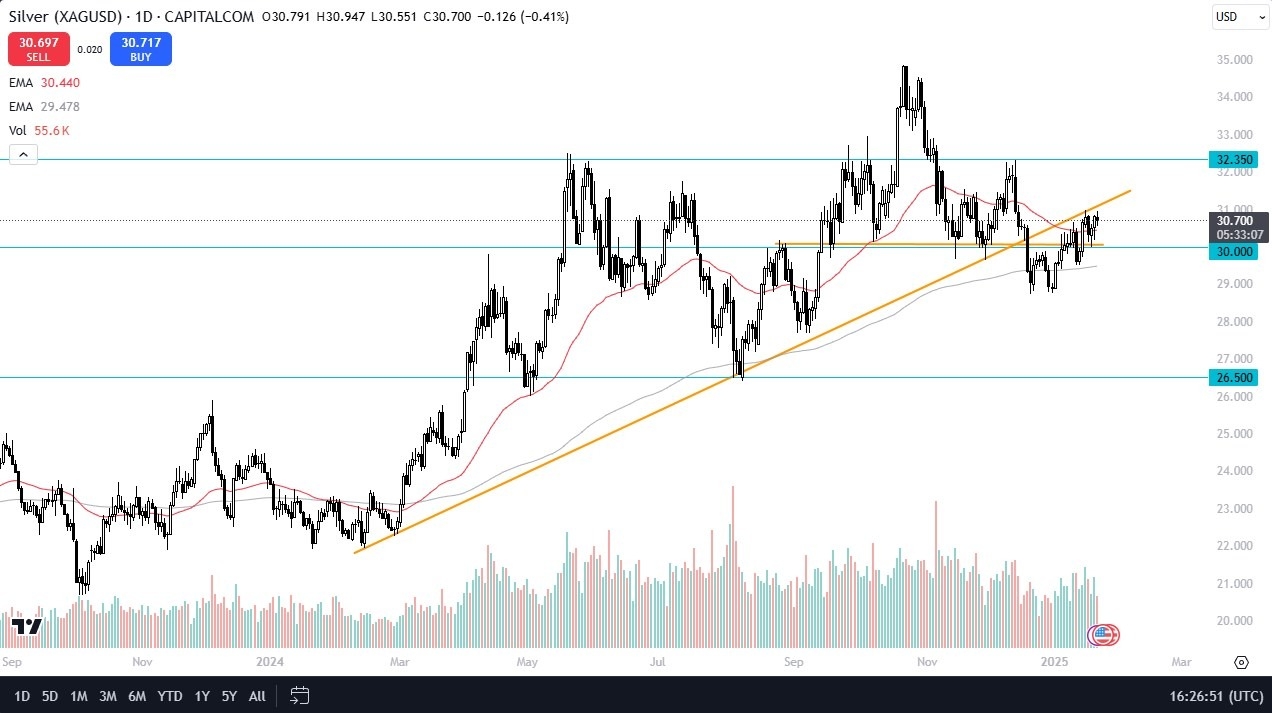
Unfortunately, most retail traders look at silver and gold through the same lens, but the recent price action is a good example of why that is not necessarily the case. As I look at the silver market right now, we are struggling a bit, but, at the same time, gold has broken above a significant resistance barrier. Because of this, the market is likely to continue to see a bit of a potential “pairs trade”, buying gold and shorting silver. Currently, silver is in a bit of a pickle.
Technical Analysis
The technical analysis for this pair is essentially sideways in the short term, but there are a lot of different things working against the price of silver right now. Therefore, you need to be cautious about buying in this market. That being said, the market is likely to continue to see a lot of questions asked of the $31 level above, which could of course be a major resistance barrier as it has been important a couple of times now. If we can break above the $31 level, the market is likely to continue to see buyers jump into the market, perhaps reaching the $32.35 level.
If we do break down from here, the market is likely going to look at the 50 Day EMA as a support level, and then of course after that, we have the $30 level offering a significant amount of support also. After that, then we have the 200 Day EMA, followed by the $28.75 level. This is an area where we have seen a little bit of a “double bottom” coming into the picture, so if we were to break down below that level, then I think silver really starts to fall apart.
All things being equal, the silver market is one that is heavily influenced by interest rates, and of course the stronger US dollar. Both of those are working against silver at the moment, so I think you’ve got a situation where we continue to see silver lag gold.
Natural gas price kept its stability within the bullish channel that its major support line located at 3.680$, to notice renewing the positive action by targeting 4.030$ barrier now, which formed the first target for the recent bullish overview.
Now, stochastic exit from the oversold areas will reinforce the chances of gathering the positive momentum to manage to surpass the current barrier and achieve additional gains by rallying towards 4.220$ followed by reaching the bullish channel’s resistance line at 4.420$.
The expected trading range for today is between 3.920$ and 4.220$
Gold price’s rise stopped near 2765.00$ level, to start bouncing bearishly after losing the positive momentum, as it returns to the bullish channel and trades below its resistance line, to hint starting bearish wave that targets visiting the mentioned channel’s support line, located now at 2707.00$.
Therefore, the bearish trend will be expected for today, and breaking 2744.00$ will ease the mission of achieving the suggested target, while breaching 2755.00$ will stop the suggested bearish wave and lead the price to resume the main bullish trend again.
The expected trading range for today is between 2730.00$ support and 2765.00$ resistance.
It is notable that last week’s trend high of 4.37 ended with a bearish candlestick pattern and a closing price below the previous trend high of 4.20. This means that if today’s advance continues, and it looks like it will, there is a good size resistance zone to be encountered before a chance at new trend highs.
If correct, the expectation would be for a period of consolidation largely contained with support around the uptrend line and key resistance at the most recent swing high of 4.33. There are a couple of prior weekly price levels that may see resistance. They include 4.02, 4.06, and 4.41. Also, there is a monthly high at 4.20.
Drop Below 3.64 is Bearish
Nonetheless, a decisive decline below the 3.64 price level increases the risk for a deeper correction. In that case, a drop to a price zone from 3.52 to 3.51 looks likely. That zone includes the 127.2% extended target for a descending ABCD pattern and the 61.8% Fibonacci retracement, respectively. A little lower is the 50-Day MA at 3.43. The 50-Day line is joined by the 3.39 prior peak from January 2024. If the 20-Day line fails to mark support, the 50-Day line becomes a target when considering moving average analysis.
Watch End of Month Relative Closing
On a monthly basis (not shown), natural gas has been progressing in a series of higher monthly highs and higher monthly lows for five months. The closing price for the month may provide a clue to the strength of weakness of demand. Currently, the trading range for the month of January is 3.33 to 4.37, which puts the middle at 3.85.
For a look at all of today’s economic events, check out our economic calendar.
It is notable that last week’s trend high of 4.37 ended with a bearish candlestick pattern and a closing price below the previous trend high of 4.20. This means that if today’s advance continues, and it looks like it will, there is a good size resistance zone to be encountered before a chance at new trend highs.
If correct, the expectation would be for a period of consolidation largely contained with support around the uptrend line and key resistance at the most recent swing high of 4.33. There are a couple of prior weekly price levels that may see resistance. They include 4.02, 4.06, and 4.41. Also, there is a monthly high at 4.20.
Drop Below 3.64 is Bearish
Nonetheless, a decisive decline below the 3.64 price level increases the risk for a deeper correction. In that case, a drop to a price zone from 3.52 to 3.51 looks likely. That zone includes the 127.2% extended target for a descending ABCD pattern and the 61.8% Fibonacci retracement, respectively. A little lower is the 50-Day MA at 3.43. The 50-Day line is joined by the 3.39 prior peak from January 2024. If the 20-Day line fails to mark support, the 50-Day line becomes a target when considering moving average analysis.
Watch End of Month Relative Closing
On a monthly basis (not shown), natural gas has been progressing in a series of higher monthly highs and higher monthly lows for five months. The closing price for the month may provide a clue to the strength of weakness of demand. Currently, the trading range for the month of January is 3.33 to 4.37, which puts the middle at 3.85.
For a look at all of today’s economic events, check out our economic calendar.
Silver prices forecast, XAG/USD continues to trade above the $30.50 mark, hovering close to its nine-day Exponential Moving Average (EMA).
Silver, often seen as a safe-haven asset, has displayed strong resilience in recent trading sessions. Currently, XAG/USD is maintaining its position above $30.50, a critical psychological level that traders are closely monitoring. This article delves into the factors influencing silver prices, the technical outlook for XAG/USD, and what investors can expect in the coming weeks.
Current Market Overview
As of now, silver is trading above the $30.50 threshold, supported by several macroeconomic factors. The ongoing geopolitical tensions, inflationary pressures, and shifts in monetary policy continue to create a favorable environment for precious metals, including silver.
Geopolitical uncertainties often drive investors towards safe-haven assets like silver and gold. Recent developments in various global hotspots have heightened market anxiety, prompting investors to seek refuge in precious metals. The ongoing conflicts and trade tensions have not only impacted investor sentiment but also contributed to fluctuations in the value of fiat currencies, further bolstering demand for silver.
Inflation remains a significant concern for many economies worldwide. Rising prices for goods and services have prompted central banks to reassess their monetary policies. In such environments, precious metals are traditionally viewed as a hedge against inflation, which is another factor propelling silver prices higher.
Interest Rate Environment
The Fed interest rate landscape is crucial in determining the attractiveness of non-yielding assets like silver. Current expectations suggest that central banks may adopt a more cautious approach to rate hikes, especially amid growing concerns about economic slowdowns. Lower interest rates typically benefit precious metals as they reduce the opportunity cost of holding them, making silver more appealing to investors.
Technical Analysis of XAG/USD
Key Support and Resistance Levels On the technical front, XAG/USD’s ability to hold above the $30.50 level is significant. This area serves as both a psychological support level and a technical benchmark. Traders will be looking for signs of consolidation above this level to confirm bullish momentum.
Support Level: The $30.50 mark is a crucial support level. A sustained breach below this could signal a shift in sentiment, leading to further declines.
Resistance Level: On the upside, key resistance is around $31.50. A breakout above this level could pave the way for further gains, potentially targeting the $32.00 region.
Moving Averages
The nine-day Exponential Moving Average (EMA) is currently acting as a dynamic support level for XAG/USD. The alignment of the price above this EMA indicates that bullish momentum may persist in the near term. Traders often look for crossovers to identify potential trend reversals or continuations, making the EMA a critical tool in their analysis.
Momentum Indicators
Momentum indicators, such as the Relative Strength Index (RSI), can provide insights into the strength of the current trend. If the RSI remains above the 50 level, it suggests that the bullish trend is intact. However, if it approaches overbought territory (above 70), it may indicate a potential pullback.
Market Sentiment and Investor Behavior
Bullish Sentiment Market sentiment around silver remains predominantly bullish, driven by the factors discussed earlier. Traders are increasingly optimistic about silver’s potential to outperform in the current economic climate. The combination of geopolitical tensions, inflation fears, and a supportive interest rate environment has created a favorable backdrop for silver investment.
Institutional Interest Institutional investors have also been showing a renewed interest in silver. As more funds allocate capital towards precious metals, this influx of institutional money could provide additional support for prices. Furthermore, exchange-traded funds (ETFs) that focus on silver have seen increased inflows, reflecting growing confidence among investors.
Retail Investor Activity Retail investors are also becoming more active in the silver market, particularly as prices hold steady above essential support levels. The accessibility of trading platforms and the availability of silver-related investment products have made it easier for individual investors to participate in this market.
Future Outlook for XAG/USD
In the short term, XAG/USD is likely to remain influenced by ongoing economic data releases and geopolitical developments. Key economic indicators, including inflation rates and employment data, will be closely watched as they could impact central bank policies and, consequently, silver prices.
Positive Scenario: If inflation continues to rise and geopolitical tensions escalate, silver could break above the $31.50 resistance level, paving the way for further gains.
Negative Scenario: Conversely, if economic data suggests a stronger-than-expected recovery, leading to a more aggressive rate hike stance from central banks, silver may struggle to maintain its current levels.
Long-Term Considerations
Looking further ahead, several factors could shape the long-term outlook for silver prices: Sustainable Inflation: If inflation proves to be persistent, silver may continue to gain traction as a hedge. Green Energy Demand: The growing emphasis on renewable energy and electric vehicles could drive increased demand for silver, which is used in various applications, including solar panels and batteries. Central Bank Policies: Ongoing adjustments in monetary policy will be crucial. A shift towards dovish policies may provide further support for silver prices.
Conclusion
In summary, XAG/USD’s ability to hold above the $30.50 mark, coupled with supportive technical indicators, presents a cautiously optimistic outlook for silver prices. Geopolitical tensions, inflationary concerns, and a favorable interest rate environment are all contributing to a bullish sentiment around silver.
Investors should remain vigilant, monitoring both technical levels and macroeconomic developments, as these factors will undoubtedly influence the trajectory of silver prices in the coming weeks and months. As always, prudent risk management and a well-defined investment strategy will be essential for navigating the complexities of the silver market.
When considering shares, indices, forex (foreign exchange) and commodities for trading and price predictions, remember that trading CFDs involves a significant degree of risk and could result in capital loss.
Past performance is not indicative of any future results. This information is provided for informative purposes only and should not be construed to be investment advice.
3M’s stock price (MMM) rallied in the intraday levels, accompanied by a surge in trading volumes, while managing to pierce the pivotal resistance of $141.45, amid the dominance of the main upward trend in the medium term, with positive pressure due to trading above the 50-day SMA, countered with negative signals from the RSI after reaching overbought levels.
Therefore we expect more gains for the stock, provided it settles firmly above $141.45, targeting the resistance of $168.54.
Gold prices kept the bullish bias above the $2,760 mark on Wednesday.
The US Dollar regained the smile amid mixed US yields.
Steady uncertainty around Trump’s policies seems to benefit the metal.
Gold Extends gains amid tariff concerns
Gold (XAU/USD) continued its weekly rally on Wednesday, marking its third consecutive day of gains. The precious metal climbed above $2,760 per troy ounce for the firdt time since early November, driven by persistent unceratainty surrounding President Trump’s announcements, particulalry regarding to tariffs.
Somewhat limiting the metal’s appeal, the US Dollar (USD) regained part of its shine lost as of late, with the Dollar Index (DXY) regaining upside traction and bouncing off recent multi-week lows, while US yields traded in a mixed fashion across various maturity periods.
Still around Trump, he announced plans to impose tariffs on the European Union, Canada and Mexico, and revealed that his administration was considering a 10% tariff on Chinese imports. The move, he claimed, was in response to fentanyl being trafficked from China to the United States through Mexico and Canada.
However, these policies could complicate the outlook for the yellow metal. While gold is traditionally seen as an inflation hedge, analysts believe that if Trump’s tariff-driven policies stoke inflation, the Federal Reserve (Fed) might be forced to keep interest rates elevated for a longer period, dampening gold’s appeal, as it is a non-yielding asset and tends to lose its shine in a high-rate environment.
What’s next for Gold?
Looking ahead, the market’s focus will likely remain on developments from the White House, especially in a light week for major economic data releases. Investors are also preparing for the Fed’s January 28–29 meeting, where interest rates are widely expected to stay in their 4.25%-4.50% range.
As political uncertainty and central bank decisions loom large, gold remains a key asset to watch, with volatility likely on the horizon.
Gold’s Technical Outlook
In the near term, gold’s next major resistance is $2,763, the 2025 high reached on January 22. Beyond that, traders will target the all-time high of $2,790, recorded on October 31. If these levels are surpassed, Fibonacci projections suggest further upside milestones at $3,009, $3,123, and $3,288.
On the downside, key support levels include December’s low of $2,582, November’s low of $2,536, and the 200-day moving average at $2,515. Deeper corrections could push prices toward $2,471 (the September low) or even $2,353 (July’s weekly low).
Should a significant selloff occur, watch for levels around $2,286 (June low) and $2,277 (May low). The ultimate downside target for now stands at $1,984, the February 2024 low—a substantial retracement from current prices.
Silver price extends its upside to near $31.00 amid a sell-off in the US Dollar.
The Greenback faces pressure as Trump has announced lower tariffs on China than expected.
The Fed is expected to keep interest rates steady in the next three policy meetings.
Silver price (XAG/USD) reclaims a more-than-a-month high of $30.95 in Wednesday’s European session. The white metal strengthens as the US Dollar (USD) extends its downside due to less-fearful tariff plans announced by United States (US) President Donald Trump in his first two days of administration.
The US Dollar Index (DXY), which tracks the Greenback’s value against six major currencies, refreshes a two-week low at 107.80. The lower US Dollar makes the Silver price inexpensive for investors. 10-year US Treasury yields tick lower to near 4.57%.
Trump has announced 25% tariffs on Mexico and Canada and is discussing 10% tariffs on China from February 1. However, his comments during the election campaign indicated that the tariffs would be much higher than what he actually announced.
Lower tariffs by Trump would also weigh on market speculation that the Federal Reserve (Fed) will keep interest rates at their current levels for longer. Market participants were anticipating that higher tariffs would increase demand for domestically produced goods and services. This scenario would have accelerated inflationary pressures.
Currently, the CME FedWatch tool shows that traders are confident that the Fed will keep its key borrowing rates in the range of 4.25%-4.50% in the coming three policy meetings.
Silver technical analysis
Silver price gathers strength to return above the north-side sloping trendline near $30.85, which is plotted from the 29 February 2024 low of $22.30 on a daily timeframe.
The white metal discovered strong buying interest near the 200-day Exponential Moving Average (EMA), around $29.45, and has now extended its upside above the 20-day EMA, which is around $30.26. This suggests that the overall trend has turned bullish.
The 14-day Relative Strength Index (RSI) rises to near 60.00. A fresh bullish momentum would trigger if it manages to break above 60.00.
Silver daily chart
Silver FAQs
Silver is a precious metal highly traded among investors. It has been historically used as a store of value and a medium of exchange. Although less popular than Gold, traders may turn to Silver to diversify their investment portfolio, for its intrinsic value or as a potential hedge during high-inflation periods. Investors can buy physical Silver, in coins or in bars, or trade it through vehicles such as Exchange Traded Funds, which track its price on international markets.
Silver prices can move due to a wide range of factors. Geopolitical instability or fears of a deep recession can make Silver price escalate due to its safe-haven status, although to a lesser extent than Gold’s. As a yieldless asset, Silver tends to rise with lower interest rates. Its moves also depend on how the US Dollar (USD) behaves as the asset is priced in dollars (XAG/USD). A strong Dollar tends to keep the price of Silver at bay, whereas a weaker Dollar is likely to propel prices up. Other factors such as investment demand, mining supply – Silver is much more abundant than Gold – and recycling rates can also affect prices.
Silver is widely used in industry, particularly in sectors such as electronics or solar energy, as it has one of the highest electric conductivity of all metals – more than Copper and Gold. A surge in demand can increase prices, while a decline tends to lower them. Dynamics in the US, Chinese and Indian economies can also contribute to price swings: for the US and particularly China, their big industrial sectors use Silver in various processes; in India, consumers’ demand for the precious metal for jewellery also plays a key role in setting prices.
Silver prices tend to follow Gold’s moves. When Gold prices rise, Silver typically follows suit, as their status as safe-haven assets is similar. The Gold/Silver ratio, which shows the number of ounces of Silver needed to equal the value of one ounce of Gold, may help to determine the relative valuation between both metals. Some investors may consider a high ratio as an indicator that Silver is undervalued, or Gold is overvalued. On the contrary, a low ratio might suggest that Gold is undervalued relative to Silver.
Lumen Technologies’ stock price (LUMN) returned lower in the intraday levels, amid the dominance of the downward correctional trend in the short term, with negative pressure due to trading below the 50-day SMA, coupled with negative signals from the RSI after reaching overbought levels compared to the stock’s movements, hinting at negative divergence.
Therefore we expect more losses for the stock, provided it settles firmly below the resistance of $5.90, and targeting the support of $4.52.