The main tag of Gold News Today Articles.
You can use the search box below to find what you need.
[wd_asp id=1]

18 12, 2024

XAG/USD struggles near $30.40 area, seems vulnerable below 100-day SMA

By |2024-12-18T16:49:14+02:00December 18, 2024|Forex News, News|0 Comments


  • Silver meets with a fresh supply near the 100-day SMA pivotal support breakpoint.
  • The technical setup suggests that the path of least resistance is to the downside.
  • Bears might still wait for a sustained break and acceptance below the $30.00 mark.

Silver (XAG/USD) struggles to capitalize on the previous day’s modest rebound from the vicinity of the monthly low, around the $30.00 psychological mark and attracts some sellers on Wednesday. The white metal remains depressed through the first half of the European session and currently trades just below mid-$30.00s, down nearly 0.30% for the day. 

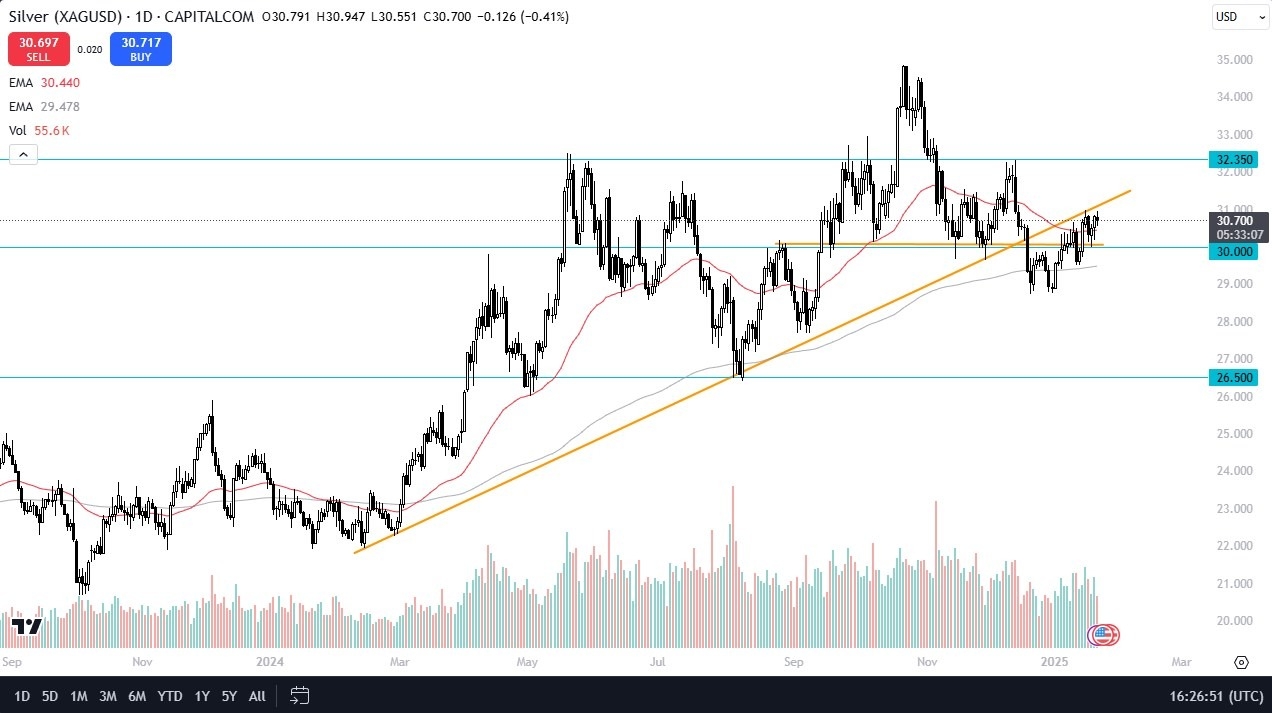
From a technical perspective, the recent failure near the $32.35 horizontal resistance and a subsequent slide back below the 100-day Simple Moving Average (SMA) favors bearish traders. Moreover, oscillators on the daily chart are holding in negative territory and are far from being in the oversold zone, suggesting that the path of least resistance for the XAG/USD is to the downside. 

That said, it will still be prudent to wait for a sustained breakdown below the $30.00 mark before positioning for deeper losses. The XAG/USD might then weaken further below the November monthly swing low, around the $29.70-$29.65 area, towards testing the next relevant support near the $29.10-$29.00 region, which if broken should pave the way for an extension of a near two-month-old downtrend. 

On the flip side, the 100-day SMA, currently around the $30.60 region, closely followed by the weekly top near the $30.75 area, now seems to act as an immediate hurdles. Some follow-through buying could assist the XAG/USD to reclaim the $31.00 mark and climb to the $31.45-$31.50 supply zone. The move up could extend towards the $32.00 round figure, which if cleared will negate the bearish outlook.

Silver daily chart

Silver FAQs

Silver is a precious metal highly traded among investors. It has been historically used as a store of value and a medium of exchange. Although less popular than Gold, traders may turn to Silver to diversify their investment portfolio, for its intrinsic value or as a potential hedge during high-inflation periods. Investors can buy physical Silver, in coins or in bars, or trade it through vehicles such as Exchange Traded Funds, which track its price on international markets.

Silver prices can move due to a wide range of factors. Geopolitical instability or fears of a deep recession can make Silver price escalate due to its safe-haven status, although to a lesser extent than Gold’s. As a yieldless asset, Silver tends to rise with lower interest rates. Its moves also depend on how the US Dollar (USD) behaves as the asset is priced in dollars (XAG/USD). A strong Dollar tends to keep the price of Silver at bay, whereas a weaker Dollar is likely to propel prices up. Other factors such as investment demand, mining supply – Silver is much more abundant than Gold – and recycling rates can also affect prices.

Silver is widely used in industry, particularly in sectors such as electronics or solar energy, as it has one of the highest electric conductivity of all metals – more than Copper and Gold. A surge in demand can increase prices, while a decline tends to lower them. Dynamics in the US, Chinese and Indian economies can also contribute to price swings: for the US and particularly China, their big industrial sectors use Silver in various processes; in India, consumers’ demand for the precious metal for jewellery also plays a key role in setting prices.

Silver prices tend to follow Gold’s moves. When Gold prices rise, Silver typically follows suit, as their status as safe-haven assets is similar. The Gold/Silver ratio, which shows the number of ounces of Silver needed to equal the value of one ounce of Gold, may help to determine the relative valuation between both metals. Some investors may consider a high ratio as an indicator that Silver is undervalued, or Gold is overvalued. On the contrary, a low ratio might suggest that Gold is undervalued relative to Silver.


Source link

18 12, 2024

XAG/USD hovers around $30.50 within a horizontal channel

By |2024-12-18T08:44:27+02:00December 18, 2024|Forex News, News|0 Comments


  • Silver price consolidates within the horizontal channel pattern.
  • The alignment of the nine- and 14-day EMAs indicates an absence of clear directional momentum.
  • The 14-day RSI consolidates below the 50 mark, suggesting an emergence of the bearish bias.

Silver price (XAG/USD) remains subdued for the fifth successive day, trading around $30.50 per troy ounce during the Asian hours on Wednesday. Analysis of the daily chart indicates a period of market consolidation as the pair is confined within the horizontal channel pattern.

Additionally, the alignment of the nine- and 14-day Exponential Moving Averages (EMAs) suggests that the short-term price movement is experiencing a period of consolidation, lacking a strong directional momentum. However, the 14-day Relative Strength Index (RSI) consolidates below the 50 mark, suggesting an emergence of the bearish bias.

On the downside, the XAG/USD pair may find its primary support around the lower boundary of the horizontal channel at $29.90, followed by a “throwback support” level at its three-month low of $29.65, which was recorded on November 28.

Regarding its resistance, the XAG/USD may test the nine- and 14-day EMAs at $30.82 and $30.90, respectively. A break above these levels could cause the bullish bias to re-emerge and help the Silver price to retest its six-week high of $32.28, reached on December 9, followed by the horizontal channel’s upper boundary at $32.50.

XAG/USD: Daily Chart

Silver FAQs

Silver is a precious metal highly traded among investors. It has been historically used as a store of value and a medium of exchange. Although less popular than Gold, traders may turn to Silver to diversify their investment portfolio, for its intrinsic value or as a potential hedge during high-inflation periods. Investors can buy physical Silver, in coins or in bars, or trade it through vehicles such as Exchange Traded Funds, which track its price on international markets.

Silver prices can move due to a wide range of factors. Geopolitical instability or fears of a deep recession can make Silver price escalate due to its safe-haven status, although to a lesser extent than Gold’s. As a yieldless asset, Silver tends to rise with lower interest rates. Its moves also depend on how the US Dollar (USD) behaves as the asset is priced in dollars (XAG/USD). A strong Dollar tends to keep the price of Silver at bay, whereas a weaker Dollar is likely to propel prices up. Other factors such as investment demand, mining supply – Silver is much more abundant than Gold – and recycling rates can also affect prices.

Silver is widely used in industry, particularly in sectors such as electronics or solar energy, as it has one of the highest electric conductivity of all metals – more than Copper and Gold. A surge in demand can increase prices, while a decline tends to lower them. Dynamics in the US, Chinese and Indian economies can also contribute to price swings: for the US and particularly China, their big industrial sectors use Silver in various processes; in India, consumers’ demand for the precious metal for jewellery also plays a key role in setting prices.

Silver prices tend to follow Gold’s moves. When Gold prices rise, Silver typically follows suit, as their status as safe-haven assets is similar. The Gold/Silver ratio, which shows the number of ounces of Silver needed to equal the value of one ounce of Gold, may help to determine the relative valuation between both metals. Some investors may consider a high ratio as an indicator that Silver is undervalued, or Gold is overvalued. On the contrary, a low ratio might suggest that Gold is undervalued relative to Silver.


Source link

18 12, 2024

XAU/USD extends range play around $2,650 as Fed verdict looms

By |2024-12-18T06:43:44+02:00December 18, 2024|Forex News, News|0 Comments


  • Gold price recovers from weekly lows, struggling near $2,650 ahead of the Fed policy verdict.        
  • The US Dollar stays defensive as Treasury bond yields pause amid market caution.  
  • The daily technical setup suggests that Gold price remains exposed to downside risks.

Despite the latest uptick, Gold price remains in a familiar range near $2,650 early Wednesday. Gold price appears to lack bullish commitment in the lead-up to the US Federal Reserve (Fed) showdown.

Gold price looks to Fed decision and Powell’s presser

Gold price has failed to sustain the upside attempts so far this week, giving into the bearish pressures on Tuesday to hit the lowest level in six days at $2,633. The unabated buying interest in US Treasury bond yields mainly sponsored the downturn in Gold price. Markets continued to believe that the Fed could pause its easing cycle early next year, especially after robust US Retail Sales data.

US Retail Sales increased 0.7% in November, outpacing expectations of a 0.5% growth in the reported period. However, the US Treasury bond yields quickly pulled back due to worsening risk sentiment on global markets. Traders turned cautious and refrained from placing bets on risk assets ahead of the critical Fed interest rate decision. This helped Gold price to limit losses and regain $2,640 at the close.

Markets remain risk-averse early Wednesday, with traders non-committal on their US Dollar positions, leaving Gold price gyrating in a narrow band. The next direction in Gold price now remains at the mercy of the language in the Fed’s policy statements, its economic projections and Chairman Jerome Powell’s press conference.

If the Summary of Economic Projections (SEP), the so-called ‘Dot-plot’ chart, points to fewer rate cuts next year than previously forecast, the US Dollar will likely see a fresh leg higher at the expense of the non-interest-bearing Gold price. Powell’s comments will also be closely scrutinised for the timing of the next rate cut if he expresses caution about inflation under Donald Trump’s presidency.

Risks appears skewed to the downside in Gold price, justified by the hawkish Fed expectations and the daily technical setup.

Gold price technical analysis: Daily chart

The daily chart shows that Gold price surrendered the 21-day Simple Moving Average (SMA) at $2,655 once again.

The 14-day Relative Strength Index (RSI) is trading flat but below the 50 level, suggesting that sellers could retain control going forward.

The immediate resistance aligns at the 21-day SMA at $2,655. However, Gold buyers need to find acceptance above the 50-day SMA at $2,672 to initiate a meaningful upside toward the $2,700 level.

Further up,  Gold price could revisit the multi-week high of $2,726.

On the downside, the weekly low of $2,633 could offer some support, below which the December 6 low of $2,613 will be tested.

Gold sellers will then target the $2,600 area, where the 100-day SMA coincides with the November 26 low.

Gold FAQs

Gold has played a key role in human’s history as it has been widely used as a store of value and medium of exchange. Currently, apart from its shine and usage for jewelry, the precious metal is widely seen as a safe-haven asset, meaning that it is considered a good investment during turbulent times. Gold is also widely seen as a hedge against inflation and against depreciating currencies as it doesn’t rely on any specific issuer or government.

Central banks are the biggest Gold holders. In their aim to support their currencies in turbulent times, central banks tend to diversify their reserves and buy Gold to improve the perceived strength of the economy and the currency. High Gold reserves can be a source of trust for a country’s solvency. Central banks added 1,136 tonnes of Gold worth around $70 billion to their reserves in 2022, according to data from the World Gold Council. This is the highest yearly purchase since records began. Central banks from emerging economies such as China, India and Turkey are quickly increasing their Gold reserves.

Gold has an inverse correlation with the US Dollar and US Treasuries, which are both major reserve and safe-haven assets. When the Dollar depreciates, Gold tends to rise, enabling investors and central banks to diversify their assets in turbulent times. Gold is also inversely correlated with risk assets. A rally in the stock market tends to weaken Gold price, while sell-offs in riskier markets tend to favor the precious metal.

The price can move due to a wide range of factors. Geopolitical instability or fears of a deep recession can quickly make Gold price escalate due to its safe-haven status. As a yield-less asset, Gold tends to rise with lower interest rates, while higher cost of money usually weighs down on the yellow metal. Still, most moves depend on how the US Dollar (USD) behaves as the asset is priced in dollars (XAU/USD). A strong Dollar tends to keep the price of Gold controlled, whereas a weaker Dollar is likely to push Gold prices up.


Source link

18 12, 2024

Crude Oil Price Forecast: Pullback Sets Stage for Potential Upside Continuation

By |2024-12-18T04:42:48+02:00December 18, 2024|Forex News, News|0 Comments


Finds Support at 20-Day Line

Notice that today’s pullback to the 20-Day line was the first test of a previous resistance area since last week’s bullish breakout. The 20-Day line was reclaimed on the same day the consolidation breakout triggered. Since a new lower swing high has been generated as of today, that high at 69.98 can be watched as a potential pivot.

A little further up is a more significant upswing high at 71.79. If crude can get above and stay above that price level, higher prices become more likely. Previous resistance shows around the 70.19 to 73.27 highs, which corresponds to the 50% retracement at 72.97.

Consolidation Breakout Could Trigger Momentum Spike

However, since a breakout of consolidation triggered there is the potential for a more aggressive move higher given the compression of the price range over recent months. In that case the 61.8% Fibonacci retracement is at 74.42 followed the 78.6% retracement at 76.47.

Also, notice that the lower boundary line of a large symmetrical triangle pattern cuts through the area between the two price levels. It also represents potential resistance. It will be interesting to see how crude oil relates to the line given that it represents the triangle.

Downward Pressure Remains

Overall, crude remains in a downtrend. The more significant swing low of the price structure of the trend is at the swing high of 73.27 from early-October. If that price level is exceeded, then a bullish long-term reversal is indicated and an upside breakout through the triangle would have also been triggered. Regardless of current technical indications, patterns evolve or fail if they don’t follow through on the initial distinction.


Source link

18 12, 2024

Natural Gas Price Forecast: Eyes Upside Targets After Bullish Reversal Signal

By |2024-12-18T02:42:02+02:00December 18, 2024|Forex News, News|0 Comments


Short-term ABCD Pattern Points to 4.33

Measured moves can be used from the nearby swings to identify an upside target from recent swings. On the chart it takes the form of an ABCD pattern. The pattern looks for price symmetry between the two advancing swings, AB and CD. Other larger patterns also identify other price target levels on the chart.

The pink ABCD pattern on the chart shows the closest swings. An initial target from this pattern is up at 4.33. That is a target well above the top of the recent symmetrical triangle at 3.64. It would align with the potential for a pickup in momentum following the triangle breakout.

Triangle Top at 3.64

Nonetheless, an initial upside breakout and bull trend continuation signal is triggered above the recent highs of 3.56. That would put natural gas well on its way to approaching the top of the triangle at 3.64. Certainly, bullish momentum has the potential to have natural gas bust right through that high and head towards higher targets. Higher targets, prior to reaching 4.33, would be around the 38.2% retracement at 3.85.

Potential Inside Week in Process

Although it continues to look like there is a good chance this week will end as an inside week, if it does it sets up for the potential of a weekly inside week breakout for next week. Further up from the 38.2% retracement is a extended target for a rising ABCD pattern (purple) at 4.06.

Also, let’s consider the 4.33 target along with other price levels. Looking at the chart can be seen that there is the confluence of several indicators starting from the 4.06 price level. The target price range goes to 4.39 and then 4.50, followed by 4.56. Resistance could be seen anywhere within that zone, if it is reached.

For a look at all of today’s economic events, check out our economic calendar.


Source link

18 12, 2024

XAG/USD slips below 100-day SMA, eyes $30.00

By |2024-12-18T00:40:47+02:00December 18, 2024|Forex News, News|0 Comments


  • Silver price falls 0.28%, signaling potential further downside.
  • Technical indicators suggest fading bullish momentum, with a near-term focus on the 200-day SMA at $29.55.
  • Resistance levels include the 100-day SMA at $30.57 and the 50-day SMA at $31.54; support could extend to $27.69 if the downtrend continues.

Silver price drops below the 100-day Simple Moving Average (SMA) of $30.57, extending its losses to four consecutive days, as the Greenback remains firm. At the time of writing, the XAG/USD trades at $30.42 a troy ounce, down 0.28%.

XAG/USD Price Forecast: Technical outlook

Silver continues to consolidate within the $30.00-$31.00 range for the last three trading days, clearing on its way to the bottom of the range, the 50 and 100-day Simple Moving Averages (SMAs).

Although the grey metal continues to respect the trend of higher highs and higher lows, bullish momentum seems to be fading as the XAG/USD spot price approaches the 200-day Simple Moving Average (SMA) at $29.55.

If Silver clears the latter, the bias will shift bearish, paving the way for testing $27.69, the September 6 swing low, followed by the August 8 low of $26.44.

On the upside, the 100-day SMA at $30.57 must be cleared before facing key resistance at the 50-day SMA at $31.54. On further strength, the next resistance would be the December 12 peak at $32.32.

XAG/USD Price Chart – Daily

Silver FAQs

Silver is a precious metal highly traded among investors. It has been historically used as a store of value and a medium of exchange. Although less popular than Gold, traders may turn to Silver to diversify their investment portfolio, for its intrinsic value or as a potential hedge during high-inflation periods. Investors can buy physical Silver, in coins or in bars, or trade it through vehicles such as Exchange Traded Funds, which track its price on international markets.

Silver prices can move due to a wide range of factors. Geopolitical instability or fears of a deep recession can make Silver price escalate due to its safe-haven status, although to a lesser extent than Gold’s. As a yieldless asset, Silver tends to rise with lower interest rates. Its moves also depend on how the US Dollar (USD) behaves as the asset is priced in dollars (XAG/USD). A strong Dollar tends to keep the price of Silver at bay, whereas a weaker Dollar is likely to propel prices up. Other factors such as investment demand, mining supply – Silver is much more abundant than Gold – and recycling rates can also affect prices.

Silver is widely used in industry, particularly in sectors such as electronics or solar energy, as it has one of the highest electric conductivity of all metals – more than Copper and Gold. A surge in demand can increase prices, while a decline tends to lower them. Dynamics in the US, Chinese and Indian economies can also contribute to price swings: for the US and particularly China, their big industrial sectors use Silver in various processes; in India, consumers’ demand for the precious metal for jewellery also plays a key role in setting prices.

Silver prices tend to follow Gold’s moves. When Gold prices rise, Silver typically follows suit, as their status as safe-haven assets is similar. The Gold/Silver ratio, which shows the number of ounces of Silver needed to equal the value of one ounce of Gold, may help to determine the relative valuation between both metals. Some investors may consider a high ratio as an indicator that Silver is undervalued, or Gold is overvalued. On the contrary, a low ratio might suggest that Gold is undervalued relative to Silver.


Source link

17 12, 2024

XAU/USD under pressure around $2,640

By |2024-12-17T22:40:13+02:00December 17, 2024|Forex News, News|0 Comments


XAU/USD Current price: $2,640.51

  • Canada’s inflation and the United Kingdom’s inflation hint at more central banks’ action.
  • The Federal Reserve will announce its decision on monetary policy on Wednesday.
  • XAU/USD posted a fresh weekly low, could soon revisit the $2,600 mark.

Spot Gold settled a fresh weekly low of $2,633.00 a troy ounce early in the American session, bouncing just modestly from the level in a risk-averse environment. Following a mixed performance of its overseas counterparts, Wall Street is firmly down, with the three major indexes trading in the red.

Investors got mixed macroeconomic headlines, as United States (US) Retail Sales were up a modest 0.7%, better than the 0.5% expected, yet not enough to boost the mood. The country also reported that November Capacity Utilization rose 76.8%, worse than the 77.3% expected, while Industrial Production in the same period fell 0.1%, missing the 0.3% advance anticipated by market analysts.

Meanwhile, the United Kingdom (UK) published its monthly employment figures, which showed that the ILO Unemployment Rate stayed unchanged at 4.3% in the three months to October, while the number of people claiming jobless benefits climbed by only 0.3K in November. Finally, the report showed an unexpected advance in wage pressures as Average Earnings excluding Bonus grew by 5.2% 3M YoY in October, while including bonuses were also up by 5.2%, both surpassing the market’s expectations.

Additionally, Canada reported that the Consumer Price Index (CPI) declined to 1.9% on a yearly basis in November, below the market expectation of 2%. On a monthly basis, the CPI matched the 0.4% increase recorded in October.

The US Dollar trades mixed across the FX board, firmer against commodity-linked currencies and barely down against European rivals, as the Federal Reserve (Fed) monetary policy announcement looms. The Fed will unveil its decision on monetary policy on Wednesday, and is widely anticipated to cut the benchmark interest rate by 25 basis points (bps). The focus will then be on the Summary of Economic Projections (SEP) and Chairman Jerome Powell’s words on what 2025 may bring.

XAU/USD short-term technical outlook

From a technical point of view, the daily chart for the XAU/USD pair suggests the pair may extend its slide. It met buyers around a now flat 20 Simple Moving Average (SMA), providing dynamic resistance at around $2,655. The 100 and 200 SMAs keep heading higher well below the current level, with the 100 SMA developing in the $2,602 region. Finally, technical indicators turned lower. The Momentum indicator remains within neutral levels, but the Relative Strength Index (RSI) indicator aims lower at 46, reflecting mounting selling pressure.

The near-term picture is bearish. The XAU/USD trades below all its moving averages in the 4-hour chart, with the 20 SMA accelerating south right above converging 100 and 200 SMAs. Technical indicators, in the meantime, turned marginally higher but remain within negative levels, falling short of supporting a recovery in the upcoming Asian session.

Support levels: 2,633.00 2,617.90 2,603.15

Resistance levels: 2,643.40 2,657.30, 2,672.70 


Source link

17 12, 2024

XAG/USD declines to near $30.30 as Fed to back fewer interest rate cuts in 2025

By |2024-12-17T16:37:45+02:00December 17, 2024|Forex News, News|0 Comments


  • Silver price refreshes a two-week low near $32.30 as bond yields continue their upside momentum ahead of the Fed’s policy.
  • The Fed is expected to cut interest rates by 25 bps to 4.25%-4.50% on Wednesday.
  • Investors expect the Fed to deliver slightly hawkish remarks on the interest rate outlook.

Silver price (XAG/USD) slumps to near $30.30 in Tuesday’s European session. The white metal weakens as bond yields stay firm on expectations that the Federal Reserve (Fed) will signal fewer interest rate reductions in 2025 after reducing key borrowing rates by 25 basis points (bps) to 4.25%-4.50% in the monetary policy meeting on Wednesday.

10-year US Treasury yields extend their winning streak for the seventh trading day on Tuesday, rises to near 4.42%. Higher yields on interest-bearing assets bode poorly for non-yielding assets such as Silver as they increase their opportunity cost. The US Dollar Index (DXY), which tracks the Greenback’s value against six major currencies, moves higher around 107.00.

According to a Bloomberg survey, the Fed is expected to cut interest rates three times in 2025. Fed’s policy-easing cycle would be more gradual as economists worry about rising upside risks to inflation than downside risks to employment.

Investors will pay close attention to Fed Chair Jerome Powell’s press conference to get cues about to what extent policies by incoming US President Donald Trump, such as immigration, trade and taxes, will influence inflationary pressures and interest rates.

Silver technical analysis

Silver price refreshes a two-week low near $30.30 on Tuesday. The white metal weakens after breaking below the 20-day Exponential Moving Average (EMA), which trades around $31.00.

The 14-day Relative Strength Index (RSI) oscillates inside the 40.00-60.00 range, suggesting a sideways trend.

Looking down, the upward-sloping trendline around $29.50, which is plotted from the February 29 low of $22.30 on a daily timeframe, would act as key support for the Silver price. On the upside, the horizontal resistance plotted from the May 21 high of $32.50 would be the barrier.

Silver daily chart

Silver FAQs

Silver is a precious metal highly traded among investors. It has been historically used as a store of value and a medium of exchange. Although less popular than Gold, traders may turn to Silver to diversify their investment portfolio, for its intrinsic value or as a potential hedge during high-inflation periods. Investors can buy physical Silver, in coins or in bars, or trade it through vehicles such as Exchange Traded Funds, which track its price on international markets.

Silver prices can move due to a wide range of factors. Geopolitical instability or fears of a deep recession can make Silver price escalate due to its safe-haven status, although to a lesser extent than Gold’s. As a yieldless asset, Silver tends to rise with lower interest rates. Its moves also depend on how the US Dollar (USD) behaves as the asset is priced in dollars (XAG/USD). A strong Dollar tends to keep the price of Silver at bay, whereas a weaker Dollar is likely to propel prices up. Other factors such as investment demand, mining supply – Silver is much more abundant than Gold – and recycling rates can also affect prices.

Silver is widely used in industry, particularly in sectors such as electronics or solar energy, as it has one of the highest electric conductivity of all metals – more than Copper and Gold. A surge in demand can increase prices, while a decline tends to lower them. Dynamics in the US, Chinese and Indian economies can also contribute to price swings: for the US and particularly China, their big industrial sectors use Silver in various processes; in India, consumers’ demand for the precious metal for jewellery also plays a key role in setting prices.

Silver prices tend to follow Gold’s moves. When Gold prices rise, Silver typically follows suit, as their status as safe-haven assets is similar. The Gold/Silver ratio, which shows the number of ounces of Silver needed to equal the value of one ounce of Gold, may help to determine the relative valuation between both metals. Some investors may consider a high ratio as an indicator that Silver is undervalued, or Gold is overvalued. On the contrary, a low ratio might suggest that Gold is undervalued relative to Silver.


Source link

17 12, 2024

Copper price: What’s in store for 2025

By |2024-12-17T12:35:46+02:00December 17, 2024|Forex News, News|0 Comments


In May, Comex copper hit an all-time intraday high of nearly $5.20 a pound or $11,500 per tonne. Positioning went to such net lengths that dollar trading volumes scaled $100 billion (twice the Dow daily average) in one 24 hour period. 

Cooler heads prevailed in London, particularly after it became clear that the squeeze was mainly a US phenomenon and cargoes destined for Rotterdam and Shanghai were soon redirected there. LME futures have yet to visit $11,000 a tonne.

Copper is the new oil

A supposedly never-wrong oil hedge fund manager from France – that bastion of the commodities world – took a pause from the black stuff to forecast $40,000 a tonne for the brown metal over “the next four years or so”.

Perhaps fitting since even those with decades of experience on metals markets got caught up in the excitement, calling copper “the new oil,” the “highest conviction trade ever seen” and predicting a 50% price upside.

But like the head on a badly poured French Blanche the froth on copper markets soon settled.

Managed money longs made another big push at the end of September, this time predicated on a Beijing bazooka of economic stimulus, but the subsequent run up for copper fell well short of what was promised just like the pronouncements of the Standing Committee of the National People’s Congress.

The final blow for copper’s year of living gloriously was Trump’s tariffs and a stronger dollar and it now looks like copper will drift into the new year with most of its 2024 gains given up.

But what’s in store for 2025?

While futures are fun to follow, on and under the ground developments unfold at a slower pace – although even here surprises could be plentiful.

How brown is your valley

Copper markets took the loss of Cobre Panama mostly in stride thanks to Codelco managing to run fast enough to stand still.

Escondida, the only 1mtpa plus copper mine in the world, is also churning out metal with the latest production figures showing a 22% year on year jump, helping to lift overall Chilean output more than 6% compared to last year.

Chile’s mining association said this week copper production will range between 5.4m and 5.6m tonnes in 2025.

While major greenfield mines coming on stream is increasingly fewer and farther between with Malmyzh in Russia (120ktpa) the only entry for 2025, expansions at Almalyk in Uzbekistan (148ktpa), Kamoa Kakula (139ktpa), and QB2 in Chile, Peru’s Las Bambas in Mongolian Oyu Tolgoi each close to 80ktpa will ensure fresh supply in 2025.

Congo contribution

With CMOC’s Tenke Fungurume and Kisanfu firing on all cylinders and ever dependable Kamoa’s contribution the DRC is likely to be once again responsible for the most additional tonnes next year as it has for the past four out of five years.

Copper price: What’s in store for 2025

The last time the US was the greatest contributor was 2008, but the incoming Trump administration positive noises around permitting may see the country once again play its part on copper markets some time in the future.

Copper markets will remain well supplied in 2025 says BMO and at around 2.8% growth will be higher relative to recent history. Macquarie thinks output could rise by as much as 4% in 2024 and with project approvals of nearly 500kt so far in 2024, the pipeline further out may not be as thin as previously thought.

Of grid

On the demand side, the backdrop of the energy transition and the rosy long term outlook for copper is very much still in place, but day-to-day it is still all about China as evidenced by the immediate response of fiscal or monetary stimulus on markets.

Overall China is responsible for around 56% of global copper consumption or around 15mt and Capital Economics in a recent research report argued that a correction in Chinese construction activity “as large as 50% decline from peak to trough” will offset most of the electrification demand.

RBC Capital Markets expects global copper demand growth of 2.9% year-over-year in 2025 with the bulk of the growth coming from outside China which will only expand by 1%.

BMO Capital Markets are more optimistic modelling 2.2% growth in China next year. Next year’s state grid budget (spending surged in 2024 by more than 20% to over $400bn) will be a factor in Chinese demand but there is consensus that the construction slump, particularly for completions, will continue to be a drag.

Getting the treatment treatment

The all-time low benchmark treatment charges of $21.25/t (the benchmark was $80/t last year and spot TCs even went negative for several months this year) agreed between Antofagasta and Jiangxi last week lifted spirits but as many have pointed out it’s a sign of smelter overcapacity not demand for concentrate.

After promised supply cuts from Chinese refiners did not materialize 2024 turned out to be the largest (refined) copper surplus in over a decade. BMO predicts a much smaller surplus this year of around 100kt. RBC sees around half that while Macquarie is most pessimistic with a refined surplus three times BMO’s (but a deficit on concentrate markets).

Macquarie also points to the wild card for copper market over the next few years: “Should the Cobre Panama mine restart, and we believe it ultimately will, then there is the potential for an additional 300ktpa of mine supply which would keep the market in a comfortable surplus out to 2029 (all else being equal).”

The price is right?

Goldman Sachs, the copper uber bulls of the last few years, took a chainsaw to its price forecast but even after cutting by $5,000 is still one of the more optimistic prognosticators. The investment bank sees copper averaging $10,160 a tonne next year.

Morgan Stanley forecasts prices will climb to $9,500 by the end of 2025. The Chile mining association is also one of the more sanguine at between $9,260–$9,920, but CitiGroup recently slashed its expectations from an average of $10,250 to $8,750 next year.

RBC lowered its 2025 estimate to $8,800 (from just under $10,000 before), while BMO’s prediction for next year is also for copper to camp out around the $4.00 or $8,800 level.

Capital Economics is the most pessimistic forecasting copper would lose touch with the $9,000 a tonne level next year, average only $8,000 by the end of 2026, and continue to drift lower through 2030.


Source link

17 12, 2024

XAG/USD remains tepid near $30.50 with a bearish outlook

By |2024-12-17T10:34:42+02:00December 17, 2024|Forex News, News|0 Comments


  • Silver price extends its losing streak as short-term price momentum weakens.
  • The alignment of the nine- and 14-day EMAs suggests a lack of strong directional momentum.
  • The initial support appears at a psychological $30.00 level, followed by a “throwback support” at its three-month low of $29.65.

Silver price (XAG/USD) continues its losing streak for the fourth successive day, trading around $30.50 per troy ounce during the Asian hours on Tuesday. Analysis of the daily chart indicates a momentum shift to bearish from bullish bias as the pair has broken below the ascending channel pattern.

The XAG/USD pair moves below both of these EMAs, indicating a bearish outlook and signaling to weakening short-term price momentum. This points to increasing selling interest and raises the likelihood of further price depreciation. Additionally, the 14-day Relative Strength Index (RSI) is positioned below the 50 mark, further confirming the emergence of the bearish bias.

However, the alignment of the nine- and 14-day Exponential Moving Averages (EMAs) suggests that the market is experiencing a period of consolidation, lacking a strong directional momentum. Traders may interpret this as a signal that the market is waiting for a catalyst to determine its next move, whether upward or downward.

The XAG/USD pair may test its primary support at the psychological level of $30.00, followed by a “throwback support” level at its three-month low of $29.65, which was recorded on November 28.

On the upside, the immediate barriers appear at the nine- and 14-day EMAs at $30.91 and $30.96, respectively. A break above these levels could cause the bullish bias to re-emerge and help the Silver price to retest its six-week high of $32.28, reached on December 9.

XAG/USD: Daily Chart

Silver FAQs

Silver is a precious metal highly traded among investors. It has been historically used as a store of value and a medium of exchange. Although less popular than Gold, traders may turn to Silver to diversify their investment portfolio, for its intrinsic value or as a potential hedge during high-inflation periods. Investors can buy physical Silver, in coins or in bars, or trade it through vehicles such as Exchange Traded Funds, which track its price on international markets.

Silver prices can move due to a wide range of factors. Geopolitical instability or fears of a deep recession can make Silver price escalate due to its safe-haven status, although to a lesser extent than Gold’s. As a yieldless asset, Silver tends to rise with lower interest rates. Its moves also depend on how the US Dollar (USD) behaves as the asset is priced in dollars (XAG/USD). A strong Dollar tends to keep the price of Silver at bay, whereas a weaker Dollar is likely to propel prices up. Other factors such as investment demand, mining supply – Silver is much more abundant than Gold – and recycling rates can also affect prices.

Silver is widely used in industry, particularly in sectors such as electronics or solar energy, as it has one of the highest electric conductivity of all metals – more than Copper and Gold. A surge in demand can increase prices, while a decline tends to lower them. Dynamics in the US, Chinese and Indian economies can also contribute to price swings: for the US and particularly China, their big industrial sectors use Silver in various processes; in India, consumers’ demand for the precious metal for jewellery also plays a key role in setting prices.

Silver prices tend to follow Gold’s moves. When Gold prices rise, Silver typically follows suit, as their status as safe-haven assets is similar. The Gold/Silver ratio, which shows the number of ounces of Silver needed to equal the value of one ounce of Gold, may help to determine the relative valuation between both metals. Some investors may consider a high ratio as an indicator that Silver is undervalued, or Gold is overvalued. On the contrary, a low ratio might suggest that Gold is undervalued relative to Silver.


Source link

Go to Top