The main tag of Gold News Today Articles.
You can use the search box below to find what you need.
[wd_asp id=1]
4
05, 2026
The main tag of Gold News Today Articles.
You can use the search box below to find what you need.
[wd_asp id=1]
Domestic coffee prices
According to market records, the price of raw coffee beans in the Central Highlands provinces in the morning session of May 4, 2026 recorded a simultaneous decrease of 900 to 1,000 VND per kg.
Specifically, the average price for the whole region is currently at 85.600 VND per kg, equivalent to a decrease of 900 VND compared to the most recent trading session.
In Dak Nong province (old), the purchase price retreated to 85,700 VND per kg, although losing 900 VND, it still maintained its position as the locality with the highest price in the region. Dak Lak and Gia Lai provinces both recorded a price of 85,600 VND per kg after a decrease of 900 VND compared to the data of the previous two days.
Meanwhile, the Lam Dong area witnessed the strongest adjustment of up to 1,000 VND, pushing the purchase price down to the lowest level in the region at 85,000 VND per kg.
World coffee prices
Contrary to the deep decline of the domestic market, world coffee prices in the nearest closing session recorded glimmering recovery signals from the 1.5-week low.
On the New York exchange, Arabica futures prices for delivery in July 2026 closed at 286.40 cents/pound, recording an increase of 0.85 cents.
On the London exchange, Robusta coffee for the same term also edged up by $3, reaching $3,364 per ton.
The main driving force supporting coffee prices to recover came from the USD index falling to its lowest level in two weeks, triggering speculative funds to boost short buys.
In addition, inventory reports recording record lows are also supporting buyers, as Arabica inventories monitored by ICE fell to a 2-month low of 494,508 bags and Robusta inventories hit a 16-month low of 3,755 lots. In addition, prolonged concerns about the closure of themuz Strait due to geopolitical tensions continue to tighten global supply through increased transportation, insurance and fertilizer costs.
Coffee price assessment and forecast
Despite recording a short-term technical recovery, coffee price prospects are still under heavy pressure from macroeconomic forecasts about a record surplus crop year.
Coffee Trading Academy forecasts that Brazil’s 2027 crop harvest output will increase sharply by 12% compared to the previous year, reaching 71.4 million bags. Even Marex Group Plc gave a more ambitious figure of 75.9 million bags, an increase of 15.5% compared to the same period last year.
In that context, StoneX forecasts that the global coffee surplus in 2026 will expand to 10 million bags, marking the largest surplus in the past 6 years.
In Vietnam, export activities were vibrant with 585,000 tons in the first quarter, an increase of 14% compared to the previous year, which is also a factor hindering the strong increase in Robusta prices.
According to forecasts from the US Department of Agriculture, world production in the 2025 crop year is expected to reach a record 178.848 million bags, signaling a challenging period for prices as supply gradually becomes abundant on a global scale.
I wrote on 26th April that the best trades for the week would be:
Long of the USD/JPY currency pair following a daily (New York) close above ¥160. This set up on Thursday, but thanks to the Bank of Japan’s intervention in the market on Friday, it produced a loss of 2.13%.
Long of Brent Crude Futures if we get a daily close above $112.50. This did not set up.
Long of the S&P 500 Index following a daily close above 7,165. This set up on Monday and produced a gain of 0.78%.
Long of the NASDAQ 100 Index following a daily close above 27,303. This set up on Monday and produced a gain of 1.48%.
The overall gain of 0.13% last week averaged as a per asset gain of 0.03%.

A summary of last week’s most important data in the market:
US Federal Funds Rate and FOMC Statement – rates held as expected, but the large number of hawkish dissenting votes surprised and produced a minor hawkish tilt.
US Core PCE Price Index – exactly as expected.
US Advance GDP – slightly lower than expected, with annualized growth seen at 2.0% not the 2.2% which was expected, giving a small dovish tilt.
US Employment Cost Index – a fraction higher than expected, which will be a tiny hawkish tilt on Fed pressures.
Bank of Japan Policy Rate, Monetary Policy Report, and Outlook Report. This was like the Fed – the Bank voted to keep rates on hold, but with a surprisingly large dissent of 3 votes for an immediate hike. This is a minor hawkish tilt.
European Central Bank Main Refinancing Rate and Monetary Policy Statement – left rates on hold as expected, but slightly more hawkish on the prospect of stagflation.
Bank of England Official Bank Rate & Votes, Monetary Policy Summary & Report
Bank of Canada Overnight Rate, Policy Report, and Rate Statement – left rates on hold as expected, but slightly more hawkish on the prospect of inflation.
Australia CPI (inflation) – came in lower than expected, with an annualized rate of 4.6% while 4.8% was expected.
Canadian GDP – this was as expected.
For yet another week, last week’s economic data releases were much less influential upon the markets than the ongoing US/Iran negotiations/standoff. Perception is moving in the direction of a stalemate, with Iran making proposal that are miles off the USA’s demands, and President Trump complaining aloud that Iran’s leadership is so divided it can’t come to a unified position, and then occasionally saying he doesn’t care about a deal and might resume bombing anyway.
The result of this is that energies are continuing to edge higher, and prediction markets are now not seeing a peace agreement as likely by the end of June, or Iran handing over enriched uranium to the USA by the end of 2026.
President Trump has a non-kinetic weapon which he may be trusting in – the US naval blockade of Iran, which is estimated to be costing Iran about $400 – $500 million per day. It may still be that the USA will launch fresh attacks – US military tankers have been observed building up at Israeli airports, just as was so before the initial hostilities erupted at the end of February. However, such attacks are most likely to happen at the weekend, so once markets reopen for the week it is probably off the table until at least the next weekend.
Although there were several major central bank policy meetings last week, they all said essentially the same thing, and nothing was truly unexpected, so there was a relatively low level of directional volatility in the markets last week. The major central bank event last week was the Bank of Japan’s public intervention last Friday to shore up the Japanese Yen after the benchmark USD/JPY currency pair traded well above ¥160. The large-scale Yen purchase sent the Yen from 2% to 3% higher against most other currencies and was the Yen’s largest daily advance in over three years. The Yen gave up some of its gains by the end of the day.
The outcome of negotiations and the ceasefire concerning the Middle East war is likely to remain very influential on the market over the coming week, with only a few scheduled high-impact items, including an Australian central bank policy meeting, which could have a big impact.
The coming week’s most important data points, in order of likely importance, are:
Reserve Bank of Australia Policy Meeting: Cash Rate, Rate and Monetary Policy Statements
US JOLTS Job Openings
US ISM Services PMI
New Zealand Unemployment Rate
Monday is a public holiday in China, Japan, and the UK.
Tuesday is a public holiday in Japan and China.
Friday is a public holiday in Japan.
Currency Price Changes and Interest Rates
For the month of April, I forecasted that the USD/JPY currency pair would rise in value. The final performance of the forecast was not profitable:

For the month of May, as there is no clear trend in the US Dollar, I make no monthly forecast.
Last week, I made no weekly forecasts as there were no unusual movements in the Forex market last week.
Volatility increased last week, with only 19% of currency pairs moving by more than 1% in value. Next week’s volatility is likely to be the same or even lower, as there are few high-impact events scheduled, although a sudden and surprising development in the USA / Iran war could move the market dramatically at any time. Having said that, a drawn-out blockade process still looks more likely than a return to kinetic war.
You can trade these forecasts in a real or demo Forex brokerage account.
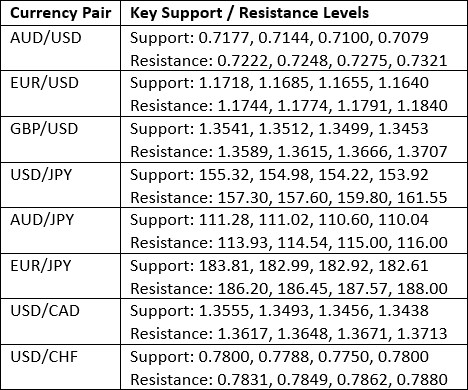
Key Support and Resistance Levels
The US Dollar printed an indecisive near-doji candlestick last week. We have a mixed long-term trend, with the 3-month trend bullish and the 6-month trend bearish.
The greenback is clearly within a long-term consolidation phase, so we cannot really expect much of a trend in the US Dollar here. I don’t see any clear direction for the greenback based on this chart.
I think the greenback will be more driven by the progression of the USA / Iran standoff– if war breaks out again, it will likely boost the Dollar, not so much as a haven but more as an effect of the inflationary shock of the rising energy prices. If we start to see progress on a real long-term deal, conversely, it will probably be bearish for the US Dollar.
Markets have become less optimistic about a deal, but so far, this is not boosting the USD. I think it will be wide to disregard the USD in trading this week – just look at the other side of the trade.
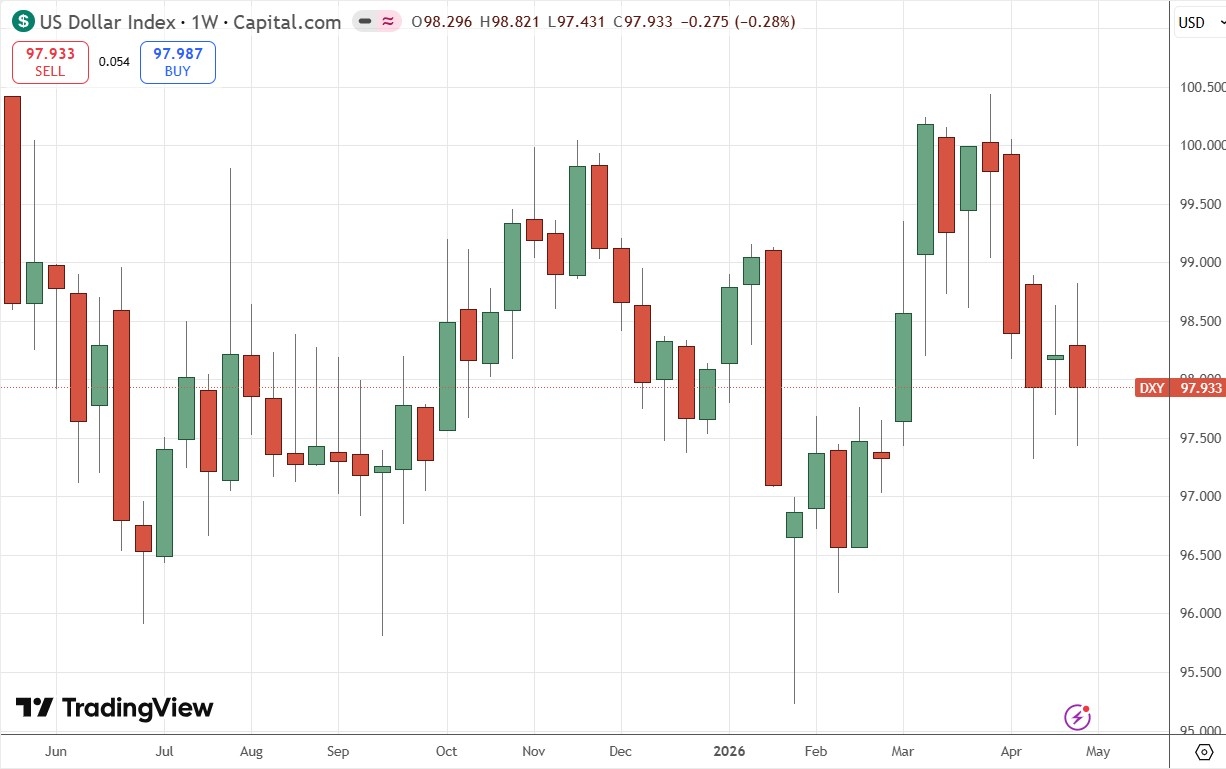
US Dollar Index Weekly Price Chart
The USD/JPY currency pair was breaking higher to reach a new long-term high price well above ¥160 when the Bank of Japan intervened on Friday. The BoJ does not want to see the Yen get any weaker, but any central bank trying to prop up their currency against the trend faces a difficult task if the market is strongly set in the opposite direction.
The Bank’s intervention ended and the rest of the day saw the Yen give up some of its gains against other currencies, but notably, not so much against the USD here.
Note how the ascending trend line drawn within the price chart below held the post-intervention low price, practically to the pip.
Despite the minor rebound and the holding trend line, I do not see the price bouncing back quicky. I think a consolidation period in this currency pair will be quite likely over the next few weeks.
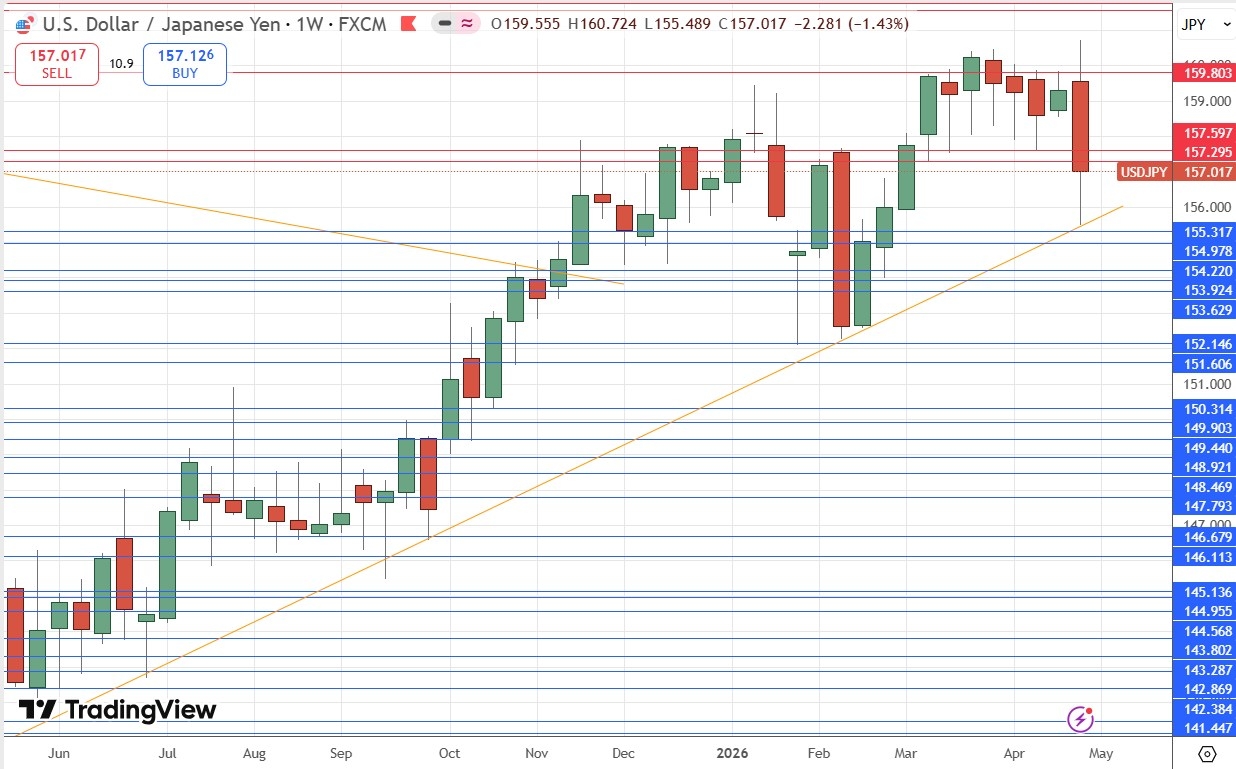
USD/JPY Weekly Price Chart
The S&P 500 Index rose again last week, as its extraordinary turnaround from its lows in late March continues. The price rose last week to trade at a new all-time high price, although it gave up some of its gains on Friday as markets turned more pessimistic about the prospect of a peace deal between the USA and Iran.
The price is rising in blue sky, so there is little reason not to be bullish, especially after a calendar month of a double-digit gain, although April wasn’t even in the top 20 months of historic gains here. It’s a great idea to be long of the US stock market when it is making new highs, but traders might want to wait for a higher daily close to show the market has moved on from Friday’s losses.
I think it will be wise to wait on the sidelines and see what the market does on Monday. If we get a daily close at the end of Monday that is higher than Friday’s closing price, a new long trade entry will look extremely tempting.
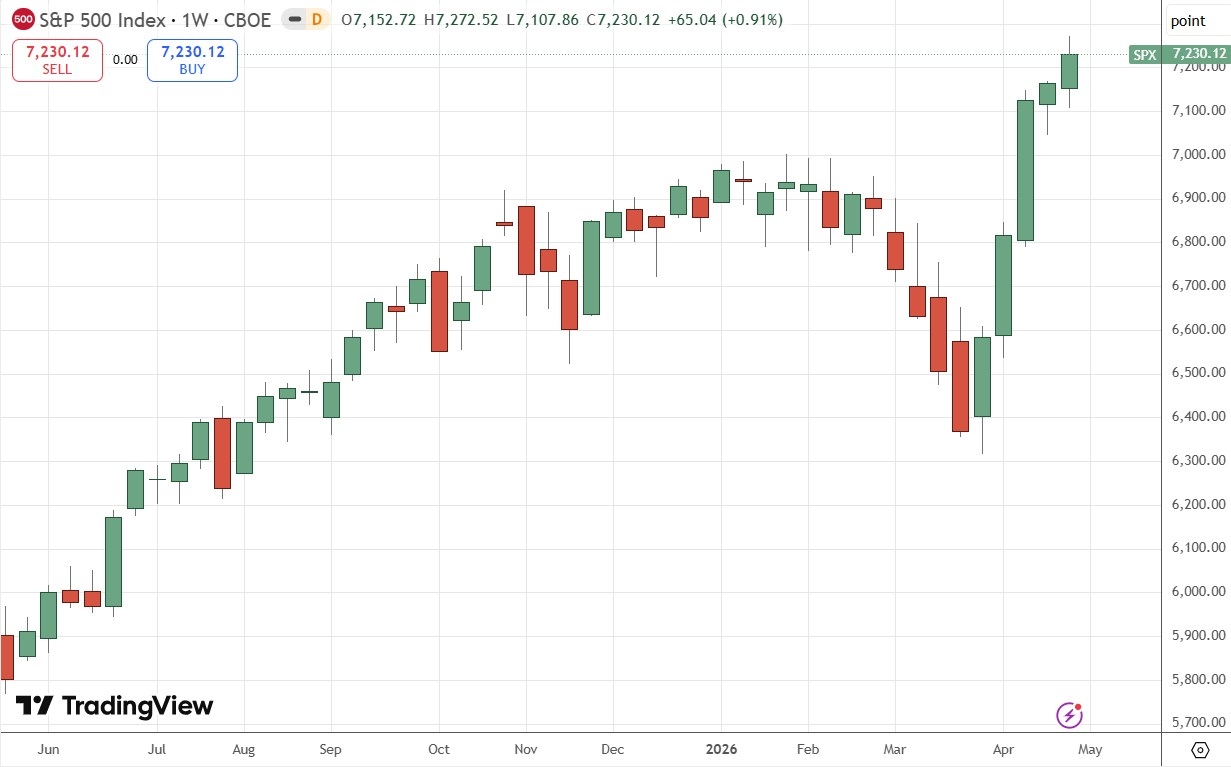
S&P 500 Index Weekly Price Chart
Everything I wrote above about the S&P 500 Index applies equally to the NASDAQ 100 Index, but the bullishness here is even stronger, with tech stocks leading the US stock market higher. As the NASDAQ 100 averages a higher return than the S&P 500 Index so if you want to be long there, you should seriously consider being long here too. It might be wise to wait for a higher daily close before entering a new long trade though.
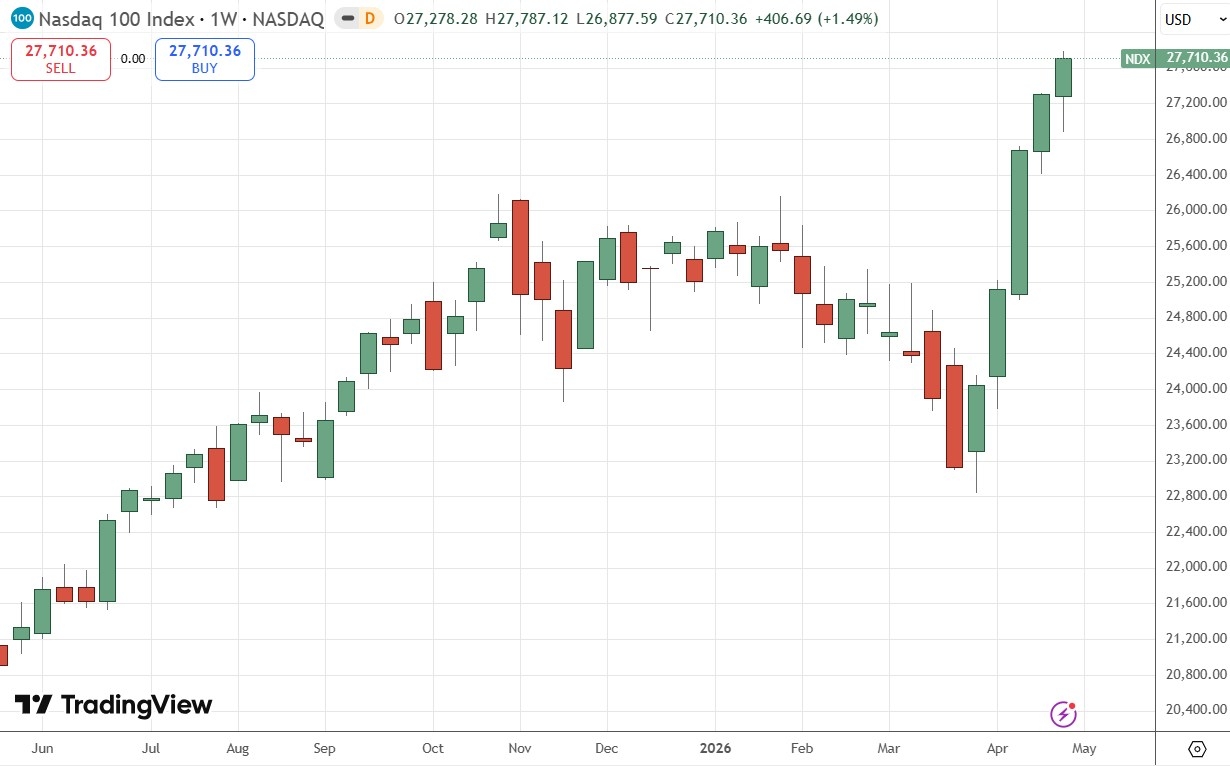
NASDAQ 100 Index Weekly Price Chart
Brent Crude Oil rose slightly last week, with the continued closure of the Strait of Hormuz by Iran and blockade of Iran by the USA driving the price higher.
This continuation of the closure situation should continue to push prices higher, and we might see a break into new highs. The price is not far from recent highs now. I am not sure that the price will fall a great deal further even if there is a peace deal, it may take a while to do that, but it should continue to trade lower in that scenario.
If the USA began bombing Iran again, following the failure of talks, we will likely see a push into new highs.
I think as the Iran situation continues to look length and messy, with a clean resolution increasingly unlikely, long trades in energy start to look more attractive, although the Trump administration will do what it can to lower prices when they reach new highs.
I will go long here if we get a daily (New York) close above $112.50 per barrel.
If you do go long, Brent will likely be the better vehicle than WTI, as it is more exposed to events in the Strait of Hormuz.
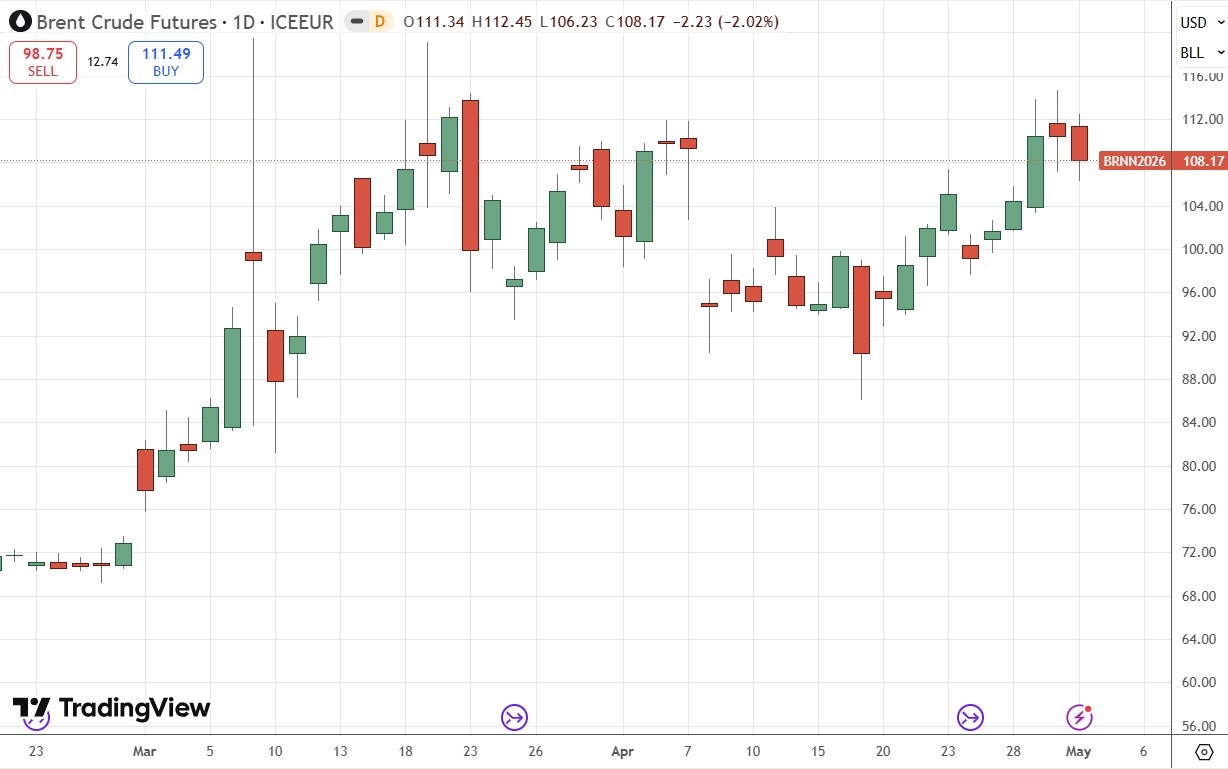
Brent Crude Oil Futures Daily Price Chart
RBOB Gasoline Futures rose quite strongly last week, with the continued closure of the Strait of Hormuz by Iran driving the price higher.
Gasoline tends to lead the price of crude oil higher in this kind of crisis, and this is where we are now.
For the reasons I outlined above in my Brent Crude Oil analysis, Gasoline looks like an interesting trade on the long side. A quick resolution of the Iran / USA crisis looks decreasingly likely, so the crisis will probably run for a while longer and continue to pressure the price of Gasoline to the upside.
Gasoline futures are too large for most retail traders, so using a CFD or an ETF like UGA could be a more accessible way to get exposure.
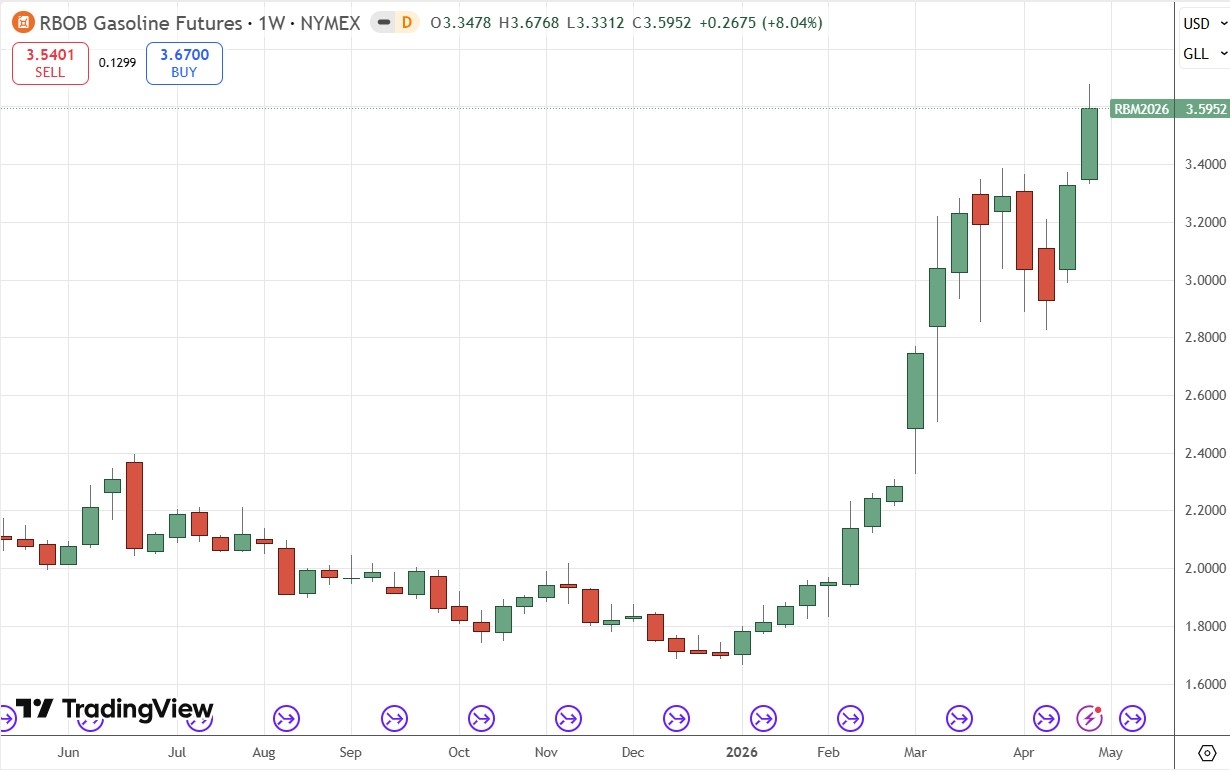
Gasoline Futures Weekly Price Chart
I see the best trades this week as:
Long of Brent Crude Futures (or a suitable ETF) if we get a daily close above $112.50. This is extremely unlikely to set up unless there is a surprise resumption of the war.
Long of Gasoline Futures (or UGA ETF).
Long of the S&P 500 Index following a daily close above 7,230.12.
Long of the NASDAQ 500 Index following a daily close above 27,685.40.
Ready to trade our weekly Forex forecast? Check out our list of the best Forex brokers.
Domestic coffee prices today
The domestic coffee market this morning, May 3rd, recorded a slight positive upturn after a series of days of deep downward pressure.
According to the latest updated data, the average purchase price for the entire Central Highlands region is currently anchored at the threshold of 86,500 VND/kg, a slight increase of 100 VND compared to the previous trading session.
In Dak Lak and Gia Lai provinces, the current price reached 86,500 VND/kg, while Dak Nong (old) maintained its highest position in the region at 86,600 VND/kg. Lam Dong region recorded slightly lower prices, fluctuating around the threshold of 86,000 VND/kg.
Although this increase cannot completely compensate for the decline of the past week, this is a signal that the market is making efforts to find a new balance point as the holidays gradually close.
World coffee prices
On the international front, green color returned in the closing session at the end of the week thanks to the relief effect from the decline of the USD. The Dollar Index ($DXY) falling to its lowest level in 2 weeks has triggered hedge funds to carry out a short covering wave on both futures exchanges.
Specifically, July Arabica futures price in New York has recovered by 0.85 cents (+0.30%), reaching 286.40 cents/lb.
At the same time, Robusta prices in London also slightly increased by 3 USD (+0.09%) to close the session at 3,364 USD/ton. This increase is important as it helps prices escape the lowest level in 1.5 weeks, which has been heavily burdened by pessimistic forecasts about global oversupply.
Coffee price assessment
Looking deeper into macroeconomic factors, the market is currently witnessing a fierce tug-of-war between the pressure of abundant supply in the future and the actual shortage of goods.
On the one hand, major organizations continuously release “huge” figures about Brazil’s 2026/27 crop season, with forecasts ranging from 71.4 million to nearly 76 million sacks, creating concerns about a global surplus of up to 10 million sacks.
On the other hand, Arabica inventories on the ICE exchange fell to a 2-month low (494,508 bags) and Robusta inventories also remained at a 16-month low (3,755 lots). This real tightening, combined with concerns that the Hormuz Strait continues to be closed, causing logistics and fertilizer costs to increase, is playing the role of a “protective net” preventing coffee prices from falling freely.
Besides coffee, pepper prices today still maintain heat at the threshold of 143,000 VND/kg, while the USD/VND exchange rate is stable at 26,108. Forecast for next week, when the market enters the official trading sessions of May, coffee prices are likely to continue to fluctuate strongly as investors balance the prospect of a bumper crop in Brazil and the complicated geopolitical situation that increases sea transport costs.
At 8:45 a.m. Eastern Time today, oil was priced at $116.10 per barrel with Brent serving as the benchmark (we’ll explain different benchmarks later in this article). That’s a rise of $1.44 compared with yesterday morning and around $53.46 higher than the price one year ago.
It’s impossible to forecast oil prices with detailed precision. Many different elements affect the market, but ultimately it boils down to supply and demand. When worries about economic recession, war, and other large-scale disruptions increase, oil’s path can shift fast.
Gas prices at the pump don’t only track crude oil. They also include what it takes to refine and move that fuel, the taxes layered on top, and the extra markup your local station adds to stay in business.
Since crude oil generally makes up a majority of the per-gallon cost, changes in its price have an outsized impact. When oil surges, gas prices typically rise in tandem. But when oil retreats, gas prices often lag on the way down, a trend sometimes described as “rockets and feathers.”
In case of emergency, the U.S. has a store of crude oil known as the Strategic Petroleum Reserve. Its primary purpose is energy security in case of disaster (think sanctions, severe storm damage, even war). But it can also go a long way toward softening crippling price hikes during supply shocks.
It’s not a long-term answer and is more meant to provide temporary relief, assisting consumers and keeping critical parts of the economy running, like key industries, emergency services, public transportation, etc.
Both oil and natural gas are key sources of the energy we use every day. Because of this, a big change in oil prices can affect natural gas. For example, if oil prices increase, some industries may swap natural gas for some segments of their operations where possible, which increases demand for natural gas.
To gauge oil’s performance, we often turn to two benchmarks:
Between these two, Brent better represents global oil performance because it prices much of the world’s traded crude. And, it’s often the best way to track historical oil performance. In fact, even the U.S. Energy Information Administration now uses Brent as its primary reference in its Annual Energy Outlook.
Looking at the Brent benchmark across several decades, oil has been anything but steady. It’s seen spikes due to factors such as wars and supply cuts, and it’s also seen crashes from global recessions and an oversupply (called a “glut”). For example:
All to say, oil’s historical performance has been anything but smooth. Again, it’s hugely affected by wars, recessions, OPEC whims, evolving energy initiatives and policies, and much more.
Looking to stay up-to-date regarding the latest energy developments? Check out our recent coverage:
The current price of oil per barrel depends largely on supply and demand, including news about potential future supply and demand (geopolitics, decisions made by OPEC+, etc.). In the U.S., prices also move based on how friendly an administration is to drilling, as it can affect future supply. For example, 2025 saw the Trump administration move to reopen more than 1.5 million acres in the Coastal Plain of the Arctic National Wildlife Refuge for oil and gas leasing, reversing the Biden administration’s policy of limiting oil drilling in the Arctic.
The price of oil updates constantly when the “futures” markets are open. A futures market is effectively an auction where people agree to buy or sell oil in the future. As long as people and companies are trading contracts, the oil price is changing.
In short, shale is rock that contains oil and natural gas. Think of shale as energy yet to be tapped. The more shale the U.S. accesses, the more energy we’ll have—and the more easily oil prices can keep from spiking as much thanks to a greater supply.
When oil is expensive, it tends to make everyday items cost more. This can be related to energy (your heating, gas utilities, etc.), but it’s also due to the logistics involved with making those items accessible to you. Shipping, for example, can affect the price of things at the grocery store, as it’s more expensive to get those products from warehouses and farms onto the shelf.
Domestic coffee prices
The domestic coffee market in today’s trading session recorded positive changes when prices simultaneously increased slightly in key growing areas. According to records, the average coffee price in the whole region reached the threshold of 86,500 VND/kg, an increase of 100 VND/kg compared to the previous trading session.
Specifically, in Dak Lak province, coffee prices are being purchased at 86,500 VND/kg. In Dak Nong province (old), the price reached the highest level in the region at 86,600 VND/kg, both increasing by 100 VND/kg. In Gia Lai, coffee prices also recorded 86,500 VND/kg. Meanwhile, in Lam Dong province, coffee prices remained stable at 86,000 VND/kg, without any new fluctuations compared to yesterday.
World coffee prices
At the close of the most recent trading session, world coffee prices recovered from the lowest level in 1.5 weeks. At the London exchange, Robusta coffee for July 2026 delivery increased by 3 USD, reaching 3,364 USD/ton. On the New York exchange, Arabica coffee for July 2026 delivery also increased by 0.85 cents, closing at 286.40 cents/lb.
The main driving force for the price recovery is the drop of the DXY index to its lowest level in 2 weeks, triggering speculators’ buy-backing activities. However, the upward momentum is still restrained by information about abundant supply prospects from Brazil. Coffee Trading Academy forecasts that the country’s 2026/27 crop output may reach 71.4 million bags, an increase of 12% over the same period. In particular, StoneX also gave a record figure of 75.3 million bags, forecasting that the global coffee surplus in 2026 will expand to 10 million bags.
In addition, Vietnam’s coffee exports in the first quarter of 2026 increased by 14% compared to the same period, reaching 585,000 tons, contributing to downward pressure on the London exchange in the long term. However, the actual inventory level on the ICE exchange is still at a record low (Robusta is the lowest in 16 months, Arabica is the lowest in 2 months) and geopolitical tensions affecting the transport route through the Strait of Hormuz are key factors supporting keeping prices from falling deeply.
Coffee price assessment and forecast
The coffee market is facing a fierce tug-of-war between forecasts of a record crop year in Brazil and short-term local supply cuts. Macroeconomic factors such as exchange rates and increased logistics costs due to geopolitical conflicts are playing a “supporting role” for prices. However, with large organizations continuously raising production forecasts, mid-term adjustment pressure is inevitable.
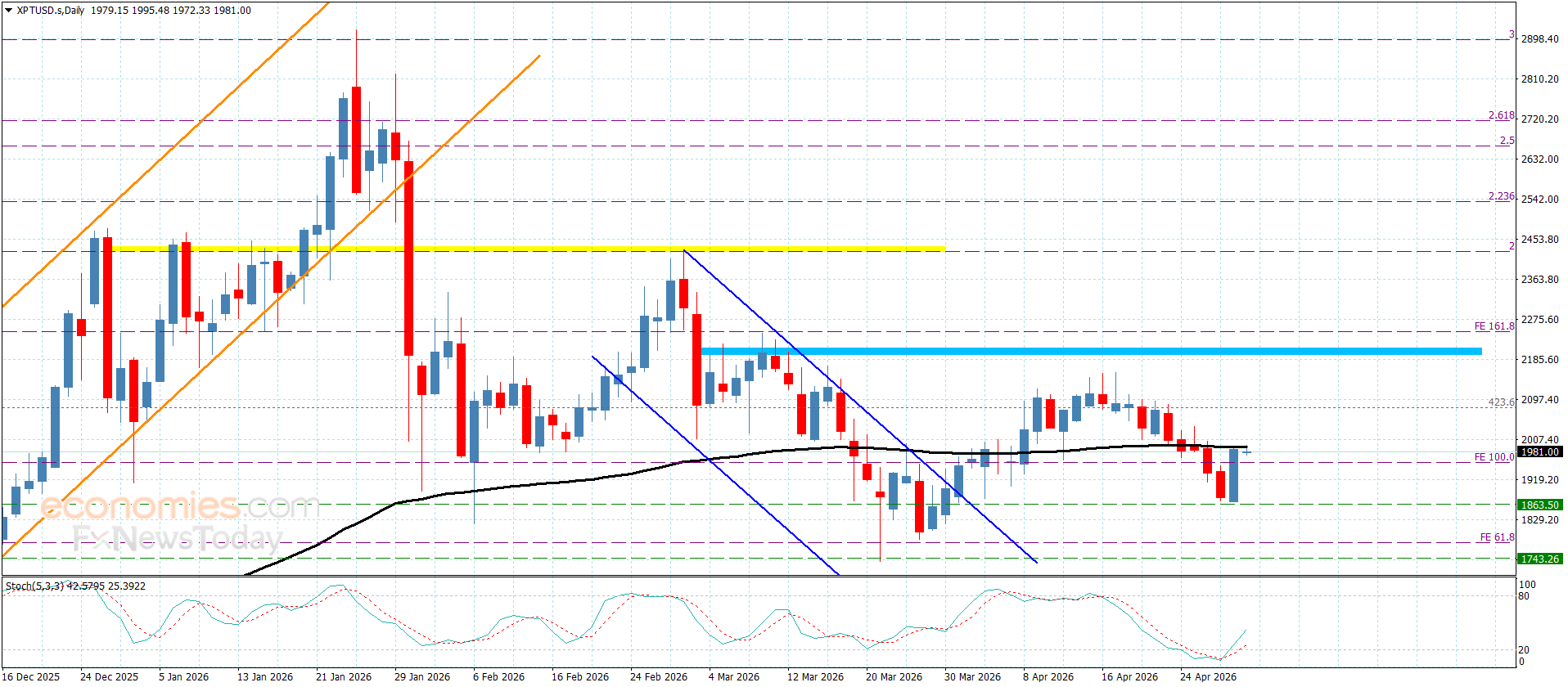
Platinum price took advantage of the stability above $1865.00 level, which represents a strong extra support, activating with stochastic intraday positivity by recording some gains, to settle near the moving average 55 at $1990.00.
The price needs a new positive momentum to help it to renew the bullish attempts, to expect reaching $2035.00 initially, to attempt to press on $2080.00 barrier, while the return of the trading below $1950.00 will confirm activating the bearish corrective trend again.
The expected trading range for today is between $1950.00 and $2035.00
Trend forecast: Bullish
Domestic coffee prices today
The domestic coffee market this morning, May 1, recorded a gloomy state as purchasing prices continued to fall, officially hitting the lowest level in a week.
According to surveys in key growing areas of the Central Highlands, the price of raw coffee beans has simultaneously decreased, pushing the regional average to the threshold of 87,700 VND/kg.
In Dak Nong province (old), coffee prices are currently trading at 87,800 VND/kg.
Dak Lak and Gia Lai localities both maintained stable prices at 87,600 VND/kg, while the Lam Dong area listed at the lowest level of 87,100 VND/kg.
Contrary to the decline of coffee, pepper prices still maintained their recovery when standing firm at 143,000 VND/kg.
World coffee prices
On world exchanges, red color covered brilliantly in the session closing early this morning with very deep declines.
The price of Arabica for July delivery on the New York exchange “evaporated” 5.15 cents, equivalent to 1.77%, closing at 294.90 cents/lb.
Similarly, the London exchange also witnessed the price of Robusta for July delivery plummet by 81 USD, equivalent to 2.35%, falling to 3,361 USD/ton.
This is the most negative adjustment in many recent sessions, reflecting investors’ concerns about the prospect of abundant supply from leading manufacturing powers in the world.
The main reason for this terrible drop is that forecasts of a “super-bumper” crop in Brazil are gradually becoming apparent. The Coffee Transaction Institute has just released an estimated figure that Brazil’s 2026/27 crop output will increase by 12% compared to the previous year, reaching about 71.4 million bags.
Even, Marex Group and StoneX have made bolder forecasts with figures up to nearly 76 million bags. This pressure becomes even heavier when StoneX forecasts that the global coffee surplus in 2026 will expand to 10 million bags, the highest level in the past 6 years. In Vietnam, the export growth in Q1 of 14% reaching 585,000 tons also contributed to easing concerns about short-term supply shortages in the international market.
Although the market is under great downward pressure, there are still some supporting factors hindering the free fall. The continued closure of the Strait of Hormuz due to geopolitical tensions is still putting pressure on global shipping, insurance and fertilizer costs.
In addition, coffee inventories on both ICE exchanges are still anchored at a record low, which is an important technical support to help prices not break deeper support levels. It is forecasted that in the coming days, domestic coffee prices will continue to fluctuate and accumulate around the 86,500 – 88,500 VND/kg range. Farmers need to be very alert to make appropriate trading decisions, avoiding panic in the context of speculative funds being aggressively liquidating positions.