The main tag of GoldPrice Articles.
You can use the search box below to find what you need.
[wd_asp id=1]
The main tag of GoldPrice Articles.
You can use the search box below to find what you need.
[wd_asp id=1]

The commodity market in March 2026 is not telling one story. It is telling two. Gold at $5,090 and silver at $82.52 are running on geopolitical fear, central bank accumulation, dollar debasement risk, and a structural loss of confidence in U.S. sovereign debt as a safe-haven instrument. These forces are not going away. They are deepening. Gold’s path to $6,300 and silver’s path to sustained $80-plus pricing are both credible if the macro environment holds its current trajectory.
Copper at $5.80 and platinum at $2,125 are telling the opposite story. Both metals face real headwinds — a 300,000-tonne copper surplus, collapsing Chinese refined copper demand, falling platinum automotive consumption, and a wave of ETF profit-taking in platinum after its extraordinary January run. Neither metal is broken structurally. Copper’s decade-long bull case from 2029 to 2035 remains intact. Platinum’s supply deficit is real and persistent. But the next six months will test conviction before the long-term stories can reassert themselves.
Gold has gained over 100% in just 12 months. A year ago, the metal traded near $2,624 per ounce. By January 2026, it crossed $5,000 for the first time in history. It then hit an all-time intraday high of $5,589 before consolidating to today’s level of $5,090. That kind of sustained, directional move does not happen by accident. Multiple forces are converging simultaneously — and each one is reinforcing the others.
The most important driver is the collapse of trust in traditional safe-haven assets. The U.S. 10-year Treasury yield climbed to 4.10% — and yet gold surged past $5,400 at the same time. That used to be impossible. For decades, rising yields made non-yielding gold less attractive to investors. That relationship has broken down. Investors are no longer treating U.S. Treasuries as the ultimate store of value. Gold has taken that crown — and the shift appears structural, not cyclical.
Central banks are accelerating this trend. Global central bank gold purchases are running at levels not seen since 1967. J.P. Morgan forecasts central bank and investor demand to average 585 tonnes per quarter in 2026, with approximately 755 tonnes of purchases expected across the full year — still dramatically elevated compared to pre-2022 averages of 400 to 500 tonnes annually. Sovereign buyers across Asia, the Middle East, and Eastern Europe are actively rotating out of dollar-denominated reserve assets and into gold. The reason is clear: the risk of U.S. sanctions, SWIFT exclusions, and asset seizures has made gold the only truly neutral reserve asset left.
Geopolitics is providing the immediate catalyst. Military strikes involving U.S. and Israeli forces hit Iranian infrastructure on February 28, 2026. Fears over the Strait of Hormuz — the chokepoint for 20% of the world’s daily oil supply — triggered a massive safe-haven bid overnight. Gold surged. Silver followed. And neither metal has given back those gains in a meaningful way. J.P. Morgan’s analysts describe gold’s current move as a “rebasing higher” — not a speculative bubble, but a genuine revaluation of what gold is worth in a world where dollar hegemony is being actively questioned. Their year-end price target for gold in 2026 is $6,300 per ounce. If just 0.5% of all foreign-held U.S. assets rotated into gold, that single flow alone would push prices to $6,000 per ounce. BofA Securities carries a $6,000 target. Goldman Sachs sits at $5,400. The direction across Wall Street is unanimous — only the pace is debated.
Silver is the headline story that most mainstream financial media are underreporting. The metal traded at just $27.52 at its 12-month low. It touched $120 per ounce just weeks ago before a sharp pullback. Today it holds at $82.52 — meaning silver has effectively tripled from its floor in under a year. It rose 146% in 2025, making it the single best-performing major asset class globally — beating equities, bonds, crypto, and every other commodity. And its structural story for 2026 remains firmly intact.
Silver operates with a dual identity that no other metal shares. It is simultaneously a safe-haven precious metal and a critical industrial raw material — and both of those demand engines are firing right now. On the safe-haven side, silver tracks gold closely, amplifying its moves in both directions. When gold rallies 1%, silver tends to rally 2% to 3%. When gold sells off, silver falls harder. That leverage is exactly what sophisticated investors seek when they want high-beta precious metals exposure.
On the industrial side, silver’s demand fundamentals are secular, not cyclical. Every solar panel manufactured today contains approximately 20 grams of silver. The global solar industry alone consumes nearly 30% of total annual silver supply. Each electric vehicle uses between 25 and 50 grams of silver for wiring, sensors, and semiconductors. AI data centres require silver for advanced chip manufacturing. None of these demand streams are slowing. All of them are growing.
The supply picture makes this more urgent. The silver market has run a structural supply deficit for five consecutive years. Above-ground stockpiles are actively being drained to meet demand. Holders of physical silver are demanding higher prices to release inventory into the market — and that dynamic alone creates a structural floor under prices regardless of short-term speculative flows.
J.P. Morgan forecasts silver to average $81 per ounce across full-year 2026 — more than double its 2025 average. The bank acknowledges that the pace of the recent surge will likely trigger some substitution and thrifting in industrial applications, which could cap the absolute ceiling. But the structural deficit, the safe-haven bid, and the clean-energy demand story together create a powerful, multi-year case for silver that most retail investors are still underestimating.
Copper’s long-term story is one of the most compelling in all of commodities. AI data centres use up to 10 times the electrical load of traditional buildings. Green energy grids, electric vehicle charging infrastructure, and 5G networks all consume enormous quantities of copper. Goldman Sachs forecasts copper demand to overtake global supply from 2029 onwards, with the LME price potentially reaching $15,000 per metric tonne by 2035. The structural bull case is real.
But none of that matters today. Copper is falling today — and the reasons are specific, data-driven, and worth understanding clearly.
China is the single most important factor. China consumes nearly 60% of the world’s refined copper annually. When Chinese buyers slow down, the entire global copper market slows with them. China’s refined copper consumption fell approximately 8% year-on-year in Q4 2025 as the boost from government stimulus policies wore off and the country’s property sector remained structurally weak. Downstream demand in transport, construction, home appliances, and power equipment is not recovering at the pace that speculative copper longs had priced in.
Goldman Sachs has revised its 2026 copper market surplus estimate upward to 300,000 tonnes — nearly double its earlier forecast of 160,000 tonnes. High prices are simultaneously damping demand growth and incentivising greater scrap copper supply. Goldman’s analysts state plainly that the copper price has overshot its fundamental fair value, which they estimate at approximately $11,500 per metric tonne. The price needs a correction — and the catalyst is likely coming.
That catalyst is the U.S. tariff decision on refined copper, expected by mid-2026. American companies and traders have been stockpiling copper ahead of anticipated tariffs, with global tracked inventory above 970,000 tonnes as of February 2026 — the highest level since 2003. Once Washington announces its decision, the rationale for stockpiling disappears, inventory floods back into the market, and prices face acute downward pressure. Goldman Sachs’ year-end 2026 copper price target is $11,000 per metric tonne. J.P. Morgan sits at $12,075. Citi has a bull-case target of $15,000. The 40% spread between top Wall Street estimates on copper is itself a warning — this is not a market with clear near-term direction.
Platinum hit $2,920 per ounce on January 26, 2026 — its highest price in nearly 15 years. Investors piled into the metal on a compelling story: three consecutive years of supply deficit, mine output at a five-year low of 5.51 million ounces, and strong momentum from safe-haven precious metals demand. The rally looked unstoppable. Six weeks later, platinum was trading at $2,000. Today it sits at $2,125. That is a 27% collapse from the peak — and understanding why it happened is critical for any investor holding or considering the metal.
The World Platinum Investment Council published its latest Platinum Quarterly on March 4, 2026 — just two days ago. Its key finding: a fourth consecutive year of platinum market deficit is expected in 2026, with the shortfall running at 240,000 ounces following a massive 1.1 million ounce deficit in 2025. That is structurally bullish. And in the long run, it will support prices. But the short-term demand picture tells a sharply different story.
Total platinum demand is forecast to contract 6% in 2026. The primary driver of that contraction is a 540,000-ounce swing in non-bar-and-coin investment demand as tariff-related uncertainty eases and ETF investors take profits. Warehouse stocks that had been drawn down aggressively in 2025 are now rebuilding — removing the physical supply urgency that justified last year’s premium pricing.
Automotive demand — platinum’s single largest end-use market — is forecast to fall another 3% to 2.915 million ounces in 2026. The reason is structural: battery-electric vehicles do not require catalytic converters, which are the primary industrial application for platinum in internal combustion engine cars. As EV adoption accelerates globally, platinum’s automotive demand base shrinks year after year. Over 70% of global platinum mine supply comes from South Africa, making the metal vulnerable to rand strength, labour disputes, and energy cost inflation — all of which compress margins and occasionally disrupt supply, but not enough to offset weakening demand.
Platinum is fundamentally not a monetary metal. It does not carry gold’s 5,000-year history as a store of value. It does not benefit from silver’s dual industrial-precious identity. When geopolitical fear spikes, investors choose gold first, silver second, and platinum only if specific conditions align. Right now, those conditions — a simultaneous safe-haven bid and robust automotive demand — are not both present. Until they are, platinum will struggle to reclaim its January highs.
The divergence in Wall Street forecasts for gold, silver, copper, and platinum is as instructive as the current price action itself.
On gold, the consensus is unusually unified in direction, differing only in magnitude. J.P. Morgan carries the most bullish target at $6,300 per ounce by year-end 2026, driven by central bank accumulation, Federal Reserve rate cuts, and de-dollarisation flows. Goldman Sachs sits at $5,400, acknowledging that gold’s break above historic yield-correlation limits represents a genuine regime change. BofA Securities has a $6,000 target but flags growing volatility as a risk to the upside timeline. Across all three major institutions, the directional call is identical: gold moves higher from here.
On silver, J.P. Morgan forecasts a full-year 2026 average of $81 per ounce — more than double its 2025 average. The bank identifies the five-year structural deficit and clean-energy industrial demand as the primary pillars of the bull case. It cautions that extremely high prices will eventually trigger substitution effects in industrial applications, which will act as a natural ceiling — but does not see that ceiling being tested until prices sustain significantly above current levels.
On copper, Goldman Sachs forecasts an LME average of $10,710 per metric tonne in H1 2026, drifting toward $11,000 by year-end before the long-term structural bull market reasserts from 2029 onwards. J.P. Morgan is more constructive at $12,075 for the full year. Both banks agree on the long-term thesis — copper scarcity is coming — but disagree sharply on the path between now and then. The U.S. tariff announcement on refined copper is the single most important near-term catalyst to watch.
On platinum, the World Platinum Investment Council’s CEO Trevor Raymond states that the key drivers of platinum’s 2025 rally — supply-demand tightness, depletion of above-ground stocks, and macropolitical safe-haven demand — are expected to persist through 2026. That is a cautiously optimistic read from the industry’s own research body. But it also signals that platinum needs very specific conditions — sustained trade tension, continued central bank precious metals buying, and stabilising automotive demand — to retest its January 2026 highs. LiteFinance forecasts a wide range of $1,833 to $3,171 for platinum in 2026 — an unusually large band that honestly reflects how binary and conditional the outlook remains.
The article covers the following subjects:
Consider long positions from corrections above 63.60 with a target of 87.00–95.50.
Breakout and consolidation below the 63.60 level will allow the asset to continue declining to the levels of 55.00–50.50.
A descending correction appears to have formed as the second wave of larger degree (2) on the weekly chart, with wave C of (2) completed as its part. On the daily time frame, the ascending third wave (3) has started unfolding, with the first wave of smaller degree 1 of (3) developing as its part. Supposedly, wave iii of 1 is developing on the H4 time frame. If this assumption is correct, WTI will continue to rise to 87.00–95.50. The level of 63.60 is critical in this scenario as the breakout below it will enable the asset to continue declining to the levels of 55.00–50.50.
This forecast is based on the Elliott Wave Theory. When developing trading strategies, it is essential to consider fundamental factors, as the market situation can change at any time.
The content of this article reflects the author’s opinion and does not necessarily reflect the official position of LiteFinance broker. The material published on this page is provided for informational purposes only and should not be considered as the provision of investment advice for the purposes of Directive 2014/65/EU.
According to copyright law, this article is considered intellectual property, which includes a prohibition on copying and distributing it without consent.
Copper price formed some bearish waves, achieving $2.7000 level, which forced it to provide mixed trading due to the continuation of the main indicators’ contradiction, to rebound towards $5.7850.
In general, we will keep our bearish scenario, depending on the stability of the barrier at $5.9700, confirming the importance of gathering extra negative momentum currently to ease the mission of resuming the negative attack by reaching $5.6200 initially, then press on the next support at $5.5100.
The expected trading range for today is between $5.5100 and $5.8500
Trend forecast: Bearish
Important DisclaimersFXEmpire is owned and operated by Empire Media Network LTD., Company Registration Number 514641786, registered at 7 Jabotinsky Road, Ramat Gan 5252007, Israel. The content provided on this website includes general news and publications, our personal analysis and opinions, and materials provided by third parties. This content is intended for educational and research purposes only. It does not constitute, and should not be interpreted as, a recommendation or advice to take any action, including making any investment or purchasing any product. Before making any financial decision, you should conduct your own due diligence, exercise your own discretion, and consult with competent advisors. The content on this website is not personally directed to you, and we do not take into account your individual financial situation or needs. The information contained on this website is not necessarily provided in real time, nor is it guaranteed to be accurate. Prices displayed may be provided by market makers and not by exchanges. Any trading or other financial decision you make is entirely your own responsibility, and you must not rely solely on any information provided through the website. FXEmpire does not provide any warranty regarding the accuracy, completeness, or reliability of any information contained on the website and shall bear no responsibility for any trading losses you may incur as a result of using such information. The website may include advertisements and other promotional content. FXEmpire may receive compensation from third parties in connection with such content. FXEmpire does not endorse, recommend, or assume responsibility for the use of any third-party services or websites. Empire Media Network LTD., its employees, officers, subsidiaries, and affiliates shall not be liable for any loss or damage resulting from your use of the website or reliance on the information provided herein.Risk DisclaimersThis website contains information about cryptocurrencies, contracts for difference (CFDs), and other financial instruments, as well as about brokers, exchanges, and other entities trading in such instruments. Both cryptocurrencies and CFDs are complex instruments and involve a high risk of losing money. You should carefully consider whether you understand how these instruments work and whether you can afford to take the high risk of losing your money. FX Empire encourages you to conduct your own research before making any investment decision and to avoid investing in any financial instrument unless you fully understand how it works and the risks involved.
Silver (XAG/USD) trades lower on Thursday, falling toward $82.20 at the time of writing, down 1.18% on the day. The precious metal is under pressure as the US Dollar (USD) rebounds following the release of stronger-than-expected US economic data.
The US Dollar Index (DXY), which tracks the Greenback’s value against a basket of six major currencies, is moving higher and approaches the 99.30 area, up 0.45% on Thursday. A stronger US Dollar tends to weigh on Silver, as the metal becomes more expensive for investors holding other currencies.
Several recent economic releases highlight the resilience of the US economy. The ADP Employment Change report showed that the private sector added 63K jobs in February, beating market expectations of 50K and sharply improving from the previous revised reading of 11K. At the same time, the Institute for Supply Management (ISM) reported that the Services Purchasing Managers Index (PMI) rose to 56.1 in February from 53.8 in the previous month, while economists had expected a slowdown to 53.5.
Additional labor market signals also point to underlying strength. Initial Jobless Claims in the US came in at 213K for the week ending February 28, slightly below expectations of 215K. Meanwhile, the Challenger, Gray & Christmas report showed a sharp decline in announced layoffs in February, although hiring plans remain cautious as companies remain wary about expanding their workforce.
Against this backdrop, expectations for an early monetary easing cycle from the Federal Reserve (Fed) have been scaled back. According to estimates based on the CME FedWatch tool, markets increasingly expect the first rate cut to arrive in September, while the chance of the Fed keeping rates unchanged at the July meeting now stands above 50%, compared to 33.4% a week earlier. Higher interest rates generally reduce the appeal of non-yielding assets such as Silver.
Geopolitical developments are nevertheless providing some support to the precious metal. Escalating tensions in the Middle East, involving the United States, Israel, and Iran, are maintaining a degree of safe-haven demand. Hopes of a potential diplomatic opening briefly emerged following reports suggesting indirect contact between Tehran and Washington, but Iranian authorities later denied the claims, leaving the outlook for the conflict uncertain.
Investors are now focusing on upcoming key US data releases, including the Nonfarm Payrolls (NFP) report and Retail Sales figures on Friday. These indicators could offer further clues about the strength of the US labor market and the likely path of monetary policy from the Federal Reserve.
Silver is a precious metal highly traded among investors. It has been historically used as a store of value and a medium of exchange. Although less popular than Gold, traders may turn to Silver to diversify their investment portfolio, for its intrinsic value or as a potential hedge during high-inflation periods. Investors can buy physical Silver, in coins or in bars, or trade it through vehicles such as Exchange Traded Funds, which track its price on international markets.
Silver prices can move due to a wide range of factors. Geopolitical instability or fears of a deep recession can make Silver price escalate due to its safe-haven status, although to a lesser extent than Gold’s. As a yieldless asset, Silver tends to rise with lower interest rates. Its moves also depend on how the US Dollar (USD) behaves as the asset is priced in dollars (XAG/USD). A strong Dollar tends to keep the price of Silver at bay, whereas a weaker Dollar is likely to propel prices up. Other factors such as investment demand, mining supply – Silver is much more abundant than Gold – and recycling rates can also affect prices.
Silver is widely used in industry, particularly in sectors such as electronics or solar energy, as it has one of the highest electric conductivity of all metals – more than Copper and Gold. A surge in demand can increase prices, while a decline tends to lower them. Dynamics in the US, Chinese and Indian economies can also contribute to price swings: for the US and particularly China, their big industrial sectors use Silver in various processes; in India, consumers’ demand for the precious metal for jewellery also plays a key role in setting prices.
Silver prices tend to follow Gold’s moves. When Gold prices rise, Silver typically follows suit, as their status as safe-haven assets is similar. The Gold/Silver ratio, which shows the number of ounces of Silver needed to equal the value of one ounce of Gold, may help to determine the relative valuation between both metals. Some investors may consider a high ratio as an indicator that Silver is undervalued, or Gold is overvalued. On the contrary, a low ratio might suggest that Gold is undervalued relative to Silver.
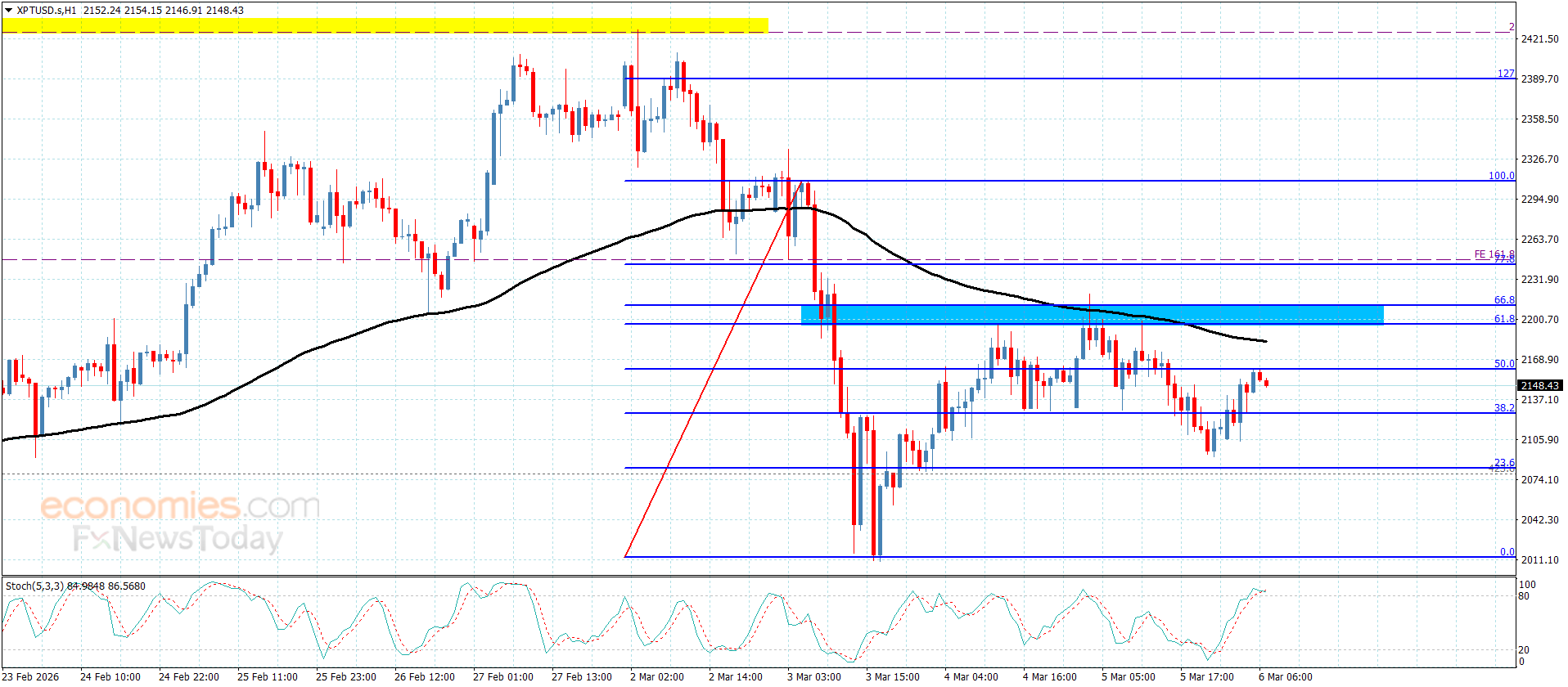
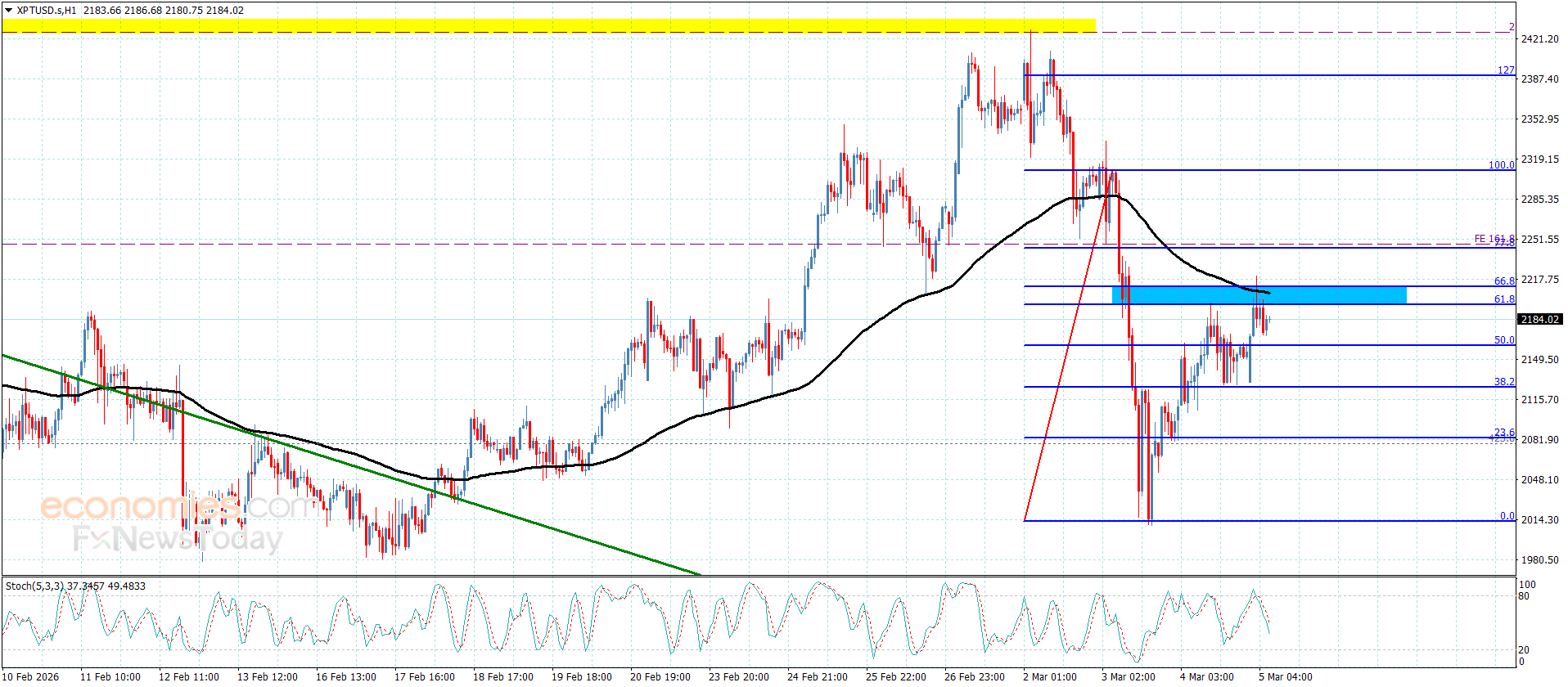
Platinum price ended its last corrective attempts by reaching $2220.00 level, to rebound quickly towards $2180.00, keeping its negative stability below $2245.00 level besides forming %61.8 Fibonacci correction level at $2200.00 level as appears in the above image.
The stability of moving average 55 above the current trading will increase the negative pressure, to reinforce the chances of resuming the negative attack, to expect targeting $2130.00 level reaching $2080.00 level.
The expected trading range for today is between $2080.00 and $2200.00
Trend forecast: Bearish
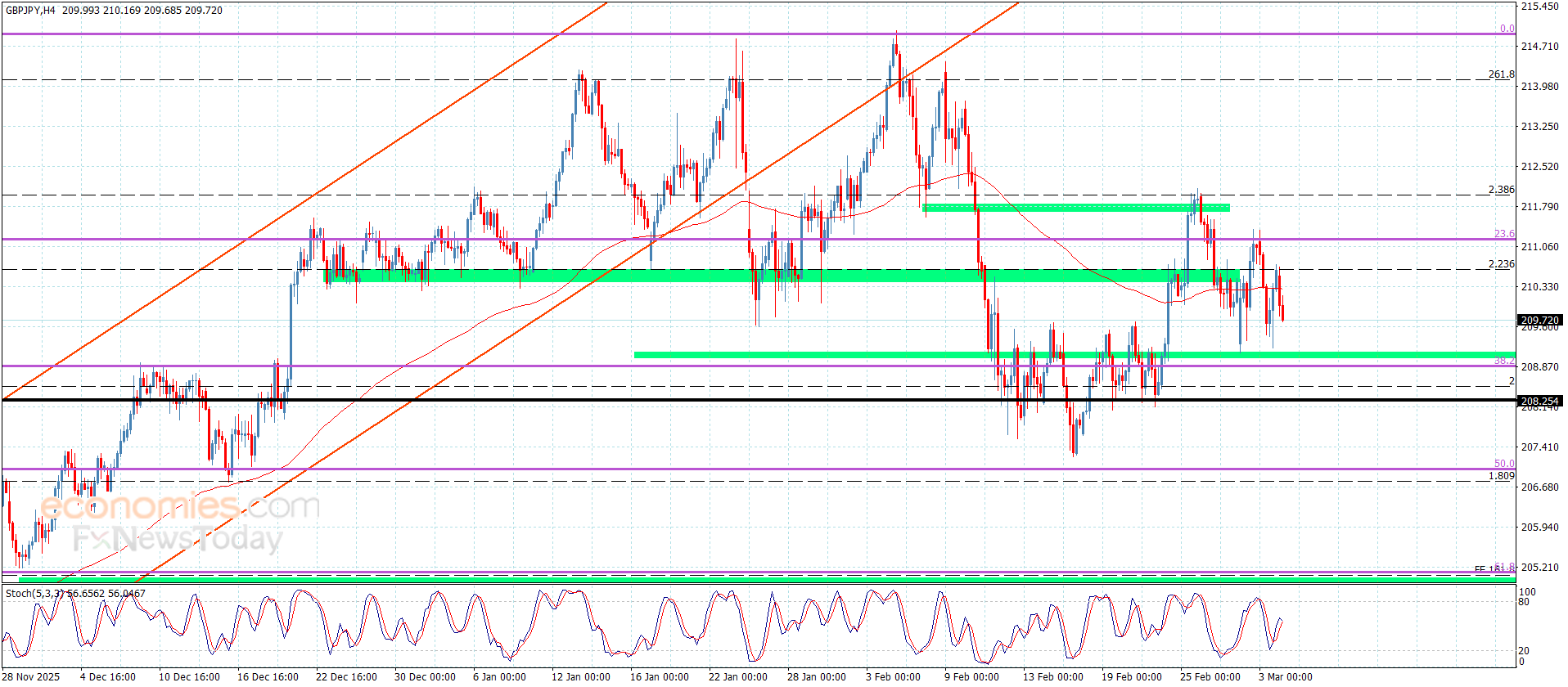
The GBPJPY pair activated with the negativity of the main indicators yesterday, to achieve the suggested negative targets in the previous report by reaching 209.40, which forces it to provide mixed trading to gather the required extra negative momentum to confirm the continuation of the negativity in the upcoming trading.
Note that forming an extra barrier at 210.65 level, and the stability of the trading below the moving average 55, these factors makes us keep the negative scenario to expect breaking the extra support at 209.10, to target new bearish stations that might begin at 208.30 reaching 206.90.
The expected trading range for today is between 208.30 and 210.40
Trend forecast: Bearish