The main tag of GoldPrice Articles.
You can use the search box below to find what you need.
[wd_asp id=1]
The main tag of GoldPrice Articles.
You can use the search box below to find what you need.
[wd_asp id=1]
Silver (XAG/USD) extends its recovery on Friday, building on Thursday’s modest rebound after hitting its lowest level in over a week earlier this week. At the time of writing, the white metal is trading around $42.35, stabilizing above key technical levels as buyers attempt to regain control following a pullback from the 14-year high at $42.97.
On the 4-hour chart, the $41.50 area — previous breakout zone — has emerged as a key support, reinforced by repeated lower wicks showing dip-buying interest. Price is also holding above the 21-period Simple Moving Average (SMA) at $42.06 and the 100-period SMA at $41.22, keeping the near-term bias constructive. A decisive break below $41.50 would risk exposing the deeper base near $40.50.
On the topside, resistance remains layered, with $42.50 acting as the next hurdle before a potential retest of the recent 14-year high at $42.97. A sustained break above that peak could open the way toward the psychological $43.50 handle, extending the broader uptrend. Until then, price action suggests a consolidation phase with an upward tilt.
Momentum signals are improving. The Relative Strength Index (RSI) has recovered to 57, showing growing bullish momentum without nearing overbought territory. Meanwhile, the MACD histogram is turning positive, with a potential bullish crossover developing. Together, these signals suggest upside pressure could build further as long as Silver holds above the $41.50 support floor.
Silver is a precious metal highly traded among investors. It has been historically used as a store of value and a medium of exchange. Although less popular than Gold, traders may turn to Silver to diversify their investment portfolio, for its intrinsic value or as a potential hedge during high-inflation periods. Investors can buy physical Silver, in coins or in bars, or trade it through vehicles such as Exchange Traded Funds, which track its price on international markets.
Silver prices can move due to a wide range of factors. Geopolitical instability or fears of a deep recession can make Silver price escalate due to its safe-haven status, although to a lesser extent than Gold’s. As a yieldless asset, Silver tends to rise with lower interest rates. Its moves also depend on how the US Dollar (USD) behaves as the asset is priced in dollars (XAG/USD). A strong Dollar tends to keep the price of Silver at bay, whereas a weaker Dollar is likely to propel prices up. Other factors such as investment demand, mining supply – Silver is much more abundant than Gold – and recycling rates can also affect prices.
Silver is widely used in industry, particularly in sectors such as electronics or solar energy, as it has one of the highest electric conductivity of all metals – more than Copper and Gold. A surge in demand can increase prices, while a decline tends to lower them. Dynamics in the US, Chinese and Indian economies can also contribute to price swings: for the US and particularly China, their big industrial sectors use Silver in various processes; in India, consumers’ demand for the precious metal for jewellery also plays a key role in setting prices.
Silver prices tend to follow Gold’s moves. When Gold prices rise, Silver typically follows suit, as their status as safe-haven assets is similar. The Gold/Silver ratio, which shows the number of ounces of Silver needed to equal the value of one ounce of Gold, may help to determine the relative valuation between both metals. Some investors may consider a high ratio as an indicator that Silver is undervalued, or Gold is overvalued. On the contrary, a low ratio might suggest that Gold is undervalued relative to Silver.
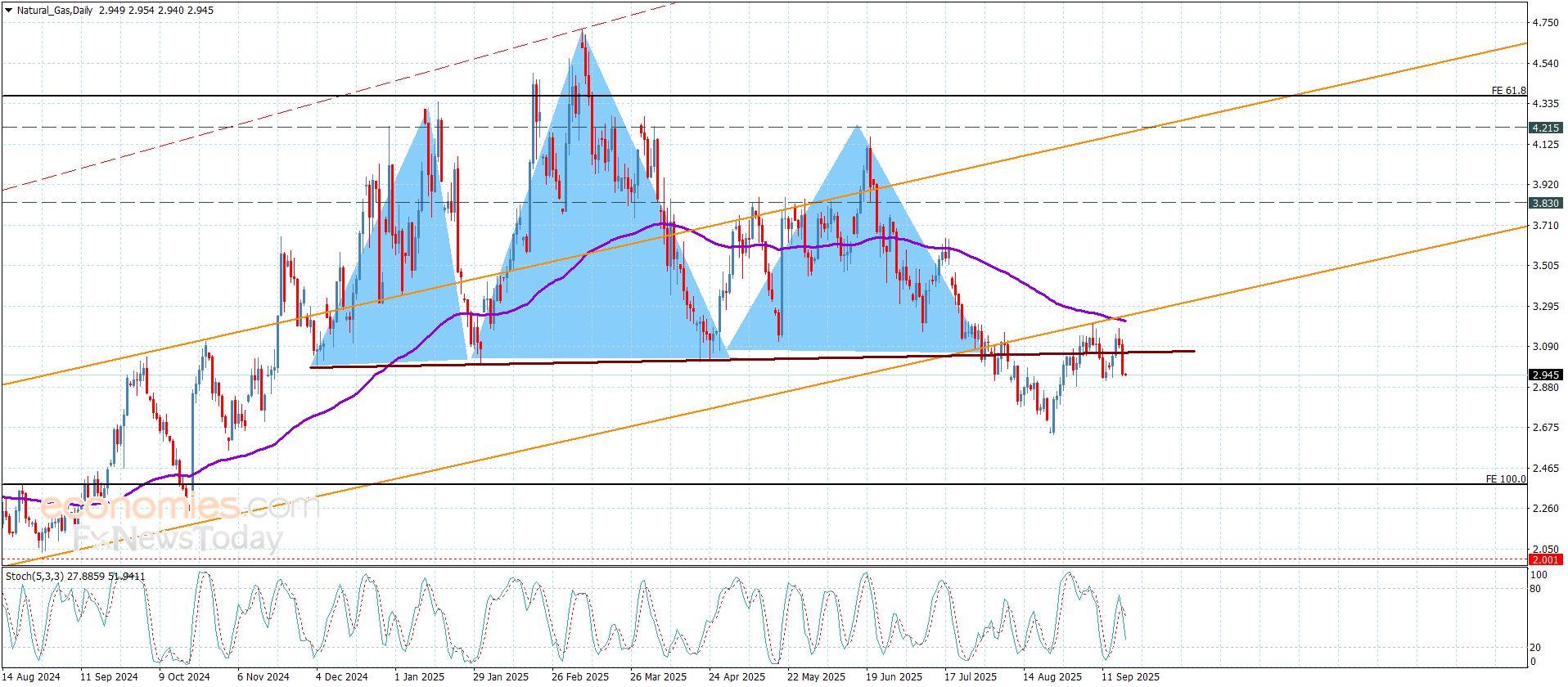
Natural Gas (NG=F) futures extended losses into Friday, trading near $2.90/MMBtu after a steep 16.1 cent decline in the prior session. The latest U.S. Energy Information Administration report revealed an injection of 90 Bcf for the week ending September 12, well above the five-year norm of 74 Bcf and ahead of market consensus of 80 Bcf. That pushed total inventories to 3.43 Tcf, positioning stocks 6.3% above seasonal averages and weighing on sentiment. The storage surprise has placed renewed pressure on Henry Hub benchmarks, with the October contract unable to reclaim the psychological $3 handle.
Forecasts for late September point to milder weather across the Midwest and South, limiting air-conditioning loads while colder winter patterns have not yet materialized. This transition period has left balances soft at the same time U.S. production is averaging a heavy 106 Bcf/d, ensuring supply remains plentiful. The rollover into November contracts next week is set to shift focus toward heating demand, which typically lifts consumption into the back half of the month. Traders are watching whether these seasonal dynamics will be strong enough to offset the current surplus.
Physical pricing shows wide regional divergence. At Waha hub in West Texas, gas changed hands near $1.065, while Transwestern and El Paso South Mainline both hovered below $1, reflecting severe takeaway constraints. Northwest Sumas plunged by almost $0.97 as Canadian bottlenecks eased, reinforcing just how sensitive basis levels remain to infrastructure swings. Maintenance at Cove Point LNG in Maryland is slashing roughly 0.7 Bcf/d of feedgas demand through early October, another factor keeping spot balances heavy in the short term.
Across the Atlantic, European natural gas prices have retained a bullish bias. TTF contracts settled just under €33/MWh, up 1.7% on the session, as traders position for potential acceleration of the EU’s phase-out of Russian LNG ahead of 2027. Storage in Europe stands at 81% capacity, down from 93.4% last year and below the five-year average of 87.6%. Cooler forecasts in northwest Europe may also slow injections, adding to concern about winter sufficiency and providing underlying support to TTF benchmarks. This structural risk premium continues to attract U.S. LNG cargoes, supporting export demand.
Macroeconomic policy adds another layer of complexity. The Federal Reserve cut rates by 25 bps this week, its first easing move of 2025, and signaled more reductions could follow. Cheaper borrowing costs could accelerate investment in LNG terminals, petrochemical facilities, and other energy-intensive projects that raise natural gas demand over the medium term. Former President Trump’s renewed calls for lower oil prices to pressure Moscow highlight how U.S. energy markets remain exposed to geopolitical swings that can spill over into natural gas dynamics.
The $2.90 to $3 corridor has become the key battleground for Henry Hub futures. The 50-day EMA is sliding at $3.07 and capping rallies, while the 200-day EMA at $3.20 is the level technicians view as confirmation of a sustained bullish reversal. Momentum indicators remain neutral, with RSI hovering mid-range and MACD flattening, showing that traders are waiting for a catalyst. Should prices breach $2.82, bears could test $2.62 as deeper support, while a clean move through $3.20 would re-open upside targets into the mid-$3s.
The forward strip shows modest gains across most U.S. hubs between September 11–17, though the Permian Basin and Canada lagged due to persistent oversupply. Hedge funds have trimmed net length in Henry Hub contracts, a sign that speculative appetite has cooled after repeated storage surprises. LNG feedgas flows remain firm near 13.2 Bcf/d, yet outages and maintenance keep the ceiling on export demand. The market is effectively in a holding pattern, waiting on either weather-driven consumption or geopolitical supply shocks to break the stalemate.
With inventories running above trend, production steady at record levels, and weather demand muted, the immediate picture for Natural Gas leans bearish. Prices holding above $2.82 will be critical to prevent a deeper slide, while the $3.20 breakout line remains the level to watch for bullish conviction. The macro backdrop of Fed easing and European supply security could shift sentiment into winter, but until then volatility is likely to remain high. Based on current fundamentals, the stance is Hold with near-term bearish bias, while strategic buyers may look to accumulate if November contracts regain momentum toward $3.20.
The U.S. Dollar Index bounced to 97.801, recovering from a post-Fed low not seen since early 2022. The greenback was lifted by stronger-than-expected jobless claims data and a cautious tone from Fed Chair Jerome Powell, who described the cut as a risk-management move rather than the start of an aggressive easing cycle.
Despite the cut, the lack of a strong dovish commitment disappointed traders betting on deeper policy easing. Still, the futures market is pricing in nearly a 90% chance of another cut at the Fed’s next meeting, suggesting dollar gains may be capped.
Citi upgraded its three-month gold price forecast to $3800 from $3600, citing a mix of cyclical and structural drivers. The bank flagged U.S. labor market weakness, rising fiscal deficits, and questions about the Fed’s independence as key factors supporting higher gold prices.
In a more extreme scenario—marked by stagflation or a hard landing—Citi believes gold could spike to $4000, though they also note a downside risk to $3400 if global growth fears ease and policy normalization resumes.
The EURJPY pair formed new bullish rally, to record the initial extra target at 174.25, then bounced quickly to retest the breached barrier, which represents a new support at 173.40.
The suggested scenario depends on the stability of the current support, as the price stability makes us expect renewing the bullish attempts to target new positive stations that begin at 175.20, while facing negative pressures and reaching below this support will increase the chances for activating the bearish correctional track again, which forces it to suffer some losses by reaching 172.80, followed by the support of the bullish channel at 171.15.
The expected trading range for today is between 173.40 and 175.20
Trend forecast: Bullish
Gold found buyers at the $3,630 level to bounce up on Friday following a two-day reversal from all-time highs at $3,700 on Wednesday. The precious metal attracted some bids with the US Dollar recovery losing steam, and returned to levels past $3,650.
Better-than-expected US jobless claims and a strong rebound of the Philly Fed Manufacturing Survey provided additional support for the US Dollar’s recovery. That said, the scope for a sharp recovery is likely to be limited with the market nearly fully pricing another Fed rate cut in October and high chances of further monetary easing in December.
Weak US employment data has boosted hopes of Fed cuts over the following months. Futures markets are broadly pricing a quarter point in each monetary policy meeting this year and some more in the first months of 2026, a view that is highly unlikely to be confirmed by Fed Chair Jerome Powell.
The technical picture shows Gold correcting from the all-time highs right above $3,700, yet with the broader upside trend intact. The Daily RSI is pulling back, but still remains at overbought levels while the MACD shows an impending bearish cross, suggesting that a deeper correction is likely.
Immediate support remains at the $3,615-3,630 area (September 11, 18 lows). Further down, the September 3 high and September 8 low, at $3,580, come into focus ahead of the September 8 low, at $3,500.
To the upside, Thursday’s high, near $3,675 is likely to challenge bulls ahead of the mentioned all-time high, at $3,710. Beyond here, the 161.8% extension of last week’s rally, near $3,740 emerges at the next upside target.
The table below shows the percentage change of US Dollar (USD) against listed major currencies today. US Dollar was the strongest against the Swiss Franc.
| USD | EUR | GBP | JPY | CAD | AUD | NZD | CHF | |
|---|---|---|---|---|---|---|---|---|
| USD | 0.25% | 0.47% | 0.04% | 0.10% | 0.19% | 0.32% | 0.50% | |
| EUR | -0.25% | 0.23% | -0.28% | -0.15% | -0.10% | 0.05% | 0.25% | |
| GBP | -0.47% | -0.23% | -0.46% | -0.38% | -0.33% | -0.27% | 0.02% | |
| JPY | -0.04% | 0.28% | 0.46% | 0.05% | 0.29% | 0.35% | 0.34% | |
| CAD | -0.10% | 0.15% | 0.38% | -0.05% | 0.09% | 0.20% | 0.40% | |
| AUD | -0.19% | 0.10% | 0.33% | -0.29% | -0.09% | 0.14% | 0.35% | |
| NZD | -0.32% | -0.05% | 0.27% | -0.35% | -0.20% | -0.14% | 0.20% | |
| CHF | -0.50% | -0.25% | -0.02% | -0.34% | -0.40% | -0.35% | -0.20% |
The heat map shows percentage changes of major currencies against each other. The base currency is picked from the left column, while the quote currency is picked from the top row. For example, if you pick the US Dollar from the left column and move along the horizontal line to the Japanese Yen, the percentage change displayed in the box will represent USD (base)/JPY (quote).
The EURJPY pair formed new bullish rally, to record the initial extra target at 174.25, then bounced quickly to retest the breached barrier, which represents a new support at 173.40.
The suggested scenario depends on the stability of the current support, as the price stability makes us expect renewing the bullish attempts to target new positive stations that begin at 175.20, while facing negative pressures and reaching below this support will increase the chances for activating the bearish correctional track again, which forces it to suffer some losses by reaching 172.80, followed by the support of the bullish channel at 171.15.
The expected trading range for today is between 173.40 and 175.20
Trend forecast: Bullish
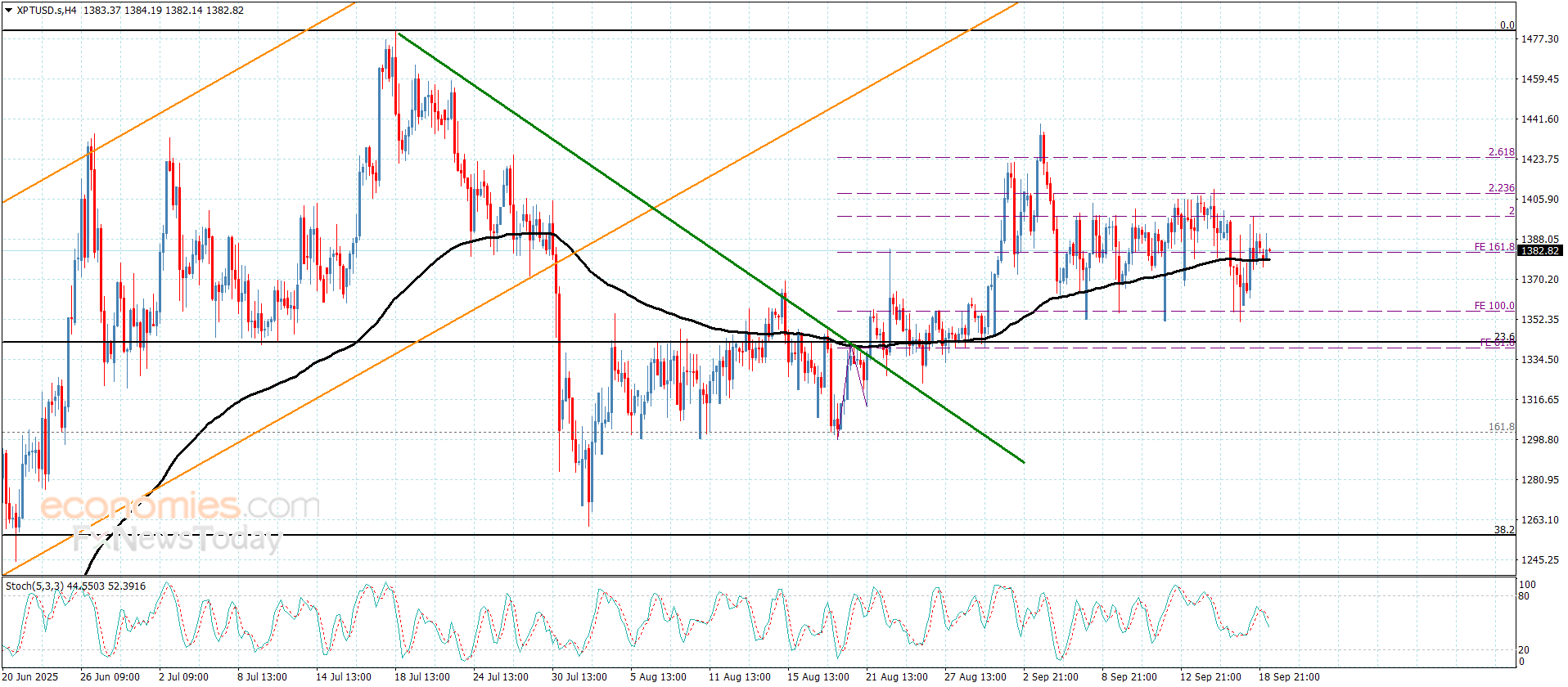
Platinum price remains under the effect of the sideways track, due to the continuation of the main indicators’ contradiction, especially by stochastic reach to 50 level, which forces it to delay the bullish attack and hold near the moving average 55 at $1382.00 level.
The stability of the price above the support at $1355.00 is important for confirming the continuation of the positivity, to keep waiting for gathering the positive momentum, to ease the mission of surpassing $1400.00 level, then begin recording the targets at $1422.00 and $1435.00.
The expected trading range for today is between $1370.00 and $1422.00
Trend forecast: Bullish
The Gold price (XAU/USD) trades in negative territory for the second consecutive day near $3,640 during the early Asian session on Friday. The precious metal edges lower after reaching a record high in the previous session due to some profit-taking and a firmer US Dollar (USD).
On Wednesday, the US Federal Reserve (Fed) cut the interest rates by 25 basis points (bps) and signaled two more reductions by the end of this year. This is the Fed’s first reduction this year and puts the target range for its main lending rate at 4.0% – 4.25%.
Fed Chair Jerome Powell indicated that the latest move to lower interest rates was a risk management cut and added that he doesn’t feel the need to move quickly on rates. A less dovish stance from the US central bank provides some support to the Greenback and weighs on the USD-denominated commodity price in the near term.
“Investors judged the Fed’s guidance less dovish than anticipated,” said MUFG analyst Soojin Kim. “Chair Powell highlighted tariff-driven inflation risks and stressed a ‘meeting-by-meeting’ approach to further cuts, sending the dollar higher,” Kim added.
On the other hand, escalating geopolitical tensions in the Middle East could boost the yellow metal, a traditional safe-haven asset. Israeli media reports indicated the military is preparing for a major ground incursion into Gaza City. For weeks, Israel has been laying the groundwork for such an operation, urging civilians to evacuate to designated humanitarian areas like Al-Mawasi.
Gold has played a key role in human’s history as it has been widely used as a store of value and medium of exchange. Currently, apart from its shine and usage for jewelry, the precious metal is widely seen as a safe-haven asset, meaning that it is considered a good investment during turbulent times. Gold is also widely seen as a hedge against inflation and against depreciating currencies as it doesn’t rely on any specific issuer or government.
Central banks are the biggest Gold holders. In their aim to support their currencies in turbulent times, central banks tend to diversify their reserves and buy Gold to improve the perceived strength of the economy and the currency. High Gold reserves can be a source of trust for a country’s solvency. Central banks added 1,136 tonnes of Gold worth around $70 billion to their reserves in 2022, according to data from the World Gold Council. This is the highest yearly purchase since records began. Central banks from emerging economies such as China, India and Turkey are quickly increasing their Gold reserves.
Gold has an inverse correlation with the US Dollar and US Treasuries, which are both major reserve and safe-haven assets. When the Dollar depreciates, Gold tends to rise, enabling investors and central banks to diversify their assets in turbulent times. Gold is also inversely correlated with risk assets. A rally in the stock market tends to weaken Gold price, while sell-offs in riskier markets tend to favor the precious metal.
The price can move due to a wide range of factors. Geopolitical instability or fears of a deep recession can quickly make Gold price escalate due to its safe-haven status. As a yield-less asset, Gold tends to rise with lower interest rates, while higher cost of money usually weighs down on the yellow metal. Still, most moves depend on how the US Dollar (USD) behaves as the asset is priced in dollars (XAU/USD). A strong Dollar tends to keep the price of Gold controlled, whereas a weaker Dollar is likely to push Gold prices up.
“Copper demand for green infrastructure may rise by over 15% by 2025, driving significant price volatility across global markets.”
Copper, often dubbed the “metal of civilization”, continues to play a critical role in our evolving world. As we advance into 2025, the copper price 2025 trend has become a focal point for a wide range of industries due to its extensive applications in agriculture, infrastructure, electrical wiring, construction materials, irrigation systems, and advanced technologies.
Unprecedented supply-demand dynamics, geopolitical events, and a global push towards renewable energy and sustainable practices have combined to create both opportunity and volatility in the copper market.
In this detailed outlook, we’ll examine the current copper price trend 2025, drivers influencing copper price 2025 trend, the impact on agriculture and infrastructure sectors, and the copper price forecast end 2025. This guide also offers insights on industry adaptation, using real-world data and Farmonaut’s expertise in satellite-driven sectoral monitoring.
As of mid-2025, the current copper price trend 2025 is marked by notable volatility. After surpassing $10,000 per metric ton in late 2024, copper prices stabilized around the $9,200 per metric ton mark—still notably above historical averages. These peaks and subsequent stabilization were driven largely by supply disruptions in major producing countries like Chile and Peru, which together account for nearly 40% of global copper output.
Investors, governments, and sector stakeholders now closely monitor copper’s price trajectory, recognizing its direct implications for project budgets, technology adoption, and overall competitiveness in 2025 and the years beyond.
“Forecasts show agriculture could face up to 10% higher input costs if copper prices surge in 2025.”
Downside risks remain present in the form of:

The copper price 2025 trend is driven by a complicated set of factors that intertwine market fundamentals, policy decisions, technological shifts, and global economic dynamics. To understand why copper remains highly valued and volatile, it’s essential to unpack these major drivers:


The ripple effects of the copper price 2025 trend resonate across agriculture and infrastructure. These two sectors, fundamental to economic development and human well-being, are directly shaped by global copper supply, price volatility, and changing demand patterns.


The copper price forecast end 2025 remains cautiously optimistic amid potential headwinds. While new mining sites are expected to ramp up output, several powerful trends continue to sustain higher price levels:
For farmers, builders, and government agencies, this copper price 2025 trend underscores the importance of forward-thinking planning, technology integration, and supply chain resilience.

By embedding copper trend analysis into long-term portfolio and project management, industry stakeholders can better anticipate cost pressures and mitigate risks due to market shocks.
Emerging technology is integral to understanding copper’s supply chain dynamics, demand shifts, and sectoral influence. At Farmonaut, we harness satellite technology, AI, and blockchain to deliver real-time insights for agriculture, mining, and infrastructure stakeholders.
Learn more: Farmonaut Platform
For developers and businesses aiming to integrate satellite and resource tracking solutions, access the Farmonaut Satellite API and see the API Developer Docs.
| Year | Estimated Copper Price (USD/ton) | Agriculture Sector Impact | Infrastructure Sector Impact |
|---|---|---|---|
| 2023 | $8,400 |
Usage: ~2.1 million MT
Modernization pace steady; initial adoption of electrified irrigation and smart sensors. Price volatility starts increasing. |
Usage: ~13 million MT
Major global infrastructure projects initiated; budget constraints moderate. |
| 2024 | $9,800 |
Usage: ~2.3 million MT
Heightened adoption of electrification in machinery and irrigation due to regulatory incentives. Input costs rise significantly. |
Usage: ~14 million MT
Infrastructure spending spike, smart city pilots rise. Supply disruptions in Chile/Peru affect cost and scheduling. |
| 2025 (Est.) | $9,200 |
Usage: ~2.5 million MT
Precision agriculture, renewable-powered irrigation, and advanced monitoring expand copper needs. Estimated 10% increase in agri input costs if prices surge. |
Usage: ~15 million MT
Large-scale utility/grid electrification, EV infrastructure, enhanced water resource projects drive demand. Strategic planning vital for cost management. |
Unlock real-time copper supply, agricultural activity, and infrastructure monitoring with affordable, scalable Farmonaut plans:
The copper price 2025 trend is primarily driven by sustained demand from green infrastructure, agricultural modernization, and supply constraints in major mining countries. Environmental regulations, labor issues, and technological advancements also influence pricing.
Analyst forecasts expect copper to remain elevated, trading between $8,800 and $9,500 per metric ton by end of 2025. Spikes above $10,000 are possible if significant supply disruptions occur.
Agriculture faces higher input costs for irrigation and electrified farm equipment, with precision technologies raising overall copper demand. Strategically managing copper purchases and leveraging technology like Farmonaut can help offset rising expenses.
Infrastructure projects—like power grids, transportation, and water management—are copper-intensive. As governments worldwide ramp up investment, demand for copper grows, influencing global pricing.
Farmonaut’s platform enables real-time monitoring of agricultural fields, mining sites, and infrastructure, providing actionable insights to help businesses optimize usage and adapt to copper price volatility. Blockchain traceability adds transparency and risk reduction across the supply chain.
Risks include further supply disruptions, stricter environmental regulations, global economic slowdowns, and the limited but evolving risk of copper alternatives. Strategic planning and smart resource management are key to resilience.
The copper price 2025 trend illustrates a market in transformation. Sustained demand from agriculture and infrastructure, tempered by supply constraints and evolving market dynamics, ensures copper’s critical role as the metal of civilization remains secure. For sector stakeholders, adapting to fluctuations requires an integrated approach—leveraging technology, optimizing investments, and proactively managing risks.
Farmonaut stands ready to empower businesses, governments, and individual users with affordable satellite-based insights, AI advisory, and digital supply chain solutions. By monitoring copper price trends, enhancing operational agility, and driving sustainability, we enable you to respond effectively to 2025’s challenges and opportunities.
Stay ahead of copper price 2025 trend with the latest intelligence, only on Farmonaut.
You have reached your limit of 5 free articles for this month.
Elevate your trading Journey.
Your coupon code
Spot Gold extends its slide on Thursday, bottoming during American trading hours at $3,627.98. The US Dollar (USD) gathered near-term momentum following the release of encouraging United States (US) data.
The country reported that Initial Jobless Claims for the week ended September 13 rose by 231K, better than the 240K anticipated and easing from the previous 264K. Additionally, the Philadelphia Fed Manufacturing Survey surged to 23.2 from the previous -0.3 while largely surpassing the expected 2.3.
Other than that, Gold eases on the back of increased demand for high-yielding assets. Wall Street trades in the green, with the Dow Jones Industrial Average (DJIA) reaching fresh record highs in pre-opening trading. American indexes advance on the back of the Federal Reserve (Fed) decision to cut interest rates following its September meeting.
Officials suggested similar cuts will come in October and December, as the dot-plot showed two more rate cuts in the docket for 2025, and one more for 2026. As a result, equities surged on the back of easing borrowing costs.
Meanwhile, the Bank of England (BoE) decided to keep its benchmark rate on hold at 4% early Thursday, as widely anticipated. Policymakers voted 7-2 to keep rates on hold, also meeting expectations. The event, which included no fresh forecast or a press conference, had no impact on financial markets.
The central banks’ week will end with the Bank of Japan (BoJ) announcing its decision on monetary policy early on Friday. The central bank is expected to hold its fire this time and keep interest rates at 0.5%, but rate hikes are in the docket for future meetings amid hawkish comments from BoJ officials.
The daily chart for the XAU/USD pair shows it is down for a second consecutive day, hovering in the $3,640 region. The decline is modest and seems corrective in the medium term, as technical indicators in the mentioned time frame eased from their extreme peaks but remain close to overbought readings. At the same time, the pair develops far above all its moving averages, with the 20 Simple Moving Average (SMA) heading firmly north at around $3,547, in line with the dominant bullish trend. The weekly low at $3,626.66 is the immediate support level, with a clear downward extension below it, opening the door for additional slides.
The near-term picture for the bright metal is bearish. The 4-hour chart shows that a mildly bullish 20 SMA cap advances, currently at around $3,675.00, while the Momentum indicator heads south almost vertically, well below its 100 line. The Relative Strength Index (RSI) indicator also aims lower within negative levels at around 43, supportive on another leg south. Finally, the 100 and 200 SMAs maintain their bullish slopes far below the current level, confirming the slide remains corrective and there’s a long way to go before Gold changes course.
Support levels: 3,626.70 3,611.70 3,600.00
Resistance levels: 3,655.90 3,675.00 3,693.40
Spot Gold extends its slide on Thursday, bottoming during American trading hours at $3,627.98. The US Dollar (USD) gathered near-term momentum following the release of encouraging United States (US) data.
The country reported that Initial Jobless Claims for the week ended September 13 rose by 231K, better than the 240K anticipated and easing from the previous 264K. Additionally, the Philadelphia Fed Manufacturing Survey surged to 23.2 from the previous -0.3 while largely surpassing the expected 2.3.
Other than that, Gold eases on the back of increased demand for high-yielding assets. Wall Street trades in the green, with the Dow Jones Industrial Average (DJIA) reaching fresh record highs in pre-opening trading. American indexes advance on the back of the Federal Reserve (Fed) decision to cut interest rates following its September meeting.
Officials suggested similar cuts will come in October and December, as the dot-plot showed two more rate cuts in the docket for 2025, and one more for 2026. As a result, equities surged on the back of easing borrowing costs.
Meanwhile, the Bank of England (BoE) decided to keep its benchmark rate on hold at 4% early Thursday, as widely anticipated. Policymakers voted 7-2 to keep rates on hold, also meeting expectations. The event, which included no fresh forecast or a press conference, had no impact on financial markets.
The central banks’ week will end with the Bank of Japan (BoJ) announcing its decision on monetary policy early on Friday. The central bank is expected to hold its fire this time and keep interest rates at 0.5%, but rate hikes are in the docket for future meetings amid hawkish comments from BoJ officials.
The daily chart for the XAU/USD pair shows it is down for a second consecutive day, hovering in the $3,640 region. The decline is modest and seems corrective in the medium term, as technical indicators in the mentioned time frame eased from their extreme peaks but remain close to overbought readings. At the same time, the pair develops far above all its moving averages, with the 20 Simple Moving Average (SMA) heading firmly north at around $3,547, in line with the dominant bullish trend. The weekly low at $3,626.66 is the immediate support level, with a clear downward extension below it, opening the door for additional slides.
The near-term picture for the bright metal is bearish. The 4-hour chart shows that a mildly bullish 20 SMA cap advances, currently at around $3,675.00, while the Momentum indicator heads south almost vertically, well below its 100 line. The Relative Strength Index (RSI) indicator also aims lower within negative levels at around 43, supportive on another leg south. Finally, the 100 and 200 SMAs maintain their bullish slopes far below the current level, confirming the slide remains corrective and there’s a long way to go before Gold changes course.
Support levels: 3,626.70 3,611.70 3,600.00
Resistance levels: 3,655.90 3,675.00 3,693.40