The main tag of GoldPrice Articles.
You can use the search box below to find what you need.
[wd_asp id=1]
The main tag of GoldPrice Articles.
You can use the search box below to find what you need.
[wd_asp id=1]
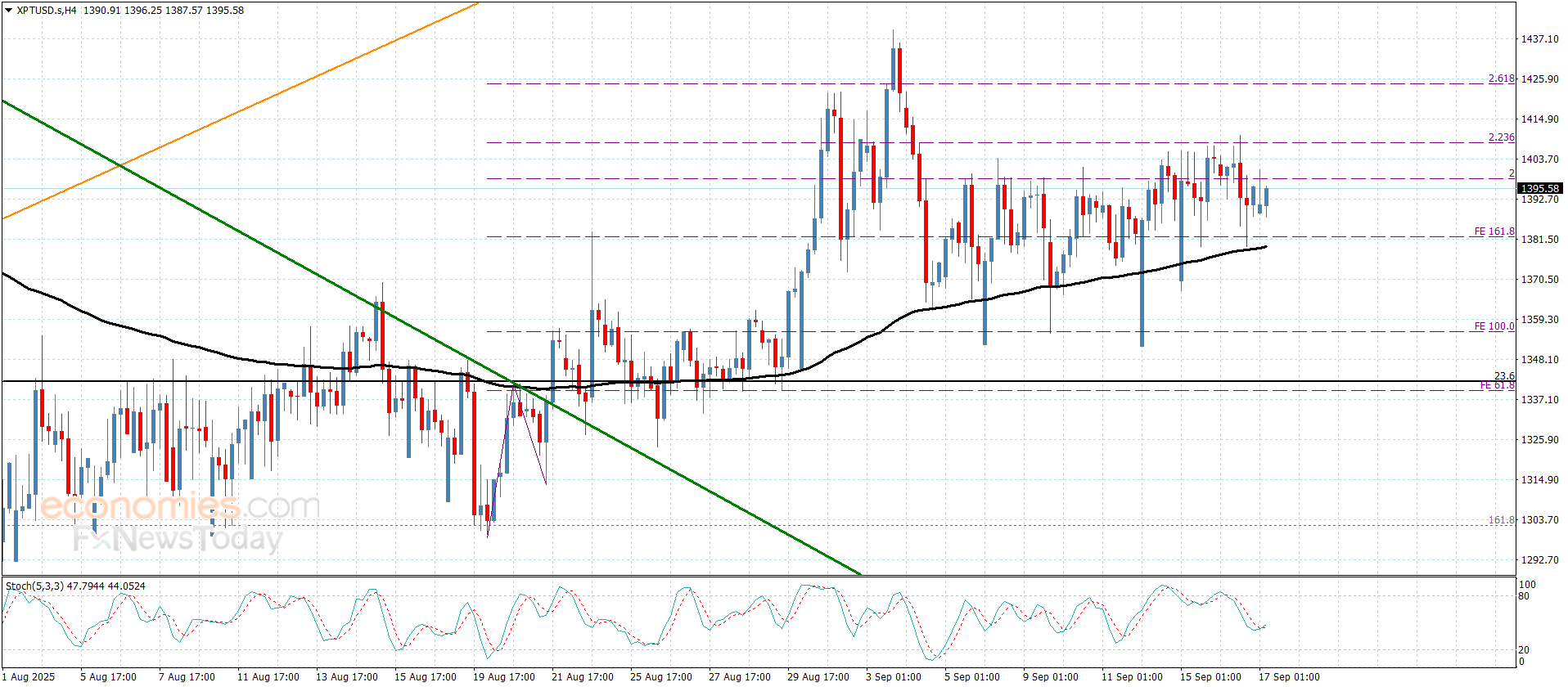
Despite the weak trading of Platinum price recently, its stability above the moving average 55 reinforces the stability of the extra support at $1382.00, besides stochastic attempt to provide positive momentum, these factors assist confirming the continuation of the positivity, to keep waiting for breaching the obstacle of $1408,00 to ease the mission of achieving the main targets that begin at $1435.00.
The risk of changing the main trend is represented by attempting to break the critical support at $1355.00, forcing it to form strong bearish waves, to expect reaching $1302.00 initially reaching to 38.2%Fibonacci correction level at $1255.00.
The expected trading range for today is between $1375.00 and $1425.00
Trend forecast: Bullish
Oil markets remain in a tight tug-of-war between oversupply signals and the slow rebuilding of a geopolitical risk premium. WTI crude (CL=F) is holding near $63.86 per barrel, up 0.96% on the day, while Brent (BZ=F) trades at $67.74, adding 0.77%. Both benchmarks have rallied from last week’s lows, but upside momentum is capped by projections of a supply glut into 2026, with Goldman Sachs forecasting Brent could slump below $55 per barrel next year on the back of a 1.8 million barrels per day surplus.
U.S. government data showed commercial crude inventories fell by 2.4 million barrels in the week ending August 22, extending a prior draw of 6 million barrels, leaving stockpiles at 418.3 million barrels—around 6% below the five-year average. Gasoline inventories slipped another 1.2 million barrels, while distillates fell 1.8 million barrels, now 15% below their seasonal norms. Refineries are producing 10 million barrels per day of gasoline and 5.2 million barrels of distillates, indicating that U.S. demand, which averaged 21.2 million bpd over the past month, remains higher by 2.5% year over year. This domestic strength has helped WTI avoid steeper losses despite global bearish forecasts.
China’s three state-run majors—CNOOC, PetroChina, and Sinopec—have all reported profit declines despite record upstream production. CNOOC booked $9.7 billion in first-half 2025 profit, down 13% YoY, even as output surged to 384.6 million barrels of oil equivalent, a 6.1% increase with gas production up 12%. PetroChina reported a 5.4% decline in earnings, while Sinopec posted a staggering 36% slump, both blaming lower refining margins and weaker domestic fuel demand tied to the rise of electric vehicles. The fall in average Brent prices from $83 per barrel in H1 2024 to $71 in H1 2025 underpinned the earnings squeeze.
Kazakhstan confirmed disruptions in shipments through the Baku-Tbilisi-Ceyhan (BTC) pipeline after contamination issues in Azeri crude forced a halt in July. Exports via this route had climbed 12% YoY in H1 2025 to 785,000 tons, around 34,000 bpd, and resuming clean flows is critical for landlocked Kazakhstan, which relies on BTC to bypass Russian ports. Meanwhile, drone strikes against Russian energy infrastructure and ongoing tariff disputes between Washington and New Delhi add layers of uncertainty to supply chains. Trump’s tariffs on Indian imports, set to take effect this week, could alter Russian crude flows and reshape global pricing dynamics if India is forced to source more barrels from the Middle East.
OPEC’s basket price stands at $70.45, while Saudi Arabia continues to lead output policy with Russia. Despite output cuts, Russia is still moving product aggressively, with Saudi Arabia and India emerging as top buyers of Russian fuel oil. Kazakhstan exceeded its OPEC+ quota in July, producing 1.827 million bpd versus its ceiling of 1.514 million bpd, underscoring the difficulty in enforcing compliance among members. The cartel faces mounting pressure as supply continues to climb globally while demand signals remain mixed, particularly in Asia where growth in petroleum product demand has slowed to zero according to Kpler data.
Chart analysis highlights that WTI is locked in a trading band with resistance near $65 per barrel and support around $62, coinciding with its 50-day EMA ceiling. Brent crude faces a similar sideways structure, capped by resistance at $69 and support at $65. Liquidity is consolidating in these ranges as traders weigh supply-driven weakness against bursts of risk premium whenever geopolitical shocks hit. Hedge funds and speculators have cut bullish bets on crude to their lowest level in 16 years, signaling widespread skepticism that prices can sustain above current levels without a significant geopolitical trigger.
While Goldman warns of Brent falling to the low $50s by 2026, fund managers like Eric Nuttall see the oversupply period setting the stage for a rebound later that year, driven by capex constraints and depletion of shale productivity. The International Energy Agency projects supply growth of 2.1 million bpd in 2025, with demand climbing only 700,000 bpd, cementing a surplus of 1.4 million bpd this year. Still, China’s crude imports are ticking higher sequentially, U.S. demand remains robust, and structural underinvestment in long-cycle projects could eventually reverse the trend.
With WTI at $63.86 and Brent at $67.74, oil prices are caught between short-term oversupply and medium-term bullish structural narratives. Inventories are tightening in the U.S. and geopolitical shocks keep adding floor support, but the macro balance tilts bearish with OPEC+ struggling to enforce quotas and analysts projecting sub-$55 Brent in 2026. Given this split picture, oil remains a Hold, with trading ranges dominating until either demand reaccelerates or supply is curbed more aggressively.
If upward pressure continues, the first major resistance comes into view at $3,734, derived from a 161.8% Fibonacci extension of the most recent bearish correction. However, a more significant upside target range sits between $3,782 and $3,812. That zone is backed by a confluence of technical levels, adding weight to its importance. Within it, the $3,786 measuring objective comes from the symmetrical triangle breakout earlier this month, while a measured move projection completes at $3,812.
The recent symmetrical triangle followed a sharp $543, or 18%, rally from the July swing low at $3,268. If replicated, that advance aligns closely with the $3,812 target, suggesting bulls may still have room to extend higher before a deeper pullback develops.
Yesterday’s breakout also cleared a minor resistance zone that capped gold for much of last week. The move higher was confirmed by a breakout from a small bull pennant visible on intraday charts, a continuation pattern that reinforces bullish positioning.
For the short term, the outlook remains constructive as long as gold’s price holds above today’s $3,675 low. A drop below that level, followed by weakness under Monday’s $3,627 low, would raise the risk of a broader pullback. Until then, the bullish bias remains intact, with buyers holding the upper hand and keeping the focus on the higher resistance cluster above $3,780.
For a look at all of today’s economic events, check out our economic calendar.
Today’s price action builds on momentum first triggered by a bullish engulfing candlestick three weeks ago on the weekly chart. That pattern engulfed two prior weeks and closed above their highs, creating a more decisive bullish signal than usual. The accompanying breakout from a falling wedge has maintained credibility, and Tuesdays outside day validates the continuation of that earlier pattern’s implications.
Where natural gas finishes Tuesday will help define support and resistance dynamics. Holding above the 50-Day line at $3.07 and Monday’s high of $3.06 underscores short-term strength. More critically, sustained trade above $3.12 and eventually $3.20, the recent swing high, would clear the way for higher targets. Multiple failed recoveries of the 50-Day line in prior weeks raises the significance of today’s potential close above it.
The recent pullback now appears complete, marked by a successful test of confluence support around the 20-Day average, the 61.8% Fibonacci retracement, and the midpoint of a falling channel. That back test strengthens the case for a move toward the channel’s upper boundary.
An ABCD pattern that includes today’s $2.87 low projects an initial target of $3.45. This aligns with both the 200-Day moving average, now near $3.50, and the upper area of the channel, creating a high-value target zone if $3.20 resistance is broken.
Heading into midweek, bulls aim to confirm strength by holding gains above $3.07 and pressing through $3.20. A close above those levels would reinforce the bullish structure and open the door to the higher $3.45 – $3.50 objective.
For a look at all of today’s economic events, check out our economic calendar.
The record run of Gold prices continued on Tuesday, with the bright metal surpassing the $3,700 mark for the first time ever amid broad US Dollar (USD) weakness. The XAU/USD pair traded as high as $3,703.08 early in the American session.
Gold retreated despite persistent USD selling and increasing caution ahead of the Federal Reserve (Fed) monetary policy announcement on Wednesday. Profit-taking could partially explain Gold’s retracement, as market participants anticipate the first of three interest rate cuts before the year’s end. Policymakers have not yet confirmed other than 50 basis points (bps) interest rate cuts for 2025, meaning markets anticipate a dovish announcement. Should Chair Jerome Powell refrain from hinting at interest rate cuts in October and December, the tide may turn, with the USD finding unexpected yet temporary strength.
Financial markets pretty much ignored better-than-anticipated United States (US) data. The country released Retail Sales, which were up 0.6% in August, above the 0.2% forecast. Also, Import Prices rose 0.3% on a monthly basis in the same month, while Export Prices also gained 0.3% vs the -0.1% and 0.2% expected respectively. Finally, the US published August Industrial Production, which ticked 0.1% up after sliding 0.4% in the previous month, and Capacity Utilization, which held steady at 77.4%.
From a technical point of view, the daily chart for the XAU/USD pair is showing modest signs of upward exhaustion. Technical indicators are losing their upward strength in extreme overbought territory, with the Relative Strength Index (RSI) indicator at around 81. Furthermore, the pair is far above all its moving averages, with a bullish 20 Simple Moving Average (SMA) at around $3,516, over $200 above the longer ones.
In the near term, and according to the 4-hour chart, the XAU/USD pair has room to extend its advance. A mildly bullish 20 SMA provides support at around $3,657, while the 100 and 200 SMAs accelerated north far below the shorter one. At the same time, the Momentum indicator resumed its advance within positive levels, while the RSI indicator seesaws directionless at around 70.
Support levels: 3,674.30 3,657.30 3,642.00
Resistance levels: 3,705.00 3,720.00 3,735.00
The (ETHUSD) price settled with slight gains in its last intraday trading, leaning on the support of its EMA50, accompanied by testing the critical support level at $4,490, amid the dominance of the main bullish trend and its trading alongside minor bias line on the short-term basis, besides the emergence of the positive signals on the relative strength indicators, after reaching oversold levels, reinforcing the chances for the price recovery on the near-term basis.
Get high-accuracy trading signals delivered directly to your Telegram. Subscribe to specialized packages tailored for the world’s top markets:
Full VIP signals performance report for September 8–12, 2025:
Silver’s (XAG/USD) is trying to break long-terrm highs at $42.75 on Tuesday’s Early European session, favoured by broad-based US Dollar weakness, as the market braces for a “dovish cut” at the end of a two-day Fed monetary policy meeting on Wednesday.
Precious metals have been thriving in recent days with investors pricing in a series of rate cuts by the Federal Reserve in the coming months, starting with a quarter-point cut on Wednesday.
The US Dollar Index, which measures the value of the US dollar against a basket of currencies, is testing two-month lows, just above 97.00, after depreciating nearly 1% from last week’s highs.
The technical pìcture is bullish, Momentum indicators show overbought levels on intra-day charts –the 4-hour RSI is above 70, but US Dollar weakness keeps downside attempts limited.
To the upside, above the mentioned $42.75 resistance area, the $43.00 psychological level might hold bulls ahead of the 261.8% retracement of the September 8 rally, at $43.50.
The pair has solid support at a previous resistance in the area of $42.50. Below here, the September 14 and 15 low, at $42.00, and the September 8 high, at $41.65, would come into focus.
(This story was corrected on September 16 at 11:45 GMT to say that the $42.75 level is a long-term high, and not an all-time high, as previously stated.)
Silver is a precious metal highly traded among investors. It has been historically used as a store of value and a medium of exchange. Although less popular than Gold, traders may turn to Silver to diversify their investment portfolio, for its intrinsic value or as a potential hedge during high-inflation periods. Investors can buy physical Silver, in coins or in bars, or trade it through vehicles such as Exchange Traded Funds, which track its price on international markets.
Silver prices can move due to a wide range of factors. Geopolitical instability or fears of a deep recession can make Silver price escalate due to its safe-haven status, although to a lesser extent than Gold’s. As a yieldless asset, Silver tends to rise with lower interest rates. Its moves also depend on how the US Dollar (USD) behaves as the asset is priced in dollars (XAG/USD). A strong Dollar tends to keep the price of Silver at bay, whereas a weaker Dollar is likely to propel prices up. Other factors such as investment demand, mining supply – Silver is much more abundant than Gold – and recycling rates can also affect prices.
Silver is widely used in industry, particularly in sectors such as electronics or solar energy, as it has one of the highest electric conductivity of all metals – more than Copper and Gold. A surge in demand can increase prices, while a decline tends to lower them. Dynamics in the US, Chinese and Indian economies can also contribute to price swings: for the US and particularly China, their big industrial sectors use Silver in various processes; in India, consumers’ demand for the precious metal for jewellery also plays a key role in setting prices.
Silver prices tend to follow Gold’s moves. When Gold prices rise, Silver typically follows suit, as their status as safe-haven assets is similar. The Gold/Silver ratio, which shows the number of ounces of Silver needed to equal the value of one ounce of Gold, may help to determine the relative valuation between both metals. Some investors may consider a high ratio as an indicator that Silver is undervalued, or Gold is overvalued. On the contrary, a low ratio might suggest that Gold is undervalued relative to Silver.
The U.S. shale patch is trimming capital expenditure budgets to preserve cash amid the lower oil prices. American producers could further cut back on spending and activity if the prevailing forecasts of a global oversupply materialize in the coming months.
Efficiency gains allow companies to pump more or equal volumes of crude with the same or reduced expenses.
The pullback in activity – the number of operating rigs and frac crews has crumbled in recent months – is not showing yet in the U.S. oil production figures. The shale patch is now in the lag window of a few months before the price decline shows up in output.
Efficiency gains are also pushing back production declines, but if the glut hits the global market and prices plunge in the $50s per barrel, the U.S. shale industry will likely curb drilling activity and cut capital budgets even more.
The market consensus appears to be that the strong summer demand is at its peak, and come the fourth quarter, global oil consumption will slow, and rising supply will overwhelm the market.
Growing supply from OPEC+ and higher output from South America will tip the market balance into oversupply toward the end of the year, analysts say.
Despite geopolitical risks, Wall Street banks have lowered their oil price forecasts for later this year and the first quarter of 2026, expecting the glut to depress prices.
Related: Oil Industry Gains Ground in California Regulatory Battle
Major investment banks, including Goldman Sachs, Morgan Stanley, and JPMorgan, see Brent Crude prices averaging $63.57 per barrel in the fourth quarter, a survey compiled by The Wall Street Journal showed this week. The projection is down from $64.13 expected in July and down from the Friday prompt price of about $68 a barrel.
For WTI Crude, the banks expect the price to average just above $60 per barrel, at $60.30, in the fourth quarter, down from last month’s $61.11 a barrel and down compared to the current price of about $64 a barrel.
Oil prices are set to further drop in the first quarter of 2026, with Brent at $62.73 and WTI at $59.65 per barrel, according to the Journal’s survey.
The glut will diminish by the third quarter of 2026, the banks reckon, as excess supply shocks are absorbed during next summer’s peak demand period.
But banks, analysts, and market participants expect oil supply to outstrip demand over the next six months, putting additional downward pressure on prices. This would make U.S. shale producers even more cautious with spending and budgets because a dip below $60 per barrel is threatening breakevens for drilling new wells.
The U.S. Energy Information Administration (EIA) is even more bearish than major banks in oil price projections.
The EIA expects in its latest Short-Term Energy Outlook (STEO) Brent to slump in the coming months, falling from $71 per barrel in July to average just $58 in the fourth quarter of 2025 and around $50 per barrel in early 2026.
Earlier this year, shale executives said that a $50 WTI price would result in declining U.S. crude production.
U.S. shale production will likely plateau if WTI prices remain in the low $60s per barrel, and decline at prices in the $50s, ConocoPhillips chairman and CEO Ryan Lance said in May.
Due to the OPEC+ supply hikes, global oil inventory builds will average more than 2 million barrels per day (bpd) in late 2025 and early 2026, which is 800,000 bpd more than in last month’s STEO.
“Low oil prices in early 2026 will lead to a reduction in supply by both OPEC+ and some non-OPEC producers, which we expect will help moderate inventory builds later in 2026,” the EIA said.
The administration expects Brent prices to average $51 a barrel next year, down from last month’s forecast of $58 a barrel.
Current growth in well productivity will push U.S. crude oil production to an all-time high near 13.6 million bpd in December 2025, the EIA said.
However, as crude oil prices fall, the EIA sees U.S. producers accelerating the decreases in drilling and well completion activity that have been ongoing through most of this year. As a result, U.S. crude oil production is set to decline from a record-high 13.6 million bpd at the end of this year to 13.1 million bpd by the fourth quarter of 2026.
Energy Intelligence forecasts U.S. shale to show greater resilience in the face of falling prices, expecting U.S. crude production to be flat at around 13.5 million bpd through the end of 2025, and closing 2026 at about 13.4 million bpd.
The actual U.S. production will depend on how large the expected oversupply will be and how low oil prices will dip, as well as to what extent efficiencies can offset a drop-off in drilling activity and budgets.
By Tsvetana Paraskova for Oilprice.com
More Top Reads From Oilprice.com
At 16:50 GMT, Natural Gas Futures are trading $3.004, up $0.063 or +2.14%.
Weather forecasts offer mixed signals for demand. NatGasWeather expects high pressure to dominate much of the U.S. this week, keeping highs in the 80s and 90s across the interior and Southwest. These conditions will boost cooling demand in the short term, though national demand is forecast to ease significantly over the weekend as northern states cool into the 60s and 70s.
This pattern translates to moderate demand early in the week, tapering off to light demand by the weekend — a setup that could cap rallies unless weather-driven demand persists longer than expected.
Supply remains a limiting factor for bullish sentiment. U.S. dry gas production continues to hover near 107 Bcf/d, keeping upward pressure on storage and tempering the impact of late-season heat.
The latest EIA storage report showed a 71 Bcf injection for the week ending September 5, bringing total inventories to 3,343 Bcf. While stocks remain 38 Bcf below last year, they sit 188 Bcf above the five-year average — a bearish overhang that looms over any short-term rallies unless demand materially exceeds expectations.
The short-term setup leans neutral-to-bearish with risks skewed lower if bulls fail to retake the $3.147 moving average. The defense of $2.887 was a critical hold, but without strong follow-through — particularly if weekend demand proves weak — prices could slip back toward $2.695.
Gold has paused its record run early Tuesday, as traders cash in on their long positions, gearing up for the top-tier US Retail Sales data and the US Federal Reserve (Fed) policy meeting, starting later in the day.
Despite the latest pullback, Gold’s bullish bias remains intact amid increased calls for aggressive easing by the Fed, in light of growing stagflation risks and the Senate confirmation of US President Donald Trump’s pick, Stephen Miran, as a Fed Governor.
Miran replaces Adrian Kuglar and will be on the Fed Board until January.
Meanwhile, Trump, in a social media post on Monday, called for Fed Chairman Jerome Powell to enact a “bigger” cut to benchmark interest rates.
Further, geopolitical and trade tensions continue to underpin the haven demand for the yellow metal.
Trump said late Monday that trade talks with China are still ongoing, adding that he is “undecided on the TikTok stake.”
The US president also “declared his intention to forcefully insert military forces under his control into cities that he personally deems require it,” per FXStreet’s Analyst Joshua Gibson.
Meanwhile, geopolitical tensions between Israel and Hamas intensify as Israeli Prime Minister Benjamin Netanyahu refused to rule out further attacks on Hamas leaders in foreign countries, following last week’s strike in Qatar.
Looking ahead, attention turns to the high-impact US Retail Sales data on Tuesday and the Fed policy announcements on Wednesday for a fresh directional impetus to Gold.
In the meantime, a brief profit-taking decline cannot be ruled out in Gold as markets resort to repositioning after the recent record rally and ahead of the Fed verdict.
The Fed is widely expected to cut fed fund rates by 25 basis points (bps) as the central bank grapples with a slowing labor market, stubborn inflation and an unprecedented push by US President Donald Trump for lower borrowing costs
Speculations are rife over a 50 bps rate cut, while markets are also betting on three rate cuts this year, beginning this week. Gold tends to benefit in a low-interest rate regime.
The daily chart shows that Gold buyers appear defiant even as the 14-day Relative Strength Index (RSI) remains in the extreme overbought zone, near 80.
On the upside, the $3,700 level is the immediate barrier to conquer, above which doors will open up toward the $3,750 region.
To the downside, the previous day’s low at $3,627 will offer some support on further pullback, below which the $3,600 round figure will be tested.
Sellers could target the previous week’s low of $3,578 on a decisive break below the $3,600 threshold.
The Retail Sales data, released by the US Census Bureau on a monthly basis, measures the value in total receipts of retail and food stores in the United States. Retail Sales measure the change in the total value of goods sold at the retail level during a year. Retail Sales data is widely followed as an indicator of consumer spending, which is a major driver of the US economy. A result higher than expected is typically viewed as positive or bullish for the USD, whereas a lower than expected result is considered negative or bearish for the USD.
Next release:
Tue Sep 16, 2025 12:30
Frequency:
Monthly
Consensus:
–
Previous:
3.9%
Source:
US Census Bureau