The main tag of GoldPrice Articles.
You can use the search box below to find what you need.
[wd_asp id=1]
The main tag of GoldPrice Articles.
You can use the search box below to find what you need.
[wd_asp id=1]

Brent crude oil’s financial benchmark is ending the first week of December on a surprisingly firm footing. The front‑month Brent Crude Oil Last Day Financial futures contract (ticker BZ=F) settled around $63.75 per barrel on Friday, 5 December, its highest close in two weeks and roughly the second straight weekly gain for the benchmark. [1]
The move comes even as forecasters warn of a looming supply surplus in 2026 and see Brent drifting back toward $55–$60 per barrel next year. Yet for now, rate‑cut expectations from the U.S. Federal Reserve and a new wave of geopolitical tension are putting a floor under prices.
This article breaks down the latest price action in Brent Crude Oil Last Day Financial futures, the macro and geopolitical drivers between 5–7 December 2025, and what major banks and agencies are projecting for oil prices in 2026 and beyond.
On the New York Mercantile Exchange (CME/NYMEX), traders can access Brent through Brent Last Day Financial Futures, ticker BZ (shown on many platforms as BZ=F).
These contracts:
Because BZ=F mirrors the global Brent benchmark without physical delivery, it has become a popular tool for refiners, airlines, producers and macro traders who want clean financial exposure to Brent without logistics risk.
Several data providers show a tight cluster of prices for Friday, 5 December:
A Saudi‑based daily market report summarised the week by listing Brent at $63.75/bbl, up 0.8% on the day and about 2.2% on the week, but still roughly 10.6% lower year‑to‑date. West Texas Intermediate (WTI) is down about 11.5% YTD at $60.08/bbl. [7]
Short‑term technical indicators for Brent futures skew positive. A popular dashboard at Investing.com shows a “Strong Buy” composite signal for Brent as of late 5 December, with the 14‑day RSI around 60 and a majority of oscillators and moving‑average signals pointing to further upside in the near term. [8]
In simple terms: futures traders see momentum improving, but not yet overheating.
The single biggest driver of this week’s bounce has been the sudden jump in expectations for a U.S. Federal Reserve rate cut at the upcoming 9–10 December FOMC meeting.
On Friday, Reuters reported that oil prices “edged up nearly 1% to a two‑week high” as traders priced in an 87% probability of a 25‑basis‑point cut, according to CME Group’s FedWatch tool. [9]
Key macro points from 5–7 December:
For BZ=F traders, the macro story is straightforward: a dovish Fed tends to weaken the dollar and support global growth expectations, both of which are historically positive for dollar‑priced commodities like Brent.
While macro data drives the broader risk appetite, geopolitics is quietly rebuilding a risk premium in Brent—and therefore in Brent Crude Oil Last Day Financial futures.
On 5 December, another Reuters piece detailed how Russian ESPO blend cargoes to China for December loading are trading at a record discount of $5–$6/bbl to ICE Brent, compared with just $0.50–$1/bbl in late October. [15]
The deeper discounts are driven by:
For Brent itself, that’s a mixed story: Russian barrels must price below Brent to clear, capping how high the benchmark can run. But the very need for such discounts underscores how sanctions and war are reframing flows around the Brent benchmark.
Looking forward, Brussels and G7 capitals are debating an even more aggressive step: replacing the current Russian oil price cap with a full ban on maritime services for Russian exports.
A 6 December Reuters exclusive says the EU and G7 are discussing a near‑total prohibition on Western shipping, insurance and other services for Russian crude, potentially in the bloc’s next sanctions package due in early 2026. [17]
Because about one‑third of Russian exports still sail on Western‑linked tankers, such a move would force Moscow to expand its “shadow fleet” of older and opaque vessels, raise shipping costs and inject further uncertainty into Atlantic‑Basin supply. [18]
Analysts also remain focused on U.S.–Venezuela tensions, with U.S. officials hinting at potential operations targeting drug traffickers that could disrupt Venezuela’s roughly 1.1 million bpd of output. [19]
Put together, these threads justify why Brent—and BZ=F—are holding above $63 even as forecasts for 2026 look notably softer.
Several fresh notes between 5–7 December offer a consistent short‑term theme: Brent likely stays range‑bound around $60–$65, but the next big move depends on the Fed and geopolitics.
A weekend forecast from TradingNEWS describes crude as “steady near $60–$64,” with WTI around $60.08 and Brent (BZ=F) near $63.75. The piece highlights a tug‑of‑war between: [20]
The conclusion: the market is “pinned” near a breakout zone but needs a clear catalyst—such as the FOMC decision or a major supply disruption—to convincingly move toward $70 or back into the mid‑$50s.
A same‑day Forex.com note titled “Crude Oil Outlook: FOMC and Geopolitical Uncertainty” similarly argues that crude markets are holding near key breakout levels, with rate‑cut sentiment offsetting worries about a 2026 supply surplus. The analysis stresses that any surprise from the Fed—or escalation in Ukraine or Venezuela—could quickly jolt prices out of their current range. [22]
The more sobering news for Brent bulls is that most medium‑term forecasts released this week see lower prices in 2026, even if near‑term volatility pushes futures higher.
On 7 December, Rabobank reiterated its view that Brent will average about $62/bbl in Q4 2025, before sliding to $60/bbl in Q1 2026 and then oscillating in a $58–$60 range for the rest of the year. [23]
The bank:
The U.S. Energy Information Administration is slightly more bearish. In its latest Short‑Term Energy Outlook, the agency projects that: [25]
as global oil inventories continue to build. The EIA did nudge its 2026 forecast up by $3/bbl compared with last month, citing stronger than expected stock draws in China and the impact of sanctions on Russia, but the direction still points lower from current BZ=F levels.
Fitch Ratings this week cut its 2025–2027 oil price assumptions, explicitly referencing market oversupply and production growth that is expected to outstrip demand. [26]
Similarly, several bank research desks have recently trimmed their 2026 forecasts, often projecting Brent in the high‑50s to low‑60s as new barrels from the U.S., Brazil and Guyana come online.
Beyond the 2026 horizon, a widely discussed Morningstar report released on 5 December offers a nuanced take on oil’s future. [27]
Key points:
For long‑dated BZ contracts and related options, this outlook helps explain why far‑out Brent strips still trade well above the mid‑$50s, even as near‑term contracts grapple with potential oversupply.
With Brent Crude Oil Last Day Financial futures (BZ=F) hovering near $63–$64/bbl, traders and hedgers face a classic late‑cycle dilemma: strong short‑term support, weaker medium‑term fundamentals.
Three themes stand out for the weeks ahead:
In this context, it isn’t surprising to see technical indicators flashing “buy” even as fundamental analysts warn of 2026 softness.
Market participants in Brent Crude Oil Last Day Financial futures will be watching:
Between 5–7 December 2025, Brent Crude Oil Last Day Financial futures (BZ=F) have:
At the same time, Rabobank, the EIA and others still project Brent drifting back toward the mid‑50s to around $60/bbl in 2026, highlighting a likely tug‑of‑war between oversupply and geopolitics in the year ahead. [35]
For traders and hedgers using the BZ contract, the message is clear: the coming Fed meeting and evolving sanctions landscape could decide whether this winter’s rally has room to run—or whether current levels are an attractive chance to lock in prices before fundamentals reassert themselves.
1. www.reuters.com, 2. en.wikipedia.org, 3. en.wikipedia.org, 4. www.reuters.com, 5. finance.yahoo.com, 6. www.nampa.org, 7. www.alrajhi-capital.com, 8. www.investing.com, 9. www.reuters.com, 10. www.reuters.com, 11. kuwaittimes.com, 12. kuwaittimes.com, 13. www.reuters.com, 14. www.reuters.com, 15. www.reuters.com, 16. www.reuters.com, 17. www.reuters.com, 18. www.reuters.com, 19. www.reuters.com, 20. www.tradingnews.com, 21. www.tradingnews.com, 22. www.forex.com, 23. www.exchangerates.org.uk, 24. www.exchangerates.org.uk, 25. www.eia.gov, 26. www.reuters.com, 27. www.mrt.com, 28. www.mrt.com, 29. www.reuters.com, 30. www.reuters.com, 31. www.reuters.com, 32. www.reuters.com, 33. www.reuters.com, 34. www.reuters.com, 35. www.exchangerates.org.uk
Gold (XAU/USD) continues to consolidate at elevated levels near $4,200, as traders prepare for the Federal Open Market Committee (FOMC) decision on December 9–10. Markets have priced in an 87% probability of a 25-basis-point rate cut, which would lower the federal funds range to 3.5%–3.75%. This expectation has underpinned safe-haven assets, driving steady inflows into gold despite moderate risk appetite across equity markets.
Over the past week, spot gold traded within a $4,163.80–$4,264.70 range, closing at $4,198.68, down just 0.41%. The U.S. dollar index (DXY) slipped below 102.00, reflecting soft labor market data — including a 32,000 job loss reported by ADP and 71,321 layoffs from Challenger — confirming that the economy continues to cool. Weaker yields and dovish rhetoric from policymakers have reinforced demand for non-yielding assets like gold.
The rally in gold prices has been further supported by the Indian rupee’s depreciation to 90 per dollar, driving MCX gold futures up by ₹958 (0.74%) this week to ₹85,260 per 10 grams, outperforming global benchmarks. In parallel, Comex gold futures slipped $11.9 (-0.28%), consolidating gains after touching six-week highs near $4,260. The weaker U.S. dollar has also boosted physical gold demand across Asia, especially in China and India, where retail purchases have risen over 15% month-on-month.
Geopolitical uncertainty in Eastern Europe and the Middle East continues to sustain safe-haven demand, while inflation in major economies remains above central bank targets. These macro headwinds make gold’s role as a portfolio hedge increasingly strategic for institutional and retail investors alike.
From a structural standpoint, XAU/USD remains technically bullish while trading above the $4,133.95 pivot, which represents the 50% retracement between $3,886.46 and $4,264.70. As long as prices hold above this zone, buyers remain in control. A confirmed breakout above $4,264.70 would expose the next resistance at $4,381.44, marking a potential retest of the all-time high.
If sellers push below $4,133.95, initial support emerges at $4,075.58, followed by $3,886.46, which served as the October low and coincides with the upper boundary of the intermediate retracement zone at $3,720.25–$3,846.50. The RSI remains above 60, confirming momentum strength, while the MACD histogram sustains a positive bias. The overall technical configuration still favors continuation rather than reversal.
Investor sentiment in gold remains decisively positive. Institutional data show continued accumulation by central banks, with net global reserves rising by 19 tonnes in November, led by China, Turkey, and India. ETF inflows resumed modestly after two months of outflows, reflecting improving conviction ahead of the Fed meeting.
In retail markets, online gold ETFs and derivatives have seen increased trading volume — up 11% week-on-week on Comex — as traders hedge against policy uncertainty. Social sentiment data also confirm a surge in bullish positioning, with gold-related discussions rising 26% on financial platforms over the last five days.
While gold remains the anchor of the precious metals complex, silver (XAG/USD) has outperformed in recent sessions. Comex silver surged by $2.40 (4.19%) to $59.90 per ounce, while domestic Indian silver futures skyrocketed ₹8,427 (4.81%) to ₹185,234 per kilogram. The industrial demand surge, coupled with tight global supply, has pushed analysts to forecast a move toward ₹200,000–₹225,000 per kilogram in early 2026.
Platinum and palladium posted mild gains of 0.7% and 0.4% respectively, reflecting broader sector stability. Gold’s relative performance remains steady, supported by its defensive utility, while silver’s parabolic momentum may invite near-term profit-taking.
Recent U.S. macro data reinforce the Fed’s easing trajectory. The PCE inflation report showed headline inflation rising 0.3% month-over-month and 2.8% year-over-year, with core inflation also easing to 2.8%. Combined with soft labor data and declining consumer inflation expectations, this suggests the Fed has room to maintain a dovish stance.
The University of Michigan Consumer Sentiment Index climbed to 53.3, reflecting moderate optimism among consumers, yet overall inflation expectations remain anchored. If the Fed confirms a rate cut and signals a dovish roadmap into 2026, gold could easily test the $4,300–$4,380 range within weeks. Conversely, a hawkish tone could trigger a temporary pullback toward $4,100 before new buying reemerges.
The World Gold Council estimates that central banks collectively purchased over 1,000 tonnes of gold in 2025, marking the second-highest annual total in history. Persistent accumulation reflects a strategic pivot toward asset diversification and a hedge against sovereign debt and dollar volatility. Institutional investors have also increased allocations to gold-backed ETFs and mining equities.
Gold producers like Alamos Gold (AGI), Barrick Gold (GOLD), and Royal Gold (RGLD) have all raised production guidance for 2026, anticipating higher realized prices and improved free cash flow margins. AGI recently saw its price target upgraded to $49 from $44, reinforcing a bullish view across the gold equity space.
Gold’s volatility profile remains stable. The CBOE Gold Volatility Index (GVZ) stands near 13.4, well below its October peak of 17.2, suggesting calm accumulation rather than panic buying. Trading volume remains elevated — averaging $65 billion daily across global futures markets — with short-term positioning favoring upside breakouts over downside corrections.
The 200-day moving average now sits at $3,960, with the 50-day EMA near $4,120, both below current prices, confirming bullish structure. Traders continue to “buy weakness,” using dips toward $4,130–$4,150 as reentry zones.
All attention now shifts to next week’s FOMC decision, followed by the Fed Chair Jerome Powell’s press conference. Markets will also monitor U.S. Jobless Claims, Employment Cost Index, and JOLTS Job Openings data for additional policy cues. Abroad, China’s trade and inflation reports could influence gold’s medium-term trajectory through currency and import demand effects.
Gold (XAU/USD) trades near $4,198, holding firm above the key support of $4,133.95 as buyers defend momentum. A break above $4,264.70 could accelerate gains toward $4,381.44–$4,420, while downside support rests near $4,075.58. The 10-year U.S. yield at 4.14% and a softer dollar (DXY 101.5) continue to boost demand. ETF inflows exceeded $685 million this week, with central banks purchasing over 1,000 tonnes year-to-date. Technical strength remains intact as gold trades above its 50-day EMA at $4,120, signaling sustained accumulation. Traders eye the FOMC rate cut decision, which could trigger a new rally above $4,300. Verdict: BUY on dips between $4,100–$4,150, targeting $4,350–$4,380 short term.
Important DisclaimersFXEmpire is owned and operated by Empire Media Network LTD., Company Registration Number 514641786, registered at 7 Jabotinsky Road, Ramat Gan 5252007, Israel. The content provided on this website includes general news and publications, our personal analysis and opinions, and materials provided by third parties. This content is intended for educational and research purposes only. It does not constitute, and should not be interpreted as, a recommendation or advice to take any action, including making any investment or purchasing any product. Before making any financial decision, you should conduct your own due diligence, exercise your own discretion, and consult with competent advisors. The content on this website is not personally directed to you, and we do not take into account your individual financial situation or needs. The information contained on this website is not necessarily provided in real time, nor is it guaranteed to be accurate. Prices displayed may be provided by market makers and not by exchanges. Any trading or other financial decision you make is entirely your own responsibility, and you must not rely solely on any information provided through the website. FXEmpire does not provide any warranty regarding the accuracy, completeness, or reliability of any information contained on the website and shall bear no responsibility for any trading losses you may incur as a result of using such information. The website may include advertisements and other promotional content. FXEmpire may receive compensation from third parties in connection with such content. FXEmpire does not endorse, recommend, or assume responsibility for the use of any third-party services or websites. Empire Media Network LTD., its employees, officers, subsidiaries, and affiliates shall not be liable for any loss or damage resulting from your use of the website or reliance on the information provided herein.Risk DisclaimersThis website contains information about cryptocurrencies, contracts for difference (CFDs), and other financial instruments, as well as about brokers, exchanges, and other entities trading in such instruments. Both cryptocurrencies and CFDs are complex instruments and involve a high risk of losing money. You should carefully consider whether you understand how these instruments work and whether you can afford to take the high risk of losing your money. FX Empire encourages you to conduct your own research before making any investment decision and to avoid investing in any financial instrument unless you fully understand how it works and the risks involved.
Technically, gold held the level it needed to. The settlement at $4,198.68 is comfortably above the $4,133.95 pivot — the 50% retracement of $3,886.46 to $4,264.70. Staying above that zone keeps buyers in control and keeps a retest of $4,264.70 in play. A breakout through the weekly high would open the door to $4,381.44, the record high.
If sellers push through $4,133.95, the first real support sits at $4,075.58. A deeper pullback would target $3,886.46 — the main bottom that halted October’s slide and matches the top of the $3,846.50–$3,720.25 intermediate retracement zone. That zone remains the best long-term value area, though reaching it would require the narrative to shift materially.
Next week’s FOMC meeting is the entire focus. The committee is split, and Powell has avoided committing to a move. Doves like Williams and Waller argue for more easing; hawks like Collins want to hold steady. Desks expect at least two dissents — rare, and a reminder that the policy debate is far from settled.
Gold (XAU/USD) remains resilient after touching an intraday high of $4,259.34 and closing near $4,198.69 per ounce, down only 0.24% as profit-taking set in ahead of the upcoming Federal Reserve meeting on December 9–10. Traders booked gains following a powerful rally that has driven the metal more than 60% higher year-to-date, placing it 20% above its 200-day moving average. The current correction appears technical rather than structural, with support forming near $4,192.36, a critical Fibonacci retracement zone that continues to attract institutional interest.
Markets now price an 87% probability of a 25 bps Fed rate cut in December, as inflation indicators soften. Core PCE inflation eased to 2.8%, and job data revealed a sharp 32,000 decline in private payrolls, signaling labor market cooling. While the U.S. dollar remains firm, its inability to rally despite weaker employment data suggests underlying vulnerability. Lower yields are supporting the gold narrative, with the 10-year Treasury yield hovering near 3.88%, down from 4.45% last month. The mix of easing policy and slowing inflation keeps gold’s safe-haven appeal intact.
Global gold accumulation by central banks has reached its highest level in modern history. Ventura Capital projects gold could advance to $4,600–$4,800 in 2026, citing aggressive central bank buying, persistent inflation, and widening U.S. fiscal deficits. Deutsche Bank lifted its 2026 forecast to $4,450, maintaining a bullish stance through 2027 with targets near $5,150. Morgan Stanley sees $4,500 per ounce by mid-2026, expecting continued ETF inflows and steady official-sector purchases even if buying moderates. Together, these institutional forecasts point to structural strength rather than speculative excess.
From a charting perspective, XAU/USD shows immediate support at $4,200, reinforced by the 50-day moving average at $4,076.14. A breakdown below that level could open the door toward $4,056–$3,950, though momentum remains constructive above $4,192. Resistance zones lie between $4,255–$4,300, with further upside capped near $4,381–$4,441. A clean breakout above $4,300 would signal renewed buying power capable of driving gold toward the $4,500 psychological barrier.
Gold’s nine consecutive quarterly gains mark the strongest streak in over five decades, reflecting declining faith in fiat stability. The metal has appreciated over 59% year-to-date, outpacing global equity indices. Analysts attribute this surge to what Ventura described as a “systemic deterioration in fiat value”, intensified by expanding U.S. deficits and trade imbalances. The narrative of gold as the second most important reserve asset after the dollar is gaining momentum, with sustained buying from Asian and Middle Eastern central banks, including China and India.
In India, gold trades roughly 15% higher than Dubai, a spread caused by high import duties and rupee weakness. The domestic market’s structural premium underscores ongoing demand despite policy friction. In China, retail gold buying has softened slightly as traders await corrections, but institutional accumulation remains steady. This divergence keeps the global market balanced, with physical shortages emerging in key bullion hubs such as Singapore and Zurich.
After reaching an all-time peak near $4,398 on October 20, 2025, gold corrected to $3,891, an 11% pullback before rebounding sharply to $4,299 in early December. This pattern reflects controlled profit-taking amid optimism for a December Fed rate cut, not structural weakness. Gold’s recovery from its November low demonstrates investor conviction that policy easing will underpin higher prices into 2026.
At the corporate level, Gold.com (NYSE:GOLD) has seen its average one-year price target raised 29.7% to $35.02, with the upper range near $47.85 per share. Institutional positioning remains strong despite quarterly portfolio rotations — Royal Bank of Canada, First Eagle, and Ameriprise collectively hold over 70 million shares in gold-related equities and funds. The put/call ratio of 0.16 on GOLD signals bullish sentiment in derivative markets. ETF inflows, especially in the SPDR Gold Trust and iShares Gold ETF, have mirrored spot gold’s trajectory, reinforcing the underlying bid from institutional portfolios.
The Relative Strength Index (RSI) stands near 58, indicating a moderate uptrend with room to extend. ADX around 37 suggests a sustained trend, while MACD remains slightly bullish, confirming that the recent dip is consolidation, not reversal. The 50-day EMA at $4,120 is converging toward the 100-day EMA, setting up a potential golden cross that could mark the start of the next leg higher if the Fed delivers the anticipated policy pivot.
Forecasts from Ventura, Deutsche Bank, and Morgan Stanley converge around a $4,600–$4,800 target for 2026, citing inflation persistence, central-bank demand, and ETF inflows. HDFC Securities recommends investors maintain a 5–10% portfolio allocation in gold and silver, given the asset’s role as a hedge against geopolitical volatility and monetary uncertainty. The medium-term bias remains upward, supported by real rate compression and continued structural demand.
With gold holding firm above $4,190 and fundamentals aligning across monetary, institutional, and technical fronts, XAU/USD remains in a confirmed bull cycle. The bias is Bullish, favoring BUY on dips toward $4,150–$4,200, targeting $4,450–$4,600 by mid-2026. Unless the Fed surprises with hawkish commentary or central banks abruptly scale back purchases, gold’s trajectory remains intact, positioning it as one of the few assets bridging monetary policy, inflation protection, and systemic risk hedging into the next cycle.
A failed move keeps gold trapped inside a five-day tight range between $4,164 and $4,264. The rising 10-day average at $4,186—successfully defended this week—remains the primary near-term dynamic support alongside this week’s $4,164 low. As long as gold holds above the 10-day line, the bias stays bullish.
A daily close above Thursday’s $4,219 high would show minor strength, but true breakout validation requires settlement above last week’s high and the six-week peak at $4,245. A decisive push and sustained trade above $4,264 is ultimately needed to prove buyers are back in charge.
The recent correction ended with a higher swing low at $3,886, followed by a repeating sequence: inside week to upside breakout to inside week to upside breakout. This week has deviated slightly with a very narrow range mostly near last week’s highs instead of a fresh advance, yet the relative strength is clear, and gold is on track for its third-highest weekly close in history.
Friday’s bounce off the 10-day average reinforces its short-term importance. Should it fail, the 20-day average at $4,144—currently converging with the late-November uptrend line—steps up as the next significant dynamic defense.
Gold continues flashing higher-price potential, but momentum remains conspicuously absent. Hold the 10-day average and deliver a close above $4,241–$4,245 to keep the bull case intact and target $4,264+; failure to do so risks another leg lower toward the 20-day/trendline confluence while the larger uptrend stays safe with price above the 50-day average, now at $4,076.
For a look at all of today’s economic events, check out our economic calendar.
Gold price (XAU/USD) gains 0.4% to near $4,230 during the European trading session on Friday. The yellow metal trades firmly, but is confided in a tight range between $4,164 and $4,265 for the last four trading days.
The outlook of the precious metal remains bullish as the Federal Reserve (Fed) is widely anticipated to cut interest rates in its monetary policy announcement on Wednesday. Lower interest rates by the Fed bode well for non-yielding assets, such as Gold.
According to the CME FedWatch tool, the probability of the Fed cutting interest rates by 25 basis points (bps) to 3.50%-3.75% in the December policy meeting is 87%. Fed dovish expectations are prompted by weakening United States (US) labor market conditions.
With expectations pointing to a 25-bps interest rate reduction, investors will pay more attention to the monetary policy guidance of 2026. Fed officials are expected to adopt a restrictive monetary policy outlook as inflation remains well above the 2% target for months.
During the European session, the US Dollar (USD) strives to hold its immediate lows, with the US Dollar Index (DXY) trading cautiously near the five-week low around 98.75.
In the daily chart, XAU/USD trades around $4,190 during Friday’s European trading hours. The 20-day Exponential Moving Average (EMA) at $4,147.96 rises, with price holding above it to maintain a positive bias. Pullbacks toward the 20-day EMA would find support while its slope stays higher.
The 14-day Relative Strength Index (RSI) rebounds after bending to near 60.00, suggesting that the momentum will remain in play until it holds that level.
The 20-day EMA remains positively aligned, keeping dip-buying interest in play. The rising trend line from the October 28 low of $3,933.90 underpins the bias, offering support near $4,110. A daily close below that line would flag a deeper pullback towards the psychological level of $4,000, while holding above it would leave scope for an extension of the advance.
(The technical analysis of this story was written with the help of an AI tool)
Gold has played a key role in human’s history as it has been widely used as a store of value and medium of exchange. Currently, apart from its shine and usage for jewelry, the precious metal is widely seen as a safe-haven asset, meaning that it is considered a good investment during turbulent times. Gold is also widely seen as a hedge against inflation and against depreciating currencies as it doesn’t rely on any specific issuer or government.
Central banks are the biggest Gold holders. In their aim to support their currencies in turbulent times, central banks tend to diversify their reserves and buy Gold to improve the perceived strength of the economy and the currency. High Gold reserves can be a source of trust for a country’s solvency. Central banks added 1,136 tonnes of Gold worth around $70 billion to their reserves in 2022, according to data from the World Gold Council. This is the highest yearly purchase since records began. Central banks from emerging economies such as China, India and Turkey are quickly increasing their Gold reserves.
Gold has an inverse correlation with the US Dollar and US Treasuries, which are both major reserve and safe-haven assets. When the Dollar depreciates, Gold tends to rise, enabling investors and central banks to diversify their assets in turbulent times. Gold is also inversely correlated with risk assets. A rally in the stock market tends to weaken Gold price, while sell-offs in riskier markets tend to favor the precious metal.
The price can move due to a wide range of factors. Geopolitical instability or fears of a deep recession can quickly make Gold price escalate due to its safe-haven status. As a yield-less asset, Gold tends to rise with lower interest rates, while higher cost of money usually weighs down on the yellow metal. Still, most moves depend on how the US Dollar (USD) behaves as the asset is priced in dollars (XAU/USD). A strong Dollar tends to keep the price of Gold controlled, whereas a weaker Dollar is likely to push Gold prices up.
Important DisclaimersFXEmpire is owned and operated by Empire Media Network LTD., Company Registration Number 514641786, registered at 7 Jabotinsky Road, Ramat Gan 5252007, Israel. The content provided on this website includes general news and publications, our personal analysis and opinions, and materials provided by third parties. This content is intended for educational and research purposes only. It does not constitute, and should not be interpreted as, a recommendation or advice to take any action, including making any investment or purchasing any product. Before making any financial decision, you should conduct your own due diligence, exercise your own discretion, and consult with competent advisors. The content on this website is not personally directed to you, and we do not take into account your individual financial situation or needs. The information contained on this website is not necessarily provided in real time, nor is it guaranteed to be accurate. Prices displayed may be provided by market makers and not by exchanges. Any trading or other financial decision you make is entirely your own responsibility, and you must not rely solely on any information provided through the website. FXEmpire does not provide any warranty regarding the accuracy, completeness, or reliability of any information contained on the website and shall bear no responsibility for any trading losses you may incur as a result of using such information. The website may include advertisements and other promotional content. FXEmpire may receive compensation from third parties in connection with such content. FXEmpire does not endorse, recommend, or assume responsibility for the use of any third-party services or websites. Empire Media Network LTD., its employees, officers, subsidiaries, and affiliates shall not be liable for any loss or damage resulting from your use of the website or reliance on the information provided herein.Risk DisclaimersThis website contains information about cryptocurrencies, contracts for difference (CFDs), and other financial instruments, as well as about brokers, exchanges, and other entities trading in such instruments. Both cryptocurrencies and CFDs are complex instruments and involve a high risk of losing money. You should carefully consider whether you understand how these instruments work and whether you can afford to take the high risk of losing your money. FX Empire encourages you to conduct your own research before making any investment decision and to avoid investing in any financial instrument unless you fully understand how it works and the risks involved.
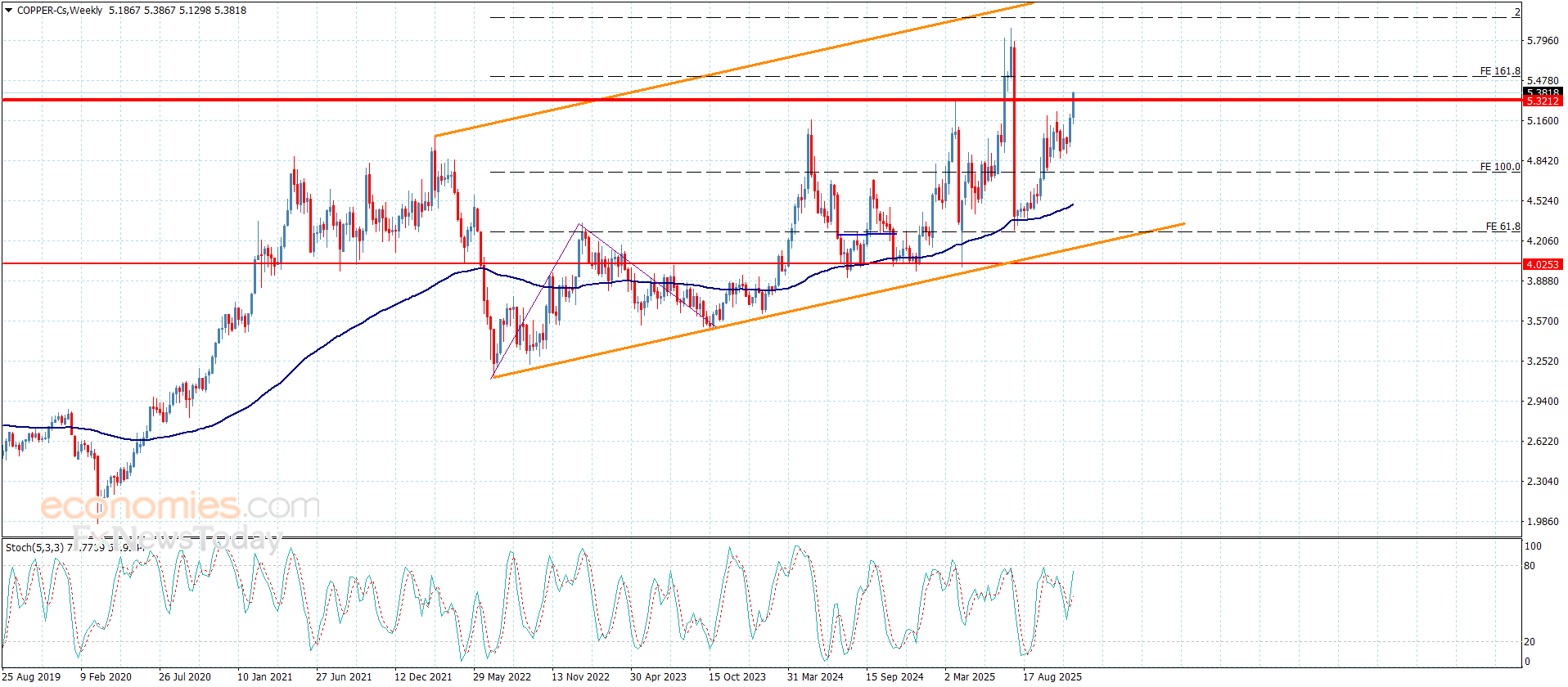
Copper price continued forming bullish trading, attempting to settle above $5.3200 level, to open the way for achieving more gains as we expected, the unionism of providing positive momentum by the main indicators will reinforce the chances of reaching $4.5000, which might form a key barrier against the current trading.
While the fluctuation below $5.2000 might force it to delay the bullish attack temporarily, which forces it to activate the bearish corrective track by targeting $4.9500 level before any attempt to record more positive targets.
The expected trading range for today is between $5.2500 and $5.5000
Trend forecast: Bullish
Prices climbed 1.36% on Thursday, recovering from early session losses to hit their highest level in nearly three years. The driver? Fresh forecasts from Atmospheric G2 showing sub-normal temperatures across the eastern U.S. from December 9–13. That’s pushing expectations for stronger heating demand, a key seasonal tailwind. Traders have seen this pattern before — winter risk premium creeping in fast, and positioning tends to follow.
Still, not all the data was bullish. The EIA reported a storage draw of just 12 bcf for the week ending November 28, well below expectations for an 18 bcf drop. The five-year average draw for this week is 43 bcf. That’s a miss, and it shows inventories remain comfortable — now 5.1% above the five-year average, even if they’re slightly below last year’s levels. Bottom line: storage isn’t screaming scarcity.
On the production front, dry gas output hit 111.5 bcf/day on Thursday, up more than 6% from a year ago. And despite the cold snap, supply hasn’t flinched. In fact, active rigs climbed to 130 last week, a 2.25-year high. That supply confidence might cap upside in the near term unless weather turns severe.
Demand is holding up. Thursday’s lower-48 consumption hit 118.1 bcf/day — a 12% jump year-over-year. Meanwhile, LNG flows ticked down slightly to 17.7 bcf/day, but that’s still a historically strong level. Power burn is also supportive: U.S. electricity output rose 2.1% y/y last week, with a 3% gain over the trailing 12 months. Traders are watching for whether this demand can keep pace with elevated production — or if another storage miss cools the rally.