The main tag of GoldPrice Articles.
You can use the search box below to find what you need.
[wd_asp id=1]
The main tag of GoldPrice Articles.
You can use the search box below to find what you need.
[wd_asp id=1]
The (ETHUSD) price declined in its last intraday levels, amid the dominance of the bearish corrective trend on the short-term basis and its trading alongside supportive bias line for this track, accompanied by the continuation of the negative pressure that comes from its trading below EMA50, intensifying the negative pressure on the price, to approach from the key support at $4,250, preparing to break it. On the other hand, we notice the emergence of positive signals on the (RSI), after reaching oversold levels, which might reduce the upcoming losses.
Get high-accuracy trading signals delivered directly to your Telegram. Subscribe to specialized packages tailored for the world’s top markets:
Full VIP signals performance report for August 25–29, 2025:
Silver price (XAG/USD) recovers ground after registering more than 1% losses in the previous session, trading around $40.80 per troy ounce during the European hours on Friday. The technical analysis of the daily chart suggests the price of the precious metal rises upwards within an ascending channel pattern, strengthening the bullish market bias.
The 14-day Relative Strength Index (RSI) is positioned slightly below the 70 level, strengthening the bullish bias. The momentum indicator suggests that Silver is trading in overbought territory, yet the prevailing uptrend remains strong with buyers maintaining control. Additionally, the XAG/USD pair is trading above the nine-day Exponential Moving Average (EMA), indicating that short-term price momentum is strengthening.
On the upside, the XAG/USD pair may test $41.47, the highest since September 2011, reached on September 3, followed by the upper boundary of the ascending channel around $42.00. A decisive break above this key resistance zone would strengthen the bullish bias and pave the way for the metal to approach the psychological level of $43.00.
The primary support lies at the nine-day EMA of $40.16, followed by the ascending channel’s lower boundary around $39.60. A break below the channel would weaken the bullish sentiment and put downward pressure on the Silver price to reach the 50-day EMA of $38.14. Further losses would undermine medium-term momentum, pushing the XAG/USD pair toward the three-month low of $35.80, last seen on July 1.
Silver is a precious metal highly traded among investors. It has been historically used as a store of value and a medium of exchange. Although less popular than Gold, traders may turn to Silver to diversify their investment portfolio, for its intrinsic value or as a potential hedge during high-inflation periods. Investors can buy physical Silver, in coins or in bars, or trade it through vehicles such as Exchange Traded Funds, which track its price on international markets.
Silver prices can move due to a wide range of factors. Geopolitical instability or fears of a deep recession can make Silver price escalate due to its safe-haven status, although to a lesser extent than Gold’s. As a yieldless asset, Silver tends to rise with lower interest rates. Its moves also depend on how the US Dollar (USD) behaves as the asset is priced in dollars (XAG/USD). A strong Dollar tends to keep the price of Silver at bay, whereas a weaker Dollar is likely to propel prices up. Other factors such as investment demand, mining supply – Silver is much more abundant than Gold – and recycling rates can also affect prices.
Silver is widely used in industry, particularly in sectors such as electronics or solar energy, as it has one of the highest electric conductivity of all metals – more than Copper and Gold. A surge in demand can increase prices, while a decline tends to lower them. Dynamics in the US, Chinese and Indian economies can also contribute to price swings: for the US and particularly China, their big industrial sectors use Silver in various processes; in India, consumers’ demand for the precious metal for jewellery also plays a key role in setting prices.
Silver prices tend to follow Gold’s moves. When Gold prices rise, Silver typically follows suit, as their status as safe-haven assets is similar. The Gold/Silver ratio, which shows the number of ounces of Silver needed to equal the value of one ounce of Gold, may help to determine the relative valuation between both metals. Some investors may consider a high ratio as an indicator that Silver is undervalued, or Gold is overvalued. On the contrary, a low ratio might suggest that Gold is undervalued relative to Silver.
The Silver price (XAG/USD) attracts some buyers near $40.85 during the Asian trading hours on Friday, bolstered by the weaker US Dollar (USD). The white metal receives support from the prospect of the US Federal Reserve (Fed) rate cut this year. Traders await the release of the highly-anticipated US August Nonfarm Payrolls (NFP) report later on Friday for fresh impetus.
Data released on Thursday showed that the US Initial Jobless Claims increased more than expected last week. Additionally, the ADP National Employment Report revealed that US private payrolls increased less than expected in August.
These reports indicated softening labor market conditions, reinforcing the Fed rate reduction expectation. This, in turn, weighs on the US Dollar (USD) and lifts the USD-denominated commodity price. Lower interest rates could reduce the opportunity cost of holding Silver, supporting the non-yielding white metal.
Additionally, geopolitical tensions might contribute to the white metal’s upside, as it is considered a safe-haven asset. The US is looking to pressure buyers of Russian crude to push Moscow into agreeing to a truce in Ukraine. US Treasury Secretary Bessent said on Tuesday that the US “will be examining sanctions on Russia very closely this week” due to the ongoing war in Ukraine.
The US NFP report will be closely watched later on Friday. This reading could offer some hints about the US interest rate path. Economists forecast to see 75,000 job additions in August. In case of a stronger-than-expected outcome, this could boost the Greenback and drag the Silver price lower in the near term.
Silver is a precious metal highly traded among investors. It has been historically used as a store of value and a medium of exchange. Although less popular than Gold, traders may turn to Silver to diversify their investment portfolio, for its intrinsic value or as a potential hedge during high-inflation periods. Investors can buy physical Silver, in coins or in bars, or trade it through vehicles such as Exchange Traded Funds, which track its price on international markets.
Silver prices can move due to a wide range of factors. Geopolitical instability or fears of a deep recession can make Silver price escalate due to its safe-haven status, although to a lesser extent than Gold’s. As a yieldless asset, Silver tends to rise with lower interest rates. Its moves also depend on how the US Dollar (USD) behaves as the asset is priced in dollars (XAG/USD). A strong Dollar tends to keep the price of Silver at bay, whereas a weaker Dollar is likely to propel prices up. Other factors such as investment demand, mining supply – Silver is much more abundant than Gold – and recycling rates can also affect prices.
Silver is widely used in industry, particularly in sectors such as electronics or solar energy, as it has one of the highest electric conductivity of all metals – more than Copper and Gold. A surge in demand can increase prices, while a decline tends to lower them. Dynamics in the US, Chinese and Indian economies can also contribute to price swings: for the US and particularly China, their big industrial sectors use Silver in various processes; in India, consumers’ demand for the precious metal for jewellery also plays a key role in setting prices.
Silver prices tend to follow Gold’s moves. When Gold prices rise, Silver typically follows suit, as their status as safe-haven assets is similar. The Gold/Silver ratio, which shows the number of ounces of Silver needed to equal the value of one ounce of Gold, may help to determine the relative valuation between both metals. Some investors may consider a high ratio as an indicator that Silver is undervalued, or Gold is overvalued. On the contrary, a low ratio might suggest that Gold is undervalued relative to Silver.
Momentum has been building since last week’s bullish breakout from a falling wedge pattern. That advance was reinforced by a reclaim of several key resistance levels, including the 20-Day moving average. If today’s low of $3.02 is broken, natural gas could revisit support near the long-term anchored VWAP, now at $2.96, with further downside risk toward the 20-Day moving average at $2.89. For now, though, the market continues to trade well above those levels, suggesting that buyers remain in control.
The 50-Day moving average is a critical pivot. A sustained advance and daily close above this average would open the door for a rally through the July swing high of $3.19 and potentially toward the 200-Day average, now near $3.50. Conversely, another rejection here would not be surprising given the nearly 20% rally off the recent $2.62 low. A brief consolidation or pullback would provide a healthier setup for continuation, rather than a straight-line advance.
On the larger timeframe, natural gas continues to show signs of strength. Last week produced a wide-ranging bullish engulfing pattern on the weekly chart, supported by a bullish reversal confirmation this week. A weekly close above last week’s high of $3.02 would cement the breakout and bolster the case for a push through current resistance. That confirmation, coupled with strong price behavior above the AVWAP and 20-Day average, underscores improving demand.
For a look at all of today’s economic events, check out our economic calendar.
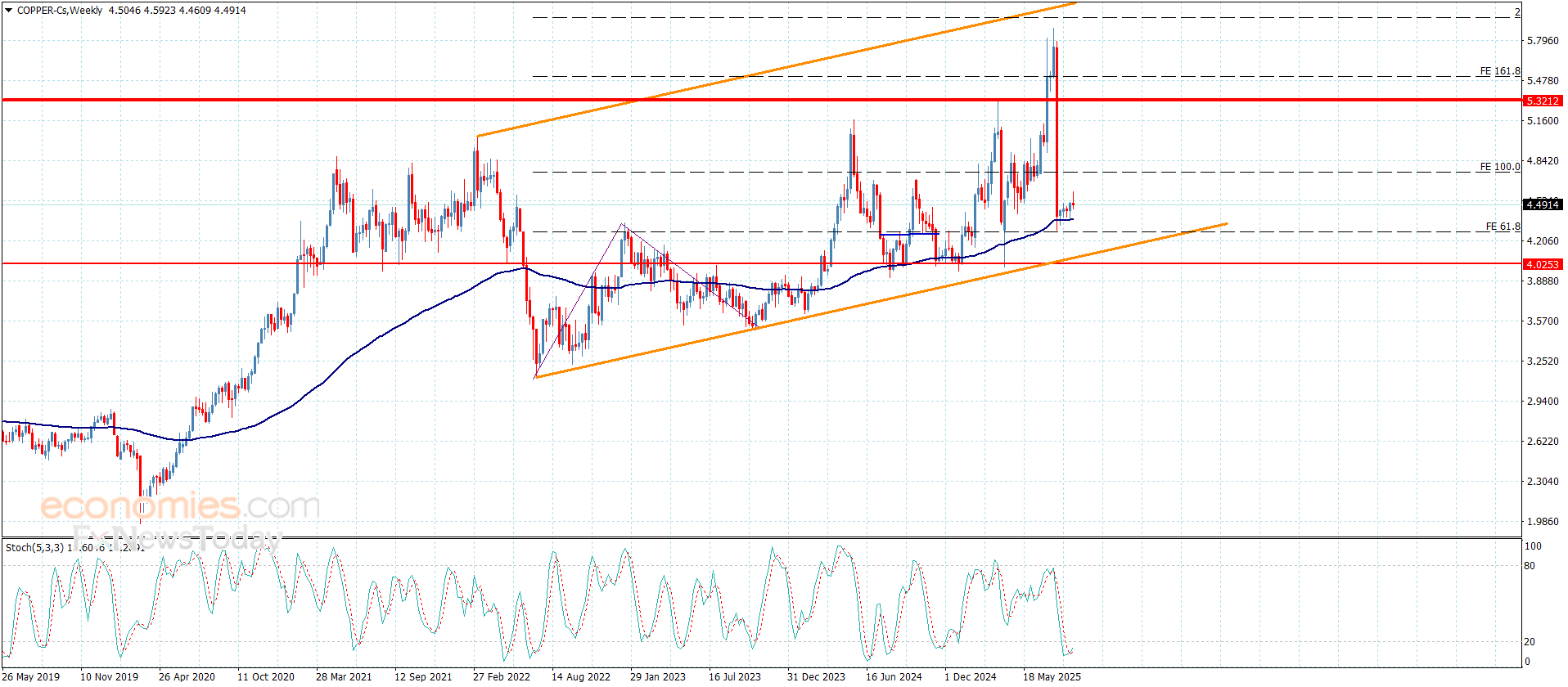
Copper price touched $4.5950 yesterday, to approach from the initial positive target, which forces it to form sideways fluctuation, due to its neediness to the positive momentum by the stability of stochastic with the oversold level.
While the stability of the price is within the bullish track, by moving away from the extra support at $4.2600, by providing positive momentum by the moving average 55, these factors make us keep the bullish suggestion, to expect surpassing $4.6200 level and reaching the next target near $4.7500.
The expected trading range for today is between $4.4200 and $4.7500
Trend forecast: Bullish
Gold (XAU/USD) is holding firm at $3,611 per ounce after opening futures at $3,619.80, marking a 0.7% rise from Wednesday’s close at $3,593.20. The metal has surged 45.3% year-over-year, climbing from $2,490 in September 2024, and is now up 36% year-to-date. Momentum was fueled by investors hedging against inflation, fiscal stress, and political intervention in central banking. The rally has firmly positioned bullion as one of the most aggressive outperformers in 2025, eclipsing major equity benchmarks and rivaling cryptocurrencies.
Strategists at Goldman Sachs argue that if President Trump’s pressure on the Federal Reserve erodes its independence, capital flight from Treasuries could ignite a historic move in XAU/USD. Their “tail-risk” model points to $4,500, with a 1% reallocation of Treasury holdings capable of driving gold toward $5,000 per ounce. At present, gold ETFs represent just 1% of the Treasury market’s size. If even a sliver of bond capital rotates into bullion, the demand shock could break records. Current spot stands at $3,596 on Comex, with traders placing a 98% probability on a September Fed rate cut, further enhancing the non-yielding asset’s appeal.
The rise is not retail-led alone. Global central banks have been net buyers, reducing exposure to dollar-denominated assets amid $37 trillion in U.S. government debt and an annual interest bill nearing $1 trillion. Gold now accounts for about 20% of global central bank reserves, surpassing the euro. The U.S. Dollar Index has slipped to 95.63, showing a –0.25 correlation with gold, its weakest in two years. This negative relationship amplifies bullion’s upside as the dollar weakens under debt concerns and tariff-driven inflation.
While the global narrative is bullish, gold miners are experiencing mixed results. Metals Exploration PLC (MTL), focused on operations in the Philippines and Nicaragua, reported interim revenue of $118.9 million, up 31% year-on-year, thanks to gold averaging $2,884 per ounce versus $2,190 last year. However, pretax profit plunged 71% to $16.8 million due to a sharp drop in impairment gains and a spike in other expenses to $18.8 million. Operating profit still more than doubled to $29.1 million, while free cash flow hit a record $70.7 million. Shares fell 2.1% to 12.64 pence in London trading, highlighting the volatility miners face even with bullion at historic highs.
Chart watchers view $3,500 as the critical support zone for XAU/USD, a level tested during Thursday’s session before rebounding. Analysts highlight $3,700 as the next breakout threshold, aligning with Goldman Sachs’ near-term year-end projection. RSI remains elevated, suggesting strong momentum but leaving room for corrective pullbacks. Traders are monitoring U.S. nonfarm payrolls closely, with weak labor data likely to provide the next impulse higher. Any breach below $3,500 could trigger quick tests of $3,450, but dips remain aggressively bought.
Local data shows how international bullion rallies ripple into emerging markets. In the Philippines, gold prices slipped slightly to PHP 6,495.52 per gram from PHP 6,544.82 the day before, translating international prices into peso terms. A troy ounce cost PHP 202,033.50, reflecting minor currency-driven fluctuations but broadly aligned with the global rise above $3,600.
U.S. government debt at 126% of GDP and political tension over the Fed have become primary catalysts for bullion demand. Trump’s firing of Fed Governor Lisa Cook and open criticism of Jerome Powell sparked renewed doubts about the Fed’s autonomy. Fiscal deficits—spending $7 trillion against $5 trillion in revenue—are forcing bond issuance at a time when investors are questioning Treasuries as reliable stores of value. Tariff battles have added further uncertainty, pushing global investors to diversify into gold.
Billionaire hedge fund managers like Ray Dalio argue that the U.S. is facing 1930s-style political and fiscal risks, making gold indispensable as a store of value. ETF assets are surging, and bullion now challenges Treasuries as a reserve hedge. Bridgewater and other funds have been reallocating capital toward metals, underscoring that this rally is not a speculative flash but a structural shift.
Storage levels remain robust across all regions, with the South Central posting a modest 4 Bcf increase. The East and Midwest both added 28 Bcf, while the Pacific region saw a rare draw of 4 Bcf. The Mountain region was flat. While the report didn’t surprise, it underlines that the supply-demand balance remains tilted toward surplus.
Recent gains in natural gas were driven by forecasts for above-normal temperatures in the Midwest and Northern U.S. during the September 8–17 period. However, the near-term forecast (Sep 2–8) shows mild conditions across key demand regions, including the Midwest and Southeast, capping electricity-driven gas demand this week.
U.S. power output, however, has been a supportive factor. According to the Edison Electric Institute, electricity generation rose 7.7% y/y for the week ending August 23, contributing to firm cooling demand. Even so, it’s unclear how much of this is already priced in given near-record gas production.
U.S. dry gas production remains near record highs, holding at 105.7 Bcf/day, up 3.3% y/y. LNG feedgas demand came in at 15.0 Bcf/day, slightly down week-over-week. Meanwhile, active U.S. natural gas rigs declined by three to 122 last week, just below the two-year high of 124 reached in early August. Although rig counts dipped, elevated output continues to weigh on any bullish momentum, especially as inventories remain healthy and demand has not spiked.
Silver (XAG/USD) is trimming losses during Thursday’s European session opening. The precious metal’s reversal from long-term highs at $41.45 has been contained at the $40.50 area, and the pair has returned to levels a few pips shy of $41.00. at the time of writing.
Precious metals are correcting lower on Thursday as dovish comments from Fed speakers eased market concerns about a global debt crisis. Nevertheless, investors’ appetite for risk remains subdued, which keeps XAG/USD’s downside attempts limited.
The technical picture shows a healthy downside correction, following a nearly 7% appreciation in a seven-day rally. The broader bullish trend remains in play, with the 4-hour RSI pulling back from overbought levels, but still above the key 50 line, and price action moving within an ascending channel.
Bears have been contained at the $40.55 level so far. Further down, the September 2 low, at 40.15, and the previous top, at $39.50, are seen as plausible targets for a corrective reversal.
Elliot Wave theorists would argue that the pair is on the fourth wave of a 5-wave bullish cycle. Immediate resistance is at Wednesday’s high, at the $41.45 area and the potential target of the fifth wave, at the confluence of the near-term channel top with the 127.2% Fibonacci extension of the early September rally, around $42.40.
Silver is a precious metal highly traded among investors. It has been historically used as a store of value and a medium of exchange. Although less popular than Gold, traders may turn to Silver to diversify their investment portfolio, for its intrinsic value or as a potential hedge during high-inflation periods. Investors can buy physical Silver, in coins or in bars, or trade it through vehicles such as Exchange Traded Funds, which track its price on international markets.
Silver prices can move due to a wide range of factors. Geopolitical instability or fears of a deep recession can make Silver price escalate due to its safe-haven status, although to a lesser extent than Gold’s. As a yieldless asset, Silver tends to rise with lower interest rates. Its moves also depend on how the US Dollar (USD) behaves as the asset is priced in dollars (XAG/USD). A strong Dollar tends to keep the price of Silver at bay, whereas a weaker Dollar is likely to propel prices up. Other factors such as investment demand, mining supply – Silver is much more abundant than Gold – and recycling rates can also affect prices.
Silver is widely used in industry, particularly in sectors such as electronics or solar energy, as it has one of the highest electric conductivity of all metals – more than Copper and Gold. A surge in demand can increase prices, while a decline tends to lower them. Dynamics in the US, Chinese and Indian economies can also contribute to price swings: for the US and particularly China, their big industrial sectors use Silver in various processes; in India, consumers’ demand for the precious metal for jewellery also plays a key role in setting prices.
Silver prices tend to follow Gold’s moves. When Gold prices rise, Silver typically follows suit, as their status as safe-haven assets is similar. The Gold/Silver ratio, which shows the number of ounces of Silver needed to equal the value of one ounce of Gold, may help to determine the relative valuation between both metals. Some investors may consider a high ratio as an indicator that Silver is undervalued, or Gold is overvalued. On the contrary, a low ratio might suggest that Gold is undervalued relative to Silver.

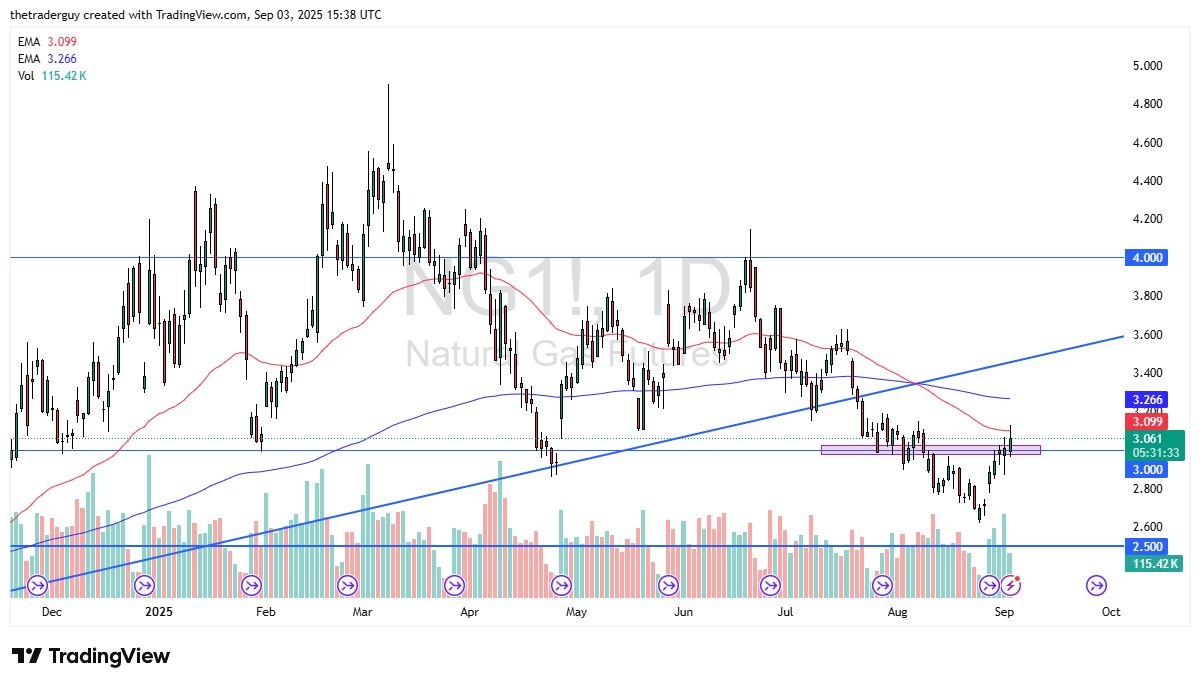
One of the most important things you need to learn about natural gas is that it most certainly has a season to it. What I mean by this is that it is the US contract, and therefore it will follow US weather patterns. At this point in time it’s very rare that it gets cold enough for heating to be a major driver of natural gas, which in the winter months most certainly is the case. It’s not necessarily that hot in the United States at the moment either, so producing electricity for air conditioning isn’t really a thought either. Because of this, I think there is still an argument to be made for this market being one that simply has no real reason to get strong at this point, and rallies could end up being selling opportunities.
If we were to break down below the $2.98 level, then I think you’ve would start to see a significant amount of downward pressure come into the picture. In that environment, I anticipate that natural gas could drop to the $2.80 level, perhaps even followed by the $2.60 level. An extraordinarily negative mood could even take natural gas down to the $2.50 level, but I think as we go deeper into the year, that’s less likely. I’m still looking for shorting opportunities and will love this bounce running out of momentum before taking advantage of the overall downtrend.
Ready to trade daily Forex analysis? We’ve shortlisted the best commodity brokers in the industry for you.
Christopher Lewis has been trading Forex and has over 20 years experience in financial markets. Chris has been a regular contributor to Daily Forex since the early days of the site. He writes about Forex for several online publications, including FX Empire, Investing.com, and his own site, aptly named The Trader Guy. Chris favours technical analysis methods to identify his trades and likes to trade equity indices and commodities as well as Forex. He favours a longer-term trading style, and his trades often last for days or weeks.
Copper price touched $4.5950 yesterday, to approach from the initial positive target, which forces it to form sideways fluctuation, due to its neediness to the positive momentum by the stability of stochastic with the oversold level.
While the stability of the price is within the bullish track, by moving away from the extra support at $4.2600, by providing positive momentum by the moving average 55, these factors make us keep the bullish suggestion, to expect surpassing $4.6200 level and reaching the next target near $4.7500.
The expected trading range for today is between $4.4200 and $4.7500
Trend forecast: Bullish