The main tag of GoldPrice Articles.
You can use the search box below to find what you need.
[wd_asp id=1]
The main tag of GoldPrice Articles.
You can use the search box below to find what you need.
[wd_asp id=1]
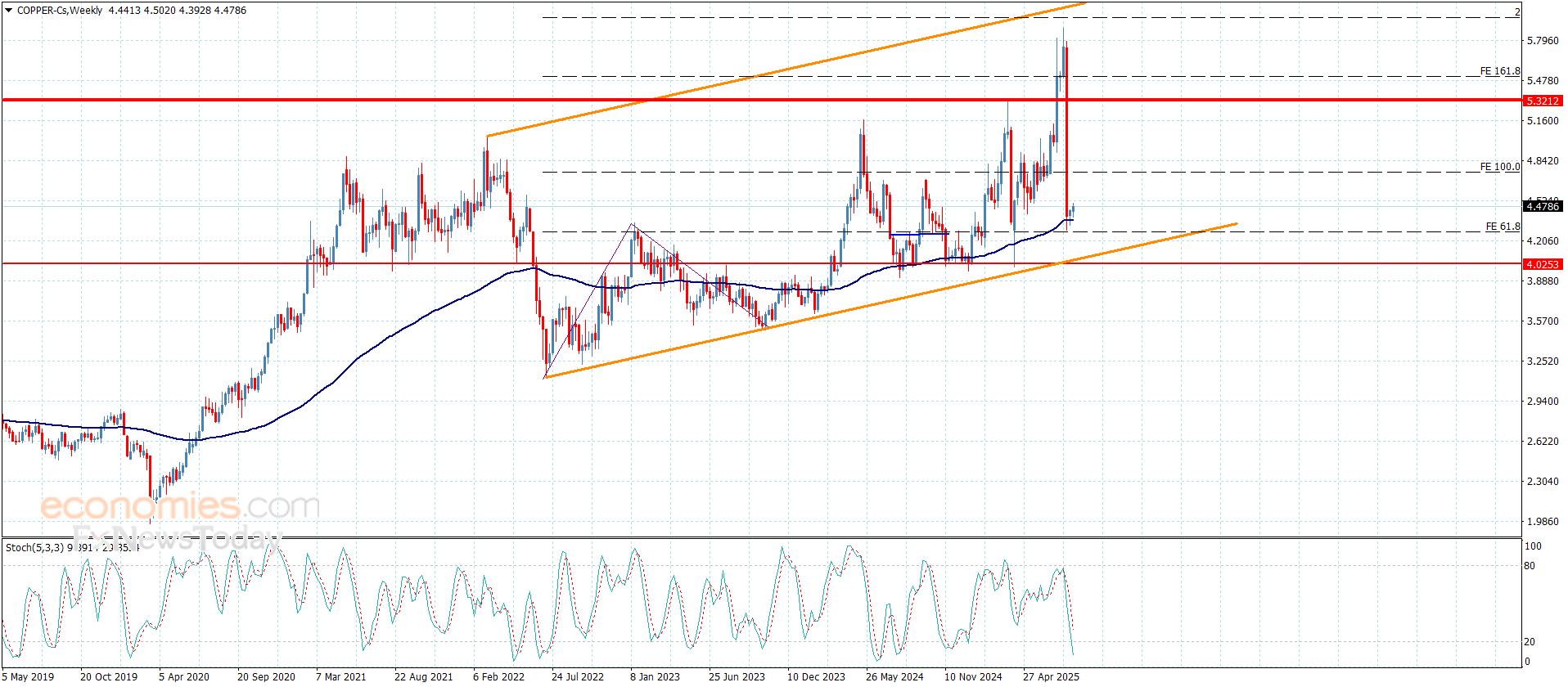
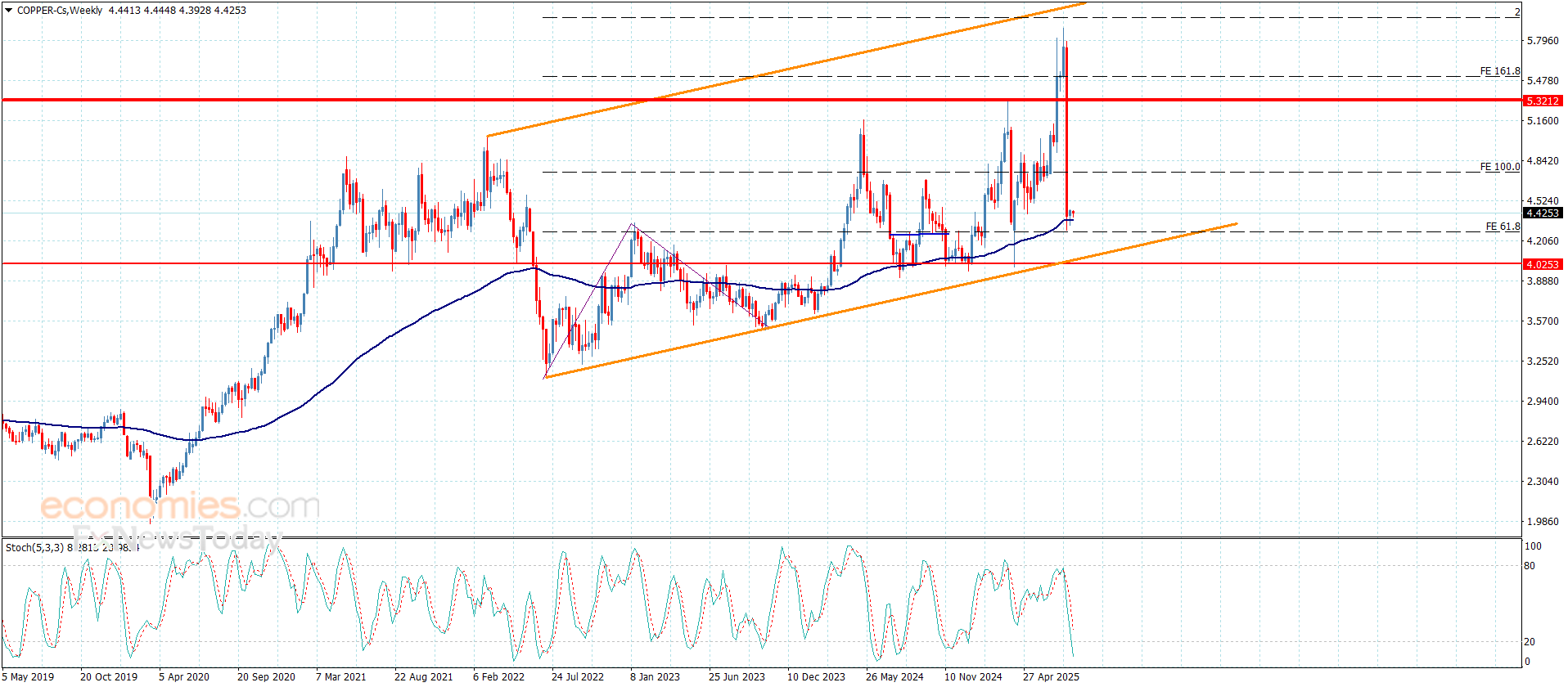
Copper price began forming slow bullish waves after stochastic reach to oversold level, to announce surpassing the negative pressure, to keep its main stability within the bullish track, which depends on the stability of the support level at $4.0500.
The price success in gaining positive momentum will ease the mission of recording positive stations, to keep waiting for reaching $4.6300, then press on the barrier at $4.7400, to monitor its behavior due to the importance of this level to detect the expected trend in the upcoming trading.
The expected trading range for today is between $4.330 and $4.6300
Trend forecast: Bullish
Copper price began forming slow bullish waves after stochastic reach to oversold level, to announce surpassing the negative pressure, to keep its main stability within the bullish track, which depends on the stability of the support level at $4.0500.
The price success in gaining positive momentum will ease the mission of recording positive stations, to keep waiting for reaching $4.6300, then press on the barrier at $4.7400, to monitor its behavior due to the importance of this level to detect the expected trend in the upcoming trading.
The expected trading range for today is between $4.330 and $4.6300
Trend forecast: Bullish
Notice that the top of the flag shows resistance around the 200-Day MA (blue) and the 20-Day MA (purple). Plus, the 20-Day line has turned down recently and that follows an advance since May 28. It is also interesting to notice that a minimum 38.2% Fibonacci retracement was completed around the recent lower swing high at $69.98. Together, these signs of resistance are consistent with the formation of a bearish flag and simultaneous bull channel breakdown.
Given the sharp descent that generated the pole portion of the bear flag, the bears will be fighting the bulls, as a large potential support zone is not much lower. When including the 50-Day MA, that zone would start around $65.74 to $64.50. The range begins with the 50-Day MA, is followed by the combination of an AVWAP level and the neckline of a double bottom pattern around $65.33 and finishes with the 61.8% Fibonacci retracement. Subsequently, a decisive decline below the 61.8% level will confirm a continuation of the bear flag breakdown.
Despite the bear trigger there needs to be follow-though to confirm. Notice that today’s range is very narrow and not what is generally anticipated on a solid breakdown. Traders should stay cautious as a rally above today’s high of $67.41 could lead to another test of resistance around 20-Day MA, now at $68.47, or another resistance level. Of course, that would keep crude oil within the flag consolidation pattern. On the upside, a decisive decline below today’s low of $66.50 triggers a continuation of the bear flag breakdown and opens the door to lower prices.
For a look at all of today’s economic events, check out our economic calendar.
Gold trades with a softer tone on Tuesday, falling to a fresh one-week low of $3,331.12 in the American session. The US Dollar (USD) gathered momentum following the release of United States (US) data, finding additional legs in political headlines.
The US published the July Consumer Price Index (CPI), which rose at an annualized pace of 2.7% in July, lower than the 2.8% market forecast. The core annual reading, however, increased by 3.1%, higher than the previous 2.9% and the 3% anticipated. On a monthly basis, the CPI rose by 0.2%, while the core monthly reading resulted at 0.3%, matching expectations.
The figures support the case for a September rate cut, leading to broad USD weakness. Stocks rallied, reflecting the better mood amid potential lower costs, and weighing on the bright metal.
The USD kept falling despite some political noise. US President Donald Trump extended the 90-day pause on massive tariffs on China, while Beijing answered reciprocally. Later in the day, Trump said he is considering allowing a lawsuit against Federal Reserve (Fed) Chair Jerome Powell amid the “ horrible, and grossly incompetent, job he has done in managing the construction of the Fed Buildings.”
Kansas City Federal Reserve (Fed) President Jeffrey Schmid said that the muted impact of tariffs on inflation should be seen as evidence that monetary policy is appropriate, and not a reason to cut interest rates.
Other than that, Trump’s candidate to replace Adriana Kugler, Stephen Miran, said he believes tariffs will be borne by the countries that they are tariffing, while the next head of the Bureau of Labor Statistics, EJ Antoni, suggested not publishing the Nonfarm Payrolls report anymore. The noise is doing no good to the Greenback.
The macroeconomic calendar cools down on Wednesday, as the only relevant figure will be the final estimate of German Harmonized Index of Consumer Prices (HICP).
The XAU/USD pair is little changed from Monday’s close, hovering around the $3,350 level. The daily chart shows the pair is unable to advance beyond a flat 20 Simple Moving Average (SMA), although well above bullish 100 and 200 SMAs. At the same time, technical indicators suggest buyers remain sidelined: the Momentum indicator ticked modestly higher but remains below its 100 line, while the Relative Strength Index (RSI) indicator heads nowhere at around 50.
In the near term, and according to the 4-hour chart, the risk skews to the downside- Technical indicators keep grinding lower below their midlines, in line with lower lows ahead. At the same time, a flat 100 SMA at around $3,359 provides intraday resistance, while the 20 SMA gains bearish traction above the longer one.
Support levels: 3.331.10 3,312.25 3,290.00
Resistance levels: 3,359.00 3,372.30 3,389.85
Gold (XAU/USD) reversal from the $3,400 area has been contained at a strong support area between $3,335 and $3,345, where the pair was contained on August 4 and 5, which is also coincident with the 50% Fibonacci retracement of the early August rally.
The pair is trading sideways without a clear bias on Tuesday’s European session, as the US Dollar Index consolidates previous gains with all eyes on the US CPI release, due later today. A more cautious market sentiment on Tuesday is keeping the precious metal from dropping further.
XAU/USD confirmed a trend shift on early Monday’s trading after breaching the bottom of the ending wedge, at $3,390. The pair featured an impulsive reversal to reach the broken wedge’s measured target, at $3,345, and is consolidating on Tuesday, awaiting a fundamental trigger to set the US Dollar’s near-term direction.
Technical indicators remain pointing lower, and a confirmation below the mentioned $3,335 level would bring the July 29 low and July 31 highs, at the $3,305-$3,315 area back to the bears’ focus, before the August 1 low, at $3,282.
To the upside, immediate resistance is at the August 8 lows at $3,380 ahead of the $3,400-$3,410 area, where the August 7 and 10 highs meet the reverse trendline. Above here, the bearish view will be cancelled with the late July highs, at $3,440 coming into view.
Gold has played a key role in human’s history as it has been widely used as a store of value and medium of exchange. Currently, apart from its shine and usage for jewelry, the precious metal is widely seen as a safe-haven asset, meaning that it is considered a good investment during turbulent times. Gold is also widely seen as a hedge against inflation and against depreciating currencies as it doesn’t rely on any specific issuer or government.
Central banks are the biggest Gold holders. In their aim to support their currencies in turbulent times, central banks tend to diversify their reserves and buy Gold to improve the perceived strength of the economy and the currency. High Gold reserves can be a source of trust for a country’s solvency. Central banks added 1,136 tonnes of Gold worth around $70 billion to their reserves in 2022, according to data from the World Gold Council. This is the highest yearly purchase since records began. Central banks from emerging economies such as China, India and Turkey are quickly increasing their Gold reserves.
Gold has an inverse correlation with the US Dollar and US Treasuries, which are both major reserve and safe-haven assets. When the Dollar depreciates, Gold tends to rise, enabling investors and central banks to diversify their assets in turbulent times. Gold is also inversely correlated with risk assets. A rally in the stock market tends to weaken Gold price, while sell-offs in riskier markets tend to favor the precious metal.
The price can move due to a wide range of factors. Geopolitical instability or fears of a deep recession can quickly make Gold price escalate due to its safe-haven status. As a yield-less asset, Gold tends to rise with lower interest rates, while higher cost of money usually weighs down on the yellow metal. Still, most moves depend on how the US Dollar (USD) behaves as the asset is priced in dollars (XAU/USD). A strong Dollar tends to keep the price of Gold controlled, whereas a weaker Dollar is likely to push Gold prices up.
The GBPJPY pair succeeded to breach the barrier at 198.85, to confirm its readiness to resume the bullish attack, reaching 199.35 taking advantage of providing positive momentum by the main indicators.
We expect forming bullish trading, to target new positive stations that might begin at 200.40, to confirm entering the bullish channel’s levels, then attempts to target 78.2%Fiboancci level at 202.000, while the risk of changing the bullish trend requires forming a sharp decline, to settle below 61.8%Fibonacci correction level at 197.45.
The expected trading range for today is between 198.70 and 200.40
Trend forecast: Bullish
The (ETHUSD) price rose in its last intraday trading, amid its move in sideways range in attempt to gain positive momentum that might help it to recover and complete the strong bullish track, amid its trading alongside a minor bullish bias line on the short-term basis, taking advantage of the dynamic support that is represented by its trading above its EMA50, on the other hand, we notice the emergence of the negative signals on the (RSI), which reduced the last gains of the price.
Therefore, our expectations suggest a rise in the (ETHUSD) price in the upcoming intraday trading, conditioned by its stability above $4,150, targeting the resistance level at $4,500.
The expected trading range is between $4,000 support and $4,500 resistance.
Today’s forecast: Bullish
The (ETHUSD) price rose in its last intraday trading, amid its move in sideways range in attempt to gain positive momentum that might help it to recover and complete the strong bullish track, amid its trading alongside a minor bullish bias line on the short-term basis, taking advantage of the dynamic support that is represented by its trading above its EMA50, on the other hand, we notice the emergence of the negative signals on the (RSI), which reduced the last gains of the price.
Therefore, our expectations suggest a rise in the (ETHUSD) price in the upcoming intraday trading, conditioned by its stability above $4,150, targeting the resistance level at $4,500.
The expected trading range is between $4,000 support and $4,500 resistance.
Today’s forecast: Bullish
Spot Gold is down on Monday, trading at its lowest in a week, just below the $3,350 mark. The bright metal fell throughout the day, despite some modest caution leading the financial board. The decline accelerated in the mid-European session and extended into American trading hours amid resurgent demand for the US Dollar (USD).
Speculative activity, however, is limited amid the absence of big news and ahead of upcoming first-tier events. On the data front, the Reserve Bank of Australia (RBA) will announce its decision on monetary policy on Tuesday. The central bank is widely anticipated to trim the Official Cash Rate (OCR) by 25 basis points, while market players will look for clues on the next move. The United States (US) will then publish the July Consumer Price Index (CPI), with the index expected to indicate inflationary pressures have ticked higher.
Other than that, US President Donald Trump had a busy start to the week. He referred to China as the deadline to reach an agreement with its major commercial partner looms. Both countries have imposed on each other massive tariffs of three digits, but ultimately paused most of them to reach a better deal. Such levies should come into effect on Tuesday, unless they announce an extension of the truce. Meanwhile, Trump announced he “hopes” China quadruples its soybean demand amid a shortage in the Asian giant.
Additionally, Trump is expected to meet Russian President Vladimir Putin later this week, to negotiate the end of the war between Moscow and Ukraine. Trump has recently punished Russian oil buyers with tariffs to put pressure on Putin.
Generally speaking, financial markets started the week with cautious optimism. Asian stocks edged higher, while European ones closed the day mixed. As for Wall Street, the Dow Jones Industrial Average (DJIA) trades in the red, but the Nasdaq Composite and the S&P500 hold on to gains.
From a technical point of view, the daily chart for the XAU/USD pair shows it is currently trading below a flat 20 Simple Moving Average (SMA), while a bullish 100 SMA loses momentum at around $3,290, providing dynamic support should the decline continue. In the meantime, technical indicators crossed their midlines into negative territory with firm downward slopes, reflecting the ongoing downward pressure and hinting at lower lows ahead.
The near-term picture is bearish, given that technical indicators fell well below their midlines, maintaining their downward slopes and with the Relative Strength Index (RSI) indicator approaching oversold readings. At the same time, the XAU/USD pair fell below its 20 and 100 SMAs, with the shorter one gaining downward traction at around $3,378. Finally, Gold is finding some near-term support in a directionless 200 SMA. A clear break below the latter should open the door for a bearish extension in the upcoming sessions.
Support levels: 3.338.60 3,312.25 3,290.00
Resistance levels: 3,356.10 3,372.30 3,389.85
The (Brent) price settled low in its last intraday trading, attempting to break the critical support level at 66.00, amid the dominance of the main bearish trend and its trading alongside a minor bias line on the short-term basis, showing the strength of this trend and its dominance, especially with the continuation of the negative pressure that comes from its trading below EMA50, with the emergence of the negative signals on the (RSI), after reaching overbought levels.
Get high-accuracy trading signals delivered directly to your Telegram. Subscribe to specialized packages tailored for the world’s top markets:
To view the full performance report for this week, visit the following link: