The main tag of GoldPrice Articles.
You can use the search box below to find what you need.
[wd_asp id=1]
The main tag of GoldPrice Articles.
You can use the search box below to find what you need.
[wd_asp id=1]
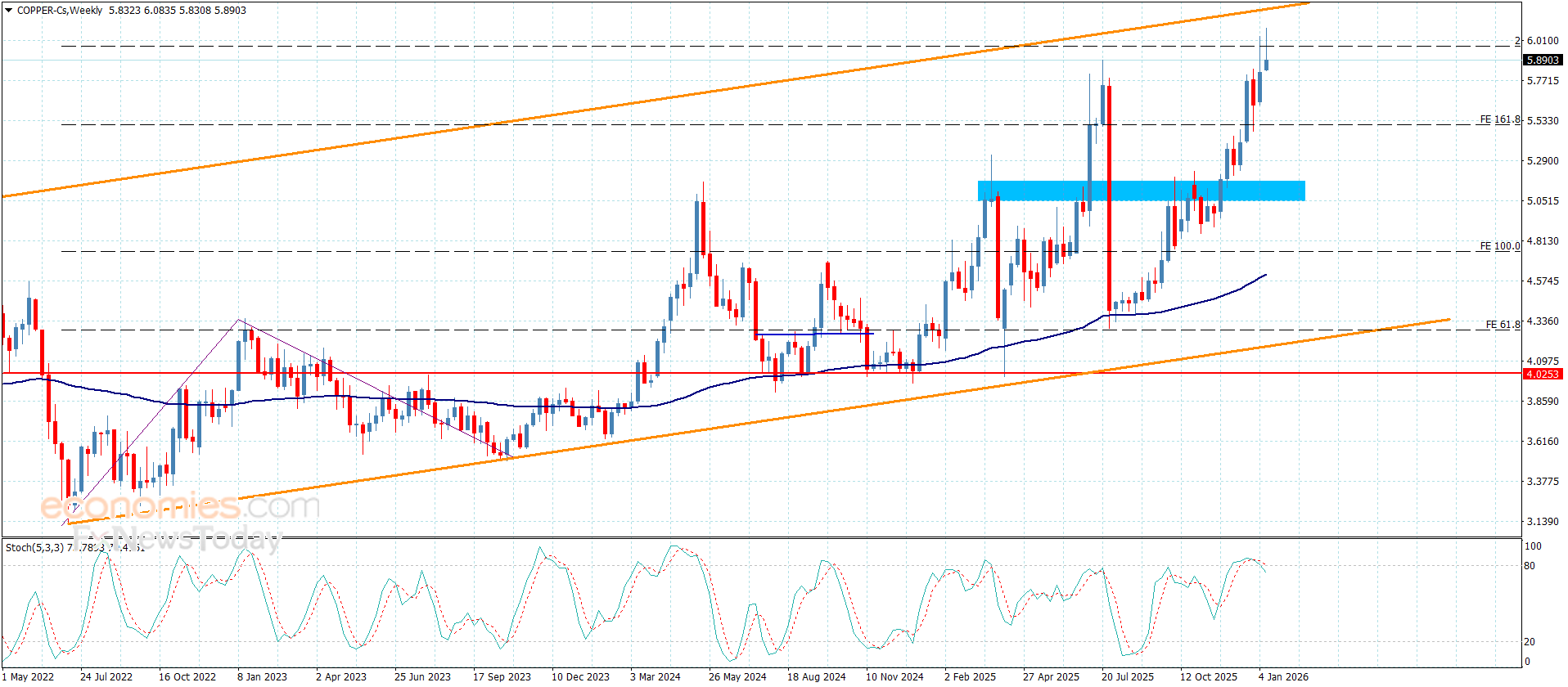
Copper price provided a new negative close below the barrier at$5.9700, announcing to delay the bullish attack, to begin activating the bearish corrective trend by reaching $5.7900 initially, approaching the initial suggested target in the previous report.
Stochastic exit from the overbought level will increase the negative pressure on the price, which makes us keep the bearish corrective suggestion, to expect targeting $5.6000 level, to press on the extra support at $5.5100.
The expected trading range for today is between $5.6000 and$5.8600
Trend forecast: Bearish correctly
Silver price (XAG/USD) extends its losses for the second successive session, trading around $91.00 during the European hours on Friday. Silver price loses ground amid decreasing safe-haven demand, which could be attributed to easing concerns over geopolitical risks and Federal Reserve (Fed) independence.
US President Donald Trump said he had stepped back from threats of military action after receiving assurances that further killings would not occur and executions would be halted. Market sentiment was also supported by reports that Israel and other regional allies urged Washington to delay any action, amid concerns over potential retaliation.
The safe-haven demand for Silver weakens as the risk-on mood improves after President Trump said he has no plans to dismiss Fed Chair Jerome Powell despite reported Justice Department indictment threats. Moreover, the US and Taiwan signed a trade agreement on Thursday aimed at boosting American semiconductor production in exchange for lower tariffs.
Silver, a non-interest-bearing asset, loses its shine as Thursday’s US Initial Jobless Claims data reinforced the likelihood that the Fed will keep interest rates on hold for the coming months. According to the CME Group’s FedWatch tool, Fed funds futures continue to price in about a 95% probability that the US central bank will keep rates unchanged at its January 27–28 meeting. Fed funds futures have pushed expectations for the next rate cut back to June, reflecting stronger labor market conditions and policymakers’ concerns over sticky inflation.
Initial Jobless Claims unexpectedly fell to 198K in the week ended January 10, below market expectations of 215K and down from the prior week’s revised 207K. The data confirmed that layoffs remain limited and that the labor market is holding up despite an extended period of high borrowing costs.
Silver is a precious metal highly traded among investors. It has been historically used as a store of value and a medium of exchange. Although less popular than Gold, traders may turn to Silver to diversify their investment portfolio, for its intrinsic value or as a potential hedge during high-inflation periods. Investors can buy physical Silver, in coins or in bars, or trade it through vehicles such as Exchange Traded Funds, which track its price on international markets.
Silver prices can move due to a wide range of factors. Geopolitical instability or fears of a deep recession can make Silver price escalate due to its safe-haven status, although to a lesser extent than Gold’s. As a yieldless asset, Silver tends to rise with lower interest rates. Its moves also depend on how the US Dollar (USD) behaves as the asset is priced in dollars (XAG/USD). A strong Dollar tends to keep the price of Silver at bay, whereas a weaker Dollar is likely to propel prices up. Other factors such as investment demand, mining supply – Silver is much more abundant than Gold – and recycling rates can also affect prices.
Silver is widely used in industry, particularly in sectors such as electronics or solar energy, as it has one of the highest electric conductivity of all metals – more than Copper and Gold. A surge in demand can increase prices, while a decline tends to lower them. Dynamics in the US, Chinese and Indian economies can also contribute to price swings: for the US and particularly China, their big industrial sectors use Silver in various processes; in India, consumers’ demand for the precious metal for jewellery also plays a key role in setting prices.
Silver prices tend to follow Gold’s moves. When Gold prices rise, Silver typically follows suit, as their status as safe-haven assets is similar. The Gold/Silver ratio, which shows the number of ounces of Silver needed to equal the value of one ounce of Gold, may help to determine the relative valuation between both metals. Some investors may consider a high ratio as an indicator that Silver is undervalued, or Gold is overvalued. On the contrary, a low ratio might suggest that Gold is undervalued relative to Silver.
Going forward, a bullish continuation of the trend will be triggered on a new high and confirmed with a closing price above $4,643. That would put gold in a position to challenge potential resistance at the next upside targets at $4,664, $4,687, and $4,713. The middle target is the 161.8% Fibonacci extension of October bearish correction. Therefore, the target is derived from a short-term measurement. On the other hand, the two other price targets are from a long-term pattern. Specifically, a 350% extension and 423.6% extension of the decline that began from the 2011 peak of $1,921, respectively.
It remains to be seen if there are signs resistance near either of those price targets but the more recent pattern target of $4,687 might have a good chance of being challenged. Above that next price zone is a $4,766 target, which is the 361.8% projection for a long-term rising ABCD pattern or measured move. It connects the 2018 swing low at $1,160 (A) and 2022 low at $1,615.
On the downside, there are several significant potential support levels for a pullback. Short-term is the recent high of $4,550 and the rising 10-day average at $4,514. A minor swing high is at $4,500 and the 20-day average is at $4,554. Overall, the bulls remain in charge as long as gold stays above the 20-day average on a daily closing basis. Signs of strength suggest that a pullback would likely be shallow and relatively short, if it occurs before new highs.
The recent pullback in October found support near the 38.2% Fibonacci retracement. That is a relatively minor retracement, reflecting strong underlying demand. In addition, a second breakout from a rising trend channel triggered in December and the top of the channel was recently confirmed as support in a similar price area as the 20-day average. That confirms a change in character for the trend. It is gaining strength.
For a look at all of today’s economic events, check out our economic calendar.
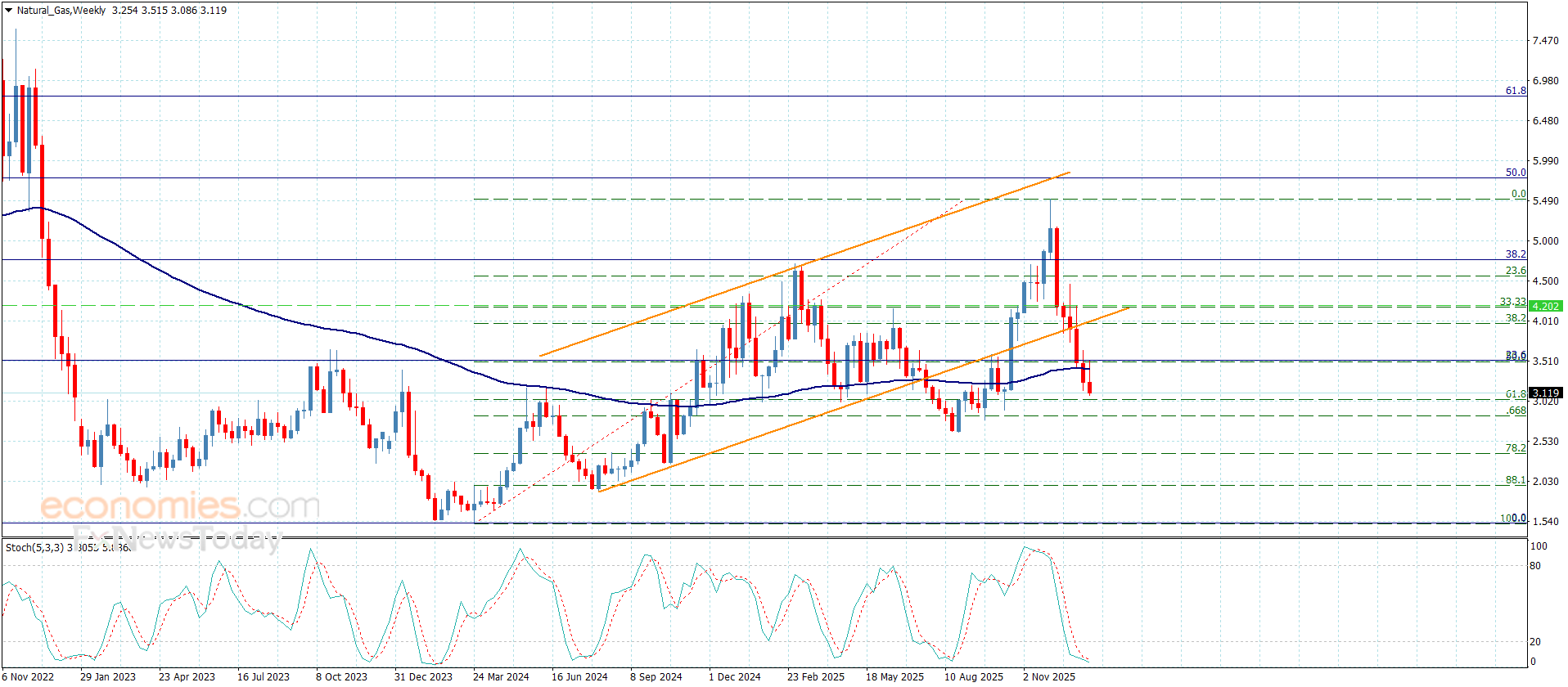
Lower targets start with an 88.6% retracement of the advance at $2.95, that began from the low in August. A little lower is the 100% projection for a falling ABCD pattern at $2.89. That matches a higher monthly low from October and therefore takes on greater potential significance. Given the conviction of sellers during the correction, with sharp declines and a failure of the long-term average, it would not be surprising to see the lower level(s) hit before the correction completes. The speed to the rebound will then provide clues to whether bearish momentum is faltering.
Despite the potential for further downside, the area around the trendline could continue to show support, leading to a bounce. Since natural gas has been correcting with a larger bull trend, it is expected to complete the retracement and continue to progress the trend. An advance above Thursday’s lower daily high will provide the next sign of strength, but within a downtrend.
Key dynamic resistance is then at the 10-day average, currently at $3.36 and falling. Short-term downward pressure remains with trading below the 10-day line. That dynamic resistance zone is followed by a lower swing high at $3.50, the 200-day average at $4.54, and another lower swing high at $3.63. A daily close above the first lower swing high at $3.50, as that would confirm a bullish reversal based on structure.
Watch how the week ends, as a daily close below last week’s low of $3.13 will confirm weakness on that larger timeframe. The Relative Strength Index (RSI) momentum oscillator is near a level where support was seen during prior bearish corrections and supports the idea that the correction is close to complete. Moreover, the two largest prior bearish measured moves since the 2024 bottom ended with a 46.5% decline and a 40.7% drop price. The current decline shows a 45.3% drop in price since the December peak at $5.50. This would suggest that the current correction has hit a low or is very close to doing so.
If you’d like to know more about what drives natural gas prices, please visit our educational area.
Copper price failed to settle for long time above $5.9700 barrier, affected by stochastic exit from the overbought level, to reach $5.8800 again, which increases the chances of activating temporary negative corrective trading, facing new bearish pressures that will force it to decline towards $5.6000 reaching extra support at $5.5100.
While the price success in surpassing the barrier and holding above it will reinforce it to record new historical gains by its rally towards $6.1200 and $6.2050.
The expected trading range for today is between $5.7500 and $6.000
Trend forecast: Fluctuated within the bullish trend
The EURJPY pair failed to breach the barrier near 185.55, forcing it to delay the bullish rally and activating the attempts of gathering gains by reaching below 184.85, to approach from %78.2 Fibonacci correction level at 184.10.
The contradiction between the main indicators confirms the dominance of the sideways bias, to keep providing mixed trading until gathering bullish momentum, to ease the mission of stepping above 184.85, then wait for targeting 185.50, we should note that the price decline below 184.10 and providing negative close will increase the efficiency of the bearish corrective track, to expect targeting the next support near 183.40.
The expected trading range for today is between 184.05 and 184.85
Trend forecast: Fluctuated within the bullish track
Spot Gold consolidates recent gains, trading comfortably around $4,610 a troy ounce. The XAU/USD pair keeps finding buyers on dips towards the $4,580 price zone, as the US Dollar (USD) remains unattractive.
Sentiment improved after Wall Street’s opening, and the United States (US) indexes seem to have left behind their poor performance of the last few days, with the tech sector rebounding and leading gains. The better mood caps the bright metal, which, anyway, holds near fresh record highs.
Other than that, the latest round of US macroeconomic data was encouraging, although not enough to bring speculative interest back to life. The country reported that Initial Jobless Claims eased to198K in the week ended January 10, improving from the 207K previous. Additionally, the Philadelphia Fed Manufacturing Survey printed at 12.6 in January following a revised -8.8 in December.
Friday will bring little of interest in terms of macroeconomic releases, with the focus on US political noise and President Donald Trump’s inside and outside battles.
The 4-hour chart shows XAU/USD trades around the 20-period Simple Moving Average (SMA) at $4,610, which partially lost its bullish strength. At the same time, the 100 and 200 SMAs maintain a bullish bias as price holds above the gauges. Initial support emerges at the 100 SMA at $4,476.27. Meanwhile, the Momentum indicator aims lower around its midline, while the Relative Strength Index (RSI) indicator eases at around 55, reflecting the lack of buying interest rather than supporting a downward extension.
In the daily chart, XAU/USD paused, but did not give up. Technical indicators are correcting overbought conditions, but lack downward strength. At the same time, the pair develops far above all its moving averages, with the 20-day Simple Moving Average (SMA) rising above the 100- and 200-day measures, and all three slope higher, underscoring a firm bullish bias. Critical dynamic support aligns at the 20-day SMA at $4,452.69, with additional layers at the 100-day at $4,069.11 and the 200-day at $3,698.49.
(The technical analysis of this story was written with the help of an AI tool.)
The EURJPY pair failed to breach the barrier near 185.55, forcing it to delay the bullish rally and activating the attempts of gathering gains by reaching below 184.85, to approach from %78.2 Fibonacci correction level at 184.10.
The contradiction between the main indicators confirms the dominance of the sideways bias, to keep providing mixed trading until gathering bullish momentum, to ease the mission of stepping above 184.85, then wait for targeting 185.50, we should note that the price decline below 184.10 and providing negative close will increase the efficiency of the bearish corrective track, to expect targeting the next support near 183.40.
The expected trading range for today is between 184.05 and 184.85
Trend forecast: Fluctuated within the bullish track
Copper price failed to settle for long time above $5.9700 barrier, affected by stochastic exit from the overbought level, to reach $5.8800 again, which increases the chances of activating temporary negative corrective trading, facing new bearish pressures that will force it to decline towards $5.6000 reaching extra support at $5.5100.
While the price success in surpassing the barrier and holding above it will reinforce it to record new historical gains by its rally towards $6.1200 and $6.2050.
The expected trading range for today is between $5.7500 and $6.000
Trend forecast: Fluctuated within the bullish trend
Silver price corrects almost 6% to near $86.50 during the Asian trading session on Thursday. The white metal retraced from its all-time high of $93.51 posted on Wednesday after United States (US) President Donald Trump said that Iran assured it will stop killings of protesters, and has no plans of large-scale civil executions, resulting in a decline in appeal of safe-haven demand.
Market sentiment remained risk-averse as US President Trump threatened military action against the government of Supreme Leader Ayatollah Ali Khamenei for executing protestors amid civil unrest in Iran. The assurance from Tehran that it will stop executions of civilians has downplayed the risks of US military action.
Meanwhile, expectations from the Federal Reserve (Fed) that it won’t reduce interest rates in the policy meeting later this month are also weighing on the Silver. The speculation for the Fed pausing its ongoing monetary easing campaign intensified after the release of the US Consumer Price Index (CPI) data on Tuesday, which showed that price pressure remained sticky.
Going forward, the major trigger for the Silver price will be the announcement of the new Fed Chairman by the White House. US President Trump said in December that he would announce the successor of Fed Chair Jerome Powell sometime in January. The comments from Trump in his latest interviews showed that White House Economic Adviser Kevin Hassett, former Fed Chair Kevin Warsh, and current Fed Governors Christopher Waller and Michelle Bowman are major contenders to replace Jerome Powell.
XAG/USD trades sharply lower to near $88.50 as of writing. The 20-day Exponential Moving Average rises and sits at $77.48, reinforcing an upward bias as THE price holds well above it. Its positive slope supports the trend and keeps pullbacks contained around the average.
The 14-day Relative Strength Index (RSI) at 68 (near overbought) reflects firm momentum after cooling from recent extremes, which could cap immediate upside if it stalls.
As long as the pair stays above the rising 20-EMA, bulls retain control, and an extension of the advance would remain the base case. A close below the 20-day EMA would shift the bias toward consolidation and open room for further downside toward the January 8 low of $73.85.
(The technical analysis of this story was written with the help of an AI tool.)
Silver is a precious metal highly traded among investors. It has been historically used as a store of value and a medium of exchange. Although less popular than Gold, traders may turn to Silver to diversify their investment portfolio, for its intrinsic value or as a potential hedge during high-inflation periods. Investors can buy physical Silver, in coins or in bars, or trade it through vehicles such as Exchange Traded Funds, which track its price on international markets.
Silver prices can move due to a wide range of factors. Geopolitical instability or fears of a deep recession can make Silver price escalate due to its safe-haven status, although to a lesser extent than Gold’s. As a yieldless asset, Silver tends to rise with lower interest rates. Its moves also depend on how the US Dollar (USD) behaves as the asset is priced in dollars (XAG/USD). A strong Dollar tends to keep the price of Silver at bay, whereas a weaker Dollar is likely to propel prices up. Other factors such as investment demand, mining supply – Silver is much more abundant than Gold – and recycling rates can also affect prices.
Silver is widely used in industry, particularly in sectors such as electronics or solar energy, as it has one of the highest electric conductivity of all metals – more than Copper and Gold. A surge in demand can increase prices, while a decline tends to lower them. Dynamics in the US, Chinese and Indian economies can also contribute to price swings: for the US and particularly China, their big industrial sectors use Silver in various processes; in India, consumers’ demand for the precious metal for jewellery also plays a key role in setting prices.
Silver prices tend to follow Gold’s moves. When Gold prices rise, Silver typically follows suit, as their status as safe-haven assets is similar. The Gold/Silver ratio, which shows the number of ounces of Silver needed to equal the value of one ounce of Gold, may help to determine the relative valuation between both metals. Some investors may consider a high ratio as an indicator that Silver is undervalued, or Gold is overvalued. On the contrary, a low ratio might suggest that Gold is undervalued relative to Silver.