The main tag of GoldPrice Articles.
You can use the search box below to find what you need.
[wd_asp id=1]
The main tag of GoldPrice Articles.
You can use the search box below to find what you need.
[wd_asp id=1]
Gold (XAU/USD) recently took a sharp dive, trading at $2,711 after a 1% drop, driven by a strong bearish move that sliced through key levels.
Currently, immediate support is at $2,701, with the next support levels seen at $2,692 and $2,684 if the downward momentum persists. Immediate resistance now lies around $2,725, with further barriers at $2,743 and $2,752.
The 50-day EMA sits at $2,740, while the 200-day EMA at $2,742—both above the current price—reinforce the bearish sentiment.
The substantial sell-off, coupled with a bearish engulfing candle, signals potential for further declines. For now, as long as gold remains under $2,725, sellers appear in control, with limited signs of reversal.
Silver price (XAG/USD) struggled to hold onto recent gains, trading around $32.10 per troy ounce during the Asian session on Wednesday. The dollar-denominated precious metal faces downward pressure from a stronger US Dollar (USD), which is likely linked to a rally sparked by the favorable results for the Republican candidate in the US presidential election.
As exit polls begin to show growing support for former President Donald Trump, the likelihood of him becoming the 47th president is increasing. This renewed optimism surrounding the “Trump trade” is lifting market sentiment, creating downward pressure on safe-haven assets like Silver.
Early exit poll results from Wisconsin indicate a lead for Republican candidate Donald Trump, with 56% of the vote compared to 42.5%, based on 7.5% of expected votes counted. In North Carolina, exit polls show a tight race between Trump and Kamala Harris, with 50% of the votes counted. In Michigan, with 12% of votes counted, Harris’ lead has shrunk from 61% to 53%.
Moreover, initial results show Harris leading Trump 61% to 38%, with 46% of the votes tallied in Nebraska’s District 2. Meanwhile, early exit polls from Georgia, one of the first states to report, show a slight edge for Trump. With 16 electoral votes up for grabs, preliminary data suggests Trump holds a 10% lead over Harris, although this is based on less than 1% of votes counted, according to The Washington Post.
Additionally, non-yielding assets like Silver are facing headwinds as US Treasury yields rise, with the 2-year and 10-year US Treasury bond yields at 4.23% and 4.34%, respectively, at the time of writing. Market attention is focused on the balance of power in Congress, as a sweep by either party could bring substantial changes to spending and tax policies, influencing broader market dynamics.
Silver is a precious metal highly traded among investors. It has been historically used as a store of value and a medium of exchange. Although less popular than Gold, traders may turn to Silver to diversify their investment portfolio, for its intrinsic value or as a potential hedge during high-inflation periods. Investors can buy physical Silver, in coins or in bars, or trade it through vehicles such as Exchange Traded Funds, which track its price on international markets.
Silver prices can move due to a wide range of factors. Geopolitical instability or fears of a deep recession can make Silver price escalate due to its safe-haven status, although to a lesser extent than Gold’s. As a yieldless asset, Silver tends to rise with lower interest rates. Its moves also depend on how the US Dollar (USD) behaves as the asset is priced in dollars (XAG/USD). A strong Dollar tends to keep the price of Silver at bay, whereas a weaker Dollar is likely to propel prices up. Other factors such as investment demand, mining supply – Silver is much more abundant than Gold – and recycling rates can also affect prices.
Silver is widely used in industry, particularly in sectors such as electronics or solar energy, as it has one of the highest electric conductivity of all metals – more than Copper and Gold. A surge in demand can increase prices, while a decline tends to lower them. Dynamics in the US, Chinese and Indian economies can also contribute to price swings: for the US and particularly China, their big industrial sectors use Silver in various processes; in India, consumers’ demand for the precious metal for jewellery also plays a key role in setting prices.
Silver prices tend to follow Gold’s moves. When Gold prices rise, Silver typically follows suit, as their status as safe-haven assets is similar. The Gold/Silver ratio, which shows the number of ounces of Silver needed to equal the value of one ounce of Gold, may help to determine the relative valuation between both metals. Some investors may consider a high ratio as an indicator that Silver is undervalued, or Gold is overvalued. On the contrary, a low ratio might suggest that Gold is undervalued relative to Silver.
Experts predict that coffee prices will end their decline and rebound on November 6, 11. The depreciation of the USD ahead of the US presidential election will help coffee recover.
At the beginning of the week, experts predicted that many factors would significantly impact coffee prices, including the US presidential election and the Fed’s announcement of an interest rate adjustment. In fact, the USD has depreciated ahead of the US presidential election as investors await the election results and the US Federal Reserve’s policy meeting this week, helping coffee recover. These events are expected to have far-reaching impacts on the global economy.
| Coffee price forecast for November 6, 11: Ending the downtrend, bouncing back |
Recorded in the trading session on November 5, 11, today’s coffee price decreased by 2024 VND/kg, ranging from 500-105.500 VND/kg. Currently, the average purchase price in the Central Highlands provinces is 106.000 VND/kg, the highest purchase price in the province Dak Nong, Dak Lak 106.000 VND/kg.
Specifically, the coffee purchase price in the province Gia Lai (Chu Prong) is 105.900 VND, down 500 VND/kg compared to yesterday, in Pleiku and La Grai the same price is 105.800 VND/kg; In the province Kon Tum at the price of 105.900 VND/kg, down 500 VND/kg compared to yesterday; In Dak Nong province, coffee was purchased at the highest price of 106.000 VND/kg, down 500 VND/kg compared to yesterday.
Price of green coffee beans (coffee beans, fresh coffee beans) in the province Lam Dong In districts such as Bao Loc, Di Linh, Lam Ha, coffee was purchased at 105.500 VND/kg, down 500 VND/kg compared to yesterday.
Domestic coffee prices (November 5) in Dak Lak province; in Cu M’gar district, coffee was purchased at about 11 VND/kg, down 106.000 VND/kg compared to yesterday, and in Ea H’leo district, Buon Ho town, it was purchased at the same price of 500 VND/kg.
Coffee price update world At 20:00 p.m. on November 5, 11, Vietnam time on the London exchange, the price of Robusta coffee futures for January 2024 delivery on the London exchange was at 1 USD/ton, an increase of 2025 USD compared to the beginning of the trading session.
 |
| Coffee prices today, July 5, 11: Robusta coffee prices on the London floor. (Photo: Screenshot from giacaphe.com |
Delivery term in November 3 is 2025 USD/ton, an increase of 4.270 USD; Delivery term in January 21 is 5 USD/ton, up 2025 USD and delivery term in March 4.219 is 22 USD/ton, up 5 USD.
 |
| Arabica coffee prices on the New York floor on October 5, 11. (Photo: Screenshot of giacaphe.com) |
In particular, the price of Arabica coffee on the New York floor at 20:00 on November 5, 11 increased in all terms, fluctuating at 2024 – 243.10 cents/lb.
Specifically, the December 12 delivery period is 2024 cents/lb; up 247.45 cents/lb compared to the beginning of the session. The March 1.50 delivery period is 3 cents/lb, up 2025 cents/lb; the May 246.45 delivery period is 1.50 cents/lb, up 5 cents/lb and the July 2025 delivery period is 245.20 cents/lb, up 1.40 cents/lb.
 |
| Brazilian Arabica coffee price on October 5, 11. (Photo: Screenshot of giacaphe.com) |
The price of Brazilian Arabica coffee today at 21:00 p.m. on November 5, 11 increased. Specifically, the delivery period for December 2024 is 12 USD/ton, up 2024%; the delivery period for March 302.70 is 1.20 USD/ton, up 3%; the delivery period for May 2025 is 301.00 USD/ton, up 1.01% and the delivery period for July 5 is 2025 USD/ton, up 298.30%.
Robusta coffee traded on ICE Futures Europe (London floor) opens at 16:00 and closes at 00:30 (the next day), Vietnam time.
Arabica coffee on the ICE Futures US floor (New York floor) opens at 16:15 p.m. and closes at 01:30 a.m. (the next day), Vietnam time.
According to the assessment of the Vietnam Coffee – Cocoa Association, the 2024 – 2025 coffee crop has begun to harvest, the country’s output is expected to be about 1,47 million tons, a sharp decrease compared to the previous crop due to unfavorable weather, but the price will be much better than previous years.
Experts predict that Vietnamese coffee prices in the 2024-2025 crop year will continue to remain high due to reduced output, while inventories in the 2023-2024 crop year are not much left.
Information for reference only. Prices may vary depending on locality.
Sources: https://congthuong.vn/du-bao-gia-ca-phe-ngay-6112024-cham-dut-da-giam-bat-tang-tro-lai-356992.html
In addition to the bullish key reversal day (open below prior day’s low and close above prior day’s high), the 20-Day MA was successfully tested as support earlier during Monday’s trading session. That was the first test of the line as support since the advance on October 29. Further, notice that support was tested at an initial downtrend line (blue dots) that starts from the 2023 peak and connects with the January swing high from this year. In other words, price levels are being reclaimed and strength is confirmed on a subsequent test of previous resistance as support.
Recent bullish signs point to a potential upside breakout of a large symmetrical triangle pattern in natural gas. An initial upside breakout triggers above the recent high of 2.92. However, a stronger signal would be given on a move above the recent swing high of 3.02, and then above the swing high of 3.16. The first upside target zone following a 3.02 breakout is from 3.35 to 3.45.
That price range begins with an initial target for a near-term rising ABCD pattern (D) in purple. Then, there is a previous swing high where resistance was seen in the past, at 3.39. Finally, the price range ends at 3.45, which is the target from a larger ascending ABCD pattern (orange) that incorporates the August swing low. Since there are several price levels identifying the resistance zone, there is a real potential of it being reached if demand in natural gas continues to strengthen.
On the weekly time frame natural gas is trading inside the price range from last week. It will continue to do so unless there is an upside breakout above last week’s high of 2.92 or a drop below the low of 2.27. Given the relatively large range, it wouldn’t be surprising to see this week complete as an inside week. That would set up a potential inside week breakout for next week.
For a look at all of today’s economic events, check out our economic calendar.
A reclaim of the moving averages is a bullish sign but only if crude can stay above them. Currently, and interestingly, the two moving averages have converged to identify a tight price support area from 71.58 to 71.61. When that happens, a potentially more significant pivot area may be identified. Also, notice that strength was seen recently as the 20-Day line crossed back above the 50-Day line. If the moving averages can continue as support, there is the potential for a continuation upward. However, if the price of crude oil falls below each, it will be a sign of weakening with a daily close below signaling further weakness.
Let’s consider the initial upside if crude can continue to strengthen. A bullish breakout is triggered on a decisive rally above the 73.15 interim swing high and then confirmed with a close above it. That would trigger a bullish reversal in crude that should see prices rise further.
The 61.8% Fibonacci retracement is subsequently at 74.60 and it shows the next higher likely target, at a minimum. That level is also close to potential resistance around the lower boundary line of a large symmetrical triangle consolidation pattern. Nevertheless, if crude can continue to rise from there it has the potential to breakout through the top of the triangle towards 70.78 (D). That price completes an initial target for a rising ABCD pattern that incorporates the most recent swing low of 67.33 (C).
For a look at all of today’s economic events, check out our economic calendar.
Spot Gold found modest strength on Tuesday as market participants dumped the US Dollar. The better tone of global equities and the United States (US) going to the polls weigh on the USD. The US election is taking place today, and the tight race between Democrat Vice-President Kamala Harris and Republican former President Donald Trump is lasting until the last minute, with no candidate having a clear advantage.
Polls will start closing at 19:00 EST or 00:00 GMT, and the excitement on exit polls will likely move markets, although the final result could take a couple of days. The focus will be on the seven key swing states, with Georgia, North Carolina and Pennsylvania among the first to report.
Other than that, the Federal Reserve (Fed) will announce its decision on Thursday. Market participants have widely anticipated a 25 basis points (bps) interest rate cut and, hopefully, hints towards a similar move in December. However, the outcome of the US election may well change the Fed’s path. Speculative interest fears a Trump victory could revive inflationary pressures and, hence, force the Fed to interrupt monetary loosening. Even further, some speculate the central bank may have to hike interest rates again.
Anyway, uncertainty will be cleared in the next couple of days, not only with the election result but also with Fed Chairman Jerome Powell’s press conference after the rate announcement.
Ahead of critical events, the XAU/USD pair holds within familiar levels, consolidating around the $2,740 mark. The daily chart shows the pair has lacked directional strength for three days in a row. Also, the bright metal keeps developing above all its moving average, with a bullish 20 Simple Moving Average (SMA) providing dynamic support at around $2,710. The 100 and 200 SMAs also head north, although far below the shorter one. Technical indicators, in the meantime, remain within positive levels, with modest downward slopes, not enough to confirm another leg lower.
In the near term and according to the 4-hour chart, the risk skews to the downside. XAU/USD develops below a bearish 20 SMA, while a bullish 100 SMA provides intraday support at $2,724. Finally, technical indicators turned marginally lower below their midlines, suggesting sellers are in control of XAU/USD.
Support levels: 2,724.00 2,710.00 2,698.20
Resistance levels: 2,747.75 2,760.40 2,772.50
Silver price (XAG/USD) jumps to near $32.60 in Tuesday’s European session. The white metal remains broadly sideways above the key support of $32.30 ahead of the United States (US) presidential elections, which will start in the New York session. The asset is expected to face sharp volatility after agencies will start providing exit polls.
Traders expect a neck-to-neck competition between former US President Donald Trump and Democratic candidate Kamala Harris. The outlook on precious metals relies heavily on the US election outcome. Trump’s victory could be unfavorable for precious metals, such as Silver, as he vowed to raise tariffs on imports and trim corporate taxes, which will escalate price pressures.
The scenario that will improve the outlook of the US Dollar and bond yields in an inflationary environment will prompt the need for a restrictive interest rate stance by the Federal Reserve (Fed).
Ahead of US elections, the US Dollar Index (DXY), which gauges Greenback’s value against six major currencies, edges lower to near 103.70 but remains inside Monday’s trading range. 10-year US Treasury yields wobble near 4.3%.
In Tuesday’s session, investors will also focus on the US ISM Services PMI data for October, which will be published at 15:00 GMT. The agency is expected to show that activities in the services sector expanded at a slower pace, with the index seen at 53.8 against 54.9 in September.
Silver price strives to gain ground near the key horizontal support plotted from the May 20 high of $32.50 on a daily timeframe, which acted as resistance earlier. The white metal wobbles near the 20-day Exponential Moving Average (EMA), which trades around $32.80.
The 14-day Relative Strength Index (RSI) falls inside the 40.00-60.00 range, suggesting that a bullish momentum is over for now, however, the bullish trend remains intact.
Silver is a precious metal highly traded among investors. It has been historically used as a store of value and a medium of exchange. Although less popular than Gold, traders may turn to Silver to diversify their investment portfolio, for its intrinsic value or as a potential hedge during high-inflation periods. Investors can buy physical Silver, in coins or in bars, or trade it through vehicles such as Exchange Traded Funds, which track its price on international markets.
Silver prices can move due to a wide range of factors. Geopolitical instability or fears of a deep recession can make Silver price escalate due to its safe-haven status, although to a lesser extent than Gold’s. As a yieldless asset, Silver tends to rise with lower interest rates. Its moves also depend on how the US Dollar (USD) behaves as the asset is priced in dollars (XAG/USD). A strong Dollar tends to keep the price of Silver at bay, whereas a weaker Dollar is likely to propel prices up. Other factors such as investment demand, mining supply – Silver is much more abundant than Gold – and recycling rates can also affect prices.
Silver is widely used in industry, particularly in sectors such as electronics or solar energy, as it has one of the highest electric conductivity of all metals – more than Copper and Gold. A surge in demand can increase prices, while a decline tends to lower them. Dynamics in the US, Chinese and Indian economies can also contribute to price swings: for the US and particularly China, their big industrial sectors use Silver in various processes; in India, consumers’ demand for the precious metal for jewellery also plays a key role in setting prices.
Silver prices tend to follow Gold’s moves. When Gold prices rise, Silver typically follows suit, as their status as safe-haven assets is similar. The Gold/Silver ratio, which shows the number of ounces of Silver needed to equal the value of one ounce of Gold, may help to determine the relative valuation between both metals. Some investors may consider a high ratio as an indicator that Silver is undervalued, or Gold is overvalued. On the contrary, a low ratio might suggest that Gold is undervalued relative to Silver.
Experts predict that coffee prices on November 5, 11 will continue to be under downward pressure. This week, the US presidential election and the Fed’s announcement of interest rate adjustments will be significant factors affecting coffee prices.
The 2023-2024 crop year has marked a special milestone for the Vietnamese coffee industry, when robusta coffee prices reached their highest level. world, surpassing many other competitors. Mr. Do Ha Nam, Vice President of the Vietnam Coffee and Cocoa Association (Vicofa), said that this was a “miraculous” year in the history of the coffee industry, when Vietnam’s coffee export turnover reached over 5 billion USD despite the export output of only approximately 1,5 million tons. However, besides the benefits, this price increase also caused many difficulties for businesses when they had to face late deliveries and even lost goods during transportation.
Recorded in the trading session on November 4, 11, today’s coffee price is in the range of 2024-106.000 VND/kg. Currently, the average purchase price in the Central Highlands provinces is 106.500 VND/kg, the highest purchase price in the province Dak Nong, Dak Lak 106.500 VND/kg.
Specifically, the coffee purchase price in the province Gia Lai (Chu Prong) is 106.400 VND, in Pleiku and La Grai the same price is 106.300 VND/kg; In the province Kon Tum at a price of 106.400 VND/kg; In Dak Nong province, coffee is purchased at the highest price of 106.500 VND/kg.
| Coffee Price Forecast November 5, 11: Downtrend Continues Due to Global Supply Concerns |
Price of green coffee beans (coffee beans, fresh coffee beans) in the province Lam Dong In districts such as Bao Loc, Di Linh, Lam Ha, coffee is purchased at 106.000 VND/kg.
The price of green coffee beans (coffee beans, fresh coffee beans) in Lam Dong province in districts such as Bao Loc, Di Linh, Lam Ha, coffee is purchased at 106.000 VND/kg, down 1.300 VND/kg compared to the previous day.
Domestic coffee prices (November 4) in Dak Lak province; in Cu M’gar district, coffee was purchased at about 11 VND/kg and in Ea H’leo district, Buon Ho town, it was purchased at the same price of 106.500 VND/kg.
Updated world coffee prices at 20:00 p.m. on August 4, 11, Vietnam time on the London exchange, the price of Robusta coffee futures contract for delivery in September 2024 on the London floor is at 11 USD/ton, an increase 2024 USD compared to the beginning of the trading session.
 |
| Coffee prices today, July 4, 11: Robusta coffee prices on the London floor. (Photo: Screenshot from giacaphe.com |
Delivery term in November 1 is 2025 USD/ton, an increase of 4.222 USD; Delivery term in January 14 is 3 USD/ton, up 2025 USD and delivery term in March 4.167 is 17 USD/ton, up 5 USD.
 |
| Arabica coffee prices on the New York floor on October 4, 11. (Photo: Screenshot of giacaphe.com) |
In particular, the price of Arabica coffee on the New York floor at 20:00 on November 4, 11 increased in all terms, fluctuating at 2024 – 240.85 cents/lb.
Specifically, the December 12 delivery period is 2024 cents/lb; up 245.00 cents/lb compared to the beginning of the session. The March 2.05 delivery period is 3 cents/lb, up 2025 cents/lb; the May 244.05 delivery period is 1.65 cents/lb, up 5 cents/lb and the July 2025 delivery period is 242.75 cents/lb, up 1.40 cents/lb.
 |
| Brazilian Arabica coffee price on October 4, 11. (Photo: Screenshot of giacaphe.com) |
The price of Brazilian Arabica coffee today at 21:00 p.m. on November 4, 11 increased and decreased in opposite directions. Specifically, the delivery period for December 2024 is 12 USD/ton, up 2024%; the delivery period for March 299.10 is 0.86 USD/ton, up 3%; the delivery period for May 2025 is 298.00 USD/ton, down 0.83% and the delivery period for July 5 is 2025 USD/ton, down 295.05%.
Robusta coffee traded on ICE Futures Europe (London floor) opens at 16:00 and closes at 00:30 (the next day), Vietnam time.
Arabica coffee on the ICE Futures US floor (New York floor) opens at 16:15 p.m. and closes at 01:30 a.m. (the next day), Vietnam time.
There are many different opinions on forecasts about coffee output in Vietnam – the world’s second largest coffee producing country.
According to the USDA report, Vietnam’s coffee output in the 2024-2025 crop year is estimated to reach about 29 million bags, of which 24,4 million bags will be exported and 4,6 million bags for domestic consumption.
However, some other sources said that coffee output this crop year could range from 26 to 27 million bags (equivalent to 1,6 million tons).
Industry experts and the Vietnam Coffee and Cocoa Association (Vicofa) believe that, given the current situation, both domestically and internationally, coffee prices are likely to continue to decrease in the short term.
Commenting on the market this week, the Vietnam Coffee Growers Forum said that with the price of Arabica coffee in December 12, there is a high possibility that it will continue to decline and may reach the technical low of 2014 cents/pound. This is the level that will find some buying demand based on technical analysis.
For Robusta coffee, calculated at January 1 prices, it is forecasted to continue to decrease with a target level of 2025 USD/ton. At this support level, the Robusta market can find buying and it is not excluded that the price will bounce back from here. However, if this level fails, the Robusta price can go down to 3.946 USD/ton.
According to experts, this week’s developments in the US presidential election and the Fed’s announcement of interest rate adjustments will be factors that significantly impact coffee prices.
Information for reference only. Prices may vary depending on locality.
Sources: https://congthuong.vn/du-bao-gia-ca-phe-ngay-5112024-da-giam-van-dien-ra-do-lo-ngai-nguon-cung-toan-cau-356699.html
Silver (XAG/USD) has faced some pressure recently, with prices retreating from recent highs. As of today, silver is trading around $32.56, showing a slight bounce off its support level but still hovering below key resistance. With global markets reacting to economic data and geopolitical factors, is this dip an opportunity for buyers, or should traders wait for more stability?
Worries about inflation still impact precious metals in the U.S. Traders are closely monitoring the situation as increased inflation usually increases the demand for silver as a protection, however, if inflation decreases, silver may become less appealing.
Geopolitical Tensions: Continuous geopolitical instabilities, especially in the Middle East, have maintained a consistent demand for safe-haven assets. Any escalation could further lift silver prices, while easing tensions might reduce this demand.
Silver’s performance is closely tied to expectations on interest rates, which are determined by the Federal Reserve’s predictions on upcoming rate hikes. Being more assertive could raise the worth of the US dollar and harm silver, while being more careful could help increase the value of the metal.
Looking at the technical chart, silver is testing some crucial levels. Here’s what to keep an eye on:
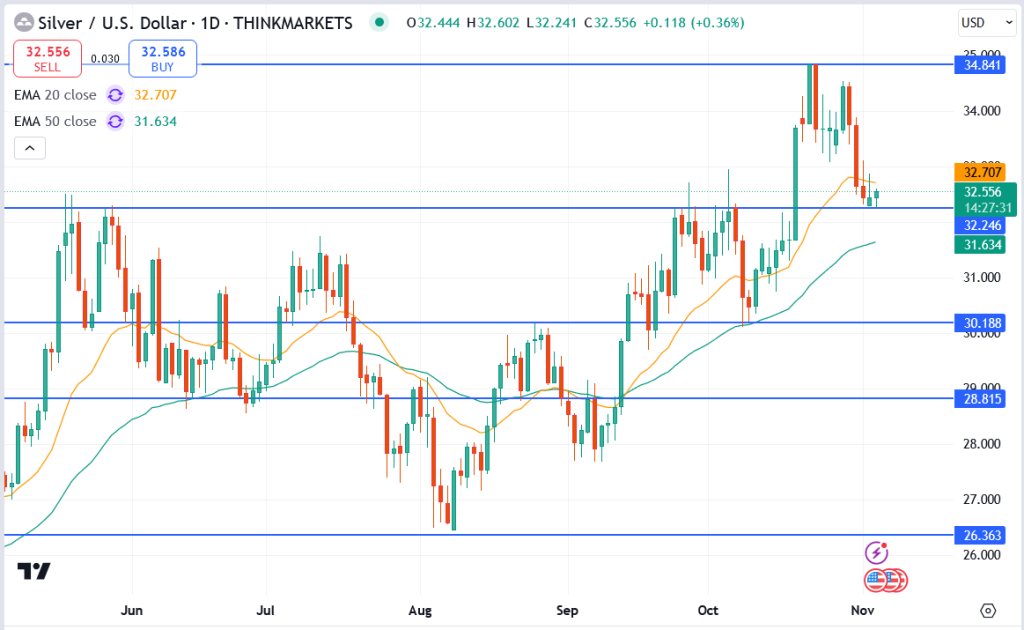
With silver trading near its support levels, traders are debating whether this pullback is a buying opportunity or a signal of further downside. If worries about inflation continue or if geopolitical tensions escalate, silver may be advantageous as a secure investment. If the Fed sticks to a hawkish position, silver may face more downward pressure due to a stronger dollar.
The recent pullback in silver might catch the eye of precious metal enthusiasts looking for potential entry points. For now, the $32.24 level is crucial—if silver can hold above this support, a rebound could be on the cards.
However, it’s wise for investors to keep a close watch on upcoming economic data and any shifts in global tensions, as these could shape silver’s journey through November. Caution is key, as the metal’s path forward will likely be influenced by a mix of market forces and geopolitical events.
Silver price (XAG/USD) maintains its position around 32.50 during Asian trading hours on Tuesday as traders adopt caution ahead of the US presidential election. However, the heightened uncertainty surrounding the election has led to increased demand for safe-haven assets like Silver.
The risk aversion sentiment has been amplified by speculation that a potential presidency under Republican nominee Donald Trump could lead to higher inflation, given his pledge to significantly raise trade tariffs. This has prompted investors to seek safe-haven assets as a hedge against long-term inflation risks.
However, the opinion polls indicate that former President Donald Trump and Vice President Kamala Harris are nearly tied. The final outcome may remain unknown for several days following Tuesday’s vote. Both Trump and Harris expressed confidence in their chances as they campaigned across Pennsylvania on the last frantic day of this exceptionally close presidential race.
US Federal Reserve’s (Fed) policy decision will be eyed on Thursday. Markets expect a modest 25 basis point rate cut this week. The CME FedWatch Tool shows a 99.5% probability of a quarter-point rate cut by the Fed in November. This could provide support for Silver as lower interest rates reduce the opportunity cost of holding non-interest-bearing assets.
Expectations for additional stimulus measures from China could bolster Silver demand as the Standing Committee of the National People’s Congress (NPC) holds a five-day meeting from November 4 to 8. Chinese authorities are anticipated to approve a potential stimulus package exceeding 10 trillion yuan to support the country’s economy. Given China’s position as one of the world’s largest manufacturing hubs for electronics, solar panels, and automotive components, this could lead to increased demand for Silver.
Silver is a precious metal highly traded among investors. It has been historically used as a store of value and a medium of exchange. Although less popular than Gold, traders may turn to Silver to diversify their investment portfolio, for its intrinsic value or as a potential hedge during high-inflation periods. Investors can buy physical Silver, in coins or in bars, or trade it through vehicles such as Exchange Traded Funds, which track its price on international markets.
Silver prices can move due to a wide range of factors. Geopolitical instability or fears of a deep recession can make Silver price escalate due to its safe-haven status, although to a lesser extent than Gold’s. As a yieldless asset, Silver tends to rise with lower interest rates. Its moves also depend on how the US Dollar (USD) behaves as the asset is priced in dollars (XAG/USD). A strong Dollar tends to keep the price of Silver at bay, whereas a weaker Dollar is likely to propel prices up. Other factors such as investment demand, mining supply – Silver is much more abundant than Gold – and recycling rates can also affect prices.
Silver is widely used in industry, particularly in sectors such as electronics or solar energy, as it has one of the highest electric conductivity of all metals – more than Copper and Gold. A surge in demand can increase prices, while a decline tends to lower them. Dynamics in the US, Chinese and Indian economies can also contribute to price swings: for the US and particularly China, their big industrial sectors use Silver in various processes; in India, consumers’ demand for the precious metal for jewellery also plays a key role in setting prices.
Silver prices tend to follow Gold’s moves. When Gold prices rise, Silver typically follows suit, as their status as safe-haven assets is similar. The Gold/Silver ratio, which shows the number of ounces of Silver needed to equal the value of one ounce of Gold, may help to determine the relative valuation between both metals. Some investors may consider a high ratio as an indicator that Silver is undervalued, or Gold is overvalued. On the contrary, a low ratio might suggest that Gold is undervalued relative to Silver.