The main tag of GoldPrice Articles.
You can use the search box below to find what you need.
[wd_asp id=1]
The main tag of GoldPrice Articles.
You can use the search box below to find what you need.
[wd_asp id=1]
The GBPJPY pair failed to settle above the barrier at 206.95 level, forcing it to form corrective waves to settle near 205.75 as appears in above image.
Stochastic attempt to exit the oversold level, to increase the intraday negative pressures on the trading, to increase the chances of testing extra support at 205.20, where breaking it will force it to suffer extra losses by reaching 204.60 and 204.10, while renewing the bullish attempts require providing new positive close above 206.90, to ease the mission of recording the main positive targets that extend to 207.70 and 208.25.
The expected trading range for today is between 205.20 and 206.60
Trend forecast: Bearish
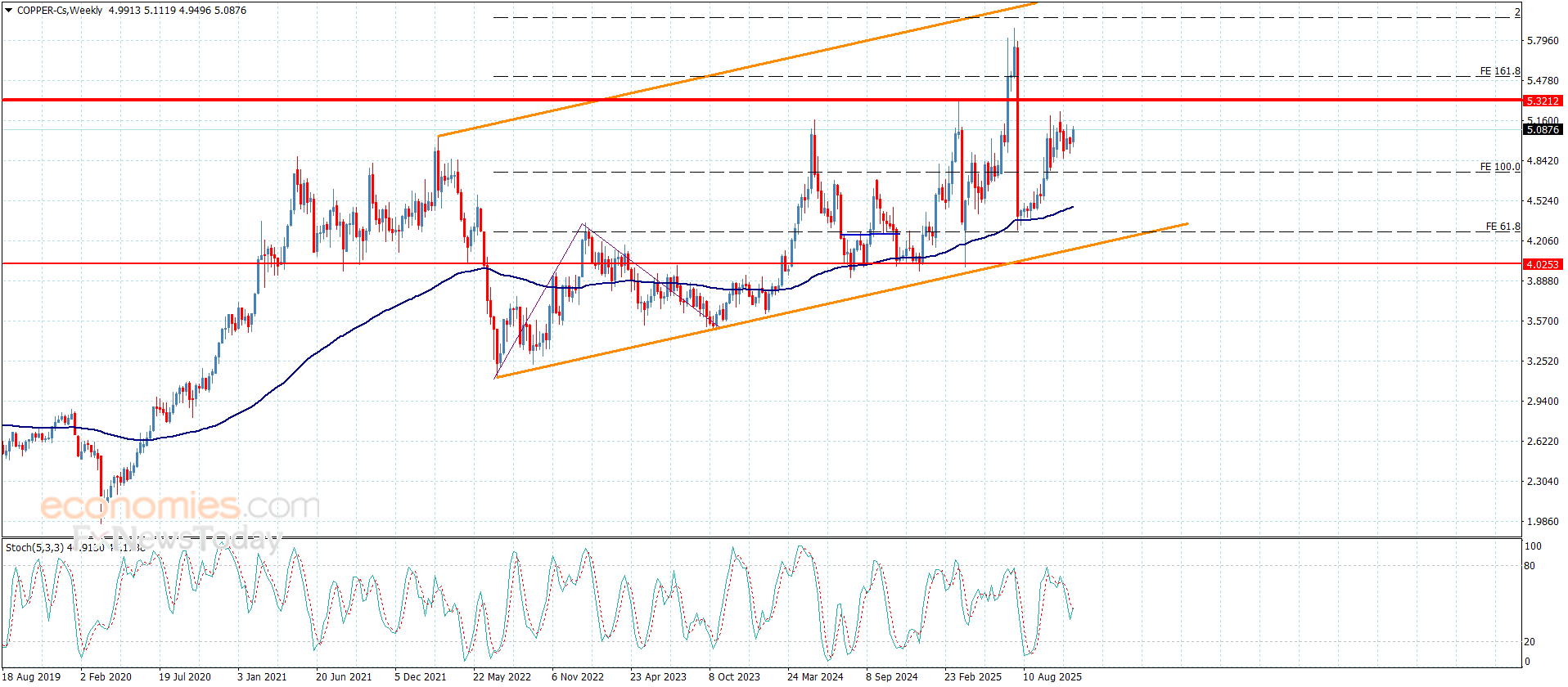
Copper price activated with stochastic positivity, to confirm the stability of the bullish scenario by surpassing the initial barrier at $5.2000 and recording extra gains.
Forming extra support at $4.9500 level, to increase the efficiency of the bullish scenario to keep waiting for targeting $5.3200 level, reaching 161.8% Fibonacci extension level at $5.5000, to form the next main target in the current trading.
The expected trading range for today is between $5.0600 and $5.3200
Trend forecast: Bullish
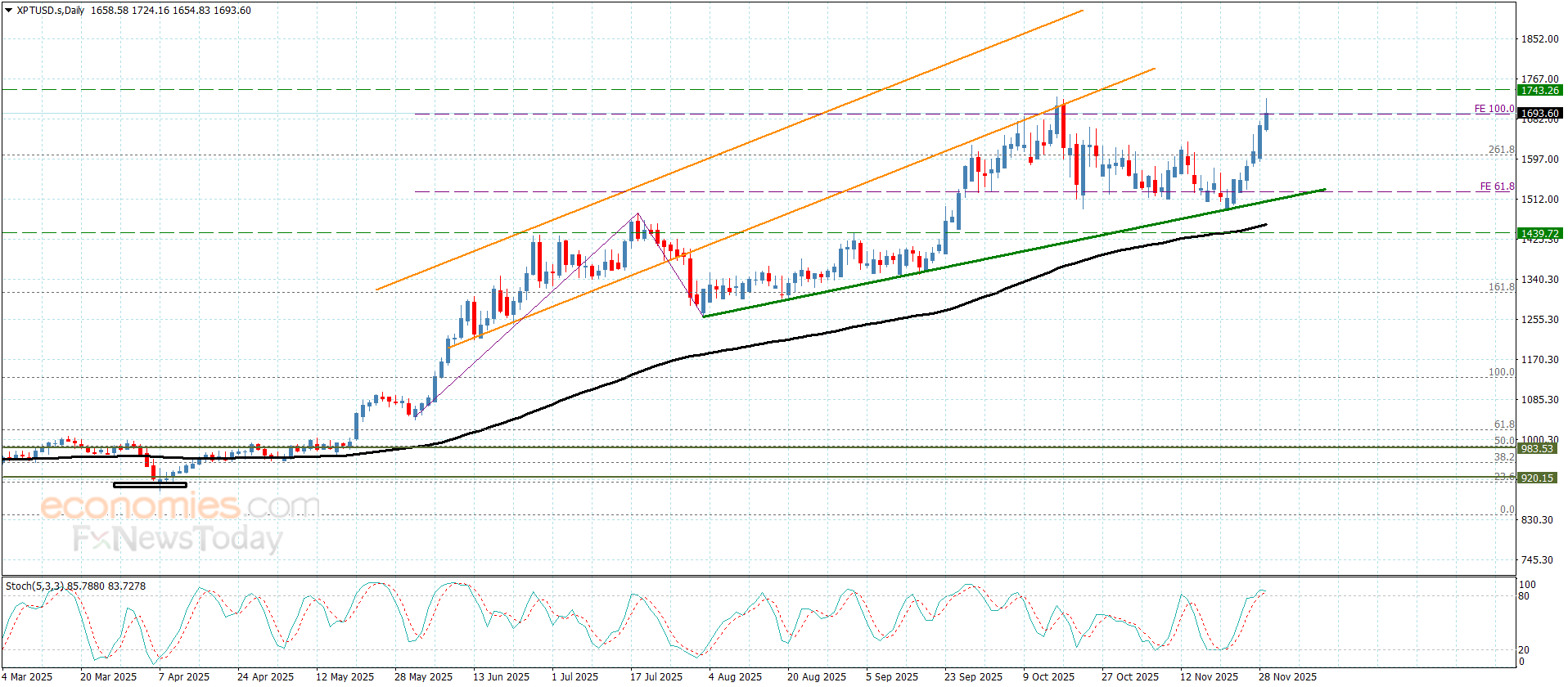
Platinum price continued to form repeated bullish trading, recording some gains by hitting $1724.00 level, to bounce back to settle near $1695.00 level.
No escape for resuming the bullish attack, as there are several factors that begin by the stability above $1605.00 support, besides the unionism of providing bullish momentum by the main indicators, therefore, we will keep our bullish suggestion that might target $1745.00 and $1778.00 level.
The expected trading range for today is between $1680.00 and $1745.00
Trend forecast: Bullish
The bond market backed the move. The 10-year Treasury yield settled at 4.017%, down 0.050 or -1.23%. Lower yields reduce the appeal of government paper relative to a non-yielding asset like gold. When rate-cut bets rise and the long end follows, gold typically benefits, and this week fit that pattern perfectly.
Fundamentals outside the U.S. also supported the metal. The economy continues to post a mixed setup: Q3 GDP held near 2.7% annualized, but jobs are losing momentum with just 119,000 new positions in September and unemployment inching up to 4.4%.
Add unresolved tensions in the Russia-Ukraine conflict plus ongoing trade uncertainty, and it’s no surprise that central bank gold buying hit 634 tonnes through Q3 — up 28% from the previous quarter.
Short-term, the bias stays bullish as long as the market expects a December rate cut. If the Fed delivers the quarter-point move on December 9–10, gold has a clear path to retest the October peak. A surprise hold would cool enthusiasm, but right now, policy expectations, soft yields, and global stress keep the advantage with buyers.
More Information in our Economic Calendar.
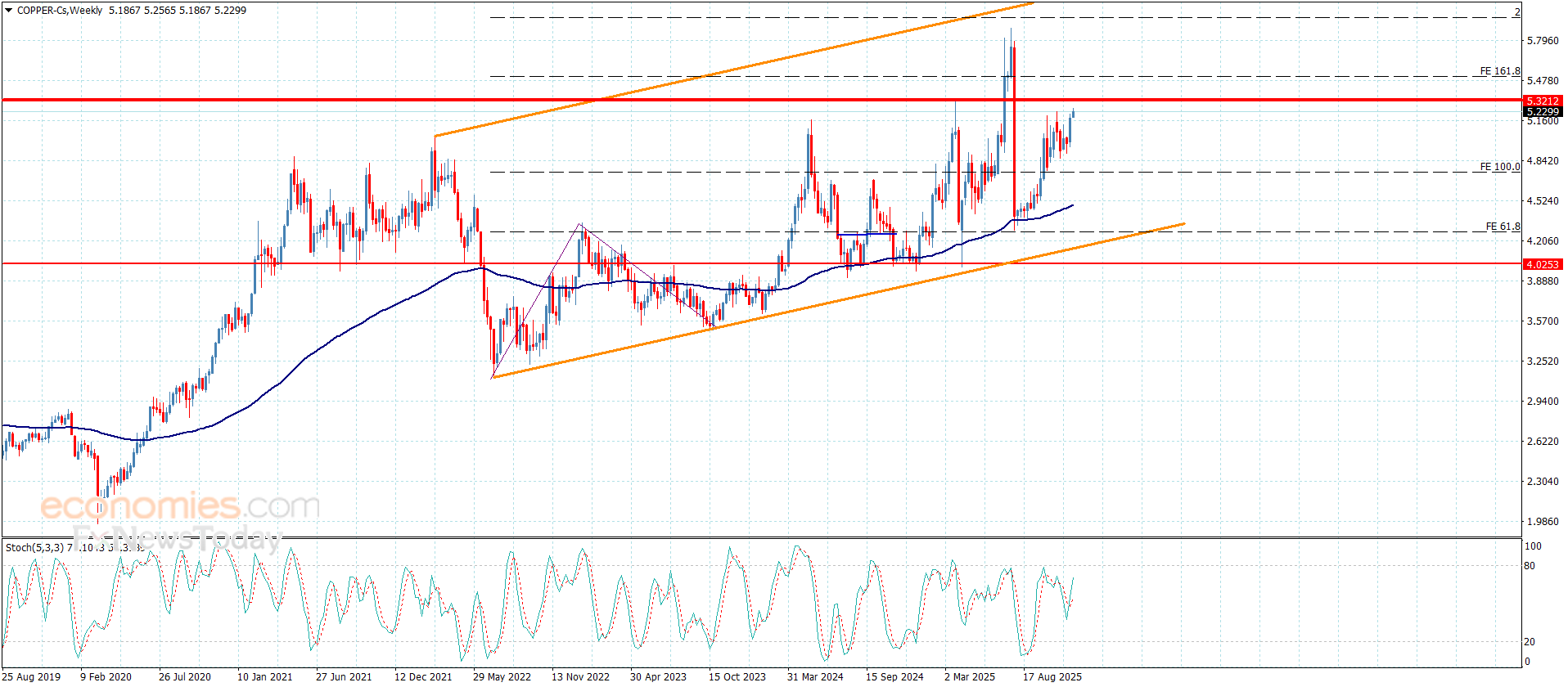
Copper price began receiving bullish momentum by stochastic approach from 50 level, reinforcing the positive stability within the bullish track, besides the continuation of forming extra support at $4.7500 level.
We expect target $5.2000 barrier, surpassing it will lead to form new bullish waves to target more positive stations that begin at $5.3200 and %161.8 Fibonacci extension level near $5.5000.
The expected trading range for today is between $4.9800 and $5.2000
Trend forecast: Bullish
The gold market (XAU/USD) closed the final week of November with explosive strength, climbing nearly $150 per ounce to end near $4,225, just below October’s all-time high of $4,250. The metal’s year-to-date rally has reached 60%, far outpacing the S&P 500’s 16.5% gain, underscoring gold’s role as the dominant performer in global assets during 2025. The surge was powered by a combination of Federal Reserve policy shifts, dollar depreciation, geopolitical strain, and an unexpected market infrastructure outage that amplified volatility across futures exchanges.
The decisive catalyst remains the Federal Reserve’s aggressive rate-cut trajectory. Odds of another 25-basis-point cut in December stand near 80%, marking what would be the third consecutive reduction and totaling 75 basis points of easing since September. Market-implied projections now price an additional three cuts in 2026, translating to a full 100-basis-point decline in the U.S. benchmark rate within twelve months.
This liquidity pivot has re-priced real yields lower and re-ignited institutional demand for non-yielding hedges like gold, reversing last year’s deflationary correction. With Treasury yields compressing and the U.S. dollar index (DXY) down 4.7% month-to-date, gold has once again reclaimed its inverse correlation to real interest rates as a dominant driver.
The dollar’s retreat accelerated as rising fiscal risks rattled bond markets. The U.S. debt-to-GDP ratio now exceeds 125%, and deficit expansion above $1.8 trillion has weakened faith in dollar-denominated debt. This macro deterioration has led to accelerated gold accumulation by central banks, whose net purchases in Q3 totaled over 380 metric tons, the strongest quarterly figure since data tracking began in 2000. China, Turkey, and India led reserve diversification, while Saudi Arabia and Brazil expanded holdings in response to dollar volatility.
Institutional surveys mirror this confidence: a Goldman Sachs client poll of over 900 institutional investors found that 70% expect gold to rise through 2026, with 36% forecasting prices above $5,000 per ounce. This broad consensus reinforces the structural shift from tactical hedging toward long-term allocation in precious metals as a core portfolio pillar.
The global backdrop remains fraught with risk. Conflicts in Ukraine and the Middle East, as well as new trade escalations between Washington and Beijing, have renewed safe-haven flows into physical gold. Simultaneously, a CME data center outage on November 29 disrupted live price feeds for several hours, widening the bid-ask spread and triggering rapid volume spikes on the Hong Kong Gold Exchange, where spot gold briefly hit HKD 15,200 per ounce.
This glitch revealed how fragile high-frequency infrastructure remains in periods of heavy stress — yet also how resilient gold’s liquidity pool is under duress. Savvy institutional traders capitalized on the dislocation, increasing futures exposure while retail investors turned to ETFs to lock in physical-linked gains.
Supply constraints are reinforcing the rally. Deutsche Bank raised its 2026 gold forecast to $4,450, citing “inelastic demand” from sovereign buyers and ETFs. Global mine output remains capped near 3,500 tons annually, while recycled supply fell 5.2% in Q3 due to record jewelry prices discouraging resale. The World Gold Council estimates total available supply will undershoot demand by 9% through 2026 — the widest deficit in two decades.
As a result, ETFs and bullion vaults have turned to forward-purchase agreements to secure inventory at fixed prices, effectively locking in the next leg of price appreciation.
Institutional positioning in COMEX gold futures has reached a net-long level of 286,000 contracts, the highest since mid-2020. Hedge funds and macro funds alike have extended duration bets anticipating a multi-quarter easing cycle. Retail participation has followed through ETFs such as SPDR Gold Shares (NYSEARCA:GLD), which saw inflows of $1.9 billion in November alone.
At the same time, individual investors in emerging markets have accelerated gold purchases as local currencies depreciate. The Indian rupee, Turkish lira, and Egyptian pound all lost between 9–14% in Q4, prompting record bullion imports and domestic price premiums exceeding 10% above spot rates.
Gold’s technical structure remains decisively bullish. After reclaiming $4,000 in early November, momentum accelerated through the $4,160 resistance zone, establishing $4,200–$4,225 as the current consolidation range. The 14-day RSI at 72 indicates moderate overbought conditions but not exhaustion. If gold breaks above $4,250, the next resistance cluster lies near $4,300–$4,350, aligning with Fibonacci projections and Deutsche Bank’s mid-2026 upper range target.
Conversely, initial support rests near $4,160, then $4,000, where substantial ETF accumulation occurred during October’s consolidation. The 200-day moving average sits at $3,785, underscoring how extended the current rally has become — but history shows that parabolic gold markets often stretch far longer when policy easing aligns with fiscal deterioration.
Gold futures activity on Asian exchanges surged following the CME outage. Hong Kong and Shanghai contracts saw intraday volumes spike 48%, highlighting the shift of liquidity eastward as Western markets struggled to recalibrate pricing feeds. Futures open interest globally now stands 22% above its 12-month average, with leverage ratios still conservative relative to 2020 highs, signaling that this rally remains underpinned by spot and ETF demand rather than speculative excess.
Traders in Hong Kong capitalized on widened spreads by arbitraging futures versus spot gold, capturing premiums between $10–$15 per ounce. This regional participation further underscores gold’s transition from a Western inflation hedge to a global collateral instrument.
Long-term projections suggest that gold remains structurally poised for further appreciation. UBS maintains an “Attractive” stance with a $4,500 mid-2026 target, while Goldman Sachs and Deutsche Bank project ranges extending up to $5,000 if central bank buying persists and the dollar continues weakening.
Current fundamentals — expanding fiscal deficits, record monetary easing, and geopolitical fragmentation — mirror the early 1970s and post-2008 environments, both of which preceded multi-year gold bull cycles. Demand growth outpacing supply by nearly 10% annually supports a sustained rally that could redefine the global monetary hedge landscape by 2026.
Despite the rally’s magnitude, the structure of holdings remains healthy. ETF and physical gold positions now represent 2.6% of global financial assets, far below the 5% weighting observed during the 2011 peak. This suggests the current rally is driven by institutional repositioning rather than retail euphoria. Futures leverage remains moderate, and volatility compression following the outage points to a controlled, data-driven market rather than panic speculation.
The broader economic setup continues to favor gold. Inflation expectations have stabilized near 2.7%, but real yields remain negative when adjusted for the U.S. fiscal outlook. Meanwhile, corporate debt issuance hit $10.3 trillion globally, a record that heightens refinancing risk in 2026. Such imbalances tend to push portfolio managers toward defensive hard assets. The S&P 500’s 705% ROI since 2009 now meets diminishing returns, while gold’s 121.8% surge since the 2020 pandemic base highlights its asymmetric potential in late-cycle environments.
All quantitative and qualitative indicators converge on the same message: gold’s structural bull market remains intact. The alignment of falling real yields, weakening dollar, record sovereign accumulation, and persistent geopolitical instability forms an unprecedented confluence for continued price expansion.
Given spot XAU/USD at $4,225, upside targets stand at $4,300 short-term, $4,500 medium-term, and $5,000 by late 2026. Downside risk remains limited to $4,000–$4,050, supported by ETF inflows and central bank bids.
Rating: Buy (Bullish Outlook) — The metal’s trajectory remains supported by data-driven fundamentals, institutional accumulation, and macroeconomic tailwinds that continue to erode fiat confidence globally.
The move satisfies a classic measured target near $4,356. That is where the second upswing from the October low equals the price change of the first advance. An area where symmetry can produce resistance or, on a clean break, signal sustained strength. A rally above the recent lower swing high at $4,245 provides the next clear confirmation of the pennant breakout and keeps momentum pointed toward that initial objective.
Beyond $4,356, the 127.2% projection of the second advance relative to the first points to $4,454, with a slightly higher 127.2% extension of the most recent pullback at $4,516. These levels represent the next upside decision zones for the developing advance.
One powerful day does not make a trend—buyers must maintain control and deliver follow-through, beginning with a push above $4,245. Friday’s $4,152 low now stands as immediate short-term support; any violation there would raise the first yellow flag and open a test of the 10-day average at $4,114 and 20-day average at $4,086.
The combination of a textbook pennant breakout, dual channel captures, and the strongest close in over a month leaves gold strongly positioned for trend continuation into new record territory. Hold above $4,152 and clearance of $4,245 keeps the path open to $4,356 minimum and $4,454–$4,516 thereafter. Sustained buying conviction remains the only requirement — momentum currently favors the bulls.
For a look at all of today’s economic events, check out our economic calendar.
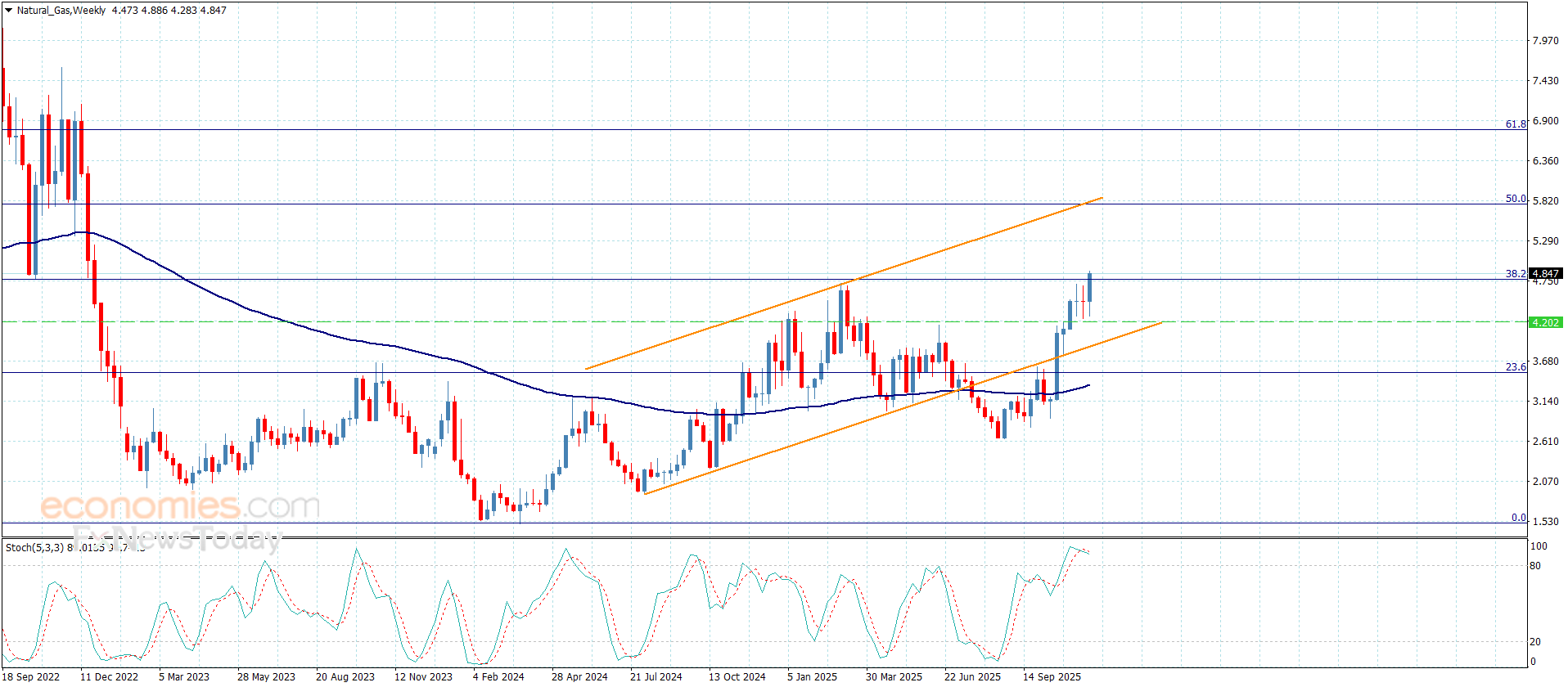
The breakout completed a 200% extension of a prior pullback exactly at $4.69 before powering through—a classic measured objective that often acts as only a pause in strong trends. Friday’s $4.53 low delivered a precise test of the 10-day moving average, met instantly with aggressive buying that triggered the triangle resolution and new highs.
Recent pullbacks have repeatedly found support at rising moving averages: the last one at the 20-day line, and on Friday at the 10-day. This progressive defense of higher averages signals strengthening demand and mirrors behavior seen in prior strong breakouts. Sustaining momentum above the 10-day line—now confirmed dynamic support—is essential for the bullish structure to remain intact.
Immediate upside focus falls on the long-term trend high from March at $4.91. A clean push above that $4.91 price zone, would generate another clear bullish signal for the developing bull trend that began from the August low. The 61.8% Fibonacci retracement of the long-term downtrend started from the November 2022 swing high, then becomes then next upside target at $5.28.
Natural gas has already reclaimed a lower October 2023 swing high, underscoring larger-timeframe improvement. Friday’s powerful green candle and close near the monthly high reinforce that shift in character.
The combination of an ascending triangle breakout, perfect 10-day average launch, and close at highs on multiple timeframes leaves natural gas strongly positioned for a continuation toward $4.91 at a minimum. The 10-day and 20-day averages now serve as trailing support gauges; any post-breakout pullback that holds above them might offer attractive risk/reward for the next leg higher. Momentum firmly favors buyers until proven otherwise.
For a look at all of today’s economic events, check out our economic calendar.
(Bloomberg) — Metals surged in volatile trading on Friday, with silver and copper hitting fresh records, after a chaotic hours-long outage on CME Group’s Chicago Mercantile Exchange.
Silver jumped as much as 5.9% to $56.53 an ounce, surpassing a peak set during a historic squeeze in the London market in October. The white metal has been supported by rising hopes of a Federal Reserve interest-rate cut in December, inflows into bullion-backed exchange-traded funds and ongoing supply tightness. Copper surged against the backdrop of supply shortfalls and bullish price predictions.
Most Read from Bloomberg
The record-setting moves came amid low Black Friday trading volumes in the US following the CME disruptions. Spreads between what dealers and sellers would buy and sell gold for briefly surged earlier, signaling an illiquid market. As most trading operations resumed early in the US morning, futures on the London Metal Exchange extended their rally.
Spot silver traded at $ an ounce as of in New York. Gold rose while platinum traded higher. LME copper futures settled 2.3% higher in London after earlier hitting a fresh record of $11,210.50 a ton.
Silver’s new high comes just over a month after a severe supply squeeze in the dominant trading hub in London last month, which sent prices soaring above levels in Shanghai and New York. While the arrival of nearly 54 million troy ounces has eased that squeeze, the market still remains markedly tight with the cost of borrowing the metal over one month hovering above its normal level.
The flows into the London market have now put pressure on other hubs, including in China. Silver inventories in warehouses linked to the Shanghai Futures Exchange recently hit their lowest level since 2015, according to bourse data.
“In the short term, a further price increase cannot be ruled out if registered silver inventories in China continue to decline,” analysts at Commerzbank AG wrote in a note earlier Friday.
Traders are also monitoring any potential tariff on silver after the precious metal was added to the US Geological Survey list of critical minerals this month. While 75 million ounces have left Comex vaults since early October, fears of a sudden premium for US silver have caused some traders to hesitate before shipping metal out of the country.
Silver has surged more than 90% this year, as investors pile into alternative assets in a wider retreat from government bonds and currencies, dubbed the debasement trade. Optimism about the metal’s fundamental supply-and-demand balance have also supported prices — the market is set to see a fifth consecutive supply deficit this year. Unlike gold, a large share of silver demand is industrial, with applications in solar cells and electronics.
Gold (XAU/USD) keeps crawling higher, and is on track to close the week 2.7% higher, with the US Dollar weighed by rising bets of Fed monetary easing. XAU/USD has been capped at $4,190 earlier on Friday, as the US Dollar picked up in a calm Thanksgiving session, but downside attempts remain limited above $4,140 so far.
The US Dollar Index, which measures the value of the US Dollar against a basket of six currencies, is picking up from lows on Friday, favoured by a mild rebound in US Treasury yields, but it remains on track for its worst weekly performance in months.
Dovish comments from Fed officials and weak US consumption figures have prompted investors to ramp up hopes of a Fed rate cut in December, which has sent US Treasury yields and the US Dollar tumbling this week.
The technical picture remains positive. The 4-hour Relative Strength Index is trending higher, reaching levels past 60, and the Moving Average Convergence Divergence (MACD) has turned up and is crossing the signal line, highlighting growing bullish pressure.
The move above $4,100 confirmed that the bearish correction from the November peak is over, and bulls have shifted their focus to the November 14 high, at $4,210, on track for November’s peak, at $4,245.
On the downside, the mentioned $4,140 support (November 27 low) keeps the bullish trend in play. A bearish reaction below here brings the November 25 low, near $4,100, to the focus, ahead of the November 21 and 24 lows between $4.025 and $4,040.
The table below shows the percentage change of US Dollar (USD) against listed major currencies this week. US Dollar was the strongest against the Japanese Yen.
| USD | EUR | GBP | JPY | CAD | AUD | NZD | CHF | |
|---|---|---|---|---|---|---|---|---|
| USD | -0.41% | -0.81% | -0.22% | -0.42% | -0.99% | -1.60% | -0.25% | |
| EUR | 0.41% | -0.39% | 0.20% | -0.02% | -0.60% | -1.20% | 0.16% | |
| GBP | 0.81% | 0.39% | 0.58% | 0.38% | -0.21% | -0.80% | 0.56% | |
| JPY | 0.22% | -0.20% | -0.58% | -0.22% | -0.84% | -1.52% | -0.03% | |
| CAD | 0.42% | 0.02% | -0.38% | 0.22% | -0.58% | -1.18% | 0.18% | |
| AUD | 0.99% | 0.60% | 0.21% | 0.84% | 0.58% | -0.59% | 0.80% | |
| NZD | 1.60% | 1.20% | 0.80% | 1.52% | 1.18% | 0.59% | 1.38% | |
| CHF | 0.25% | -0.16% | -0.56% | 0.03% | -0.18% | -0.80% | -1.38% |
The heat map shows percentage changes of major currencies against each other. The base currency is picked from the left column, while the quote currency is picked from the top row. For example, if you pick the US Dollar from the left column and move along the horizontal line to the Japanese Yen, the percentage change displayed in the box will represent USD (base)/JPY (quote).