The main tag of GoldPrice Articles.
You can use the search box below to find what you need.
[wd_asp id=1]
The main tag of GoldPrice Articles.
You can use the search box below to find what you need.
[wd_asp id=1]
Silver (XAG/USD) climbs to a fresh all-time high on Friday, buoyed by dovish Federal Reserve (Fed) expectations alongside strong industrial and investment demand. At the time of writing, XAG/USD is trading around $56.40, with prices up over 12% this week and on track to log a seventh straight monthly gain.
A tightening supply backdrop is adding further support to the rally, with reports indicating that inventories at Shanghai Futures Exchange warehouses have dropped to their lowest level since 2015. Market data also show that physical Silver turnover on the Shanghai Gold Exchange has slipped to a nine-year low.
According to the Silver Institute, 2025 is on track to mark the fifth consecutive year of a structural supply deficit, with global output from mining and recycling still struggling to keep pace with rising demand from solar, electronics and investment channels.
From a technical standpoint, bulls remain firmly in control, driving XAG/USD deeper into uncharted territory after a clean breakout from the falling-wedge formation. The rally comes after a period of subdued momentum, marking a clear shift back in favour of upward continuation.
XAG/USD continues to trade comfortably above all major moving averages, reinforcing the strength of the prevailing uptrend. The 21-day Simple Moving Average (SMA) near $50.72 is rising steadily and remains the first layer of dynamic support, while the 50-day and 100-day SMAs sit much lower.
On the downside, any pullback is likely to attract fresh dip-buying interest, with initial support at the $55.00-$54.00 zone. A break below this area would shift attention toward the $50.70-$50.00 region, reinforced by the rising 21-day SMA.
Momentum indicators support the bullish narrative. The Moving Average Convergence Divergence (MACD) extends above the Signal line, with both in positive territory and a widening histogram, suggesting strengthening bullish momentum. The Relative Strength Index (RSI) has climbed to 71, entering overbought territory, although there are no clear signs of exhaustion.
Silver is a precious metal highly traded among investors. It has been historically used as a store of value and a medium of exchange. Although less popular than Gold, traders may turn to Silver to diversify their investment portfolio, for its intrinsic value or as a potential hedge during high-inflation periods. Investors can buy physical Silver, in coins or in bars, or trade it through vehicles such as Exchange Traded Funds, which track its price on international markets.
Silver prices can move due to a wide range of factors. Geopolitical instability or fears of a deep recession can make Silver price escalate due to its safe-haven status, although to a lesser extent than Gold’s. As a yieldless asset, Silver tends to rise with lower interest rates. Its moves also depend on how the US Dollar (USD) behaves as the asset is priced in dollars (XAG/USD). A strong Dollar tends to keep the price of Silver at bay, whereas a weaker Dollar is likely to propel prices up. Other factors such as investment demand, mining supply – Silver is much more abundant than Gold – and recycling rates can also affect prices.
Silver is widely used in industry, particularly in sectors such as electronics or solar energy, as it has one of the highest electric conductivity of all metals – more than Copper and Gold. A surge in demand can increase prices, while a decline tends to lower them. Dynamics in the US, Chinese and Indian economies can also contribute to price swings: for the US and particularly China, their big industrial sectors use Silver in various processes; in India, consumers’ demand for the precious metal for jewellery also plays a key role in setting prices.
Silver prices tend to follow Gold’s moves. When Gold prices rise, Silver typically follows suit, as their status as safe-haven assets is similar. The Gold/Silver ratio, which shows the number of ounces of Silver needed to equal the value of one ounce of Gold, may help to determine the relative valuation between both metals. Some investors may consider a high ratio as an indicator that Silver is undervalued, or Gold is overvalued. On the contrary, a low ratio might suggest that Gold is undervalued relative to Silver.
Palo Alto Networks (PANW) resumed its decline in its latest intraday trading, pressured by continued negative momentum resulting from trading below its previous 50-day SMA. This confirms the break of a main medium-term ascending trendline, which further intensifies the bearish pressure surrounding the price, especially after it successfully relieved part of its oversold saturation on the RSI indicators.
Therefore we expect the stock to decline in its upcoming trading, as long as it remains below the resistance level of $193.10, targeting the support level of $172.75.
Today’s price forecast: Bearish
Silver remains steady near $54.00 after rejection at $54.40 area.
XAG/USD metal is on track for a nearly 8% rally this week.
Investors’ hopes of Fed monetary policy easing are supporting speculative demand for precious metals.
Silver (XAG/USD) has failed to break November’s peak, at $54.40 area on Friday, weighed by a somewhat firmer US Dollar. The precious metal, however, remains close to $54.00, trading at $53,85 at the time of writing, after rallying nearly 8% this week.
The US Dollar Index (DXY), which measures the value of the USD against a basket of peers, is picking up from weekly lows amid a frail rebound in US Treasury yields on Friday’s thinned Thanksgiving trading.
Nevertheless, the market is pricing a quarter-point rate cut by the Federal Reserve in December, and a few more next year, which is likely to keep speculative demand for the Greenback subdued and fuel the precious metal’s rally.
The technical picture remains positive. The rejection at $54.40 earlier on Friday has been contained above $53.50. Oscillators are at positive levels. The 4-Hour RSI is right below oversold territory while the MACD is turning flat at high levels, suggesting the possibility of some consolidation.
On the downside, the intra-day low at the mentioned $53.50 level is the prime support area ahead of Thursday’s low at the $52.70 area and the November 25 low, near $50.70.
Bulls remain focused on the November 13 highs, at the $54.40 area, which is the last hurdle ahead of the multi-year high of $54.85 reached in mid-October. Further up, the 261% Fibonacci extension of the November 21-25 rally, a common exhaustion level, is at the $56.60 area.
Silver is a precious metal highly traded among investors. It has been historically used as a store of value and a medium of exchange. Although less popular than Gold, traders may turn to Silver to diversify their investment portfolio, for its intrinsic value or as a potential hedge during high-inflation periods. Investors can buy physical Silver, in coins or in bars, or trade it through vehicles such as Exchange Traded Funds, which track its price on international markets.
Silver prices can move due to a wide range of factors. Geopolitical instability or fears of a deep recession can make Silver price escalate due to its safe-haven status, although to a lesser extent than Gold’s. As a yieldless asset, Silver tends to rise with lower interest rates. Its moves also depend on how the US Dollar (USD) behaves as the asset is priced in dollars (XAG/USD). A strong Dollar tends to keep the price of Silver at bay, whereas a weaker Dollar is likely to propel prices up. Other factors such as investment demand, mining supply – Silver is much more abundant than Gold – and recycling rates can also affect prices.
Silver is widely used in industry, particularly in sectors such as electronics or solar energy, as it has one of the highest electric conductivity of all metals – more than Copper and Gold. A surge in demand can increase prices, while a decline tends to lower them. Dynamics in the US, Chinese and Indian economies can also contribute to price swings: for the US and particularly China, their big industrial sectors use Silver in various processes; in India, consumers’ demand for the precious metal for jewellery also plays a key role in setting prices.
Silver prices tend to follow Gold’s moves. When Gold prices rise, Silver typically follows suit, as their status as safe-haven assets is similar. The Gold/Silver ratio, which shows the number of ounces of Silver needed to equal the value of one ounce of Gold, may help to determine the relative valuation between both metals. Some investors may consider a high ratio as an indicator that Silver is undervalued, or Gold is overvalued. On the contrary, a low ratio might suggest that Gold is undervalued relative to Silver.
West Texas Intermediate (WTI) Oil price falls on Friday, early in the European session. WTI trades at $58.96 per barrel, down from Thursday’s close at $59.02.
Brent Oil Exchange Rate (Brent crude) ,on the contrary, is up, advancing from the $62.89 price posted on Thursday, and trading at $63.04.
WTI Oil is a type of Crude Oil sold on international markets. The WTI stands for West Texas Intermediate, one of three major types including Brent and Dubai Crude. WTI is also referred to as “light” and “sweet” because of its relatively low gravity and sulfur content respectively. It is considered a high quality Oil that is easily refined. It is sourced in the United States and distributed via the Cushing hub, which is considered “The Pipeline Crossroads of the World”. It is a benchmark for the Oil market and WTI price is frequently quoted in the media.
Like all assets, supply and demand are the key drivers of WTI Oil price. As such, global growth can be a driver of increased demand and vice versa for weak global growth. Political instability, wars, and sanctions can disrupt supply and impact prices. The decisions of OPEC, a group of major Oil-producing countries, is another key driver of price. The value of the US Dollar influences the price of WTI Crude Oil, since Oil is predominantly traded in US Dollars, thus a weaker US Dollar can make Oil more affordable and vice versa.
The weekly Oil inventory reports published by the American Petroleum Institute (API) and the Energy Information Agency (EIA) impact the price of WTI Oil. Changes in inventories reflect fluctuating supply and demand. If the data shows a drop in inventories it can indicate increased demand, pushing up Oil price. Higher inventories can reflect increased supply, pushing down prices. API’s report is published every Tuesday and EIA’s the day after. Their results are usually similar, falling within 1% of each other 75% of the time. The EIA data is considered more reliable, since it is a government agency.
OPEC (Organization of the Petroleum Exporting Countries) is a group of 12 Oil-producing nations who collectively decide production quotas for member countries at twice-yearly meetings. Their decisions often impact WTI Oil prices. When OPEC decides to lower quotas, it can tighten supply, pushing up Oil prices. When OPEC increases production, it has the opposite effect. OPEC+ refers to an expanded group that includes ten extra non-OPEC members, the most notable of which is Russia.
An upside breakout of the consolidation triangle as it is currently configured is initially triggered above the top trendline but more reliable on a rise above the lower swing high at $4,245. That breakout level confirms a triangle breakout as well as generating a higher swing high and continuation of the bull trend begun from the October swing low. A rising ABCD pattern on the chart shows an initial 78.6% harmonic target for the pattern at $4,280, while price symmetry between the two rising measured moves completes at $4,356. This makes those two price levels the first upside targets on a breakout above the high for November at $4,245 (B).
However, an initial signal for a continuation of the bull trend towards the $4,245 high is on a sustained breakout above Wednesday’s high and the current high of the CD leg of the advance at $4,173. The breakout will need to prove itself once triggered, with a clear pick-up in bullish momentum.
The weekly chart shows a bullish view, with a higher weekly high and higher low established following another successful test of support at the 20-day moving average. That is consistent with dynamic support near the longer-view 10-week average. A weekly close above last week’s high of $4,133 will confirm the weekly bull breakout and show buyers in control on that time frame. Subsequently, if gold stays above this week’s low of $4,040, the potential for the long-term bull trend to resume remains the most likely possibility for now.
Tighter risk management can be achieved by the 20-day average support indicated at $4,075 currently and rising again after a slightly bearish decline. The more significant potential dynamic support line is at the 50-day average at $4,019. A decisive move above $4,173–$4,245 targets $4,280–$4,356; failure to clear the downtrend line risks a lower swing high and test of $4,075 – $4,040.
For a look at all of today’s economic events, check out our economic calendar.
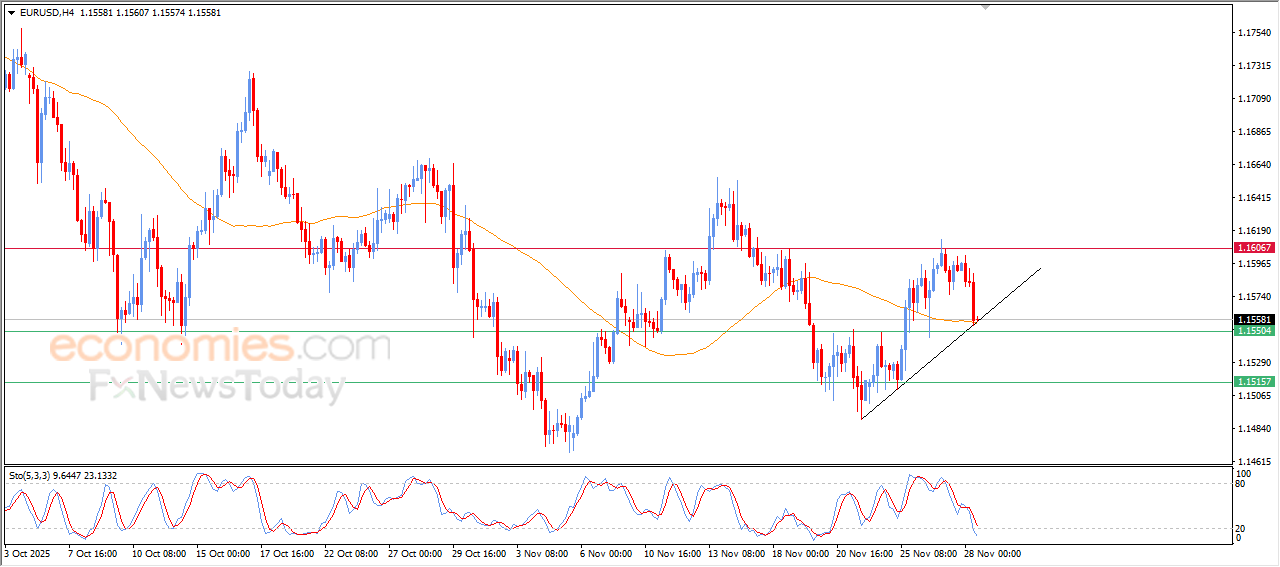
No news for EURJPY pair’s new sideways trading and its fluctuating near 181.15, but its stability above the support level near 179.40 and attempting to form extra support at 180.25 level, these factors support the chances of renewing the bullish attempts, attempting to breach the barrier at 181.75, targeting new positive stations that might begin at 182.30 reaching the main target at 183.05.
Note that stochastic approach from 80 level will increase the chances of achieving extra bullish momentum, to pave the way for achieving the breach and reaching the suggested targets.
The expected trading range for today is between 180.35 and 182.30
Trend forecast: Bullish
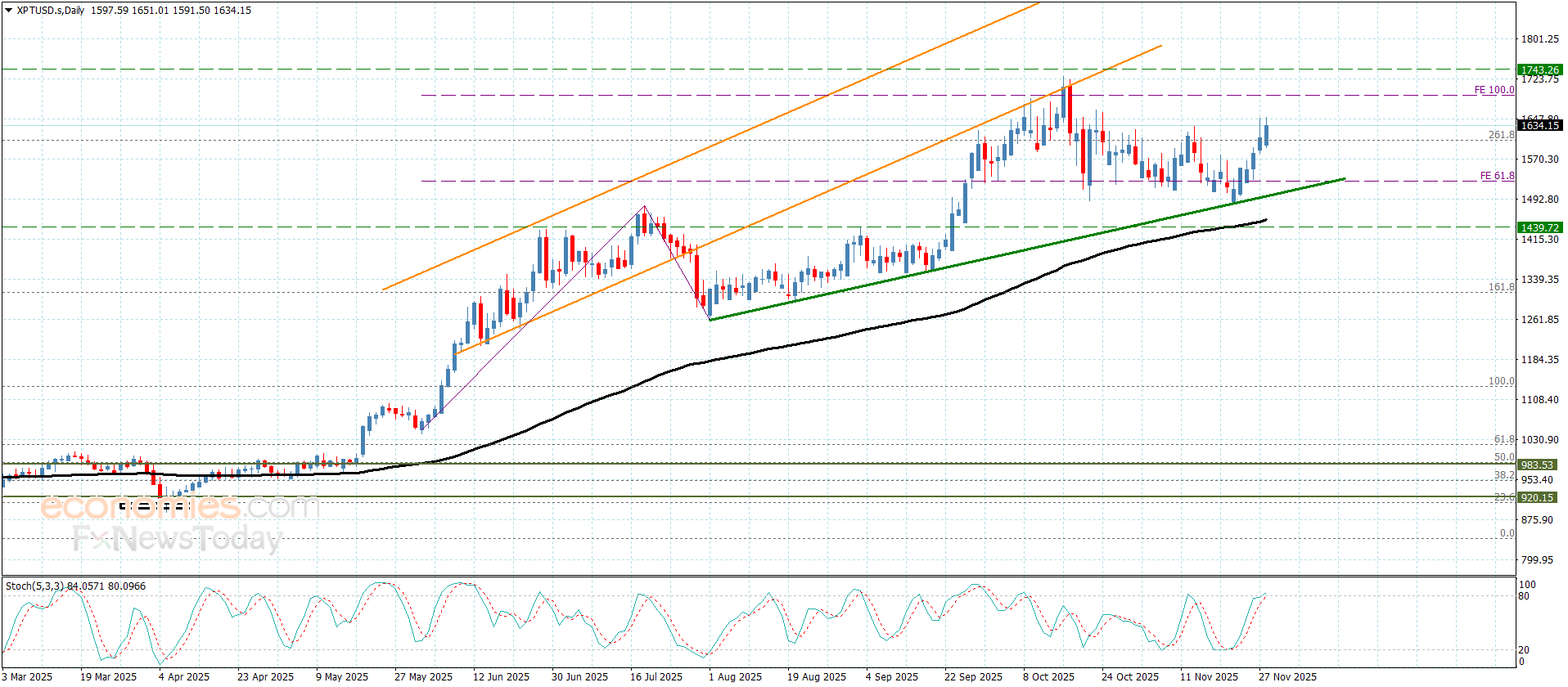
Platinum price succeeded in providing new positive close above $1605.00 level, to confirm its readiness to resume the bullish trend, fluctuating near $1635.00.
The continuation of providing positive signals by the main indicators will ease the mission of breaching $1645.00 level, to open the way for recording extra gains that might begin at $1695.00 and $1745.00.
The expected trading range for today is between $1600.00 and $1695.00
Trend forecast: Bullish
Rate expectations moved sharply. Futures markets now assign an added 85% probability to a quarter-point cut next month, up from roughly 50% a week earlier. The shift pushed the US Dollar to a one-week low, though stronger risk appetite limited gold’s upside.
US economic figures delivered a mixed signal. Durable goods orders rose 0.5%, beating forecasts but slowing from the prior month, while unemployment claims fell to 216,000, the lowest in seven months. However, the Chicago PMI dropped to 36.3, its deepest contraction in months, highlighting ongoing business weakness.
Despite the divergence, traders focused more on the Fed’s dovish tone than the data itself, keeping pressure on gold and silver as markets rotated into risk assets.
Silver eased alongside gold, with sentiment supported by signs of progress in geopolitical negotiations and firming global equities. As an industrial-linked metal, silver remains particularly sensitive to shifting growth expectations, and the improved risk backdrop tempered haven demand.
For now, both metals remain anchored to the Fed’s policy trajectory. With markets heavily pricing in a December cut, upcoming inflation data and scheduled Fed speeches will likely guide the next move.
Gold may range between $4,122–$4,179 as traders await a breakout from the triangle, while silver holds a bullish bias above $52.26, eyeing $53.46–$54.44 if momentum strengthens.
Micron Technology (MU) rose in its latest intraday trading, supported by the beginning of positive signals from the RSI indicators after reaching extremely oversold levels, along with ongoing positive momentum from trading above its 50-day SMA. All of this comes under the dominance of the main short-term ascending trend.
Therefore we expect the stock to rise in its upcoming trading, as long as it remains above the support level of $192.40, targeting the pivotal resistance level of $257.00.
Today’s price forecast: Bullish
Gold (XAU/USD) was capped at the $4,175 area on Wednesday and is showing minor losses on Thursday, although it remains trading within the previous day’s range, with support around the $4,140 area holding downside attempts for now.
The US Dollar Index (DXY) is showing a mild recovery after dropping nearly 0.7% over the previous three days, which is weighing on Gold’s recovery. The precious metal is about 0.5% higher on the week, as growing hopes that the US Federal Reserve will cut rates further in December have sent US Treasury yields tumbling and the Greenback down with them
The technical pìcture shows the broader bullish trend still in play with XAU/USD trading at $4,156. The Relative Strength Index (RSI) in four-hour charts prints 58.73, above the midline, suggesting buyers retain a modest advantage, while the Moving Average Convergence Divergence (MACD) eases toward the zero line with its latest reading near positive territory, hinting at fading bullish momentum.
Wednesday’s highs at $4,175 are holding bulls for now, although the focus remains on the November 14 high, at $4,211, and the November peak, near $4,245.
On the downside, immediate support is seen at Wednesday’s low of $4,140, ahead of the November 25 low, right below $4,110. A confirmation below here would cancel the bullish scenario and bring the November 20,21, and 24 lows, between $4,020 and $4,040, back into play.
(The technical analysis of this story was written with the help of an AI tool)
Gold has played a key role in human’s history as it has been widely used as a store of value and medium of exchange. Currently, apart from its shine and usage for jewelry, the precious metal is widely seen as a safe-haven asset, meaning that it is considered a good investment during turbulent times. Gold is also widely seen as a hedge against inflation and against depreciating currencies as it doesn’t rely on any specific issuer or government.
Central banks are the biggest Gold holders. In their aim to support their currencies in turbulent times, central banks tend to diversify their reserves and buy Gold to improve the perceived strength of the economy and the currency. High Gold reserves can be a source of trust for a country’s solvency. Central banks added 1,136 tonnes of Gold worth around $70 billion to their reserves in 2022, according to data from the World Gold Council. This is the highest yearly purchase since records began. Central banks from emerging economies such as China, India and Turkey are quickly increasing their Gold reserves.
Gold has an inverse correlation with the US Dollar and US Treasuries, which are both major reserve and safe-haven assets. When the Dollar depreciates, Gold tends to rise, enabling investors and central banks to diversify their assets in turbulent times. Gold is also inversely correlated with risk assets. A rally in the stock market tends to weaken Gold price, while sell-offs in riskier markets tend to favor the precious metal.
The price can move due to a wide range of factors. Geopolitical instability or fears of a deep recession can quickly make Gold price escalate due to its safe-haven status. As a yield-less asset, Gold tends to rise with lower interest rates, while higher cost of money usually weighs down on the yellow metal. Still, most moves depend on how the US Dollar (USD) behaves as the asset is priced in dollars (XAU/USD). A strong Dollar tends to keep the price of Gold controlled, whereas a weaker Dollar is likely to push Gold prices up.