The main tag of GoldPrice Articles.
You can use the search box below to find what you need.
[wd_asp id=1]
The main tag of GoldPrice Articles.
You can use the search box below to find what you need.
[wd_asp id=1]
The GBPJPY pair approached the previously waited main target by reaching 207.30 level which forces it to form some bullish corrective waves, affected by stochastic rally above 50 level, which allows it to recover some losses to settle near 208.15.
Note that the negative stability below 209.15 level represents main factor to confirm the previously suggested negativity, therefore, we will keep waiting for gathering extra negative momentum to reinforce the chances of reaching 207.05, while surpassing the barrier and holding above it will ease the mission of achieving several gains by its rally towards 209.85 reaching 207.05.
The expected trading range for today is between 207.05 and 208.75
Trend forecast: Bearish
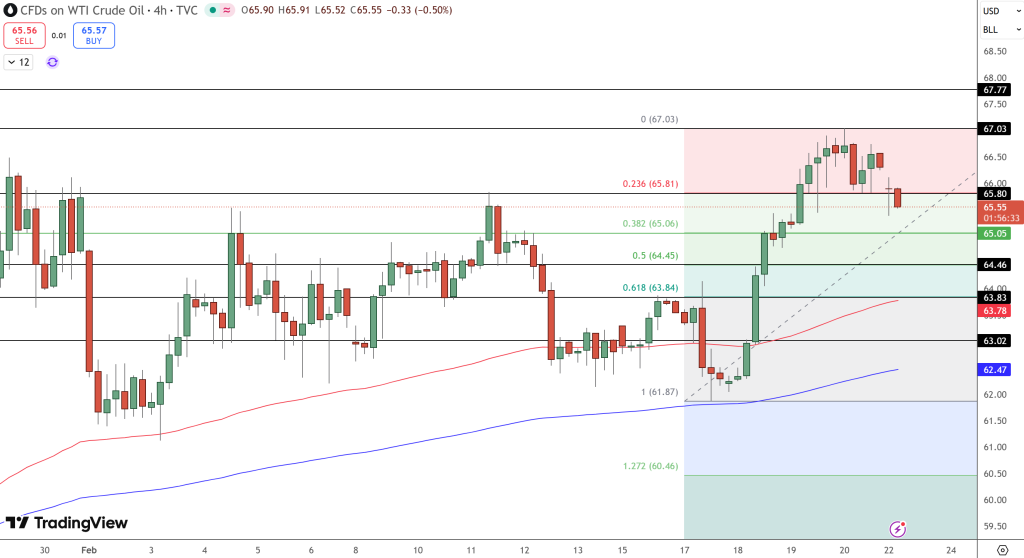
The Lowdown: WTI Crude Oil is backpedalling from six-month highs on February 23, 2026, with prices dropping to $65.50 as optimism around US-Iran nuclear talks starts to fade the ‘war premium’. With the IEA cutting its demand forecast and a clear rejection at $67.03, we’re taking a closer look at whether oil is headed for a deeper correction towards $63 or if OPEC+ discipline can rescue the rally.
The ‘war premium’ that sent WTI Crude soaring to $67 just a few weeks ago is being put to the test. On February 23, 2026, USOIL took a 1.5% intraday hit, trading between $65.50 and $66.00 per barrel.
The main driver behind today’s bearish price action is a sudden shift in the geopolitical narrative in the Middle East.
1.US-Iran Nuclear Deal Breakthrough?
Market players are pricing in progress on a potential US-Iran nuclear deal, with reports of an “understanding on guiding principles” between Tehran and Washington having taken some of the threat of military strikes or blockades off the table . As the fear of a conflict diminishes, a lot of speculative bets on rising oil prices are getting unwound.
Adding to the bearish mood , the International Energy Agency has cut its global demand growth forecast for 2026 all the way down to 850,000 b/d. This puts it at odds with OPEC’s more upbeat +1.4 mb/d projection . The IEA’s warning of a surplus coming due to growth from non-OPEC+ suppliers is really weighing on long-term sentiment.
While OPEC+ is sticking to its production quotas through March, record level production from the US, Brazil, and Guyana is expected to add +2.4 mb/d to global supply in 2026 . This structural surplus narrative is capping any long-term rally above $67.
The 4 hour chart for WTI Crude shows pretty clearly that price has rejected the $67.03 resistance level which is right at a critical horizontal supply zone .
Analysts are bracing for a year of “two halves,” where geopolitical shocks provide short-term spikes against a backdrop of fundamental oversupply.
| Scenario | Target Price (WTI) | Primary Driver |
| Bullish Case | $70.00+ | Failed Iran talks & persistent inventory draws |
| Base Case | $67.00 | OPEC+ discipline balancing high U.S. output |
| Bearish Case | $50.00s | IEA surplus forecast & successful nuclear deal |
Bottom Line: The long term trend remains solid within an ascending channel – but today’s dip is a necessary cooling phase as the geopolitical fever breaks. Bulls need to keep an eye on the $64.00 support zone to stop a total breakdown.
Trade Idea: Sell below $65.00 aiming for $64.45 – with a protective stop loss above $66.50.

Arslan Butt
Lead Markets Analyst – Multi-Asset (FX, Commodities, Crypto)
Arslan Butt serves as the Lead Commodities and Indices Analyst, bringing a wealth of expertise to the field. With an MBA in Behavioral Finance and active progress towards a Ph.D., Arslan possesses a deep understanding of market dynamics.
His professional journey includes a significant role as a senior analyst at a leading brokerage firm, complementing his extensive experience as a market analyst and day trader. Adept in educating others, Arslan has a commendable track record as an instructor and public speaker.
His incisive analyses, particularly within the realms of cryptocurrency and forex markets, are showcased across esteemed financial publications such as ForexCrunch, InsideBitcoins, and EconomyWatch, solidifying his reputation in the financial community.
Join me for my weekly trading plan with this week’s forex analysis covering:
DXY, EUR/USD, GBP/USD, USD/JPY, USD/CAD, USD/CHF, AUD/USD, NZD/USD
EUR/AUD, EUR/CHF, GBP/CHF, GBP/AUD, EUR/JPY, GBP/JPY
Bitcoin analysis – BTC/USD
Ethereum analysis – ETH/USD
Gold analysis – XAU/USD
Silver analysis – XAG/USD
Crude Oil analysis – WTI
No change on CHFJPY’s price track until this moment, due to its stability above the support of the bullish channel’s support near 198.65, besides the attempts of the main indicators to provide bullish momentum, fluctuating near199.90 level.
We expect the continuation of gathering bullish momentum by forming bullish waves, attempting to reach 200.50, to extend the trading towards facing %61.8 Fibonacci corrective level at 201,25, which represents confirmation key for the main trend on the medium-term trading.
The expected trading range for today is between 0.5630 and 0.5720
Trend forecast: Bullish
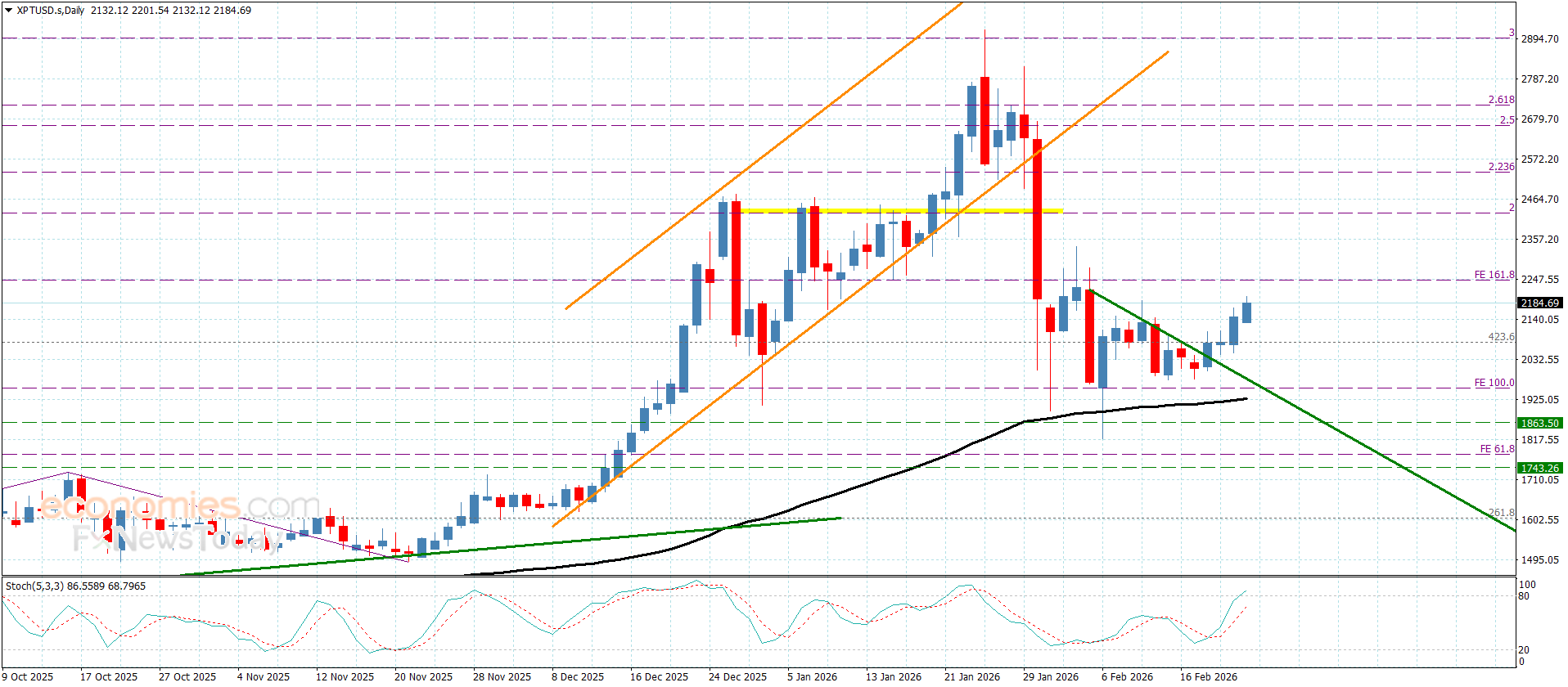
Platinum price took advantage by the positive factors that are represented by providing bullish momentum by the main indicators, besides forming extra support level at $2020.00, forming new bullish waves to settle near $2190.00.
We expect reaching $2245.00 barrier soon, and surpassing it will confirm its move to a new positive station, to reinforce the chances of recording extra gains that might begin at $2315.00 and $2425.00, while the failure to breach will reinforce the dominance of the sideways bias in the near-period, and there is chance to activate the bearish corrective track.
The expected trading range for today is between $2110.00 and $2245.00
Trend forecast: Bullish
Silver (XAG/USD) prices jumped on February 23, 2026, rising 6% in one day to $87.30 and outpacing gold. This surge comes after President Trump’s 15% global tariffs and another year of market deficits. Analysts are now watching for a possible move back to $100. Key technical levels and strong demand from AI industries are helping drive this rally.
Gold is still rising steadily, but today silver took center stage with a sharp 6% jump, reaching $87.30. This is a strong comeback after some early February swings, when silver briefly dropped after a speculative spike.
Silver is both a safe-haven investment and an important industrial metal, which is causing a special supply and demand crunch.
Uncertainty is the main reason for today’s price jump. After the U.S. Supreme Court ended “reciprocal tariffs,” President Trump responded with a 15% global tariff by executive order. This change has brought back worries about trade wars and inflation, pushing investors toward hard assets to protect against a possibly unstable U.S. dollar.
Washington has given Iran a strict 10-to-15-day deadline on nuclear enrichment, which has added a big risk premium to metals. Because silver is more volatile, it tends to react strongly to this kind of news, which explains today’s large gains.
The Silver Institute says the market will face its sixth year in a row of shortages in 2026, with a shortfall of 67 million ounces expected. Even though solar companies are using less silver per panel, strong demand from AI data centers, electric vehicles, and advanced semiconductors is making up for it.
[[XAG/USD-graph]]
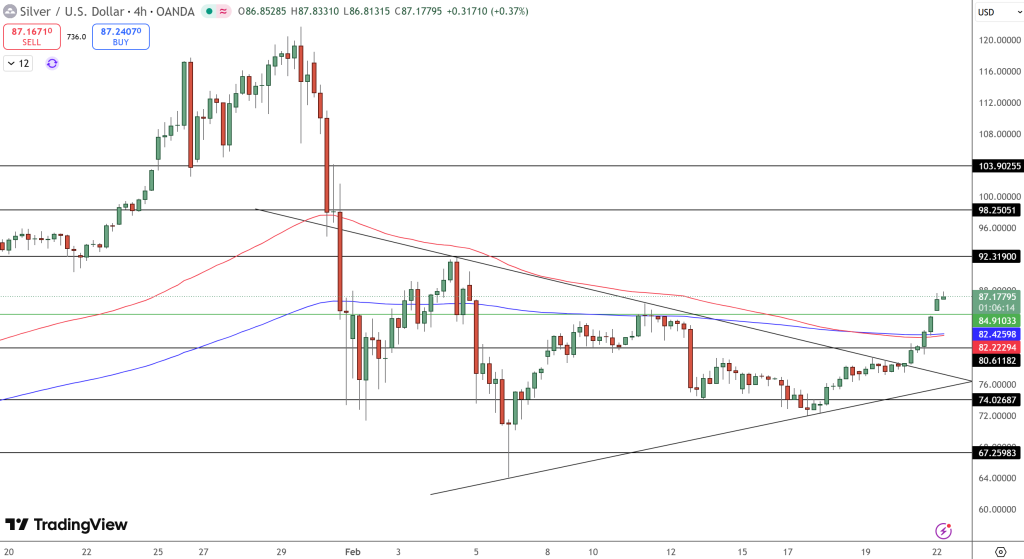
Looking at the 4-hour chart, XAG/USD has moved above the $84.91 resistance level, breaking a long-term downward trend.
Analysts disagree on whether silver will reach its $120 all-time high again this year, but most agree that prices are unlikely to fall much lower.
| Scenario | Target Price | Key Catalyst |
| Bullish Case | $100 – $133 | Escalating trade wars & sustained AI industrial demand |
| Base Case | $81 – $92 | Steady industrial growth offsetting solar substitution |
| Bearish Case | $64 – $72 | Swift resolution of tariffs & global economic slowdown |
The Bottom Line: In summary, silver is acting both as a safe investment during uncertain times and as an important material for green energy and AI. Even though prices are still volatile, the strong momentum shows that support above $80 is solid, and buyers are leading the market between $87 and $92.
Trade Idea: Consider buying if silver pulls back toward $85.00, aiming for a target of $92.30 and using a stop-loss below the 50-period moving average at $82.20.
Arslan Butt
Lead Markets Analyst – Multi-Asset (FX, Commodities, Crypto)
Arslan Butt serves as the Lead Commodities and Indices Analyst, bringing a wealth of expertise to the field. With an MBA in Behavioral Finance and active progress towards a Ph.D., Arslan possesses a deep understanding of market dynamics.
His professional journey includes a significant role as a senior analyst at a leading brokerage firm, complementing his extensive experience as a market analyst and day trader. Adept in educating others, Arslan has a commendable track record as an instructor and public speaker.
His incisive analyses, particularly within the realms of cryptocurrency and forex markets, are showcased across esteemed financial publications such as ForexCrunch, InsideBitcoins, and EconomyWatch, solidifying his reputation in the financial community.
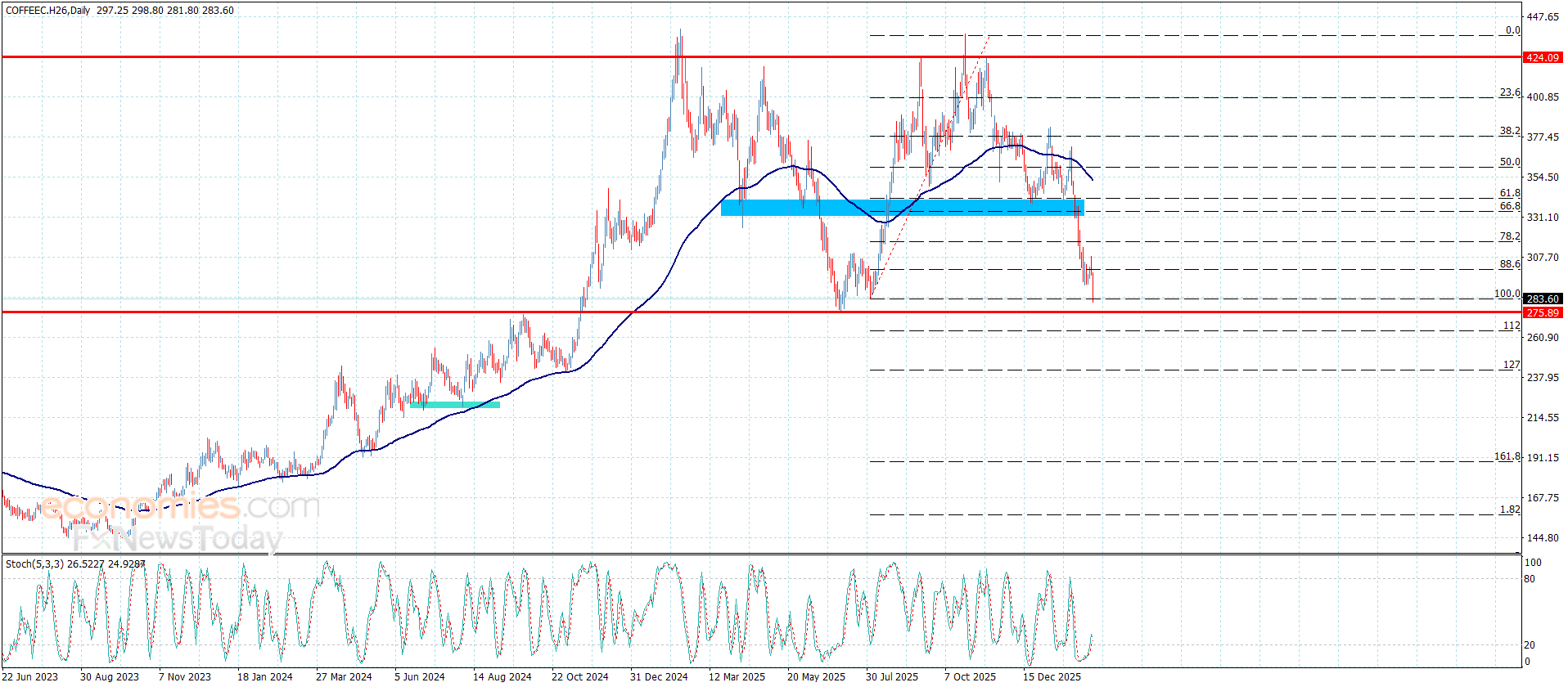
Coffee price continued forming strong bearish trading, affected by forming solid barrier at 330.00 level in the last trading, to notice reaching 283.00 to record the suggested targets in the previous reports.
Stochastic attempt to exit the oversold level might push the price to form mixed trading, but it will not affect the negative scenario, to expect reaching 275.80 level, and breaking it will open the way for reaching extra negative stations that might begin at 264.60 and 241.40.
The expected trading range for today is between 264.00 and 298.00
Trend forecast: Bearish
A rising ABCD pattern on the chart marks recent swings, but considers the $4,842 swing low to be contained within the CD leg of the formation. This is a judgement call, based on the decisiveness expressed in the first leg up from the bottom. With the measurement, an initial upside target is shown at $5,345. That is where the CD advance matches the rise in price seen in the AB leg.
Once that occurs, a potential pivot is identified. This target has greater significance in addition to a 100% ABCD target. The price matches a 78.6% Fibonacci retracement of the bearish correction. When two indicators identify a similar price level, that price area takes on greater significance as support or resistance. In this case, it is resistance.
Could gold continue to rise towards the $5,598 record high? Certainly, the reclaim of the moving averages indicates a recovery of those averages as support. The relationship shows demand improving as higher prices are recovered.
It could be argued that the recent sharp 21.4% bearish correction has reached a bottom. Support was seen at the confluence of the 50-day moving average and the top of a long-term rising channel. A bounce from $4,402 confirmed support at prior resistance from the channel. Together, the bullish response from these indicators suggests the correction may be complete, reinforcing the potential for further upside.
If you’d like to know more about how to trade gold and silver, please visit our educational area.
Silver (XAG/USD) builds on its recent recovery on Friday, with prices climbing for a third consecutive day as lingering geopolitical risks fuel safe-haven flows. At the time of writing, XAG/USD is trading near $82.80, on track to post a weekly gain of more than 5%.
The white metal has regained bullish traction after sliding to nearly two-week lows earlier in the week and continues to advance despite a broadly stronger US Dollar, suggesting dip buyers remain active.
The latest leg higher comes as tensions between the United States and Iran escalate, with fears mounting over potential US military action amid a significant American military buildup in the Middle East.
On Friday, US President Donald Trump said he is considering a limited strike on Iran. The remarks followed his warning on Thursday that Tehran must reach a “meaningful deal” or face “bad things,” adding that he expects clarity on a new nuclear agreement within the next 10 to 15 days.
Beyond geopolitics, underlying fundamentals remain constructive. Steady institutional inflows and resilient industrial demand, along with sustained expectations of lower interest rates in the United States later this year, keep the broader outlook for Silver tilted to the upside.
From a technical perspective, the 4-hour chart points to improving short-term momentum. Price is hovering near the upper Bollinger Band as the bands begin to widen, signaling rising volatility and building bullish pressure following a prior period of contraction.
The Moving Average Convergence Divergence (MACD) extends above the Signal line and stands in positive territory, with a widening histogram suggesting strengthening bullish momentum.
Meanwhile, the Relative Strength Index (RSI) is holding near 66, reflecting firm upside traction while remaining below overbought territory, leaving room for further gains.
On the upside, a sustained break above the upper Bollinger Band near $82.39 could pave the way for a continuation toward the $86.00 region, with the next key resistance seen around $92.00.
On the downside, the 20-period SMA (Bollinger middle band) at $77.34 provides immediate support. A decisive break below this level would expose the lower Bollinger Band around $72.16, followed by the February swing low near $64.00
Silver is a precious metal highly traded among investors. It has been historically used as a store of value and a medium of exchange. Although less popular than Gold, traders may turn to Silver to diversify their investment portfolio, for its intrinsic value or as a potential hedge during high-inflation periods. Investors can buy physical Silver, in coins or in bars, or trade it through vehicles such as Exchange Traded Funds, which track its price on international markets.
Silver prices can move due to a wide range of factors. Geopolitical instability or fears of a deep recession can make Silver price escalate due to its safe-haven status, although to a lesser extent than Gold’s. As a yieldless asset, Silver tends to rise with lower interest rates. Its moves also depend on how the US Dollar (USD) behaves as the asset is priced in dollars (XAG/USD). A strong Dollar tends to keep the price of Silver at bay, whereas a weaker Dollar is likely to propel prices up. Other factors such as investment demand, mining supply – Silver is much more abundant than Gold – and recycling rates can also affect prices.
Silver is widely used in industry, particularly in sectors such as electronics or solar energy, as it has one of the highest electric conductivity of all metals – more than Copper and Gold. A surge in demand can increase prices, while a decline tends to lower them. Dynamics in the US, Chinese and Indian economies can also contribute to price swings: for the US and particularly China, their big industrial sectors use Silver in various processes; in India, consumers’ demand for the precious metal for jewellery also plays a key role in setting prices.
Silver prices tend to follow Gold’s moves. When Gold prices rise, Silver typically follows suit, as their status as safe-haven assets is similar. The Gold/Silver ratio, which shows the number of ounces of Silver needed to equal the value of one ounce of Gold, may help to determine the relative valuation between both metals. Some investors may consider a high ratio as an indicator that Silver is undervalued, or Gold is overvalued. On the contrary, a low ratio might suggest that Gold is undervalued relative to Silver.
So for now, the gold price is effectively in limbo, with traders looking to see what the next set of US economic data really says before deciding which way to bet.
It’s worth remembering that the Federal Reserve minutes from their January meeting made it pretty clear that the central bank is under no pressure to slash interest rates anytime soon. In fact, some officials were even talking up the possibility of raising rates again if inflation doesn’t start to slow down like they think it should.
On top of that we’ve just seen yet more economic data showing the US job market is still going strong. Put all that together with more hawkish comments from Fed officials and investors are now starting to rethink their expectations for a serious rate cut.
As a result, the US dollar has gone from strength to strength and has now reached its highest level in months – and that’s all bad news for gold.
On the geopolitical front, President Donald Trump sent out a pretty stern warning to Iran on Thursday – telling them they have to get a nuclear deal sorted within 10 to 15 days or else. Iran’s response to UN Secretary General Antonio Guterres was that they don’t want war but that if anyone attacks them, then Iran will hit back – and they might even hit some key military targets in the region.
Which of course, just increases the chances of a wider conflict breaking out in the Middle East, and that’s good news for Gold, because we all know how well it tends to do when tensions start to rise.
![EUR/USD, XAU/USD, GBP/USD, XAG/USD & More [Video]](https://editorial.fxsstatic.com/images/i/market-chaos-03_Medium.jpg "EUR/USD, XAU/USD, GBP/USD, XAG/USD & More [Video]")