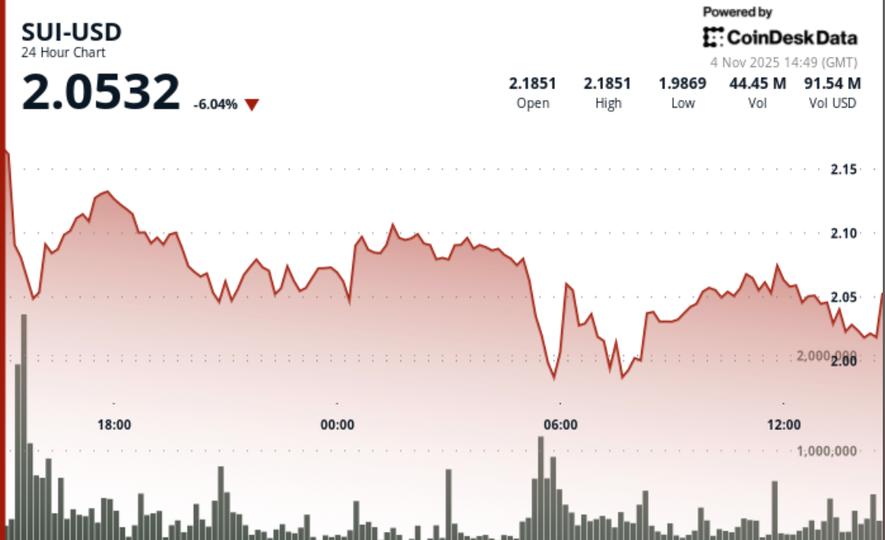
SUI, the native token of the Sui blockchain, fell Tuesday after breaching critical support levels and triggering a wave of technical selling. The token dropped 9.2% to as low as $2.02 as trading volume spiked and recovery attempts repeatedly failed.
The sell-off followed Monday’s news of a $116 million exploit involving decentralized finance (DeFi) protocol Balancer, which has rattled sentiment across the industry.
As security concerns mounted, investors appeared to unwind exposure to riskier layer-1 tokens, with SUI showing signs of institutional liquidation, according to CoinDesk Research’s technical analysis model. Nearly 42.6 million tokens changed hands during the breakdown, 68% more than the daily average, according to on-chain data.
The $2.08 level — once a support zone — flipped into resistance during the rout, with multiple failed bounces reinforcing the bearish trend. During U.S. morning hours, SUI hovered around $2.02 in low-volume trading, suggesting traders were positioning ahead of the next major move.
Chart watchers noted classic capitulation behavior: a single-hour collapse, followed by lower highs and tight consolidation. If the token breaks below $2.014, technical targets point toward $1.98 or even $1.95. To regain momentum, bulls would need to reclaim $2.07 with conviction.
The CoinDesk 5 Index of the biggest cryptocurrencies dropped 1.15% on the day with all constituents lower.
Disclaimer:Parts of this article were generated with the assistance from AI tools and reviewed by our editorial team to ensure accuracy and adherence toour standards. For more information, seeCoinDesk’s full AI Policy.
Hackers pilfered millions of dollars worth of cryptocurrency on Monday from the decentralized finance protocol Balancer.
Estimates varied but most blockchain security firms tracked more than $120 million in losses. At least $99 million of the stolen funds were in ETH.
A mainstay in the DeFi industry, Balancer initially said it is aware of the exploit and is investigating it. Cryptocurrency security experts said the incident was traced back to faulty access control mechanisms that were compromised by the attackers.
By Monday afternoon, the company released a longer message explaining the incident began in the early morning.
“Any pools that could be paused have been paused and are now in recovery mode,” the company said, noting that it has ties to several other crypto platforms that they could not unilaterally pause.
“Balancer is committed to operational security, has undergone extensive auditing by top firms, and had bug bounties running for a long time to incentivize independent auditors. We are working closely with our security and legal teams to ensure user safety and are conducting a swift & thorough investigation.”
They are still working with experts to examine what happened and plan to release a post-mortem at some point.
Balancer warned users that fraudulent messages claiming to be from the company’s security team are circulating and should not be interacted with.
Several other blockchain organizations tied to Balancer announced efforts to address the incident. The Berachain Foundation said it halted its network as its team took emergency measures to protect user assets. The organization was able to freeze some funds stolen from its platform. Other crypto platforms like Gnosis, Sonic, Beefy and others have taken similar measures.
Last week, hackers stole about $10.8 million from another DeFi platform called Garden Finance.
More than $2 billion in cryptocurrency was stolen by hackers in the first half of 2025, according to the blockchain security firm Chainalysis.
Most of the funds were stolen by hackers allegedly connected to North Korea’s government — which has made crypto theft a key source of revenue for its ballistics missile program.
A report released last week by the governments of the U.S., France, Germany, Japan and others said North Korea was responsible for stealing at least $1.65 billion in cryptocurrency from January to September 2025.
For years, Balancer stood as one of DeFi’s most reliable institutions, a protocol that had survived several bear markets, audits, and integrations without scandal.
However, that credibility collapsed on Nov. 3, when the blockchain security firm PeckShield reported that Balancer and several of its forks were under an active exploit spreading across multiple chains.
Within hours, more than $128 million was gone, leaving a trail of drained pools, frozen protocols, and shaken investors.
PeckShield data showed the platform’s protocol on Ethereum suffered the heaviest losses of about $100 million. Berachain followed with $12.9 million, while Arbitrum, Base, and smaller forks such as Sonic, Optimism, and Polygon recorded lower but still significant thefts.
Total Funds Stolen from Balancer Hack (Source: Peckshield)
As the drain unfolded, Balancer acknowledged a “potential exploit impacting Balancer v2 pools,” stating that its engineering and security teams were investigating the issue with high priority.
However, the acknowledgment did little to slow withdrawals across integrators and forks.
By the end of the day, DeFiLlama data showed that Balancer’s total value locked (TVL) had decreased by 46% to approximately $422 million from $770 million as of press time.
Balancer DeFi Hack (Source: DeFiLlama)
What happened?
Preliminary forensics from blockchain security firm Phalcon indicated that the attacker targeted Balancer Pool Tokens (BPT), which represent user shares in liquidity pools.
According to the firm, the vulnerability stemmed from how Balancer calculated pool prices during batch swaps. By manipulating that logic, the exploiter distorted the internal price feed, creating an artificial imbalance that let them withdraw tokens before the system corrected itself.
How Attacker Exploited Balancer Code (Source: Phalcon)
“Improper authorization and callback handling allowed the attacker to bypass safeguards. This enabled unauthorized swaps or balance manipulations across interconnected pools, draining assets in rapid succession (within minutes).”
Meanwhile, Balancer’s composable vault architecture, which is long praised for its flexibility, amplified the damage. Because vaults could reference each other dynamically, the distortion rippled through interconnected pools.
Interestingly, Coinbase’s Conor Grogan pointed out that the attacker’s approach suggested professional sophistication.
Grogan noted that the attacker’s address was initially funded with 100 ETH from Tornado Cash, implying the funds likely originated from earlier exploits.
“People don’t typically park 100 ETH in Tornado Cash for fun,” he wrote, suggesting the transaction pattern reflected an experienced and previously active hacker.
DeFi trust collapse
While the exploit itself was technical, its impact was psychological.
Balancer had long been regarded as a conservative venue for liquidity providers, a place to park assets and earn modest, steady yield. Its longevity, audits, and integrations across leading DeFi platforms fostered the illusion that endurance equaled safety. The Nov. 3 breach destroyed that narrative overnight.
Lefteris Karapetsas, founder of the crypto platform Rotki, called it “a trust collapse” and not just a hack of the DeFi platform.
He decried the fact that:
“A protocol live since 2020, audited and widely used, can still suffer a near-total TVL loss. That’s a red flag for anyone who believes DeFi is ‘stable.’”
That reaction captured the broader sentiment. In a market that prizes self-custody and verifiable code, confidence had quietly replaced trust as the hidden foundation of DeFi.
Balancer’s failure showed that even mathematically sound systems are vulnerable to unforeseen complexity.
Robdog, the pseudonymous developer of Cork Protocol, said:
“Whilst [DeFi] foundations are becoming safer and safer, the sad reality is smart contract risk is all around us.”
Implications for DeFi
The Balancer exploit hit at a delicate point for decentralized finance, shattering a brief period of calm. In October, total losses from hacks dropped to a yearly low of just $18 million, according to PeckShield.
However, with a single incident in November, the figure has already surged past $120 million, making it the third-worst month for DeFi breaches in 2025.
Monthly DeFi Hacks Losses in 2025 (Source: DeFiLlama)
Meanwhile, this attack highlights a fundamental paradox at the heart of DeFi: composability, the feature that enables protocols to connect and build upon one another, also amplifies systemic risk.
When a core protocol like Balancer breaks, the impact ripples instantly through the networks that depend on it.
On Berachain, validators paused block production to prevent contagion. Other protocols followed with temporary suspensions of lending and bridging functions.
These quick reactions limited losses, but they also underscored a broader truth showing that DeFi operates without the coordination mechanisms that steady traditional finance.
In this space, there are no regulators, central banks, or mandated backstops. Instead, crisis management relies heavily on developers and auditors working in tandem, often within minutes, to contain the fallout.
Considering this, Robdog said:
[This is] a good reminder why we need to develop better risk management infrastructure.”
Beyond the immediate technical loss, the damage to trust may be harder to repair.
Each major exploit erodes confidence in DeFi’s promise of self-regulating code. For institutional investors considering exposure to the industry, the repeated failures signal that decentralized markets remain experimental.
Karapetsas noted:
“No serious capital allocates into systems that are this fragile.”
That perception is already shaping policy in major economies globally.
Suhail Kakar, a prominent web3 developer, highlighted a sobering reality in the aftermath of the Balancer exploit: even multiple, high-profile security audits can’t guarantee safety in DeFi.
As he noted, Balancer underwent more than ten audits, with its core vault contract reviewed by several independent firms; yet, the protocol still suffered a major breach.
Kakar’s point highlights a growing sentiment in the industry that “audited by X” is no longer a mark of infallibility; rather, it reflects the inherent complexity and unpredictability of decentralized systems where even well-tested code can harbor unseen vulnerabilities.
Balancer V2 Audits (Source: Balancer docs via Suhail Kakar)
Authorities in the United States are developing frameworks that would introduce regulations on DeFi protocols. Industry observers expect the Balancer exploit to accelerate these efforts, as policymakers grapple with the growing risk of continued integration between crypto and the traditional financial industry.
People used to play games primarily for entertainment purposes and to kill time while trying to achieve better scores. The gaming world experienced a rapid transformation during that period. Modern games now offer players the ability to earn actual money through their gameplay activities. The play-to-earn gaming model enables users to generate financial rewards through their screen activities. Players can now receive cryptocurrency rewards from their gaming activities, which they can use for trading or converting into cash.
The play-to-earn gaming model has created a major disruption throughout the entire gaming sector. Through play-to-earn games, users can acquire digital tokens and NFTs and crypto coins, which possess monetary worth. The entire system operates through blockchain technology, which maintains complete transaction records and protects all financial activities. The twist? Players are not just consumers anymore. They are part of an entire digital economy that rewards their time and skill.
It’s funny because some of these ideas came from places you’d least expect, like casino-style gaming. The thrill, the suspense, and the instant reward feeling from spinning reels in online slots somehow found its way into blockchain games. It’s that rush of possibility, that sense of reward, only now backed by ownership and decentralization.
What Are Play to Earn Crypto Games, and How Do They Work?
Play-to-earn games unite fun with the financial opportunities. The games operate on blockchain platforms, which protect your earned assets through the secure tracking systems that prevent any form of duplication or deception. Your achievements in missions will reward you with tokens, while your battle victories will grant you access to rare NFTs. Your digital assets exist in your crypto wallet instead of company-controlled servers. So they’re truly yours.
Players have the ability to exchange their items between each other while also using them to generate additional rewards through staking. The gaming community includes people who support themselves through this system, while others play for the satisfaction of achieving something meaningful. The process of transactions follows a straightforward path where you play games to receive rewards, which you can exchange for money.
Element
Description
Example
Blockchain
Records ownership and transactions
Ethereum, Polygon
NFTs
Represent in-game assets
Weapons, avatars, lands
Tokens
In-game currency with real value
SLP, AXS, GALA
This setup gives power back to the players. Traditional games keep the money locked inside their own systems, but blockchain games allow everything to move freely. Your sword, your card, and your land, it’s all verifiable, tradeable, and real.
The Role of Web3 and NFTs in Play to Earn Gaming
True Digital Ownership
Web3 changed gaming forever. Before, you could spend hours grinding in a game, and if that company shut down, you’d lose everything. But now with NFTs, what you earn or buy stays with you. Your assets exist outside of the game itself.
Players can buy or win items that belong to them completely. These NFTs can be sold on marketplaces or even used across different platforms. Some players have built entire careers flipping digital land or trading unique characters. It’s almost like turning gameplay into entrepreneurship.
Interoperability and Decentralization
The magic word here is interoperability. It means that what you own in one game might work in another. It’s like taking your car from one racing game and driving it in another world entirely.
This freedom echoes the same principles found in decentralized casino models. When you play online slots using blockchain, your wins and losses are recorded publicly and fairly. That same concept of transparency and mobility powers play-to-earn games, making them fairer and more flexible than traditional titles.
What Games Can You Play to Earn Crypto?
Play-to-earn games come in all flavors. Some are massive RPGs; others are casual farming simulators or strategy titles. A few even take inspiration from casino culture, using crypto payouts and instant win systems.
Game Type
Example
Reward Type
RPG
Axie Infinity
Tokens (AXS, SLP)
Card Game
Splinterlands
NFTs
Strategy
Gods Unchained
Cards or Tokens
Casual
Town Star
Crypto rewards
Casino Hybrid
CryptoSlots
crypto payouts
The game Axie Infinity established itself as one of the first successful blockchain games. Players in the game obtain and reproduce Axies, which they use to fight battles to earn tradable cryptocurrency tokens. The blockchain game Splinterlands introduced card battling to players, while Town Star allowed them to construct and oversee their own towns for financial rewards.
The blockchain experiences of CryptoSlots and BC Game operate as casino-inspired games that reward players with cryptocurrency payouts. The P2E model received significant influence from these games. Online slots had already achieved perfection in their risk-versus-reward system and exciting gameplay experience before play-to-earn games emerged. The ownership feature became the main addition that play-to-earn games brought to the existing risk versus reward system.
The Connection Between Crypto Slots and Play to Earn Mechanics
Shared Tokenomics and Reward Cycles
At first glance, casino slots and play-to-earn games seem worlds apart. One is pure chance; the other involves strategy and economy. But if you look closely, the foundation is surprisingly similar. Both rely on transparent systems, smart contracts, and real-world payouts.
Crypto slot platforms were among the first to use blockchain to ensure fairness. Every spin and every win is recorded. That concept inspired the way modern blockchain games manage rewards. Players trust the system because it’s transparent, and the reward feels earned, not random.
Slot games also popularized the instant win mechanic. That feeling of anticipation just before the reels stop is now mirrored in Web3 gaming. The difference is that instead of winning temporary credits, players earn tokens or NFTs that can exist and grow in value beyond the game itself.
Game Design and User Psychology
It’s no secret that casino design plays with human psychology. The bright visuals, sound effects, and fast feedback create excitement. Web3 game developers learned from that playbook. They added emotional triggers and reward loops that keep players hooked but in a healthier, more productive way.
You might spend hours on a quest not just because it’s fun, but because every item you win could be valuable later. That blend of entertainment and opportunity is what keeps P2E games thriving. It’s a game of both mind and market.
Challenges and Risks in Play to Earn Ecosystems
Of course, it’s not all gold and glory. Play-to-earn ecosystems face real issues. One of the biggest problems is token inflation. When too many players earn too many coins, the value drops. That can hurt both players and developers.
Another challenge is keeping the game actually fun. Some projects focus too much on the earning side and forget the gaming part. Once the novelty wears off, players leave, and the economy collapses.
There’s also the wild nature of crypto markets. Values can swing overnight. One day your in-game token might be worth hundreds; the next day just a few cents. And as governments start paying attention, regulations will tighten.
Web3 gaming walks a fine line between entertainment and gambling. Just like crypto casinos, it will need clear rules and responsible structures. Balancing freedom with protection will decide its long-term success.
The Future of Play to Earn Gaming
The upcoming period appears promising despite current challenges. The play-to-earn sector continues to develop rapidly since its initial introduction. Game developers now understand that they should create enjoyable games before pursuing profitability.
The combination of improved token systems and intelligent game design will maintain player interest without creating excessive market supply.
The upcoming years will introduce extensive interconnected game worlds, which enable players to transfer their assets between different virtual environments. Players can create characters in one game, which they can then use to trade or fight or explore in different games.
Web3 games will continue to develop through three essential elements, which include transparency and fairness and innovative approaches. Web3 games will continue to evolve through the combination of casino-style logic with clear rules and instant payouts and verifiable outcomes.
Play-to-earn gaming has transitioned from being a short-lived trend into an established gaming format. The current gaming landscape shows how digital ownership and entertainment will develop during the upcoming ten years. Blockchain games have transformed the fundamental experience of playing games while earning rewards and achieving digital ownership of virtual assets.
FAQs
Q1. Can I earn crypto by playing games?A. Yes. Many play to earn games give you crypto or NFT rewards that can be exchanged for real money.
Q2. Are play to earn games real?A. They are very real. Games like Axie Infinity and Gods Unchained have created entire economies around player participation.
Q3. Does Play to Win pay real money?A. Yes, depending on the game. The rewards can be sold or traded for cryptocurrency, which has real-world value.
Q4. What is the best game to play to earn money?A. It depends on your taste. RPG lovers might prefer Illuvium or Axie Infinity, while casual players can try CryptoSlots or Town Star for simpler experiences.
Ethereum-based DeFi protocol Balancer was exploited on Nov. 3, with losses exceeding $70 million.
Attackers drained multiple liquidity pools and moved funds into a single new wallet within minutes.
This marks Balancer’s third major breach since 2020, raising renewed questions about DeFi security.
The decentralized finance (DeFi) protocol Balancer, one of Ethereum’s most established automated market makers (AMMs), suffered a major exploit on Nov. 3, leading to losses of nearly $70.9 million.
On-chain data shows that multiple Balancer liquidity pools were drained in rapid succession, with the stolen tokens quickly transferred to a newly created wallet controlled by the attacker.
According to blockchain trackers, the drained assets included:
6,850 OSETH
6,590 WETH
4,260 wSTETH
The swift execution of the transfers suggests the attacker had a deep understanding of Balancer’s smart contracts, potentially exploiting a flaw in how the platform handles swaps or manages pool balances.
Balancer did not immediately respond to a request for comment.
As of press time, Balancer’s team has not issued an official statement addressing the exploit.
The lack of communication has fueled uncertainty within the DeFi community, as users scramble to understand the scope and cause of the breach.
Blockchain analysts have urged traders to avoid interacting with Balancer pools until more information is released, warning that additional vulnerabilities could still be at play.
Meanwhile, Balancer’s native token (BAL) dropped over 8% intraday, mirroring investor unease and highlighting how quickly sentiment can shift when transparency is absent in the wake of a major hack.
This is not Balancer’s first encounter with hackers. In fact, the platform has now suffered three major security incidents in five years — an unsettling record for one of DeFi’s longest-running protocols.
In 2020, attackers exploited Balancer’s handling of deflationary tokens, draining roughly $500,000.
In 2023, another vulnerability in its “boosted pools” led to $900,000 in losses despite prior security warnings.
The latest $70 million attack dwarfs those previous incidents, making it Balancer’s most severe exploit to date and one of the largest DeFi hacks of 2025.
Security researchers and DeFi auditors are still analyzing the exploit’s technical vector.
Early evidence indicates a smart contract vulnerability that enabled the attacker to manipulate swaps or imbalances across multiple pools — a recurring weakness in complex AMM protocols.
Treasure NFT New Update: Will Treasure NFT Withdrawal Reopen on Nov 2?
Treasure NFT calls itself a blockchain platform that mixes non-fungible tokens, gaming, and income rewards. Users earn by staking, doing daily tasks, or inviting others through referral links.
The platform earlier announced that the Treasure NFT withdrawal will open on November 1 2025, but today’s news shocked the crypto market.
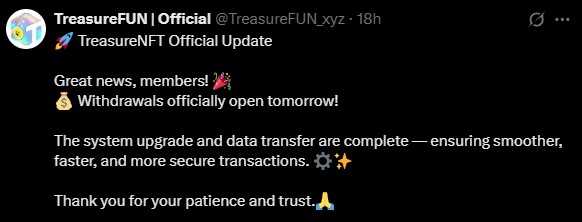
After weeks of silence and delay, the team has announced that the withdrawal will officially reopen tomorrow, November 2, 2025. This update came from its official X account.
Let’s uncover the reasons behind the delay, is the project real or fake, and will the date push forward or not.
The Treasure NFT Withdrawal New Date: Why November 2 Matters?
The much awaited referral programme which was earlier promised to start on November 1, has now been officially set for Nov 2 as the new date.
As per the team’s latest X post, the Treasure NFT withdrawal date delay reasons are comprised on two major concerns:
System upgrade and data transfer to new Nova NFT platform
India and U.S. time difference delayed the upgradation process.
The team promised that fund release will now be “smoother, faster, and more secure.”
Fake Project or Real? Experts Know the Answer
After so many changes and constant delays, people are asking the same question: is Treasure non fungible tokens fake or real? Will this date really happen, or will it be delayed again?
However, many experts say its system looks more like a referral-based reward program than a real digital collectible marketplace.
Unrealistic daily return promises (up to 5–10% reported)
Lack of verified company registration under RBI or SEBI
Opaque leadership and missing audits
Referral-heavy business model resembling MLM structures
Unlike trusted sites like OpenSea or Magic Eden, this project doesn’t show any verified non-fungible tokens listings or clear blockchain proof of ownership, resulting in the platform’s less credibility.
Telegram Updates Confusion: Will Withdrawal Open Tomorrow or More Delay?
On October 28, the team made a big claim that BlackRock, one of the world’s biggest investment companies, had bought these non-fungible tokens to protect user money. This made many people believe things were finally safe.
A few days later, however, Binance Square clearly said that BlackRock never made any such deal. The company itself confirmed there was no partnership or investment made.
The situation is getting more confusing every day. As per Treasure NFT new update, the team told users to “stay calm” and said the company is still working and will start new features “soon.
All of these system upgraders, false news, new features launch, and date delay confusion are signaling that November 2 withdrawal might also be at risk.
Experts Weigh In: They say investors should stay patient and wait for real blockchain proof. “Treasure NFT withdrawal new date promise sounds good, but until we see real transactions on the blockchain, it’s not confirmed.”
Conclusion: What’s the Next Reality Check?
The next 24 hours Treasure NFT updates are very important to watch, because if funds release opens tomorrow, then users might get back some trust. People should see on-chain confirmations or wallet transactions within hours. However, based on past patterns, repeated postponements and unverifiable claims, analysts advise extreme caution.
If it doesn’t reopen, then the Nova migration may just be a new name to cover the same old issues. For now, everyone is waiting for Treasure NFT withdrawal November 2, to see whether users finally get their funds or if another excuse appears.
Disclaimer: This article is for news and information only. Crypto investments are risky, so always DYOR before making any financial decision.
KapKap, a cutting-edge Web3 platform leveraging AI for attention-based value distribution in gaming, has successfully raised a total of US$10 million across its seed and strategic funding rounds.
The seed round was led by Animoca Brands, with additional participation from Shima Capital, Mechanism Capital, Klaytn Foundation, and Big Brain Holdings. The latest strategic round saw investments from Unicorn Verse, Rzong Capital, and BGX Capital, reflecting strong investor confidence in KapKap’s innovative model.
The newly raised funds will be directed toward enhancing its proprietary KAPS (Key Attention Pricing System) — a unique AI-driven reputation system that converts user engagement into measurable digital value. KapKap also plans to expand collaborations with global game developers and launch new casual gaming titles to broaden its ecosystem.
Key Highlights
KapKap secures US$10 million to expand its AI-powered Web3 gaming and attention-based value distribution platform.
Animoca Brands leads KapKap’s seed round, with major investors backing its innovative KAPS reputation system.
KapKap partners with BAYC, ApeCoin DAO, and SNK to launch new blockchain games and NFT-driven gaming experiences.
The platform has forged strategic partnerships with major brands such as BAYC (Bored Ape Yacht Club), ApeCoin DAO, and SNK, and works with popular Web3 games including Summon of Glory and Idle Knights. With over 1.7 million monthly active users (MAUs) and 25,000 daily active users (DAUs), KapKap continues to strengthen its foothold in the Web3 gaming landscape.
Notably, KapKap holds licensing rights to SNK IPs such as The King of Fighters and Samurai Shodown through Summon of Glory, and has even launched a BAYC-themed NFT hero series, merging blockchain gaming with iconic digital collectibles.
By integrating AI, blockchain, and Web3 technology, KapKap is redefining how user attention and engagement translate into reputation and digital value, paving the way for a new era in AI-powered Web3 gaming.
Defi Technologies Inc. stocks have been trading down by -8.29 percent amid growing concerns over regulatory challenges.
Recent Performance and Market News
Despite an empty news database, optimism surrounds Defi Technologies based on promising fundamentals, expecting their strategic direction to spur innovative growth and market confidence.
Historical performance shows stock volatility amidst market fluctuations. However, analysts pinpoint catalysts such as potential strategic partnerships and tech advancements promising improvement.
Recent financial releases reveal a mixed record of revenues and profit margins but highlight attempts to minimize operational costs and capture new market opportunities.
With an emphasis on innovation and adaptation, investors entertain the idea of Defi Technologies leveraging technology trends to capture market share and possibly realizing an uptick in stock valuation.
Considering company resilience amid broader market challenges, projections hint at possible recovery and long-term gains, fueled by favorable policy shifts and macroeconomic factors.
Live Update At 14:02:30 EST: On Thursday, October 30, 2025 Defi Technologies Inc. stock [NASDAQ: DEFT] is trending down by -8.29%! Discover the key drivers behind this movement as well as our expert analysis in the detailed breakdown below.
DEFT Financial Overview and Earnings Analysis
As Tim Bohen, lead trainer with StocksToTrade says, “I focus on momentum that’s visible right now. Speculation on future moves is outside my playbook.” In the world of trading, such an approach emphasizes the importance of reacting to current market conditions rather than attempting to predict unpredictable future shifts. Therefore, traders pay close attention to present trends and patterns, ensuring that their strategies align with observable market activity.
The financial statements tell a complicated story. With revenue nearing $49.4M, Defi Technologies struggles in profitability. Gross margin stands impressively at 63.6%, indicating they’ve kept production costs low, highlighting efficient core operations. Nonetheless, pressure mounts with an EBIT margin of -18.2%, showing operational challenges that weigh heavily on financial results.
On paper, DEFT displays aggressive growth attempts in tech innovation but wrestles with a significant profit margin contraction from operational expenses. Critical financial strength metrics show total debt to equity at just 0.12, hinting at relatively low debt burden — a silver lining for financial flexibility.
Their strategic alignment seems disrupted by inefficient cost management. High total expenses affect bottom-line profitability despite a positive cash position of roughly $26.3M at period-end. They seem poised for tactical adjustments with an operational cash outflow of over $20.3M highlighting operational challenges they must address forthwith.
More Breaking News
Identifying their strengths, Defi appears poised to exploit In Market AI trends. If DEFT can leverage innovation while tightening profit margins, growth potential might edge towards tangible gains. Yet, current metrics paint an urgent call to improve efficiencies across their endeavors.
Story of Resilience and Potential Rebound
Analyzing Defi Technologies reveals a narrative where strategic ambition meets operational struggles. There’s a juxtaposition of aiming high alongside pressing challenges in execution. Their intent to evolve is stifled by complexities intrinsic to fast-moving tech sectors. A balancing act ensues as they strive for meaningful scale by aligning innovation with profitability.
With revenue metrics indicating more than twofold growth over multiple years, there rests underutilized potential contingent upon orchestrating better cost structures and investor-driven agendas. Given the swaying market fortune, they stand at the precipice of redefining their market trajectory.
Stock moved from $2.05 on Oct 10 to dip at $1.796 by the end of the month, reflecting economic headwinds impacting momentum-driven assets. Short-term quakes hide long-term promise. A crucial pivot emerges — aligning internal strategies with macroeconomic cues could signal an inflection within DEFT’s trajectory.
Investors intrigued by moderate risk should observe if DEFT orchestrates an operational shift. This holds potential for buoyed valuation given tech’s transformative capabilities match their portfolio. Over the horizon, a rebound delves on strategic realignment, optimizing costs, and enhancing bottom-line growth.
Conclusion: Strategic Position and Future Outlook
In summation, Defi Technologies emerges in a light of calculated caution and potential opportunity. There’s vibrant hope nestled within hurdles they bid to overcome — predicated on strategic navigation that merges ambition with adept execution. Traders curious about tech’s pulse may find avenues within DEFT’s adaptive strategies. As Tim Bohen, lead trainer with StocksToTrade says, “There’s a pattern in everything; you just have to stick around long enough to see it.” Embracing this philosophy, DEFT enhances their capacity to identify consistent trends within market fluctuations.
Given their intricate dance of innovation versus operational efficiency, the long-term view obliges key adjustments for budding potential to actualize. Harnessing nimble transitions with tactical foresight by leaning on emerging tech trend winds could renew trader faith, possibly lifting stock valuations appreciably.
To wit, judgment lingers on DEFT’s keenness to rectify fiscal disparities and capitalize on industry shifts, setting a stage for how this stock might unfurl its story of aspiration and transformation against sector waves ready to propel their prospects into actuality.
This is stock news, not investment advice. StocksToTrade News delivers real-time stock market updates tailored to highlight the key catalysts driving short-term price movements. Our coverage is designed for active traders and investors who thrive in fast-moving markets, with a focus on volatile sectors like penny stocks, AI stocks, Robinhood stocks and other momentum plays. From earnings reports and FDA approvals to mergers, new contracts, and unusual trading volume, we break down the events that can spark significant price action.
Looking to level up your trading game? Explore StocksToTrade, the ultimate platform for traders. With powerful tools designed for swing and day trading, integrated news scanning, and even social media monitoring, StocksToTrade keeps you one step ahead.
Check out our quick startup guide for new traders!
Ready to build your watchlists? Check out these curated lists:
Once your watchlist is set, take the next step and trade with confidence using StocksToTrade’s robust platform. Don’t miss out — grab your 14-day trial for just $7 and experience the edge you need to thrive in today’s fast-paced markets.
Microsoft Azure has just released a Blockchain-as-a-Service product that uses Ethereum to support blockchain with a set of templates to deploy and configure your choice of blockchain network. This can be done with minimal Azure and blockchain knowledge.
The conventional blockchain in the open is based on Proof-of-Work (PoW) and requires mining as the parties do not trust each other. An enterprise blockchain does not require PoW but is based on Proof-of-Authority (PoA) where approved identities or validators on a blockchain, validate the transactions on the blockchain.
The PoA product features a decentralized application (DApp) called the Governance DApp. Blockchains in this new model can be deployed in 5-45 minutes depending on the size and complexity of the network.
The PoA network comes with security features such as identity leasing system to ensure no two nodes carry the same identity. There are also other features to achieve good performance.
Web assembly smart contracts: Solidity is cited as one of the pain areas when developing smart contracts on Ethereum. This feature allows developers to use familiar languages such as C, C++, and Rust.
Azure Monitor: Used to track node and network statistics. Developers can view the underlying blockchain to track statistics while the network admins can detect and prevent network outages.
Extensible governance: With this feature, customers can participate in a consortium without managing the network infrastructure. It can be optionally delegated to an operator of their choosing.
Governance DApp: Provides a decentralized governance in which network authority changes are administered via on-chain voting done by select administrators. It also contains validator delegation for authorities to manage their validator nodes that are set up in each PoA deployment. Users can audit change history, each change is recorded, providing transparency and auditability.
Unlock access to the largest independent learning library in Tech for FREE!
Get unlimited access to 7500+ expert-authored eBooks and video courses covering every tech area you can think of.
Along with these features, the Governance DApp will also ensure each consortium member has control over their own keys. This enables secure signing on a wallet chosen by the user.
The blog mentions “In the case of a VM or regional outage, new nodes can quickly spin up and resume the previous nodes’ identities.”
Welcome to the US Crypto News Morning Briefing—your essential rundown of the most important developments in crypto for the day ahead.
Grab a coffee for Standard Chartered’s latest outlook, suggesting stablecoins have done more than disrupt TradFi, quietly setting the stage for a $2 trillion DeFi revolution.
Sponsored
Sponsored
Crypto News of the Day: Stablecoins Pave the Way for DeFi’s Next Trillion-Dollar Era, Standard Chartered Says
According to Geoff Kendrick, Head of FX and Digital Assets Research at Standard Chartered, the explosive growth of stablecoins in 2025 goes beyond reshaping traditional finance (TradFi). It also set the foundation for a new era of decentralized finance (DeFi).
In a new note shared with clients, Kendrick said the widespread success of stablecoins this year has begun to “disrupt TradFi payment networks and savings,” while triggering three key preconditions for a sustained DeFi boom.
“The success of stablecoins in 2025 has started to disrupt TradFi payment networks and savings. It has also set three important DeFi boom preconditions in motion — raised awareness in developed markets, created the necessary liquidity on-chain, and driven an expansion of on-chain lending and borrowing,” Kendrick wrote.
Kendrick believes this convergence between stablecoins and DeFi will ignite massive growth in tokenized real-world assets (RWAs), a sector he expects to expand from $35 billion today to $2 trillion by the end of 2028.
This prediction aligns with forecasts from the Treasury Borrowing Advisory Committee (TBAC) as reported in a recent US Crypto News publication.
The projection also aligns with his previous forecast for the stablecoin market cap, suggesting that institutional adoption of on-chain assets could mirror the pace of stablecoin integration into the global financial system.
“Specifically, I think stablecoins will go from $230 billion to $2 trillion by the end of 2028. That growth will require an extra $1.6 trillion of US T-bills to be held as reserves, and that is all of the planned new T-bill issuance over that period,” Kendrick told BeInCrypto recently.
Sponsored
Sponsored
Ethereum Emerges as the Bridge Between TradFi and DeFi
The shift comes as Ethereum, which dominates DeFi by total value locked, strengthens its appeal to institutions.
On Wednesday, the Ethereum Foundation launched a new Institutional Use Case page designed to explain DeFi infrastructure and value propositions to traditional finance players.
1/ Now live: the Ethereum for Institutions site
Ethereum is the neutral, secure base layer where the world’s financial value is coming onchain
Today, we’re launching a new site for the builders, leaders, and institutions advancing this global movement pic.twitter.com/KGNKVaPda0
Kendrick said the move reflects Ethereum’s growing role as the backbone of global digital finance.
Sponsored
Sponsored
“TradFi is turning to Ethereum, which dominates the DeFi space. Key DeFi protocols like Aave are going to be the winners. The future of finance is now,” he said.
Standard Chartered has been one of the few major banks that are consistently bullish on digital asset integration. The firm has previously forecast Bitcoin reaching new highs amid global liquidity shifts and regulatory normalization.
Kendrick’s latest note extends that optimism to DeFi, positioning it as the next frontier of institutional blockchain adoption.
If his projections hold, traditional financial institutions could, in the coming years, go beyond experimenting with DeFi to start relying on it as a core part of the global economic architecture.