
Category: Forex News, News
XAU/USD technical outlook remains bullish, Fed speakers eyed
- Gold built on previous weeks gains and advanced above $2,400.
- The near-term technical perspective suggests that the bullish outlook remains unchanged.
- Fedspeak and FOMC Minutes could influence XAU/USD’s action next week.
Gold (XAU/USD) price continued to push higher this week and rose above $2,400 on Friday, gaining nearly 2% for the week. Investors will continue to scrutinize comments from Federal Reserve (Fed) officials next week and look for fresh hints on the timing of the policy pivot in the minutes of the April 30-May 1 meeting.
Gold benefited from retreating US Treasury bond yields
Gold started the new week under bearish pressure and lost nearly 1% on Monday. In the absence of fundamental drivers, however, XAU/USD’s action looked to be a technical correction following the upsurge seen in the second half of the previous week.

The data published by the US Bureau of Labor Statistics (BLS) showed on Tuesday that the Producer Price Index (PPI) rose 2.2% on a yearly basis in April. This reading followed the 1.8% increase recorded in March and came in line with the market expectation. The immediate reaction to this data caused the US Dollar (USD) to weaken and allowed Gold to regain its traction. While speaking at the Foreign Bankers’ Association’s Annual General Meeting later in the day, Fed Chairman Jerome Powell noted that the PPI data was mixed and reiterated that the restrictive policy may take longer than expected to bring inflation down. These comments helped the USD limit its losses and capped XAU/USD’s upside.
On Wednesday, the BLS reported that annual inflation in the US, as measured by the change in the Consumer Price Index (CPI), edged lower to 3.4% in April from 3.5% in March. In the same period, core CPI inflation, which excludes volatile food and energy prices, arrived at 3.6% and met analysts’ estimates. On a monthly basis, the CPI and the core CPI both rose 0.3%. The benchmark 10-year US Treasury bond yield declined over 2% after the April inflation report and allowed Gold to push higher toward $2,400. Meanwhile, other data from the US showed that Retail Sales remained unchanged at $705.2 billion in April.
In the second half of the week, Fed officials adopted a cautious tone regarding the timing of the policy pivot and helped the USD find a foothold. In turn, Gold corrected lower on Thursday.
New York Fed President John Williams said that he doesn’t see the need for a rate cut in the near term. Commenting on the April CPI reading, “kind of a positive development after a few months, where the data were disappointing,” Williams told Reuters in an exclusive interview. Richmond Fed President Thomas Barkin told CNBC that the latest CPI data showed that inflation was not where the Fed was trying to get, and Atlanta Fed President Bostic argued that a continued fall in inflation could make it appropriate to reduce the policy rate later in the year.
The action in financial markets remained subdued in the first half of the day on Friday. Boosted by week-end flows, Gold turned north in the American session and reached its highest level in nearly a month above $2,400.
Gold investors await more Fedspeak, FOMC Minutes
S&P Global’s preliminary Manufacturing and Services PMI data for May will be next week’s high-tier data releases from the US on Thursday. In case these data come in below 50 and show a contraction in the private sector’s business activity, the USD could come under renewed selling pressure with the immediate reaction and open the door for a leg higher in XAU/USD. On the other hand, the USD could find demand if PMI surveys point to an acceleration in the private sector’s expansion rate.

Throughout next week, several Fed policymakers will be delivering speeches. According to the CME FedWatch Tool, markets are currently pricing in a 33% probability that the Fed will leave the policy rate unchanged in September. Although Fed officials are unlikely to say whether September will be the right time to lower the interest rates, their comments on the economic outlook and inflation developments could influence rate cut odds. If policymakers reiterate the need to see several more good monthly inflation data before considering a policy pivot, investors could reassess the probability of a rate cut in September and help the USD stay resilient, limiting Gold’s upside. In case officials voice their concerns over the loosening conditions in the labor market and/or the growing uncertainty surrounding the growth outlook, US Treasury bond yields could edge lower and allow XAU/USD to gather bullish momentum.
In the policy statement published after the April 30-May 1 meeting, the Fed said that “in recent months, there has been a lack of further progress toward the Committee’s 2% inflation objective”. On Wednesday, the Fed will publish the minutes of that meeting, and investors will scrutinize policymakers’ discussions on the rate outlook in the face of the first quarter’s strong inflation readings. If the publication shows that some policymakers lean toward a single rate cut in 2024, the USD could gather strength. On the other hand, XAU/USD could extend its uptrend if the report suggests that investors are still in favor of more than one rate reduction.
Gold technical outlook
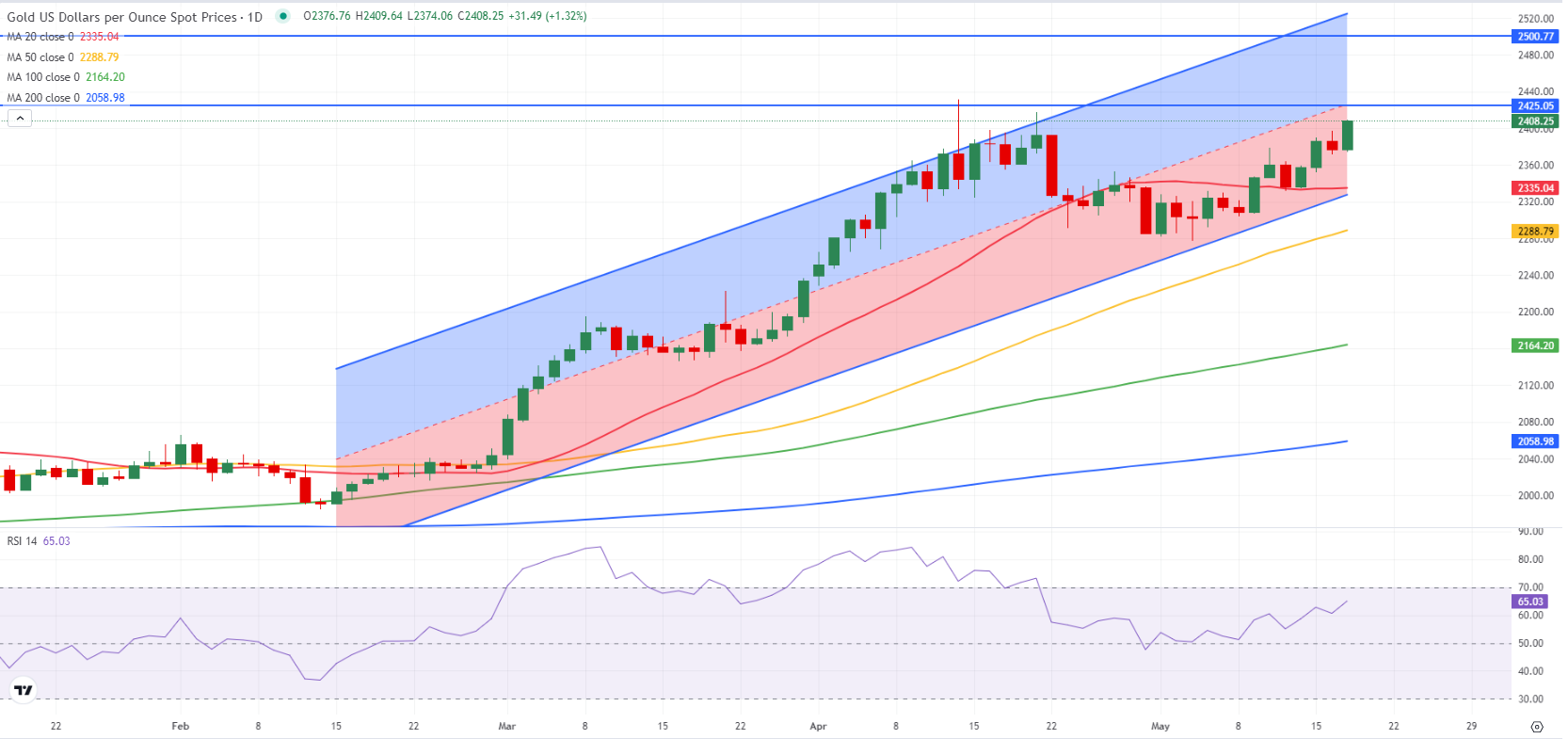
On the daily chart, the Relative Strength Index (RSI) indicator holds above 60 and Gold remains within the ascending channel coming from mid-April, reflecting the bullish bias. Once Gold confirms $2,400 (static level, psychological level) as support, it could face interim resistance at $2,425 (mid-point of the ascending channel) before $2,430 (static level) and $2,500.
On the downside, strong support seems to have formed at $2,335-$2,330, where the 20-day Simple Moving Average (SMA) and the lower limit of the ascending channel align. If this support fails, technical sellers could take action. In this scenario, $2,300 (psychological level) and $2,290 (50-day SMA) could be seen as next support levels.
Fed FAQs
Monetary policy in the US is shaped by the Federal Reserve (Fed). The Fed has two mandates: to achieve price stability and foster full employment. Its primary tool to achieve these goals is by adjusting interest rates. When prices are rising too quickly and inflation is above the Fed’s 2% target, it raises interest rates, increasing borrowing costs throughout the economy. This results in a stronger US Dollar (USD) as it makes the US a more attractive place for international investors to park their money. When inflation falls below 2% or the Unemployment Rate is too high, the Fed may lower interest rates to encourage borrowing, which weighs on the Greenback.
The Federal Reserve (Fed) holds eight policy meetings a year, where the Federal Open Market Committee (FOMC) assesses economic conditions and makes monetary policy decisions. The FOMC is attended by twelve Fed officials – the seven members of the Board of Governors, the president of the Federal Reserve Bank of New York, and four of the remaining eleven regional Reserve Bank presidents, who serve one-year terms on a rotating basis.
In extreme situations, the Federal Reserve may resort to a policy named Quantitative Easing (QE). QE is the process by which the Fed substantially increases the flow of credit in a stuck financial system. It is a non-standard policy measure used during crises or when inflation is extremely low. It was the Fed’s weapon of choice during the Great Financial Crisis in 2008. It involves the Fed printing more Dollars and using them to buy high grade bonds from financial institutions. QE usually weakens the US Dollar.
Quantitative tightening (QT) is the reverse process of QE, whereby the Federal Reserve stops buying bonds from financial institutions and does not reinvest the principal from the bonds it holds maturing, to purchase new bonds. It is usually positive for the value of the US Dollar.
Source link


Written by : Editorial team of BIPNs
Main team of content of bipns.com. Any type of content should be approved by us.






Share this article: