About Editorial team of BIPNs

Main team of content of bipns.com. Any type of content should be approved by us.
21 12, 2025

XAU/USD Near $4,350 as Fed “Pause” Talk Meets $5,000 Forecasts for 2026

By |2025-12-21T23:28:35+02:00December 21, 2025|Forex News, News|0 Comments


Gold is ending 2025 where it spent much of the year: near record territory, with investors debating whether the next move is a breakout—or a breath. As of Sunday, December 21, 2025, live spot pricing put gold around $4,352/oz, keeping the metal within striking distance of its 2025 record near $4,381/oz and reinforcing the narrative that bullion has shifted from a “rate-cut trade” into a structural portfolio asset for central banks and investors alike. [1]

What makes today’s setup especially interesting is the collision of three powerful themes: fresh signals that the Federal Reserve could keep rates steady for months, year-end liquidity conditions that can amplify swings, and a growing consensus among major banks that 2026 could still bring gold closer to $4,800–$5,000 even if the pace of gains slows from 2025’s historic surge. [2]

Gold price today: where XAU/USD stands on December 21, 2025

Live spot quotes on Sunday showed gold at $4,352.63/oz (12:08 PM ET), up modestly on the day. [3]

On major pricing feeds tracking XAU/USD, the current exchange rate was around 4,338.55, with an indicated daily range roughly between 4,309 and 4,356—a reminder that different feeds (spot quotes, broker composites, OTC pricing windows) can vary slightly, especially around weekends and thin liquidity. [4]

For context, gold’s 2025 run has been extraordinary: the World Gold Council notes the metal notched 50+ all-time highs this year and delivered 60%+ returns, driven by a mix of geopolitical risk, USD weakness, and momentum. [5]

The headline risk today: a Fed “hold steady for months” message hits the tape

A key macro headline on Dec. 21 came via Reuters: Cleveland Fed President Beth Hammack said she sees no need to change U.S. interest rates for months, with the current benchmark range at 3.5% to 3.75%, suggesting policy could stay on hold until at least spring while officials assess inflation dynamics—including the downstream effects of tariffs moving through supply chains. [6]

Why it matters for the gold price:
Gold tends to dislike “higher-for-longer” surprises because firmer rate expectations can lift real yields and support the dollar—both classic headwinds for non-yielding bullion. But the 2025 playbook has been more complicated: strong demand from central banks and diversification-focused investors has repeatedly cushioned pullbacks, even when rates didn’t fall as fast as markets hoped. [7]

Forecast roundup as of Dec. 21: where major banks see gold in 2026

The most striking feature of late-December research is how many mainstream institutions now treat $4,500+ gold as plausible—even if they warn the rally may cool.

Bank and institutional targets making headlines

  • Goldman Sachs:$4,900/oz by December 2026 in its base case, citing “structurally high” central-bank demand and cyclical support from Fed cuts, with upside risk if private investor diversification broadens. [8]
  • Morgan Stanley (Reuters summary): expects slower gains but still sees $4,800/oz by Q4 2026, supported by anticipated rate cuts, a weaker dollar, and demand factors including China and central banks. [9]
  • J.P. Morgan (via Reuters reporting): expects prices averaging above $4,600 in Q2 2026 and above $5,000 in Q4 2026; Reuters also reports J.P. Morgan estimates about 350 tonnes per quarter of central-bank + investment demand is needed to keep prices flat, with a forecast around 585 tonnes per quarter in 2026. [10]
  • Metals Focus (Reuters): sees gold at $5,000 by end-2026. [11]
  • Deutsche Bank: lifted its 2026 forecast to $4,450/oz, projecting a $3,950–$4,950 range and arguing ETF flows could help hold a ~$3,900 support floor; it also kept a $5,150 forecast for 2027. [12]
  • Macquarie (Reuters): sees average prices around $4,225 in 2026, slightly below then-current spot levels at the time of the report. [13]
  • State Street Global Advisors (SSGA): frames a bull case of $4,500–$5,000 and says it sees a 30% probability of gold hitting $5,000/oz, with scenarios involving steady official/China demand and sustained ETF flows. [14]

The “underowned gold” argument

One widely shared late-December thesis: even after the rally, gold may still be under-allocated in key markets. Business Insider, citing Goldman’s analysis, reported gold ETFs were only ~0.17% of private U.S. financial portfolios, and Goldman estimated that even small increases in allocation could have an outsized price effect in a comparatively small market. [15]

Why gold surged in 2025—and why strategists say the cycle may not be over

Reuters’ late-year roundup captured the scale of the move: gold posted its biggest jump since the 1979 oil crisis, with prices doubling in the last two years and reaching a record around $4,381/oz in October. [16]

Strategists highlighted several forces that turned a “normal” macro rally into something more structural:

1) Central banks as a price anchor

Reuters described central-bank reserve diversification away from dollar assets as a key foundation for 2026, with official buyers stepping in when positioning looks stretched and prices dip. [17]

2) ETF and investor demand broadened beyond the usual crowd

Gold’s 2025 story is no longer just “rates and recession.” Reuters pointed to new market participants (including corporate/crypto-linked buyers) and a broader investor pool. [18]

3) Demand hit record levels during the year

ING, citing World Gold Council figures, reported global gold demand reached 1,313 tonnes in Q3 2025, described as the strongest quarterly total on record, driven by investment demand (ETFs, bars, coins) and central-bank buying. [19]

4) The “uncertainty premium” expanded

Analysts cited concerns ranging from geopolitics to policy disputes and questions about Fed independence as additional support pillars for bullion going into 2026. [20]

A new warning in the background: is gold trading like a risk asset?

Not everyone is comfortable with how gold behaved in 2025.

Reuters reported that the Bank for International Settlements (BIS) raised concerns about a rare co-movement of gold and equities that it says hasn’t been seen in at least half a century, suggesting “growing fragility” in a risk-on environment and questioning what happens if both stocks and gold correct together. Reuters also noted BIS commentary that gold began behaving “much more like a speculative asset,” and flagged unusual signals such as gold ETF pricing trading at a premium versus NAV (per the BIS discussion reported by Reuters). [21]

For gold investors, this matters because it challenges the simplest “safe haven always offsets equities” assumption—especially in a world where portfolio rebalancing can force selling across asset classes during sharp drawdowns.

Policy and supply-side developments to watch

Gold’s price is driven mainly by macro and demand—but policy and supply headlines can still shape sentiment, especially when they reinforce the “gold as sovereignty” narrative.

Italy: “the people’s gold” debate

Reuters reported that an Italian parliamentary committee approved an amendment declaring that the central bank’s gold reserves belong to “the people,” drawing criticism from the ECB over potential implications for central bank independence. Italy’s reported stockpile is 2,452 metric tons, valued around $300 billion in the Reuters report. [22]

Even if largely symbolic, the story underscores how politically salient gold reserves have become in an era of fiscal strain and de-dollarisation debates.

Zimbabwe: adjusting royalties as gold prices soar

On the supply side, Reuters reported Zimbabwe reversed plans to double gold royalties to 10%, keeping 5% royalties for gold between $1,200 and $5,000/oz, and applying 10% only above $5,000/oz. Reuters also noted Zimbabwe’s gold production hit 42 metric tons in the first 11 months of 2025, a record. [23]

Near-term outlook: thin liquidity, key U.S. data, and a “breakout vs pullback” market

With Christmas week beginning, many desks are lightly staffed, and liquidity can thin quickly—conditions that often amplify short-term moves in FX, rates, and metals.

Holiday-week volatility risk is real

India-based market coverage on Dec. 21 highlighted a common theme: year-end low volumes can mean quieter trading—or sudden swings if a surprise data print hits a thin book. Times of India reported analysts watching U.S. data such as GDP, housing statistics, and consumer confidence, while anticipating reduced participation around the holidays. [24]

A separate Dec. 21 report carried by Rediff (PTI/market commentary) similarly emphasized the risk of consolidation/correction amid low participation, while pointing to the same cluster of U.S. macro releases as near-term catalysts. [25]

Technical levels traders are watching (no charts—just the numbers)

Technical commentary published on Dec. 21 illustrates how tight the market’s focus has become around the highs:

  • FXEmpire’s daily metals coverage described gold as sitting just under the all-time high near $4,381, with traders split between chasing a breakout and buying dips; it also referenced nearby support levels as the market “debates” direction. [26]
  • DailyForex’s weekly outlook noted gold has been trying to “catch up” with other precious metals, pointing to a move beyond the $4,270 area and suggesting the market is watching for a decisive push above the record zone. [27]

The key takeaway: when a market grinds near record highs late in the year, the first big move can be exaggerated—either a breakout that forces under-allocated investors to chase, or a quick pullback driven by profit-taking and thin liquidity.

What happens next for gold in 2026?

Putting the day’s headlines and the latest institutional forecasts together, the 2026 gold narrative is shaping up around three questions:

  1. Does the Fed cut enough—or pause long enough—to keep real yields supportive for gold? Hammack’s “hold steady for months” stance adds tension to a market that has largely priced in easier policy over time. [28]
  2. Do central banks keep buying at a pace that offsets softer ETF demand if retail flows cool? That’s central to the bullish bank cases, and a key assumption in forecasts clustered between $4,450 and $5,000. [29]
  3. Does gold remain a portfolio “cornerstone” even if risk assets wobble—or does the BIS-style “double bubble” risk lead to a broader de-risking? [30]

For now, price action says the bull market is not “over”—it’s being renegotiated. Gold is no longer just reacting to the next CPI print; it’s being priced as a strategic hedge against a wider set of risks: geopolitics, reserve diversification, fiscal concerns, and shifting confidence in fiat stability. [31]

References

1. www.jmbullion.com, 2. www.reuters.com, 3. www.jmbullion.com, 4. www.investing.com, 5. www.gold.org, 6. www.reuters.com, 7. www.reuters.com, 8. www.reuters.com, 9. www.reuters.com, 10. www.reuters.com, 11. www.reuters.com, 12. www.reuters.com, 13. www.reuters.com, 14. www.ssga.com, 15. markets.businessinsider.com, 16. www.reuters.com, 17. www.reuters.com, 18. www.reuters.com, 19. think.ing.com, 20. www.reuters.com, 21. www.reuters.com, 22. www.reuters.com, 23. www.reuters.com, 24. timesofindia.indiatimes.com, 25. money.rediff.com, 26. www.fxempire.com, 27. www.dailyforex.com, 28. www.reuters.com, 29. www.reuters.com, 30. www.reuters.com, 31. www.gold.org


Source link

21 12, 2025

Choppy After BoE and CPI (Video)

By |2025-12-21T22:51:38+02:00December 21, 2025|Forex News, News|0 Comments

  • The British pound reacted to central bank decisions and U.S. CPI data with choppy trading, but broader dynamics remain unchanged.
  • Key resistance and support levels continue to define direction, with relative strength versus peers likely to persist.

The British pound has been very noisy during trading on Thursday, which is not a huge surprise considering that we had the Bank of England interest rate decision during the day. On the other side of the Atlantic, we had the CPI numbers come out of the United States. The English cut their rates as anticipated. The CPI numbers in the United States came in much weaker than anticipated. So this has helped lift the British pound just a touch.

That being said, I don’t know that anything has changed. The interest rate differential, which of course changed when the Federal Reserve cut rates last week, is now gone. And now we have a situation where we have to question whether or not the US starts slowing down, because if the US starts slowing down, typically what follows is the rest of the world slowing down. So you see an initial move against America, only to turn around and run back to America via currency markets and more specifically the bond market, which, of course, is a main driver of the currency market.

Key Levels and Relative Strength Outlook

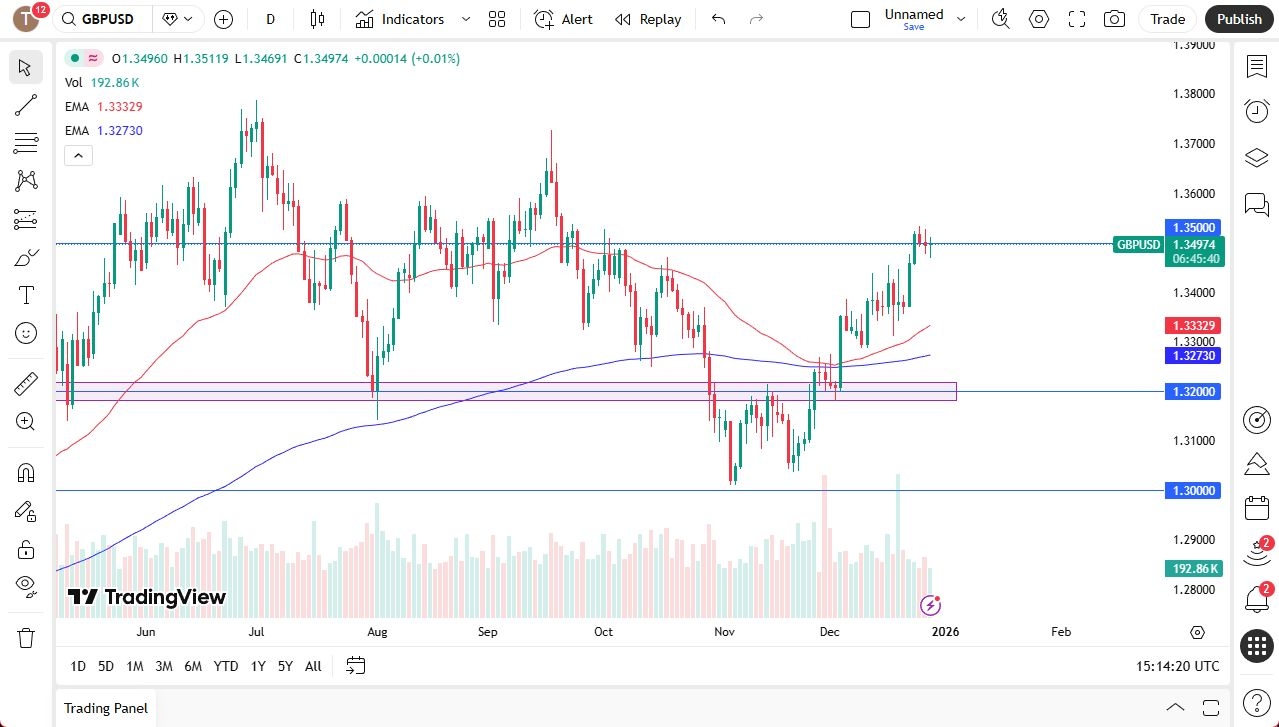
As things stand right now, it looks like the 1.34 level continues to be massive resistance or more or less a magnet for price. And it’s really not until we break above the 1.35 level that I think the British pound has the all clear to go higher. In that environment, we could go looking to the 1.3750 level. Just have to wait and see.

To the downside, if we can break down below the Wednesday candlestick, I think at that point in time, I might start shorting this pair. It could open up a move down to 1.32 and then eventually 1.30 over the longer term. Nonetheless, I would say this about the British pound. It has outperformed most of its contemporaries against the US dollar both up and down over the last couple of years. And I anticipate that to continue being the case here, as the US dollar is the main driver of Forex markets, but it’s a relative game and relatively speaking, the pound is stronger than most other currencies.

Ready to trade our daily GBP/USD Forex forecast? Here’s some of the best forex broker UK reviews to check out.

Christopher Lewis has been trading Forex and has over 20 years experience in financial markets. Chris has been a regular contributor to Daily Forex since the early days of the site. He writes about Forex for several online publications, including FX Empire, Investing.com, and his own site, aptly named The Trader Guy. Chris favours technical analysis methods to identify his trades and likes to trade equity indices and commodities as well as Forex. He favours a longer-term trading style, and his trades often last for days or weeks.

Source link

21 12, 2025

Will ADA Explode to $2 by 2030?

By |2025-12-21T22:37:33+02:00December 21, 2025|Crypto News, News|0 Comments

BitcoinWorld

Cardano Price Prediction: Will ADA Explode to $2 by 2030?

As the cryptocurrency market continues to evolve, investors are eagerly watching Cardano’s ADA token. With its unique proof-of-stake consensus mechanism and strong development roadmap, many are wondering: could ADA reach the coveted $2 mark in the coming years? This comprehensive analysis examines Cardano price predictions from 2026 through 2030, combining technical analysis, market trends, and expert insights to give you a clear picture of ADA’s potential trajectory.

Understanding Cardano’s Current Market Position

Cardano stands as one of the most established blockchain platforms in the cryptocurrency space. Founded by Charles Hoskinson, co-founder of Ethereum, Cardano has built a reputation for its research-driven approach and peer-reviewed development process. As of current market conditions, ADA maintains a strong position among top cryptocurrencies by market capitalization, but what does this mean for future price movements?

The platform’s transition to a proof-of-stake consensus mechanism through its Ouroboros protocol has positioned it as an energy-efficient alternative to proof-of-work blockchains. This fundamental advantage, combined with ongoing development through the Basho and Voltaire eras, creates a solid foundation for potential growth.

Cardano Price Prediction 2026: The Near-Term Outlook

Looking ahead to 2026, several factors will influence ADA’s price trajectory. Market analysts consider both technical indicators and fundamental developments when making their Cardano price prediction for this period.

Key factors for 2026 include:

  • Adoption of Cardano’s smart contract capabilities
  • Growth of decentralized applications on the platform
  • Overall cryptocurrency market conditions
  • Regulatory developments affecting proof-of-stake assets

Most conservative estimates suggest ADA could trade between $0.80 and $1.20 by 2026, assuming steady platform growth and favorable market conditions. More optimistic projections, based on accelerated adoption and successful implementation of Cardano’s roadmap, suggest potential highs approaching $1.50.

ADA Price Forecast 2027: Building Momentum

The year 2027 represents a crucial period for Cardano’s long-term trajectory. By this time, the platform should have fully implemented its Voltaire governance system, allowing ADA holders to participate directly in network decisions. This increased utility could significantly impact the ADA price.

Scenario Low Estimate High Estimate
Conservative $1.00 $1.40
Moderate $1.20 $1.80
Optimistic $1.50 $2.20

These projections assume continued development success and growing institutional interest in proof-of-stake cryptocurrencies. The cryptocurrency forecast for 2027 heavily depends on Cardano’s ability to attract and retain developers, as well as the platform’s performance relative to competitors like Ethereum and Solana.

Cardano 2030: Long-Term Vision and Potential

Looking further ahead to 2030, the Cardano 2030 outlook becomes both more speculative and potentially more exciting. Long-term predictions must account for technological advancements, regulatory landscapes, and broader economic factors that are difficult to forecast with precision.

Several scenarios could unfold:

  • Base Scenario: Steady growth with ADA reaching $1.50-$2.50 range
  • Bull Scenario: Major adoption breakthroughs pushing ADA to $3-$5
  • Bear Scenario: Market challenges limiting growth to $0.80-$1.20

The most compelling question remains: Will ADA hit $2? Based on current trajectories and assuming successful execution of Cardano’s development roadmap, reaching $2 by 2030 appears achievable, though not guaranteed. The $2 milestone represents approximately a 4x increase from current levels, which aligns with historical cryptocurrency growth patterns for established projects with strong fundamentals.

Factors That Could Accelerate ADA Growth

Several developments could propel ADA beyond current predictions:

Institutional Adoption: Increased investment from traditional financial institutions could dramatically increase demand for ADA. As proof-of-stake assets gain regulatory clarity, more institutional investors may enter the Cardano ecosystem.

Technological Breakthroughs: Successful implementation of Cardano’s scaling solutions and interoperability features could position ADA as a leading platform for decentralized finance and other applications.

Market Cycles: Cryptocurrency markets historically move in cycles. A major bull market coinciding with Cardano’s development milestones could create perfect conditions for significant price appreciation.

Risks and Challenges to Consider

While the Cardano price prediction outlook appears promising, investors must consider potential challenges:

Competition: Cardano faces intense competition from other smart contract platforms. Ethereum’s continued development, along with emerging layer-1 and layer-2 solutions, could limit Cardano’s market share.

Regulatory Uncertainty: Changing regulatory landscapes, particularly regarding proof-of-stake assets and securities classification, could impact ADA’s price and adoption.

Execution Risk: Cardano’s development timeline has historically been deliberate. Any significant delays or technical challenges could affect market confidence and price performance.

Expert Insights and Market Sentiment

Leading cryptocurrency analysts offer varied perspectives on ADA’s future. While some emphasize Cardano’s strong fundamentals and research-based approach, others caution about the competitive landscape. Most agree that Cardano’s success depends on execution of its roadmap and ability to attract developers and users to its ecosystem.

The overall cryptocurrency forecast for ADA remains cautiously optimistic, with many experts believing the platform’s unique approach could pay dividends in the long term, particularly as environmental concerns make proof-of-stake mechanisms more attractive to institutional investors.

Actionable Insights for Investors

Based on current Cardano price prediction models and market analysis:

1. Consider dollar-cost averaging rather than timing the market
2. Monitor Cardano’s development progress through official channels
3. Diversify within the cryptocurrency sector
4. Stay informed about regulatory developments affecting proof-of-stake assets
5. Set realistic expectations based on your investment horizon

FAQs: Cardano Price Prediction

What is the highest price Cardano could reach by 2030?
While predictions vary, some optimistic models suggest ADA could reach $5-$10 by 2030 under ideal conditions, though most analysts project more conservative targets in the $2-$4 range.

Who founded Cardano?
Cardano was founded by Charles Hoskinson, who also co-founded Ethereum. The project is developed by Input Output Hong Kong (IOHK).

How does Cardano differ from Ethereum?
Cardano uses a proof-of-stake consensus mechanism called Ouroboros, while Ethereum recently transitioned from proof-of-work to proof-of-stake. Cardano also emphasizes peer-reviewed research and formal methods in its development process.

What factors most influence ADA price?
Key factors include overall cryptocurrency market trends, Cardano platform adoption, technological developments, regulatory changes, and competition from other blockchain platforms.

Is Cardano a good long-term investment?
Many analysts view Cardano as a promising long-term investment due to its strong fundamentals and research-based approach, though all cryptocurrency investments carry significant risk and volatility.

Conclusion: The Path to $2 and Beyond

The journey toward ADA reaching $2 involves multiple factors aligning favorably. Cardano’s deliberate development approach, combined with growing recognition of proof-of-stake advantages, creates a compelling case for long-term growth. While reaching $2 by 2030 appears within reach based on current projections, investors should remain aware of market volatility and the competitive landscape.

Cardano’s success ultimately depends on execution—transforming its technological promise into real-world adoption. As the platform continues to develop and the broader cryptocurrency market evolves, ADA’s price trajectory will reflect both Cardano’s specific achievements and general market conditions. For investors with a long-term perspective and risk tolerance, Cardano represents an intriguing opportunity in the evolving blockchain ecosystem.

To learn more about the latest cryptocurrency markets trends, explore our article on key developments shaping blockchain technology and digital asset adoption.

This post Cardano Price Prediction: Will ADA Explode to $2 by 2030? first appeared on BitcoinWorld.

Source link

21 12, 2025

Prices Slip on Warm Forecasts as LNG Supply Plans Shift

By |2025-12-21T21:27:45+02:00December 21, 2025|Forex News, News|0 Comments


December 21, 2025 — Natural gas markets are closing out the year with a familiar winter paradox: heating season is underway, but prices are being dragged lower by milder temperature forecasts and a supply picture that still looks comfortable in both the U.S. and Europe.

In the United States, NYMEX natural gas futures for January delivery slid to $3.879 per million British thermal units (mmBtu) in the latest session, touching a seven-week low as traders priced in warmer-than-normal weather into early January and continued strength in Lower 48 production. [1]

Globally, the soft tone is reinforced by weaker benchmark prices in Europe and Asia—reducing LNG “pull” from overseas and narrowing export margins. At the same time, major structural stories continue to reshape the longer-term outlook: Qatar-linked expansion activity moved forward with a new offshore contract, while at least one large proposed U.S. export project was paused amid cost and oversupply concerns. [2]

Below is a detailed look at the key news, forecasts, and market analysis shaping natural gas as of Dec. 21, 2025.


Key takeaways driving natural gas today

  • U.S. prices: January futures ended the latest session around $3.879/mmBtu, pressured by milder weather outlooks and near-record output. [3]
  • Supply comfort signals: The closely watched March–April 2026 spread (“widow-maker”) traded near a record-low premium of ~1 cent, a sign traders aren’t pricing in major late-winter scarcity risk right now. [4]
  • Production and demand: Lower 48 output hovered around 109.6 bcfd (billion cubic feet per day) for December, while projected total demand (including exports) was expected to fall sharply over the next two weeks as warmth trims heating needs. [5]
  • LNG feedgas remains high: Flows to the eight large U.S. LNG export plants averaged about 18.5 bcfd so far this month—near record territory—though plant-specific fluctuations continue. [6]
  • Project signals: Energy Transfer said it is suspending development of its Lake Charles LNG export project in Louisiana as it prioritizes pipeline investments amid cost inflation and oversupply concerns. [7]
  • Geopolitics and regional gas: Israel approved what it described as its largest-ever gas export deal, tied to Leviathan supply to Egypt through 2040 (or until contract value is reached), underscoring how East Med gas is becoming more central to North African balances. [8]
  • Europe policy shift continues: The European Parliament approved legislation to phase out Russian gas imports—including halting Russian LNG by end‑2026 and pipeline gas by end‑September 2027—a structural bullish factor for LNG demand over time even if near-term prices are soft. [9]
  • 2026 forecasts diverge: EIA expects Henry Hub to average about $4.01/mmBtu in 2026 (and around $4.30/mmBtu this winter season), while Enverus projects $3.80 through winter before softening in summer 2026; Goldman sees higher 2026 pricing in both the U.S. and Europe than current winter softness implies. [10]

Where U.S. natural gas prices stand—and what’s pushing them

The current U.S. move is less about a sudden collapse in fundamentals and more about a rapid repricing of winter expectations. After earlier cold-driven strength, the latest model runs shifted warmer—enough to shave expected heating demand in the critical late-December/early-January window.

Reuters-reported market data showed meteorologists expecting weather to stay mostly warmer than normal through Jan. 3, reducing the volume of gas needed for residential and commercial heating. [11]

At the same time, supply remains strong. Lower 48 output has been hovering near record levels (~109.6 bcfd), giving the market less reason to pay up for winter risk. [12]

One of the most telling indicators is the forward curve. The March–April 2026 spread—nicknamed the “widow-maker” for how violently it can move when late-winter weather swings—compressed to around a 1-cent premium, an unusually calm signal for the end of winter. [13]

Storage: still not tight (for now)

Storage is also helping keep a lid on panic pricing. In the same Reuters dataset, the U.S. storage position was shown close to normal—recently around 0.9% above the five-year average at the reported point in time (with totals cited around 3,579 bcf for the referenced week). [14]

That doesn’t mean winter is “solved.” It means the market currently believes supply + storage are adequate unless a sustained cold regime emerges.


LNG: high export flows, but global prices are softening

U.S. LNG export demand continues to be a critical support pillar. Feedgas to the eight major U.S. LNG plants averaged around 18.5 bcfd so far this month—up from a monthly record of 18.2 bcfd in November, according to Reuters-reported figures. [15]

However, softer global gas benchmarks are complicating the picture.

Earlier in the week, Reuters reporting noted European (TTF) and Asian (JKM) benchmarks trading near multi‑month lows, with global prices declining as the winter heating season began slowly and markets weighed prospects of improved Russia-linked supply conditions over time. [16]

This matters because LNG is not just a “volume” story—it’s a margin story. When international prices fall faster than Henry Hub (or when shipping and liquefaction costs rise), U.S. cargo economics can tighten, especially for spot-linked volumes.

Operational noise: Freeport and Venture Global headlines

Operationally, traders are still tracking plant-level events. Reuters noted a shutdown of one liquefaction train at Freeport LNG in Texas during the week, a reminder that unplanned outages can quickly change short-term balances. [17]

Separately, Reuters also pointed to small flow declines at Venture Global facilities in Louisiana in recent days (as referenced in market reporting), though overall U.S. LNG feedgas stayed near record highs. [18]


Big project signal: Energy Transfer pauses Lake Charles LNG

One of the most important structural stories heading into 2026 isn’t a price tick—it’s what developers are doing (or not doing) with multi‑billion-dollar export projects.

Energy Transfer said it is suspending development of its Lake Charles LNG export project in Louisiana, citing a preference to focus capital on pipeline investments amid rising costs and fears of looming global oversupply as more LNG capacity comes online. The project had been planned at roughly 16.45 million tonnes per annum of liquefaction capacity. [19]

For the market, this is a two-sided signal:

  • In the short-to-medium term, fewer new terminals could be supportive for U.S. balances if demand growth from LNG slows.
  • In the long term, it highlights how financing and cost inflation can gatekeep the next wave of LNG—potentially preventing the most bearish oversupply scenarios from materializing on schedule.

Qatar keeps the long game in focus

While some U.S. capacity ambitions are being reassessed, Qatar’s expansion narrative keeps moving.

Italy’s Saipem won an offshore EPCI contract from QatarEnergy LNG (in partnership with China’s COOEC), with the overall contract value around $4 billion and Saipem’s share around $3.1 billion. The work is described on a multi‑year timeline, with offshore installation operations expected later in the decade. [20]

The strategic message is clear: Qatar’s North Field-linked expansion remains one of the most consequential supply additions expected for the second half of the 2020s.

For traders and policymakers, that raises the central question: Will demand growth (Europe’s LNG reliance, Asia’s industrial/power growth, and new uses like data center power demand) keep pace with the supply wave? [21]


Europe: policy is tightening even as prices stay calm

European gas is increasingly shaped by policy—and by the reality that LNG is now a structural pillar of supply.

EU moves closer to a Russian gas phase-out

The European Parliament approved the bloc’s plan to phase out Russian gas imports, including halting Russian LNG by end‑2026 and ending pipeline gas imports by end‑September 2027. Reuters reported Russia accounted for about 12% of EU gas imports as of October 2025, down sharply from pre‑2022 levels. [22]

This is a long-duration bullish factor for LNG infrastructure and flexible supply—but it doesn’t automatically translate into high near-term prices if weather is mild and inventories are adequate.

Methane regulation becomes a trade friction point

Another European factor that could influence LNG flows—and compliance costs—is methane policy.

Reuters reported the U.S. asked the EU to exempt U.S. oil and gas imports from aspects of the EU’s methane emissions regulation until 2035, framing it as a trade barrier and warning of implementation challenges given complex U.S. supply chains and commingled molecules. The EU, however, signaled the legislation stands while discussing implementation pathways. [23]

For market participants, methane rules can affect contract structures, certification practices, and potentially the attractiveness of certain supply sources over time—particularly in a world where Europe is expected to remain a premium LNG buyer for years.

Trading infrastructure: TTF’s financial market is getting bigger

Even as prices soften, European gas market activity is expanding. Intercontinental Exchange (ICE) reported record trading volumes for benchmark Dutch TTF contracts in 2025 and said it is preparing to extend trading hours to better align with global cycles, reflecting how Europe’s gas pricing is increasingly connected to Henry Hub and Asian LNG benchmarks. [24]


East Mediterranean gas: Israel’s Leviathan deal reshapes Egypt’s supply picture

A major regional headline this week came from the Eastern Mediterranean.

Reuters reported Israel approved what it described as its largest-ever natural gas export deal—valued around $34.67 billion—to supply Egypt with gas from the Leviathan field. The deal referenced roughly 130 bcm of gas through 2040 (or until the contract value is met), and it comes as Egypt works through an energy crunch linked to domestic production declines and rising demand. [25]

Why this matters beyond the region:

  • Egypt’s ability to secure reliable pipeline gas can influence whether it becomes a steadier LNG exporter again—or remains a net importer during tight periods.
  • The deal underscores how “regional pipeline gas” can still compete with LNG in certain corridors, even as Europe globalizes gas through LNG.

Australia’s domestic gas debate highlights a global tension

Natural gas is increasingly global: LNG prices and flows often ripple back into domestic energy bills.

In Australia, policy debate remains active over how to protect local consumers and industry from LNG-linked price pressures. Reporting highlighted concerns around high gas prices and scrutiny of mechanisms meant to ensure adequate domestic supply. [26]

For global readers, the takeaway is broader than Australia: countries that are large LNG exporters often face political pressure to “decouple” domestic pricing from international markets—especially when cost-of-living becomes a dominant theme.


Forecasts for 2026: what major outlooks are saying now

Forecasting gas is notoriously difficult because weather dominates and LNG is both a demand source and a volatility amplifier. Still, several major outlooks released or highlighted in December frame today’s debate: Is the recent pullback a pause—or a reset lower?

EIA: firmer 2026, strong LNG exports, and winter volatility risk

In its December Short‑Term Energy Outlook messaging, EIA forecast Henry Hub natural gas prices at $3.56/mmBtu for 2025 and $4.01/mmBtu for 2026, and described winter conditions putting upward pressure on prices—projecting a winter average around $4.30/mmBtu in its forecast narrative. EIA also projected U.S. LNG gross exports rising to ~16 bcfd in 2026 (from ~15 bcfd in 2025). [27]

Enverus: the winter spike looked “premature”

Enverus Intelligence Research projected Henry Hub prices averaging about $3.80/mmBtu through winter before softening to around $3.60/mmBtu in summer 2026, arguing the earlier run-up had gotten ahead of fundamentals amid expectations for a mild winter and continued Lower 48 supply growth. [28]

Goldman: higher 2026 pricing assumptions than the market is signaling today

Reuters reporting on Goldman’s outlook included expectations that in 2026 Dutch TTF could average around €29/MWh and U.S. natural gas around $4.60/mmBtu, illustrating how some bank forecasts still lean above what today’s softened winter curve implies. [29]

Kpler: storage trajectory and LNG imports will decide Europe’s end‑winter comfort

Kpler’s European natural gas outlook suggested EU‑27 storage could end the 2025–26 winter around 36% full, with the estimate sensitive to LNG import expectations and pipeline inflows—another reminder that Europe’s balance is increasingly an LNG scheduling story. [30]


What to watch next week (and why it matters)

Natural gas is entering a period where small changes in weather models can drive outsized moves. Here’s what professionals are watching right now:

  1. Late‑December / early‑January weather revisions
    With forecasts currently leaning warm, any shift toward sustained cold could quickly reprice the curve—especially given how aggressively winter risk premium has been compressed. [31]
  2. LNG plant reliability and feedgas trends
    Feedgas is near record highs, but events like the Freeport train outage show how quickly balances can change. [32]
  3. U.S. storage withdrawals vs. expectations
    The market has been pricing “comfortable” storage conditions; surprises (either direction) will matter more with the curve already leaning bearish. [33]
  4. Policy signals in Europe
    Russian gas phase-out timelines and methane compliance negotiations are structural, but they can influence contracting, LNG sourcing, and long-run price formation. [34]
  5. Final investment decisions and cancellations in LNG
    The Energy Transfer pause is a reminder: not all proposed LNG capacity becomes real, and that uncertainty is itself a key driver of 2026–2028 expectations. [35]

References

1. www.tradingview.com, 2. www.tradingview.com, 3. www.tradingview.com, 4. www.tradingview.com, 5. www.tradingview.com, 6. www.tradingview.com, 7. www.reuters.com, 8. www.reuters.com, 9. www.reuters.com, 10. www.eia.gov, 11. www.tradingview.com, 12. www.tradingview.com, 13. www.tradingview.com, 14. www.tradingview.com, 15. www.tradingview.com, 16. www.tradingview.com, 17. www.tradingview.com, 18. www.tradingview.com, 19. www.reuters.com, 20. www.tradingview.com, 21. www.reuters.com, 22. www.reuters.com, 23. www.reuters.com, 24. www.reuters.com, 25. www.reuters.com, 26. www.theguardian.com, 27. www.eia.gov, 28. www.mrt.com, 29. www.reuters.com, 30. www.kpler.com, 31. www.tradingview.com, 32. www.tradingview.com, 33. www.tradingview.com, 34. www.reuters.com, 35. www.reuters.com


Source link

21 12, 2025

Protein supplements explained: Safety, daily need and when they help

By |2025-12-21T20:41:43+02:00December 21, 2025|Dietary Supplements News, News|0 Comments


Most people may get enough protein from food, but protein supplements, such as shakes, can help curb post-workout hunger. Photo: Getty Images.

“High-protein” is the biggest buzzword in nutrition, having dethroned predecessors “low-fat” and “low-sugar” as the food industry’s compound adjective of the moment. Historically the domain of lean meats, poultry, fish, eggs, beans, lentils, nuts, seeds, tofu and dairy products, you can now find products ranging from bottled water to breakfast cereals to Pop-Tarts fortified with it and generally trumpeting protein’s presence on the packaging.

As so many shaker bottles attest, protein supplements are also in vogue — in particular, the protein powders that those shaker bottles help dissolve into liquid. Which begs some questions: How much protein do we actually need? Are protein supplements a good way to up protein intake? Will too much protein cause weight gain? Are protein supplements safe?

UCHealth Today gathered expert insights from dietitians and a toxicologist to answer these questions and more.

What is protein, actually?

We tend to talk about protein in the singular “protein,” but it’s really about “proteins.” There are thousands of different proteins in and about our cells. Each is a long chain of some combination of the 22 amino acids that comprise all proteins in the body. Those chains then fold back on and around themselves in countless ways. Every cell in your body is partially made of protein, and all cells make use of it in various ways.

What roles do proteins play in the body?

Protein is best known for building muscle, and that’s the key driver of the protein-supplements business. But muscle and tissue development, maintenance and repair are among the many important roles proteins play in the body. Enzymes, which enable or speed up biochemical reactions, are proteins. Many hormones — chemical messengers between organs — are proteins, as are energy and nutrient transporters such as hemoglobin, which carries oxygen from lungs to cells throughout the body.

The keratin in your hair and fingernails, the collagen in your bones, tendons and skin, and the elastin that lets your arteries and lungs expand and contract are proteins. The antibodies your immune system depends on are proteins, and proteins also are critical in maintaining proper blood pH (acid-base balance) as well as fluid balance. Finally, protein can serve as an energy source, though the body much prefers to metabolize sugars and fats.

“There’s so many things that protein steps up to do that other macronutrients cannot do,” said Cathy Deimeke, a UCHealth registered dietitian and diabetes educator.

How much protein do I need?

That depends on how big you are, how active you are, what activities you’re doing and how old you are.

Cathy Deimeke, a UCHealth registered dietitian and diabetes educator, discusses protein and how much the body needs. Photo: UCHealth.

The rule of thumb for sedentary adults is 0.8 grams of daily protein intake per kilogram of body weight (0.45 grams of protein per pound). For a 150-pound adult, that’s about 54 grams of protein a day. For a 120-pound adult, it’s 44 grams.

“That’s the starting point, but for most people, I go a little higher,” Deimeke said.

But as the chart below shows, estimated protein needs really do depend on the person. Athletes require more protein to recover and build muscle: 1-1.6 grams per kilogram of body weight per day for endurance athletes and 1.6-2 grams per kilogram of body weight per day for those doing strength- and power-focused training, according to the International Society of Sports Nutrition.

Those over 65, who increasingly deal with the inevitable age-related muscle loss (sarcopenia), also need more protein — roughly as much as a younger person doing routine strength- or power-focused training. Based on that, an older 150-pounder’s ideal protein consumption would be 82 to 136 grams per day.

Daily protein needs based on weight, activity level and ageA chart showing the daily protein needed based on weight and activity level. Source: doi.org.

Do runners, bikers, fitness buffs and other active people need to supplement proteins?

Assuming a balanced diet, the vast majority of us, including the very active, get enough protein through what they eat, Deimeke said. Her general rule of thumb is that 20% of calories should arrive through protein. Because people who burn more calories and tax their muscles through physical activity will naturally be hungrier, they will generally consume more protein as a matter of course, she said. In essence, increased appetite leads to higher protein intake.

Also, high-protein foods can cover even elevated protein needs without undue focus on the macronutrient. Four ounces of chicken breast, a serving about the size of the palm of your hand, has 30 grams of protein, and the same amount of beef has only slightly less. A cup of cottage cheese has 25 grams, a can of tuna or a cup of Greek yogurt 20 grams each. Nuts, lentils, tofu and other foods add to the tally.

But again, there’s no one answer to how much protein people need or how to deliver it, Deimeke said.

“We’re going to take a look at underlying health conditions. We’re going to look at the level of activity. So, it’s just not one-size-fits-all,” she said.

Do I need protein supplements at all?

Most of us don’t, Deimeke said. But protein supplements can help in a couple of ways. The 20 to 30 grams of protein in a protein supplement can help quell post-workout hunger, and in a quantity that the body can readily metabolize (roughly 0.4 grams per kilogram of body weight every couple of hours, or 27 grams for our 150-pounder). Also, for people who are generally food averse or the aged whose declining appetites can’t keep up with increasing protein needs, protein bars and shakes can be a quick, efficient way to catch up.

Explore expert UCHealth Today articles on other supplements, including vitamins and minerals for better health:

“That’s where protein drinks and supplements are very nice, because they’re an efficient way for people to take in calories and protein, especially when they don’t feel like eating,” Deimeke said.

What if I eat too much protein?

Like carbohydrates, protein contains about four calories per gram (fat holds nine calories per gram). Unlike carbohydrates and fat, the body doesn’t store protein for future use. If we don’t get enough dietary protein, our body breaks down structural proteins. It also can convert amino acids to glucose for immediate energy. It’s important to note, Deimeke said, that taking in adequate carbohydrates and fat protects amino acids from being used for energy, thus allowing protein to accomplish its many roles. Taking in too much protein when carbohydrate intake is adequate will result in amino acids being converted to fat, she said.

Taking in more protein than the body needs is, thanks to that conversion, generally safe for healthy people. Because processing that extra protein makes the kidneys work a little harder, those with kidney problems who are thinking about boosting their protein intake should consider reaching out to a dietitian to establish a baseline, Deimeke said.

Consumer Reports found lead in protein powders — should you be worried?

Dr. Kennon Heard, section chief of Medical Toxicology at the University of Colorado School of Medicine and a UCHealth Emergency Medicine physician, said there’s no “safe” level for lead consumption. But, he said, the levels of lead that Consumer Reports testing found would result in much less exposure than people routinely experienced in the 1950s and 1960s, when leaded gasoline and lead-soldered food cans were prevalent.

Dr. Kennon Heard, section chief of Medical Toxicology at the University of Colorado School of Medicine and a UCHealth Emergency Medicine physician, discusses lead found in protein powders. Photo: UCHealth.

“The bottom line is, yes, there’s no good effect from having lead in your body. That said, the primary problem that we see is usually in children, and it has more to do with development,” Heard said. “In adults, there’s less evidence that lead causes problems until you get pretty high concentrations, and then there’s some strong evidence that it can cause problems with blood pressure and kidney problems.”

Robin Bingham, director of nutrition therapy for UCHealth University of Colorado Hospital and UCHealth Longs Peak Hospital, notes that the Consumer Reports “levels of concern” were based on California’s Proposition 65 maximum allowable dose level of 0.5 micrograms per day per deciliter of blood. That’s much lower than the U.S. Food and Drug Administration’s interim reference level of 8.8 micrograms per day for women of childbearing age (designed to limit exposure during pregnancy) or even the 2.2 micrograms per day for children.

In an email, Bingham also said that there are studies that “have not found an increased risk of non-carcinogenic health effects due to heavy metal exposure from protein powder.” Environmental exposures appear to far outweigh any contribution from lead in protein supplements. Meaning: Be aware of lead content in protein powders, but don’t necessarily be wary of it.


Source link

21 12, 2025

$2 Level in Focus as Spot XRP ETF Inflows Top $1B and XRPL Lending Nears Vote

By |2025-12-21T20:36:35+02:00December 21, 2025|Crypto News, News|0 Comments

December 21, 2025 — XRP is ending the weekend in a familiar spot: hovering just below the psychological $2.00 mark while traders weigh a rare combination of tailwinds (institutional ETF demand and growing “real-world” utility narratives) against a market still prone to sudden selloffs.

As of today, XRP is trading around $1.91 with roughly $2.38B in 24-hour volume, and is down about 1% over the last 24 hours, according to CoinMarketCap’s live market data. [1]

That headline number, however, masks the more important story driving XRP price discussion on 21.12.2025: spot XRP ETFs are still pulling in steady inflows, yet the token can’t convincingly reclaim $2, a level that has become the market’s decision point heading into the last full trading week of the year. [2]

Below is a breakdown of the key XRP news, forecasts, and analyses dated Dec. 21, 2025, plus the context investors are using to interpret what comes next.


XRP price snapshot: where XRP stands on December 21, 2025

Today’s XRP pricing across major trackers is tightly clustered around the low-to-mid $1.90s:

  • Live spot price: about $1.91 [3]
  • Day’s trading range (Yahoo Finance): Open ~1.9324, High ~1.9471, Low ~1.9195, Close ~1.9361 (with volume shown around 2.41B units) [4]
  • CoinGecko’s historical datapoint for 2025-12-21 shows market cap around $117.0B and volume around $1.93B (datasets and methodologies can differ by provider). [5]

Why the $2 level matters right now: multiple Dec. 21 analyses frame $2.00 as the pivot—not just a round number, but a “line in the sand” where market structure shifts from defensive consolidation to breakout attempts. [6]


The Dec. 21 headline: spot XRP ETFs hit a major milestone, but XRP is still stuck below $2

One of the most-discussed XRP headlines today is the ETF data:

  • XRP spot ETFs have reportedly logged 32 consecutive trading days of net inflows since launching on Nov. 13, and surpassed $1B in cumulative net inflows, per figures cited from SoSoValue via Sentora/IntoTheBlock in today’s reporting. [7]
  • As of Dec. 19 (ET), the same reporting cites total net assets around $1.21B and cumulative net inflows around $1.07B. [8]

The “disconnect” traders are debating: despite that steady ETF bid, XRP has remained range-bound under $2.00. That gap between “institutional wrapper demand” and “spot price follow-through” is a big reason Dec. 21 coverage is so heavily focused on technical levels and near-term catalysts. [9]


Institutional credibility boost: Franklin Templeton’s XRP ETF adds a regulated on-ramp

Part of the ETF narrative is that major issuers are now competing to offer “regulated exposure” to XRP.

Franklin Templeton’s own press release describes the Franklin XRP ETF (ticker: XRPZ) as an NYSE Arca-listed product designed to track XRP performance (before fees/expenses), using the CME CF XRP-Dollar Reference Rate (New York Variant) as its benchmark measure. [10]

Notable details that matter for market perception:

  • The product is structured as a grantor trust that holds XRP, with daily NAV calculations. [11]
  • Coinbase Custody Trust Company is listed as the XRP custodian, and BNY is listed as administrator/transfer agent/cash custodian. [12]

Why this matters for XRP price: even skeptics of crypto can recognize what a product like this does—it lowers operational friction for institutions that can’t (or won’t) custody tokens directly. The market is now trying to figure out whether those flows are “sticky,” and whether they translate into sustained spot demand beyond the ETF wrapper.


XRPL Lending Protocol: the “institutional-grade yield” narrative lands on Dec. 21

A second major theme in today’s XRP coverage is utility expansion—specifically, the idea that XRP holders could eventually earn yield through protocol-native, institution-oriented lending rather than relying on external DeFi workarounds.

RippleXDev has publicly teased a coming “protocol-native” Lending Protocol for the XRP Ledger, describing fixed-term, fixed-rate, underwritten credit. [13]

Ripple engineer Edward Hennis has posted that amendments are expected to enter validator voting by late January (2026), and referenced Single Asset Vaults as part of the design (aimed at isolating risk). [14]

Dec. 21 market coverage ties this directly to XRP-holder expectations around “institutional-grade yield,” framing it as a potential next chapter for XRPL functionality if governance approval and rollout go smoothly. [15]

The market takeaway (today): XRP price isn’t just trading a chart—participants are increasingly trading a narrative about XRP as settlement infrastructure + regulated investment access + credit rails. Whether that narrative becomes a sustained driver depends on delivery timelines and real adoption, not headlines alone.


XRP technical analysis on Dec. 21: support at $1.88–$1.90, resistance near $1.98, and the $2.00 “decision line”

Today’s most explicit technical roadmap comes from FX Leaders’ Dec. 21 analysis:

  • XRP is described as stabilizing above a support zone around $1.88–$1.90 [16]
  • A key near-term barrier is the 100-EMA near ~$1.98, with the analysis suggesting that a close above that region improves the bullish setup [17]
  • The “headline” scenario: reclaiming $2.00 could set up a move toward ~$2.15 (roughly a mid-teens percentage swing from support, depending on entry). [18]

Meanwhile, today’s ETF milestone coverage also flags $2.00 as the immediate retest zone, with additional resistance levels cited around $2.15 and $2.58. [19]

Two scenarios traders are watching this week

1) Bullish path (breakout):

  • Price holds above $1.88–$1.90, clears ~$1.98, then flips $2.00 into support
  • Next “magnet” level cited in today’s analysis: $2.15 [20]

2) Bearish path (breakdown):

  • Failure to reclaim resistance zones keeps XRP trapped; a loss of the $1.88–$1.90 base would increase odds of a deeper pullback
  • Traders typically interpret that as “range resolution lower,” especially if the broader crypto market turns risk-off.

XRP price prediction and forecast roundup (Dec. 21, 2025)

Because XRP sits at a technical inflection point, forecasts published today are unusually wide—ranging from conservative “tight-range” expectations to bold upside calls hinging on ETFs and regulatory clarity.

Forecast 1: Motley Fool’s 2026 targets — $8 vs. $3

A Dec. 21 Motley Fool piece highlights a bullish call from Standard Chartered’s Geoffrey Kendrick, who estimates XRP could reach $8 in 2026, citing regulatory clarity and the “recent approval” of spot XRP ETFs as catalysts. The author then argues a more “reasonable” 2026 target is $3. [21]

How to read it: This is less a precise forecast than a signal of how Wall Street-style narratives are forming around XRP—ETFs + clearer rules + payments use case = “institutional asset,” even if price action hasn’t caught up yet.

Forecast 2: Changelly’s December 2025 range — roughly $1.89 to $1.96

Changelly’s Dec. 21 update is far more cautious on near-term volatility, forecasting that for December 2025 XRP could trade with a maximum around $1.96, a minimum around $1.89, and an average around $1.93. [22]

For 2026, the same page projects a narrower band (minimum around $1.94, maximum around $2.07, with average estimates listed). [23]

How to read it: models like this tend to be mean-reversion oriented and can understate “headline risk” (both up and down). But they show why the $2 zone is so central—many projection frameworks cluster right around it.

Forecast 3: FX Leaders’ near-term technical target — $2.15 if $2 breaks

FX Leaders’ Dec. 21 technical view is straightforward: XRP consolidates around the low $1.90s, but a move reclaiming resistance (including the ~$1.98 region) and then $2.00 could open the door to ~$2.15. [24]

How to read it: this forecast is not saying XRP “will” hit $2.15; it’s defining the level the market will likely target if the breakout conditions are met.


The regulatory backdrop: the Ripple-SEC case is no longer the overhang it used to be

Even though the major legal milestones aren’t new today, they remain part of why analysts are more willing to discuss “institutional adoption” without an asterisk.

Reuters reported that the SEC ended its lawsuit against Ripple, leaving a $125 million fine intact, after the parties agreed to dismiss appeals tied to the case. [25]

The SEC itself also published a litigation release stating it filed a joint stipulation to dismiss its appeal and Ripple’s cross-appeal, resolving the civil enforcement action against Ripple and two executives. [26]

Why this still impacts XRP price psychology: for years, XRP’s trading has been uniquely sensitive to regulatory headlines. With that chapter largely closed, more “traditional” drivers—macro risk appetite, ETF flows, product rollout, and network utility—have more room to dominate the narrative.


Macro check: why broader markets still matter for XRP price

XRP doesn’t trade in a vacuum. This week’s risk sentiment has been shaped by macro data and rate-cut expectations—drivers that can quickly overwhelm token-specific news.

Barron’s coverage of crypto’s reaction to U.S. inflation data this week underscores the continued volatility and “seller control” dynamic that analysts see across the market, even during rebounds. [27]

Translation for XRP: even strong XRP-specific headlines (ETF milestones, protocol upgrades) can struggle to lift price if the broader market is de-risking.


Key risks to watch (especially into year-end liquidity conditions)

If you’re following XRP price into the final stretch of 2025, the biggest risks are not mysterious—and many are explicitly spelled out in institutional product disclosures:

  • XRP can be highly volatile, with rapid price swings possible [28]
  • Regulatory and market structure shifts can still affect access, liquidity, and sentiment [29]
  • ETF flows can change quickly; a “no outflow days” streak can end abruptly if positioning flips.

This is why the market is so focused on observable signals right now: does XRP hold $1.88–$1.90 support, does it reclaim $2.00, do ETF inflows persist, and does the XRPL Lending Protocol progress toward validator voting without controversy?


What to watch next for XRP price

As of Dec. 21, 2025, XRP’s roadmap into the next few days is unusually clean:

  1. Price action around $2.00 (breakout attempt vs. repeated rejection) [30]
  2. ETF flow continuity after a milestone week (does the streak continue into the holidays?) [31]
  3. XRPL Lending Protocol timeline heading toward validator voting referenced for late January [32]

References

1. coinmarketcap.com, 2. www.tradingview.com, 3. coinmarketcap.com, 4. finance.yahoo.com, 5. www.coingecko.com, 6. www.fxleaders.com, 7. u.today, 8. u.today, 9. www.fxleaders.com, 10. www.franklintempleton.com, 11. www.franklintempleton.com, 12. www.franklintempleton.com, 13. x.com, 14. x.com, 15. u.today, 16. www.fxleaders.com, 17. www.fxleaders.com, 18. www.fxleaders.com, 19. u.today, 20. www.fxleaders.com, 21. www.fool.com, 22. changelly.com, 23. changelly.com, 24. www.fxleaders.com, 25. www.reuters.com, 26. www.sec.gov, 27. www.barrons.com, 28. www.franklintempleton.com, 29. www.franklintempleton.com, 30. www.fxleaders.com, 31. www.binance.com, 32. x.com

Source link

21 12, 2025

MATIC Price Prediction: $0.45-$0.52 Target by Q1 2026 Despite Current Bearish Momentum

By |2025-12-21T18:35:25+02:00December 21, 2025|Crypto News, News|0 Comments


Ted Hisokawa
Dec 21, 2025 11:37

MATIC price prediction shows potential 18-37% upside to $0.45-$0.52 range by January 2026, though immediate resistance at $0.58 must break for bullish continuation.


MATIC Price Prediction Summary

MATIC short-term target (1 week): $0.36-$0.40 range (-5% to +5%)
Polygon medium-term forecast (1 month): $0.35-$0.45 range with potential breakout
Key level to break for bullish continuation: $0.58 resistance
Critical support if bearish: $0.35 with final support at $0.33

Recent Polygon Price Predictions from Analysts

The latest MATIC price prediction from analysts reveals a cautiously optimistic consensus despite current market weakness. CoinCodex maintains a conservative short-term target of $0.1141, representing only a 2.33% monthly gain, reflecting the prevailing bearish sentiment with the Fear & Greed Index at 20 (Extreme Fear).

However, MEXC News presents a more bullish Polygon forecast, targeting the $0.45-$0.52 range for medium-term gains of 18-37%. This prediction aligns with multiple analyst views that see MATIC recovering to historical support levels around $0.45 by January 2026, provided the token maintains critical support at $0.35.

The consensus among prediction models suggests that while immediate prospects remain challenging, the medium-term outlook for Polygon shows promise if key technical levels hold.

MATIC Technical Analysis: Setting Up for Potential Reversal

The current Polygon technical analysis reveals a cryptocurrency positioned at a critical juncture. Trading at $0.38, MATIC sits just above the immediate support level of $0.35, with the RSI at 38.00 indicating neither oversold nor overbought conditions.

The MACD histogram showing -0.0045 confirms bearish momentum persists, while the price position within Bollinger Bands at 0.29 suggests MATIC is trading in the lower portion of its recent range. However, this positioning could indicate oversold conditions that often precede reversals.

Volume analysis from Binance shows $1.07 million in 24-hour trading, which remains relatively low and suggests consolidation rather than aggressive selling pressure. The daily ATR of $0.03 indicates controlled volatility, creating potential for measured moves in either direction.

The moving average structure tells a compelling story: while MATIC trades below all major moving averages (SMA 20 at $0.43, SMA 50 at $0.45), the proximity to these levels suggests potential resistance-turned-support scenarios if buying pressure emerges.

Polygon Price Targets: Bull and Bear Scenarios

Bullish Case for MATIC

The bullish MATIC price target of $0.45-$0.52 becomes achievable if several technical conditions align. First, MATIC must reclaim the SMA 20 at $0.43, which would signal initial bullish momentum. The critical breakthrough level remains at $0.58, where strong resistance has formed.

Should buyers push MATIC above $0.58, the path opens toward the upper Bollinger Band at $0.56 initially, followed by the more ambitious targets around $0.52. This scenario requires volume expansion and RSI moving above 50 to confirm momentum shift.

The bullish case strengthens if broader cryptocurrency markets recover, as Polygon’s utility in the DeFi and gaming sectors could drive demand. Historical support at $0.45 represents a logical first target, offering approximately 18% upside from current levels.

Bearish Risk for Polygon

Bearish scenarios for Polygon center on the breakdown of the $0.35 support level. Should this critical support fail, the next major level sits at $0.33, representing the strong support identified in technical analysis.

A break below $0.33 could trigger further selling toward the 52-week low of $0.37, though this level has already been tested. The bearish case gains strength if the RSI drops below 30 into oversold territory while volume increases, suggesting capitulation selling.

Risk factors include continued broader market weakness, regulatory concerns affecting DeFi protocols, and potential competition from other Layer 2 solutions that could pressure Polygon’s market position.

Should You Buy MATIC Now? Entry Strategy

The current technical setup suggests a cautious approach to buying MATIC. Conservative investors should wait for confirmation above $0.43 (SMA 20) before establishing positions, with initial targets at $0.45.

More aggressive traders might consider accumulating near current levels around $0.38, but must implement strict risk management with stop-losses below $0.35. Position sizing should remain modest given the uncertain technical picture.

A dollar-cost averaging approach makes sense for longer-term investors, as the medium-term Polygon forecast suggests eventual recovery to the $0.45-$0.52 range. However, any purchases should be made with the understanding that a test of $0.35 support remains possible.

Entry strategy should focus on the $0.36-$0.38 range for initial positions, with additional buying planned if MATIC retests $0.35 support successfully.

MATIC Price Prediction Conclusion

The MATIC price prediction for the coming months shows cautious optimism despite current technical weakness. While short-term prospects remain challenging with bearish momentum indicators, the medium-term outlook suggests potential recovery to the $0.45-$0.52 range by Q1 2026.

Key indicators to monitor for prediction validation include RSI movement above 50, MACD histogram turning positive, and most critically, whether MATIC can break above the $0.58 resistance level. Failure to hold $0.35 support would invalidate the bullish scenario and suggest deeper correction toward $0.33.

The timeline for this prediction spans 1-3 months, with confidence level assessed as MEDIUM based on the technical setup and analyst consensus. Investors should prepare for volatility while positioning for potential medium-term recovery in Polygon’s price trajectory.

Image source: Shutterstock


Source link

21 12, 2025

4 Misconceptions About Vegan Collagen—and What You Should Really Know

By |2025-12-21T16:40:01+02:00December 21, 2025|Dietary Supplements News, News|0 Comments


Collagen supplements can help support your skin, bone, and joint health. Your body produces less collagen as you age, so these products provide animal-derived collagen to make up for the difference. However, as plant-based and vegan diets have become more popular, there has been a greater demand for vegan collagen alternatives.

A common misconception about vegan collagen is that it’s the plant version of animal collagen—a protein that provides structure to the tissues in skin, tendons, bones, and more. However, plants don’t make collagen. This protein is only found in humans and animals.

Instead, many vegan collagen supplements are collagen builders, meaning they are made up of plant ingredients that help your body make collagen naturally. These include:

  • Vitamins A, C, and E
  • Zinc
  • Copper
  • Plant-based amino acids and enzymes

While many vegan collagen supplements on the market contain collagen-boosting ingredients rather than actual collagen, some products are biomimetic supplements. Biomimetic means a substance has been engineered to mimic a biological process or structure.

Supplements that are biomimetic contain plant-based compounds and fermented amino acids that, together, replicate the structure and role of human collagen. Essentially, this tricks your body into thinking it’s receiving real collagen.

A small 2024 study using a vegan biomimetic collagen product found that participants who took the supplement saw significant improvements in skin collagen density, elasticity, wrinkles, and hydration compared to the placebo group. However, more research is needed to confirm the safety and effectiveness of these products.

Although vegan collagen supplements work differently from animal-derived collagen products, they have similar effects. Both products aim to increase the body’s collagen production and stored levels.

Animal collagen has more research to back up its effectiveness. But recent studies show vegan collagen-builders and biomimetic supplements can significantly improve skin, joint, and muscle health.

Still, animal collagen may show quicker results than vegan collagen-builders. This is because the animal product provides a directly accessible form of collagen, while collagen-builders only supply ingredients for the body to build collagen.

Being a plant-based product does not necessarily make vegan collagen more nutritious or generally healthier than animal collagen. Many studies support the safety and effectiveness of animal collagen supplements.

Vegan collagen supplements are a good choice for people following a vegan or vegetarian diet or who need to avoid animal collagen due to health conditions. Plant-based collagen alternatives can also be a more sustainable choice, as animal farming can have a significant environmental impact.

When choosing a vegan collagen, here are a few things to keep in mind:

  • Collagen-booster vs. biomimetic formula: A collagen-booster can help enhance your body’s natural collagen production, while biomimetic supplements provide your body with a ready-to-use collagen structure.
  • Key ingredients: When choosing a collagen-booster, take a look at the ingredients list. You should see a combination of amino acids, such as glycine and proline, vitamin C, and other minerals like zinc or copper. Also, check for any unwanted additives, like artificial sweeteners, fillers, or preservatives.
  • Third-party testing: Look for products with a third-party testing seal from companies like NSF, USP, or ConsumerLab. These labs test for purity and potency, making sure the ingredient list matches what’s inside.


Source link

21 12, 2025

Prediction: XRP (Ripple) Will Soar to This Price in 2026

By |2025-12-21T16:34:45+02:00December 21, 2025|Crypto News, News|0 Comments

Key Points

  • The SEC earlier this year dropped its appeal against Ripple, a fintech company that uses XRP to facilitate fast and cheap cross-border transactions.

  • Ripple CEO Brad Garlinghouse estimates that the XRP blockchain will capture 14% of the transaction volume currently handled by the SWIFT system within five years.

  • The SEC recently approved several spot XRP ETFs that should encourage adoption by eliminating friction associated with cryptocurrency exchanges.

  • 10 stocks we like better than XRP ›

Geoffrey Kendrick at Standard Chartered Bank estimates XRP (CRYPTO: XRP) will reach $8 in 2026. His forecast, which implies 315% upside from the current price of $1.90, is based on the idea that increased regulatory clarity and the recent approval of spot XRP ETFs will boost adoption.

While I agree in principle — those tailwinds could certainly drive XRP’s price higher — the forecast itself seems overly optimistic, especially when XRP has actually fallen 7% year to date despite the Trump administration’s support for the broader cryptocurrency industry. I think a more reasonable target is $3 in 2026, which implies about 58% upside.

Where to invest $1,000 right now? Our analyst team just revealed what they believe are the 10 best stocks to buy right now. Continue »

Here’s what investors should know about XRP.

Image source: Getty Images.

Favorable developments in legal and regulatory matters

In 2020, the Securities and Exchange Commission (SEC) filed a lawsuit against Ripple for allegedly selling XRP as an unregistered security. In 2023, a U.S. district court issued a split ruling, determining direct sales to institutional investors were illegal, but programmatic sales (through exchanges) to retail investors were not.

The SEC initially appealed the ruling, but more recently dropped the appeal. The situation reflects the Trump administration’s broader push to support the cryptocurrency industry. For instance, President Trump earlier this year signed an executive order that created a national digital asset stockpile. He also nominated cryptocurrency advocate Paul Atkins as SEC chairman.

Here’s the big picture: The SEC’s decision to drop its appeal against Ripple may encourage XRP adoption among investors and financial institutions because a legal headwind has been eliminated. Additionally, the Trump administration’s policies could reinforce the trend by treating digital assets as a legitimate component of the U.S. financial system.

XRP supports faster and cheaper cross-border transactions

XRP is the native digital asset on the XRP Ledger, a blockchain designed to support fast and cheap cross-border transactions. The SWIFT messaging system is currently the industry standard in wire transfers, but settlement times are longer and transaction fees are higher. In short, XRP is a bridge currency that resolves those pain points.

Like any asset, XRP’s price will rise as demand rises. One potential catalyst is that fintech company Ripple uses XRP to provide payment services to financial institutions, and Ripple CEO Brad Garlinghouse recently predicted the XRP blockchain would capture 14% of SWIFT’s payment volume (equivalent to $20+ trillion) within five years.

In that scenario, demand for XRP could push its price much higher. But Garlinghouse’s prediction seems too optimistic. It makes no sense to use a volatile cryptocurrency to move money when stablecoins exist. And while Ripple has addressed that problem by introducing the stablecoin Ripple USD (CRYPTO: RLUSD), it competes with better established options like Circle‘s USDC.

Here’s the big picture: Despite legal headwinds clearing and the regulatory environment improving, XRP monthly transaction volume has steadily declined over the last two years. That suggests neither XRP nor RLUSD is gaining significant traction as a bridge currency, and I doubt that will change in the future.

Spot XRP ETFs could unlock demand among institutional and retail investors

In November, several spot XRP ETFs started trading on U.S. markets, including one product launched by Franklin Templeton, which ranks among the 25 largest money managers in the world by AUM. Those funds may encourage adoption by removing friction associated with traditional cryptocurrency exchanges, such as high fees and the headache of managing multiple accounts.

Indeed, Bitcoin‘s price has increased 90% since spot Bitcoin ETFs were approved in January 2024, so it stands to reason XRP could see material price appreciation as spot XRP ETFs unlock demand. In that context, I think XRP’s price could increase 58% to $3 (more or less) in the next year.

Here’s the big picture: The recent approval of spot XRP ETFs is the most compelling reason to want XRP exposure. XRP is the fifth-largest cryptocurrency by market value, which means it’s probably one of the digital assets in which institutional investors are most interested. Demand from that well-capitalized group could send XRP’s price higher. But I still have far more confidence in Bitcoin, so I would keep any position in XRP (or a spot XRP ETF) rather small.

Should you buy stock in XRP right now?

Before you buy stock in XRP, consider this:

The Motley Fool Stock Advisor analyst team just identified what they believe are the 10 best stocks for investors to buy now… and XRP wasn’t one of them. The 10 stocks that made the cut could produce monster returns in the coming years.

Consider when Netflix made this list on December 17, 2004… if you invested $1,000 at the time of our recommendation, you’d have $509,039!* Or when Nvidia made this list on April 15, 2005… if you invested $1,000 at the time of our recommendation, you’d have $1,109,506!*

Now, it’s worth noting Stock Advisor’s total average return is 972% — a market-crushing outperformance compared to 193% for the S&P 500. Don’t miss the latest top 10 list, available with Stock Advisor, and join an investing community built by individual investors for individual investors.

See the 10 stocks »

*Stock Advisor returns as of December 21, 2025.

Trevor Jennewine has no position in any of the stocks mentioned. The Motley Fool has positions in and recommends Bitcoin and XRP. The Motley Fool recommends Standard Chartered Plc. The Motley Fool has a disclosure policy.

The views and opinions expressed herein are the views and opinions of the author and do not necessarily reflect those of Nasdaq, Inc.

Source link

21 12, 2025

Weekly Forex Forecast – 21th to 26th December 2025 (Charts)

By |2025-12-21T14:47:33+02:00December 21, 2025|Forex News, News|0 Comments

I wrote on the 14th December that the best trades for the week would be:

  1. Long of the S&P 500 Index following a daily close above 6,920. This did not set up.
  2. Long of Silver with half the normal position size following a daily close above $63.57. This set up on Wednesday, and a gave a winning trade worth 1.37%.
  3. Long of Gold with half the normal position size following a daily close above $4,355.80. This did not set up.

Overall, these trades gave a gain of 0.46% per asset.

A summary of last week’s most important data:

  1. US CPI (inflation) – markets were surprised by a notably lower US inflation rate. An annualized rate of 2.7% was recorded while 3.1% was expected. According to the CME FedWatch tool, markets are still only pricing in two Fed rate cuts of 0.25% each for 2026, but expectations have shifted towards cuts. Despite this dovish tilt the US Dollar rose on the news, suggesting markets have become much less concerned with inflation, and are tending towards President Trump’s view that inflation is no longer a major concern.
  2. US Average Hourly Earnings – was expected to show a month-on-month increase of 0.3%, but came in at only 0.1%, suggesting lowering wage inflation pressures. That is another dovish signal for the USA.
  3. US Non-Farm Employment Change – this was approximately as expected.
  4. European Central Bank Policy Meeting – there were no surprises here.
  5. Bank of Japan Policy Meeting – a rate hike of 0.25% was delivered as expected. However, the big news was in the Bank’s statement that its real rate of interest (the interest rate minus the rate of inflation) would remain negative for the foreseeable future. This had a strong dovish effect on the Yen, it was about as dovish a hike as you could possibly imagine.
  6. US Retail Sales – this was flat, one tick lower than expected, suggesting a slowing US economy.
  7. Bank of England Policy Meeting – a rate cut of 0.25% was delivered as expected. There were no surprises.
  8. Canadian CPI (inflation) – as expected, it showed a month-on-month increase of 0.1%.
  9. UK CPI (inflation) – this was expected to show an annualised rate of 3.5%, but it came in surprisingly lower at 3.2%, which is a bit of a dovish tilt for the Pound.
  10. US / UK / Germany PMI Flash Services & Manufacturing – Germany and USA data was a bit worse than expected, but the UK was a little better than expected.
  11. New Zealand GDP – it was expected to show fairly strong quarterly growth of 0.8% but came in even higher at 1.1%.
  12. US Unemployment Rate – one tick higher than expected, at 4.6%, suggesting a slowing US economy.
  13. UK Retail Sales – this was considerably worse than expected, showing a slight contraction, which is a sign of a slowing UK economy.
  14. UK Claimant Count Change – approximately as expected.

Last week’s data had a marginal impact, with one exception: the Bank of Japan. Although this rate hike was expected, the Bank said that it could be expected that real interest rates will remain negative. This was a dovish shock, which sent the Yen tumbling, with every major currency gaining firmly against it. The Yen now looks like a great bet as a short component of any long-term trade, with some analysts now seeing it as the new Turkish Lira, but with a much cheaper spread.

The other thing which really stood out last week was the way market shrugged off a surprising drop in US inflation data. This did give the stock market a bit of a boost, but it was nothing special, and the S&P 500 Index is still off its recent high, even as we head towards the end of the year. This suggests two things might be true:

  1. The US stock market’s bull market is exhausted.
  2. Markets are no longer much concerned about high inflation in the USA, even though the rate is above the Fed’s target of 2%.

It is notable that the lower inflation rate has not shifted rate cut expectations for 2026 in a decisive way.

Finally, precious metals continued to rise strongly over the past week, which along with the Japanese Yen is probably the main thing for traders to be watching now. Arguably, the continuing rate cuts we are seeing by major central banks is giving precious metals a strong tailwind.

The coming week includes the Christmas holiday, which includes public holidays in several major markets on Thursday and Wednesday or Friday in some cases. This will almost definitely mean a much less liquid and active market than usual.

We are likely to see a decrease in volatility this week. There is almost no high-impact data due.

This week’s most important data points, in order of likely importance, are:

  1. US Preliminary GDP
  2. Canadian GDP
  3. US Unemployment Claims

Currency Price Changes and Interest Rates

For the month of December 2025, I made no forecast.

Last week, I made no forecast, as there were no recent excessive moves in currency crosses.

The US Dollar was the strongest major currency last week, while the Japanese Yen was the weakest. Directional volatility fell again last week, with only 11% of all major pairs and crosses changing in value by more than 1%.

Next week’s volatility will almost certainly be even lower.

You can trade these forecasts in a real or demo Forex brokerage account.

Weekly Forex Forecast – 21th to 26th December 2025 (Charts)

Key Support and Resistance Levels

Last week, the US Dollar Index printed a bullish pin bar. The price is now above its levels of 13 weeks ago and of 26 weeks ago, so by my preferred metric, I declare a long-term bullish trend. The problem with that though, is that the price is just consolidating, and there is very low separation within that metric, so I have no faith in it.

US inflation came in unexpectedly low last week, but the Dollar rose. You could say that is a bullish sign for the greenback, with the market ignoring bearish news. However, the inflation print did not significantly shift rate cut expectations, so I don’t see this as a bullish sign.

I take no bias on the US Dollar right now.

Weekly Forex Forecast – 21th to 26th December 2025 (Charts)US Dollar Index Weekly Price Chart

The USD/JPY currency pair weekly chart printed a powerful bullish engulfing (outside) candlestick that is very close to testing the 2025 high. The price closed right on its high. There are lots of bullish signs here.

Drilling down, this is really about the Japanese Yen and not the US Dollar – the greenback, as I have already said, is consolidating, although it may be a bit bullish. The Yen is the big story, and it all happened on Friday when the Bank of Japan made a rate cut but effectively committed to keeping negative real interest rates for the foreseeable future, because it cannot service the huge level of debt in Japan without this. This signifies that the BoJ is happy to let the Yen depreciate, provided the moves are orderly and within an acceptable range of volatility.

It is rare for traders to get a signal from a central bank that is tradable, but we have one now. There may be pullbacks and the moves may be slow, but short Japanese Yen looks like an excellent medium to long-term bet.

I am long this currency pair. Over the short-term bulls might do well to be mindful of the swing high at ¥158.88.

Weekly Forex Forecast – 21th to 26th December 2025 (Charts)

USD/JPY Price Chart

The CHF/JPY currency cross weekly chart printed a powerful bullish candlestick that reached an all-time high price. This alone is a notably bullish sign but just look at the orderly ascending trend we have seen here since March this year, shown by the linear regression price channel study in the price chart below.

I usually ignore trends in currency crosses, but this is a powerful one. There are also good fundamental reasons why the Swiss Franc has been the strongest major currency over the long term, and the Japanese Yen has been the weakest.

The Swiss Franc has a zero interest rate but deflation, so the currency is naturally appreciating, while the Japanese Yen has been declining for a long time due to an ultra-loose monetary policy. The Bank of Japan said on Friday it would maintain negative real interest rates even as it begins to hike, and that has been enough to send the Yen tumbling and giving a very strong signal that the Yen is likely to decline further.

I will not be going long here myself, but it is something other traders might want to investigate and consider. As the USD is not doing very much and the bet here is short Yen, it might make sense to be long of a basket of currencies or assets against the Yen, and the Swiss Franc should probably be included in that.

Weekly Forex Forecast – 21th to 26th December 2025 (Charts)

CHF/JPY Weekly Price Chart

The daily price chart below shows that this major US stock index gained slightly last week, after coming very close to breaking its record high just a few weeks ago. It ended Friday right on its high, which is a bullish sign, and within reach of its record high.

Although the chart looks technically bullish, I think the boost here is all about the lower-than-expected US inflation data which was released on Thursday. The Index had been falling steadily over the past week until that release.

The all-time high here is not far from the big round number at 7,000. As we are about to enter a low-liquidity market period, I think it will be wise to only enter a new long trade here if we get a daily close above that level, without a significant upper wick on the daily candlestick used to trigger the entry.

Weekly Forex Forecast – 21th to 26th December 2025 (Charts)

S&P 500 Index Daily Price Chart

A few weeks / months ago, Silver was in a strong bullish trend which saw the price increase by about 50% in only two months. The rise peaked in October and saw quite a strong retracement, which is usually a sign that the price is not going to make new highs soon. This bearish outlook was reinforced by what seemed to be a bearish double top formed just five weeks ago. However, the price has come up again and then made a very strong bullish breakout with an unusually large move.

We saw a further gain last week as the outsize bullish momentum continued. Volatility is high and the moves can be messy but it’s a bullish breakout that continues to advance.

Another bullish factor is that all the major precious metals rose in value last week, although there is no doubt the Silver is leading the way.

Be mindful of the high volatility, but as last week saw another very bullish move and ended very close to the high, I think being long here is a good idea, but a half normal position size is probably wise.

Weekly Forex Forecast – 21th to 26th December 2025 (Charts)

Silver Weekly Price Chart

Platinum had its best week last week in years. It ended the week right at its high, and above the round number at $2,000. Platinum has not reached these prices since 2008.

With the strong advances we are seeing in several other precious metals, it makes sense to be long here, but of course the high recent volatility makes it very easy for a stop loss to be hit if you are using a long-term ATR to size your stop loss and position size, so be mindful of that.

It might be wise for any new entry to be made with half normal position size.

Weekly Forex Forecast – 21th to 26th December 2025 (Charts)

Platinum Weekly Price Chart

All precious metals have been rising as an asset class, partly fueled by Fed policies and the declining Dollar, partly due to safe haven inflow.

Silver has clearly been leading the way, but these past two weeks have seen the price Gold start to catch up with a minor bullish breakout beyond the $4,270 area. The price got close to the record high last week, but the weekly candlestick was a small doji, which signifies indecision.

I will keep a close eye on Gold and enter a new long trade if we get a daily close above the record high, at or above $4,355.80.

If this long trade sets up, as the progress upwards has been steadier and more orderly than what we have seen in Silver, you might keep a normal position size. I prefer to use half my normal position size.

Weekly Forex Forecast – 21th to 26th December 2025 (Charts)

Gold Weekly Price Chart

I see the best trades this week as:

  1. Long of the USD/JPY currency pair.
  2. Long of the S&P 500 Index following a daily close above 7,000.
  3. Long of Silver with half the normal position size.
  4. Long of Platinum with half the normal position size.
  5. Long of Gold with half the normal position size following a daily close above $4,355.80.

Ready to trade our weekly Forex forecast? Check out our list of the top 100 Forex brokers.

Source link

Go to Top