The Global Probiotic Cultures Market reached USD 6.12 billion in 2022 and is expected to reach USD 9.18 billion by 2031, growing at a steady CAGR of 5.2% during the forecast period 2024-2031.
Market growth is driven by increasing consumer awareness of gut health, rising demand for functional foods and dietary supplements, and expanding applications of probiotics in dairy and non-dairy products. Additionally, innovations in probiotic formulations and growing adoption in the animal feed sector are further supporting market expansion.
Get a Free Sample PDF Of This Report (Get Higher Priority for Corporate Email ID):- https://www.datamintelligence.com/download-sample/probiotic-cultures-market?ram
United States: Key Industry Developments
✅ December 2025: Chr. Hansen launched Probiotic Precision Poultry Feed, a targeted strain blend enhancing gut health and feed conversion in broiler chickens, responding to rising demand for antibiotic alternatives amid stricter FDA regulations.
✅ November 2025: Cargill introduced OptiPro swine probiotics with multi-strain formulations improving immunity and growth rates by 12%, backed by field trials in Midwest hog farms to support sustainable pork production.
✅ October 2025: DSM Nutritional Products unveiled AnimalBiome Probiotics for ruminants, featuring heat-stable lactobacilli strains that boost milk yield and reduce methane emissions, aligning with USDA sustainability grants.
Asia Pacific / Japan: Key Industry Developments
✅ November 2025: Yakult Honsha expanded its probiotic feed line with BioLive Poultry Pro, a bifidobacteria-based product for Japanese layer farms, improving egg quality and shell strength per MAFF trials.
✅ October 2025: CJ CheilJedang rolled out Asia-Pacific ProFeed Aqua for shrimp aquaculture, using Bacillus subtilis to cut disease outbreaks by 25% and enhance survival rates in Vietnam and Indonesia operations.
✅ September 2025: Meiji Co., Ltd. debuted PetPro Lacto strains for companion animal feeds in Japan, focusing on digestive health for pets amid growing premium pet food trends and regulatory approvals.
Key Merges and Acquisitions(2025):
✅ Leading firms in the probiotic cultures market bolstered their global strain portfolios through strategic acquisitions of specialized fermentation technology providers in early 2025, enhancing production capabilities and innovation pipelines.
✅ Major players expanded their North American and European footprints by acquiring regional production facilities and novel strain developers, driving market share growth amid rising demand for functional foods.
✅ Industry leaders pursued targeted buyouts of innovative biotech startups focused on next-generation probiotic cultures, strengthening applications in dietary supplements and animal feed segments.
Market Segmentation Analysis:
-By Type: Bacteria Dominates with 90% Market Share
Bacteria leads the probiotic cultures market with 90% share as of 2025, fueled by strains like Lactobacillus and Bifidobacterium that support gut health in functional foods and supplements.
Yeast holds the remaining 10%, valued for immune-boosting properties in niche dietary and animal feed applications, though slower growth limits its expansion.
-By Distribution Channel: Pharmacies Lead at 35% Share
Pharmacies/drug stores command 35% market share, driven by consumer trust and healthcare professional endorsements for therapeutic probiotics.
Hypermarkets/supermarkets follow at around 25%, offering convenient access to everyday probiotic yogurts and beverages; e-commerce grows fastest at 9%+ CAGR via online convenience; specialty stores and others fill the rest with targeted premium products.
-By Product Type: Capsules and Tablets Prevail with 40% Combined Share
Capsules capture 25% share for precise dosing in supplements, while tablets hold 15%, popular for portability in human consumption.
Gummy gain traction at 13% for appealing taste among children and adults; others like powders and drops make up the balance in versatile formats.
-By Application: Food Industry Tops at 68% Share
Food and beverages dominate with 73% share, propelled by probiotic-enriched yogurts, drinks, and functional foods amid rising health awareness.
Dietary supplements follow at 18% for direct gut health benefits; pharmaceuticals, cosmetics, animal feed, and others contribute smaller shares focused on therapeutics, skincare, and livestock nutrition.
-By End User: Human Leads with 75% Share
Human end users hold 75% market share, driven by demand for digestive, immune, and wellness probiotics in daily diets.
Animal use accounts for 25%, growing in pet and livestock feed for better digestion and disease resistance.
Purchase this report before year-end and unlock an exclusive 30% discount: https://www.datamintelligence.com/buy-now-page?report=probiotic-cultures-market?ram (Purchase 2 or more Reports and get 50% Discount)
Why is the Probiotic Cultures Market Growing?
The rapid expansion of the Probiotic Cultures market in 2025 is fueled by several critical factors.
-Rising Health Awareness: Increasing consumer focus on gut health and immunity boosts demand for probiotic-fortified foods, supplements, and beverages amid rising chronic digestive issues.
-Personalized Nutrition Trends: Advances in microbiome testing enable tailored probiotic solutions, driving growth in direct-to-consumer wellness products.
-Animal and Pet Applications: Expanding use in livestock feed and pet nutrition enhances disease resistance and supports sustainable agriculture, opening new revenue streams.
-Asia-Pacific Dominance: Strong regional growth from infrastructure investments and high market share (over 40%) accelerates global commercialization.
Regional Insights:
-Asia Pacific leads the Probiotic Cultures Market with approximately 40.12% share of the global revenue projected at $57.5 billion in 2025, driven by high consumption in countries like China (29.62% within the region), Japan (19.90%), and India (14.06%), fueled by rising health awareness and traditional fermented food practices.
-North America follows with 28.77% global market share, valued at $16.543 billion in 2025, supported by strong demand for supplements and functional foods amid growing gut health trends in the U.S. and Canada.
-Europe accounts for a significant portion through key markets like Germany (15.21%), UK (12.61%), and France (13.48%), benefiting from advanced dairy production and regulatory support for probiotic innovations.
Speak to Our Analyst and Get Customization in the report as per your requirements: https://www.datamintelligence.com/customize/probiotic-cultures-market?ram
Key Highlights (Top 5 Key Players) for Probiotic Cultures Market:
-BioGaia develops, manufactures, markets, and sells probiotic products focused on gut, oral, and immune health using strains like L. reuteri.
-Chr. Hansen produces and supplies specialized probiotic cultures for dairy, food, and dietary supplements, emphasizing strain-specific health benefits and stability.
-DowDuPont (now DuPont Nutrition & Biosciences) innovates probiotic formulations and delivery systems for functional foods, beverages, and health applications.
-Lallemand specializes in manufacturing high-quality probiotic cultures and yeast-based solutions for food, beverage, and nutraceutical industries worldwide.
-DSM develops advanced probiotic strains and blends for gut health products, integrating them into supplements, dairy, and infant nutrition formulations.
Unlock 360° Market Intelligence with DataM Subscription Services: https://www.datamintelligence.com/reports-subscription?ram
Power your decisions with real-time competitor tracking, strategic forecasts, and global investment insights all in one place.
Have a look at our Subscription Dashboard: https://www.youtube.com/watch?v=x5oEiqEqTWg
Contact Us –
Company Name: DataM Intelligence
Contact Person: Sai Kiran
Email: Sai.k@datamintelligence.com
Phone: +1 877 441 4866
Website: https://www.datamintelligence.com
About Us –
DataM Intelligence is a Market Research and Consulting firm that provides end-to-end business solutions to organizations from Research to Consulting. We, at DataM Intelligence, leverage our top trademark trends, insights and developments to emancipate swift and astute solutions to clients like you. We encompass a multitude of syndicate reports and customized reports with a robust methodology.
Our research database features countless statistics and in-depth analyses across a wide range of 6300+ reports in 40+ domains creating business solutions for more than 200+ companies across 50+ countries; catering to the key business research needs that influence the growth trajectory of our vast clientele.
The U.S. dollar’s recent retreat has started to ripple through global markets, and cryptocurrencies like Ethereum are positioned to benefit. With the Federal Reserve easing rates and the dollar’s decade-long strength beginning to fade, investors are reassessing where real growth and returns could come from. Ethereum price, currently trading near $2,955, sits at the intersection of this shift — quietly coiling for what could be a decisive move in early 2026.
Why Dollar Weakness Matters for Ethereum Price Prediction?
A weaker dollar tends to lift risk assets, from tech stocks to cryptocurrencies, as global investors search for alternatives that can outperform depreciating U.S. holdings. The dollar index fell about 10% in 2025, marking its first sustained decline in years. Analysts at Deutsche Bank and TD Securities expect that trend to continue into 2026 as the Fed maintains a dovish stance and global growth remains resilient.
For Ethereum price, that macro backdrop is critical. When the dollar weakens, demand often rises for scarce, globally traded digital assets like ETH price. Investors holding non-U.S. currencies find crypto cheaper to buy, while U.S. investors hedge against the dollar’s loss of purchasing power. This dynamic historically drives inflows into Bitcoin and Ethereum — a pattern seen during previous rate-cut cycles.
Ethereum Price Prediction: Compression Before Expansion
Ethereum price daily chart shows tight consolidation between $2,900 and $3,000, following months of gradual decline since mid-October. The Bollinger Bands have narrowed significantly, a classic signal of declining volatility that often precedes a breakout. The lower band near $2,801 is acting as key support, while the upper band near $3,176 defines resistance.
Volume has been muted, but candles over the past two weeks hint at accumulation — small-bodied candles with long wicks at lower levels show buyers stepping in around $2,900. If Ethereum can close convincingly above $3,000, the next psychological target sits around $3,200, followed by the Fib retracement levels at $3,350 (0.382) and $3,550 (0.5). Failure to hold $2,800, on the other hand, opens downside risk toward $2,500, where the 0.618 retracement and prior December lows align.
The Macro Chain Reaction: Rate Cuts, Risk Appetite, and ETH Demand
Fed rate cuts directly reduce yields on U.S. Treasuries, making them less appealing compared to growth assets like equities and crypto. As institutional investors rotate capital, ETH price stands to gain not only as a speculative play but also as a yield-generating asset via staking — a crucial differentiator in a lower-yield world.
Meanwhile, the weakening dollar makes Ethereum-denominated DeFi ecosystems more attractive globally. Transactions, liquidity pools, and yield opportunities priced in ETH become relatively cheaper for international participants, encouraging cross-border capital flow into Ethereum’s on-chain economy.
Investor Sentiment: Fear Easing, Accumulation Rising
Despite price stagnation, on-chain metrics show improving sentiment. Active addresses have stabilized, and exchange reserves continue to decline — a sign that holders are moving ETH into cold storage or staking rather than selling. That behavior often precedes medium-term rallies.
The dollar’s decline also has a psychological effect: it reignites the inflation hedge narrative that powered crypto’s earlier bull runs. Even if true de-dollarization remains exaggerated, perception alone can fuel speculative demand — and Ethereum price often benefits first when macro tailwinds shift.
Early 2026 Ethereum Price Prediction: ETH Price Could Retest $3,500 if Dollar Weakness Persists
If the Fed maintains its easing path through Q1 2026 and the dollar continues sliding, Ethereum price has a clear path to reclaim higher levels. The most probable scenario is a gradual climb toward $3,500 by March, followed by potential consolidation before a larger breakout later in the year.
However, if the Fed pauses cuts sooner or the dollar rebounds, Ethereum price may remain range-bound near $2,800–$3,000. For now, technical compression and supportive macro tailwinds both point to accumulation, not capitulation.
The dollar’s weakening isn’t just a macro footnote — it’s a potential catalyst for Ethereum’s next major move. The combination of lower U.S. yields, persistent global demand for decentralized assets, and Ethereum’s improving on-chain strength could create the conditions for a renewed rally in early 2026.
As the saying goes, bull markets don’t start with headlines — they start with quiet accumulation. Right now, $ETH looks like it’s in exactly that phase.
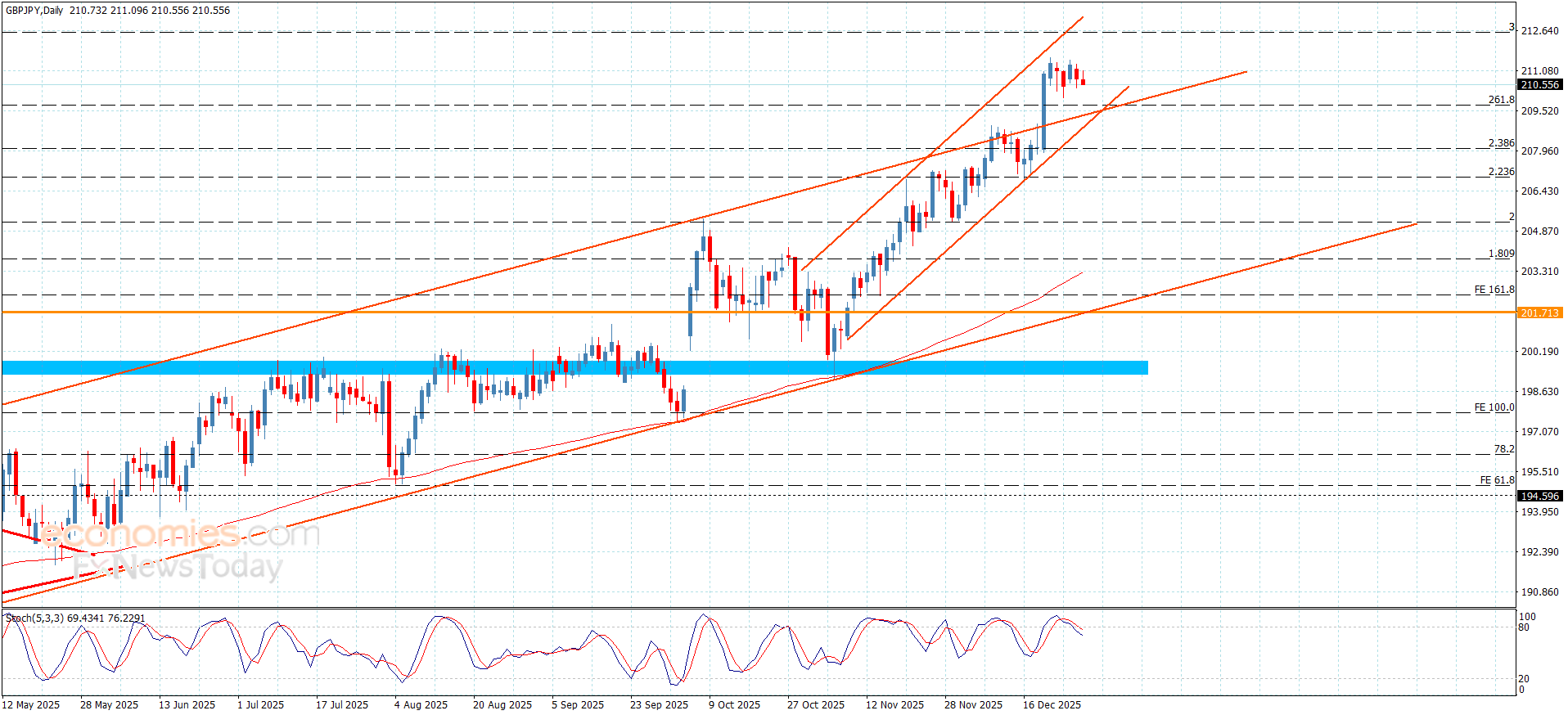
The GBPJPY pair is forced to provide slow corrective trading, due to the contradiction between the main indicators, keeping its fluctuations near 210.65 level, but its stability below 211.30 level supports the chances of activating the bearish corrective attack, to keep waiting for our negative expectations until reaching 209.70 level reaching the minor bullish channel’s support at 209.00.
While gathering extra bullish momentum and its rally above the barrier will provide new opportunity for activating the bullish trend, to expect targeting new positive stations that might begin at 212.65.
The expected trading range for today is between 209.30 and 211.20
Sterling’s rally against the Japanese Yen has stalled below the 211.50 level. The pair is now looking for direction, with downside attempts contained above 210.00 so far. The minutes of the latest BoJ meeting have cemented hopes of further monetary tightening, and the tensions in the East China Sea have dampened risk appetite, altogether providing support to the safe-haven Yen.
The Chinese Navy extends military drills for the second day, including live-fire of missiles and rehearsals of a total blockade of the Taiwan island, which has forced Taipei to ramp up its defences. The escalating tensions in the region have hammered Asian markets and are providing some support to the safe-haven Yen on Tuesday.
Technical analysis: Indicators show a fading bullish momentum
In the 4-hour chart, GBP/JPY trades at 210.76, posting marginal losses on the daily chart. The broader bullish trend remains intact, but technical indicators are entering negative territory. The Moving Average Convergence Divergence (MACD) remains slightly below zero, while the Relative Strength Index (RSI) remains wavering around the key 50 level, showing a lack of clear direction.
Immediate support stands at 210.05 (December 24 low), and the trendline from early November lows is now at 209.35. A confirmation below those levels will bring the mid-December highs, around 208.90, into focus.
On the upside, the 211.53 long-term high is holding bulls for now. Further up, tthe 127.2% Fibonacci extension of the December 15 to December 22 rally, at 212.75, and the 161.8% extension of the same cycle, at 214.38, are plausible targets.
(The technical analysis of this story was written with the help of an AI tool)
Japanese Yen Price Today
The table below shows the percentage change of Japanese Yen (JPY) against listed major currencies today. Japanese Yen was the strongest against the Swiss Franc.
USD
EUR
GBP
JPY
CAD
AUD
NZD
CHF
USD
0.00%
-0.07%
-0.12%
-0.08%
-0.23%
-0.16%
-0.01%
EUR
-0.01%
-0.08%
-0.13%
-0.10%
-0.26%
-0.16%
-0.04%
GBP
0.07%
0.08%
-0.04%
-0.02%
-0.17%
-0.07%
0.04%
JPY
0.12%
0.13%
0.04%
0.03%
-0.11%
-0.05%
0.14%
CAD
0.08%
0.10%
0.02%
-0.03%
-0.14%
-0.07%
0.06%
AUD
0.23%
0.26%
0.17%
0.11%
0.14%
0.08%
0.21%
NZD
0.16%
0.16%
0.07%
0.05%
0.07%
-0.08%
0.13%
CHF
0.01%
0.04%
-0.04%
-0.14%
-0.06%
-0.21%
-0.13%
The heat map shows percentage changes of major currencies against each other. The base currency is picked from the left column, while the quote currency is picked from the top row. For example, if you pick the Japanese Yen from the left column and move along the horizontal line to the US Dollar, the percentage change displayed in the box will represent JPY (base)/USD (quote).
Marks & Spencer is launching a range of foods tailored to people taking weight-loss injections as use of the drugs accelerates in the UK.
The new range of 20 “nutrient-dense” products from the retailer is aimed at customers taking GLP-1 weight-loss medications, as supermarkets increasingly adapt to the impact the drugs are having on shopping baskets.
The range will go on sale in M&S foodhalls from January 5 and includes salads, meals and bread designed to deliver high levels of fibre, vitamins and minerals in smaller portions.
There has been a dramatic rise in the use of GLP-1 drugs in the UK. Online searches and private prescriptions have increased sharply, driven by their effectiveness for weight loss and widespread media attention. About 1.5 million people in the UK are now estimated to be accessing GLP-1 treatment privately, while NHS England prescriptions for the injections have risen by around 900 per cent since 2020.
GLP-1 medications — known formally as glucagon-like peptide-1 (GLP-1) receptor agonists — were originally developed to treat type 2 diabetes by helping to regulate blood sugar. In recent years, drugs such as semaglutide (sold as Ozempic for diabetes and Wegovy for weight loss) and tirzepatide (sold as Mounjaro) have surged in popularity for their weight-loss effects, as they suppress appetite, slow digestion and signal fullness to the brain.
Nutrient-dense foods are those that provide a concentrated source of vitamins, minerals, fibre, healthy fats and protein relative to their calorie content. M&S said the range was developed by its nutritionists in consultation with the British Nutrition Foundation, using criteria that ensure each product delivers more nutrients per mouthful.
M&S said the new range had been developed to address the nutritional challenges that can arise when people eat less, whether due to medication, age or lifestyle. A reduced appetite can make it harder to consume enough fibre and essential nutrients, increasing the risk of deficiencies and digestive side effects such as constipation.
Grace Ricotti, M&S head of food nutrition, said: “Our nutrient-dense range is perfect for customers looking to support their health as each recipe is packed with the key nutrients we all need in our diets.
“With the increase in popularity of weight-loss injections, a reduced appetite can mean missing out on important nutrients and that’s why nutrient density is so important. These new meals, snacks and drinks can help everyone get more fibre, vitamins and minerals in their diet.”
Supermarkets and consumer goods companies are increasingly catering to households using the drugs. Morrisons was the first UK supermarket to announce a dedicated “GLP-1 friendly” range, developed with sports nutrition brand Applied Nutrition, under its “Small & Balanced” banner. Nestlé, the consumer goods giant, has launched a frozen food brand in the US aimed at GLP-1 users, while Haleon, the British multinational consumer healthcare company, has introduced a multivitamin designed to help replenish nutrients for people eating less.
The trend is expected to accelerate further as GLP-1 medications move beyond injections. Tablet versions are beginning to reach the market, with US regulators approving an oral version of Wegovy and rival pills expected to follow, potentially widening access to the drugs.
While the drugs are approved for diabetes and obesity treatment, clinicians have raised concerns about the number of people accessing them outside clinical pathways for cosmetic weight loss. The long-term consequences of widespread use are still being studied, particularly as lower calorie intake can increase the risk of nutrient deficiencies if diets are not carefully managed.
XRP price
prediction 2026 presents conflicting signals as the digital asset trades at
$1.85 on December 30, 2025, caught between bullish institutional forecasts and
bearish technical patterns.
Standard
Chartered projects XRP could surge 330% to $8 by end-2026, driven by
sustained ETF inflows exceeding $1.15 billion and regulatory clarity following
the SEC settlement.
However, my
technical analysis reveals a death cross formation targeting declines toward
$1.25 before a potential Q2 2026 reversal, creating uncertainty about
whether XRP can escape its current consolidation near 2025 lows.
The token
remains down 11.84% from one year ago and approximately 47% below its 2025 peak
near $3.50, despite 30 consecutive days of XRP ETF inflows signaling strong
institutional interest. This divergence between price action and investor
sentiment makes 2026 a pivotal year for XRP holders evaluating long-term price
targets and whether XRP can participate in the next crypto bull run.
In this article, I answer the question of what XRP
price predictions look like for 2026 and how high the XRP price could rise.
XRP is
trading at $1.85 per token with a market capitalization of $111.79 billion and
24-hour trading volume of $2.22 billion. The cryptocurrency has experienced
significant volatility throughout December, declining from $2.20 highs in late
November to test support in the $1.80-$1.90 range.
Technical
indicators paint a concerning picture for short-term XRP sentiment. The token
has formed a death cross pattern where the 50-day exponential
moving average crossed below the 200-day EMA, historically a bearish signal
indicating extended downside momentum.
XRP price
is moving within a descending channel with clear resistance at $1.93, which the
token failed to break during recent rallies, reinforcing selling pressure and
bearish momentum.
Key
short-term technical points for XRP price analysis include:
Resistance levels: $1.93 and $2.00
psychological zone where XRP recorded repeated rejections.
Trend structure: XRP price may remain in a
downward-sloping channel until buying volume returns.
XRP price technical analysis on a daily chart. Source: Tradingview.com
Based on my
technical analysis of the XRP/USDT chart, the next logical target sits at $1.25,
representing October 2025 flash crash lows where stronger accumulation may
emerge. Only after realizing this final bottom does the technical setup suggest
cleansing of weak hands and foundation for stronger institutional support that
could push XRP price back toward $3.50+ levels seen in 2025.
How XRP Compares to
Bitcoin and Ethereum?
The broader
crypto market context shows Bitcoin trading near $87,000 and Ethereum around
$2,900, with both major cryptocurrencies experiencing similar Q4 volatility.
XRP’s price action reflects macro conditions affecting the crypto market, but
the token’s underperformance relative to bitcoin and Ethereum highlights
specific concerns about XRP sentiment and long-term holders’ conviction.
Bitcoin price remains closer to
its all-time high, supported by ETF inflows and large market cap.
Ethereum trades in a
consolidating range but benefits from tokenization and ETF narratives.
XRP is a cryptocurrency with
strong branding and cross-border use case, yet its price trajectory shows
lagging performance versus Bitcoin and Ethereum in late 2025.
This
comparison matters for institutional investors considering whether to buy XRP
versus other digital assets as part of a diversified crypto portfolio.
Institutional XRP Price
Targets for 2026
Standard
Chartered has emerged as the most bullish institutional voice on XRP price
prediction 2026, with Geoffrey Kendrick, the bank’s global head of digital
assets research, projecting
the token will reach $8.00 by end-2026.
This target
represents a potential 330% increase from current levels around $1.86 and
reflects structural changes in XRP’s regulatory environment and institutional
adoption rather than short-term speculative hype.
How Standard Chartered
Models the XRP Rally?
Kendrick’s
methodology centers on quantitative modeling of ETF flows and supply dynamics.
The analyst calculates that if XRP ETFs maintain their current pace and attract
$10 billion in total inflows by late 2026, this capital would need to purchase
approximately 4-5 billion tokens at average prices around $2.20.
Standard
Chartered’s multi-year trajectory for xrp price may be summarized as follows:
Year
XRP price prediction
Key driver
2025
5.50 dollar
ETF
launches, SEC case resolution
2026
8.00 dollar
10B ETF
inflows, institutional support
2027
10.40 dollar
Growing cross-border adoption
2028
12.50 dollar
Mature
ETF market, broader crypto bull
This
long-term price outlook assumes sustained institutional investors’ interest in
XRP as a digital asset and continued progress in Ripple Labs’ cross-border
payment partnerships.
The
Motley Fool offers
a more cautious institutional view, suggesting $3.00 as a realistic
2026 target, implying approximately 58% upside from current levels.
Analysts there acknowledge the positive tailwinds from regulatory clarity and
ETF approvals but underline that XRP’s price has declined year-to-date despite
the Trump administration’s supportive stance towards the crypto industry.
Consensus Forecasts and
Market-Implied Probabilities
Consensus
analyst forecasts across multiple platforms show a range of $2.71 to
$8.60 for XRP price in 2026, with an average prediction around $3.90.
Several Wall Street analysts cited by crypto market outlets project XRP could
trade between $3.40 and $5.00, marking a 40-70% gain from mid-2025
levels. These mid-range forecasts rely heavily on:
Continued ETF inflows
supporting xrp price.
Improved XRP sentiment among
institutional investors.
XRP’s market cap closing the
gap with larger cryptocurrencies.
Options-based
analysis from Jeff Anderson, Head of Asia at STS Digital, provides
market-implied probabilities instead of directional forecasts.
“Based on
current market conditions, including observed volatility and skew, we can
estimate the probability that each asset will trade above specific price
targets by 31 December 2026,” he commented for FinanceMagnates.com
“XRP,
trading near $1.85, shows a 25pct probability of finishing above $2.40 and a
10pct probability of exceeding $3.90 and finally,” he forecasted.
These
probabilities help investors calibrate expectations around price levels without
assuming the crypto market will necessarily enter a new bull run.
Changelly’s
algorithmic model forecasts an average XRP price of $5.12 in 2026 with
a maximum around $5.79, while CoinCodex projects $2.75 by mid-2026,
reflecting more moderate expectations for XRP’s price trajectory. Together,
these estimates reinforce a wide but data-backed range for long-term price
scenarios.
Crypto Analyst and
Influencer XRP Price Predictions
The crypto
analyst community offers more aggressive long-term price forecasts, leaning on
technical indicators, Elliott Wave structures, and historical volatility to
project XRP’s potential performance in 2026 and even 2030.
EGRAG Crypto: Bull Run
Structure and Fibonacci Targets
EGRAG
Cryptomaintains
a bullish long-term XRP price prediction based on Elliott Wave theory.
According to this analysis, XRP is completing a Wave 4 correction and
preparing for an explosive Wave 5 move that could redefine its
price level in the crypto market. Using Fibonacci extensions, EGRAG
identifies resistance targets at:
$4.78
$5.515
$6.755
$18.25
Up to $27 in an extreme bull
market
The analyst
compares the current consolidation to XRP’s 2017 setup, when xrp price traded
sideways for six months before surging to its all-time high of $3.84 in January
2018. EGRAG’s base case assumes that a break above $3.40-4.00 would confirm a
new bullish structure and open the path to $10 and beyond, although such
targets are more relevant for longer horizons like 2030 rather than a single
year.
Dark Defender: Wave 5
Target at $5.85
Dark
Defender provides
a complementary Elliott Wave view, suggesting that XRP completed Wave 4 at
$1.88 in late 2025 and is now poised
to move toward $5.85 dollar in Wave 5. The analyst
highlights:
XRP’s 3-day RSI has entered
oversold territory historically associated with strong rebounds.
Corrective phases in XRP’s
price action are considered normal within a larger bullish cycle.
Ignoring short-term fear and
focusing on long-term price structure may benefit xrp holders.
Dark
Defender links this uptrend potential to sustained ETF inflows and improving
XRP sentiment as regulatory risks fade, but acknowledges that timing remains
uncertain and dependent on broader crypto market conditions.
AI Models on XRP Price
Outlook
AI-based
forecasts add another layer to the long-term price debate. When asked to model
XRP price under a scenario of 10 billion dollar in ETF inflows by
late 2026:
ChatGPT projects a range
of $6-8, treating profit-taking and volatility as natural
brakes on a parabolic move.
Claude AI forecasts a more
ambitious $8-14 range, viewing ETF demand as a “catalytic
force” that could trigger self-reinforcing bull markets amid rising
trading volume and improving XRP sentiment.
Key Catalysts Driving XRP
Price Outlook for 2026
Several
critical catalysts will determine whether XRP price prediction scenarios skew
toward the conservative or bullish end of the spectrum. These include ETF
flows, the SEC case outcome, cross-border utility, and macro conditions
affecting the crypto market.
Filip
Dzięciołowski, Editor-in-Chief at Cryps.pl, notes that XRP currently trades at the lowest
levels of 2025 in a narrow consolidation zone and that nothing suggests a rapid
trend change in the coming weeks or months.
“For now,
there are no clear signs that this situation will change in the coming weeks or
even months,” he says. “Over the longer term, however, and looking ahead to the
whole of 2026, a return toward this year’s high, above $3.50, is assumed.”
ETF Inflows, Sec Case, and
Institutional Support
XRP ETFs
are at the center of the current narrative around whether XRP could outperform
in 2026. Since their launch in November 2025, these products have:
Attracted over $1.15
billion in combined inflows.
Recorded 30 consecutive
trading sessions of net inflows with no outflows.
Contributed to a 45%
reduction in exchange balances, from 3.95 to 2.6 billion XRP.
This
pattern signals strong institutional support and interest in XRP as a regulated
investment product, changing the way many investors approach xrp profit
calculator tools and long-term price planning.
“XRP,
so far, remains mostly an ETP- and ETF-flow story,” Ryan Lee, Chief Analyst at
Bitget, commented for FinanceMagnates.com. “Much depends on the persistence of
these inflows and on whether institutional interest in Ripple’s payments
ecosystem translates into something more meaningful. There’s a kind of tension
between short-term fear and long-term positioning in crypto, with ETF inflows
staying steady and exchange balances continuing to fall, exactly what I
associate with mid-cycle consolidation.”
Metric
Value
ETF cumulative inflows
1.15B dollar+
Consecutive inflow days
30
Exchange balance reduction
45% (3.95B to 2.6B XRP)
XRP
share of new ETF flows
Outperforming BTC ETFs
The SEC
case resolution represents another foundational catalyst. The
Securities and Exchange Commission dropped its appeal against Ripple, and the
company agreed to a $50 million settlement without admitting wrongdoing. Judge
Analisa Torres clarified that XRP is not considered financial security when
sold on exchanges to retail investors, reducing legal uncertainty that had
weighed on xrp price for years.
This
regulatory clarity has encouraged institutional investors previously cautious
about the lawsuit against Ripple, improving market sentiment and creating room
for ETFs and other products to gain traction in the U.S crypto market.
Cross-Border Payments,
SWIFT Ambitions, and Real-World Utility
XRP’s
long-term price outlook and predictions for XRP in 2030 depend heavily on
real-world utility as a cross-border settlement token. Ripple CEO Brad
Garlinghouse has stated that XRP could capture 14% of SWIFT’s global
transaction volume within five years, which would represent more than
2.8 trillion dollar in annual flows routed through the XRP Ledger.
While this
goal remains ambitious, even partial realization would significantly increase
demand for XRP as a bridge currency. However, skeptics highlight several
challenges:
Many banks use RippleNet’s
messaging stack without adopting XRP for liquidity.
Traditional financial
institutions move slowly in replacing established infrastructure.
Stablecoins and CBDCs compete
with XRP for cross-border transaction roles.
For XRP to
justify the upper end of price forecasts, Ripple Labs must convert more
messaging-only clients into full On-Demand Liquidity users, directly linking
network adoption to demand for the token itself.
Macro, Crypto Market
Sentiment, and Four-Year Cycles
Macroeconomic
conditions will influence whether 2026 feels like consolidation or a new bull
phase for crypto. Expectations for Federal Reserve rate cuts toward
the 3.00-3.25% range could support risk assets, including cryptocurrencies, by
lowering the opportunity cost of holding volatile digital assets like XRP.
However, unexpected inflation spikes or recession risks could shift
institutional positioning away from crypto, impacting XRP price and trading
volume across exchanges.
The
traditional four-year Bitcoin cycle is also being questioned
as institutional ETFs change market structure. If the cycle moderates, crypto
market participants might see fewer extreme sell-offs, allowing long-term
holders of XRP to benefit from more stable bull markets. If the cycle persists,
however, 2026 could become a consolidation year where XRP trades sideways or
corrects, delaying more substantial rallies until the next cycle leg.
Risk Factors and Technical
Challenges for XRP
While the
bullish narrative around XRP price prediction 2026 is compelling, several key
risk factors may prevent XRP from reaching high-end targets like $8 or even $10.
Structural Weaknesses:
Volume, Utility, and Competition
The most
important structural risks include:
Declining transaction volume: Several analyses
highlight that XRP’s on-chain activity and transaction volume have
decreased over the last two years, raising questions about organic growth.
Utility gap: Ripple’s RLUSD stablecoin
and XRP’s price action do not yet reflect broad adoption as a primary
cross-border settlement layer.
Competitive landscape: Other cryptocurrencies,
including Bitcoin, Ethereum, and newer blockchain networks, continue to
compete for institutional support and cross-border use cases.
If XRP’s
real-world utility stagnates while the broader crypto space innovates, the
price trajectory may lag even in a broader bull run.
Short-Term Bearish
Momentum and Underperformance
From my
technical analysis perspective, XRP faces several immediate challenges that
weigh on XRP sentiment:
Key support at $1.82 is under
pressure, with sellers controlling near-term price action.
The target around $1.25 implies
additional downside from current levels before long-term support emerges.
These
conditions suggest that, even if long-term price forecasts remain bullish, XRP
price may see further underperformance against Bitcoin and Ethereum in early
2026.
Market Positioning and
Investment Considerations for XRP Holders
Despite
numerous risks, XRP continues to attract attention from long-term holders,
institutional investors, and traders using XRP profit calculator tools to model
various scenarios for 2025, 2026, and 2030.
What Long-Term Holders
Should Watch
Key metrics
to monitor as part of a data-driven XRP investment thesis include:
Weekly ETF inflows and
outflows: Sustained
net inflows are crucial for maintaining bullish structure.
Ripple quarterly reports: On-Demand Liquidity
volumes, cross-border corridors, and new RippleNet partnerships.
On-chain indicators: XRP recorded transaction
counts, volatility, and trends in long-term holders versus short-term
traders.
Regulatory headlines: Any changes in U.S or
international policy affecting classification of digital assets.
Contrarian
investors may be attracted by the current Fear & Greed Index levels around
24-25 (Extreme Fear), which historically have preceded rebounds in the broader
crypto market. However, aligning entries with technical support levels such as $1.25-1.50
could improve risk-reward profiles compared with buying at current prices
purely based on optimistic forecasts.
XRP Price Scenarios: 3, 6,
and 8 Dollar
Summarizing
the main 2026 price scenarios for XRP:
Conservative case ($3): Assumes modest ETF
success and limited utility gains; supported by The Motley Fool.
Base case ($3.90-5.12): Reflects consensus
forecasts and Changelly’s model, assuming steady ETF inflows and moderate
adoption growth.
Bullish case ($8): Based on Standard
Chartered’s projection that XRP could hit 8 dollar by end-2026 if ETF
inflows reach 10 billion dollar and institutional support continues.
Each
scenario implies different risk profiles and requires close monitoring of
trading volume, institutional positioning, and macro conditions in the crypto
market.
Before
you leave, take a look at my earlier cryptocurrency analyses, and if you find
my work useful, consider following me on X.
I have also included a helpful FAQ section below.
FAQ: XRP Price Predictions
and Investment Questions
What is the XRP Price
Prediction for 2026?
XRP price
prediction for 2026 ranges from conservative institutional forecasts of 3
dollar to bullish targets of 8 dollar, with consensus averaging around 3.90
dollar. Standard Chartered’s Geoffrey Kendrick expects 8 dollar driven by ETF
flows and regulatory clarity, while technical analysis suggests a possible drop
toward 1.25 dollar before a recovery in Q2 2026.
How Much Will XRP Be in
2026?
XRP could
trade between 2.40 and 8 dollar by the end of 2026, with options data from Jeff
Anderson indicating a 25% probability of finishing above 2.40 dollar and a 10%
probability of exceeding 3.90 dollar [provided quotes]. Consensus forecasts
around 3.90 dollar balance bullish long-term price expectations with caution
about the token’s current bearish momentum and regulatory history.
Should I Buy XRP in 2026?
Whether to
buy XRP depends on individual risk tolerance, time horizon, and conviction in
Ripple’s ability to convert regulatory clarity into real-world adoption. ETF
inflows, supportive court rulings in the SEC case, and institutional support
provide solid arguments for long-term investors, but the current technical
downtrend and potential move toward 1.25 dollar suggest waiting for clearer
bullish confirmation or more attractive price levels may be prudent for some
market participants. This article does not constitute financial advice.
What Are XRP’s Key
Catalysts for 2026?
Key
catalysts that could shape XRP’s price outlook include:
Sustained ETF inflows reaching
5-10 billion dollar in assets under management.
Ripple converting more banking
partners to On-Demand Liquidity users that require XRP.
Additional regulatory clarity
and crypto-friendly legislation in the U.S.
Macro conditions supporting
risk assets, especially if bitcoin and ethereum enter a new bull market.
Why Is XRP Price Declining
in December 2025?
XRP price
is declining in December 2025 due to a combination of broad crypto market
weakness, bearish technical indicators such as the death cross, and
profit-taking after the 2024-2025 rally. Despite strong institutional support
via ETFs, short-term selling pressure and underperformance relative to bitcoin
and ethereum have weighed on xrp sentiment and market-wide evaluations of its
near-term potential.
Will XRP Reach 10 Dollar
in 2026?
Reaching 10
dollar in 2026 remains a low-probability scenario in institutional models,
although EGRAG Crypto’s Elliott Wave analysis allows for such levels in a
full-blown bull run. Achieving 10 dollar would imply a market cap approaching
600 billion dollar, requiring XRP to capture a much larger share of the crypto
market and cross-border payment flows than currently observed. Most forecasts
see 10 dollar as a potential longer-term target beyond 2026 rather than a
central scenario for the next 12 months.
What Is XRP’s All-Time
High Price?
XRP’s
all-time high is 3.84 dollar, reached in January 2018 at the peak of a previous
crypto bull run. In early 2025, XRP approached this level again when it surged
to around 3.50 dollar following Donald Trump’s election victory and subsequent
favorable regulatory developments, but it has since retreated to 1.85 dollar.
How Do XRP ETFs Affect
Token Price?
XRP ETFs
affect token price by removing significant supply from exchanges as providers
accumulate XRP to back shares, contributing to a 45% drop in exchange balances.
With over 1.15 billion dollar in ETF inflows and 30 consecutive days without
outflows, these structures have become central to any serious XRP price
prediction for 2026 and beyond. If inflows continue and reach 10 billion dollar
as Standard Chartered models, xrp price may see structural upward pressure
regardless of short-term volatility.
How Has the Price of XRP
Changed Since 2024 and What Is Its Current Value?
The price
of xrp has experienced dramatic swings since 2024, driven largely by the legal
battle with the SEC and broader crypto industry volatility. At the time of
writing, XRP trades at 1.87 dollar with a current value reflecting 49% decline
from its 2025 peak of 3.66 dollar. Throughout 2024, XRP tested multiple key
price points between 0.50 and 0.70 dollar as the legal battle outcome remained
uncertain, keeping institutional investors cautious.
The token
surged 580% between November 2024 and January 2025 following regulatory
clarity, reaching critical price points near 3.50 dollar before the recent
sell-off brought it back toward 1.80-1.90 dollar support levels. This
volatility pattern demonstrates how regulatory developments continue to drive
major price of xrp movements across the crypto industry, with the SEC case
resolution in 2025 marking an inflection point that allowed institutional
support through ETFs to emerge despite subsequent bearish technical pressure.
XRP price
prediction 2026 presents conflicting signals as the digital asset trades at
$1.85 on December 30, 2025, caught between bullish institutional forecasts and
bearish technical patterns.
Standard
Chartered projects XRP could surge 330% to $8 by end-2026, driven by
sustained ETF inflows exceeding $1.15 billion and regulatory clarity following
the SEC settlement.
However, my
technical analysis reveals a death cross formation targeting declines toward
$1.25 before a potential Q2 2026 reversal, creating uncertainty about
whether XRP can escape its current consolidation near 2025 lows.
The token
remains down 11.84% from one year ago and approximately 47% below its 2025 peak
near $3.50, despite 30 consecutive days of XRP ETF inflows signaling strong
institutional interest. This divergence between price action and investor
sentiment makes 2026 a pivotal year for XRP holders evaluating long-term price
targets and whether XRP can participate in the next crypto bull run.
In this article, I answer the question of what XRP
price predictions look like for 2026 and how high the XRP price could rise.
XRP is
trading at $1.85 per token with a market capitalization of $111.79 billion and
24-hour trading volume of $2.22 billion. The cryptocurrency has experienced
significant volatility throughout December, declining from $2.20 highs in late
November to test support in the $1.80-$1.90 range.
Technical
indicators paint a concerning picture for short-term XRP sentiment. The token
has formed a death cross pattern where the 50-day exponential
moving average crossed below the 200-day EMA, historically a bearish signal
indicating extended downside momentum.
XRP price
is moving within a descending channel with clear resistance at $1.93, which the
token failed to break during recent rallies, reinforcing selling pressure and
bearish momentum.
Key
short-term technical points for XRP price analysis include:
Resistance levels: $1.93 and $2.00
psychological zone where XRP recorded repeated rejections.
Trend structure: XRP price may remain in a
downward-sloping channel until buying volume returns.
XRP price technical analysis on a daily chart. Source: Tradingview.com
Based on my
technical analysis of the XRP/USDT chart, the next logical target sits at $1.25,
representing October 2025 flash crash lows where stronger accumulation may
emerge. Only after realizing this final bottom does the technical setup suggest
cleansing of weak hands and foundation for stronger institutional support that
could push XRP price back toward $3.50+ levels seen in 2025.
How XRP Compares to
Bitcoin and Ethereum?
The broader
crypto market context shows Bitcoin trading near $87,000 and Ethereum around
$2,900, with both major cryptocurrencies experiencing similar Q4 volatility.
XRP’s price action reflects macro conditions affecting the crypto market, but
the token’s underperformance relative to bitcoin and Ethereum highlights
specific concerns about XRP sentiment and long-term holders’ conviction.
Bitcoin price remains closer to
its all-time high, supported by ETF inflows and large market cap.
Ethereum trades in a
consolidating range but benefits from tokenization and ETF narratives.
XRP is a cryptocurrency with
strong branding and cross-border use case, yet its price trajectory shows
lagging performance versus Bitcoin and Ethereum in late 2025.
This
comparison matters for institutional investors considering whether to buy XRP
versus other digital assets as part of a diversified crypto portfolio.
Institutional XRP Price
Targets for 2026
Standard
Chartered has emerged as the most bullish institutional voice on XRP price
prediction 2026, with Geoffrey Kendrick, the bank’s global head of digital
assets research, projecting
the token will reach $8.00 by end-2026.
This target
represents a potential 330% increase from current levels around $1.86 and
reflects structural changes in XRP’s regulatory environment and institutional
adoption rather than short-term speculative hype.
How Standard Chartered
Models the XRP Rally?
Kendrick’s
methodology centers on quantitative modeling of ETF flows and supply dynamics.
The analyst calculates that if XRP ETFs maintain their current pace and attract
$10 billion in total inflows by late 2026, this capital would need to purchase
approximately 4-5 billion tokens at average prices around $2.20.
Standard
Chartered’s multi-year trajectory for xrp price may be summarized as follows:
Year
XRP price prediction
Key driver
2025
5.50 dollar
ETF
launches, SEC case resolution
2026
8.00 dollar
10B ETF
inflows, institutional support
2027
10.40 dollar
Growing cross-border adoption
2028
12.50 dollar
Mature
ETF market, broader crypto bull
This
long-term price outlook assumes sustained institutional investors’ interest in
XRP as a digital asset and continued progress in Ripple Labs’ cross-border
payment partnerships.
The
Motley Fool offers
a more cautious institutional view, suggesting $3.00 as a realistic
2026 target, implying approximately 58% upside from current levels.
Analysts there acknowledge the positive tailwinds from regulatory clarity and
ETF approvals but underline that XRP’s price has declined year-to-date despite
the Trump administration’s supportive stance towards the crypto industry.
Consensus Forecasts and
Market-Implied Probabilities
Consensus
analyst forecasts across multiple platforms show a range of $2.71 to
$8.60 for XRP price in 2026, with an average prediction around $3.90.
Several Wall Street analysts cited by crypto market outlets project XRP could
trade between $3.40 and $5.00, marking a 40-70% gain from mid-2025
levels. These mid-range forecasts rely heavily on:
Continued ETF inflows
supporting xrp price.
Improved XRP sentiment among
institutional investors.
XRP’s market cap closing the
gap with larger cryptocurrencies.
Options-based
analysis from Jeff Anderson, Head of Asia at STS Digital, provides
market-implied probabilities instead of directional forecasts.
“Based on
current market conditions, including observed volatility and skew, we can
estimate the probability that each asset will trade above specific price
targets by 31 December 2026,” he commented for FinanceMagnates.com
“XRP,
trading near $1.85, shows a 25pct probability of finishing above $2.40 and a
10pct probability of exceeding $3.90 and finally,” he forecasted.
These
probabilities help investors calibrate expectations around price levels without
assuming the crypto market will necessarily enter a new bull run.
Changelly’s
algorithmic model forecasts an average XRP price of $5.12 in 2026 with
a maximum around $5.79, while CoinCodex projects $2.75 by mid-2026,
reflecting more moderate expectations for XRP’s price trajectory. Together,
these estimates reinforce a wide but data-backed range for long-term price
scenarios.
Crypto Analyst and
Influencer XRP Price Predictions
The crypto
analyst community offers more aggressive long-term price forecasts, leaning on
technical indicators, Elliott Wave structures, and historical volatility to
project XRP’s potential performance in 2026 and even 2030.
EGRAG Crypto: Bull Run
Structure and Fibonacci Targets
EGRAG
Cryptomaintains
a bullish long-term XRP price prediction based on Elliott Wave theory.
According to this analysis, XRP is completing a Wave 4 correction and
preparing for an explosive Wave 5 move that could redefine its
price level in the crypto market. Using Fibonacci extensions, EGRAG
identifies resistance targets at:
$4.78
$5.515
$6.755
$18.25
Up to $27 in an extreme bull
market
The analyst
compares the current consolidation to XRP’s 2017 setup, when xrp price traded
sideways for six months before surging to its all-time high of $3.84 in January
2018. EGRAG’s base case assumes that a break above $3.40-4.00 would confirm a
new bullish structure and open the path to $10 and beyond, although such
targets are more relevant for longer horizons like 2030 rather than a single
year.
Dark Defender: Wave 5
Target at $5.85
Dark
Defender provides
a complementary Elliott Wave view, suggesting that XRP completed Wave 4 at
$1.88 in late 2025 and is now poised
to move toward $5.85 dollar in Wave 5. The analyst
highlights:
XRP’s 3-day RSI has entered
oversold territory historically associated with strong rebounds.
Corrective phases in XRP’s
price action are considered normal within a larger bullish cycle.
Ignoring short-term fear and
focusing on long-term price structure may benefit xrp holders.
Dark
Defender links this uptrend potential to sustained ETF inflows and improving
XRP sentiment as regulatory risks fade, but acknowledges that timing remains
uncertain and dependent on broader crypto market conditions.
AI Models on XRP Price
Outlook
AI-based
forecasts add another layer to the long-term price debate. When asked to model
XRP price under a scenario of 10 billion dollar in ETF inflows by
late 2026:
ChatGPT projects a range
of $6-8, treating profit-taking and volatility as natural
brakes on a parabolic move.
Claude AI forecasts a more
ambitious $8-14 range, viewing ETF demand as a “catalytic
force” that could trigger self-reinforcing bull markets amid rising
trading volume and improving XRP sentiment.
Key Catalysts Driving XRP
Price Outlook for 2026
Several
critical catalysts will determine whether XRP price prediction scenarios skew
toward the conservative or bullish end of the spectrum. These include ETF
flows, the SEC case outcome, cross-border utility, and macro conditions
affecting the crypto market.
Filip
Dzięciołowski, Editor-in-Chief at Cryps.pl, notes that XRP currently trades at the lowest
levels of 2025 in a narrow consolidation zone and that nothing suggests a rapid
trend change in the coming weeks or months.
“For now,
there are no clear signs that this situation will change in the coming weeks or
even months,” he says. “Over the longer term, however, and looking ahead to the
whole of 2026, a return toward this year’s high, above $3.50, is assumed.”
ETF Inflows, Sec Case, and
Institutional Support
XRP ETFs
are at the center of the current narrative around whether XRP could outperform
in 2026. Since their launch in November 2025, these products have:
Attracted over $1.15
billion in combined inflows.
Recorded 30 consecutive
trading sessions of net inflows with no outflows.
Contributed to a 45%
reduction in exchange balances, from 3.95 to 2.6 billion XRP.
This
pattern signals strong institutional support and interest in XRP as a regulated
investment product, changing the way many investors approach xrp profit
calculator tools and long-term price planning.
“XRP,
so far, remains mostly an ETP- and ETF-flow story,” Ryan Lee, Chief Analyst at
Bitget, commented for FinanceMagnates.com. “Much depends on the persistence of
these inflows and on whether institutional interest in Ripple’s payments
ecosystem translates into something more meaningful. There’s a kind of tension
between short-term fear and long-term positioning in crypto, with ETF inflows
staying steady and exchange balances continuing to fall, exactly what I
associate with mid-cycle consolidation.”
Metric
Value
ETF cumulative inflows
1.15B dollar+
Consecutive inflow days
30
Exchange balance reduction
45% (3.95B to 2.6B XRP)
XRP
share of new ETF flows
Outperforming BTC ETFs
The SEC
case resolution represents another foundational catalyst. The
Securities and Exchange Commission dropped its appeal against Ripple, and the
company agreed to a $50 million settlement without admitting wrongdoing. Judge
Analisa Torres clarified that XRP is not considered financial security when
sold on exchanges to retail investors, reducing legal uncertainty that had
weighed on xrp price for years.
This
regulatory clarity has encouraged institutional investors previously cautious
about the lawsuit against Ripple, improving market sentiment and creating room
for ETFs and other products to gain traction in the U.S crypto market.
Cross-Border Payments,
SWIFT Ambitions, and Real-World Utility
XRP’s
long-term price outlook and predictions for XRP in 2030 depend heavily on
real-world utility as a cross-border settlement token. Ripple CEO Brad
Garlinghouse has stated that XRP could capture 14% of SWIFT’s global
transaction volume within five years, which would represent more than
2.8 trillion dollar in annual flows routed through the XRP Ledger.
While this
goal remains ambitious, even partial realization would significantly increase
demand for XRP as a bridge currency. However, skeptics highlight several
challenges:
Many banks use RippleNet’s
messaging stack without adopting XRP for liquidity.
Traditional financial
institutions move slowly in replacing established infrastructure.
Stablecoins and CBDCs compete
with XRP for cross-border transaction roles.
For XRP to
justify the upper end of price forecasts, Ripple Labs must convert more
messaging-only clients into full On-Demand Liquidity users, directly linking
network adoption to demand for the token itself.
Macro, Crypto Market
Sentiment, and Four-Year Cycles
Macroeconomic
conditions will influence whether 2026 feels like consolidation or a new bull
phase for crypto. Expectations for Federal Reserve rate cuts toward
the 3.00-3.25% range could support risk assets, including cryptocurrencies, by
lowering the opportunity cost of holding volatile digital assets like XRP.
However, unexpected inflation spikes or recession risks could shift
institutional positioning away from crypto, impacting XRP price and trading
volume across exchanges.
The
traditional four-year Bitcoin cycle is also being questioned
as institutional ETFs change market structure. If the cycle moderates, crypto
market participants might see fewer extreme sell-offs, allowing long-term
holders of XRP to benefit from more stable bull markets. If the cycle persists,
however, 2026 could become a consolidation year where XRP trades sideways or
corrects, delaying more substantial rallies until the next cycle leg.
Risk Factors and Technical
Challenges for XRP
While the
bullish narrative around XRP price prediction 2026 is compelling, several key
risk factors may prevent XRP from reaching high-end targets like $8 or even $10.
Structural Weaknesses:
Volume, Utility, and Competition
The most
important structural risks include:
Declining transaction volume: Several analyses
highlight that XRP’s on-chain activity and transaction volume have
decreased over the last two years, raising questions about organic growth.
Utility gap: Ripple’s RLUSD stablecoin
and XRP’s price action do not yet reflect broad adoption as a primary
cross-border settlement layer.
Competitive landscape: Other cryptocurrencies,
including Bitcoin, Ethereum, and newer blockchain networks, continue to
compete for institutional support and cross-border use cases.
If XRP’s
real-world utility stagnates while the broader crypto space innovates, the
price trajectory may lag even in a broader bull run.
Short-Term Bearish
Momentum and Underperformance
From my
technical analysis perspective, XRP faces several immediate challenges that
weigh on XRP sentiment:
Key support at $1.82 is under
pressure, with sellers controlling near-term price action.
The target around $1.25 implies
additional downside from current levels before long-term support emerges.
These
conditions suggest that, even if long-term price forecasts remain bullish, XRP
price may see further underperformance against Bitcoin and Ethereum in early
2026.
Market Positioning and
Investment Considerations for XRP Holders
Despite
numerous risks, XRP continues to attract attention from long-term holders,
institutional investors, and traders using XRP profit calculator tools to model
various scenarios for 2025, 2026, and 2030.
What Long-Term Holders
Should Watch
Key metrics
to monitor as part of a data-driven XRP investment thesis include:
Weekly ETF inflows and
outflows: Sustained
net inflows are crucial for maintaining bullish structure.
Ripple quarterly reports: On-Demand Liquidity
volumes, cross-border corridors, and new RippleNet partnerships.
On-chain indicators: XRP recorded transaction
counts, volatility, and trends in long-term holders versus short-term
traders.
Regulatory headlines: Any changes in U.S or
international policy affecting classification of digital assets.
Contrarian
investors may be attracted by the current Fear & Greed Index levels around
24-25 (Extreme Fear), which historically have preceded rebounds in the broader
crypto market. However, aligning entries with technical support levels such as $1.25-1.50
could improve risk-reward profiles compared with buying at current prices
purely based on optimistic forecasts.
XRP Price Scenarios: 3, 6,
and 8 Dollar
Summarizing
the main 2026 price scenarios for XRP:
Conservative case ($3): Assumes modest ETF
success and limited utility gains; supported by The Motley Fool.
Base case ($3.90-5.12): Reflects consensus
forecasts and Changelly’s model, assuming steady ETF inflows and moderate
adoption growth.
Bullish case ($8): Based on Standard
Chartered’s projection that XRP could hit 8 dollar by end-2026 if ETF
inflows reach 10 billion dollar and institutional support continues.
Each
scenario implies different risk profiles and requires close monitoring of
trading volume, institutional positioning, and macro conditions in the crypto
market.
Before
you leave, take a look at my earlier cryptocurrency analyses, and if you find
my work useful, consider following me on X.
I have also included a helpful FAQ section below.
FAQ: XRP Price Predictions
and Investment Questions
What is the XRP Price
Prediction for 2026?
XRP price
prediction for 2026 ranges from conservative institutional forecasts of 3
dollar to bullish targets of 8 dollar, with consensus averaging around 3.90
dollar. Standard Chartered’s Geoffrey Kendrick expects 8 dollar driven by ETF
flows and regulatory clarity, while technical analysis suggests a possible drop
toward 1.25 dollar before a recovery in Q2 2026.
How Much Will XRP Be in
2026?
XRP could
trade between 2.40 and 8 dollar by the end of 2026, with options data from Jeff
Anderson indicating a 25% probability of finishing above 2.40 dollar and a 10%
probability of exceeding 3.90 dollar [provided quotes]. Consensus forecasts
around 3.90 dollar balance bullish long-term price expectations with caution
about the token’s current bearish momentum and regulatory history.
Should I Buy XRP in 2026?
Whether to
buy XRP depends on individual risk tolerance, time horizon, and conviction in
Ripple’s ability to convert regulatory clarity into real-world adoption. ETF
inflows, supportive court rulings in the SEC case, and institutional support
provide solid arguments for long-term investors, but the current technical
downtrend and potential move toward 1.25 dollar suggest waiting for clearer
bullish confirmation or more attractive price levels may be prudent for some
market participants. This article does not constitute financial advice.
What Are XRP’s Key
Catalysts for 2026?
Key
catalysts that could shape XRP’s price outlook include:
Sustained ETF inflows reaching
5-10 billion dollar in assets under management.
Ripple converting more banking
partners to On-Demand Liquidity users that require XRP.
Additional regulatory clarity
and crypto-friendly legislation in the U.S.
Macro conditions supporting
risk assets, especially if bitcoin and ethereum enter a new bull market.
Why Is XRP Price Declining
in December 2025?
XRP price
is declining in December 2025 due to a combination of broad crypto market
weakness, bearish technical indicators such as the death cross, and
profit-taking after the 2024-2025 rally. Despite strong institutional support
via ETFs, short-term selling pressure and underperformance relative to bitcoin
and ethereum have weighed on xrp sentiment and market-wide evaluations of its
near-term potential.
Will XRP Reach 10 Dollar
in 2026?
Reaching 10
dollar in 2026 remains a low-probability scenario in institutional models,
although EGRAG Crypto’s Elliott Wave analysis allows for such levels in a
full-blown bull run. Achieving 10 dollar would imply a market cap approaching
600 billion dollar, requiring XRP to capture a much larger share of the crypto
market and cross-border payment flows than currently observed. Most forecasts
see 10 dollar as a potential longer-term target beyond 2026 rather than a
central scenario for the next 12 months.
What Is XRP’s All-Time
High Price?
XRP’s
all-time high is 3.84 dollar, reached in January 2018 at the peak of a previous
crypto bull run. In early 2025, XRP approached this level again when it surged
to around 3.50 dollar following Donald Trump’s election victory and subsequent
favorable regulatory developments, but it has since retreated to 1.85 dollar.
How Do XRP ETFs Affect
Token Price?
XRP ETFs
affect token price by removing significant supply from exchanges as providers
accumulate XRP to back shares, contributing to a 45% drop in exchange balances.
With over 1.15 billion dollar in ETF inflows and 30 consecutive days without
outflows, these structures have become central to any serious XRP price
prediction for 2026 and beyond. If inflows continue and reach 10 billion dollar
as Standard Chartered models, xrp price may see structural upward pressure
regardless of short-term volatility.
How Has the Price of XRP
Changed Since 2024 and What Is Its Current Value?
The price
of xrp has experienced dramatic swings since 2024, driven largely by the legal
battle with the SEC and broader crypto industry volatility. At the time of
writing, XRP trades at 1.87 dollar with a current value reflecting 49% decline
from its 2025 peak of 3.66 dollar. Throughout 2024, XRP tested multiple key
price points between 0.50 and 0.70 dollar as the legal battle outcome remained
uncertain, keeping institutional investors cautious.
The token
surged 580% between November 2024 and January 2025 following regulatory
clarity, reaching critical price points near 3.50 dollar before the recent
sell-off brought it back toward 1.80-1.90 dollar support levels. This
volatility pattern demonstrates how regulatory developments continue to drive
major price of xrp movements across the crypto industry, with the SEC case
resolution in 2025 marking an inflection point that allowed institutional
support through ETFs to emerge despite subsequent bearish technical pressure.
As of December 30, 2025, Ethereum still leads the decentralized finance (DeFi) world. Nearly 60% of all DeFi value is locked on Ethereum and its ecosystem. This shows that most money in DeFi still flows through Ethereum. At the same time, Solana is gaining traction with faster networks and rising activity.
In the background, Big Tech is moving into crypto. A major tech company has plans to launch a crypto wallet in 2026, which could open the door for millions of new users.
This moment feels big for crypto. The old guard still holds strength. New challengers are pushing hard. And big companies are getting involved. This article explores what all of this means for Ethereum, Solana, and the future of DeFi.
Ethereum’s DeFi Dominance and Solana’s Rise
Ethereum still controls a large part of decentralized finance (DeFi) even as market conditions shift. As of late 2025, the Ethereum network holds roughly 68% of total DeFi value locked (TVL) across public blockchains, with more than $69 billion locked into its smart contracts despite volatile ETH prices. This strong share shows that many protocols and users still trust Ethereum’s security and deep liquidity. Its role goes beyond DeFi alone, as the chain also serves as the settlement hub for over $191 billion in stablecoins, a backbone for many financial activities on the chain.
📊 DeFi TVL concentration looks higher in the short term but lower structurally
Today, the top 5 protocols (Aave, Lido, EigenLayer, Binance Staked ETH, EtherFi) control 35.65% of total DeFi TVL, up from 32.16% six months ago.
This dominance comes from Ethereum’s early advantage and vast ecosystem. Major protocols like Uniswap, Aave, and Maker remain leaders in their niches, and institutional players such as Bitmine and Fasanara Capital have boosted holdings in ETH, underlining confidence in its long-term use. Even as price pressures persist, the structural usage of Ethereum for complex financial products keeps it central to the broader DeFi landscape.
At the same time, Solana is emerging as a significant force. Its TVL has climbed steadily and now represents a notable portion of DeFi growth outside Ethereum. Robust technical design, high throughput, and ultra-low fees have encouraged new activity and adoption, especially for high-frequency trading and fast settlement apps. Protocols like Raydium and Jupiter now rival similar platforms on Ethereum in user activity and revenue generation.
Analysts note that Solana’s expansion reflects not just raw usage, but a strategic appeal to developers and traders seeking scalable alternatives to Ethereum’s sometimes congested ecosystem. This competition underscores a DeFi environment that is becoming more diverse rather than dominated by a single chain.
How Solana Is Gaining Ground?
Solana’s growth in DeFi is real and measurable through several key trends. By September 2025, Solana’s DeFi TVL surged to roughly $12.2 billion, marking a significant increase from previous years and pushing the network to new participation highs. This climb shows that users are moving capital into Solana protocols, not just for speculation but for active financial use cases.
Defillama Source: Solana TVL Overtime September 2025 Overview
A major reason behind this momentum is Solana’s technical performance. It can handle thousands of transactions per second at near-zero fees, making it attractive for traders and developers alike. This speed drives higher engagement on decentralized exchanges (DEXs) and other financial apps. Data shows Solana’s decentralized exchange volume often surpasses that of Ethereum’s L1 alone, especially during peak activity windows.
Solana’s ecosystem also benefits from vibrant developer activity and expanding revenue generation across its application layer. Tools like Jupiter, Raydium, and Jito contribute to a diversified DeFi environment. In some sectors, these platforms outpace Ethereum alternatives in user counts and trading volume, proving that Solana’s appeal is broadening.
🎢State of x402 on Solana 2025.
1. Big Picture > Base still has more transactions overall (it started with @coinbase support). But Solana is exploding in volume and speed > In Dec 2025, @solana exploded: ~36% of txns & up to 77% of volume > First 10 days of Dec alone: >$3M… pic.twitter.com/ZUfyFe9sVh
Still, Solana faces challenges. Reports indicate the network saw a downturn in application revenue in mid-2025, highlighting that rapid growth can also lead to temporary performance swings. However, ecosystem improvements and ongoing upgrades aim to bolster long-term stability and use case depth.
Overall, Solana’s rise matters because it shows the DeFi landscape is no longer a one-chain story. Networks are carving out niche strengths that cater to specific user needs, from ultra-fast trading to scalable decentralized apps, reshaping how developers and users structure their on-chain activity.
Big Tech Eyes Crypto Wallets: Mainstream Impact
Big technology companies are now predicted to enter the cryptocurrency wallet market within the next year. Experts suggest that by 2026, at least one major tech firm could launch or integrate a crypto wallet into its platform, broadening access to blockchain assets and services. This development could help billions of users interact with digital currencies in everyday apps.
BREAKING: COINBASE CEO JUST CONFIRMED WHAT MOST STILL DENY.
“The world’s largest financial institutions are deeply integrating crypto. And yes, the U.S. government now holds a strategic Bitcoin reserve.”
These moves are not just speculative. Venture capital leaders are signalling that mainstream tech ecosystems are preparing for deeper crypto adoption. Big brands already have large existing user bases, security infrastructure, and platform reach, all elements that could accelerate everyday crypto use. Integrating wallets into widely used apps could reduce friction for new users, helping them hold, send, and spend digital assets without needing standalone crypto software.
Many companies have already laid the groundwork for blockchain engagement. For example, messaging apps and financial services have incorporated wallet features, and payment partners are easing the buying process for cryptocurrencies. These steps hint at broader acceptance and normalization of digital finance.
If Big Tech enters the wallet space, it could boost crypto adoption by making on-chain interaction a common part of digital life. This “mainstreaming” may not only benefit Ethereum and Solana ecosystems but also push regulatory and institutional frameworks toward clearer structures, encouraging further investment in blockchain innovation.
Challenges Facing Ethereum and Solana
Despite strong positioning, both Ethereum and Solana face significant hurdles. For Ethereum, technical upgrades such as validator method shifts tied to upcoming ZK-proof systems create execution risks. Critics warn that the next stage of scaling could strain validator networks if not implemented carefully. These challenges reflect the balancing act between growth and reliability for a protocol that underpins so much of DeFi.
DeFi liquidity remains heavily concentrated on Ethereum
Despite the growth of alternative L1s and L2s, Ethereum continues to command the majority share of total value locked, reflecting sustained institutional and ecosystem trust
Solana, on its side, recorded a marked decline in application revenue in mid-2025 even as TVL rose. This drop suggests that raw usage statistics don’t always translate to strong economic output for developers and platforms. Sustained ecosystem health depends on both user activity and revenue capture.
Furthermore, competition among Layer-1 and Layer-2 ecosystems remains fierce. If established DeFi hubs do not innovate efficiently, they could lose share to newer networks that solve current pain points like gas fees or transaction speed.
Still, these challenges are part of crypto’s broader evolution as developers, institutions, and users refine what on-chain finance means for the next decade.
Conclusion: Signals to Watch in 2026
Ethereum remains the dominant force in DeFi as 2025 closes, with Solana rising fast in areas like TVL growth and trading volume. Both ecosystems show unique strengths that will shape the next phase of decentralized finance. Mainstream tech’s move into crypto wallets by 2026 could dramatically expand user access and adoption.
At the same time, technical upgrades and ecosystem resilience will determine how well these networks retain or grow market share. Watch for stablecoin settlement trends, institutional flows, and regulatory developments, as these will also steer global crypto dynamics. The future of DeFi is likely to be multi-chain, deeply integrated with traditional finance, and increasingly built for real-world use cases.
Frequently Asked Questions (FAQs)
Why is Ethereum still leading DeFi in 2025?
As of December 2025, Ethereum leads DeFi due to deep liquidity, trusted security, strong developer tools, and wide stablecoin use that keeps major protocols active and reliable.
Can Solana overtake Ethereum in DeFi?
As of 2025, Solana is growing fast with low fees and high speed, but overtaking Ethereum depends on long-term stability, developer adoption, and whether capital keeps moving into Solana DeFi.
Will Big Tech crypto wallets boost ETH and SOL adoption?
If launched in 2026, Big Tech crypto wallets could raise ETH and SOL adoption by simplifying access, improving trust, and bringing millions of new users into blockchain services.
Disclaimer
The content shared by Meyka AI PTY LTD is solely for research and informational purposes. Meyka is not a financial advisory service, and the information provided should not be considered investment or trading advice.
Silver price (XAG/USD) gains more than 2% after registering a steep drop of more than 7% in the previous session, trading around $74.40 per troy ounce during the early European hours on Tuesday. Traders engaged in aggressive profit-taking after the XAG/USD pair hit a record high of $85.87 in the previous session.
The technical analysis of the daily chart timeframe suggests the price of the precious metal moves upwards within an ascending channel pattern, strengthening the bullish bias. The 14-day Relative Strength Index (RSI) stands at 70.51 (overbought), signaling stretched momentum.
The nine-day Exponential Moving Average (EMA) rises above the 50-day EMA, and the price holds well above both, framing a strong bullish trend. The short-term average has steepened in recent sessions, reinforcing upside bias.
Immediate resistance aligns at the upper boundary of the ascending channel around $79.30. A break above the channel would help the Silver price to approach the record high of $85.87, which was recorded on December 29.
A sustained push through the channel could extend gains toward new cycle highs, while failure to clear it would encourage consolidation. With moving averages trending higher and positive momentum intact, dips would attract buyers, and the trend would remain supported above the short-term average.
On the downside, support is seen at the nine-day EMA of $71.02, followed by the lower ascending channel boundary around $69.00. Further declines below this confluence support zone would open the doors for the Silver price to explore the region around the 50-day EMA at $58.73.
XAG/USD: Daily Chart
Silver FAQs
Silver is a precious metal highly traded among investors. It has been historically used as a store of value and a medium of exchange. Although less popular than Gold, traders may turn to Silver to diversify their investment portfolio, for its intrinsic value or as a potential hedge during high-inflation periods. Investors can buy physical Silver, in coins or in bars, or trade it through vehicles such as Exchange Traded Funds, which track its price on international markets.
Silver prices can move due to a wide range of factors. Geopolitical instability or fears of a deep recession can make Silver price escalate due to its safe-haven status, although to a lesser extent than Gold’s. As a yieldless asset, Silver tends to rise with lower interest rates. Its moves also depend on how the US Dollar (USD) behaves as the asset is priced in dollars (XAG/USD). A strong Dollar tends to keep the price of Silver at bay, whereas a weaker Dollar is likely to propel prices up. Other factors such as investment demand, mining supply – Silver is much more abundant than Gold – and recycling rates can also affect prices.
Silver is widely used in industry, particularly in sectors such as electronics or solar energy, as it has one of the highest electric conductivity of all metals – more than Copper and Gold. A surge in demand can increase prices, while a decline tends to lower them. Dynamics in the US, Chinese and Indian economies can also contribute to price swings: for the US and particularly China, their big industrial sectors use Silver in various processes; in India, consumers’ demand for the precious metal for jewellery also plays a key role in setting prices.
Silver prices tend to follow Gold’s moves. When Gold prices rise, Silver typically follows suit, as their status as safe-haven assets is similar. The Gold/Silver ratio, which shows the number of ounces of Silver needed to equal the value of one ounce of Gold, may help to determine the relative valuation between both metals. Some investors may consider a high ratio as an indicator that Silver is undervalued, or Gold is overvalued. On the contrary, a low ratio might suggest that Gold is undervalued relative to Silver.
(The technical analysis of this story was written with the help of an AI tool.)
The Euro pulled back a bit during the trading session on Monday against the Japanese yen, as we continue to see a lot of noisy overall trading behavior.
EUR/JPY
Nonetheless, the longer-term trend is most certainly to the upside, and I think that continues to be the major driver of where we go next. If we were to drop from here, the 182 yen level is an area that I think will more likely than not offer quite a bit of support, especially as the 50-day EMA is racing toward it. Remember, the interest rate differential still favors the Euro over the Japanese yen.
Because of this, I think traders will continue to try to hold this pair over the longer term, and getting paid at the end of every day certainly helps. If we were to break down below the 182 yen level, then I will be watching the 50-day EMA, presently at the 180.47 level and rising for support.
Upside Targets
To the upside, I see the 186 yen level as a potential target. The 185 yen level underneath there, of course, has a certain amount of psychology attached to it, but I think given enough time, we will slice through it. In fact, we almost did about a week ago, and I think you have a situation where we will continue to see buyers willing to take advantage of dips.
The Bank of Japan has recently raised rates, but quite frankly, the market didn’t seem too impressed by it, and as a result, I think the Japanese yen will continue to get punished for a whole host of reasons. I have no interest in shorting this pair but do keep in mind that if we get some type of major systemic fear out there, it does tend to benefit the Japanese yen. That correction would probably be a nice opportunity to get long again at an even better price.
Christopher Lewis has been trading Forex and has over 20 years experience in financial markets. Chris has been a regular contributor to Daily Forex since the early days of the site. He writes about Forex for several online publications, including FX Empire, Investing.com, and his own site, aptly named The Trader Guy. Chris favours technical analysis methods to identify his trades and likes to trade equity indices and commodities as well as Forex. He favours a longer-term trading style, and his trades often last for days or weeks.
The Global Gummy Supplements Market reached USD 24.34 billion in 2023 and is expected to reach USD 66.79 billion by 2031, growing at a strong CAGR of 13.6% during the forecast period 2024-2031.
Market growth is driven by rising consumer preference for convenient and palatable dietary supplements, increasing awareness of preventive healthcare, and growing demand for vitamins, minerals, and herbal supplements in gummy form. Additionally, expanding adoption among children and adults, continuous product innovations with sugar-free and plant-based formulations, and the widening availability of gummy through online and retail channels are further accelerating market expansion.
Get a Free Sample PDF Of This Report (Get Higher Priority for Corporate Email ID):- https://www.datamintelligence.com/download-sample/gummy-supplements-market?ram
United States: Key Industry Developments
✅ October 2025: Zhou Nutrition unveiled five new gummy supplements including Colostrum, Shilajit, Irish Sea Moss, Beetroot, and Magnesium Glycinate, targeting immunity, digestion, and overall wellness with plant-based, science-backed ingredients.
✅ September 2025: TopGum expanded across North America with functional gummy supporting immunity, sleep, energy, and beauty, leveraging advanced production for precise dosing in the U.S. wellness market.
✅ July 2025: Bayer launched One A Day® Kids Multi with Iron, a gummy multivitamin supplement featuring 12mg of iron per serving to address nutritional needs in children.
Asia Pacific / Japan: Key Industry Developments
✅ November 2025: Otsuka Pharmaceutical introduced probiotic-infused gummy supplements aimed at digestive wellness, capitalizing on rising demand for functional nutrition in Japan.
✅ October 2025: Japanese nutraceutical firms launched new adult-focused functional gummy in beauty-from-within and energy categories amid growing consumer preferences.
✅ September 2025: Japanese companies adopted low-sugar and collagen-rich gummy formulations to align with health-conscious trends and expand market appeal.
Key Merges and Acquisitions(2025):
✅ A leading nutraceutical firm expanded its North American production footprint through strategic acquisitions of key gummy manufacturing assets, significantly boosting capacity for vitamin and immune support formulations.
✅ An established supplement manufacturer strengthened its European market position by acquiring multiple specialized production sites focused on gummy formats, enhancing distribution in pharmacies and retail channels.
✅ Major industry players collaborated on innovative probiotic and collagen-infused gummy technologies to address rising demand in Asia Pacific wellness segments.
Market Segmentation Analysis:
-By Type: Vitamins Lead with 45% Share
Vitamins dominate at 45% market share in 2025, fueled by demand for immune-boosting and multivitamin gummy among health-conscious consumers seeking convenient daily nutrition.
Minerals hold 25%, targeting bone health and electrolyte balance with formulations like calcium and magnesium blends.
Probiotics/prebiotics claim 15%, botanicals/herbals 10%, and specialty nutrients/others 5%, driven by gut health trends and natural extracts.
-By End-User: Adults Dominate at 55%
Adults lead with 55% share, appealing to busy professionals via targeted wellness like stress relief and energy support.
Children/kids follow at 25%, popular for fun, flavored immune and vitamin options parents prefer over pills.
Seniors hold 15% for joint and cognitive health, while pregnant women/others take 5% focused on prenatal nutrition.
-By Distribution Channel: Offline Retail Tops at 60%
Offline channels like supermarkets/hypermarkets and pharmacies command 60%, offering impulse buys and trusted in-store advice.
Online/e-commerce grows at 30%, boosted by direct-to-consumer brands and subscription models for convenience.
Specialty stores/others account for 10%, catering to niche health shops.
Purchase this report before year-end and unlock an exclusive 30% discount: https://www.datamintelligence.com/buy-now-page?report=gummy-supplements-market?ram (Purchase 2 or more Reports and get 50% Discount)
Why is the Gummy Supplements Market Growing?
The rapid expansion of the Gummy Supplements market in 2025 is fueled by several critical factors:
-Rising Health Consciousness: Consumers increasingly seek convenient, enjoyable alternatives to traditional pills, boosting demand for functional gummy targeting immunity, vitamins, and wellness.
-Preference for Tasty Formats: The fun, candy-like appeal overcomes supplement fatigue, especially among children, seniors, and busy adults prioritizing palatable nutrition.
-Plant-Based and Clean-Label Trends: Surging interest in vegan, sugar-free, and natural ingredients like ashwagandha and spirulina drives innovation in sustainable formulations.
-E-Commerce and Regional Growth: Expanded online access and rising disposable incomes in Asia-Pacific and North America accelerate adoption of personalized, immunity-boosting products.
Regional Insights:
-North America leads the Gummy Supplements Market with the highest regional share, accounting for approximately 44% of the global market in recent years, driven by strong consumer demand for convenient nutrition, robust manufacturing presence, and high awareness of health supplements in countries like the US and Canada.
-Europe follows as the second-largest region, benefiting from increasing adoption of gummy formats among health-conscious adults and children, alongside a mature retail infrastructure and rising nutritional deficiency concerns, though exact share figures hover below North America’s dominance.
-Asia Pacific ranks third in market share, showing the fastest growth potential due to expanding middle-class populations, rising disposable incomes, and preferences for palatable supplements in nations like China, India, and Japan, fueled by wellness trends and local flavor innovations.
Speak to Our Analyst and Get Customization in the report as per your requirements: https://www.datamintelligence.com/customize/gummy-supplements-market?ram
Key Players:
Amway Corp. | Bayer AG | Haleon Group of Companies | Nestle | Hero Nutritionals, Inc. | Unilever | Herbaland USA | Nature’s Truth | Otsuka Pharmaceutical Co., Ltd.
Key Highlights (Top 4 Key Players) for Gummy Supplements Market:
-Amway Corp. expands its Nutrilite gummy vitamins line, particularly for children’s growth and development with essential nutrients, leveraging its global multi-level marketing network.
-Bayer AG provides gummy supplements as part of its consumer health portfolio, emphasizing vitamins, minerals, and targeted wellness formulations through strong distribution channels.
-Haleon Group of Companies delivers gummy vitamins and supplements via brands like Centrum, prioritizing immunity, digestion, and daily health needs with innovative formats.
-Nestle launches gummy supplements under its Wellness by Nestle brand, targeting specific health areas like immunity and energy with nutrient-specific formulations.
Unlock 360° Market Intelligence with DataM Subscription Services: https://www.datamintelligence.com/reports-subscription?ram
Power your decisions with real-time competitor tracking, strategic forecasts, and global investment insights all in one place.
Have a look at our Subscription Dashboard: https://www.youtube.com/watch?v=x5oEiqEqTWg
Contact Us –
Company Name: DataM Intelligence
Contact Person: Sai Kiran
Email: Sai.k@datamintelligence.com
Phone: +1 877 441 4866
Website: https://www.datamintelligence.com
About Us –
DataM Intelligence is a Market Research and Consulting firm that provides end-to-end business solutions to organizations from Research to Consulting. We, at DataM Intelligence, leverage our top trademark trends, insights and developments to emancipate swift and astute solutions to clients like you. We encompass a multitude of syndicate reports and customized reports with a robust methodology.
Our research database features countless statistics and in-depth analyses across a wide range of 6300+ reports in 40+ domains creating business solutions for more than 200+ companies across 50+ countries; catering to the key business research needs that influence the growth trajectory of our vast clientele.