GUWAHATI: The Assam Government has taken a slew of measures to various issues affecting the small tea growers, including their problem relating to the fixation of green leaf prices.
The state has around 1.22 lakh small tea growers who have tea plantations on around 1.25 lakh hectares of land. In 2024, their production was 295 million kg of green leaf.
The Department of Industries has initiated the process of forming Farmer-Producer Organizations (FPOs), with each FPO comprising 500 small tea growers. In the first phase, FPOs will be formed in the Dibrugarh district through village-level meetings. Once the FPOs are established, they will be able to handle the buying and selling of green tea leaves and help in determining fair prices. Additionally, the FPOs will assist in assessing the quality of green tea leaves.
As part of this initiative, Minister of Industries, Commerce, and Public Enterprises Bimal Borah held a meeting at the Janata Bhawan with Ishwar Chanabasappa Pujar, Director of the Indian Institute of Entrepreneurship (IIE), in the presence of Aheduz Zaman, Director of Tea, Assam. The discussion focused on how these FPOs can be supported under various central government schemes.
In the next phase, IIE will provide appropriate training to the FPO members. It is notable that under central government schemes, each FPO may receive financial assistance of up to Rs 20 lakh.
With the formation of these FPOs, there is a strong possibility that many of the long-standing problems faced by small tea growers will be resolved.
A high-level meeting regarding the formation of FPOs involving IIE, the Tea Board of India, the Tea Directorate of Assam, the Assam Industrial Development Corporation, and the Industries Department was held today. The meeting had a detailed discussion on the role of all stakeholders in forming the PFOs and the logistic support to be provided by IIE.
Most of the small tea growers are first-generation young educated entrepreneurs who have started contributing immensely towards the transformation of socio-economic life in rural Assam. The state government has already launched several schemes to benefit them. However, the main hurdle for them is the fixation of green leaf prices, as bought leaf factories continue to deny them a remunerative price.
In a recent video, analyst Steph discussed what 2,000 XRP tokens could be worth by the end of the 2025 bull cycle.
According to him, XRP’s market dominance, after years of decline, has finally broken out of a long-term downtrend dating back to 2017.
Historically, XRP reached a market dominance of around 30% during the last powerful bull cycle. At the time of Steph’s recording, XRP held roughly 4% of the total crypto market share. Meanwhile, Bitcoin dominated at 62% and Ethereum at around 10%.
Steph suggests that if XRP can reclaim its previous dominance highs, it could significantly boost the token’s value and reward today’s investors. He leveraged various market assumptions for XRP to forecast the potential worth of 2,000 coins.
Scenario 1: Conservative Market Cap, Major XRP Upside
In the first scenario, Steph assumes the total crypto market cap remains stagnant at $3.48 trillion, which he describes as highly conservative. If XRP regains 30% market dominance, the token could see a 7.5x increase from its current level.
With a then-current price of $2.13 per XRP, this scenario implies a target price of $17.10 per token. That would bring the value of 2,000 XRP to $34,200. Compared to the current investment of around $4,650, that’s a potential return of 635%, even without any overall market cap growth.
However, the likelihood of this outcome remains speculative, as it assumes XRP alone experiences massive growth while other assets remain relatively flat.
Scenario 2: Market Cap Doubles, XRP Hits $34
Steph’s second scenario assumes a more optimistic market environment, where the total crypto market cap doubles to $6.96 trillion.
With the same 30% market dominance, XRP’s price would rise to $34.20. Under this projection, 2,000 XRP tokens could be worth $68,400, representing a gain of over 1,370% from current levels.
Steph emphasizes that this scenario is possible and probable, given growing institutional interest and broader crypto adoption trends. Notably, several institutions have disclosed plans to hold XRP as a treasury asset. Others have filed for ETF products involving XRP.
Technical Pattern Supports Bullish Outlook
Beyond market dominance, Steph highlighted a key technical formation on XRP’s monthly chart: a double bottom (W) pattern, with a confirmed breakout above the neckline and monthly closes above previous all-time highs.
The target price from this chart formation is approximately $30 per XRP, aligning closely with the target in Scenario 2.
“This is extremely bullish,” Steph noted, pointing out how the chart pattern supports both a market cap doubling and a return to historical dominance levels.
Despite the bullish outlook, Steph tempers expectations by noting there are no guarantees XRP will return to 30% dominance. Meanwhile, he noted even a rise to 15–20% could still deliver strong gains for investors.
DisClamier: This content is informational and should not be considered financial advice. The views expressed in this article may include the author’s personal opinions and do not reflect The Crypto Basic opinion. Readers are encouraged to do thorough research before making any investment decisions. The Crypto Basic is not responsible for any financial losses.
The price of Bitcoin BTCUSD has dropped by 0.43% over the past day.TradingView”>
On the hourly chart, the rate of BTC has broken the local support of $104,426. However, one should focus on the daily bar’s closure.
If it happens with a long wick and the candle closes far from that mark, the ongoing correction might be postponed.TradingView”>
On the bigger time frame, the price of the main coin is in the middle of the channel, between the support of $1.3,675 and the resistance of $106,329. As none of the sides is dominating, there are low chances of seeing sharp moves by the end of the week.TradingView”>
From the midterm point of view, the rate of BTC is within the previous weekly bar. The volume is not going up, which means ongoing sideways trading around the current prices is the more likely scenario.
Cardano is trading near a major breakout point, with fresh institutional backing and bullish weekly signals hinting at a potentially decisive move ahead.
ADA Cardano price might be gearing up for something big. A fresh wave of institutional attention led by Franklin Templeton, and a bullish weekly chart setup are catching participants’ interest again. With the ADA Cardano price hovering near key technical zones, the stage looks set for a decisive move.
Franklin Templeton Enters the Cardano Arena
Cardano has just received a significant credibility boost. Asset management giant Franklin Templeton, with over $1.5 trillion in assets under management, is now running Cardano nodes, according to a recent tweet from Dan Gambardello. This isn’t just passive interest; it’s hands-on infrastructure support from one of TradFi’s biggest names. Even more telling, Franklin Templeton’s CEO recently met with Frederik Gregaard of the Cardano Foundation, signaling clear intent for deeper institutional collaboration.
Franklin Templeton begins running Cardano nodes, signaling a strong institutional commitment to ADA’s long-term growth. Source: Dan Gambardello via X
This move opens the door to a new wave of validation and alignment for Cardano. While the market hasn’t fully priced this in yet, the long-term prospect will now be drawing more capital flows for Cardano.
Cardano Weekly Chart Signals Upside
Following the Franklin Templeton development, Cardano’s price action is now showing a bullish technical alignment as per the analyst CryptoCred. According to him, ADA is currently sitting on strong weekly support with a higher low structure in place. The $0.68 to $0.70 zone continues to act as a key pivot, and the recent defense of this area suggests buyers are positioning for a bigger move. If this structure holds, the path toward the $1 level opens up again.
Cardano holds strong above weekly support hinting at a potential breakout toward the $1 mark. Source: CryptoCred via X.
Zooming out, the weekly chart presents a clean reclaim of long-term support and continuation pattern. There’s no aggressive chase yet, which makes this setup interesting for those looking for structured entries rather than hype-driven volatility.
Triangle Breakout Would Trigger a 20% Swing
While ADA’s weekly structure looks healthy, the lower timeframe is flashing a different kind of signal. ChartX highlights a classic symmetrical triangle pattern developing on the daily chart. Price action has steadily tightened, with both trendlines now converging near the apex, closer to a price breakout.
Cardano forms a symmetrical triangle on the daily chart, tightening toward a breakout that could trigger a 10–20% price swing. Source: ChartX via X
This kind of setup often leads to a major directional breakout. Once price breaks out from this triangle, whether that’s in a couple of hours or days, it’s likely to dictate ADA’s next 10% to 20% move.
On-Chain Growth Backs Cardano’s Technical Setup
While Cardano’s price has been hovering near a major triangle breakout point, the latest weekly development report by Input Output confirms that the chain’s fundamentals are far from stagnant. Over 2,000 projects are now building on Cardano, with active wallet numbers and token policies inching higher week over week. On-chain activity continues to expand, with 109.98 million total transactions and a growing list of scripts being deployed.
Cardano on-chain activity is reinforcing bullish technical signals with steady network growth. Source: Input Output
This steady uptick reflects builder confidence and active engagement on the protocol, something that aligns well with the bullish weekly chart setup and Franklin Templeton’s recent node integration. If the technical breakout does arrive, it’ll be resting on a strong and steadily growing foundation, rather than any speculative developments.
Contrary View: Short-Term Bear Flag Shadows the Bullish Setup
Despite the recent on-chain strength and institutional buzz around Cardano, not all charts are pointing north. Chill Trader has flagged a classic bear flag formation on ADA’s lower timeframe chart, where price is consolidating in an upward-sloping channel after a steep drop. This structure typically leans bearish, with a breakdown often leading to continuation in the prior downtrend. The projected move targets the $0.60 zone.
Cardano forms a potential bear flag on lower timeframes, suggesting a short-term dip toward $0.60. Source: Chill Trader via X
Still, this setup offers a short-term contrary view against a higher time-frame broader bullish narrative. With Franklin Templeton’s involvement and Cardano’s fundamentals looking strong, this bearish pattern could end up having limited impact rather than a full breakdown.
Final Thoughts: Bullish Scenario or Bearish Outlook?
Cardano is sitting in a moment caught between strong long-term fundamentals and mixed short-term signals. The Franklin Templeton node news adds serious weight to the bullish case, backed by a solid weekly structure and clear on-chain growth. But near-term charts still suggest a potential dip, especially if the bear flag plays out. The real question now is whether the triangle breakout arrives first and pushes ADA toward $1, or if a short-term shakeout to $0.60 happens before the next leg higher. Either way, Cardano’s price prediction is entering a key stretch that could set the tone for the rest of the summer.
Today’s bearish behavior sets the stage for a potential test of support around the 50-Day MA, now at $3.52, and the 20-Day MA, currently at $3.51. Weekly support from this week is at $3.50. Despite the potential for eventual higher prices, as indicated by the larger price patterns, bearish price action today could postpone the potential advance. The 50-Day MA was reclaimed for a third time since the April breakdown on Monday. So, it represents a key price level to help determine the health of the trend.
Breakout Above $3.84 Targets $
Nonetheless, a decisive breakout above this week’s high, prior to a deeper pullback, will provide a new bullish signal. That would put natural gas in a position to likely break out above the $3.84 swing high. A rally above that high will trigger a continuation of the rising ABCD pattern that points to an initial minimum target of $4.08. Since the 61.8% Fibonacci retracement is near at $4.12. The two price levels can be seen as a potential resistance range.
Key Support at $3.44
Since the higher swing low in May, natural gas has advanced with two upswings, each followed by a two-day pullback. The most recent pullback found support at the higher swing low of $3.44 and created a higher swing low. That marks a key potential support level as it is part of the near-term price structure. If it is broken to the downside, further bearish behavior might follow. Therefore, it is a maximum low for a deeper bearish pullback before the bullish outlook weakens.
For a look at all of today’s economic events, check out our economic calendar.
Iron is a vital mineral that supports many bodily functions, including the production of red blood cells and the transportation of oxygen throughout the body. Men typically get enough iron from their diet, but if you’ve been experiencing symptoms such as extreme fatigue, shortness of breath, or unusual weakness, it may be time to test your iron levels. While iron deficiency in men is rare, it can occur, usually due to factors such as blood loss, underlying medical conditions, or inadequate dietary intake.
The National Institutes of Health’s recommended daily iron intake for men is 8 milligrams (mg), which is less than it is for women. The body’s iron needs are typically met by eating foods such as meat, beans, and fortified cereals. For example, a 3-ounce serving of beef contains about 2 mg of iron. However, while your body needs an adequate amount of iron to function properly, taking more than you need can be harmful. In fact, excessive iron levels can lead to serious health problems, so it’s crucial to avoid iron supplementation unless directed by a healthcare provider.
If your doctor does recommend that you take an iron supplement, choosing the right type is essential. Options can vary by form (liquid, chewable, tablets, or capsules), as well as in terms of potential side effects, such as constipation. Some brands even include vitamin C to help with absorption and make gentle formulas for sensitive stomachs.
To simplify your search, we’ve put together a list of the best iron supplements for men. These products, carefully reviewed by registered dietitians, were selected for their safety, ingredient quality, and effectiveness. From chewable options to vegan-friendly ones, here are nine trusted iron supplements to meet your needs.
XRP downside risks persist amid subdued sentiment in the broader cryptocurrency market.
XRP futures open interest and trading volume decline, while long position liquidations prevail.
The SuperTrend indicator’s buy signal suggests that selling pressure could be easing, potentially setting the stage for a near-term rebound.
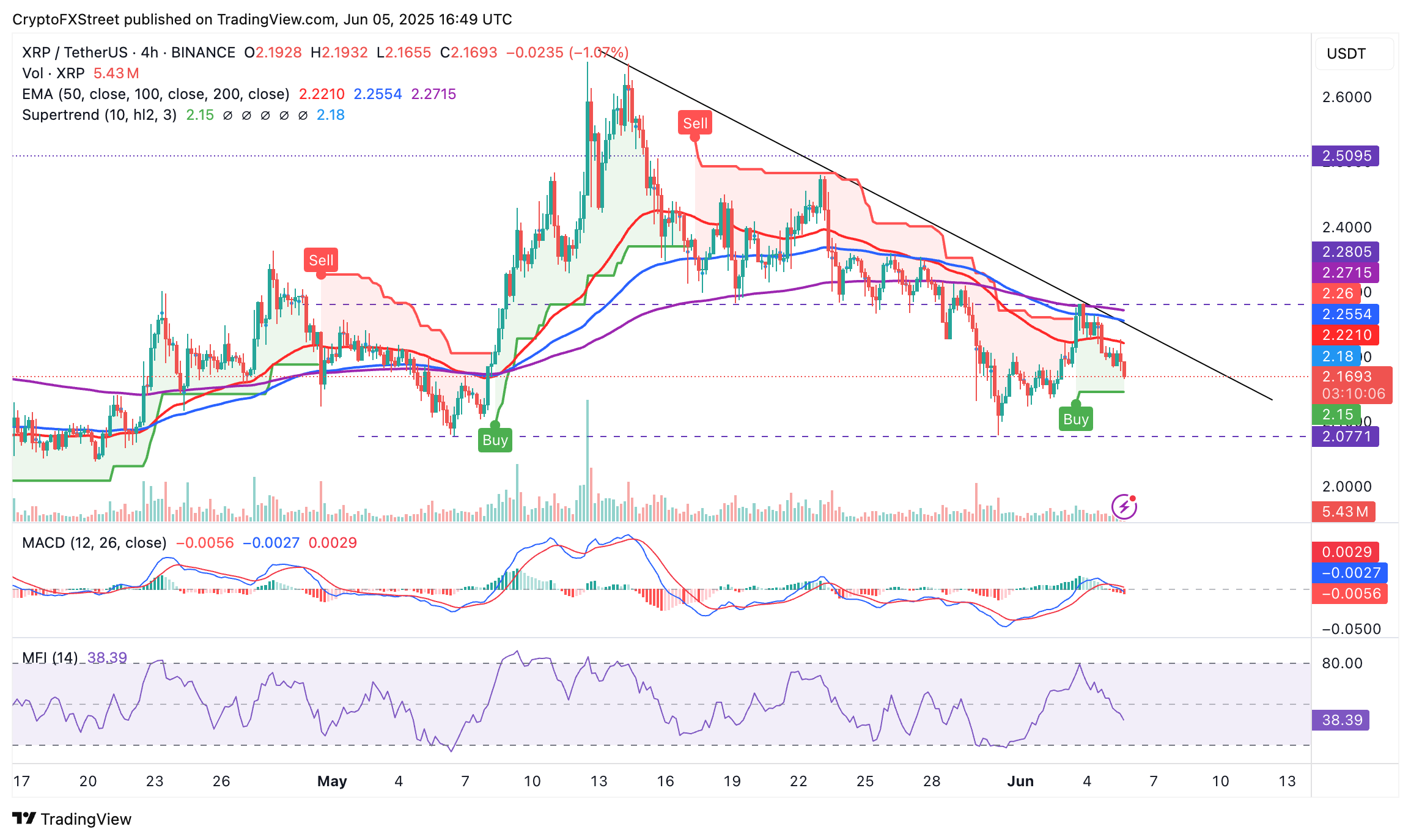
Ripple’s (XRP) bulls are struggling to limit downside risks while the broader cryptocurrency market consolidates. The international money transfer token trades at around $2.18 after extending losses by 4%. Fundamentals from the derivatives market suggest that overhead pressure could continue to overshadow demand, especially with the Open Interest (OI) and trading volume falling sharply.
XRP risks extending losses as open interest and volume drop
The XRP derivatives market exhibits signs of a potentially prolonged downtrend, primarily due to a decline in open interest (OI) and trading volume. According to CoinGlass data, OI declined by almost 3% to $3.91 billion over the past 24 hours. This drop coincides with a larger 14% plunge in trading volume to $3.53 billion, signaling a decline in trader interest in XRP and low market participation.
XRP derivatives market data | CoinGlass
The price drop, coupled with the falling OI, could continue to fuel liquidations. Long position traders currently bear the biggest brunt of the changing market dynamics, with $4.45 million in value wiped out, compared to approximately $294,000 in shorts. If XRP upholds the downtrend in upcoming sessions, the long-to-short ratio at 0.9275 could continue to favor sellers, reducing the probability of a trend reversal.
Technical outlook: What’s next as XRP losses surge
XRP hovers under key moving averages such as the 4-hour 200-period Exponential Moving Average (EMA) currently at $2.27, the 100-period EMA at $2.25 and the 50-period EMA at $2.22. This, alongside a sell signal from the Moving Average Convergence Divergence (MACD) indicator, underscores the overhead pressure.
The blue MACD line recently crossed below the red signal line, validating the sell signal and likely encouraging traders to reduce exposure to XRP. Furthermore, the expanding red histogram bars below the mean line (0.00) increase downside risks.
Based on the Money Flow Index (MFI), which tracks the amount of money flowing into and out of XRP, there is a higher probability that declines could extend to test support at $2.07.
XRP/USDT 4-hour chart
Despite the bearish outlook, the SuperTrend indicator suggests a potential near-term trend reversal after flashing a buy signal in the same 4-hour timeframe. The trend-following tool serves as dynamic support and resistance by utilizing the Average True Range (ATR) to measure market volatility. Traders often consider buying when the price crosses above the SuperTrend line, changing color from red to green.
A reversal cannot be ruled out at the momentum, which means that the 50-period EMA at $2.22, the 100-period EMA at $2.25 and the 200-period EMA at $2.27 are key areas of interest to traders betting on a potential rebound.
Matcha tea is experiencing a surge in popularity in the U.S. right now. So much so that a shortage, due to the specialized stone grinders being unable to grind it quickly enough to meet global demand, is causing the price to spike even further.
For Masanori Den Shirakata, the third-generation owner of Den’s Tea in Torrance, the frothy, alluringly green, caffeinated beverage goes back 100 years, long before it turned into a trend.
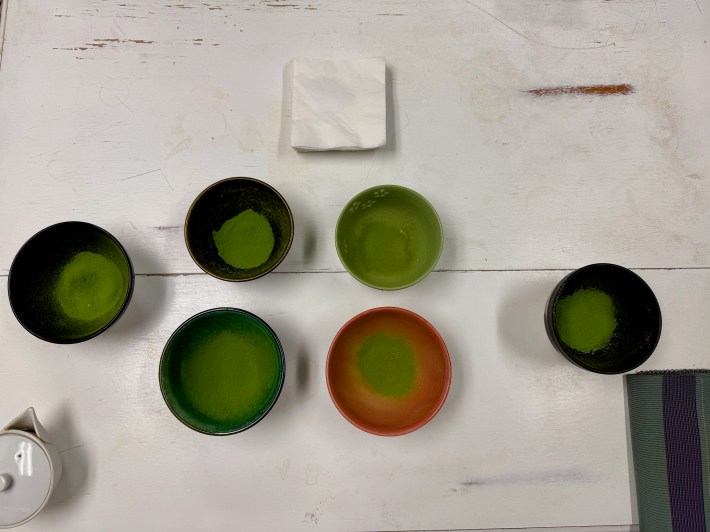
At a random refrigerated warehouse, a couple of blocks away from Torrance’s Monkish and Smog City breweries, Den takes us through a matcha “cupping”, a quality-tasting experience, starting from “Organic Premium Restaurant” matcha to the most expensive “Organic Ceremonial” grade.
The latter goes for $126 for a half-pound on Den’s website. The more premium ingredients tend to be more buttery, less bitter, and more vibrantly green than the cheaper culinary ingredients used more for desserts or sweetened drinks.
The Shirakata family’s tea journey began over 102 years ago. What started as a local tea business has now evolved into a global matcha enterprise, blending traditional Japanese tea culture with the modern American market.
Den Shirakata represents the third generation of tea merchants, carrying forward a tradition that began when his grandfather first recognized the potential of Shizuoka, Japan, as a top-tier tea-producing region. The business now sources tea from other areas too, now.
Matcha and its different grades at a tasting at Den’s Tea in Torrance. Photo by Javier Cabral for L.A. TACO. Six different grades of matcha. Photo by Javier Cabral for L.A. TACO.
At just 26 years old, Den unexpectedly became the president of his family’s tea company after the early passing of his father. Despite not being the traditional first-born heir, he embraced the family business with passion and vision. His journey took an unexpected turn in the late 1990s when he saw an emerging opportunity in the United States.
Den first came to the U.S. in 1987 to study English and marketing, with no big plans for tea. “Back then, I only saw Lipton tea bags here,” he says with a grin.
However, by the late 1990s, he noticed green tea gaining momentum at a U.S. Tea Association event, and thought it might be connected to the increasing popularity of Japanese restaurants. In 2000, he launched Den’s Tea in Torrance, tapping into the South Bay’s community and the growing matcha buzz.
The current matcha market presents both opportunities and challenges. Prices have increased by approximately 20% in just the last year and are expected to continue, driven by surging demand from major retailers and even all the mom-and-pop cafes.
“I saw all these Japanese restaurants and thought there might be an opportunity,” he says.
He nailed it—matcha exports to the U.S. have jumped 70% recently, with matcha dominating green tea shipments. Den’s direct line from Shizuoka keeps his tea fresh and top-notch.
During the tasting, he showed us how he can discern the quality of matcha just by how it feels in his fingers. On average, matcha is at least 10 times finer than AP flour.
“The good stuff gets smoother between your fingers,” he says, showing his hands-on approach.
Matcha’s quality is easier to judge than sencha (steamed green tea)—its color and taste stand out.
“You can see and taste the difference,” he notes, leaning on years as a tea instructor in Japan.
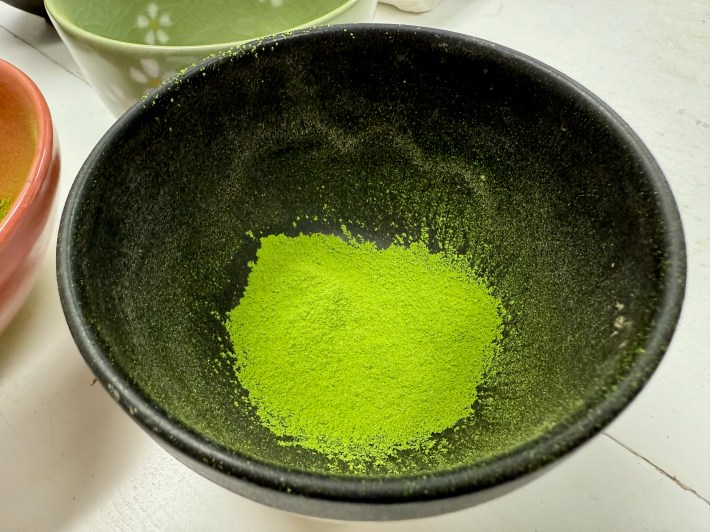
Ceremonial matcha powder at Den’s tea. Photo by Javier Cabral for L.A. TACO. Matcha is traditionally drunk with water and whisked until frothy. Sweetened and milky beverages are newer inventions. Photo by Javier Cabral for L.A. TACO.
Freshness is everything to him. While some store tea at room temp, Den’s all about cold storage.
“I rented a refrigerated warehouse right away,” he says, keeping tea at zero to five degrees Celsius for that vibrant kick. “We keep prices as fair as we can and quality high using traditional Japanese techniques,” he adds.
Matcha has taken off—Den’s shocked that the U.S. now out-drinks Japan.
“I think the U.S. consumes more matcha than Japan now,” he says.
Demand is so high that prices have increased by 20% over the last year. “Supply’s tight,” he admits, noting some Shizuoka farmers are switching from sencha to matcha.
Den sees room to grow beyond the coasts.
“Inland, matcha’s still new—it’s got potential,” he says. He sticks to the basics: fresh tea, straight from Japan, from someone who knows their craft.
“Check the source and storage,” he advises buyers.
Den’s clear on why Japanese tea beats out others, like Chinese blends. It’s the process—steaming and rolling that pulls out 80% of the tea’s contents in one cup.
“That’s where the health benefits shine,” he says.
The techniques for cultivating and processing matcha in Japan have been refined over hundreds of years, compared to Chinese counterparts who have just jumped on the bandwagon. His matcha is a hit at places like Bristol Farms, Gusto Bread, and other local cafe chains that he’s not allowed to disclose, including one major chain churns out thousands of matcha lattes a day.
Den of Den’s tea at his office in Torrance. Photo by Javier Cabral for L.A. TACO.
He’s still amazed by the shift.
“I used to explain green tea at store demos—now even kids say they love matcha,” he laughs. Customers ask about tea gardens and cultivars, keeping him on his toes.
Den has juggled tradition and growth like a champ. After the family business reached 100 years, he handed over Japan operations to his cousin to focus on the U.S. His son might carry it on, but Den’s chill about it.
“Family businesses have pros and cons,” he says.
The rise of matcha has been particularly transformative for Den’s business. When he first started, matcha was a niche product. Now, it accounts for nearly 80% of Japanese tea exports to the United States, with a 30% year-over-year increase.
The current matcha market presents both opportunities and challenges. Prices have increased by approximately 20% in just the last year and are expected to continue, driven by surging demand from major retailers and even all the mom-and-pop cafes.
Den understands that as matcha becomes more popular, maintaining quality becomes increasingly challenging. Nonetheless, he’s grateful for its growth, from its origins with ancient monks to today’s influencers.
“Even if they don’t get it, they’re spreading the word,” he says of the hype.
Solana (SOL) is seeing a notable spike in network activity, even as its recent price action remains underwhelming. This contrast has sparked Solana price predictions hinting at a possible climb toward $500.
Meanwhile, JetBolt (JBOLT) is piquing the interest of crypto whales thanks to its advanced feature set. This young altcoin continues to push the boundaries of crypto with its distinct and practical innovations, such as zero-gas technology and an AI-powered insights tool. These next-gen features are fueling JetBolt’s strong presale performance, with over 356 million tokens sold as of writing.
Can JetBolt sustain its momentum? Does SOL have a real shot at $500 and what are the latest Solana price predictions? Read on for the latest developments on JetBolt’s presale and Solana price forecasts.
Solana Price Prediction: Can SOL Reach $500 with Rising On-Chain Activity?
Solana (SOL) is gaining positive momentum as its network experiences a surge in on-chain activity, particularly a jump in 30-day fee revenue. As of May 2025, Solana’s 30-day fees rose compared with April, indicating growing demand for SOL tokens.
Chart showing Solana’s overall TVL and other data, sourced from DefiLlama
Solana’s rising total value locked (TVL) is another strong indicator of the spike in network activity. According to DefiLlama, Solana’s TVL has surpassed $8 billion, reflecting strong user engagement and deepening liquidity across its ecosystem.
Despite these positive developments, SOL is still trading below $180. SOL’s current market rate is approximately $153.84, down 10.6% over the past week.
According to Maham Arslan’s analysis, SOL may be trending downward. Nevertheless, its next price movement can potentially range between $157 and $165—a slight rebound from its current levels.
However, without a clear bullish catalyst, Solana price predictions suggesting a rally to $500 remain highly optimistic.
Here’s How JetBolt (JBOLT) Pushes the Boundaries of Crypto
While Solana’s network activity is booming, a rising altcoin is setting a new standard in the Web3 space. JetBolt (JBOLT) continues to gain traction as its high-tech features attract savvy crypto users and whales.
Championing next-level usability, JetBolt introduces its game-changing zero-gas technology. JetBolt leverages the Skale network’s gas-free architecture to enable users to transact without the burden of hefty gas fees.
JetBolt also introduces a fresh take on crypto staking with its intuitive staking platform. This innovative system lets participants earn bonuses when they simultaneously stake their tokens while interacting with friends.
Another standout feature is JetBolt’s crypto insights tool, powered by artificial intelligence. This AI-driven tool displays snippets of trending crypto market developments and other information about the crypto landscape.
Currently in presale, JetBolt offers early-bird perks. Presale buyers can unlock up to 25% bonus tokens when they purchase Alpha Boxes or JBOLT tokens in batches. With its exciting perks for early adopters, JetBolt has sold over 356 million tokens so far.
To sum up, JetBolt’s user-centric features, powered by cutting-edge technology, make this novel cryptocurrency worth keeping an eye on.
Conclusion — Solana’s Growing Network Activity and JetBolt’s Web3 Features
Solana’s growing network activity is hard to ignore. However, with SOL’s price hovering around $150, price predictions suggesting a climb to $500 seem far-fetched. Meanwhile, crypto whales are zeroing in on JetBolt. This rising star redefines the limits of crypto with a suite of groundbreaking features.
This article offers no financial or crypto trading advice. All cryptocurrencies are risky and volatile.Due diligence and in-depth research are essential before purchasing any crypto asset.
We partnered with The Great Girlfriends Show and COPD Foundation, with support from Sanofi and Regeneron, to bring this critical conversation to light.
Key topics include:
Understanding COPD: What it is and why it’s affecting millions in silence.
The importance of early detection and proactive health measures.
How community support and advocacy can transform patient outcomes.
Ways you can get involved in raising awareness and supporting those impacted.